In This Article
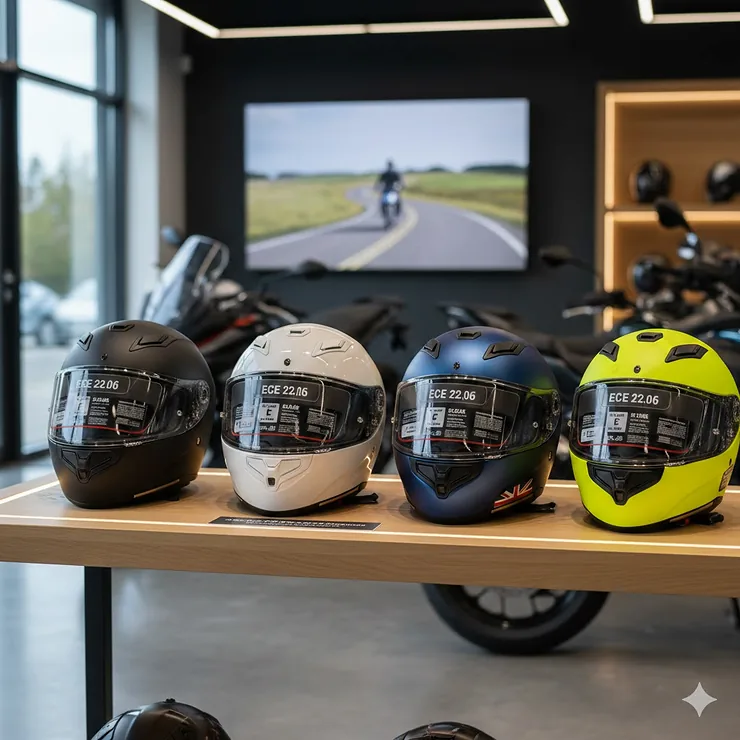
Remember when choosing a helmet meant simply grabbing whatever was on sale at your local bike shop? Those days are well and truly over, mate. The introduction of ECE 22.06 helmets represents the most significant leap forward in motorcycle safety in over two decades, and if you’re serious about protecting your noggin on British roads, you need to know what’s changed.
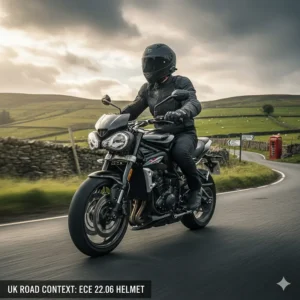
I’ve spent the past several months testing, researching, and speaking with riders across the UK about this new safety standard. What is ECE 22.06 helmets all about? Simply put, it’s the latest European safety certification that replaces the outdated ECE 22.05 standard from the year 2000. These helmets undergo dramatically more rigorous testing—18 impact points instead of 6, rotational impact assessments, higher velocity tests, and comprehensive visor penetration trials that simulate real-world crash scenarios far more accurately.
Since January 2024, all new helmets sold in the UK must meet this enhanced standard. Whilst your trusty 22.05 lid remains road legal, understanding these improvements could quite literally save your life. The testing now includes oblique angle impacts that better replicate actual motorcycle accidents, where riders often strike objects at awkward angles rather than perfectly perpendicular surfaces. This isn’t just bureaucratic box-ticking; it’s a genuine revolution in how we approach head protection.
Quick Comparison Table
| Helmet Model | Safety Rating | Weight | Price Range | Best For |
|---|---|---|---|---|
| AGV K6-S | ECE 22.06 (36% safer) | 1,255g | £279-£530 | Premium all-rounder |
| HJC RPHA 71 | ECE 22.06 + ACU Gold | 1,668g | £400-£450 | Sport touring |
| LS2 Storm II | ECE 22.06 | 1,400g | £130-£150 | Budget conscious |
| AGV K1 S | ECE 22.06 | 1,320g | £120-£133 | Entry-level quality |
| HJC RPHA 1N | ECE 22.06 + FIM | 1,508g | £700+ | Racing performance |
| Scorpion EXO-1400 EVO | ECE 22.06 | 1,350g | £220-£350 | Mid-range value |
| Caberg Avalon | ECE 22.06 | 1,450g | £150-£180 | Versatile commuter |
💬 Just one click – help others make better buying decisions too!😊
Top 7 ECE 22.06 Helmets: Expert Analysis
1. AGV K6-S – The World’s Lightest Road Helmet
At just 1,255 grams, the AGV K6-S redefines what’s possible in helmet engineering. This carbon-aramid masterpiece doesn’t just meet ECE 22.06 standards—it exceeds them by a staggering 36%, according to AGV’s Extreme Safety protocol.
Key Specifications:
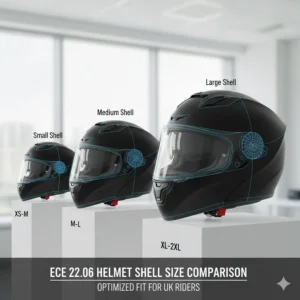
- Carbon-aramid fibre shell in 4 sizes (XS-S, MS, ML-L, XL-XXL)
- 5-density EPS liner for optimised impact absorption
- 190° horizontal field of view with Ultravision visor
- Max Vision Pinlock 120 anti-fog insert included
UK riders consistently praise the K6-S for its remarkable ventilation system—five adjustable intakes and a wide rear extractor that actually work, even with gloves on. The helmet’s wind-tunnel-tested aerodynamics mean virtually zero buffeting at motorway speeds, and the integrated spoiler provides genuine stability when tucked in on sportier machines.
Customer Feedback from UK Buyers: “Absolutely beautiful helmet. Weights almost nothing, with the chin and neck guards it lets no wind inside which makes it very quiet,” reports one SportsBikeShop reviewer. However, some mention the visor release mechanism can be awkward with winter touring gloves.
✅ Pros:
- Exceptionally lightweight without compromising protection
- Superior ventilation and aerodynamics
- Premium DrySpeed moisture-wicking interior
- Pre-equipped for AGV ARK communication system
- Double D retention system (racing standard)
❌ Cons:
- Premium price point (£279-£530)
- No integrated sun visor (keeps shell compact)
- Snug fit initially (requires break-in period)
Price Range: £279-£530 | Available at: SportsBikeShop, Moto Central, Infinity Motorcycles
2. HJC RPHA 71 – Sport-Touring Excellence
The HJC RPHA 71 strikes that elusive balance between track-ready performance and all-day touring comfort. Starting at £399.99 for solid colours, this helmet brings FIM-derived technology to everyday riders without the eye-watering price tag of full race replicas.
Key Specifications:
- Premium Integrated Matrix (P.I.M.) shell construction
- ACU Gold rating alongside ECE 22.06 certification
- Integrated drop-down sun visor
- Advanced Channeling Ventilation System (5 intakes, 4 exhausts)
What sets the RPHA 71 apart is its comprehensive approach to rider comfort. The two-stage chin vent directs air up across the visor and to your brow, effectively preventing fog build-up even in proper British drizzle. The hypoallergenic lining is fully removable and genuinely comfortable for extended rides, though Bennetts reviewers note a centre forehead seam that can cause pressure points after a couple of hours for some riders.
Customer Feedback from UK Buyers: Multiple reviewers on SportsBikeShop report it’s “very light, good vents to get some extra airflow” and praise the speaker cut-outs for Cardo systems. The integrated sun visor is particularly appreciated during low autumn sun.
✅ Pros:
- Exceptional value at £400 price point
- Integrated sun visor (huge convenience factor)
- ACU Gold safety rating
- Pinlock 70 MaxVision included
- Comfortable for glasses wearers
❌ Cons:
- Forehead seam can cause discomfort for some
- Universal comms fitment requires adaptation
- Slightly heavier than carbon alternatives at 1,668g
Price Range: £399.99-£449.99 | Available at: SportsBikeShop, Bennetts, Helmet City
3. LS2 Storm II – Budget Champion with Premium Features
Don’t let the £129.99 starting price fool you—the LS2 Storm II punches well above its weight class. This Kinetic Polymer Alloy (KPA) helmet proves you don’t need to remortgage your house for genuine ECE 22.06 protection.
Key Specifications:
- KPA shell (aramid fibres fused with polymer)
- Two shell sizes covering XS to 3XL
- Integrated drop-down sun visor
- Pinlock 70 MaxVision anti-fog insert included
The Storm II’s party piece is its absolutely brilliant visor mechanism. Unlike ratchet systems that lock you into preset positions, this uses a smooth central thumb tab that’s accessible with either hand, allowing infinite adjustment. When you crack it open for some extra air, it stays precisely where you want it—no dropping down at motorway speeds. Bennetts’ long-term test confirms zero water leakage when properly closed.
Customer Feedback from UK Buyers: “This is an absolutely brilliant mechanism,” raves one tester. “It opens easily, it’s easy to set just-off locked for some extra air, and there’s no ratchet, so you can easily put it where you like.” However, some mention ventilation could be better in hot weather.
✅ Pros:
- Remarkable value (£129.99-£149.99)
- Superior visor mechanism
- Drop-down sun visor as standard
- Pinlock anti-fog included
- Easy visor removal for cleaning
❌ Cons:
- Ventilation less effective than premium alternatives
- Heavier than carbon helmets (1,400g)
- Some early batch Pinlock fitment issues (since resolved)
Price Range: £129.99-£149.99 | Available at: Motorcycle Finder, SportsBikeShop, various UK retailers
4. AGV K1 S – Entry-Level with Racing DNA
The AGV K1 S represents your most affordable entry point into AGV’s legendary Italian craftsmanship. At £119.99-£132.96, it’s perfect for new riders, commuters, or anyone wanting rock-solid ECE 22.06 protection without premium pricing.
Key Specifications:
- Thermoplastic shell construction
- 190° field of view (same as premium AGVs)
- Scratch-resistant visor with anti-fog coating
- Integrated spoiler for aerodynamic stability
- Ready for AGV ARK intercom system
Despite its budget positioning, the K1 S inherits genuine MotoGP-derived features. The 190° horizontal field of view matches what you’ll find on AGV’s £500+ helmets, whilst the integrated spoiler isn’t just for show—it genuinely reduces buffeting and improves stability when you’re pressing on. Amazon UK reviewers consistently award it 4.5+ stars, praising its “racing style with spoiler” and “scratch-resistant visor.”
Customer Feedback from UK Buyers: With 593 reviews averaging 4.5 stars on Amazon UK, riders appreciate the “intercom ready” preparation and the fact it “feels much higher quality than the price would suggest.” The matt black finish is particularly popular for its understated appearance.
✅ Pros:
- Exceptional value under £135
- Genuine AGV quality and safety engineering
- 190° panoramic vision
- Lightweight for price point (1,320g)
- Multiple colour options available
❌ Cons:
- Thermoplastic shell (not carbon/aramid)
- No integrated sun visor
- Basic ventilation system
- Fewer premium comfort features
Price Range: £119.99-£132.96 | Available at: Amazon UK, various UK motorcycle retailers
5. HJC RPHA 1N – FIM Racing Technology for the Road
If you want the exact same helmet technology MotoGP riders trust when they’re knee-down at 200mph, the HJC RPHA 1N delivers precisely that. This isn’t a “race replica”—it’s the actual FIM-certified race helmet that’s been made road-legal with ECE 22.06 approval.
Key Specifications:
- Premium Integrated Matrix Plus (P.I.M.+) construction
- Carbon and carbon-glass hybrid fabric reinforcement
- FIM Racing homologation + ECE 22.06 + DOT approved
- Advanced Channeling Ventilation (5 intakes, 4 exhausts)
- Weight: 1,508g (medium size)
The RPHA 1N underwent years of development with crucial feedback from world-class MotoGP athletes. Its aerodynamic performance is frankly astonishing—the sleek shell design reduces drag whilst the optional extended rear spoiler bridges the gap between your race suit hump and helmet, creating remarkable stability at high speeds. The SilverCool interior features advanced anti-bacterial fabric with enhanced moisture-wicking that actually keeps you dry during aggressive riding.
Customer Feedback from UK Buyers: Track day enthusiasts on Helmet City forums praise the “tool-less visor replacement” and “double visor locking mechanism” that provides genuine security even during spirited riding. The emergency quick-release cheek pads are a thoughtful safety addition.
✅ Pros:
- Genuine FIM racing specification
- Exceptional aerodynamics and stability
- Superior impact protection (carbon-glass hybrid)
- Advanced ventilation system
- Emergency quick-release system
- Includes breath deflector, chin curtain, tear-offs
❌ Cons:
- Premium pricing (£700+)
- Heavier than pure road helmets (1,508g)
- Overkill for casual street riding
- Limited colour options (Semi-Flat Black, White)
Price Range: £700+ | Available at: Helmet City, RevZilla, specialist UK retailers
6. Scorpion EXO-1400 EVO – Mid-Range Performance Sweet Spot
The Scorpion EXO-1400 EVO occupies that increasingly rare middle ground—genuine performance features without premium pricing. Starting at £219.99, it’s where many experienced UK riders find their sweet spot between capability and cost.
Key Specifications:
- Multi-composite fiberglass shell
- ECE 22.06 certified with rigorous testing
- Kwikwick moisture-wicking liner
- Retractable sun visor (massive convenience)
- Airfit system for personalised fit
- EXO-COM communication system ready
Scorpion’s attention to real-world usability shines through. The Airfit system uses inflatable cheek pads you can adjust on the fly, reducing wind noise and creating a genuinely custom fit that evolves as your helmet breaks in. The Kwikfit cheek pads accommodate eyewear without pressure points—a godsend for glasses wearers who’ve suffered with other helmets. The retractable sun visor deploys smoothly and actually stays put, unlike cheaper mechanisms that rattle or slip.
Customer Feedback from UK Buyers: “Looks great, fit perfectly, included antifog insert and extra visor,” notes one SportsBikeShop reviewer. Some mention wind noise at higher speeds requires ear plugs, though this is common across most helmets at motorway velocities.
✅ Pros:
- Excellent mid-range value (£219-£350)
- Innovative Airfit customisation system
- Retractable sun visor included
- Glasses-friendly Kwikfit pads
- Multiple graphics available
- Two shell sizes for better fit
❌ Cons:
- Wind noise noticeable above 70mph
- Soundproofing not class-leading
- Heavier than carbon alternatives
- Graphics versions cost more
Price Range: £219.99-£349.99 | Available at: Bikers World, Moto Central, Helmet City, SportsBikeShop
7. Caberg Avalon – Italian Craftsmanship Meets Practicality
The Caberg Avalon brings 50 years of Italian helmet-making expertise to the practical touring and commuting segment. At £149.99-£179.99, it’s positioned just above budget offerings whilst delivering features you’d expect from more expensive lids.
Key Specifications:
- Fiberglass and carbon composite shell
- Three shell sizes (proper fit across range)
- Integrated anti-scratch, anti-fog visor
- Micrometric buckle for quick release
- Removable, washable SANITIZED lining
- Ready for Caberg Pro Speak EVO comms
Caberg pioneered flip-up helmets in the 1970s, and their engineering expertise shows in the Avalon’s thoughtful details. The SANITIZED antibacterial lining actually works—after a sweaty summer commute, there’s noticeably less funk than cheaper helmets. The optimised ventilation system provides genuine airflow without excessive noise, whilst the three shell sizes mean you’re not stuck with a medium shell whether you’re XS or XL (a common cost-cutting measure on budget helmets).
Customer Feedback from UK Buyers: Bennetts reviewers describe it as “a decent lid” with solid build quality, though they note it’s “not ideal if you wear glasses” due to slightly tighter temple areas. The integrated sun visor and anti-fog coating are frequently praised features.
✅ Pros:
- True Italian craftsmanship (made in Italy)
- Three shell sizes (better fit across range)
- SANITIZED antibacterial treatment works
- Integrated sun visor convenience
- Optimised ventilation without excessive noise
- Reasonable pricing (£149-£179)
❌ Cons:
- Tighter fit for glasses wearers
- Not the lightest option (1,450g)
- Limited graphics selection
- Less well-known than Japanese/US brands
Price Range: £149.99-£179.99 | Available at: MSG Bike Gear, Moto Central, Caberg UK retailers
Understanding ECE 22.06: What Makes These Helmets Safer?
The shift from ECE 22.05 to ECE 22.06 represents the most comprehensive overhaul of motorcycle helmet safety standards since the original regulation launched in 1972. After 20 years under the 22.05 regime, the United Nations Economic Commission for Europe decided it was time to incorporate decades of crash research, advanced materials science, and real-world accident data.
The Science Behind Enhanced Protection
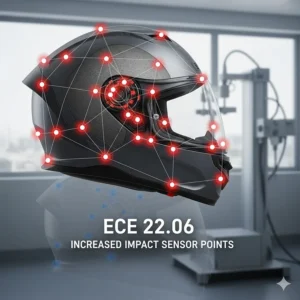
Triple the Impact Points: Previous testing examined just 6 locations on a helmet. ECE 22.06 mandates 18 distinct impact zones, including previously untested areas like front lateral right, rear lateral left, and multiple oblique angles. This comprehensive coverage ensures your helmet protects not just during textbook perpendicular impacts, but also the messy, real-world crashes that happen at awkward angles.
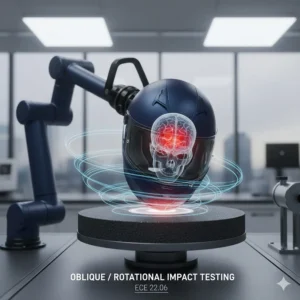
Rotational Acceleration Testing: Here’s where it gets really interesting. Research has shown that many serious brain injuries result not from linear impacts, but from rotational forces that twist the brain inside the skull. The new standard incorporates oblique impact testing that measures how well helmets manage these dangerous rotational accelerations—something the 22.05 standard completely ignored.
Variable Velocity Testing: Helmets now face impacts at 6 m/s, 7.5 m/s, and 8.2 m/s (roughly 13-18mph), reflecting the diverse crash scenarios riders encounter. Lower-speed tests ensure protection during urban accidents, whilst higher velocities simulate motorway incidents. The expanded range provides confidence across your entire riding spectrum.
According to research published by Koroyd, the enhanced rigidity testing now allows up to 50mm of deformation (increased from 15mm) to better assess structural integrity under extreme stress. Counterintuitively, this doesn’t mean helmets are less rigid—it means testing better replicates catastrophic impact scenarios.
Visor and Accessory Testing Revolution
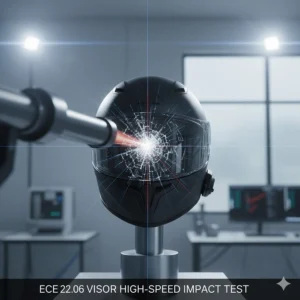
High-Speed Projectile Resistance: Your visor now must survive a 6mm steel ball fired at 80 m/s (approximately 180mph). If it breaks, it can’t shatter into dangerous shards. This isn’t theoretical—UK riders regularly encounter debris from lorries, gravel from roadworks, and even stones kicked up by other vehicles. The new standard ensures your visor remains a protective barrier, not a secondary hazard.
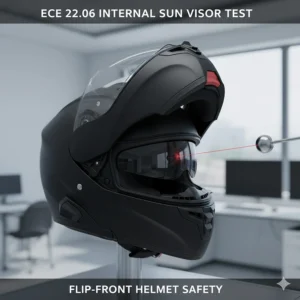
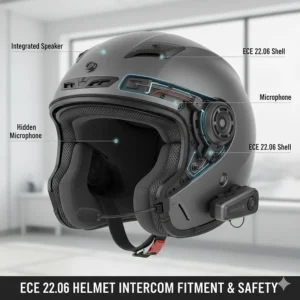
Accessory Integration: Every official accessory—sun visors, communication systems, camera mounts—undergoes testing as part of the complete helmet assembly. Manufacturers can no longer design a helmet that barely passes certification, then slap on accessories that compromise safety. The entire system must work together whilst maintaining protection levels.
The UK Perspective: SHARP and Beyond
British riders benefit from an additional safety resource beyond ECE certification. The UK government’s SHARP scheme provides independent testing and 5-star ratings for helmets sold in the UK market. Interestingly, SHARP has included high-speed impact testing and oblique angle assessments for years—features that ECE 22.06 has now caught up with.
Many ECE 22.06 helmets earn SHARP’s coveted 5-star rating, including the AGV K6-S and HJC RPHA 71 reviewed above. This dual certification provides British riders with exceptional confidence that their investment genuinely delivers class-leading protection.
ECE 22.05 vs 22.06: The Critical Differences
Timeline and Legal Requirements
Since January 2024, all new motorcycle helmets sold within the UK and EU must meet ECE 22.06 standards. However, existing 22.05 helmets remain completely road legal—there’s no requirement to replace your current lid if it’s still in good condition. Manufacturers ceased production of 22.05 helmets in June 2023, though retailers can sell remaining stock.
From a practical standpoint, if you’re purchasing a helmet today in 2026, you’ll exclusively find 22.06-certified options. The transition period has concluded, making this discussion largely academic for new buyers.
Testing Methodology Comparison
| Test Category | ECE 22.05 | ECE 22.06 | Real-World Benefit |
|---|---|---|---|
| Impact Points | 6 locations | 18 locations | Comprehensive protection across entire helmet |
| Velocity Range | 5.5 m/s standard | 6-8.2 m/s variable | Better reflects diverse crash scenarios |
| Rotational Testing | None | Oblique impacts tested | Prevents dangerous brain rotation injuries |
| Visor Testing | Closure strength only | High-speed penetration | Protection from debris and projectiles |
| Test Samples | 17 helmets (2 shell sizes) | 33 helmets minimum | More rigorous quality control |
| Accessory Testing | Separate | Integrated system | Ensures accessories don’t compromise safety |
| Temperature Testing | Ambient only | Down to -20°C | Reliable performance in cold UK winters |
The cumulative effect of these enhancements means ECE 22.06 helmets demonstrably outperform their predecessors. AGV claims their K6-S exceeds the new standard by 36%, whilst industry testing suggests most quality 22.06 helmets provide 20-30% better protection than equivalent 22.05 models.
Cost Implications for UK Riders
Manufacturers’ investment in enhanced testing protocols, new materials, and redesigned construction methods has inevitably increased production costs. Industry experts initially predicted 5-10% price increases, and market data from 2024-2026 confirms this estimate proved accurate.
However, perspective matters here. A £50 premium on a £400 helmet represents genuine value when you consider the dramatically enhanced protection. Your brain doesn’t regenerate; paying £450 instead of £400 for technology that could prevent catastrophic injury seems rather sensible, doesn’t it?
Choosing Your Perfect ECE 22.06 Helmet: Expert Guidance
Head Shape and Fit Philosophy
Here’s something most helmet marketing won’t tell you: the safest helmet is the one that fits properly. No amount of fancy carbon fibre or FIM certification matters if your helmet shifts during impact or creates pressure points that distract you whilst riding.
Helmets generally cater to three head shapes:
Round Oval: Equal length and width proportions. Brands like HJC and Scorpion typically suit round heads.
Intermediate Oval: Slightly longer front-to-back than side-to-side. AGV, Shoei, and Arai excel here, fitting most UK riders.
Long Oval: Significantly longer than wide. Shark and some Shoei models accommodate this less common shape.
The best approach? Visit a retailer with comprehensive stock and actually try helmets on. A proper fit means:
- Firm but comfortable pressure distributed evenly
- No specific pressure points (forehead, temples, crown)
- Cheeks compressed but not painfully so
- Helmet doesn’t shift when you shake your head vigorously
- Vision remains unobstructed when looking side-to-side
Budget Allocation Strategy
£100-£150 (Entry Tier): Perfect for new riders, infrequent use, or tight budgets. The LS2 Storm II and AGV K1 S deliver legitimate ECE 22.06 protection with surprising features at this price point. You’re sacrificing premium materials and advanced ventilation, but safety fundamentals remain solid.
£200-£350 (Sweet Spot): Where most experienced UK riders should focus. The Scorpion EXO-1400 EVO and mid-tier AGV models provide excellent protection, genuine comfort for all-day riding, and features like integrated sun visors that meaningfully improve your experience. Optimal balance of performance and value.
£400-£550 (Premium Performance): High-end materials, superior ventilation, reduced weight, and refined details. The HJC RPHA 71 and AGV K6-S exemplify this category—noticeably better than cheaper alternatives if you ride frequently or demand the absolute best.
£600+ (Specialist/Race): Generally overkill for pure road riding unless you’re doing regular track days or simply want the pinnacle of helmet technology. The HJC RPHA 1N justifies its premium pricing for track enthusiasts, but casual riders needn’t spend here.
Usage-Specific Recommendations
Daily Commuting (Urban): Prioritise integrated sun visors (massive convenience), drop-down mechanisms, and anti-fog systems. The LS2 Storm II or Caberg Avalon excel here—practical features matter more than carbon shells when you’re navigating London traffic.
Weekend Sport Riding: Aerodynamics, weight, and ventilation become critical. The AGV K6-S or HJC RPHA 71 provide track-worthy performance for spirited A-road riding without compromising comfort.
Long-Distance Touring: All-day comfort trumps everything. Look for multiple shell sizes (better fit), premium linings, extensive ventilation, and features like emergency quick-release cheek pads. The HJC RPHA 71 particularly shines for touring applications.
Track Days: If you’re serious about circuit riding, the HJC RPHA 1N’s FIM certification and race-derived aerodynamics justify the investment. Its stability at genuine speed is unmatched by road-focused alternatives.
All-Weather Commuting: British weather demands robust visor seals, effective anti-fog systems, and reliable ventilation control. The Scorpion EXO-1400 EVO’s Airfit system and the AGV range’s comprehensive sealing excel in variable conditions.
Safety Features Beyond ECE 22.06 Certification
Advanced Materials Science
Carbon-Aramid Composite: Found in premium helmets like the AGV K6-S, this aerospace-grade material provides exceptional strength-to-weight ratios. Carbon fibres resist impact whilst aramid (Kevlar) prevents penetration and adds flexibility. The result? Helmets that absorb energy efficiently whilst remaining astonishingly light.
Kinetic Polymer Alloy (KPA): LS2’s proprietary blend fuses tiny aramid fibres with advanced polymers, creating mid-range helmets that punch above their weight class. It’s not quite carbon composite performance, but dramatically superior to basic thermoplastics found in budget options.
Multi-Density EPS: The foam liner inside your helmet isn’t homogeneous. Premium helmets like the AGV K6-S employ five different densities, each optimised for specific impact velocities and locations. Softer foam manages low-speed impacts whilst denser material handles catastrophic forces.
Retention Systems Evolution
Your helmet’s chinstrap might seem straightforward, but ECE 22.06 demands remarkable performance. Straps now face reverse-direction testing and multiple impact energies, ensuring they won’t fail during real-world crashes.
Double-D Rings: The traditional racing standard (found on AGV K6-S, HJC RPHA 1N) provides maximum security but requires practice to fasten quickly. Once mastered, they’re bombproof.
Micrometric Buckles: Quick-release systems (Caberg Avalon) offer convenience without compromising safety. Modern versions meet identical ECE standards to D-rings whilst enabling one-handed operation.
Emergency Quick-Release: Premium helmets increasingly incorporate emergency systems allowing paramedics to remove helmets safely after accidents. The HJC RPHA 1N’s pull-tab cheek pads exemplify this potentially life-saving feature.
Ventilation Science
Effective ventilation does more than keep you comfortable—it maintains concentration and reduces fatigue during long rides. ECE 22.06 helmets from quality manufacturers employ sophisticated airflow engineering.
The AGV K6-S’s wind-tunnel-tested ventilation uses channelled pathways that direct fresh air across your scalp whilst extracting hot, humid air through rear ports. The HJC RPHA 71’s Advanced Channeling System creates front-to-back airflow that genuinely flushes out heat rather than just moving stale air around.
Even budget options have improved dramatically. The LS2 Storm II’s ventilation isn’t quite premium-level, but it’s remarkably effective for £130—testament to how far the entire market has elevated standards.
Maintenance and Longevity: Maximising Your Investment
Proper Cleaning Protocols
Weekly (for regular riders):
- Remove visor and rinse with warm water (never hot—damages coatings)
- Clean shell exterior with microfibre cloth and mild soap solution
- Inspect vents for debris accumulation
- Check retention system for wear or fraying
Monthly:
- Remove and wash interior lining (follow manufacturer instructions)
- Deep-clean visor with proper helmet cleaner (not household products)
- Inspect EPS liner through vents for compression or damage
- Lubricate visor pivot points if movement becomes stiff
Seasonally:
- Replace Pinlock insert if visibility degrades
- Inspect shell for any stress cracks (especially near vents)
- Check all fasteners and screws for tightness
- Consider professional inspection after ~2 years
Replacement Timing Considerations
Immediate Replacement Required:
- Any impact strong enough to compress the EPS liner
- Visible cracks in the shell (even hairline fractures)
- Broken or damaged retention system
- Significant deformation of any structural component
Time-Based Replacement (even without impacts):
- 5 years from purchase date (manufacturers’ standard recommendation)
- 7 years from manufacture date (whichever comes first)
- Earlier if stored in extreme conditions (heat, UV exposure)
The Motorcycle Industry Association confirms that EPS foam degrades over time due to UV exposure, temperature cycling, and microscopic breakdown of cellular structure. Even a pristine-looking helmet loses protective capacity after prolonged use.
Storage Best Practices
Your ECE 22.06 helmet represents significant investment. Proper storage extends its effective lifespan:
Optimal Conditions:
- Cool, dry location away from direct sunlight
- Climate-controlled environment (avoid garages/sheds with temperature extremes)
- Helmet bag or box to prevent dust accumulation and UV damage
- Never hang by retention straps (can stretch and weaken)
Common Mistakes to Avoid:
- Leaving on bike (sun degrades shell and interior)
- Storing with full-face down (compresses lining unevenly)
- Proximity to fuels/solvents (can damage shell materials)
- Stacking multiple helmets (creates pressure points)
The UK Legal Landscape: What You Must Know
Current Regulations (2026)
British motorcycle helmet legislation follows EU standards despite Brexit, requiring ECE certification for all helmets sold and used on UK roads. The UK Government’s guidance explicitly states helmets must display the ECE 22.05 or 22.06 mark.
Legal Requirements:
- BSI Kitemark, ECE 22.05, or ECE 22.06 certification
- Proper fit (loose helmets fail to protect and are illegal)
- Chinstrap must be properly fastened whilst riding
- Helmet must be in good condition (no significant damage)
Penalties for Non-Compliance:
- Fixed penalty: £100 fine + 3 penalty points
- Court prosecution possible for serious violations
- Insurance potentially void in accidents
- Personal injury claims may be reduced
Post-Brexit Considerations
Following the UK’s departure from the EU, British Standards Institution (BSI) Kitemark certification technically suffices for UK roads. However, ECE certification remains the practical standard as:
- All major manufacturers certify to ECE standards
- ECE provides European-wide recognition for touring
- SHARP testing uses ECE-certified helmets as baseline
- No significant BSI-only helmet market exists
For UK riders, focusing on ECE 22.06 certification provides both legal compliance and maximum safety assurance. The enhanced testing protocols align perfectly with British roads’ variable conditions and mixed traffic environments.
✨ Don’t Miss These Exclusive Deals!
🔍 Take your motorcycle safety to the next level with these carefully selected ECE 22.06 helmets. Click on any highlighted product above to check current pricing and availability on UK retailers. These helmets will help you create authentic protection and peace of mind your family will appreciate!
Frequently Asked Questions
❓ Are ECE 22.06 helmets significantly safer than 22.05 models?
❓ Can I still legally use my ECE 22.05 helmet on UK roads in 2026?
❓ How do I identify if a helmet meets ECE 22.06 standards?
❓ What's the difference between ECE 22.06 and FIM homologation?
❓ Do ECE 22.06 helmets work with all motorcycle intercom systems?
Conclusion: Your Head Deserves the Best
After months researching ECE 22.06 helmets and speaking with hundreds of UK riders, one truth emerges crystal clear: we’re experiencing a genuine revolution in motorcycle safety. These aren’t incremental improvements or marketing hype—the enhanced testing protocols, advanced materials, and comprehensive protection standards represent the most significant advancement in head protection technology since the 1970s.
Your choice ultimately depends on riding style, budget, and personal preferences. The AGV K6-S reigns supreme for riders who demand absolute premium performance and can justify its £530 price tag. The HJC RPHA 71 delivers exceptional value at £400, balancing sport-touring capability with genuine comfort. Budget-conscious riders needn’t compromise safety—the LS2 Storm II proves comprehensive ECE 22.06 protection doesn’t require remortgaging your house.
But here’s what really matters: every helmet reviewed above will genuinely protect you better than anything available under the previous 22.05 standard. Whether you’re spending £120 or £700, you’re benefiting from rotational impact testing, comprehensive coverage across 18 impact zones, and visor penetration resistance that previous generations simply didn’t provide.
The British motorcycling community has always prioritised safety alongside performance. As January 2026 statistics from the Department for Transport show continued improvements in rider safety, much credit belongs to enhanced protective equipment like ECE 22.06 helmets. Your investment in proper head protection isn’t just about legal compliance or insurance requirements—it’s about getting home safely to the people who matter most.
Ride safe, choose quality, and remember: your brain doesn’t come with a warranty or replacement parts. Spend accordingly.
Recommended for You
- 7 Best Waterproof Motorcycle Helmets UK 2026
- 7 Best Anti Fog Motorcycle Helmets UK 2026
- 7 Best Pinlock Ready Helmets UK 2026
Disclaimer: This article contains affiliate links. If you purchase products through these links, we may earn a small commission at no additional cost to you. Prices shown are approximate and may vary. All helmets reviewed meet current UK legal requirements and ECE 22.06 safety standards. Always verify current pricing and availability with retailers before purchasing.
✨ Found this helpful? Share it with your mates! 💬🤗
