In This Article
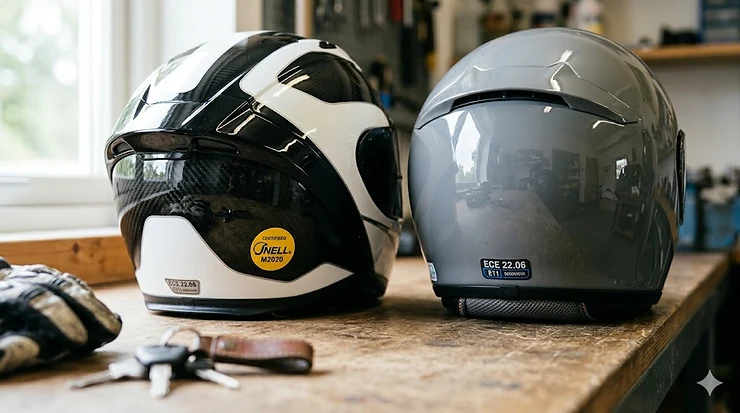
When you’re hurtling down the M25 at 70 mph or carving through the Welsh mountains, the last thing you want to ponder is whether your helmet’s safety sticker represents genuine protection or merely bureaucratic box-ticking. Yet here we are in 2026, with two heavyweight certification systems—Snell and ECE 22.06—each claiming to offer superior head protection, and British riders caught in the middle wondering which one actually keeps their brain intact during the inevitable off.
The confusion is entirely understandable. ECE 22.06 became mandatory across Europe in June 2023, representing the most substantial safety standard overhaul in over two decades. Meanwhile, Snell M2025 maintains its reputation as the gold standard for racing environments, with testing protocols that make government standards look rather gentle by comparison. But here’s what the certification stickers won’t tell you: helmets certified under ECE 22.06 offer very strong real-world protection aligned with current head injury research, whilst Snell certification is the gold standard for racing environments.
The practical reality for UK riders is that you don’t necessarily need to choose one over the other. Many premium helmets now carry dual certification—ECE 22.06 plus Snell M2025—giving you the best of both worlds. What you absolutely need to understand, however, is what each standard actually tests, where they differ, and which matters more for the type of riding you do on British roads. Spoiler: if you’re primarily commuting through Manchester traffic rather than lapping Silverstone, the answer might surprise you.
Quick Comparison: Snell vs ECE 22.06 at a Glance
| Factor | Snell M2025 | ECE 22.06 | Best For |
|---|---|---|---|
| Testing Organisation | Snell Memorial Foundation (non-profit, USA) | Economic Commission for Europe (government standard) | ECE = Legal requirement in UK |
| Impact Test Points | 5 locations, 2 impacts same spot | 18 locations, 1 impact per spot | ECE = More comprehensive coverage |
| Impact Velocity | 7.9 m/s (edge anvil) | 8.2 m/s (various anvils) | ECE = Higher speed testing |
| Rotational Impact | Yes (M2025 onwards) | Yes (oblique angle tests) | Both test brain rotation |
| Shell Hardness | Harder shells (historical criticism) | Softer, more flexible shells | ECE = Energy absorption priority |
| Accepted In | Racing organisations, voluntary | 50+ countries, legal requirement | ECE = Road use necessity |
| UK Road Legal | Only if also DOT/ECE certified | Yes, mandatory standard | ECE = Must-have for UK |
| Price Range | £300-£1,200+ | £90-£700+ | ECE = Wider price accessibility |
Analysis: The table reveals something rather important that helmet marketing departments would prefer you overlook. ECE 22.06 actually employs higher impact velocities than Snell in testing (8.2 m/s versus 7.9 m/s), testing more locations on the helmet shell (18 versus 5), and prioritises rotational impact protection that research increasingly identifies as the primary cause of serious brain injury. Snell’s advantage lies in its two-impact-same-location protocol, which ensures the helmet can withstand a second blow—useful if you’re bouncing across tarmac at Brands Hatch, less relevant for most street crashes. For UK riders, ECE 22.06 certification isn’t optional; it’s the legal requirement. Snell becomes the cherry on top for track day enthusiasts, not the foundation of street safety.
💬 Just one click — help others make better buying decisions too!😊
Top 7 Helmets: Expert Analysis for UK Riders
1. AGV K6 S — The Lightweight European Champion
The AGV K6 S represents Italian engineering at its finest, weighing a mere 1,255 grams whilst exceeding ECE 22.06 standards by 36% according to AGV’s internal Extreme Safety protocol. This carbon-aramid composite shell delivers protection that surpasses the legal requirement, not merely meets it. The helmet’s available in the £400-£550 range on Amazon.co.uk, positioning it firmly in premium territory without quite reaching Arai or Shoei pricing stratosphere.
What the spec sheet won’t tell you: that featherweight construction translates to noticeably less neck fatigue on long motorway slogs from London to Edinburgh. The five adjustable intake vents actually function with gloved hands—a detail that matters when you’re caught in one of Britain’s sudden weather shifts. The 190° horizontal field of view matches what you’d find on AGV’s £700+ race helmets, giving you peripheral awareness that cheaper lids sacrifice. UK reviewers on Amazon consistently award it 4.5+ stars, praising the integrated spoiler that genuinely reduces buffeting rather than existing purely for aesthetics.
The K6 S suits sport-touring riders who split time between urban commuting and weekend blast through the Cotswolds. It’s overkill for pure city work, where you’re rarely exceeding 40 mph and that premium price feels extravagant. For riders who regularly cover 200+ miles in a day, the comfort and reduced weight justify every pound.
✅ Pros:
- Carbon-aramid shell: 1,255g weight prevents neck fatigue
- ECE 22.06 + 36% safety margin: exceeds legal requirements
- 190° field of view: peripheral awareness matches race-spec helmets
❌ Cons:
- Premium pricing: £400-£550 range strains budgets
- Sport-fit profile: narrow shape doesn’t suit rounder heads
Price Verdict: Around £400-£550 on Amazon.co.uk. Represents the sweet spot where safety innovation meets reasonable pricing—you’re paying for genuine engineering, not just Italian cachet.
2. Shoei NXR2 — The British Rider’s Go-To
The Shoei NXR2 sits around £450 on Amazon.co.uk and earns its reputation through sheer refinement rather than flashy features. This helmet carries dual ECE 22.06 and UK SHARP 5-star ratings, meaning it’s aced both European legal requirements and Britain’s independent safety assessment. The multi-composite shell uses four different densities of fibreglass, creating a structure that manages impact energy progressively rather than simply being hard or soft.
In practical British terms: this helmet excels on motorway miles where wind noise fatigues you before physical exertion does. Shoei’s wind tunnel testing shows in real-world quietness that’s noticeably superior to helmets costing £100 less. The Emergency Quick Release System (EQRS) allows paramedics to remove cheek pads without yanking the helmet off your head—a feature you hope never to use but appreciate knowing exists. The intermediate oval internal shape suits the majority of British head shapes better than Arai’s rounder profile.
The NXR2 targets serious year-round riders rather than fair-weather enthusiasts. If you commute daily through Leeds or Bristol traffic, this helmet’s £450 outlay amortises to pennies per ride over five years. For occasional Sunday riders, the cost-per-use equation tilts towards mid-range alternatives.
✅ Pros:
- SHARP 5-star + ECE 22.06: dual validation from independent testers
- Intermediate oval fit: suits majority of UK head shapes
- Superior motorway quietness: wind tunnel refinement reduces fatigue
❌ Cons:
- £450 price point: substantial investment for occasional riders
- Sportier fit than GT-Air: less forgiving for relaxed touring positions
Price Verdict: Around £450 on Amazon.co.uk with Prime delivery. Delivers tangible comfort improvements that justify the premium for daily commuters covering serious miles.
3. HJC RPHA 71 — The Value Disruptor
The HJC RPHA 71 at £330-£400 delivers roughly 90% of the ventilation and comfort performance of helmets costing £150-£200 more. This represents the efficiency sweet spot where Korean manufacturing meets contemporary safety standards without the heritage brand markup. ECE 22.06 certified with a carbon-composite shell that weighs 1,320 grams—marginally heavier than the AGV but substantially lighter than budget alternatives.
The practical advantage British riders notice immediately: those large vent sliders operate easily with winter gloves on. When you’re caught in a Scottish downpour that suddenly clears to brilliant sunshine by afternoon, being able to adjust airflow without removing gloves matters more than marketing copy suggests. The drop-down internal sun visor saves fumbling with sunglasses, whilst the rounder internal shape generally accommodates spectacle wearers more comfortably than narrow sport-fit designs.
This helmet suits budget-conscious riders who refuse to compromise on modern safety features. University students, new riders, or anyone stretching to afford their first proper kit will find the RPHA 71 delivers premium features at mid-range pricing. Premium brand loyalists will notice the slightly less refined finish, but that’s aesthetics, not safety.
✅ Pros:
- £330-£400 pricing: premium features at mid-range cost
- Large vent sliders: winter glove operation actually works
- Rounder fit: accommodates glasses without pressure points
❌ Cons:
- Finish refinement: doesn’t feel as luxurious as Shoei/Arai
- Brand perception: HJC lacks heritage cachet despite solid engineering
Price Verdict: Around £330-£400 on Amazon.co.uk. Best value-to-performance ratio in the premium-but-not-silly-money category.
4. Arai Quantic — The First ECE 22.06 Champion
The Arai Quantic entered production as the very first helmet certified to ECE 22.06 standards, setting the benchmark before competitors caught up. Priced around £500-£550 on Amazon.co.uk, this represents Arai’s commitment to hand-built quality and that legendary rounder shell shape that prioritises glancing-blow deflection over flat-surface impact absorption. The five-year warranty versus typical two-year coverage changes the ownership cost equation substantially.
What Arai doesn’t shout about loudly enough: that rounder shell shape means the Quantic doesn’t fit every head brilliantly. If you have a long oval head (front-to-back measurement exceeds side-to-side), Shoei’s intermediate oval will likely fit better. But for riders whose heads suit Arai’s shape, the comfort becomes addictive. The ventilation system moves genuine air even at urban speeds where ram-air effect barely exists. The multiple EPS liner densities absorb impact progressively, which research suggests reduces brain injury severity compared to single-density foam.
The Quantic suits riders who’ve tried multiple brands and discovered Arai fits their head like it was custom-moulded. First-time premium helmet buyers should try both Arai and Shoei before committing—the £500+ investment deserves proper fitting. For touring riders who wear their helmet 6-8 hours on long Continental trips, that perfect fit justifies every pound.
✅ Pros:
- First ECE 22.06 helmet: pioneered modern safety standards
- Five-year warranty: extended coverage reduces long-term costs
- Hand-built quality: refinement you can feel
❌ Cons:
- Rounder shell: doesn’t suit all head shapes equally
- £500-£550 pricing: premium positioning limits accessibility
Price Verdict: Around £500-£550 on Amazon.co.uk. Premium pricing justified by warranty length and build quality for riders whose heads suit Arai’s rounder profile.
5. LS2 FF800 Storm II — The Budget ECE 22.06 Entry
The LS2 FF800 Storm II sits under £150 on Amazon.co.uk and proves that ECE 22.06 certification needn’t demolish budgets. This thermoplastic helmet weighs more than carbon-composite alternatives (around 1,550 grams), but provides genuine modern safety standards at pricing that makes premium brands wince. The drop-down sun visor and included Pinlock anti-fog insert represent features that budget helmets previously sacrificed.
The honest assessment British riders need to hear: at urban speeds under 40 mph, this helmet protects your head equally well as helmets costing four times more. ECE 22.06 testing doesn’t grade on a curve—you either pass or fail. Where the Storm II compromises is comfort refinement and noise levels. Motorway miles generate more wind noise than premium alternatives, and the ventilation system moves less air than helmets with wind tunnel development. For new riders, commuters, or anyone stretching budgets to afford proper gear, these trade-offs make perfect sense.
This helmet suits riders prioritising essential safety over premium comfort. CBT students, courier riders, or anyone needing legitimate protection without premium pricing will find the Storm II delivers what matters most. Long-distance tourers covering 300+ miles per day will notice the comfort gap versus premium alternatives.
✅ Pros:
- Sub-£150 pricing: ECE 22.06 certification accessible to tight budgets
- Drop-down sun visor: premium feature at budget price point
- Included Pinlock: anti-fog insert saves additional £30 purchase
❌ Cons:
- 1,550g weight: noticeably heavier than composite alternatives
- Motorway noise: wind roar fatigues on long high-speed runs
Price Verdict: Around £130-£150 on Amazon.co.uk with Prime delivery. Outstanding value for riders prioritising safety certification over comfort refinement.
6. Bell Race Star Flex DLX — The Track Day Special
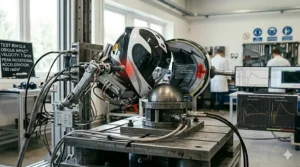
The Bell Race Star Flex DLX carries dual Snell M2025 and ECE 22.06 certification, positioning it squarely for riders who split time between road and track. Priced around £550-£650 on Amazon.co.uk, this carbon-composite helmet integrates three-layer impact liner technology and a flexible shell section designed to manage rotational forces. The Magnefusion magnetic cheek pad attachment system allows emergency removal without tools—crucial when seconds matter after a crash.
The track-focused reality: this helmet’s aerodynamic profile creates minimal lift at 150+ mph, but feels slightly aggressive for relaxed touring positions. The ventilation system moves tremendous airflow at speed but feels adequate rather than exceptional in urban stop-start traffic. UK track day regulars will appreciate that Snell M2025 certification satisfies circuit insurance requirements and paddock credibility equally. The intermediate oval fit suits most British riders, though the sportier internal padding creates more pressure points than touring-focused alternatives.
This helmet targets track day enthusiasts and spirited road riders who occasionally venture onto circuits. Daily commuters rarely benefit from Snell’s racing-oriented testing protocols. If your riding includes multiple track days annually or you’re shopping for legitimate race-spec protection, the Race Star Flex DLX delivers both certifications without compromise.
✅ Pros:
- Dual Snell M2025 + ECE 22.06: track and road certification combined
- Three-layer impact liner: advanced rotational force management
- Magnefusion cheek pads: emergency removal system
❌ Cons:
- £550-£650 pricing: substantial investment for occasional track riders
- Aggressive aerodynamics: touring comfort sacrificed for speed stability
Price Verdict: Around £550-£650 on Amazon.co.uk. Justified investment for track-focused riders who need legitimate racing certification alongside road legality.
7. HJC i70 — The Commuter’s Sensible Choice
The HJC i70 consistently scores 4-5 stars in UK SHARP testing despite costing under £200 on Amazon.co.uk. This intermediate shell size helmet proves that safety doesn’t require premium pricing—you’re sacrificing refinement and features, not fundamental protection. The integrated sun visor drops down smoothly, the Pinlock-ready visor prevents fogging on damp British mornings, and the basic ventilation system moves adequate airflow for typical UK riding temperatures.
The candid assessment: this helmet excels at commuting duties where you’re rarely exceeding 60 mph and comfort trumps performance. The slightly heavier weight (around 1,650 grams) becomes noticeable on multi-hour motorway slogs, and the wind noise increases noticeably above 70 mph compared to premium alternatives. But for the 15-mile urban commute through Birmingham or Cardiff traffic, those compromises simply don’t matter. The money you save versus premium alternatives funds better riding gear, advanced training, or fuel for actual riding.
This helmet suits practical riders who view motorcycling as transport rather than lifestyle. Daily commuters, courier riders, or anyone prioritising essential features over brand prestige will find the i70 delivers legitimate safety at pricing that makes sense. Weekend warriors covering 200+ miles per ride will notice the comfort gap versus helmets costing £300 more.
✅ Pros:
- Sub-£200 pricing: 4-5 SHARP stars without premium cost
- Integrated sun visor: convenient for varied British light conditions
- Intermediate sizing: fits broader range of head shapes
❌ Cons:
- 1,650g weight: neck fatigue on extended motorway rides
- Basic ventilation: adequate but not exceptional airflow
Price Verdict: Around £180-£200 on Amazon.co.uk. Best budget choice for riders prioritising proven safety over premium refinement.
Real-World Riding Scenarios: Which Helmet Certification Actually Matters
Before you obsess over whether Snell or ECE 22.06 offers superior protection, consider what actually happens when British riders crash. According to UK Department for Transport collision data, the overwhelming majority of motorcycle accidents occur at speeds below 50 mph, often involving glancing blows against vehicles, kerbs, or road furniture rather than perpendicular impacts onto flat surfaces. This real-world context matters enormously when evaluating helmet certifications.
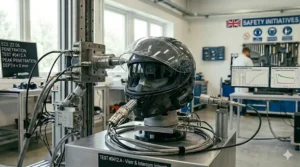
ECE 22.06’s oblique angle impact testing specifically addresses these common crash scenarios. The standard includes dropping helmets onto a 45-degree platform lined with 80-grit sandpaper at 8.0 metres per second, measuring both linear and rotational acceleration. Why does this matter? Because your brain doesn’t care whether your helmet’s shell remains intact—it cares about rotational forces that cause the brain to twist inside your skull, potentially shearing blood vessels and causing diffuse axonal injury that modern medicine struggles to repair.
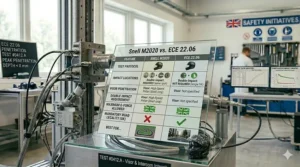
Snell M2025 now includes oblique impact testing as well, acknowledging decades of research showing rotational forces cause the majority of serious brain injuries. The difference lies in testing philosophy: Snell prioritises ensuring the helmet can withstand multiple impacts to the same location, simulating scenarios where you’re tumbling across tarmac and hitting obstacles repeatedly. ECE 22.06 focuses on comprehensive coverage across the helmet shell, testing 18 different impact points versus Snell’s 5 locations.
For typical UK street riding—commuting through Manchester, weekend rides through the Lake District, touring across Scotland—ECE 22.06 certification addresses the injury mechanisms you’re most likely to encounter. The standard’s emphasis on rotational impact protection, comprehensive shell coverage, and real-world crash scenario simulation makes it fundamentally well-suited to British roads where speeds rarely exceed 70 mph and urban obstacles present greater risks than high-speed racing impacts. Snell certification becomes genuinely valuable when you’re lapping circuits at speeds where racing-specific impact scenarios become relevant.
How to Choose Between Snell and ECE 22.06 for Your Riding
Forget the tribal arguments on internet forums. Your helmet choice should align with your actual riding patterns, not aspirational track day fantasies or brand loyalty inherited from your mates. Here’s the decision framework that actually works:
1. Identify Your Primary Riding Environment Urban commuters navigating London congestion zones face different risks than weekend sportbike riders tackling Welsh mountain roads. If you’re spending 90% of your riding time in stop-start city traffic, ECE 22.06 certification covers every scenario you’re likely to encounter. The comprehensive multi-point impact testing and rotational force management address urban crash dynamics where you’re glancing off car doors and low-speed obstacles. Premium Snell certification adds minimal practical benefit when you’re rarely exceeding 40 mph.
Track day regulars or canyon carvers regularly pushing 100+ mph face genuinely different impact scenarios. At these speeds, Snell’s higher-energy impact testing and multiple-hit-same-location protocol becomes relevant. If your riding includes regular circuit time or you’re genuinely exploiting modern sportbike performance on track, dual Snell + ECE certification makes sense. The premium you pay funds testing protocols designed for high-energy impacts that street riders rarely experience.
2. Match Certification to Legal and Insurance Requirements In the UK, ECE 22.06 certification isn’t optional—it’s the legal requirement for road use. Snell-only helmets without accompanying ECE approval cannot legally be used on British public roads, regardless of how thoroughly they’ve been tested. Track day organisers and racing series often mandate Snell certification (or FIM homologation for higher-level competition), making dual certification necessary if you split riding between road and track.
Check your insurance policy’s fine print. Some insurers specify ECE 22.06 (or the older 22.05) as minimum requirements for claims validity. Wearing a non-certified helmet—or one whose certification has expired—could theoretically provide insurers grounds to reduce payouts. The bureaucratic reality makes ECE certification your baseline requirement, with Snell becoming the optional upgrade for specific use cases.
3. Assess Budget Reality Against Safety Improvements Here’s the uncomfortable truth helmet manufacturers avoid stating clearly: ECE 22.06 certification represents a minimum safety threshold, not a graduated scale. A £150 LS2 helmet that passes ECE 22.06 testing provides fundamentally equivalent protection to a £500 Arai that also passes the same standard. What you’re paying extra for is comfort refinement, weight reduction, ventilation efficiency, and build quality—not categorically superior crash protection.
Snell certification adds genuine testing rigour beyond ECE requirements, but the safety improvement isn’t proportional to price premiums. Testing data shows that dual-certified helmets (ECE + Snell) perform well, but single ECE-certified helmets from reputable manufacturers also provide excellent protection. If budget constraints force choosing between a £300 Snell-certified helmet and a £300 ECE-only helmet with superior fit and comfort features, prioritise the better-fitting option. An ill-fitting helmet that shifts during impact provides worse protection than a well-fitted helmet with “lesser” certification.
4. Prioritise Fit Over Certification Bragging Rights This cannot be overstated: helmet fit matters more than certification stickers. A Snell M2025-certified helmet that’s slightly too large will shift during impact, potentially causing the shell edge to contact your skull or allowing your head to contact the interior padding with excessive force. An ECE 22.06-certified helmet that fits your head shape perfectly will remain stable during impact, allowing the energy-absorbing liner to function as designed.
Different manufacturers design internal shapes for different head geometries. Shoei tends toward intermediate oval (slightly longer front-to-back than side-to-side), Arai favours rounder profiles, and budget manufacturers often use more generic shaping. Your head shape doesn’t care about brand prestige—it cares about contact pressure distribution and stability. Try multiple brands and sizes before committing, ideally wearing each helmet for 10-15 minutes to identify pressure points that’ll cause headaches on longer rides.
5. Consider Long-Term Ownership Costs Premium helmets often include extended warranties (Arai offers five years versus typical two), replaceable parts availability, and liner replacement services that budget alternatives lack. A £500 Arai worn for five years costs £100 annually; a £150 budget helmet replaced every two years also costs £75 annually. Factor in superior comfort reducing fatigue-related errors, better ventilation preventing visor fogging that causes you to crack the shield open in rain, and noise reduction that preserves hearing over decades of riding.
Snell-certified helmets typically cost £350-£1,200, whilst ECE 22.06 certification spans £90-£700 price ranges. If your budget genuinely stretches to premium pricing, dual certification makes sense—you’re getting belt-and-braces safety plus the features that justify higher costs. If you’re stretching budgets to afford proper gear, prioritise well-fitting ECE 22.06 certification over chasing Snell stickers you don’t need for street riding.
Common Mistakes When Choosing Helmet Certifications
British riders make predictable errors when shopping for helmets, often based on outdated information or forum mythology that refuses to die despite contradicting current testing standards. Avoid these pitfalls:
Assuming Snell Always Means Better Protection The persistent belief that Snell certification automatically provides superior protection to ECE 22.06 stems from historical context that’s no longer entirely accurate. Older ECE 22.05 standards (pre-2023) did employ less rigorous testing than Snell M2015/M2020. However, ECE 22.06 introduced rotational impact testing, increased the number of impact test points from 6 to 18, raised impact velocities, and added comprehensive visor penetration trials. Snell testing features flat, hemispheric, and edge anvils, whilst ECE differs from DOT with its use of curbstone anvils, but flat and sloping anvils are now utilised under ECE 22.06.
The testing methodologies now overlap substantially, with ECE 22.06 actually employing higher impact velocities (8.2 m/s) than Snell’s maximum (7.9 m/s on edge anvils). Snell’s advantage lies in requiring two impacts to the same location and maintaining stricter control over liner hardness, which benefits racing scenarios but doesn’t automatically translate to superior street crash protection. Modern ECE 22.06 helmets from quality manufacturers provide excellent real-world protection.
Ignoring UK-Specific Legal Requirements Some riders purchase helmets from American retailers without verifying UK compliance, particularly when chasing bargain prices on discontinued models. US-market helmets often carry DOT certification without ECE approval, making them illegal for British road use regardless of how thoroughly they’ve been tested. Brexit hasn’t changed ECE requirements—the UK continues recognising ECE 22.06 (and older 22.05) as the legal standard, with UKCA marking requirements primarily affecting manufacturers rather than end users.
Northern Ireland presents additional complications due to the Protocol, potentially creating different approval requirements for helmets sold there versus Great Britain. Always verify that helmets purchased online explicitly state ECE 22.05 or 22.06 certification. Snell-only helmets, regardless of price or brand prestige, cannot legally be used on UK roads without accompanying ECE approval.
Overlooking SHARP Ratings for Dual-Certified Helmets The UK’s Safety Helmet Assessment and Rating Programme (SHARP) provides independent testing beyond manufacturer claims, yet many riders ignore these ratings when selecting helmets. SHARP tests helmets that already hold ECE 22.06 certification, subjecting them to additional impact tests across multiple points and awarding 1-5 star ratings based on performance. Interestingly, some expensive Snell-certified helmets score only 3-4 SHARP stars, whilst certain budget ECE-only helmets achieve 5 stars.
This reveals that certification isn’t everything—actual impact performance varies between helmets holding identical certifications. A £200 HJC i70 with 5 SHARP stars provides measurably better impact protection than a £400 helmet with 3 SHARP stars, despite both holding ECE 22.06 approval. Check SHARP ratings at https://sharp.dft.gov.uk before purchasing, particularly when comparing helmets at similar price points.
Confusing Shell Hardness with Safety The “hard shell versus soft shell” debate generates tremendous internet arguments whilst missing the fundamental point: optimal impact protection requires shells hard enough to prevent penetration whilst soft enough to absorb energy progressively. Snell’s historical preference for harder shells attracted criticism that persists despite M2025 standards allowing more flexible constructions. ECE 22.06’s emphasis on energy absorption through liner crush and shell flexion represents current safety thinking, but doesn’t mean softer automatically equals safer.
Premium helmets use multi-density EPS liners that crush progressively, managing impact energy across varying collision severities. The shell’s job is preventing sharp objects from penetrating whilst distributing impact forces across the liner. Carbon-composite shells achieve this whilst weighing less than fibreglass alternatives; thermoplastic shells cost less but weigh more. Neither approach is categorically superior—both can meet ECE and Snell standards when properly engineered. Focus on overall helmet design rather than obsessing over shell material alone.
Neglecting Replacement Schedules Regardless of Certification Both Snell and ECE standards assume helmets maintain protective capability for approximately five years from manufacture date, after which UV exposure, temperature cycling, and general degradation compromise liner effectiveness. Yet many British riders wear 8-10 year old helmets, apparently believing that premium pricing or Snell certification extends usable life indefinitely. It doesn’t.
The EPS foam liner that absorbs impact energy becomes brittle over time, whilst adhesives securing retention systems degrade. A 10-year-old Snell-certified helmet provides worse protection than a 2-year-old ECE-certified helmet, regardless of original testing standards. Check the manufacture date (usually stamped on chin strap or comfort liner), and replace helmets older than five years even if they’ve never been dropped. After any impact—even seemingly minor ones like dropping the helmet onto concrete from waist height—replace immediately. The liner crushes microscopically, compromising future impact protection.
UK Weather Considerations: How Climate Affects Helmet Performance
British riding conditions present unique challenges that helmet certifications don’t specifically address, yet profoundly affect real-world usability and safety. Understanding how ECE and Snell-certified helmets perform in persistent rain, temperature swings, and limited daylight hours helps you select kit suited to actual British conditions rather than Mediterranean fantasy riding.
Visor Fogging and Ventilation in Damp Conditions The UK’s notorious damp climate means visor fogging isn’t occasional inconvenience—it’s near-constant battle from October through April. ECE 22.06 testing includes visor penetration resistance and optical clarity requirements, but doesn’t simulate persistent condensation in 8°C drizzle. Premium helmets include breath guards and superior vent designs that minimise fogging, whilst budget alternatives often sacrifice these features.
Snell certification doesn’t address ventilation quality, focusing solely on impact protection. A Snell M2025-certified helmet could theoretically fog horrendously whilst still meeting all safety requirements. When comparing helmets, verify Pinlock compatibility (most premium ECE and Snell helmets include Pinlock preparation), check for breath guards that direct exhaled air away from the visor, and ensure chin vents can be fully closed for motorway riding in winter. The AGV K6 S, Shoei NXR2, and Arai Quantic all excel in British damp conditions through superior vent design and included anti-fog solutions.
Weight Considerations for Year-Round Riding Carbon-composite helmets weighing 1,200-1,300 grams reduce neck fatigue substantially compared to 1,600+ gram thermoplastic alternatives—but the difference becomes most noticeable during long winter rides when you’re already fighting cold-induced muscle tension. British riders covering 30+ miles each direction for work commutes will notice weight differences that occasional summer riders overlook entirely.
Both ECE 22.06 and Snell M2025 certification accommodate various shell materials and weights. Premium dual-certified helmets typically use carbon-aramid or multi-composite fibreglass, achieving superior protection-to-weight ratios. Budget ECE-only helmets use heavier thermoplastic but still meet safety requirements. If your riding includes frequent motorway commutes through Birmingham or Manchester, lighter helmets justify premium pricing through reduced fatigue. Occasional urban riders covering 10-15 miles per trip can manage heavier budget alternatives without significant discomfort.
Visibility and Reflectivity in British Light Conditions UK winter riding means departing for work in darkness and returning home after sunset, with limited daylight even during midday. Neither ECE nor Snell certification addresses helmet visibility to other road users, yet this affects your crash likelihood as much as impact protection affects injury severity. Lighter-coloured helmets with reflective elements increase conspicuity in Britain’s frequent overcast conditions and during dawn/dusk commuting hours.
Consider helmets with light-coloured shells or high-visibility graphics if substantial riding occurs in low-light conditions. The Shoei GT-Air 3 and HJC i70 offer bright colourway options that improve visibility versus murdered-out matt black alternatives. Some riders add reflective strips or high-visibility helmet covers for winter commuting, though this obviously doesn’t affect certification status. Brightness isn’t merely aesthetic—it’s practical safety enhancement for British riding realities.
FAQ: Snell vs ECE 22.06 Helmet Safety
❓ Which is safer: Snell or ECE 22.06 helmets for UK road riding?
❓ Do I need Snell certification if my helmet has ECE 22.06 approval?
❓ Are Snell-certified helmets legal on UK roads without ECE approval?
❓ How do ECE 22.06 and Snell M2025 testing methods differ?
❓ Will insurance companies pay out if I'm wearing a non-ECE certified helmet?
Conclusion: Making the Informed Choice for British Riding
The Snell versus ECE 22.06 debate ultimately dissolves when you understand what each certification actually tests and which scenarios you’re most likely to encounter on British roads. For the overwhelming majority of UK riders—commuters navigating urban traffic, weekend warriors exploring Welsh mountain roads, touring enthusiasts covering Scottish Highlands—ECE 22.06 certification provides comprehensive, well-researched protection specifically designed for real-world street crashes.
The standard’s emphasis on rotational impact protection addresses the primary mechanism of serious brain injury. Its testing across 18 helmet locations ensures comprehensive shell coverage. The oblique angle impact protocol simulates glancing blows against vehicles, kerbs, and road furniture that dominate UK crash statistics. ECE 22.06 represents contemporary safety science applied to the riding most of us actually do.
Snell M2025 certification adds genuine value for specific use cases: track day regulars who need circuit insurance compliance, racers whose organisations mandate Snell approval, and riders who genuinely push into triple-digit speeds where racing-specific impact scenarios become relevant. The testing’s multiple-impact-same-location protocol and stringent liner hardness controls address scenarios that street riders rarely encounter but track enthusiasts face regularly.
The genuinely optimal solution for serious riders exists in dual certification. Helmets carrying both ECE 22.06 and Snell M2025 approval provide road legality, insurance compliance, track acceptance, and belt-and-braces safety validation. Premium models from AGV, Shoei, Arai, and Bell increasingly offer dual certification without forcing riders to choose. But if budget constraints demand prioritisation, ECE 22.06 certification addresses British riding realities more comprehensively than Snell certification alone.
Ultimately, helmet fit matters more than certification bragging rights, comfort affects safety through fatigue reduction, and actually wearing your helmet correctly trumps obsessing over testing protocols. Choose ECE 22.06 as your baseline requirement, add Snell certification if your riding includes track time, prioritise proper fit above brand loyalty, and replace your helmet every five years regardless of how much you paid or which stickers it carries.
✨ Don’t Miss These Exclusive Deals!
🔍 Take your motorcycle safety to the next level with these carefully selected helmets. Click on any highlighted product to check current pricing and availability on Amazon.co.uk. These expert picks will help you find exactly the protection your head deserves!
Recommended for You
- 7 Best Snell Certified Racing Helmets UK 2026
- Best Snell M2020 Helmets UK: 7 Top Rated Safety Picks 2026
- 7 Best FIM Homologated Helmet for Track Racing UK 2026 Guide
Disclaimer: This article contains affiliate links. As an Amazon Associate, I earn from qualifying purchases. If you purchase products through these links, we may earn a small commission at no additional cost to you.
✨ Found this helpful? Share it with your mates! 💬🤗
