

In This Article
You know the drill. You’ve got your riding jacket on, gloves sorted, and then comes that moment — the undignified origami act of trying to wedge your prescription specs through a helmet opening that seems specifically designed to make your life difficult. Temple bars scraping the padding, lenses fogging up before you’ve even reached the end of your street, and the persistent dull ache across your ears that builds somewhere around the M6 and doesn’t let up until you’ve been home for twenty minutes. Sound familiar?

Here’s the thing: it doesn’t have to be this way. The best bluetooth motorcycle helmet for glasses wearers in the UK has come a long way in 2026 — and the category has genuinely matured. Modern helmets now offer dedicated eyewear grooves carved right into the liner, generous temple channels that accommodate even chunkier prescription frames, and wide chin-bar openings on flip-up designs that mean you can actually put your glasses on before the helmet goes on. Combined with integrated Bluetooth communication — music, intercom, GPS guidance — these lids represent a genuine quality-of-life upgrade for the estimated one in three UK riders who wear corrective eyewear.
A bluetooth motorcycle helmet for glasses wearers isn’t a niche product any more. It’s increasingly the sensible, connected default for spectacle-wearing riders navigating everything from London’s congestion zones to the winding B-roads of the Peak District. What sets a great one apart? Eyeglass-compatible liner design, ECE 22.06 certification (now the mandatory safety standard across Great Britain, as confirmed by the DVSA-backed SHARP safety programme), and Bluetooth that actually works in British conditions — meaning wet gloves, gusty crosswinds, and the occasional downpour you didn’t account for.
In this guide, we’ve done the legwork: seven real helmets available on Amazon.co.uk, reviewed with glasses wearers specifically in mind.
Quick Comparison: Bluetooth Helmets for Glasses Wearers at a Glance
| Helmet | Type | Bluetooth | Eyewear Feature | Safety Cert | Price Range | Best For |
|---|---|---|---|---|---|---|
| HJC i90 + Smart 10B | Modular | Integrated (Sena) | Eyeglass grooves | ECE 22.05 | £150–£240 | Budget-conscious tourers |
| Sena Outrush R | Modular | Built-in (Sena 5.0) | Generous temple space | ECE 22.06 | £200–£280 | Connected commuters |
| AGV K3 | Full-face | Bluetooth-ready | EyewearReady liner | ECE 22.06 | £180–£260 | Sport-touring riders |
| AGV Streetmodular | Modular | ARK-compatible | EyewearFit (18 configs) | ECE 22.06 | £320–£420 | Urban riders with large frames |
| HJC C91 | Modular | Bluetooth-ready | Dedicated groove liner | ECE 22.06 | £140–£210 | Value seekers |
| Shoei GT-Air 3 + SRL3 | Full-face | Sena SRL3 integrated | Glasses-padded temples | ECE 22.06 | £520–£700 | Premium touring |
| FreedConn BM12 | Full-face | Built-in (mesh) | Wide eyeport/open visor | ECE 22.06 | £80–£140 | Budget entry point |
Looking at the table above, a clear pattern emerges: modular (flip-front) helmets dominate this category, and with good reason. The ability to flip the chin bar up means you can don your specs before the helmet goes on — a small thing in isolation, but genuinely transformative for your daily routine. If you wear glasses and you’re debating between a full-face and a modular, the modular wins. Every time.
💬 Just one click — help others make better buying decisions too! 😊
✨ Don’t Miss These Exclusive Deals!
🔍 Take your riding experience to the next level with these carefully selected helmets. Click on any highlighted item to check current pricing and availability on Amazon.co.uk. These picks will help you find exactly what you need!
Top 7 Bluetooth Motorcycle Helmets for Glasses Wearers: Expert Analysis
1. HJC i90 with Smart HJC 10B Bluetooth (Sena)
The i90 is the workhorse of this list — the helmet that consistently turns up in UK forum threads when someone asks “what should I buy if I wear glasses and don’t want to spend a fortune?” And the reason is simple: HJC has quietly made glasses-friendliness a genuine engineering priority, not an afterthought.
The advanced composite shell with CAD-optimised channelling sits atop a liner that includes dedicated eyeglass grooves — precisely positioned channels running where most spectacle temples naturally fall. In practice, this means your frames slot in without creating the hot-spot pressure that makes a 90-minute motorway run feel like an endurance test. The Pinlock Max-ready visor is worth noting too: British weather being what it is, you’ll want every anti-fogging advantage available, and not having to buy one separately saves you a trip down that particular rabbit hole.
The Smart HJC 10B Bluetooth module (co-developed with Sena) integrates into purpose-built speaker pockets and a rear module housing, so there are no protruding brackets fighting for real estate with your earpieces. Range sits at around 400 metres — modest by 2026 standards, but adequate for most paired-riding scenarios. The intermediate oval shell shape suits the majority of British and European head shapes well.
UK riders on dedicated motorbike forums describe the i90 as comfortable once settled in, with genuine praise for how the Bluetooth module doesn’t interfere with the glasses-wearing experience. A few note the helmet runs slightly loud at motorway speeds — something worth considering if you’re doing regular A-road blasts.
✅ Excellent eyeglass grooves for all-day comfort
✅ Pinlock Max-ready visor — essential for UK dampness
✅ Sena-powered Bluetooth with HJC-specific integration
❌ Older Bluetooth 3.0 spec in the 10B unit — consider upgrading to the 20B module
❌ Runs slightly louder than mid-range competitors at speed
Price range: Around £150–£240 on Amazon.co.uk. Exceptional value for a glasses-wearing commuter who wants integrated communications without breaking the bank.
2. Sena Outrush R
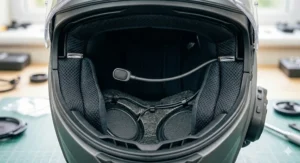
The Sena Outrush R occupies an interesting position: rather than a helmet that accepts a Bluetooth system, this is a Bluetooth system that happens to come with a helmet. The communications technology is genuinely first-class — Sena built their reputation on it — and the modular design makes it a reasonable choice for glasses wearers who prioritise connectivity above all else.
Bluetooth 5.0 powers 4-way intercom up to around 900 metres, with 2-way HD quality when paired one-to-one. Twelve hours of talk time means you’re covered for a full day’s touring without hunting for a socket. The flip-front chin bar is where glasses wearers will find their peace of mind: put specs on first, helmet second. The drop-down internal sun visor adds a useful layer of glare control without requiring you to swap visors mid-ride — a genuine convenience on those unpredictable British summer days that cycle through four seasons between breakfast and lunch.
The honest caveat is that while the Outrush R works with glasses rather than against them, it doesn’t feature the dedicated eyeglass groove system of the HJC models. Temple comfort depends more on the depth of the liner padding and the modular opening than on specific groove engineering. Riders with particularly wide or thick frames may want to try before buying.
UK riders importing from EU sellers should be aware that post-Brexit import duties may apply — one Amazon reviewer noted this experience, adding cost to the headline price.
✅ Class-leading Sena Bluetooth 5.0 fully integrated
✅ Modular flip-front ideal for glasses management
✅ 12-hour battery life suits full touring days
❌ No dedicated eyeglass groove system
❌ Some UK buyers have faced import duty on EU-sourced stock
Price range: Around £200–£280. A sensible mid-range choice for riders where communication quality is the top priority.
3. AGV K3
Don’t let the K3’s sport-touring aesthetic fool you — AGV have thought carefully about eyewear compatibility here. The EyewearReady interior is a genuine design differentiator: the liner is specifically sculpted to create a natural pathway for spectacle temples, with softer padding material at the contact points that reduces pressure even over longer rides.
The optional Transitions photochromic shield is the party trick. It darkens automatically in bright sunlight and clears in low light — adjusting, according to UK riders who’ve tested it, with impressive speed. For spectacle wearers, this is particularly meaningful: if you’ve ever tried to ride into a setting autumn sun with both prescription glasses and a tinted visor creating competing visual layers, you’ll appreciate anything that simplifies the equation. ECE 22.06 certification is present and correct, as it should be.
AGV’s ARK Bluetooth system isn’t included in the base helmet purchase — it’s an additional £120–£180 investment — but it integrates cleanly without compromising the aerodynamic profile. Worth considering as a bundle if you’re going all-in from the start. The intermediate oval fit aligns well with the European head shapes common across Britain.
UK feedback highlights the visor as a standout feature, with riders noting quick light adaptation and no pressure points from the EyewearReady system. Some find the AGV sizing slightly firm initially; a break-in period of a few rides tends to resolve this.
✅ EyewearReady liner specifically designed for spectacle wearers
✅ Optional photochromic visor — brilliant for variable British light conditions
✅ ECE 22.06 certified with strong safety credentials
❌ Bluetooth system sold separately — adds to total cost
❌ Snug initial fit may require a break-in period
Price range: Around £180–£260 for the helmet; allow an extra £120–£180 for the ARK Bluetooth add-on. Strong value when purchased as a bundle.
4. AGV Streetmodular
If the K3 is considered design intelligence, the Streetmodular is design obsession. AGV’s EyewearFit technology goes further than almost any other helmet on this list: up to 18 different interior configurations — achieved through a combination of interchangeable cheek pads and liner sections — mean that virtually any combination of head shape and glasses frame can be accommodated without resorting to the resigned acceptance that your ears just have to ache.
The wide flip-front opening is generous enough that putting on even larger frames before helmeting up is genuinely effortless — a detail that becomes less trivial when you’re suiting up on a cold morning with gloves on. The ventilation system manages airflow sensibly, which matters for glasses wearers who are already dealing with one fog-prone surface (their lenses) without adding visor misting to the equation.
This is a premium product at a premium price, and the Bluetooth isn’t included in the box — the ARK system needs to be added separately. What you’re paying for is that extraordinary customisation range and the feeling that the helmet was genuinely designed around your lifestyle rather than modified to accommodate it. For city riders in Bristol or Edinburgh who spend a lot of time in stop-start traffic with their visor up, the modular convenience combined with the glasses-forward design is hard to argue against.
UK feedback is positive, with particular praise for the cheek pad adjustability and the clean aesthetics — this is a helmet that doesn’t look like a compromise.
✅ Industry-leading EyewearFit with 18 interior configurations
✅ Exceptionally wide chin-bar opening for effortless glasses management
✅ Premium build quality with strong urban aesthetics
❌ Bluetooth system not included — additional cost required
❌ Premium price point may be steep for occasional riders
Price range: Around £320–£420. The pick for glasses wearers with larger or unconventional frames who need maximum adjustability.
5. HJC C91
The HJC C91 is a quieter proposition than its stablemate the i90, but it earns its place on this list through a combination of value, ECE 22.06 certification (the newer, more demanding standard), and those same dedicated eyeglass groove channels that have made HJC a go-to brand among spectacle-wearing UK riders.
The modular flip-up design handles the fundamental glasses management problem — chin bar up, specs on, chin bar down — while the groove system handles the comfort problem once everything is in place. The polycarbonate shell is honest enough about what it is: not premium, but properly protective and well-assembled. Ventilation is adequate rather than outstanding, which for British riding conditions — where you’re rarely in danger of overheating — is entirely acceptable.
For riders who want the glasses-groove benefits but don’t need the Bluetooth integration baked in (perhaps because you already have an aftermarket Sena unit from a previous helmet), the C91’s Bluetooth-ready speaker pockets and wiring channels make retrofitting clean and straightforward. Think of it as the sensible middle option: more current safety certification than the i90, less complexity than the AGV Streetmodular, at a price that makes it an easy recommendation for UK commuters on a budget.
✅ ECE 22.06 — the current mandatory UK standard
✅ Dedicated eyeglass groove liner: proven HJC system
✅ Bluetooth-ready design accommodates aftermarket units neatly
❌ Ventilation slightly basic for warmer rides
❌ Polycarbonate shell limits premium feel
Price range: Around £140–£210. The smart choice for glasses-wearing commuters who want the right certification without the AGV price tag.
6. Shoei GT-Air 3 with Sena SRL3
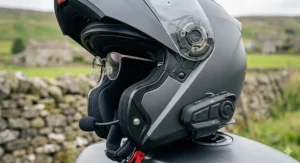
Here’s where the list gets properly serious. The Shoei GT-Air 3 paired with the Sena SRL3 communication system is the closest thing currently available to a purpose-built premium bluetooth motorcycle helmet for glasses wearers — even if Shoei don’t specifically market it that way. The glasses-friendly credentials come from exceptionally refined internal padding: temple zones that use lower-density foam to reduce pressure without compromising skull protection, and a visor port wide enough that most prescription frames don’t intrude on your sight line.
The Sena SRL3 integration is proper integration — Shoei’s Comlink system means the unit installs flush with the shell, with no external protrusions. The aerodynamic consequences of bolting a Bluetooth box onto a carefully wind-tunnel-tested lid are simply absent here. At motorway speeds, this helmet is noticeably quieter than any other option on this list, which matters both for comfort and for Bluetooth audio clarity. You’re not competing with wind noise at 70 mph on the M1.
Five-star SHARP safety rating. ECE 22.06 certified. Three shell sizes for a genuinely close fit. The quality of materials and assembly is, frankly, obvious the moment you pick it up. It’s a significant financial commitment — budget for both the helmet and the SRL3 unit — but if you’re covering serious mileage in all British weathers, this is the one that earns its keep.
UK touring riders consistently rate this as their benchmark lid, with specific mention of how it handles the M-road crosswinds that can make lesser helmets feel genuinely unstable.
✅ 5-star SHARP rating — best-in-class safety
✅ Sena SRL3 flush integration: no aerodynamic compromise
✅ Exceptional wind noise suppression for long-distance touring
❌ Significant combined investment (helmet + SRL3)
❌ Full-face design means no chin-bar flip — glasses go on via visor opening only
Price range: Around £520–£700 for the helmet; SRL3 adds approximately £200–£260. The definitive premium pick for serious UK touring riders who wear glasses.
7. FreedConn BM12
Right, let’s be straightforward about what the FreedConn BM12 is — and what it isn’t. It’s a budget-end, integrated Bluetooth full-face helmet available on Amazon.co.uk for a price that makes the Shoei above look like a different category of consumer product entirely. ECE 22.06 certified (worth checking the specific listing to confirm current certification status), with built-in mesh Bluetooth supporting group intercom for up to 24 riders and a range stretching to around 2 km in open terrain. At this price, that’s remarkable.
The glasses-wearer compatibility comes primarily from a wide eyeport and visor design rather than a dedicated groove system — so the experience varies somewhat depending on your frame size. Riders with slim profiles or rimless glasses tend to fare better; those with larger, heavier frames may find comfort diminishes over longer rides. The integrated LED brake light is a clever safety feature for UK road conditions where rear visibility can be genuinely poor in wet weather or at dusk.
WiFi-enabled firmware updates are a thoughtful touch at this price point — the sort of feature you’d expect on something costing considerably more. The composite fibreglass shell is honestly assembled, and the build quality exceeds what the price might lead you to expect. What you sacrifice versus mid-range options is refinement: the helmet-on, glasses-in experience requires a bit of technique, and the audio quality, while adequate, won’t trouble audiophiles.
For new riders or those wanting to trial integrated Bluetooth before committing to a premium spend, this is a perfectly legitimate entry point.
✅ ECE 22.06 with mesh Bluetooth — extraordinary value
✅ 24-rider group intercom range up to 2 km
✅ Integrated LED brake light for UK road safety
❌ No dedicated eyeglass groove system — comfort varies by frame type
❌ Audio quality and refinement reflect the price
Price range: Around £80–£140. An ideal starting point for budget-conscious riders or those new to integrated Bluetooth helmets.
How to Put Your Glasses On Without Wanting to Throw Your Helmet into a Hedge: A UK Rider’s Setup Guide
Getting the routine right is half the battle. Here’s what actually works in practice — and what the instruction manual won’t tell you.
Step 1: Always choose modular first. If you wear glasses full-time and you’re currently shopping for a full-face helmet, reconsider. A flip-front modular means specs on first, helmet second — every time, without the contortion. It’s not a minor convenience; it’s a fundamentally different experience.
Step 2: Loosen the liner before first use. New helmets have stiff liners that compress over the first 10–15 hours of use. When trying helmets on Amazon.co.uk, factor in that what feels tight around your temples in week one will relax considerably by week three. Read sizing guides carefully — most UK vendors, including Amazon, link to brand-specific head-shape guides.
Step 3: Install glasses last, bottom-up. When putting on a full-face helmet, tilt your head forward, slide the temples in from below at a shallow angle, then push up into position. It’s counter-intuitive but dramatically reduces the scraping-temples experience.
Step 4: Use a Pinlock insert. Your prescription lenses and your visor are already competing for optical clarity. A Pinlock anti-fog insert (see the official Pinlock guide) eliminates one variable entirely. Most of the helmets on this list are Pinlock Max-ready.
Step 5: Check your Bluetooth pairing before you leave the driveway. British weather has a talent for making you want to sort everything out while stationary. Pair your phone and any intercom devices at home, confirm volume levels with gloves on, then go.
Step 6: Protect your helmet from UK damp. Store it in a breathable helmet bag rather than a plastic carrier — the moisture that accumulates inside a wet-weather lid benefits from air circulation overnight. A damp liner accelerates foam degradation and, frankly, creates a rather unpleasant olfactory experience.
Three UK Riders, Three Different Helmets: Real-World Scenarios
The Manchester Commuter (5 days a week, urban A-roads, persistent drizzle)
Meet the kind of rider who’s in the saddle before 8am, navigating Salford traffic, and parked up again before the commuter rush reverses. For this person, glasses comfort over an 8-hour workday (with a midday gym trip factored in) matters enormously, as does the ability to take hands-free calls without touching a phone.
Best pick: HJC C91. ECE 22.06, eyeglass grooves, Bluetooth-ready speaker pockets for your existing aftermarket unit, and a price that doesn’t sting when a kerb takes a chunk out of it in a Deansgate car park.
The Weekend Tourer (Peak District, Lake District, 250+ km Saturday runs)
This rider isn’t worried about the price — they’re worried about a 6-hour ride ending with a headache. Wind noise, glasses pressure, and communication with their riding group are the priorities.
Best pick: Shoei GT-Air 3 + Sena SRL3. The quietest helmet on this list by a significant margin, a SHARP 5-star safety rating, and Bluetooth integration that doesn’t compromise aerodynamics on fast A-roads and exposed moorland stretches where buffeting is a real concern.
The London Courier (Inner-city delivery, stop-start, visor up half the time)
Fast glasses adjustment at lights, minimal bulk, decent audio for navigation, and something that won’t bankrupt them if it takes a knock during loading.
Best pick: AGV Streetmodular. The 18-configuration EyewearFit system accommodates the larger wraparound frames common among urban riders, and the wide flip-front opening means visor management at frequent stops is effortless. Worth the premium for someone spending 6–8 hours per day in it.
What to Look for When Buying a Bluetooth Helmet as a Glasses Wearer in the UK
1. Dedicated eyeglass grooves — not marketing language
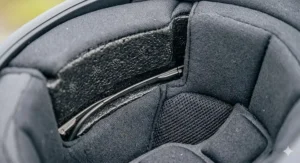
This is the non-negotiable. Some brands list “glasses-friendly” as a feature when they simply mean the helmet opening is wide enough that you won’t completely destroy your frames getting them in. What you actually want is liner grooves: physically sculpted channels that follow the path of your temple arms, reducing contact pressure over long distances. HJC is the benchmark here; AGV’s EyewearFit and EyewearReady systems are genuinely engineered alternatives.
2. Modular vs full-face: it’s not even close
As noted above, the flip-front modular is categorically easier for glasses wearers. The chin-bar opening eliminates the helmet-vs-temples origami problem entirely. The only scenario where a full-face makes more sense is if you’re a sport rider prioritising aerodynamic performance and weight — in which case, the Shoei GT-Air 3’s softened temple padding becomes especially valuable.
3. ECE 22.06 certification: mandatory for UK roads from 2024
The UK government mandated ECE 22.06 as the minimum safety standard for new helmets sold in Britain, superseding ECE 22.05. This isn’t a marketing badge — it’s a meaningfully more demanding test, particularly around impact management. The SHARP helmet safety programme run by the Department for Transport offers independent star ratings across certified helmets; checking your shortlisted lids here before purchasing is time well spent.
4. Bluetooth integration: built-in vs Bluetooth-ready
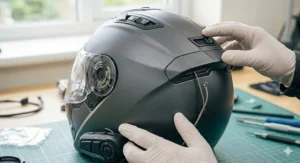
There’s a meaningful difference. “Built-in” means the comms system is factory-installed and tested as part of the helmet (Sena Outrush R, FreedConn BM12, Shoei GT-Air 3 + SRL3). “Bluetooth-ready” means the helmet has purpose-built speaker pockets, wiring channels, and a module housing designed for a specific aftermarket unit (HJC i90 + Smart 10B, HJC C91, AGV K3 + ARK). Both work well — the choice depends on whether you prefer the simplicity of an all-in-one or the flexibility of upgrading your comms independently.
5. Visor and lens interaction
If you wear varifocals or bifocals, the internal sun visor drop-down found in most modular helmets can interact oddly with your prescription — the lower portion of your visual field may feel distorted when the sun visor occupies part of your peripheral vision. Try before committing if possible. Photochromic visors (as on the AGV K3 option) can simplify the equation by reducing your need to manage separate tinted lenses.
6. Post-Brexit UK compliance
Since Brexit, the UKCA marking has replaced CE marking for products sold in Great Britain (note: Northern Ireland follows different rules under the Windsor Framework and may accept CE marking — see the UK Government guidance). For helmets, ECE 22.06 certification remains the primary safety standard and is recognised across Great Britain. Most established brands like Shoei, AGV, and HJC ensure UK-compliant versions are stocked through their UK distribution channels. When buying via Amazon.co.uk, check that the listing specifies UK stock rather than EU import — post-Brexit duties on the latter can add unexpected cost, as some Sena Outrush R buyers have found.
Common Mistakes UK Glasses Wearers Make When Buying a Bluetooth Helmet
Buying a helmet online without checking eyeglass compatibility reviews specifically. General helmet reviews rarely address glasses comfort in depth. Seek out UK-specific feedback from riders who wear specs — motorcycle forums like UKGSer or the MCN forum, and specialist sources like BillyCrashHelmets.co.uk that specifically catalogue glasses-compatible models, are far more useful than generic review aggregators.
Ignoring the Bluetooth module position relative to their glasses arm. Some helmet designs position the Bluetooth module’s wiring channel or speaker housing in a location that adds pressure to the precise spot where a spectacle arm sits. Always check for specific commentary on this when researching — it’s a detail that rarely appears in spec sheets.
Assuming “one size up” solves glasses pressure. Going a size larger can reduce glasses pressure in the short term but compromises the helmet’s protective function — a motorcycle helmet that moves on your head during an impact is not doing its job properly. The correct solution is a helmet with a glasses-specific liner design, not a looser fit.
Buying a helmet shipped from outside the UK without checking import status. A significant number of budget Bluetooth helmets on Amazon.co.uk ship from EU warehouses. Post-Brexit, this can trigger import duty of up to 12% on top of the listed price, negating the apparent saving. Listings with “Dispatched from and sold by Amazon” or UK-based third-party sellers typically avoid this issue.
Ignoring the SHARP database before buying. The SHARP programme (sharp.dft.gov.uk) is genuinely useful and free — it’s conducted independently by Transport Research Laboratory on behalf of the Department for Transport, rating helmets from 1 to 5 stars based on real-world impact testing. A premium price doesn’t guarantee a premium safety rating. Check before you buy.
✨ Don’t Miss These Exclusive Deals!
🔍 Whether you’re a daily commuter or weekend tourer, these carefully selected helmets deliver exactly what glasses-wearing riders need. Click any highlighted item to check current pricing and availability on Amazon.co.uk.
Bluetooth Motorcycle Helmet vs Traditional Helmet + Aftermarket System: What’s the Real-World Difference?
| Factor | Integrated Bluetooth Helmet | Traditional Helmet + Aftermarket Unit |
|---|---|---|
| Setup | Plug-and-play | Installation required (30–90 mins) |
| Aesthetics | Clean, no external units | External module on side/rear |
| Audio quality | Optimised for shell acoustics | Variable — depends on fit |
| Cost | Higher upfront | Can reuse system across helmets |
| Upgrade path | Limited by helmet replacement | Transfer system to new helmet |
| Best For | New riders, convenience seekers | Riders with existing Sena/Cardo systems |
The honest truth is this: if you already own a Sena or Cardo system you’re happy with, buying a “Bluetooth-ready” helmet with proper eyeglass grooves (like the HJC C91 or HJC i90) makes more financial sense than buying a fully integrated helmet and abandoning working kit. The integration quality on purpose-designed Bluetooth-ready helmets has reached the point where the experience is near-identical to factory-installed systems — provided you choose a helmet specifically designed for your comms brand.
If you’re starting from scratch with no existing system, an integrated helmet (Sena Outrush R, FreedConn BM12, or the GT-Air 3 + SRL3 at the premium end) saves the hassle of installation and typically delivers better acoustic results from the outset.
FAQ
❓ What makes a motorcycle helmet suitable for glasses wearers?
❓ Is ECE 22.06 certification required for motorcycle helmets in the UK in 2026?
❓ Do Bluetooth helmets with built-in speakers interfere with prescription glasses arms?
❓ Can I use a modular Bluetooth motorcycle helmet for glasses wearers as both open-face and full-face on UK roads?
❓ Are there post-Brexit import duties on Bluetooth motorcycle helmets bought on Amazon.co.uk from EU sellers?
Conclusion
Wearing prescription glasses on a motorcycle doesn’t have to be a negotiation with your own kit. The best bluetooth motorcycle helmet for glasses wearers in the UK in 2026 actually exists — in several excellent versions, at several price points.
If you’re starting out and budget is the main concern, the FreedConn BM12 gives you integrated Bluetooth and ECE 22.06 certification without drama, while the HJC C91 adds the all-important eyeglass groove system and remains sensibly priced. In the mid-range, the HJC i90 + Smart 10B combo represents the sweet spot for most UK glasses-wearing riders: genuine glasses comfort, proper Sena-quality Bluetooth, and a price that doesn’t require a serious conversation with your bank account.
If you’re stepping into premium territory, the Shoei GT-Air 3 + Sena SRL3 is simply the best overall package — quieter, safer, and more refined than anything else on this list. The AGV Streetmodular earns its place for city riders with unusual frame sizes who need that remarkable 18-configuration EyewearFit flexibility.
Whatever you choose: check the SHARP database, confirm ECE 22.06 certification, and look specifically for glasses-wearer reviews rather than relying on general helmet feedback. Your prescription specs deserve a helmet that was designed to work with them — not just tolerate them.
✨ Don’t Miss These Exclusive Deals!
🔍 Ready to ride in comfort and stay connected? Click any highlighted helmet to check current pricing and availability on Amazon.co.uk. Prime members enjoy free next-day delivery on eligible orders.
Recommended for You
- Best Smart Helmet for Winter Riding UK 2026 – 7 Top Picks
- 7 Best Smart Motorcycle Helmets UK 2026: Stay Connected, Ride Safe
- Best Intercom Helmet UK 2026: 7 Top Picks for Group Rides
Disclaimer: This article contains affiliate links. As an Amazon Associate, I earn from qualifying purchases. If you purchase products through these links, we may earn a small commission at no additional cost to you.
✨ Found this helpful? Share it with your mates! 💬🤗
