
In This Article
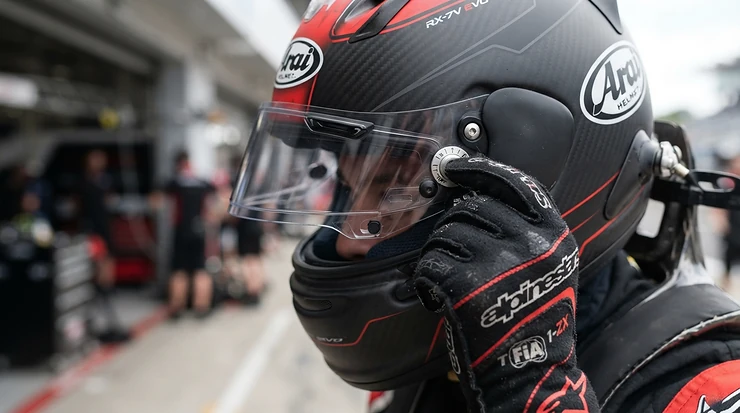
Tear-off laminates for helmet visor use are thin, optically clear plastic films that stud onto the outside of a racing visor, stacked in layers. When the outer film is plastered with oil, rubber, mud or insects, you peel it away in one motion and the clean layer beneath takes over. No wiping, no scratching, no pit stop.

Picture the end of a long straight on a damp afternoon. The car ahead throws up a fine mist of grit and tyre rubber, and your view turns to frosted glass. You can’t wipe a visor with a glove without grinding that grit into the surface, so a tear-off does the sacrificial work instead. Even at the very top of the sport, riders use them one-handed at speed. MotoGP’s own explainer also shows the flip side: a discarded film can end up under a tyre and cause real trouble.
A quick word on method. This guide is built from manufacturer part data, UK and international retailer specifications and published racing guidance. It is not hands-on testing, and I haven’t used these products. Where I couldn’t verify enough genuine independent reviews for a listing, I say so rather than paper over the gap. Prices are ranges only, indicative and converted from retailer listings at the time of research, so check the current price before you buy.
Below you’ll find seven real options, a fitting guide, a stacking breakdown, a race day visor prep checklist and a plain-English look at helmet standards.
Quick Comparison: Tear-Off Laminates for Helmet Visor at a Glance
| Product | Format | Typical price range | Best For |
|---|---|---|---|
| Bell 276/281 pack | 10 single films | £30-£35 | Budget buyers with a matching Bell shield |
| Bell SE03/SE05 X-Stack | 3 stacks × 10 laminated films, 2 mil | £30-£40 | GP3, GTX3 and GT5 club racers |
| Perimeter Seal 10206CP | 3 stacks × 10, sealed edges | £35-£50 | Wet-weather and dusty-circuit racers |
| Bell SE07 X-Stack | 3 stacks × 10, 2 mil (4 mil option exists) | £40-£55 | Bell 7 Series owners |
| Stilo ST5 2 mil | 3 stacks × 10, 2 mil | £40-£55 | Endurance runs on a Stilo ST5 |
| Stilo ST5 4 mil | Stacks of 3, 4 mil | £40-£55 | Sprint races and glove-friendly peeling |
| Sparco RF/KF tear-offs | Single films, pack size to verify | £20-£30 | Sparco RF and KF shell owners |
Looking at the table, the pre-laminated stacks win on cost per clean view. Bell SE03/SE05 X-Stack and Stilo ST5 2 mil both give 30 films per pack, whereas Bell 276/281 pack gives 10. If your helmet is a Bell GP3 and you race in the wet, Perimeter Seal 10206CP costs a little more but tackles the dirt that creeps behind a stack. Sparco RF/KF tear-offs are the simple answer if your lid is a Sparco, since fit matters more than any marketing claim.
💬 Just one click — help others make better buying decisions too!😊
Top 7 Tear-Off Laminates for Helmet Visor: Expert Analysis
1. Bell Visor Tear Offs (276/281), Pack of 10 — simplest budget way in
This is the no-frills option: single films you apply one at a time, rather than a factory-laminated stack. Bell describes the range as designed for its full-face motorsport visors, with mounting points on both sides of the shield and tabs that are easy to find with gloves on.
A pack of 10 equals one full stack, so think of it as one race dressing rather than a season’s supply. The upside is flexibility. Because you apply the films yourself, you can run four layers for a short sprint or all ten for an endurance stint. The trade-off is that hand-laid films can trap tiny air pockets or dust between layers, and every extra surface is another chance for a reflection. Based on the spec comparison, this suits occasional track-day and kart drivers who want to try tear-offs before committing to laminated stacks.
On reviews: I couldn’t verify enough independent buyer feedback on this exact listing to summarise it responsibly. Read the verified-purchase comments on the product page, particularly any mention of fit against the 276/281 shield code.
Pros:
- ✅ Lowest cost of entry on this list
- ✅ Choose your own layer count per race
- ✅ Tabs reportedly easy to find with gloves on
Cons:
- ❌ Only 10 films per pack
- ❌ Hand-laid layers can trap dust and air
Expect a price around £30-£35, which makes it fair value for trial use but poor value per film once you race regularly.

2. Bell SE03/SE05 Racing Optics X-Stack — pre-laminated for GP3 and GTX3
Racing Optics makes this one for Bell, and the point is that the layers arrive pre-bonded as a laminated stack. Each stack holds 10 films at 2 mil (0.05 mm), and a pack contains three stacks, so 30 films in total. Listings name the Bell GTX3, GP3 Carbon, GP3 Sport, GT5 Carbon, GT5 and B2 Apex among the fits, and some retailers add the HP5.
Stack the maths: 10 films × 0.05 mm gives about 0.5 mm of plastic per visor. The manufacturer’s pitch is that optical-grade Mylar laminated into a stack cuts the reflected light between layers, which is where hand-laid films tend to lose clarity. On paper this means a cleaner view after each peel and less fuss on the grid, because the stack goes on in one go. It also suits UK club racers, since the GP3 Sport is a typical FIA 8859-2015 helmet according to Demon Tweeks’ standards guide.
On reviews: I couldn’t verify a substantial pool of independent UK reviews for this exact part, so check current buyer comments for fit.
Pros:
- ✅ 30 films per pack for the price
- ✅ Pre-laminated, so one application per stack
- ✅ Wide Bell fitment list
Cons:
- ❌ No perimeter seal against creeping dirt
- ❌ Part is shield-code specific (SE03/SE05)
Price range is around £30-£40, and for GP3 and GTX3 drivers it is the sensible default.
3. Racing Optics XStack Perimeter Seal 10206CP — edge seal keeps grime behind the stack out
Same Bell shield family, same 10-film, 2 mil, three-stack format, but with a perimeter seal. Per the manufacturer’s description relayed by retailers, the seal gives a tighter fit to the visor, keeping dirt, dust and water from working behind the stack. Post spacing is 11½ inches (about 292 mm), and listings include the Bell Dominator.3, GTX.3, GP.3, GT.5 Touring, HP.3 and HP5 Touring.
Why does that matter? A peel only helps if the next layer is as clean as the day you applied it. Once water or fine dust sneaks behind the stack, every layer beneath is compromised. What most buyers overlook is that this is a wet-weather and dusty-circuit problem rather than a dry-sprint problem. Be careful with fitment, though: the “.3” naming used here differs from the SE03/SE05 listing, so confirm the shield code on your helmet before ordering.
On reviews: I couldn’t verify enough independent feedback to summarise sentiment fairly for this specific part number.
Pros:
- ✅ Edge seal targets dirt and water ingress
- ✅ Same 30-film pack as the standard stack
- ✅ Clear 292 mm post spacing for matching
Cons:
- ❌ Costs more than the unsealed equivalent
- ❌ Fitment naming needs careful checking
Expect around £35-£50. If you race in British drizzle, this premium looks easy to justify next to Bell SE03/SE05 X-Stack.
4. Bell SE07 Racing Optics X-Stack — made for the 7 Series shield
The SE07 pattern covers the Bell HP7, HP77, RS7 and KC7-CMR. Racing Optics lists it as 2 mil films, three stacks of ten, with clear (10235C) and smoke (10235S) part numbers. Bell’s own listings also show a thicker option for the 7 Series: four stacks of three films at 4 mil (0.1 mm).
That choice is the interesting bit. A 2 mil stack of ten gives you ten peels but a slightly bulkier 0.5 mm stack, while the 4 mil stack of three gives only three peels at about 0.3 mm. The thicker film is easier to grab and peels more decisively, which could matter in heavy gloves. There is also a catch: the HP77 has a smaller aperture, and the tear-offs sold for it cover less height. They will fit a 7 Series shield but leave a larger uncovered area, so don’t mix them up.
On reviews: I couldn’t verify genuine independent reviews I’d be comfortable summarising here. Treat fitment questions as the thing to ask the retailer.
Pros:
- ✅ Clear and smoke versions available
- ✅ 2 mil and 4 mil options for the 7 Series
- ✅ Racing Optics laminated construction
Cons:
- ❌ Dearer than the SE03/SE05 stack
- ❌ HP77 and 7 Series coverage differs
A price around £40-£55 is fair for 7 Series owners, who have few alternatives.
5. Stilo ST5 2 Mil Tear-Offs (10259C) — thin layers for the ST5 shell
Made for the Stilo ST5 range, this pack follows the same recipe: three stacks of ten, each film 2 mil (0.05 mm), glued into stacks. Retailers state it fits all ST5 helmets but not the ST4F or ST4W, so check your model before you buy.
The thin layers translate into ten peels per visor, which is why endurance and long-race drivers gravitate to this format. Over a 45-minute race with a lot of rubber on track, having ten chances to refresh your view beats having three. The compromise is feel: very thin films can be a touch fiddly to peel in thick gloves, so practise before race day rather than discovering it in anger. The spec sheet won’t tell you this, but a stack that peels cleanly in the garage can behave differently with cold, damp fingers.
On reviews: I couldn’t verify enough independent reviews of this exact listing to summarise, though retailer pages show only limited feedback.
Pros:
- ✅ Ten peels per stack for long races
- ✅ Three stacks cover three visor dressings
- ✅ Purpose-cut for ST5 visors
Cons:
- ❌ Thin films need glove practice
- ❌ Not compatible with ST4F or ST4W
Pricing is around £40-£55, and for ST5 owners who race longer events the cost per film (see the value table later) is competitive.

6. Stilo ST5 4 Mil Tear-Offs — chunky layers for gloved fingers
This is the thicker sibling: 4 mil (0.1 mm) films, supplied in stacks of three, with four stacks to a pack according to the retailer data I found. A perimeter-sealed small-tab variant is also listed under part 3459CP. Listings are inconsistent on pack counts, so verify exactly what ships before you click.
Do the arithmetic. A stack of three at 4 mil is about 0.3 mm thick, compared with 0.5 mm for a ten-film 2 mil stack, so the visor profile is slimmer but you only get three peels. The thicker film should feel more positive under a glove and is less likely to tear halfway or peel two at once. In practice that makes this a sprint-race and short-event product, where three clean views are plenty.
On reviews: I couldn’t verify a trustworthy volume of independent reviews for this one, so rely on the spec reasoning above.
Pros:
- ✅ Thicker film is easier to grip
- ✅ Slimmer 0.3 mm stack profile
- ✅ Perimeter-sealed variant exists
Cons:
- ❌ Only three peels per stack
- ❌ Pack contents vary between listings
Expect around £40-£55. Cost per clean view runs higher than Stilo ST5 2 mil, which matters if you race often.
7. Sparco RF/KF Visor Tear-Offs (SPA00315K01) — straightforward fit for Sparco shells
Sold through UK motorsport retailers, this part is for Sparco RF and KF helmets. The retailer’s guidance is refreshingly practical: tear-offs stud onto the posts on the visor, sizing is model specific, and one that nearly fits will lift at speed. They also advise fitting in the garage rather than on the grid and buying more than you think you need, since the product is consumable by design.
That last point is the commercial truth of the whole category. Tear-offs are cheap compared with a replacement visor, so the sensible approach is to treat them as a running cost. The retailer also makes the sound point that wiping with a glove can scratch a visor, which is the whole reason a sacrificial layer exists. The pack size wasn’t clear from my research, so confirm the count before comparing value with the Racing Optics stacks.
On reviews: I couldn’t verify genuine independent reviews for this listing, so I won’t characterise buyer sentiment.
Pros:
- ✅ Cut specifically for RF and KF shells
- ✅ Available from UK-based motorsport retailers
- ✅ Simple fitting, with clear advice
Cons:
- ❌ Pack size unclear from listings
- ❌ Only useful if you own a Sparco RF/KF
A price around £20-£30 makes it good value if the fit is right, which is the only thing that matters here.
Tear-Off Laminate Application: A Step-by-Step Fitting Guide
Good tear-off laminate application is boring on purpose. Skipped steps are what cause films to lift on the first fast lap. Always follow the instructions that came with your pack, but this sequence reflects the logic behind the manufacturers’ and retailers’ guidance.
- Confirm the posts first. Check your helmet actually has visor tear-off posts on both sides, and that the shield code matches the pack.
- Clean and dry the visor. Use mild soapy water and a clean microfibre cloth, then let it dry completely. Residual moisture is what sits behind a stack and ruins the view.
- Line up the stack. Hold it by the tab end, locate the first hole on a post, then work across to the second. Stretching a stack to meet the posts is a sign you have the wrong fitment.
- Press the edges flat. Smooth from the centre outward so no air or dust sits between stack and visor.
- Do a test peel. Pull one layer off with your racing gloves on. The tab should be easy to find and the film should come away in one clean motion.
- Fit it in the garage. The Sparco retailer’s advice to avoid fitting on the grid is sound. Rushed fitting is where wrinkles and misaligned holes come from.
Finally, keep a spare stack in your kit bag. A visor stack is a consumable, and the wrong moment to discover you’ve run out is between qualifying and the race.
Visor Laminate Stacking: How Many Layers Is Too Many?
Visor laminate stacking is a trade-off between peels available and the bulk you carry on your visor. More layers means more clean views, but a thicker stack and, if the films aren’t pre-laminated, more surfaces for glare and trapped dust. The simple rules below come from the spec arithmetic rather than lab tests.
| Setup | Film thickness | Films per stack | Approx. stack thickness | Best For |
|---|---|---|---|---|
| Bell SE03/SE05 X-Stack | 2 mil (0.05 mm) | 10 | 0.5 mm | Club racing, mixed conditions |
| Perimeter Seal 10206CP | 2 mil (0.05 mm) | 10 | 0.5 mm | Wet or dusty circuits |
| Stilo ST5 2 mil | 2 mil (0.05 mm) | 10 | 0.5 mm | Longer events |
| Stilo ST5 4 mil | 4 mil (0.1 mm) | 3 | 0.3 mm | Short sprints |
| Bell SE07 X-Stack (4 mil option) | 4 mil (0.1 mm) | 3 | 0.3 mm | 7 Series sprint use |
The table shows that thickness and peel count pull in opposite directions. A 2 mil stack gives you roughly three times the number of peels of a 4 mil stack, at the cost of a stack about two-thirds thicker and a lighter feel under the glove. Treat a full ten-film stack as the ceiling, and check the visor still closes cleanly and seats properly against the helmet seal. For a 15-minute kart heat, three clean peels is usually generous. For a long endurance stint, you’ll want the thinner films and a spare stack ready.
Race Day Visor Prep: A Practical Checklist
Good race day visor prep starts the night before, not on the grid. The goal is simple: no surprises when you’re strapped in with a helmet on your head.
The night before:
- ✅ Fit a fresh stack and test-peel it with your race gloves on
- ✅ Pack at least one spare stack, plus a clean microfibre cloth for the outside of the visor
- ✅ Check the visor tear-off posts aren’t cracked or loose
On the grid:
- ✅ Decide in advance how many peels you expect to use, because the count is finite
- ✅ Make sure the pull tab sits on the side your dominant hand will reach
- ✅ Confirm the stack hasn’t lifted at the edges after the formation lap
On track:
Peel with intent rather than habit. SlashGear’s explainer on F1 tear-offs makes the point that ripping one off every lap litters the circuit and burns through your supply, and it also mentions a 2026 MotoGP incident where a rider’s bike reportedly slipped on a discarded film. Hold the used layer and stow it rather than releasing it into the air stream. A tear-off is a visibility tool, not a way to feel better about a slow lap.
Laminate Peel Layers: Common Problems and How to Fix Them
Laminate peel layers should come away smoothly, one at a time. When they don’t, the cause is nearly always fitment, preparation or thickness. These fixes are reasoned from the specifications and retailer guidance rather than lab testing.
Problem 1: Films lifting at the edges at speed.
The Sparco retailer notes that a near-fit lifts, and they’re right. Re-check the shield code, then consider a sealed option like Perimeter Seal 10206CP for helmets it fits.
Problem 2: Two layers coming off at once.
Thin films can double up in cold, gloved fingers. Move to a thicker option such as Stilo ST5 4 mil, and practise with your actual race gloves.
Problem 3: Can’t find the tab quickly.
Position the tab on your dominant side and rehearse the motion in the garage. Bell says its tabs are easy to find with gloves on, but familiarity beats design.
Problem 4: Murky view even after a fresh peel.
Dirt or water has probably crept behind the stack. A sealed stack helps, and so does cleaning the visor properly before fitting.
Problem 5: Running out mid-weekend.
Divide your expected peels by film count. A 30-film pack of Bell SE03/SE05 X-Stack is three visor dressings, so buy two packs for a busy weekend.
How to Choose Tear-Off Laminates for Helmet Visor: 6 Steps
The right pick is mostly a matching exercise. Work through these six steps in order.
- Confirm helmet compatibility. A motorsport-approved helmet is the starting point. Per Demon Tweeks’ standards guide, ECE-approved helmets are not approved for motorsport use, and tear-offs won’t change that.
- Identify your shield code. Look for SE03/SE05, SE07, ST5, RF/KF or similar. Tear-off sizing is model specific, so a close match isn’t good enough.
- Check the visor tear-off posts. Confirm the helmet has them and note the spacing, for example 11½ inches on the Perimeter Seal 10206CP.
- Pick a thickness for your race length. 2 mil for more peels, 4 mil for fewer, more tactile ones.
- Decide on pre-laminated or single films. Laminated stacks apply faster and cost less per film, while singles give flexibility.
- Match conditions to features. Wet or dusty circuits justify a perimeter seal. Dry sprints often don’t.
Follow those six and you’ll narrow the field to one or two options before price even enters the conversation.
Helmet Visor Tear-Off Posts: Why They Decide Everything
Helmet visor tear-off posts are the small studs on each side of the visor that the holes in a tear-off stack locate onto. Bell notes that its motorsport visors carry mounting points on both sides, and the Sparco retailer is blunt about the principle: check your helmet has them, because without posts a stack has nothing to hold it.
Posts also set the geometry. Spacing varies between helmet families: the Perimeter Seal 10206CP lists 11½ inches (about 292 mm), while a related Racing Optics sealed pack for other Bell shields lists 12⅛ inches (about 308 mm). A 16 mm difference sounds small, but it’s the gap between a stack that sits flat and one that bows or lifts. This is exactly why universal tear-offs rarely work well.
If you’re wondering whether you need visor tear-off posts at all, one UK crash-helmet reviewer notes that tear-off-ready track helmets are aimed at serious racers, and that most casual riders probably don’t need them. For circuit racers and rally and kart drivers, they’re a basic part of the kit. Inspect the posts for cracks before each event, because a failed post is a failed stack.

Common Mistakes When Buying Tear-Off Laminates for Helmet Visor Setups
Most mistakes come from assuming that tear-offs are interchangeable. They aren’t, and these are the pitfalls worth avoiding.
- Buying on brand rather than shield code. The right brand with the wrong code still won’t sit flat.
- Confusing similar helmet families. The ST4F and ST4W aren’t covered by the ST5 pack, and the HP77 uses a shorter pattern than the rest of the 7 Series.
- Ignoring pack contents. Listings for Stilo ST5 4 mil vary on count, so verify before assuming it’s equivalent to a 30-film pack.
- Buying just one pack. The Sparco retailer’s advice to buy more than you think you need is correct. Consumables run out at the worst moment.
- Fitting on the grid. Rushed application is how wrinkles and trapped dust happen.
- Skipping glove practice. A film that peels beautifully with bare fingers may fight you in race gloves.
The cheapest option is rarely the cheapest in practice. A pack that doesn’t fit is money wasted twice: once at purchase and again when you rebuy the right one.
Tear-Off Laminates vs Wiping, Spare Visors and Doing Nothing
Plenty of drivers manage without tear-offs. Whether that’s wise depends on what lands on your visor and how long you race.
| Approach | Clear view mid-race | Scratch risk | Running cost | Best For |
|---|---|---|---|---|
| Wiping with a glove or cloth | Slow and smeary | High | None | Emergencies only |
| Spare visor swap | Only at a pit stop | Low | High (visor cost) | Long endurance with stops |
| Tear-off laminates | Instant, one motion | Low (films take the damage) | Low per film | Most circuit, kart and rally use |
The pattern is clear. Wiping is free but, as the Sparco retailer points out, it tends to smear oil and rubber across the screen and risks scratching. A spare visor is slow and expensive. Stilo ST5 2 mil and its laminated rivals sit in the middle: a small cost per film for an instant refresh with no stop. For anyone following another car closely or racing in changeable weather, tear-offs are the pragmatic choice.
Long-Term Cost: Budgeting for Tear-Off Laminates for Helmet Visor Use
Cost per film is the number that actually matters. The estimates below divide my indicative price ranges by pack counts, so treat them as approximations and recheck against live prices.
| Product | Films per pack | Approx. cost per film | Best For |
|---|---|---|---|
| Bell 276/281 pack | 10 | £3.00-£3.50 | Trial use |
| Bell SE03/SE05 X-Stack | 30 | £1.00-£1.35 | Regular club racing |
| Perimeter Seal 10206CP | 30 | £1.15-£1.70 | Wet or dusty circuits |
| Bell SE07 X-Stack | 30 | £1.35-£1.85 | 7 Series owners |
| Stilo ST5 2 mil | 30 | £1.35-£1.85 | Endurance on ST5 |
| Stilo ST5 4 mil | 12 (verify) | £3.35-£4.60 | Short sprints |
| Sparco RF/KF tear-offs | Not verified | Not verified | Sparco RF/KF owners |
The figures show why the laminated 2 mil packs dominate for regular racers: they cost roughly a third of the single-film or 4 mil options per film. If you use five peels per race and race twelve times a season, that’s 60 films, and the difference between roughly £1.20 and £3.25 per film adds up to a few hundred pounds. Add the cost of a scratched or damaged visor, and spending a little more on tear-offs looks like cheap insurance. Always confirm pack counts before you buy.
Safety, Regulations and Helmet Standards: What Tear-Offs Don’t Change
Tear-offs improve visibility; they don’t make a helmet legal. According to Demon Tweeks’ guide, ECE-approved helmets are not approved for motorsport, and the standards that matter in UK racing include FIA 8859-2015, FIA 8859-2024 and FIA 8860-2018, with Snell SA standards also seen on dual-labelled helmets. Check the label inside your helmet and the regulations for your series.
In my research I couldn’t find a Motorsport UK rule that specifically governs tear-offs, so I won’t claim one exists. What I can say is that you should confirm with your club’s scrutineer if you’re unsure, particularly if you’ve modified a visor. Never drill, cut or alter a visor to accept tear-offs, and don’t fit films to a visor that wasn’t designed to carry them.
On track, treat used films as litter you’re responsible for. A stray tear-off is a hazard to the car behind you, which is exactly what the MotoGP and F1 examples above illustrate. Stow it, don’t throw it.

FAQ
❓ How many tear-offs should I fit for a short race?
❓ Can I use tear-offs from a different helmet brand?
❓ When should I fit a new stack before an event?
❓ Is a perimeter seal worth paying extra for?
❓ Are pre-laminated stacks better than single films?
Conclusion
The best tear-off laminates for helmet visor setups are the ones that fit your shield exactly, suit your race length and arrive in sensible quantities. For Bell GP3 and GTX3 drivers, Bell SE03/SE05 X-Stack is the value default, and Perimeter Seal 10206CP is the upgrade if you race in the wet. Bell SE07 X-Stack covers the 7 Series, Stilo ST5 2 mil and Stilo ST5 4 mil split the endurance and sprint ground for ST5 owners, and Sparco RF/KF tear-offs are the obvious pick for Sparco shells. Bell 276/281 pack remains a cheap way to try the idea.
Remember the fundamentals. Confirm your visor tear-off posts, practise the peel in race gloves, fit stacks in the garage and carry a spare. Treat laminate peel layers as a consumable, budget accordingly and never throw one onto the circuit. Do that, and you’ll swap guesswork for a clean view when the car ahead starts throwing muck.
✨ Ready to sort your visor before the next race weekend?
🏁 Click through any highlighted product above to check current pricing and availability, then fit your stack in the garage and go racing with confidence!
Recommended for You
- Universal Tear-Offs For Motocross Goggles: 7 Proven Picks (2026)
- Tear-Off Visor Pack: 7 Proven Picks For UK Riders (2026)
- Pinlock Anti-Fog Insert: 7 Best Picks To Stop Fog (2026)
Disclaimer: This article contains affiliate links. As an Amazon Associate, I earn from qualifying purchases. If you purchase products through these links, we may earn a small commission at no additional cost to you.
✨ Found this helpful? Share it with your friends! 💬🤗
