In This Article
There’s a moment — usually somewhere around the third hour of a motorway slog into a headwind — when the weight of a cheap polycarbonate helmet stops feeling like a minor inconvenience and starts feeling like a punishment. Your neck aches. Your shoulders tighten. And somewhere in the back of your mind, you wonder if there’s a better way.
There is. It’s called a carbon composite helmet, and in 2026 it’s no longer the exclusive preserve of MotoGP riders and people with inexplicably large disposable incomes.
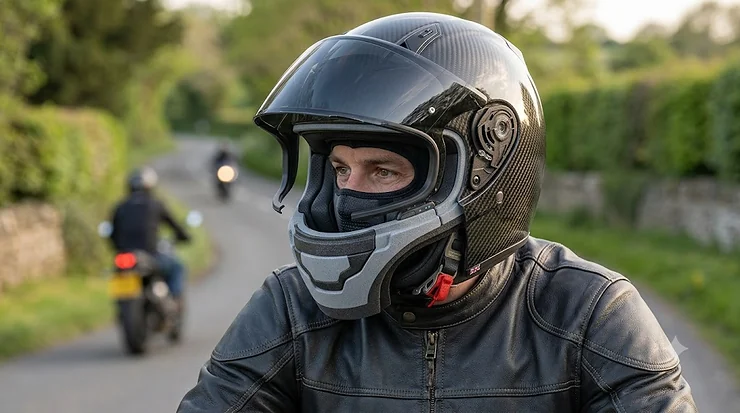
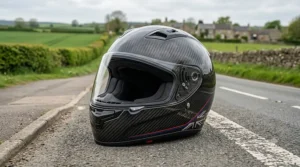
A carbon composite helmet is a motorcycle helmet whose outer shell incorporates carbon fibre — often blended with aramid (Kevlar-type) fibres, fibreglass, or other reinforcing materials — to achieve an exceptional balance of strength, impact absorption, and low weight. The result is typically a shell that weighs 200–350 grams less than a comparable polycarbonate helmet, while meeting or exceeding the same safety standards.
That weight saving might sound trivial on paper. Over a full day’s riding through the Peak District or along the A9 in Scotland, it absolutely isn’t.
Here in the UK, we’re also dealing with conditions that make a properly constructed helmet more than a vanity purchase: wet roads, low winter sun, diesel-slicked roundabouts, and the ever-present optimism that today might actually be dry. According to SHARP — the UK Government’s independent helmet safety scheme, run by the Department for Transport — motorcyclists represent roughly 1% of traffic but account for 19% of casualties, with around 80% of all motorcyclist fatalities involving head injuries. Buying the right helmet isn’t a luxury. It’s just sensible.
This guide covers seven real products available to UK buyers in 2026, with honest commentary on what each one actually means for the rider wearing it — not just the spec sheet.
Quick Comparison: Carbon Composite Helmets at a Glance
| Helmet | Shell Type | Weight (approx.) | ECE 22.06 | Best For | Price Range |
|---|---|---|---|---|---|
| AGV K6 S | Carbon-aramid | ~1,255g | ✅ | All-round lightweight | £300–£450 |
| Scorpion EXO-R1 Evo Carbon | TCT-U 3K Carbon | ~1,300g | ✅ | Track-to-road crossover | £250–£380 |
| Shark Spartan RS Carbon | Carbon + fibreglass | ~1,380g | ✅ | Budget-conscious sport | £220–£320 |
| HJC RPHA 11 | Multi-composite | ~1,300g | ✅ | Mid-range sport/track | £250–£380 |
| LS2 FF811 Vector II Carbon | Full carbon | ~1,300g | ✅ | Value carbon with sun visor | £270–£370 |
| Shoei NXR2 | AIM+ composite | ~1,450g | ✅ | Premium road touring | £400–£500 |
| Shark Spartan GT Pro Carbon | Carbon/fibreglass | ~1,350g | ✅ | Luxury sport-touring | £450–£620 |
The table above tells an interesting story at a glance. The AGV K6 S is in its own weight class — quite literally — but it comes without an integrated sun visor, which matters enormously on British winter mornings when low glare off a wet dual carriageway turns the M1 into a genuine ordeal. Meanwhile, the Shark Spartan GT Pro Carbon costs roughly twice the Spartan RS and shares some DNA — so whether that premium is worth it depends entirely on how many miles and what kind of riding you’re doing.
💬 Just one click — help others make better buying decisions too! 😊
✨ Don’t Miss These Exclusive Deals!
🔍 Take your riding to the next level with these carefully selected carbon composite helmets. Click on any highlighted item to check current pricing and availability on Amazon.co.uk. These picks will help you find exactly the lid you need!
Top 7 Carbon Composite Helmets: Expert Analysis
1. AGV K6 S — The Lightweight Benchmark
Let’s start with the one that makes every other helmet feel a bit apologetic about itself. The AGV K6 S is built around a carbon and aramid fibre shell, and it weighs approximately 1,255 grams. For context, that’s less than a bag of sugar. For further context, it’s genuinely the lightest full-face road helmet in its category.
The carbo-aramid blend here isn’t marketing shorthand — aramid fibres (the same family as Kevlar) add tensile toughness to the carbon’s compressive strength, resulting in a shell that handles the kind of oblique, glancing impacts that real-world crashes tend to involve. AGV’s own protocols mean the K6 S passes all ECE 22.06 tests by a considerable margin — the brand claims it’s 36% safer than the current road homologation requirements demand. Whether you choose to believe marketing claims or prefer to verify on the SHARP database, the independent tests consistently back the shell’s performance.
What most UK buyers overlook: there is no internal sun visor on the K6 S. AGV sacrificed it to keep the shell profile tight and the weight down. On a sun-drenched Spanish motorway that’s irrelevant; on the A303 in October with light glancing off standing water, you’ll want to budget for a tinted visor swap (available cheaply on Amazon.co.uk).
UK customer feedback is consistently positive — riders praise the immediate lightness on first fitting and the wide 190° horizontal field of view. The fit tends to suit intermediate-oval head shapes; try before you buy if your head runs particularly round or narrow.
✅ Genuinely the lightest in class
✅ ECE 22.06 certified with margins to spare
✅ Five front vents for decent airflow on British summer days (both of them)
❌ No integrated sun visor
❌ Premium pricing — around £300–£450 depending on colourway
Best for: Commuters and touring riders who cover significant daily mileage and feel their current helmet in their neck by lunchtime.
2. Scorpion EXO-R1 Evo Carbon Air — Race Pedigree at a Sensible Price
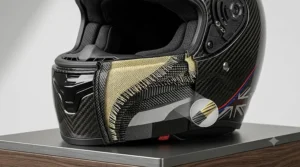
Scorpion Exo is a French company — based in Strasbourg — and they’ve built the EXO-R1 series around genuine racing DNA rather than the aspirational kind. The Evo Carbon uses what Scorpion calls a TCT-U 3K carbon composite weave: a resin-infused 3K carbon fibre construction that delivers aircraft-grade impact dispersal properties without the weight penalty of a conventional fibre shell.
The standout feature for UK riders is the Airfit pump system in the cheek pads — an inflation mechanism that lets you dial in a personalised, secure fit. It’s the kind of innovation that Scorpion pioneered and which other brands have since borrowed. This matters rather more on British roads than the spec sheet implies: a slightly loose helmet generates wind noise that at motorway speeds is genuinely fatiguing. The Airfit system solves that particular problem neatly.
The Pinlock Max Vision anti-fog insert is included as standard, which is non-negotiable for UK riding between September and April. Fog on the visor at 70mph on the M6 isn’t just uncomfortable; it’s actively dangerous.
UK buyers on Amazon.co.uk and Sportsbikeshop consistently mention the excellent peripheral vision and the quality of the tinted visor included in the box. A few note some wind buffeting at motorway speeds — not unusual for a racing-focused shell, and generally addressed by a neck gaiter.
✅ TCT-U 3K carbon shell — lighter and stronger than fibreglass
✅ Airfit customisable fit system
✅ Pinlock Max Vision included
❌ Ventilation can disappoint on very hot days
❌ Some wind noise at high motorway speeds
Best for: Riders who do mixed track days and road riding, or anyone upgrading from a heavy polycarbonate lid who wants genuine carbon construction without a four-figure price tag. Priced in the £250–£380 range.
3. Shark Spartan RS Carbon — The Smart Entry Point
Shark is a French brand with serious racing credentials and a refreshingly pragmatic approach to pricing. The Spartan RS Carbon combines a fibreglass and carbon fibre composite shell with multi-density EPS — a construction that achieves good impact absorption while keeping the overall weight to around 1,380 grams.
The Spartan RS Carbon includes an integrated UV380 sun visor with anti-fog treatment and a Pinlock 120 Max Vision insert as standard — both features that justify the asking price on a drizzly November morning in Manchester. The optical Class 1 main visor is anti-scratch and anti-fog treated, which, in this climate, qualifies as essential rather than optional.
The honest limitation: the shell construction uses fibreglass alongside carbon, rather than pure carbon or carbon-aramid. That means the weight sits a step above the AGV K6 S or the Scorpion’s pure carbon shell. What you gain is a meaningfully lower purchase price and a helmet that still feels considerably lighter than most polycarbonate alternatives.
UK riders consistently highlight value for money and the emergency release system — cheek pads that pull out quickly in an accident scenario, a safety feature you hope to never need but absolutely want to be there.
✅ Integrated sun visor — excellent for low UK winter light
✅ Pinlock 120 Max Vision included
✅ Strong value at £220–£320
❌ Heavier than pure carbon alternatives
❌ Interior padding less plush than premium rivals
Best for: First-time composite helmet buyers, commuters, and anyone who wants the carbon-fibre look and improved weight without committing to top-tier prices.
4. HJC RPHA 11 — South Korean Engineering, Surprisingly Premium Results
HJC is the world’s largest helmet manufacturer by volume, which sometimes leads people to assume they make compromised products. The RPHA 11 corrects that assumption fairly efficiently. Built on a multi-layer composite shell — carbon, glass fibre, aramid, and organic fibre layers working in combination — it brings proper lightweight performance to the mid-range price bracket.
The RPHA 11 weighs around 1,300 grams and carries ECE 22.06 certification. The wide visor aperture gives excellent vision on the move, and the quick-change visor mechanism makes swapping to tinted glass on the rare occasions British weather obliges genuinely painless.
What particularly stands out for UK riders is the emergency cheek pad release — a feature Scorpion and AGV reserve for their more expensive models, but which HJC includes here. The interior is removable and washable, which matters for anyone commuting year-round through British drizzle. The liner doesn’t just feel nice when new; it stays manageable after months of damp.
The RPHA 11 sits at a useful intersection: genuinely lighter than polycarbonate, properly certified, and priced where the upgrade from an entry-level helmet feels justifiable rather than extravagant.
✅ Multi-material composite shell with genuine carbon reinforcement
✅ Emergency cheek pad release system
✅ Removable/washable interior — important for year-round UK use
❌ No integrated sun visor
❌ Aerodynamics tuned for sport riding — can be noisy on upright tourers
Best for: Spirited road riders and occasional trackday participants who want sport-helmet feel without crossing into premium pricing. Around £250–£380.
5. LS2 FF811 Vector II Carbon — Six Shell Sizes and a Sun Visor. At This Price.
LS2 is a Spanish brand that has built a loyal following in the UK by delivering features you’d normally associate with helmets costing considerably more. The FF811 Vector II Carbon is their argument that a full carbon shell, integrated sun visor, and six outer shell sizes (meaning a more precise fit for more head shapes) shouldn’t require a second mortgage.
The combination of a full carbon construction and six outer shell sizes in a helmet at this price point is exceptional — those two features together are typically only found on high-end helmets. Six shell sizes matter because a helmet that fits your head precisely isn’t just more comfortable; it moves less in a crash, meaning the energy-absorbing EPS liner does its job more effectively.
The Vector II Carbon comes in at approximately 1,300 grams and includes a Pinlock 120 Max Vision insert as standard, along with a retractable integrated sun visor — particularly useful for UK riders contending with the peculiarly blinding quality of winter sun reflected off wet tarmac.
SHARP independently tested the LS2 Vector 2 (fibreglass version), confirming it as a credible performer in safety testing. Always verify the exact carbon variant’s rating on the SHARP website before purchasing, as shell material variants are sometimes tested separately.
✅ Full carbon shell with six outer shell sizes
✅ Integrated sun visor — genuinely useful in UK conditions
✅ Excellent price-to-feature ratio — £270–£370
❌ Noise isolation slightly below class leaders
❌ Interior materials less premium-feeling than HJC or Shark rivals
Best for: Value-conscious riders who want genuine carbon construction, a sun visor, and a precise fit without agonising over the purchase.
6. Shoei NXR2 — The Quiet Professional
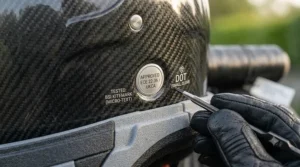
The Shoei NXR2 is built around Shoei’s proprietary AIM+ multi-composite shell — a blend of fibreglass, organic fibres, and resin that doesn’t use carbon fibre in the conventional sense but achieves a shell weight of approximately 1,450 grams while offering exceptional rigidity and consistency. It’s heavier than the pure carbon alternatives above, but what Shoei trade in weight, they recoup in refinement.
The NXR2 is available in seven sizes from XS to XXXL and carries a SHARP-tested RRP position at the premium end of the road helmet market, with independent safety ratings validating its construction quality. For UK riders doing regular motorway miles, the practical difference lies in noise: the NXR2 is notably quiet for a full-face sport lid. Long runs up the M6 towards Scotland are measurably less exhausting wearing this helmet compared to many rivals.
The CNS-3 visor system is genuinely easy to operate on the road — an underrated feature when you’re trying to swap to tinted glass at a service station with one glove on. Shoei’s integration with Sena SRL intercom systems is among the cleanest available, keeping aerodynamic profiles intact.
UK buyers regularly flag the build quality and interior comfort as class-leading. It’s a helmet that feels expensive in the right way — not ostentatious, just meticulously assembled.
✅ Premium AIM+ composite shell — exceptional build quality
✅ Very quiet at motorway speeds
✅ Excellent Sena intercom integration
❌ Heavier than carbon-fibre alternatives
❌ Premium pricing — £400–£500 — puts it firmly in the “considered purchase” category
Best for: High-mileage tourers and motorway commuters who prioritise refinement and quiet over outright weight savings.
7. Shark Spartan GT Pro Carbon — When You Want the Best of Both Worlds
The Shark Spartan GT Pro Carbon is the helmet you buy when budget isn’t the first question you ask, but you still want something you can actually live with daily rather than merely admire. It sits at the premium end of this guide’s range — £450–£620 — and largely justifies the position.
The Spartan GT Pro Carbon earned strong praise from Bennetts BikeSocial’s detailed test review for its deeply padded cheek pads, full neck skirt, and plush interior padding — a genuinely comfortable helmet for extended daily wear. The emergency pull cord removal system is clearly labelled and fast — a reassuring detail that cheaper helmets sometimes skip.
The carbon and fibreglass composite shell balances weight with impact compliance. The integrated sun visor is well-positioned and easy to operate with gloves on — a small thing that makes a daily difference when you’re navigating the morning rush into central London and the sun appears without warning through a gap in the cloud.
Riders transitioning from the standard Spartan GT will notice the improved interior quality immediately. The padding is plush without feeling cloying, and it stays that way across long days in the saddle.
✅ Premium interior quality — plush, comfortable over full riding days
✅ Well-designed integrated sun visor
✅ Emergency removal system clearly labelled
❌ Significant premium over the Spartan RS Carbon for incremental gains
❌ Shell opening can be tight for larger head shapes on first fit
Best for: Sport-touring riders who cover serious annual mileage and want to invest once in a helmet that rewards daily use.
How to Choose a Carbon Composite Motorcycle Helmet in the UK: 5 Essential Steps
1. Confirm ECE 22.06 certification — non-negotiable. From January 2024, helmet manufacturers can only obtain approval for new designs that comply with UN ECE R22-06, which is the legal requirement for motorcycle helmets in the UK. This standard involves more demanding tests than its predecessor, better reflecting real-world crash scenarios. Any carbon composite helmet you consider in 2026 should carry this marking visibly inside the shell.
2. Cross-reference with the SHARP database. ECE 22.06 sets a floor; SHARP tests above it. The SHARP programme recommends choosing a helmet marked ECE R22-06 to benefit from higher safety standards — and their independent testing goes further still, using higher impact velocities than the regulation requires. A helmet can pass ECE 22.06 and still score two stars on SHARP. Know the difference.
3. Understand what “carbon composite” actually means. Not all carbon helmets are created equal. A full 3K carbon fibre shell (Scorpion EXO-R1 Evo Carbon) behaves differently from a carbon-aramid blend (AGV K6 S) or a fibreglass-carbon hybrid (Shark Spartan RS Carbon). For UK conditions — where the impacts you’re statistically most likely to experience involve oblique forces on wet roads — a carbon-aramid or fibreglass-carbon blend often provides better real-world performance than pure carbon alone, which can be brittle under certain impact geometries. See Wikipedia’s overview of carbon fibre reinforced polymers for a useful primer on material properties.
4. Try it on — even if you’re buying online. Head shape varies enormously, and carbon helmets (especially multi-shell-size designs like the LS2 FF811 Vector II Carbon) reward careful fitting. A helmet that moves on your head in a crash absorbs less energy effectively.
5. Budget for UK-specific accessories. A Pinlock anti-fog insert isn’t optional in this climate. Neither is a quality tinted visor or a neck gaiter. Factor these into the total cost.
Carbon Composite Helmets in British Conditions: What the Spec Sheet Won’t Tell You
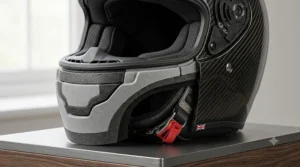
The spec sheet will tell you that the AGV K6 S weighs 1,255 grams. It won’t tell you that this weight reduction becomes significant somewhere around hour two of a run up the M1 in November, when the rain is coming sideways and every gram saved is a gram of neck fatigue avoided.
Here are the real-world nuances that matter for UK riders specifically:
Visor fogging is your enemy — and it’s almost always manageable. Every helmet on this list is either Pinlock-ready or ships with a Pinlock insert. Use it. Britain’s temperature differentials — warm body heat meeting cold, wet autumn air — make visor fog a genuine safety issue rather than a mild annoyance. The Pinlock Max Vision inserts on the Scorpion, Shark, and LS2 models are particularly effective.
Weight savings matter differently at UK speeds. On a Spanish autopista at 120km/h, aerodynamic forces dominate. On the A-roads and 60mph rural routes that make up the majority of UK recreational riding, neck fatigue from helmet weight is a much bigger factor. The AGV K6 S genuinely earns its price premium here.
Low winter sun is a real hazard. It gets overlooked in helmet reviews that originate from sunnier climates. The UK winter sun sits low and hard, and it reflects off wet tarmac with particular malice. Helmets with quality integrated sun visors — the LS2 FF811 Vector II Carbon, Shark Spartan RS Carbon, and Shark Spartan GT Pro Carbon — earn genuine extra marks for this.
Post-Brexit note on EU products: Several helmets in this guide are manufactured in Europe. UK prices include 20% VAT, and while import adjustments from post-Brexit trading arrangements have been largely absorbed by the major manufacturers, it’s worth buying from UK-stock retailers (Amazon.co.uk, Sportsbikeshop, Helmet City, Infinity Motorcycles) to ensure UK warranty terms and straightforward returns under the Consumer Rights Act 2015.
Common Mistakes When Buying a Carbon Composite Helmet in the UK
Assuming carbon automatically means safer. It doesn’t. The SHARP programme has repeatedly demonstrated that helmet price — and by extension, shell material — is not proportionate to the level of protection provided. A well-designed fibreglass helmet can and does outscore a carbon-shelled rival on SHARP testing. Check the ratings; don’t buy the material.
Buying to a US or international spec. Several popular carbon helmets reviewed on American websites aren’t stocked on Amazon.co.uk, or arrive with DOT-only certification rather than ECE 22.06. DOT certification doesn’t meet UK legal requirements. Verify before purchasing from any grey-market source.
Ignoring head shape. This is the biggest practical mistake UK buyers make when shopping online. Carbon helmet shells are often manufactured in fewer sizes than polycarbonate equivalents to keep weight down. If a helmet doesn’t fit correctly, it cannot perform as designed in a crash.
Overlooking the internal sun visor question. The AGV K6 S is remarkable, but it has no internal sun visor. For many UK riders — especially those commuting year-round through seasons of variable light — that’s a genuine daily inconvenience. The LS2 FF811 Vector II Carbon costs considerably less and includes both the sun visor and a Pinlock insert as standard.
Neglecting maintenance in the UK climate. Carbon and aramid shells don’t rust, but the retention systems, visor mechanisms, and interior liners need care in persistently damp conditions. Rinse visors with clean water rather than solvents; wash liners per the manufacturer’s instructions; and store helmets away from direct moisture when not in use.
Real-World Scenarios: Which Carbon Composite Helmet Is Right for You?
The London daily commuter — Zone 2, mixed traffic, one or two motorway stints per week. You need a helmet that’s light enough to reduce fatigue through stop-start riding, fog-resistant for winter mornings, and genuinely comfortable for 45-minute journeys in gear. The Scorpion EXO-R1 Evo Carbon fits well: the Airfit pump system keeps it quiet in traffic, the Pinlock insert handles London’s peculiar cold-and-damp combination, and the weight is low enough to matter. Budget: around £250–£380.
The weekend tourer in the north of England — Peak District, Yorkshire Dales, Lake District. Variable weather, longer days in the saddle, significant elevation changes. The integrated sun visor is genuinely useful here (low light through Dales valleys in autumn is something else). The Shark Spartan GT Pro Carbon rewards extended riding comfort, and its plush interior remains bearable across a full day. The LS2 FF811 Vector II Carbon offers 80% of that experience at roughly half the price, which is a perfectly valid alternative.
The occasional trackday participant — novice/intermediate group, mostly road riding, one or two track days per year. The HJC RPHA 11 occupies the best position: it’s light enough to feel purposeful on track, certified properly for UK roads, and priced so the inevitable road-use wear doesn’t feel like desecrating an investment.
The budget-conscious upgrade rider — moving from polycarbonate to composite for the first time. The Shark Spartan RS Carbon at £220–£320 is the obvious recommendation: it delivers the composite shell weight reduction, the integrated sun visor, and ECE 22.06 certification without asking you to justify the purchase to yourself for three months.
✨ Check Prices on Amazon.co.uk
🔍 Ready to upgrade your lid? Click on any highlighted helmet above to check current pricing and availability on Amazon.co.uk. Prime-eligible models get next-day delivery — perfect if your current helmet is overdue for retirement.
Long-Term Value and Maintenance: The True Cost of Carbon in the UK
Carbon composite helmets carry a genuine price premium — sometimes significant — over polycarbonate alternatives at the same safety rating. So does the maths actually work out?
For riders covering 5,000–10,000 miles per year (a reasonable UK average), the fatigue reduction from a lighter helmet translates to meaningful riding comfort across the life of the product. Most quality carbon composite shells carry a manufacturer lifespan recommendation of five years from manufacture (not purchase date — check the date stamp inside the shell). At £300–£450 for a quality carbon-aramid helmet, amortised over five years, the daily cost is negligible.
Replacement parts are generally available on Amazon.co.uk for all brands in this guide: visors, Pinlock inserts, cheek pads, and chin curtains are routinely stocked. AGV and Shoei replacement visors tend to be slightly more expensive; LS2 and HJC are notably more affordable.
One maintenance point specific to UK conditions: visor mechanisms that are routinely exposed to road spray and motorway grime need periodic cleaning and lubrication. A small amount of silicone spray on pivot points every few months prevents the stiffness that develops when grit infiltrates the mechanism — a minor issue that becomes a major annoyance when you’re trying to crack the visor at a roundabout in the rain.
FAQ: Carbon Composite Helmets in the UK
❓ Is a carbon composite helmet legal on UK roads?
❓ What is the difference between carbon composite and full carbon fibre helmets?
❓ Do SHARP ratings apply to carbon composite helmets specifically?
❓ Are carbon composite helmets worth the extra cost over polycarbonate for UK commuters?
❓ Can I buy carbon composite helmets on Amazon.co.uk with Prime delivery?
Conclusion: The Right Carbon Composite Helmet for UK Roads
The British motorcycling market in 2026 has never had better access to genuine composite helmet technology at sensible prices. The days when a carbon composite helmet cost £600 and above are largely behind us — the Shark Spartan RS Carbon and LS2 FF811 Vector II Carbon prove that definitively.
The question isn’t really “should I buy a carbon composite helmet?” It’s “which one matches my actual riding and my actual budget?” For most UK riders, the Scorpion EXO-R1 Evo Carbon or Shark Spartan RS Carbon represent the sweet spot: proper carbon construction, ECE 22.06 certification, and pricing that doesn’t require a difficult conversation with your bank. For those who cover serious miles and feel it in their neck, the AGV K6 S remains the weight benchmark that everything else is measured against.
Whatever you choose, verify the ECE 22.06 marking, cross-reference on the SHARP database, and try the fit before you commit to a purchase. A helmet that fits you well will always outperform a helmet that doesn’t — regardless of what its shell is made of.
✨ Ready to Find Your Perfect Lid?
🔍 Check current pricing and availability on all seven helmets above at Amazon.co.uk. Free delivery on orders over £25, with Prime next-day delivery available on eligible models.
Recommended for You
- Best Arai Carbon Helmet UK 2026: 7 Top Picks Reviewed
- Best Full Carbon Helmet UK 2026: 7 ACU Gold Picks Tested & Ranked
- Carbon Fibre vs Fibreglass Helmet: 7 Best UK Picks for 2026
Disclaimer: This article contains affiliate links. As an Amazon Associate, I earn from qualifying purchases. If you purchase products through these links, we may earn a small commission at no additional cost to you.
✨ Found this helpful? Share it with your mates! 💬🤗
