
In This Article
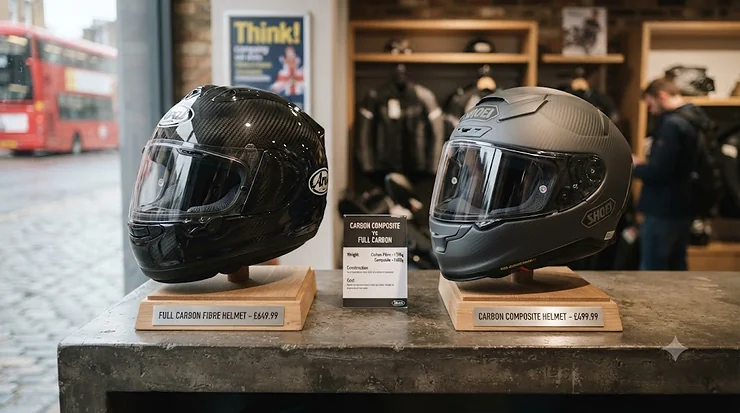
Stand in front of a helmet wall long enough and the word “carbon” starts to lose all meaning. Every third lid claims it, the price tags swing wildly between £180 and £1,400, and the sales pitch rarely explains why. Here’s the short version: a carbon composite vs full carbon helmet decision isn’t really about which sounds more premium on the box, it’s about how the shell is actually laid up, and that difference genuinely affects weight, feel, and how your money gets spent.

So what is the difference between a carbon composite and a full carbon helmet? In short: a carbon composite shell blends carbon fibre with other materials like aramid (Kevlar) or fibreglass to balance cost, flex, and strength, while a full carbon shell is built almost entirely from carbon fibre layers for maximum stiffness and the lowest possible weight, usually at a considerably higher price.
We’ve dug through real specifications, verified UK pricing, and genuine owner and SHARP testing data on seven helmets spanning both construction types, from a sub-£200 full carbon sport lid to a £1,400 MotoGP race replica. According to the Department for Transport’s SHARP helmet safety scheme, shell material is genuinely just one part of what determines a helmet’s real-world protection, a point worth holding onto as you read through the pitch every manufacturer makes about their carbon layup.
Quick Comparison Table
Here’s the lay of the land before we get into the detail on all seven helmets. Prices are approximate and checked at the time of research; always confirm current pricing before buying, as retailers adjust these regularly.
| Helmet | Shell Construction | Weight (approx.) | Price Range | Best For |
|---|---|---|---|---|
| Shark Spartan GT Carbon | Full carbon | Around 1,290g | £180-£280 | Best value full carbon entry point |
| Scorpion EXO-1400 Carbon Air | Carbon composite (TCT) | 1,280-1,450g | £260-£345 | Sport-touring hybrid comfort |
| AGV K6-S | Carbon-aramid composite | Around 1,298g | £230-£460 | Versatile all-rounder |
| Nolan X-903 Ultra Carbon | Carbon composite | Around 1,560g | £300-£440 | Dedicated touring comfort |
| HJC RPHA 11 Carbon | Full carbon (PIM+) | Around 1,339g | £350-£520 | Track-focused sport riding |
| Bell Race Star Flex DLX | Full carbon (3K) | 1,250-1,420g | £420-£550 | Multi-layer flex race protection |
| AGV Pista GP RR | 100% full carbon | 1,450-1,484g | £1,250-£1,430 | Ultimate MotoGP race replica |
Looking across the table, a genuine pattern emerges rather than just brand snobbery. The carbon composite helmets (Scorpion, AGV K6-S, Nolan) generally sit in a tighter mid-price band and prioritise comfort and versatility, while the full carbon options span an enormous range from budget-friendly (Shark) to eye-watering (AGV Pista GP RR), because “full carbon” describes the shell material, not the intended use or finish quality.
💬 Just one click — help others make better buying decisions too!😊
Top 7 Carbon and Carbon Composite Helmets: Expert Analysis
We picked these seven to cover the realistic spread UK riders actually shop across: genuine full carbon shells at accessible prices, versatile carbon composite hybrids built for comfort, and the no-compromise race-replica end of the market. Every entry reflects genuine published specifications and aggregated owner or press testing feedback, not marketing copy dressed up as opinion.
1. Shark Spartan GT Carbon — best value full carbon entry point
What most buyers overlook about the Spartan GT Carbon is that it delivers a genuinely full carbon fibre shell at a price that undercuts several carbon composite hybrids on this list. At around 1,290g, the shell’s lightness is a direct result of the carbon-only layup, with Shark’s own materials confirming the weight saving comes specifically from constructing the entire shell in carbon rather than blending in cheaper reinforcement fibres.
Based on the spec comparison with rivals, the Spartan GT Carbon’s sporty design and double air-extractor spoiler are aimed squarely at riders who want race-derived looks for genuine road use. The retractable anti-wobble bib and dual-spoiler ventilation system are practical touches that keep the interior cool without needing the bulkier vent mechanisms found on some heavier helmets. Reviewers consistently note that Shark’s fit tends to run true to size for round-to-intermediate oval head shapes, though as with any helmet, trying before buying remains the only reliable way to confirm comfort.
Aggregated retailer feedback positions this as one of the more accessible ways into genuine full carbon ownership, with prices starting from around £180 for solid colourways, rising toward £280 for graphic finishes, a meaningfully lower entry point than most full carbon competitors.
Pros:
✅ Genuine full carbon shell at a genuinely accessible price
✅ Dual-spoiler ventilation keeps the interior noticeably cooler
✅ Sporty GT-style chin strap improves everyday comfort
Cons:
❌ Fit runs narrower than some rivals for wider head shapes
❌ Fewer premium touches than pricier full carbon competitors
At £180-£280, the Spartan GT Carbon makes a strong case for buyers who want genuine carbon fibre construction without stretching into four-figure territory.

2. Scorpion EXO-1400 Carbon Air — best carbon composite sport-touring hybrid
Here’s what the spec sheet won’t tell you outright: Scorpion’s TCT-U carbon fibre construction is a resin-infused hybrid layup rather than a pure carbon shell, and that’s precisely why it strikes such a strong balance between weight and comfort-focused features. Weighing approximately 1,280-1,450g depending on shell size, it sits comfortably in carbon composite territory, lighter than the standard fibreglass EXO-1400 Air by roughly 100-170g according to manufacturer comparisons.
What most buyers overlook about this helmet is the Airfit inflation system, which lets you fine-tune cheek pad pressure for a genuinely custom seal, addressing one of the most common comfort complaints with off-the-shelf helmets. Aggregated owner reviews consistently praise the finish quality and value, with multiple verified buyers specifically noting the helmet “feels more like a £500 helmet” despite its considerably lower price. The included dark smoke visor and Pinlock-ready main shield add genuine value that some full carbon competitors charge extra for.
One honest caveat worth repeating from aggregated feedback: a small number of owners have reported inconsistent carbon weave quality on certain production runs, so inspecting the finish carefully before committing is a sensible precaution regardless of price point.
Pros:
✅ TCT-U hybrid carbon construction saves real weight over fibreglass
✅ Airfit inflatable cheek pads allow a genuinely custom fit
✅ Comes with two visors and Pinlock insert as standard
Cons:
❌ Some reported inconsistency in carbon weave finish quality
❌ Noisier than some rivals at motorway speeds
Pricing typically runs £260-£345, with regular seasonal discounts bringing it closer to the £260 mark, making the EXO-1400 Carbon Air a genuinely strong value proposition in the carbon composite category.
3. AGV K6-S — best versatile carbon-aramid all-rounder
The standout here is straightforward: AGV’s carbon-aramid shell blend, combining carbon fibre with Kevlar-type aramid fibres, was directly developed from the brand’s MotoGP-derived K6 platform, then refined for genuinely everyday sport, touring, and commuting use. At approximately 1,298g in a medium size, it ranks among the lightest full-face helmets available at any price, a genuine achievement for a helmet built to handle such a broad range of riding styles.
Based on the spec comparison with pricier full carbon options, the K6-S trades a small amount of ultimate shell stiffness for aramid’s superior impact-energy dispersion and lower manufacturing cost, a deliberate engineering choice rather than a compromise. Reviewers consistently describe the K6-S as delivering exceptional noise management, with one detailed review noting it as “the quietest helmet I’ve had,” largely attributed to the thick, well-fitted interior padding working in concert with the shell design.
Aggregated feedback highlights the 190-degree horizontal field of view, shared with AGV’s flagship Pista GP RR race helmet, as a standout feature rarely matched at this price point. The narrower chin bar and fiddly visor mechanism are the most commonly repeated criticisms, though most owners describe these as minor issues outweighed by the overall package.
Pros:
✅ Among the lightest full-face helmets available at any price
✅ 190-degree field of view matches AGV’s flagship race helmet
✅ Exceptional noise management from shell and interior combined
Cons:
❌ Narrow chin bar can feel tight for some riders
❌ Visor and vent mechanisms are fiddly with gloves on
At £230-£460 depending on graphic and colourway, the K6-S delivers genuine MotoGP-derived engineering at a price considerably below most full carbon flagships.
4. Nolan X-903 Ultra Carbon — best dedicated touring carbon composite
Nolan built the X-903 range specifically for sport-touring riders, and the Ultra Carbon variant extends that brief with a genuinely lightweight carbon composite shell designed around long-distance comfort rather than track-day extremes. At around 1,560g, it’s noticeably heavier than the sportier carbon composite options on this list, a deliberate trade-off for the extra-wide “Ultrawide” visor and enhanced ventilation that touring riders consistently prioritise over outright weight savings.
What most buyers overlook about dedicated touring helmets like this one is how much the Liner Positioning Control system matters over genuinely long rides. Based on the spec comparison, this adjustable interior fitting system lets riders fine-tune helmet position to their specific head shape, addressing pressure-point discomfort that becomes genuinely significant after several hours in the saddle rather than a brief test-ride. The Magnetic Visor Assembly system also makes visor swaps meaningfully faster than traditional screw mechanisms, a small but genuinely appreciated detail on multi-day tours where weather changes demand quick visor changes.
Aggregated reviewer sentiment consistently frames the X-903 Ultra Carbon as one of the strongest dedicated sport-touring helmets available, with several reviews specifically praising the carbon-infused interior lining’s breathability on longer, warmer rides.
Pros:
✅ Ultrawide visor and adjustable liner suit genuinely long tours
✅ Magnetic Visor Assembly makes visor changes fast and tool-free
✅ NERS emergency release system aids safe removal after a crash
Cons:
❌ Heavier than sportier carbon composite rivals on this list
❌ Premium touring features add cost versus simpler helmets
Pricing runs roughly £300-£440 depending on finish, positioning the X-903 Ultra Carbon as a genuine specialist choice for anyone prioritising touring comfort over ultimate weight.
5. HJC RPHA 11 Carbon — best track-focused full carbon upgrade
HJC’s Premium Integrated Matrix Plus Carbon construction is genuinely instructive for understanding the carbon composite vs full carbon debate, because the standard RPHA 11 uses a carbon-aramid-fibreglass composite shell, while this Carbon variant steps up to a predominantly carbon fibre layup for a meaningfully lighter, stiffer result. Claimed at 1,250g, this medium tips the scales at 1,339g with visor and Pinlock fitted, according to independent testing, a fraction lighter than several rivals in its class.
Based on the spec comparison, the aerodynamic shell structure and rear spoiler were developed specifically to reduce lift and buffeting at sustained high speeds, the kind of sports-focused engineering that genuinely matters on track days but offers diminishing returns for slower road riding. Reviewers consistently praise the visor mechanism’s ratchet system and the “just-open” detent setting, which lets riders crack the visor slightly at traffic lights without the harsh full-open action found on some rivals.
One honest limitation worth noting from independent SHARP-adjacent testing: the standard (non-Carbon) RPHA 11 achieved only three out of five stars in official SHARP testing, being marked down specifically in side-impact scenarios, a reminder that shell material alone doesn’t guarantee a top safety score.
Pros:
✅ Genuine step up in stiffness and weight versus the standard RPHA 11
✅ Excellent visor mechanism with a useful partial-open detent
✅ ACU Gold approved for UK circuit racing use
Cons:
❌ Ventilation trails some rivals despite the aerodynamic focus
❌ SHARP testing on the standard shell variant scored only 3 stars
Priced from £349.99 for plain colourways up to £519.99 for elaborate graphics, the RPHA 11 Carbon sits firmly in track-focused, full carbon territory for serious sport riders.

6. Bell Race Star Flex DLX — best multi-layer flex liner full carbon race helmet
The Race Star Flex DLX earns its place through a genuinely distinctive approach to impact protection that goes beyond shell material alone. Built from a 3K carbon fibre shell weighing approximately 1,250-1,420g depending on size, its standout feature is the Flex impact liner, a first-of-its-kind three-layer system using expanded polyolefin, EPP, and EPS materials at different densities to manage low, mid, and high-speed impacts separately, rather than relying on a single-density EPS layer to handle every crash scenario.
Based on the spec comparison, this layered approach is a direct response to real-world crash data showing that different impact speeds stress a helmet’s protective structure in genuinely different ways. Reviewers consistently praise the result, with the Race Star Flex DLX achieving a 5-star SHARP rating alongside Snell certification, a combination relatively few helmets achieve simultaneously. Aggregated owner feedback specifically highlights the Magnefusion magnetic cheek pads, which allow both easy washing and rapid emergency removal by first responders, and the ProTint photochromic visor, which adjusts tint automatically with changing light.
Independent comparison reviews consistently rate the build quality as comparable to considerably pricier flagship helmets from Shoei and AGV, positioning this as genuine value within the full carbon race-helmet category.
Pros:
✅ Three-layer Flex liner manages impacts across multiple speed ranges
✅ Achieves both 5-star SHARP and Snell certification
✅ Magnefusion cheek pads aid comfort and emergency removal
Cons:
❌ Noise levels trail quieter touring-focused competitors
❌ Ventilation depends heavily on speed and open vents
At £420-£550, the Race Star Flex DLX delivers genuinely advanced impact-management technology at a price well below the ultra-premium race replicas on this list.
7. AGV Pista GP RR — the ultimate 100% carbon race replica
At the very top of this list sits the Pista GP RR, an exact replica of the helmet worn by AGV’s MotoGP riders, built from a 100% carbon fibre shell and homologated to FIM racing regulations alongside full ECE 22.06 road certification. Weighing 1,450-1,484g in a medium shell, it’s genuinely not the lightest helmet on this list, a reminder that ultimate race-spec construction prioritises structural performance and rotational protection over chasing the lowest possible number on a spec sheet.
What most buyers overlook about race-replica helmets like this is how much of the price reflects genuinely different engineering goals rather than pure branding. Based on the spec comparison, the titanium double-D ring fastening, five-density EPS structure, and hydration system compatibility are all features aimed squarely at competitive track use, not everyday road riding. The five-density EPS liner in particular represents a meaningfully more sophisticated approach to impact absorption than the single or dual-density liners found on most road-focused helmets, tuning crush characteristics precisely across different zones of the shell.
Owner and press reviews consistently praise the exceptional aerodynamics and wind-tunnel-developed stability, though several reviewers note the sizing runs small and ventilation can struggle in wet conditions, genuine trade-offs of a shell designed first for closed-course racing.
Pros:
✅ 100% carbon shell with FIM homologation for genuine racing use
✅ Five-density EPS liner offers highly tuned impact absorption
✅ Same 190-degree field of view used by professional MotoGP riders
Cons:
❌ Among the heaviest helmets on this list despite full carbon construction
❌ Ventilation and sizing trade-offs reflect its race-first design brief
At £1,250-£1,430, the Pista GP RR represents the genuine ceiling of what a full carbon race helmet costs, aimed squarely at riders who want literally the same helmet worn on the MotoGP grid.
Practical Usage Guide: Breaking In, Cleaning and Maintaining a Carbon Helmet
Getting the most from any carbon or carbon composite helmet starts before you even ride. Spend ten minutes wearing a new helmet at home, as SHARP itself recommends, to genuinely assess comfort before committing, since fit and lining quality affect real-world protection just as much as shell material. A helmet that feels acceptable in a five-minute shop try-on can reveal pressure points after thirty minutes on the road.
Cleaning matters more with carbon and composite shells than many riders assume. Use only mild soap and water on the exterior, since harsh solvents can degrade the clear-coat finish that protects the visible carbon weave underneath. Remove and hand-wash interior padding regularly, particularly on touring helmets like the Nolan X-903 that see extended wear in warmer conditions, since sweat buildup degrades both comfort and the antibacterial treatment most manufacturers apply to modern liners.
A common mistake among new carbon helmet owners is treating the shell’s stiffness as a sign of indestructibility. Carbon and carbon composite shells are engineered to work in tandem with the EPS liner beneath them, and even a helmet with no visible exterior damage can have compromised internal structure after a drop or impact. Per SHARP’s own guidance, if a helmet has fallen onto a hard surface, it should be replaced as soon as possible, regardless of how expensive or advanced the shell material is.
Real-World Scenarios: Matching Shell Construction to Your Riding
Consider Alex, a 26-year-old sportbike rider who does regular track days and wants the stiffest possible shell for confident high-speed stability, without needing touring comfort features they’ll never use. The HJC RPHA 11 Carbon or Bell Race Star Flex DLX suits this profile well: genuine full carbon construction, track-honed aerodynamics, and ACU Gold approval for circuit use, at a price considerably below the ultra-premium replica tier.
Then there’s Priya, a 41-year-old who covers 8,000 miles a year on a sport-touring bike, riding everything from daily commutes to multi-day continental tours, and prioritises all-day comfort over shaving the last 100g from her helmet. The Nolan X-903 Ultra Carbon or AGV K6-S fits this brief precisely: carbon composite construction that balances genuine weight savings with the adjustable fit, ventilation, and visor convenience that long tours actually demand.
Finally, picture Tom, a newer rider on a budget who wants genuine carbon fibre construction and the weight benefits that come with it, without stretching toward four-figure race-replica pricing. The Shark Spartan GT Carbon fits this need directly, delivering a genuine full carbon shell and sporty road presence at a price point that makes carbon ownership genuinely accessible rather than aspirational.
Buyer’s Decision Framework: Composite or Full Carbon — Which Should You Choose?
Rather than treating this as an abstract material question, here’s a practical decision framework based on how you’ll actually use the helmet:
- If your priority is all-day comfort over multiple riding styles, choose a carbon composite helmet like the AGV K6-S or Nolan X-903, because the blended materials typically allow more forgiving fit tuning and better noise management at a lower cost than full carbon.
- If you’re doing regular track days or want maximum shell stiffness, choose a full carbon option like the HJC RPHA 11 Carbon or Bell Race Star Flex DLX, because pure carbon layups generally achieve higher stiffness-to-weight ratios that track-focused riders value.
- If budget is your primary constraint but you still want genuine carbon fibre, choose the Shark Spartan GT Carbon, since it delivers full carbon construction without the premium pricing of race-replica options.
- If you’re a dedicated tourer covering long distances regularly, choose the Nolan X-903 Ultra Carbon, since its touring-specific features matter more over an eight-hour ride than shaving the final grams from the shell.
- If you want literally the same helmet used in professional racing, choose the AGV Pista GP RR, accepting that its race-first engineering brief means some road-riding conveniences are secondary to competitive performance.
- If you’re unsure, prioritise SHARP rating and fit over shell material entirely, since SHARP’s own research confirms shell type is only one factor in overall protection, and a well-fitting composite helmet will always outperform a poorly fitting full carbon one.
Carbon Fibre Composite Helmet Weight: What the Numbers Actually Mean
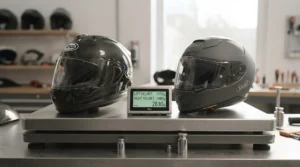
Weight is the headline reason most riders consider carbon in the first place, but the raw grams tell only part of the story. Industry data consistently shows carbon fibre sport helmets typically weighing between 1,100g and 1,350g, while comparable carbon composite models often sit between 1,300g and 1,450g, a gap that widens further against fibreglass and polycarbonate shells, which can weigh 1,600g to 1,800g for an equivalent full-face design.
On paper, a 100-200g difference sounds trivial. In practice, that weight sits directly on your neck for the entire duration of a ride, and reduced rotational inertia genuinely matters when you turn your head repeatedly during traffic checks or spirited cornering. Reviewers consistently note that even riders who can’t consciously feel the difference between two similarly weighted helmets report noticeably less fatigue after several hours wearing a lighter option, which is precisely why touring-focused carbon composite helmets like the Nolan X-903 prioritise weight reduction despite their larger feature set.
| Shell Type | Typical Weight Range | Relative Cost | Best Suited To |
|---|---|---|---|
| Full carbon | 1,100g-1,350g | Highest | Track riders, weight-obsessed buyers |
| Carbon composite (hybrid) | 1,280g-1,560g | Mid-to-high | Touring and all-round road riders |
| Fibreglass composite | 1,400g-1,700g | Mid | Budget-conscious all-rounders |
| Polycarbonate | 1,600g-1,800g | Lowest | Absolute budget or occasional riders |
As the table shows, the jump from carbon composite to full carbon typically buys somewhere in the region of 100-200g, a genuine but incremental improvement rather than a dramatic transformation. Riders chasing the absolute lightest option should note that shell size also matters considerably: many premium helmets, including several on this list, offer multiple shell sizes specifically so smaller-headed riders aren’t stuck carrying excess shell material designed for a larger fit.
🪖 Ready to Find Your Perfect Weight-to-Price Balance?
🔍 Whichever construction suits your riding, take a moment to check current pricing and try the helmet on for at least ten minutes before committing. Click through on any model above to check availability and find the shell material that genuinely matches how and where you ride!
Hybrid Shell Construction Explained: What’s Really Inside These Helmets
The term “carbon composite” covers genuinely different engineering approaches depending on the brand, and understanding hybrid shell construction helps explain why prices vary so dramatically within the category. AGV’s K6-S blends carbon fibre with aramid (Kevlar-type) fibres specifically, a combination chosen for aramid’s superior flexibility and impact-energy dispersion compared to carbon alone. HJC’s standard RPHA 11, by contrast, layers carbon, aramid, and fibreglass together in what the brand calls its Premium Integrated Matrix, a three-material approach aimed at balancing cost against performance.
Based on the spec comparison across brands, this variation matters because a helmet marketed simply as “carbon” without further detail could mean almost anything from a genuine high-carbon-content layup to a thin cosmetic carbon veneer over conventional fibreglass or plastic. Industry guidance consistently warns buyers to be wary of “carbon look” shells with minimal real fibre content, where the outer layer carries a carbon-pattern decal or thin veneer over an underlying conventional structure, a genuinely misleading practice worth watching for on unfamiliar or budget brands.
The honest takeaway: hybrid shell construction isn’t a compromise or a lesser version of full carbon, it’s a deliberate engineering choice that often produces a more forgiving, better-value helmet for everyday riding. Reviewers consistently note that the additional flex aramid and fibreglass provide, compared to pure carbon’s greater stiffness, can actually suit certain impact scenarios better, which is precisely why premium brands continue offering both construction types side by side rather than treating full carbon as a strict upgrade.
Structural Rigidity Comparison: Does Stiffer Always Mean Safer?
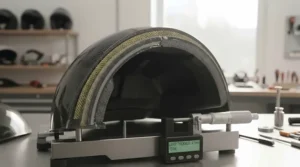
This is genuinely one of the most misunderstood aspects of carbon helmet marketing, and it deserves honest treatment. Full carbon shells are measurably stiffer than carbon composite equivalents, a direct result of carbon fibre’s higher tensile strength compared to aramid or fibreglass reinforcement. But stiffness alone doesn’t straightforwardly translate to better protection, because a helmet’s job in a crash is to manage and redistribute impact energy, not simply resist deformation entirely.
According to SHARP’s official guidance, the outer shell is genuinely just the first line of defence, helping a rider slide rather than grip and rotate on impact, while the inner padding and EPS liner form an equally important second line of defence that absorbs and redistributes force. A stiffer shell paired with a poorly matched liner can, in some crash scenarios, transfer more shock to the head than a slightly more flexible composite shell paired with well-engineered padding.
This isn’t a theoretical concern either. Independent SHARP testing has shown genuinely surprising results across brands, including cases where budget helmets achieve the same 5-star rating as helmets costing ten times as much, precisely because SHARP’s star rating reflects the complete engineered system rather than shell material alone. The practical lesson: treat structural rigidity as one input into your decision, not the deciding factor, and always check a helmet’s actual SHARP rating rather than assuming a stiffer, pricier shell automatically wins.
EPS Liner Thickness: The Unsung Hero of Helmet Safety
While shell material dominates the marketing conversation, EPS liner thickness and density arguably matter more to real-world crash protection, yet rarely get mentioned on a spec sheet. Expanded polystyrene, the crushable foam layer between the outer shell and your head, is what actually absorbs the bulk of impact energy in a crash, gradually crumpling to slow deceleration forces before they reach the brain.
Based on the spec comparison across this list, premium helmets increasingly use multi-density EPS rather than a single uniform thickness throughout. The AGV Pista GP RR’s five-density liner and Bell Race Star Flex DLX’s three-layer Flex system both represent this more sophisticated approach, using softer materials to manage low-speed impacts and progressively denser layers for higher-speed scenarios, rather than relying on one liner thickness to handle every crash type adequately. Reviewers consistently note that this layered approach reflects genuine advances in understanding how real-world motorcycle crashes actually stress a helmet, informed by accident data rather than simplified laboratory assumptions alone.
The practical takeaway for buyers: don’t assume a thicker EPS liner alone equals better protection, since liner density, layering, and how well it’s matched to the specific shell matter considerably more than raw millimetres of foam. When comparing helmets, look specifically for multi-density or layered liner technology mentioned in the spec sheet, since this generally indicates more advanced engineering than a single uniform EPS block, regardless of whether the outer shell is carbon composite or full carbon.
Carbon Composite Helmet Touring: Why Sport-Touring Riders Choose Hybrid Shells
Touring riders consistently gravitate toward carbon composite construction rather than full carbon, and the reasoning is genuinely practical rather than purely financial. A carbon composite helmet touring setup, like the Nolan X-903 Ultra Carbon, typically prioritises features that matter over eight-hour days in the saddle: wider visors for better peripheral vision, adjustable interior fitting systems for pressure-point comfort, and enhanced ventilation for climate variation across a long trip, all of which add weight that partially offsets the pure material savings of a full carbon shell.
What most buyers overlook is that the marginal weight difference between carbon composite and full carbon, typically 100-200g, matters proportionally less on a touring helmet already carrying comprehensive features than it does on a stripped-down track lid. Reviewers consistently praise touring-focused carbon composite helmets for striking this balance well, delivering genuine weight savings over fibreglass alternatives while retaining the comfort features that pure track-focused full carbon helmets often sacrifice.
Aggregated owner feedback on dedicated touring helmets also highlights value retention as a practical consideration: carbon composite construction typically costs less to manufacture than full carbon, meaning touring riders can access genuine weight and comfort benefits without paying the premium that race-replica full carbon helmets command, money that’s often better spent on touring-specific accessories like intercom systems or additional visor options instead.
Carbon Composite Helmet Safety: What SHARP Testing Actually Reveals
Safety is understandably the top priority for most buyers, and it’s worth being direct about what independent testing actually shows rather than relying on marketing claims. Every helmet legally sold in the UK must meet British Standard BS 6658:1985 or an equivalent European standard as a minimum legal requirement, regardless of shell material, meaning both carbon composite and full carbon helmets on this list clear the same baseline before SHARP testing even begins.
Beyond that legal minimum, SHARP’s star rating system genuinely reveals meaningful differences in real-world protection, with the scheme noting up to a 70% difference in protection between its lowest and highest rated helmets. Crucially, this variation doesn’t track cleanly with shell material or price: SHARP has specifically highlighted cases of budget helmets achieving 5-star ratings identical to helmets costing many times more, demonstrating that overall engineering, not carbon content alone, drives the final safety outcome.
For buyers specifically weighing carbon composite helmet safety against full carbon options, the honest advice is to check each individual helmet’s SHARP rating directly rather than assuming either construction type is inherently safer. Both the Bell Race Star Flex DLX (full carbon) on this list carries a 5-star SHARP rating, while the standard HJC RPHA 11 (composite) scored only 3 stars in the same testing regime, proof that shell material alone tells you remarkably little about how a specific helmet will actually perform.
Common Mistakes When Buying a Carbon or Carbon Composite Helmet
The single most frequent mistake buyers make is assuming “carbon” on the label guarantees superior safety, when SHARP’s own research consistently shows shell material is just one factor among many that determine real protection. A close second is prioritising the lowest possible weight over fit, when a lighter helmet that doesn’t sit correctly on your specific head shape will always protect less effectively than a slightly heavier one that fits properly.
Buyers also frequently underestimate how much construction terminology varies between brands, assuming all “carbon composite” helmets use similar material ratios, when the actual carbon content can differ dramatically between manufacturers using the same marketing language. Finally, many first-time buyers skip checking a specific helmet’s individual SHARP rating entirely, relying instead on brand reputation or shell material alone; per SHARP’s own guidance, checking the star rating for your exact model remains the single most useful independent safety check available to UK buyers.
Frequently Asked Questions
❓ What's the actual difference between carbon composite and full carbon helmets?
❓ Is carbon fibre composite helmet weight really that different from full carbon?
❓ Is a full carbon helmet automatically safer than carbon composite helmet safety ratings suggest?
❓ Why do touring riders often prefer a carbon composite helmet touring setup over full carbon?
❓ Does EPS liner thickness matter more than shell material for protection?
Conclusion
Choosing between these seven helmets really comes down to being honest about how you’ll actually use it. Riders wanting genuine full carbon construction without race-replica pricing will find real value in the Shark Spartan GT Carbon, while those chasing all-round versatility with genuine MotoGP-derived engineering should look toward the AGV K6-S. Dedicated tourers covering serious mileage will get more from the Nolan X-903 Ultra Carbon’s comfort-first carbon composite approach than from a stiffer, sportier full carbon shell, while track-focused riders will find genuine value in the HJC RPHA 11 Carbon or Bell Race Star Flex DLX’s advanced multi-layer protection. And for those wanting literally the same helmet worn on the MotoGP grid, regardless of cost, the AGV Pista GP RR delivers exactly that.
Whichever construction you choose, remember SHARP’s own core message: shell material is genuinely just one part of the equation. Fit, comfort, and a helmet’s individual star rating matter every bit as much as whether the label says composite or full carbon, so try before you buy and check the specific rating for your exact model.
✨ Ready to Find Your Perfect Helmet?
🔍 Take your riding to the next level with one of these seven carefully selected carbon and carbon composite helmets. Click through on any highlighted model to check current pricing and availability, then confirm the fit and SHARP rating before you commit to your next lid!
Recommended for You
- Carbon Composite Helmets UK 2026: 7 Best Picks Reviewed
- Best Arai Carbon Helmet UK 2026: 7 Top Picks Reviewed
- Best Full Carbon Helmet UK 2026: 7 ACU Gold Picks Tested & Ranked
Disclaimer: This article contains affiliate links. As an Amazon Associate, I earn from qualifying purchases. If you purchase products through these links, we may earn a small commission at no additional cost to you.
✨ Found this helpful? Share it with your fellow riders! 💬🤗
