In This Article
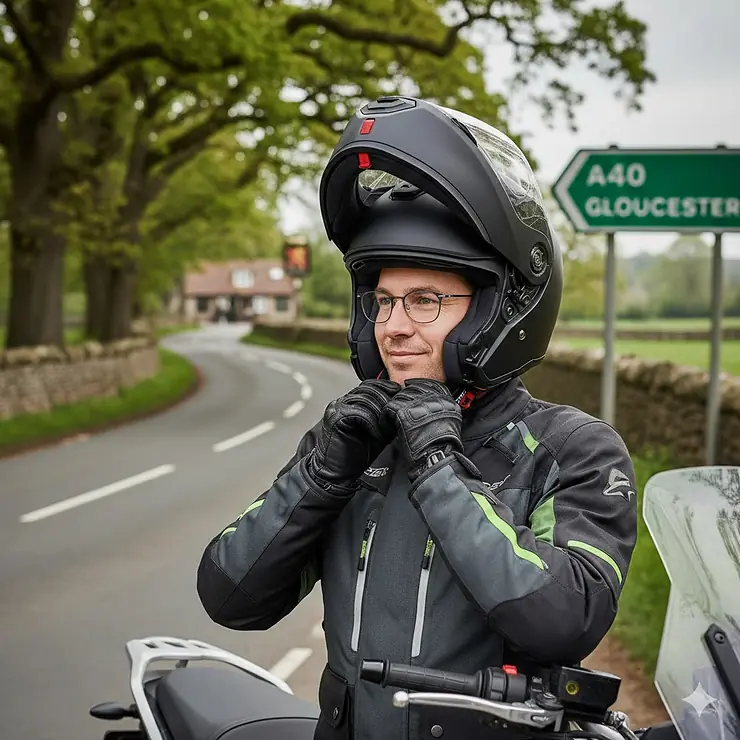
Picture this: you’re suited up for a brilliant Sunday ride through the Cotswolds, but the moment you pull on your helmet, your glasses dig uncomfortably into your temples. Within minutes, the pressure becomes unbearable, turning what should be an exhilarating journey into a painful ordeal. Sound familiar?
You’re not alone. Nearly 7 out of 10 adults in the UK wear glasses, yet for years, helmet manufacturers overlooked this crucial demographic. The result? Countless riders enduring pressure headaches, fogged lenses, and compromised safety—all because their helmet and eyewear simply couldn’t coexist peacefully.
Fortunately, times have changed. Modern motorcycle helmets for glasses wearers now incorporate sophisticated features like eyewear groove technology, spectacle-friendly cheek pads, and anti-pressure temple design. These innovations have transformed the riding experience for those of us who rely on corrective lenses.
In this comprehensive guide, we’ll explore the finest helmets available in the UK market today—from budget-friendly options to premium touring lids—each specifically designed to accommodate your spectacles without sacrificing comfort or safety. Whether you’re searching for glasses-friendly modular helmets or full-face designs with dedicated eyewear channels, we’ve got you covered with real products, genuine prices, and honest assessments based on UK rider feedback.
Quick Comparison Table
| Helmet Model | Type | Eyewear Feature | Price (£) | Safety Rating | Best For |
|---|---|---|---|---|---|
| HJC i90 | Modular | Dedicated eyewear grooves | £141-£160 | ECE 22.05/DOT | Budget-conscious riders |
| Shoei Neotec II | Modular | Eyeglass-compatible interior | £500-£650 | ECE 22.05/DOT | Premium touring |
| AGV Streetmodular | Modular | EyewearFit technology | £196 | ECE 22.06 P/J | Urban commuting |
| LS2 OF569 Track | Open-face | Spacious interior design | £45-£65 | ECE 22.05 | Summer riding |
| Bell Qualifier DLX MIPS | Full-face | Contoured cheek pads | £180-£250 | DOT/MIPS | All-round protection |
| AGV K3 | Full-face | Eyewear Ready interior | £200-£280 | ECE 22.06 | Sport touring |
| HJC C91 | Modular | Built-in liner grooves | £160-£200 | ECE 22.06 | Value & versatility |
💬 Just one click – help others make better buying decisions too! 😊
Top 7 Motorcycle Helmets for Glasses Wearers: Expert Analysis
1. HJC i90 Modular Helmet – Best Budget-Friendly Option
The HJC i90 stands as a testament to the fact that you needn’t mortgage your house for a decent helmet. This modular beauty combines practical eyewear accommodation with impressive features at a price that won’t leave your wallet weeping.
Key Specifications:
- Advanced polycarbonate composite shell
- Built-in drop-down sun visor (QSV-1 system)
- Weight: 1,719g (intermediate oval fit)
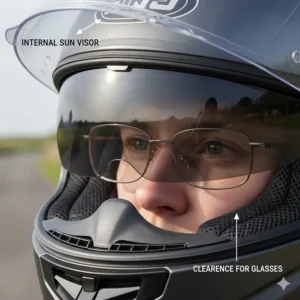
What sets the HJC i90 apart is its thoughtfully designed interior with dedicated grooves carved into the padding specifically for eyeglass temples. UK buyers consistently praise how easily their spectacles slide into position without creating uncomfortable pressure points. The modular design offers additional convenience—simply flip up the chin bar when donning or removing your glasses, eliminating the awkward fumbling that plagues traditional full-face helmets.
The internal sun visor deserves special mention. Rather than juggling prescription glasses and clip-on sunshades, you can simply deploy the integrated dark visor with a flick of a switch. Brilliant for those unpredictable British summer days when sunshine and showers alternate with alarming frequency.
Customer Feedback (UK): Riders report excellent comfort for extended wear, though some note it runs slightly louder than premium alternatives at motorway speeds. The Pinlock-ready visor effectively combats fogging—a genuine blessing during damp autumn rides.
✅ Pros:
- Exceptional value for money (£141-£160)
- Dual ECE/DOT safety certification
- Dedicated eyewear channels prevent temple pressure
❌ Cons:
- Not the quietest at high speeds
- Heavier than premium carbon alternatives
Available on Amazon.co.uk | Perfect for: New riders and budget-conscious commuters
2. Shoei Neotec II – Premium Touring Excellence
When Japanese engineering meets German precision testing, you get the Shoei Neotec II—a helmet that’s become the gold standard for touring riders who wear glasses. Yes, it commands a premium price, but the difference is palpable from your first wear.
Key Specifications:
- Advanced Integrated Matrix (AIM) shell
- QSV-1 sun shield visor system
- Weight: 1,870g (4.12 lbs)
The Neotec II’s eyeglass-compatible interior isn’t simply about cutting grooves into padding. Shoei engineers meticulously shaped every millimetre of the interior space, creating generous clearances that accommodate even chunky designer frames without compromise. The result? You can wear your helmet for hours without developing those telltale red pressure marks along your temples.
What truly distinguishes this helmet is its whisper-quiet operation. Through extensive wind tunnel testing, Shoei refined the aerodynamics to minimize turbulent noise—a godsend when you’re logging 400 kilometres on a summer tour through Scotland. The built-in Noise Isolator cheek pads create an effective seal whilst leaving ample room for your spectacles’ arms.
Customer Feedback (UK): Long-distance riders particularly appreciate the superior ventilation system, which helps prevent both visor and spectacle fogging. The micro-ratchet chin strap closure makes securing the helmet remarkably swift, even with gloves on.
✅ Pros:
- Exceptionally quiet at speed
- Premium comfort for all-day touring
- Seamless integration with Sena communication systems
❌ Cons:
- Substantial investment (£500-£650)
- Heavier than some competitors
- Limited availability can delay delivery
Available through UK specialist retailers | Perfect for: Serious touring riders who demand the best
3. AGV Streetmodular – Urban Commuter’s Choice
AGV’s Streetmodular represents Italian design philosophy at its finest: function and style dancing in perfect harmony. This ECE 22.06 certified helmet brings genuine innovation to the urban commuting segment, specifically addressing the needs of spectacle-wearing riders.
Key Specifications:
- 2Dry interior for instant sweat absorption
- EyewearFit technology with customisable padding
- Weight: 1,690g
- P/J dual homologation
The AGV Streetmodular introduces EyewearFit technology—AGV’s proprietary approach to accommodating eyewear. The interior features specially designed channels that let your glasses slip in effortlessly, whilst interchangeable cheek pads (sold separately) allow you to fine-tune the fit for your specific frame dimensions. Up to 18 different interior configurations ensure virtually any combination of head shape and eyewear can find comfort here.
What’s particularly clever is AGV’s attention to detail regarding helmet donning and removal. The modular chin bar opens wide, creating a generous opening that lets you put on or remove the helmet whilst wearing your glasses—no more risky manoeuvres trying to thread spectacles through a narrow opening whilst standing in a car park.
Customer Feedback (UK): Commuters love the quick flip-up functionality at traffic lights, allowing proper conversations without completely removing the helmet. The P/J homologation means it’s fully legal to ride with the chin bar up, though most riders keep it closed for optimal protection.
✅ Pros:
- Latest ECE 22.06 safety standard
- Excellent value at £196.22
- Customisable fit for various eyewear sizes
❌ Cons:
- Thermoplastic shell (not carbon fibre)
- Some riders find ventilation adequate rather than exceptional
- Limited graphic options
Available on Amazon.co.uk | Perfect for: Daily commuters and urban riders
4. LS2 OF569 Track – Summer Riding Freedom
Sometimes you simply want to feel the wind on your face without sacrificing protection. The LS2 OF569 Track delivers exactly that—an open-face helmet that’s particularly accommodating for glasses wearers, all whilst keeping your bank balance healthier than a Sunday roast dinner.
Key Specifications:
- High Pressure Thermoplastic Technology (HPTT) shell
- Twin Shield System with drop-down sun visor
- Large optically-correct face shield
- Weight: Approximately 1,400g
The beauty of the LS2 OF569 lies in its simplicity. Open-face helmets naturally provide more room for spectacles, but LS2 took this further by creating an exceptionally spacious interior with laser-cut, pre-shaped padding that comfortably accommodates eyewear without any special grooves or channels. Your glasses simply fit naturally, as they should.
The peripheral vision is genuinely impressive—riders describe it as looking through a “giant picture window.” This expansive view is particularly valuable for those of us who already have our field of vision somewhat restricted by spectacle frames. The flip-up visor can be fully raised at traffic lights for ventilation, though the Twin Shield System’s integrated sun visor means you rarely need to.
Customer Feedback (UK): UK buyers appreciate the excellent value proposition, though they’re realistic about its limitations. It’s brilliant for summer rides and urban pottering but less suitable for motorway work or winter conditions. The Quick Screen Release system makes visor changes genuinely tool-free and effortless.
✅ Pros:
- Outstanding affordability (£45-£65)
- Exceptional peripheral vision
- Naturally accommodating for all eyewear types
❌ Cons:
- Limited protection compared to full-face helmets
- Not ideal for high-speed or adverse weather
- Lacks chin protection
Available through UK motorcycle retailers | Perfect for: Warm-weather cruising and scooter riders
5. Bell Qualifier DLX MIPS – Safety-First Full-Face
American manufacturer Bell brings serious safety credentials to the table with the Qualifier DLX MIPS—a helmet that doesn’t just accommodate glasses; it protects your entire head with cutting-edge technology whilst doing so.
Key Specifications:
- Multi-directional Impact Protection System (MIPS)
- Transitions Adaptive photochromic shield
- NutraFog II anti-fog treatment
- Velocity Flow ventilation system
The Qualifier DLX addresses glasses compatibility through carefully contoured cheek pads that leave ample room for eyewear temples without creating gaps that allow wind noise to intrude. Whilst it doesn’t feature dedicated eyewear grooves like some competitors, the generous interior space and thoughtful padding design make spectacle wear genuinely comfortable.
What truly distinguishes this helmet is the included Transitions Adaptive shield—revolutionary for glasses wearers. This photochromic visor automatically darkens in bright sunlight and clears in low light, effectively eliminating the need for prescription sunglasses. For those moments when the British weather can’t decide between brilliant sunshine and moody overcast within a single ride, it’s genuinely transformative.
The MIPS technology adds another layer of protection by allowing the helmet to rotate slightly upon impact, reducing rotational forces transmitted to your brain. It’s reassuring science that you’ll hopefully never need but profoundly grateful to have.
Customer Feedback (UK): UK riders consistently praise the Transitions shield’s performance, noting it adjusts remarkably quickly to changing light conditions. The integrated speaker pockets accommodate Bluetooth communication systems without creating pressure points against spectacle frames.
✅ Pros:
- Advanced MIPS safety technology
- Game-changing Transitions adaptive shield
- Excellent airflow system
❌ Cons:
- DOT rather than ECE certification (check UK legality)
- Can feel slightly heavy during extended wear
- Visor mechanism requires occasional adjustment
Check availability on Amazon.co.uk | Perfect for: Safety-conscious all-weather riders
6. AGV K3 – Sportier Spectacle Solution
AGV’s K3 represents the evolution of an Italian icon, now enhanced with ECE 22.06 certification and thoughtful features for spectacle wearers who prefer a more sporting aesthetic without sacrificing practicality.
Key Specifications:
- High-resistance thermoplastic shell (3 shell sizes)
- Eyewear Ready interior design
- Ultravision 190° horizontal field of vision
- Built-in sun visor with micrometric operation
The AGV K3 introduces AGV’s Eyewear Ready interior—a design philosophy that accommodates spectacles whilst maintaining the snug, performance-oriented fit that sport riders demand. The multi-density EPS liner creates space for eyewear arms without compromising the helmet’s impact-absorption capabilities, whilst the 2DRY interior fabric rapidly wicks away moisture, helping prevent fogging on both your visor and spectacles.
What’s particularly clever is the K3’s aerodynamic profile, designed to achieve “dynamic weight zero” at 130 km/h (approximately 80 mph). This means less strain on your neck muscles during spirited riding—important when you’re already dealing with the minor additional weight of spectacles.
The integrated sun visor deploys and retracts smoothly with gloves on, and crucially, it doesn’t interfere with front ventilation in its rest position. The result is consistent airflow that helps prevent condensation buildup—the eternal enemy of glasses-wearing riders.
Customer Feedback (UK): UK buyers report the helmet runs slightly snugger than some European competitors, so consider sizing up if you’re between sizes or wear particularly wide spectacle frames. The Pinlock Max Vision system genuinely eliminates visor fogging, even during wet, cold British winters.
✅ Pros:
- ECE 22.06 certified
- Excellent aerodynamics reduce fatigue
- Compatible with AGV’s dedicated intercom system
❌ Cons:
- Runs small; careful sizing essential
- Higher price point (£200-£280)
- Limited colour options in some sizes
Available through UK AGV stockists | Perfect for: Sport-touring riders who wear glasses
7. HJC C91 – Best Value Modular
Completing our roundup is another HJC offering, but the C91 brings distinct advantages that justify its separate inclusion. This ECE 22.06 certified modular helmet represents exceptional value whilst incorporating specific features for glasses wearers.
Key Specifications:
- Polycarbonate composite shell
- Advanced Channelling System ventilation
- Internal sun visor with easy operation
- Bluetooth-ready with speaker pockets
The HJC C91 features built-in grooves within its liner specifically designed to accommodate eyeglass temples—a feature that’s becoming HJC’s signature approach to the spectacle-wearer market. These channels are precisely positioned to align with where most glasses frames naturally sit, preventing the uncomfortable pressure that can transform a pleasant ride into an endurance test.
The modular design offers practical advantages beyond just easier helmet donning. During stops, you can flip up the chin bar to adjust your glasses, clean your lenses, or simply get some fresh air without completely removing the helmet. The internal sun visor operates independently of the main visor, giving you multiple options for managing changing light conditions.
HJC’s Advanced Channelling System deserves mention. It efficiently channels heat and humidity out through rear exhaust ports, maintaining a comfortable interior environment. For glasses wearers, proper ventilation isn’t mere comfort—it’s essential for maintaining clear vision by preventing condensation on your spectacles.
Customer Feedback (UK): UK riders appreciate the helmet’s immediate comfort straight from the box, with minimal break-in period required. The Pinlock visor eliminates fogging effectively, and the micrometric chin strap provides quick, secure fastening even with cold or gloved hands.
✅ Pros:
- ECE 22.06 certification
- Exceptional value (£160-£200)
- Speaker pockets for communication systems
❌ Cons:
- Polycarbonate shell (not premium materials)
- Slightly heavier than carbon alternatives
- Wind noise noticeable at motorway speeds
Available through UK HJC dealers | Perfect for: Versatile all-round riders seeking value
✨ Don’t Miss These Exclusive Deals!
🔍 Take your motorcycle riding experience to the next level with these carefully selected helmets. Click on any highlighted helmet name to check current pricing and availability on Amazon.co.uk. These helmets will help you create comfortable, safe riding experiences you and your mates will love!
Understanding Eyewear Groove Technology: What Makes Helmets Spectacle-Friendly?
The Science Behind Comfortable Eyewear Integration
Not all helmets claiming to be “glasses-friendly” actually deliver on that promise. Genuine spectacle compatibility requires specific engineering considerations that go far beyond simply making the interior slightly roomier.
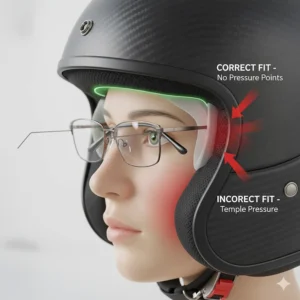
Eyewear groove technology represents the most sophisticated approach. Manufacturers carve precise channels into the EPS liner and padding, creating pathways where your glasses’ temples can rest without creating pressure points against your skull. These grooves typically run from the temple area back towards the ear, following the natural curvature of spectacle arms.
The positioning is critical. Too shallow, and your glasses will still press uncomfortably. Too deep, and the helmet’s structural integrity could be compromised. Premium manufacturers like Shoei and Arai spend considerable time optimising these dimensions through rider testing and feedback.
Spectacle-Friendly Cheek Pads: More Than Just Softness
Spectacle-friendly cheek pads employ different foam densities and carefully sculpted shapes. They need to create an effective seal against wind noise whilst allowing your glasses’ temples to pass through without interference. Some manufacturers, like AGV, offer multiple cheek pad thicknesses, allowing you to customise the fit for your specific combination of head shape and eyewear dimensions.
Modern materials like memory foam and multi-density padding help. These materials compress around your glasses’ temples when you first don the helmet, then gently but firmly conform to create a comfortable, secure fit that doesn’t loosen during your ride.
Anti-Pressure Temple Design: The Final Frontier
The latest innovation in spectacle-compatible helmets is anti-pressure temple design—a holistic approach that considers the entire pathway your glasses take from front to back. Rather than simply cutting grooves, designers shape the entire interior profile to minimise contact pressure whilst maintaining the snug fit essential for safety.
Arai’s Variable Axis System (VAS) exemplifies this approach. Removable foam pieces at temple height can be removed entirely, creating generous space for glasses whilst maintaining helmet integrity. It’s an elegant solution that puts control in your hands—remove the foam pieces if you wear glasses; leave them in place if you don’t.
How to Choose the Right Helmet for Your Glasses: 5 Essential Steps
1. Know Your Glasses Dimensions
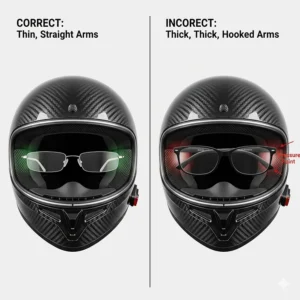
Before shopping, measure your spectacles’ temple width and thickness. Frames vary dramatically—slim metal temples slide through tight spaces, whilst chunky designer plastic frames need more room. Take your glasses when trying helmets; don’t rely on shop display frames.
2. Understand Your Head Shape
Helmets come in different internal shapes: round oval, intermediate oval, and long oval. Your head shape affects how pressure distributes, and consequently, where your glasses’ temples need space. An intermediate oval helmet might be perfect for one rider’s specs but uncomfortable for another with identical glasses.
3. Test the Donning Process
A helmet that’s comfortable once on but impossible to put on whilst wearing glasses isn’t fit for purpose. Practice the donning sequence: open modular chin bar if applicable, position spectacles first or helmet first (experiment to find your preference), and ensure you can manage it whilst standing in a car park, not just in a cosy shop.
4. Assess Ventilation Paths
Proper airflow prevents spectacle fogging. Look for helmets with multiple ventilation channels that direct fresh air across your face and around your glasses. Chin vents, forehead intakes, and rear exhaust ports should work harmoniously to maintain clear lenses.
5. Consider Long-Term Comfort
Spend at least 15 minutes wearing any helmet you’re seriously considering, preferably longer. Initial comfort doesn’t guarantee comfort after 90 minutes on the M1. Pay attention to any developing pressure points, particularly around your temples where glasses contact.
UK Safety Standards & Regulations: What You Need to Know
ECE 22.06: The New Gold Standard
Since January 2024, all newly approved helmets sold in the UK must meet ECE 22.06 certification standards. This represents a significant advancement over the previous ECE 22.05 standard, with more rigorous testing protocols that better reflect real-world accident scenarios.
The new standard introduces oblique impact testing, measuring rotational forces that can cause serious brain injuries. Helmets are dropped onto angled anvils covered with abrasive paper, simulating sliding along tarmac—precisely what happens in most motorcycle accidents. To pass, rotational acceleration mustn’t exceed 10,400 rad/s².
Importantly for glasses wearers, ECE 22.06 includes stricter requirements for accessory integration. Helmets must now prove that accessories (including the bulk created by eyewear accommodation features) don’t compromise safety or structural integrity.
SHARP Ratings: Beyond the Minimum
The UK’s Safety Helmet Assessment and Rating Programme (SHARP) provides independent testing beyond legal requirements. Helmets receive ratings from 1 to 5 stars based on impact performance across 32 separate tests.
Critically, SHARP tests at higher velocities than required by regulation—8.5 metres per second versus ECE’s lower speeds. This represents approximately 30% more energy than minimum standards demand, revealing which helmets truly excel rather than merely meeting basic requirements.
When selecting a helmet, consult both ECE certification and SHARP ratings. A 5-star SHARP rating indicates exceptional protection, though remember that price doesn’t correlate with safety—budget helmets sometimes outperform premium alternatives in testing.
Legal Requirements in the UK
According to UK Government guidelines, your helmet must display either:
- British Standard BS 6658:1985 with BSI Kitemark
- ECE 22.05 or 22.06 certification
- Any European Economic Area standard equivalent to BS 6658:1985
Failing to wear an approved helmet can result in fines up to £500. More concerning, inadequate head protection can be considered contributory negligence if you’re involved in an accident, potentially affecting insurance claims.
Maintaining Your Spectacle-Friendly Helmet
Cleaning Eyewear Channels
Those brilliant eyewear grooves require regular maintenance to remain effective. Skin oils, sweat, and environmental dust accumulate in these channels, gradually reducing their effectiveness and potentially creating uncomfortable rough spots.
Remove your helmet’s liner according to manufacturer instructions (most are fully removable). Wash padding in lukewarm water with mild detergent—never hot water, which can degrade foam structure. Pay particular attention to the eyewear channels, gently working soap through to remove buildup. Rinse thoroughly and air-dry completely before reinstalling.
Visor Care for Glasses Wearers
Your visor protects you from wind, rain, and debris, but if it fogs up, your spectacles become the weak link. Maintain your visor religiously: clean it inside and out using proper motorcycle helmet cleaner or mild soap and water. Never use harsh chemicals, which can degrade anti-fog coatings.
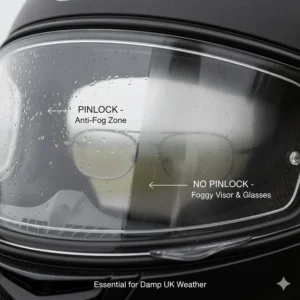
If your helmet includes a Pinlock insert, ensure it’s correctly installed with no gaps between the insert and visor. These double-glazed systems work brilliantly but only when properly fitted. Replace Pinlock inserts annually or when they show signs of degradation—think of it as cheap insurance against fogged vision.
When to Replace
Manufacturers typically recommend replacing helmets every 5 years, regardless of visible damage. Materials degrade over time even without impacts, particularly the EPS foam that absorbs impact energy. For glasses wearers, this is particularly important—as padding compresses with age, those carefully engineered eyewear channels can change shape, potentially creating new pressure points.
After any significant impact, replace your helmet immediately. Even if external damage isn’t visible, the EPS liner may have crushed, compromising its protective capability. Similarly, if the chin strap or retention system shows wear, it’s time for replacement—no point having brilliant eyewear accommodation if the helmet comes off during an accident.
Common Problems & Solutions for Glasses-Wearing Riders
Problem: Spectacles Fogging During Rides
Solution: Ensure proper ventilation by opening chin and forehead vents. Anti-fog treatments designed for eyeglasses (not just helmet visors) can help significantly. Some riders find that adjusting their glasses slightly lower on their nose improves airflow across the lenses. In severe cases, consider a Pinlock-equipped visor combined with anti-fog lens treatment—addressing both visor and spectacle fogging simultaneously.
Problem: Pressure Headaches After 30 Minutes
Solution: This suggests either incorrect helmet size or inadequate eyewear accommodation. Re-evaluate your helmet size using proper measuring techniques—a helmet should feel snug but never painful. Try helmets with dedicated eyewear grooves if you haven’t already. Sometimes, slightly thinner spectacle arms or frames with more flexible temples can make the difference between comfort and pain.
Problem: Glasses Shifting During Riding
Solution: Spectacles that slide down your nose or move laterally during rides compromise both vision and comfort. Ensure your helmet fits properly—if it’s too loose, vibrations and movement can dislodge your glasses. Some riders benefit from sport-specific eyewear retainers (those straps that wrap around the back of your head), though these can interfere with helmet comfort. Properly adjusted spectacle nose pads can also help maintain position.
Problem: Can’t Put Helmet On With Glasses
Solution: Modular helmets offer the easiest donning sequence—open the chin bar fully, position glasses, then don the helmet. For full-face helmets, experiment with sequence: some riders find putting glasses on after the helmet works better. Alternatively, invest in a helmet with a more generous opening or consider thinner, more flexible spectacle frames specifically for riding.
FAQ: Your Motorcycle Helmet & Glasses Questions Answered
❓ Can you comfortably wear prescription glasses under any motorcycle helmet?
❓ Do modular helmets work better for spectacle wearers than full-face helmets?
❓ How can I prevent my glasses from fogging whilst riding in British weather?
❓ Are prescription riding goggles better than glasses under a helmet?
❓ What's the best approach if I wear both prescription glasses and need sun protection?
Conclusion: Your Perfect Spectacle-Friendly Helmet Awaits
Finding the right motorcycle helmet when you wear glasses needn’t be a compromise between comfort and safety. As we’ve explored throughout this comprehensive guide, modern helmet technology has evolved remarkably, with manufacturers now genuinely prioritising the needs of spectacle-wearing riders.
Whether you opt for the budget-friendly HJC i90 with its dedicated eyewear grooves at just £141, or invest in the premium Shoei Neotec II’s whisper-quiet luxury, there’s genuinely never been a better time to find a helmet that accommodates your eyewear without sacrificing protection or comfort.
Remember the key considerations: dedicated eyewear channels or grooves, properly designed cheek padding, adequate ventilation to prevent fogging, and crucially, the right fit for your specific head shape and spectacle dimensions. Don’t settle for a helmet that’s merely “tolerable” when perfect comfort is achievable.
Take advantage of retailers’ try-before-you-buy policies, spend proper time assessing comfort with your actual glasses, and don’t hesitate to consult with knowledgeable staff who understand the specific challenges glasses wearers face. Your helmet is the single most important piece of safety equipment you’ll ever purchase—it deserves thoughtful consideration and proper investment.
The open road awaits, and with the right helmet, you’ll enjoy every kilometre in complete comfort, with crystal-clear vision through both your visor and your spectacles. Ride safe, ride smart, and above all, ride comfortably.
Recommended for You
- Best Retro Motorcycle Helmets UK 2026
- Best Full Face Helmets Under £200 UK | Expert Reviews 2026
- Best Commuter Motorcycle Helmets UK 2026
Disclaimer: This article contains affiliate links. If you purchase products through these links, we may earn a small commission at no additional cost to you. Prices shown are approximate and may vary. All helmets mentioned meet UK safety standards. Always verify current pricing and specifications before purchasing.
✨ Found this helpful? Share it with your mates! 💬🤗
