
In This Article
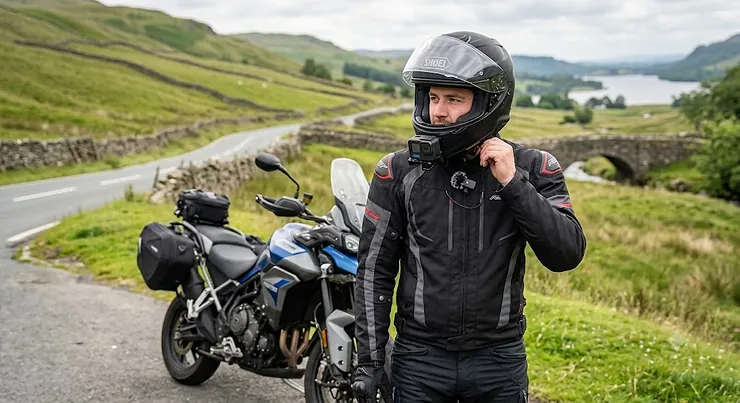
Let’s be honest. The humble motorcycle helmet used to have one job — to protect your head. Full stop. It didn’t need a personality, a Wi-Fi connection, or an opinion about video resolution. And then YouTube happened. And TikTok. And suddenly, thousands of UK riders realised that the view from behind the visor — the Peak District unfolding on a Sunday morning, the mad ballet of a London rush hour, the sheer mechanical theatre of a canyon road blast in Wales — was content that the world wanted to watch.
The motorcycle vlogging helmet is now a legitimate piece of creator kit. Not a gimmick. Not a novelty. A genuine tool for content creators, for riders who want to document their journeys, and increasingly, for everyday commuters who simply want dash-cam footage for insurance purposes. In 2026, a good setup combines ECE-certified safety, clean audio capture, solid 4K-or-better video, and — perhaps most critically for British riders — real resilience against weather that ranges from “pleasantly overcast” to “actually, I should have stayed home.”
What separates a proper motovlogger setup from strapping a camera to any old lid and hoping for the best? That’s exactly what we’re going to unpick. Whether you’re a YouTube riding helmet enthusiast building your first rig or a seasoned content creator motorcycle helmet upgrader who wants to know if the new Insta360 X5 is worth the step up, this guide is for you.
Expect honest assessments, real-world British context, and zero marketing waffle.
Quick Comparison: Best Motorcycle Vlogging Helmets UK 2026
| Product | Camera Type | Audio Quality | Best For | Price Range (GBP) |
|---|---|---|---|---|
| Sena 50C | Integrated 4K@30fps | Harman Kardon speakers + mic | All-in-one vloggers | £400–£500 |
| Insta360 X5 | 8K 360° clip-on | Excellent wind reduction | Serious content creators | £450–£530 |
| Insta360 GO 3S | 4K clip-on, 140 min | Good integrated mic | Minimalist/travel riders | £280–£340 |
| GoPro HERO13 Black | 5.3K60fps clip-on | Requires external mic | Versatile action riders | £340–£400 |
| GoPro MAX 2 | 5.6K 360° dual-lens | Decent wind noise suppression | Cinematic 360° riders | £430–£520 |
| Cardo Packtalk Edge | No built-in camera | Premium comms audio | Audio-first vloggers | £320–£400 |
| INNOVV K7 | Dual-channel 4K hardwired | Loop recording audio | Touring/commuter dashcam | £180–£260 |
Prices are indicative ranges; always check current pricing on Amazon.co.uk as these fluctuate regularly.
The table above reveals something useful straight away: there is no single “best” motorcycle vlogging helmet setup — the right choice depends entirely on how you ride and what you want to capture. An all-in-one unit like the Sena 50C simplifies your helmet enormously, but you trade raw video resolution for convenience. The Insta360 X5 delivers jaw-dropping footage but adds a clip-on camera to an otherwise clean lid. And the INNOVV K7? It’s almost invisible to other riders, which is rather the point. Before clicking “buy,” read the full breakdowns below.
💬 Just one click — help others make better buying decisions too! 😊
✨ Don’t Miss These Exclusive Deals!
🔍 Take your motorcycle vlogging setup to the next level with these carefully selected products. Click on any highlighted item to check current pricing and availability on Amazon.co.uk. Your next great ride deserves to be remembered properly.
Top 7 Motorcycle Vlogging Helmets: Expert Analysis
1. Sena 50C — The All-in-One Champion for UK Motovloggers
The Sena 50C is the device you buy when you want a clean helmet and a comprehensive content creator motorcycle helmet solution without a tangle of wires and mounts ruining the aesthetic. It combines Sena’s excellent Mesh Intercom 3.0 communication system with a 4K@30fps camera and those much-loved Harman Kardon premium speakers — all in one module that clamps to the side of your lid.
The 4K@30fps resolution is honest rather than spectacular. In good British summer light (yes, it does occasionally occur), your footage will look polished and broadcast-ready. On the kind of grey, overcast autumn days that make up roughly half the riding calendar in northern England and Scotland, you will notice the limitations of the sensor — shadows tend to flatten and colours get muddy. That said, the voice capture is genuinely excellent; your narration comes through clear and natural even on motorways, which is more than can be said for action cameras relying on tiny onboard mics. This makes it arguably the strongest streaming helmet option for riders who prioritise voiceover content over cinematic visuals.
For the typical UK motovlogger — someone commuting from the suburbs of Manchester or doing weekend blasts in the Yorkshire Dales — the Sena 50C represents a tidy, all-encompassing solution that you can pair across an entire group of riders via Mesh intercom.
Customer feedback: UK reviewers consistently praise the audio quality and seamless intercom integration. A common gripe is the camera’s position relative to the helmet’s aerodynamics on certain lid shapes.
✅ Outstanding audio capture for voiceover content
✅ Mesh Intercom 3.0 connects to virtually unlimited riders
✅ Voice-activated controls — genuinely useful when you’re gloved up
❌ 4K@30fps lacks the creative resolution headroom of standalone cameras
❌ Premium price point for what is, at its core, a communications unit with a camera added
In the £400–£500 range, this is strong value if comms and content creation are both priorities for you — but pure videographers may find it limiting.
2. Insta360 X5 — The Professional-Grade Motovlogger’s Secret Weapon
Calling the Insta360 X5 “just a helmet camera” is like calling a Leica “just a point-and-shoot.” This is a proper piece of creator hardware. Dual 1/2″ sensors, up to 8K 360° capture, advanced wind noise reduction built into the firmware, and Bluetooth Dual-Track Audio that records both ambient sound and, critically, your intercom audio simultaneously. It works seamlessly with Sena and Cardo headsets, which means if you’re already running a premium comms system, the X5 slots straight into your existing ecosystem.
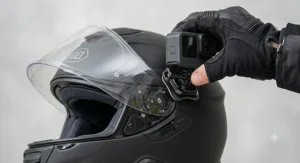
The real game-changer for the motovlogging community is reframing. Shoot 360° and decide later whether you want the standard POV, a follow-me shot, or a wide cinematic angle. In practical terms, this means one camera sitting on your chin mount captures every angle of that B-road in the Cotswolds — and you edit the perspective in post rather than guessing it in the moment. For British weather, the waterproofing (no case needed) is genuinely important; you are not going to get away with a fragile camera housing when a ride from Yorkshire to the Lakes can involve three different weather systems in forty miles.
The Insta360 X5 is best suited to riders who are committed to YouTube riding helmet content as a creative pursuit — someone who edits their footage, thinks about framing, and wants their channel to look genuinely cinematic rather than simply documentary.
Customer feedback: Widely praised for stabilisation quality and the flexibility of 360° reframing in post. Battery life (90–120 minutes at 4K) is the most frequently cited limitation for longer touring days.
✅ Best-in-class stabilisation via FlowState — handles motorway vibration beautifully
✅ 8K 360° gives extraordinary post-production flexibility
✅ Waterproof without a case — essential for UK riding conditions
❌ Editing 360° footage has a learning curve for newer creators
❌ Premium pricing puts this firmly in the “investment” category
Priced in the £450–£530 range on Amazon.co.uk — worth every penny if serious content creation is the goal.
3. Insta360 GO 3S — The Lightweight Champion for Minimalist Riders
Some riders simply don’t want a camera that announces itself to the world. The Insta360 GO 3S is tiny — absurdly so — and the motorcycle POV bundle version includes a purpose-built chin mount that integrates cleanly into most full-face and modular helmets. At 4K resolution with 140 minutes of battery life (including the charging case), it is a more capable little device than its size suggests.
Where it wins, decisively, is in weight and aerodynamics. Mounting a GoPro on a helmet chin mount creates measurable aerodynamic drag at motorway speeds — enough that your neck will tell you about it on longer motorway stints. The GO 3S is so light that after twenty minutes of riding, you genuinely forget it is there. For UK commuters who want to capture their daily route — partly for the content, partly for the insurance footage — this unobtrusive profile is a significant practical advantage.
The audio quality from the integrated microphone is acceptable but not exceptional. Wind noise at speeds above 80 km/h is noticeable in footage. The smart solution, used by many established UK motovloggers, is to pair the GO 3S with a Cardo or Sena headset for clean voice capture and let the camera focus purely on the visuals.
Customer feedback: UK riders love the compact form factor and the quality-to-weight ratio. Several reviewers noted it handles rain and light spray without complaint — encouraging for our climate.
✅ Remarkably light — negligible aerodynamic impact
✅ 140-minute battery (with case) covers most UK day rides
✅ Waterproof to 10 metres — more than sufficient for British weather
❌ Built-in mic struggles with wind at speed
❌ Lower resolution ceiling than the X5 or HERO13 for serious post-production work
Available in the £280–£340 range — one of the more accessible entries into quality motovlogging.
4. GoPro HERO13 Black — The Workhorse That Needs No Introduction
The GoPro HERO13 Black is the camera equivalent of a Kawasaki Z900 — not the flashiest thing on the market, but reliable, well-proven, and trusted by people who actually ride rather than just talk about riding. At 5.3K60fps with HyperSmooth 6.0 stabilisation and a Max Lens Mod 2.0-compatible body, it is an exceptionally versatile chin mount camera helmet option.
What distinguishes the HERO13 from its predecessors, and from rival action cameras, is the modular lens system. The standard lens is already superb for standard road capture, but slapping the Max Lens Mod 2.0 onto it gives you that wide, immersive POV aesthetic that has come to define the best UK motovlogging content. The Anamorphic Mod is there for riders who want that cinematic letterbox look — slightly indulgent, but undeniably effective on a sweeping Scottish coastal road.
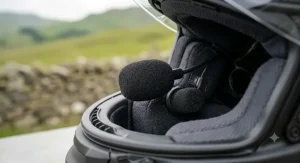
The honest limitation for motovlogging purposes is audio. The onboard microphone is adequate for general footage, but it is not designed for clear voice narration at speed. Pairing the HERO13 with an external microphone mounted inside the helmet, or running it alongside a Cardo or Sena unit, is the standard professional approach and something any serious audio and video quality setup should account for in the budget.
Customer feedback: Consistently high ratings for video quality and stabilisation. Firmware reliability has improved substantially over recent generations — UK reviewers note fewer connectivity issues than with older GoPro models.
✅ 5.3K60fps with class-leading HyperSmooth 6.0 stabilisation
✅ Modular lens system offers creative flexibility beyond most competitors
✅ Massive ecosystem of compatible mounts and accessories
❌ Audio quality requires supplementing with external mic for clean voiceover
❌ Battery life (approximately 90 minutes at 5.3K) can feel short on longer touring days
In the £340–£400 range — the default recommendation for riders who want proven, upgradeable quality.
5. GoPro MAX 2 — When One Angle Simply Isn’t Enough
The GoPro MAX 2 occupies an interesting space in the motovlogging world. It shoots 5.6K 360° spherical video with a dual-lens design, which sounds very similar to the Insta360 X5 pitch — and in some ways it is. Where the MAX 2 differentiates itself is in the GoPro ecosystem integration, particularly if you’re already running a HERO series camera and want consistent colour science across both.
For UK riders who also shoot non-riding content — walking tours, urban exploration, countryside hiking — the MAX 2’s flexibility across different activities is a genuine selling point. It moves from helmet to hand to selfie stick without losing coherence as a tool.
The wind noise suppression is good, though not quite at the level of the Insta360 X5’s best-in-class audio processing. For riders doing most of their vlogging on B-roads and in urban environments (rather than motorway blasts), the difference is largely academic. The MAX 2 is a strong choice for riders building a broader content creation workflow rather than those purely focused on motorcycle footage.
✅ 5.6K 360° video with strong GoPro ecosystem compatibility
✅ Versatile enough to work brilliantly off the bike too
✅ Improved wind noise handling over its predecessor
❌ Pricier than a standard action camera for broadly comparable results in standard (non-360°) riding footage
❌ Editing spherical footage is still more time-intensive than standard video
In the £430–£520 range on Amazon.co.uk.
6. Cardo Packtalk Edge — For Riders Who Know Audio Is Half the Story
The Cardo Packtalk Edge is not, strictly speaking, a camera. But it earns its place on this list because the single biggest differentiator in high-quality motorcycle vlog content — the thing that separates a watchable channel from an irritating one — is clean, natural audio. And the Packtalk Edge is simply one of the best Bluetooth intercom systems available in the UK, with microphone quality that puts most integrated camera mics to shame.
The workflow used by most serious UK motovloggers is a two-device setup: the Cardo Packtalk Edge handles all audio capture (your voice, ambient sound from the JBL speakers’ pickup, group intercom conversations), while a separate camera handles the visuals. The Packtalk Edge pairs natively with the Insta360 Ace Pro via Bluetooth, meaning the camera can record both the voice track from the intercom and the ambient audio separately — giving you proper dual-track audio in post-production without any fiddly hardware workarounds.
For group rides and touring content, the Edge’s Dynamic Mesh Communication (DMC) technology keeps your group connected across distances that make Bluetooth-only intercoms struggle. If you’re running a channel built around group ride content — which is, frankly, some of the most watchable motorcycling content on YouTube right now — this is the communications backbone the whole setup should be built around.
✅ Best-in-class audio quality for voice capture in UK riding conditions
✅ DMC technology for seamless group ride comms — content gold
✅ Pairs natively with Insta360 cameras for dual-track audio
❌ No integrated camera — requires a separate device for video
❌ Top-end pricing for a communications-only device
In the £320–£400 range — pairs most powerfully with an Insta360 camera for a complete streaming helmet setup.
7. INNOVV K7 — The Quietly Brilliant Touring Dashcam for Everyday Riders
The INNOVV K7 is the one on this list that your average viewer won’t even see, and that is rather the point. It’s a hardwired, dual-channel 4K motorcycle dashcam kit — a central recording unit, a handlebar controller, and two compact bullet cameras that mount facing forward and backward on the bike itself (not the helmet). For UK commuters and tourers who want continuous, reliable footage without the faff of remembering to charge a clip-on camera before every ride, this is a quietly brilliant solution.
Loop recording means the footage overwrites itself automatically, keeping only what you choose to save — a sensible approach for daily commuters navigating the particular chaos of urban British roads. The GPS tracking overlay is useful for ride review content, and the smartphone app via Wi-Fi makes downloading clips straightforward. What it doesn’t do is capture the intimate, helmet-POV perspective that defines traditional motovlogging. The INNOVV K7 is best positioned as a complementary device — the always-on insurance footage running in the background while a chin-mounted camera captures your vlog content.
For riders based in cities with higher bike theft rates (particularly central London, Manchester, and Birmingham), the continuous rear-facing camera also serves as a security measure during stops — a practical UK-specific bonus that no amount of YouTube subscribers can replace.
✅ Hardwired — no charging required, always ready
✅ Dual-channel covers both forward and rear perspectives simultaneously
✅ GPS-overlay footage ideal for touring route documentation
❌ Doesn’t capture helmet-POV footage — a deliberate design choice, but a limitation for traditional motovlogging
❌ Professional installation recommended for hardwiring — adds to the overall cost
In the £180–£260 range — excellent value as a permanent touring/commuter setup.
How to Build the Perfect UK Motovlogging Setup: A Practical Framework
Picking a camera in isolation is a bit like choosing a new exhaust note without considering whether it’ll actually fit your bike. The best motorcycle vlogging setups are systems — camera, audio, mounting, and helmet working together. Here’s how to think about it.
Step 1: Start with the Helmet, Not the Camera
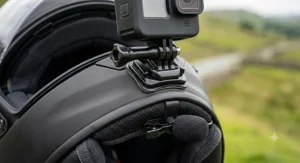
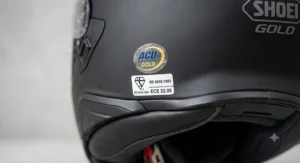
This seems obvious but most people do it backwards. Your helmet determines what can be mounted where, and more importantly, whether mounting anything affects its ECE R22.06 certification. According to the UK government’s own SHARP programme — the Safety Helmet Assessment and Rating Programme run by the Department for Transport — ECE R22.06 is the current legal standard for motorcycle helmets on UK roads, and from January 2024, all new helmet designs must comply with this updated regulation. The new “UA” (Universal Accessory) subcategory means some helmets are now specifically tested and certified with external accessories attached. Schuberth’s new Concept lid was one of the first to achieve ECE R22.06 UA marking — a meaningful distinction if you’re mounting a camera externally. If your current helmet lacks this designation, use adhesive mounts rather than permanent modifications, and keep the camera’s profile as low as possible.
Step 2: Decide Your Primary Content Type
Are you narrating commentary over road footage? Audio quality is your priority — invest in a Sena or Cardo unit first. Are you capturing cinematic visuals of routes and scenery? Video resolution and stabilisation lead the purchase decision. Are you doing group ride content? You need comms with good range. Identifying your primary use case before spending a penny prevents the all-too-common outcome of owning brilliant kit that doesn’t quite fit how you actually ride.
Step 3: Match Your Budget Across the Whole System
A rough guide in GBP:
- Under £350 total: Insta360 GO 3S on a chin mount with your existing communications setup. Perfectly capable for beginner channels.
- £350–£600 total: GoPro HERO13 or Sena 50C. This tier delivers genuinely publishable quality for a growing audience.
- £600+ total: Insta360 X5 paired with a Cardo Packtalk Edge. This is the dual-track audio, 360° capture, professional-grade setup. Justifiable if you’re monetising your content or building a serious audience.
Step 4: Account for British Conditions From Day One
Waterproofing is non-negotiable. Wind noise management matters more here than it does for a rider doing desert tours in California. Buy foam windscreens for any external microphone. Keep your memory cards in a small dry bag in your jacket pocket rather than in an external mount on windy, damp days.
Real-World Scenarios: Matching the Right Setup to Your Riding Life
Profile 1: The London Commuter
You’re filtering through Zone 2 traffic on a Monday morning, GoPro HERO13 on the chin mount, Cardo Packtalk Edge handling audio. The main priorities here are reliable loop recording (the INNOVV K7 running in the background), compact camera profile for urban filtering, and waterproofing that laughs at November drizzle. The two-camera approach — HERO13 for vlog content, INNOVV K7 for insurance footage — is genuinely worth the combined cost for regular London riding.
Profile 2: The Weekend Yorkshire Dales Blaster
You ride for the joy of it and want to share that joy. Here, the Insta360 X5 makes an obvious case for itself. The 360° capture means you never miss a sweeping corner or a dramatic moorland backdrop, and you can reframe in post to find exactly the shot that captures why that particular stretch of the B6160 on a clear October morning is worth getting out of bed for. Pair it with the Cardo Packtalk Edge if you’re riding with mates — the group intercom content practically writes itself.
Profile 3: The Long-Distance Tourer
You’re doing a Land’s End to John O’Groats run and want it documented properly. Battery life becomes the paramount concern. The INNOVV K7’s hardwired setup means you never run out of charge. Supplement it with an Insta360 GO 3S (charging case gives 140 minutes) for when you want proper helmet-POV footage at interesting sections of the route. This combination covers 90% of touring content needs without requiring you to manage battery anxiety on top of the 1,400 km of riding itself.
UK Regulations, Safety Standards & What the Law Actually Says About Helmet Cameras
Let’s address the question every UK motovlogger is quietly thinking: is it actually legal to mount a camera on your helmet?
The honest answer is nuanced. The gov.uk motorcycle helmet requirements page specifies that helmets must meet either BS 6658:1985 or ECE R22.06. The new ECE R22.06 standard, which became mandatory for all new helmet designs from January 2024 according to the SHARP programme, introduced the UA (Universal Accessory) subcategory precisely because of the explosion in helmet-mounted cameras and intercoms.
The practical position, as Bennetts BikeSocial reported in a detailed February 2026 investigation, is that while there is no blanket ban on helmet cameras in the UK, mounting external accessories to a helmet technically modifies it from its certified state. An ECE R22.06 UA-marked helmet sidesteps this concern entirely, as it has been crash-tested with an accessory attached.
The pragmatic takeaway: use quality adhesive mounts designed for helmets (not glue from a DIY shop), avoid drilling or permanently modifying the shell, and if you’re investing in a new helmet anyway, consider whether ECE R22.06 UA certification is worth prioritising. For insurance purposes, footage from a properly mounted camera is broadly admissible in UK civil proceedings — which, given the state of some UK road users, is increasingly relevant.
For independent safety ratings beyond the ECE standard, SHARP remains the go-to independent UK resource — helmets are purchased anonymously from retailers and tested without manufacturer involvement. A five-star SHARP rating alongside ECE R22.06 compliance is the combination to look for.
Features That Actually Matter (And Those That Don’t)
What Actually Matters
Stabilisation quality. Full stop. Shaky footage is unwatchable regardless of resolution. HyperSmooth 6.0 (GoPro), FlowState (Insta360), and electronic stabilisation on the INNOVV cameras all deliver the smoothness that makes riding footage genuinely pleasant to watch. Any camera without strong EIS (Electronic Image Stabilisation) should be dismissed immediately for motorcycle use.
Wind noise handling. This is the most overlooked spec in camera marketing. Resolution numbers look impressive in press releases; wind noise matters on the A1 at 100 km/h. The Insta360 X5’s dedicated wind noise reduction algorithms are genuinely class-leading for helmet use.
Battery life in real conditions. Manufacturers test battery life at optimal temperatures. In February in the Pennines, expect 10–20% less runtime than the stated figure. Plan accordingly.
Mounting ecosystem. The GoPro mount standard is the de facto industry standard — hundreds of third-party mounts exist for it, including excellent chin mount systems. Cameras with proprietary mounts limit your options and add cost over time.
What Doesn’t Matter as Much as You’d Think
Maximum resolution. 8K sounds extraordinary. It is. It also produces files that will fill a 256GB card alarmingly quickly and require a powerful computer to edit. Most YouTube content is watched at 1080p or 1440p. 4K footage properly stabilised and lit will always beat shaky, poorly lit 8K. Don’t chase numbers.
Waterproof depth rating. You are not freediving with your motorcycle helmet. IPX5 (resistant to rain and spray) is more than adequate. The Insta360 X5 boasts 10-metre waterproofing. Unless you’re planning to ride your bike off Beachy Head, the additional waterproofing depth is marketing, not utility.
Common Mistakes When Setting Up a Motorcycle Vlogging Helmet in the UK
1. Buying US-spec cameras with incompatible mounts. This happens more than it should. Always verify Amazon.co.uk availability rather than importing from Amazon.com — charging adapters and plug configurations aside, UK consumer rights under the Consumer Rights Act 2015 only apply to products purchased from UK-based sellers. Returns and warranty claims become substantially more complicated with grey imports.
2. Ignoring audio entirely. The most common amateur motovlogging mistake. A viewer will forgive less-than-perfect video quality. They will click away within thirty seconds of howling wind noise or muffled narration. Invest in audio infrastructure — whether that’s a quality intercom system’s microphone, an external windshield, or a dual-track audio setup — before you worry about upgrading your camera resolution.
3. Mounting cameras at incorrect angles. The optimal chin mount position for a POV motorcycle shot is approximately 20–25 degrees downward from horizontal — enough to capture the road ahead, the instruments, and the scenery without pointing at the sky or your tank. Test with a short ride before committing to any permanent adhesive mount.
4. Forgetting about memory card speed. 4K@60fps footage requires a UHS-I Speed Class 3 (U3) or V30 card as a minimum. 5.3K–8K benefits from UHS-II or V60/V90 cards. Using an inadequate card causes dropped frames or outright recording failures — frustrating on an unremarkable Tuesday, genuinely annoying when you’re halfway through a once-in-a-lifetime Scottish coastal run.
5. Overlooking the ECE certification question. As discussed above, mounting anything to a helmet technically modifies it from its tested state. For most riders with adhesive mounts, this is a legal grey area rather than an active concern. But it is worth knowing, particularly for any riders who also race — ACU Gold helmets used in competition have stricter rules about external modifications.
FAQ
❓ Is it legal to use a motorcycle vlogging helmet with a camera in the UK?
❓ What is the best motorcycle vlogging helmet setup for a beginner UK rider?
❓ Does weather affect motorcycle helmet camera footage in the UK?
❓ Which motorcycle vlogging helmet setup gives the best audio quality for YouTube?
❓ Do I need a special helmet for motovlogging, or can I use any ECE-certified lid?
Conclusion: Pick Your Weapon and Get Riding
The truth about choosing a motorcycle vlogging helmet setup in 2026 is that the technology is no longer the limiting factor — your content is. Whether you go for the clean, all-in-one simplicity of the Sena 50C, the creative latitude of the Insta360 X5, or the unobtrusive workhorse reliability of the INNOVV K7, you have access to tools that professional filmmakers would have envied a decade ago.
For most UK riders starting their motovlogging journey, the pragmatic recommendation is this: buy the best helmet you can afford — check its SHARP rating at sharp.dft.gov.uk and confirm ECE R22.06 compliance — and then add a camera from the £280–£400 range. The Insta360 GO 3S or GoPro HERO13 will both serve you exceptionally well. Sort your audio out from day one. The rest — the editing style, the voice, the storytelling — that part is entirely yours.
Now stop reading about it and go film something worth watching.
✨ Don’t Miss These Exclusive Deals!
🔍 Ready to start your motovlogging journey? Click on any highlighted product name in this article to check current pricing and availability on Amazon.co.uk. Prime members get free next-day delivery on most of these picks — which means you could be filming your commute by tomorrow morning. 🎬
Recommended for You
- Best Helmet Camera Integrated: Top 7 Picks for UK Riders 2026
- Best GoPro Ready Motorcycle Helmet UK 2026: Top 7 Picks Reviewed
- Best Motorcycle Helmet with Built In Camera: 7 Top Picks for UK Riders (2026)
Disclaimer: This article contains affiliate links. As an Amazon Associate, I earn from qualifying purchases. If you purchase products through these links, we may earn a small commission at no additional cost to you.
✨ Found this helpful? Share it with your mates! 💬🤗
