
In This Article
A polycarbonate helmet for commuting is a motorcycle helmet with an outer shell moulded from thermoplastic polycarbonate rather than fibreglass or carbon fibre, chosen by daily riders for its blend of affordability, durability and consistent ECE-approved protection. If you’re reading this on a Sunday evening, dreading Monday’s ride into town, you’re exactly who this guide is for. There’s something faintly ridiculous about spending forty minutes each way stuck behind the same white van, and yet somehow it’s still better than the alternative sitting in it. Your helmet is the one piece of kit doing all the heavy lifting when things go wrong, so it deserves more thought than “whichever one’s cheapest on the shelf.”
This guide walks through seven genuine, currently available polycarbonate helmets sold through amazon.co.uk, ranging from sub-£100 entry lids to premium flip-fronts, each assessed against real specifications, independent safety data from SHARP, the UK’s official helmet safety scheme, and honest aggregated feedback from riders and professional testers. We’ll also cover how polycarbonate stacks up against fibreglass and carbon, what actually matters when you’re filtering traffic on a wet Tuesday, and where riders commonly waste money buying the wrong helmet for the wrong commute. British weather doesn’t do half-measures, and neither should your safety gear.
Everything below is written for UK roads, UK regulations and amazon.co.uk pricing. Prices shift constantly, so treat every figure here as a guide rather than gospel — always check the current price before buying. Let’s get into it.
Quick Comparison Table
| Helmet | Type | Approx. Weight | Price Range | Best For |
|---|---|---|---|---|
| HJC C10 | Full-face | ~1,510-1,550g | £75-£100 | First-time buyers wanting ECE 22.06 |
| Vcan V151 | Full-face | ~1,400g | £70-£100 | Absolute tightest budget |
| MT Thunder 3 SV | Full-face | ~1,550-1,600g | £85-£110 | Best safety score under £100 |
| LS2 Storm II | Full-face | ~1,540-1,550g | £130-£155 | All-rounder with sun visor |
| Nolan N60-6 | Full-face | ~1,520-1,530g | £150-£190 | Sporty fit, lightweight feel |
| Shark D-Skwal | Full-face | ~1,550g | £150-£190 | Upgrade path to LED visibility |
| Nolan N100-6 | Flip-front | ~1,780-1,820g | £220-£340 | Commuting plus touring versatility |
Looking at this table, the spread tells its own story: three genuinely budget options under £110, two solidly mid-range lids around the £150 mark, and a flip-front that costs more but earns its keep by doubling as an open-face for petrol stops and school runs. Weight differences of a few hundred grams sound trivial on paper, but after ninety minutes of stop-start traffic they translate into real neck fatigue, which is worth factoring in alongside price. If your commute is under thirty minutes on mostly urban roads, the budget tier genuinely competes with the pricier lids on protection; it’s comfort and features where the gap widens.
💬 Just one click — help others make better buying decisions too!😊
Top 7 Polycarbonate Helmets for Commuting: Expert Analysis
1. HJC C10 — best value ECE 22.06 debut helmet
The HJC C10 replaced the long-running CS-15 and became, almost overnight, one of the first sub-£100 helmets in the UK to carry the tougher ECE 22.06 approval. That standard matters more than marketing copy suggests: it adds oblique impact testing that the older ECE 22.05 rule never covered, meaning the shell and liner have to manage rotational forces as well as straight-line ones.
The Advanced Polycarbonate Composite shell comes in four separate outer shell sizes, which is unusually generous for this price bracket — most rivals make do with two or three, cramming smaller heads into oversized shells padded out with extra foam. That matters because a shell sized closer to your actual head keeps weight and bulk down without compromising the EPS liner’s crumple zone. Reviewers who’ve road-tested the C10 for extended periods consistently flag the fit as neutral and rounded, closer to a premium Japanese brand than you’d expect at this price, with cheek pads that hold their shape rather than flattening out after a few hundred miles.
Independent testers weighing the medium size have recorded figures between roughly 1,510g and 1,550g — on the heavier side for polycarbonate, largely because ECE 22.06 certification generally demands slightly more shell material to pass the extra tests. In practice, riders report that this weight is rarely noticeable once moving; it’s aerodynamic drag, not raw grams, that causes neck strain on faster roads.
Pros:
- ✅ ECE 22.06 approval at a genuinely entry-level price
- ✅ Four shell sizes for a properly tailored fit
- ✅ Three-year warranty from purchase, five from manufacture
Cons:
- ❌ Heavier than several pricier polycarbonate rivals
- ❌ Basic feature set — no drop-down sun visor included
Reported around the £75-£100 range depending on colourway, with plain finishes cheaper than graphics options. For a first “proper” commuting helmet meeting the newest safety standard, the C10 is hard to beat on value alone.
2. Vcan V151 — lowest entry price for road-legal riding
The Vcan V151 sits at the absolute floor of what you’d want to spend on a full-face helmet, and it earns that position through simplicity rather than corner-cutting on the fundamentals. It’s ECE 22.05 approved and carries ACU Gold status, meaning it clears the bar for UK road use and amateur track days without further modification.
At roughly 1,400g, it’s genuinely one of the lighter helmets in this entire round-up, polycarbonate or otherwise — a side effect of keeping the feature list lean. There’s no drop-down sun visor, no fancy shell-sizing matrix, just a moulded anti-scratch visor, removable washable lining, and a ventilation layout with chin intakes and rear exhausts. For a rider commuting five days a week on a budget that simply doesn’t stretch further, that’s not a compromise so much as a sensible allocation of money towards fuel and insurance instead.
Genuine buyer feedback on Amazon UK describes the V151 in blunt, practical terms — “very good helmet,” fast dispatch, straightforward fitment — though a handful of reviewers note that listing photos sometimes show a dark visor that isn’t actually included as standard on every variant, so it’s worth double-checking exactly what’s in the box before you order. That’s a labelling quirk rather than a safety concern, but it’s the kind of thing worth flagging honestly rather than glossing over.
Pros:
- ✅ One of the lightest helmets in this entire list
- ✅ ACU Gold approved for UK track use too
- ✅ Genuinely rock-bottom price point
Cons:
- ❌ No drop-down sun visor or premium extras
- ❌ Listing photos can mislead on included accessories
Typically found in the £70-£100 bracket. If your budget is the deciding factor above all else, this is where to start looking.
3. MT Thunder 3 SV — highest SHARP score under £100
Spanish manufacturer MT has built a reputation on squeezing genuine safety performance out of modest price tags, and the MT Thunder 3 SV is the clearest example of that in this list. It’s independently rated four stars out of five by SHARP — the Department for Transport’s official helmet safety testing programme — a score that comfortably matches or beats helmets costing twice as much.
The injection-moulded polycarbonate shell is available across a wide size range (XS through 3XL, with two outer shell sizes on the SV variant), and at around 1,550-1,600g for a size large, it sits close to the average for the category rather than standing out as unusually heavy. What lifts the Thunder 3 SV above many rivals at this price is the drop-down internal sun visor and Pinlock-ready main visor, features you’d normally expect to pay a £50-£70 premium for elsewhere.
Genuine customer reviews collected by UK retailers paint a consistent picture: riders repeatedly praise the comfort and finish “for less than £100,” with one owner specifically noting they chose it because “it’s got such a high SHARP test rating.” The recurring criticism is a whistling noise at certain head angles on faster roads, and a couple of buyers found the internal sun visor sits a touch close to the nose. Neither issue affects the SHARP-rated impact performance, but they’re worth knowing before you commit.
Pros:
- ✅ SHARP four-star rating independently verified by the DfT
- ✅ Drop-down sun visor included as standard
- ✅ Removable, washable interior for easy upkeep
Cons:
- ❌ Some owners report wind whistle at certain angles
- ❌ Sun visor sits close to the nose for a minority of riders
Generally available around £85-£110. For riders who want SHARP-verified protection without stretching the budget, this is arguably the smartest pick on this entire list.
4. LS2 Storm II — best mid-range all-rounder with sun visor
Once you cross into the £130-£150 bracket, the LS2 Storm II shows what a modest budget increase buys you. LS2 builds the shell from what it calls Kinetic Polymer Alloy (KPA) — not a pure polycarbonate in the strictest sense, but a polymer-and-aramid-fibre blend that behaves like a reinforced version of the same family of thermoplastics, offered here as the mid-range step up from a basic polycarbonate shell. It’s ECE 22.06 certified, putting it on the same modern safety footing as the HJC C10 above but with considerably more equipment layered on top.
Professional testers who’ve run the Storm II for extended mileage describe the finish as feeling like it “costs a lot more than £130,” citing the drop-down sun visor, Pinlock-ready optically correct main visor, and glove-friendly micrometric fastening as standout touches. Available in two outer shell sizes across an XS-3XL range, the fit tends toward a neutral, slightly rounded profile that suits a broad range of head shapes.
Weighed in a size medium, independent testers have recorded figures around 1,540-1,550g, which sits in line with the category average despite the extra features packed in. What’s genuinely useful for commuting specifically is the “3D optically correct” curved sun visor, which reviewers note gives distortion-free vision even at the edges of the lens — handy when you’re constantly glancing sideways for filtering traffic rather than looking dead ahead.
Pros:
- ✅ ECE 22.06 certified with a reinforced polymer shell
- ✅ Integrated drop-down sun visor plus Pinlock-ready main visor
- ✅ Reviewers rate the finish above its actual price point
Cons:
- ❌ Only two outer shell sizes across the full range
- ❌ Noticeably pricier than the three budget options above
Typically listed around £130-£155 depending on colourway and graphics. A genuinely strong middle-ground choice for riders upgrading from a first helmet.
5. Nolan N60-6 — sportiest fit with Lexan shell
Italian brand Nolan uses a specific grade of polycarbonate called Lexan for the Nolan N60-6, marketed as the entry point into the wider Nolan range and pitched squarely at “sporty but not extreme” riders — which, translated, means daily urban commuters as much as weekend blast riders. It carries ECE 22.06 approval and sits in a single-shell-size arrangement for most sizes, with the range extending across two outer shells overall.
What distinguishes the N60-6 from the other polycarbonate options here is its Airbooster ventilation system and ultrawide visor, both inherited from Nolan’s pricier models. It ships with a Pinlock insert included in the box rather than sold separately — worth noting given several rivals on this list charge extra for that. Nolan’s polycarbonate helmets have an unusually consistent SHARP track record: independent testers reviewing the closely related N60-5 point out that every single one of Nolan’s polycarbonate helmets tested by SHARP over the years has scored four stars, whether full-face or flip-front, which speaks to genuinely consistent engineering rather than a one-off lucky result.
At a recorded weight of around 1,520-1,530g in testing, it’s among the lighter full-face options here despite the additional visor hardware. Buyers commenting on Nolan’s value proposition consistently describe it as “the best value sporty lid on the market” at its price point, particularly once you account for the included Pinlock and drop-down sun visor as standard rather than optional extras.
Pros:
- ✅ Lexan polycarbonate shell with a strong SHARP-family track record
- ✅ Pinlock anti-fog insert included in the box
- ✅ Drop-down sun visor and ultrawide screen as standard
Cons:
- ❌ Limited to fewer outer shell sizes than the HJC C10
- ❌ Sportier fit may feel snugger for wider head shapes
Usually found around £150-£190 depending on graphic finish. A strong pick if you want sportier looks without sacrificing daily practicality.
6. Shark D-Skwal — LED-ready visibility upgrade path
French brand Shark’s Shark D-Skwal brings something genuinely different to this list: a polycarbonate shell engineered specifically to accept the brand’s own Sharktooth LED lighting system, which fits neatly into pre-planned locations on the shell without aftermarket bodging. For a commuter riding through darker winter mornings and evenings, that’s a real, tangible safety upgrade path rather than a gimmick.
Independently SHARP-tested, the D-Skwal scores four stars, a rating shared with virtually every thermoplastic Shark helmet the DfT has tested — the brand has one of the more consistent safety records among mid-range manufacturers. The shell comes in five sizes from XS to XL, and testers weighing a sample recorded around 1,551g, describing it as light enough for all-day wear without causing strain.
Genuine buyer feedback highlights the Max Vision Pinlock visor and the sun visor’s UV protection as standout comfort features, alongside praise for how straightforward it is to fit an aftermarket Bluetooth communication unit given the helmet’s comms-ready design. The recurring niggle among owners relates to fitting the optional Sharktooth lighting kit itself, which several describe as fiddly, with the supplied pads not quite matching the wiring channel on first attempt — a fair trade-off, most conclude, for the visibility benefit once it’s actually installed.
Pros:
- ✅ Purpose-built for Shark’s plug-in LED visibility system
- ✅ SHARP four-star rating, consistent with the wider Shark range
- ✅ Comms-ready design simplifies fitting Bluetooth intercoms
Cons:
- ❌ LED Sharktooth kit sold separately and fiddly to install
- ❌ Sits at the upper end of the mid-range price bracket
Generally priced £150-£190, rising toward £190 for graphic finishes. Worth the premium specifically if visibility during dark winter commutes is your priority.
7. Nolan N100-6 — premium flip-front for commute and touring
The Nolan N100-6 is the only flip-front helmet in this list, and it earns its place because so much of daily commuting revolves around exactly the situations a modular helmet solves — paying for fuel, chatting at the lights, popping into a shop without removing the whole lid. Nolan describes it as setting “a new standard for premium polycarbonate flip-up helmets,” dual-homologated so it’s legal to ride with the chin bar raised as well as lowered, which not every modular helmet can claim.
The standout engineering detail is the elliptical chin-bar rotation, which pulls the raised guard in closer to the shell than a simple hinge would allow, cutting wind drag and reducing the “brick on a stick” sensation some flip-fronts produce when riding chin-up. It includes an integrated drop-down sun visor (VPS) and Nolan’s Airbooster ventilation, and is ready to accept Nolan’s N-Com communication system without any aftermarket adaptation.
That extra mechanical complexity comes with a genuine weight penalty: testers weighing a medium have recorded around 1,780-1,820g, roughly 250-300g heavier than the full-face options on this list. One detailed reviewer specifically addressed a persistent myth that polycarbonate flip-fronts need replacing sooner than composite ones, calling the idea “made-up nonsense” given the five-year warranty and comparable real-world longevity to fibreglass alternatives. It’s a genuinely more expensive helmet, but for riders who commute daily and also tour at weekends, the versatility argument is a strong one.
Pros:
- ✅ Dual-homologated — legal open or closed, not just full-face
- ✅ Elliptical chin-bar mechanism reduces drag when riding open
- ✅ Communication-system ready straight out of the box
Cons:
- ❌ Noticeably heavier than every full-face option in this guide
- ❌ Highest price point on this list by a wide margin
Typically priced in the £220-£340 range depending on finish and whether an intercom bundle is included. The obvious choice if your commute sometimes becomes a weekend tour.
Practical Usage Guide: Get the Most from Your New Helmet
Buying the right shell is only half the job — how you set it up and maintain it in the first month determines whether it still fits and protects properly a year from now. Start by checking the retention strap is snug enough that you can’t pull the helmet off over your chin without undoing it; a loose strap is one of the most common reasons helmets detach in an accident. Fit any Pinlock insert before your first wet commute rather than during one, since it needs the visor’s pins correctly tensioned to seal properly against fogging.
In the first thirty days, avoid the classic mistake of hanging your helmet from a wing mirror by the chin strap between rides — it stretches the retention system over time and looks careless outside the newsagent’s, too. Store it on a proper helmet hook or shelf, away from direct sunlight through a window, since UV exposure genuinely degrades polycarbonate shells over months and years even without visible damage, gradually reducing the material’s impact-absorbing properties. If your commute includes motorway stretches, budget for earplugs from week one; even four-star SHARP helmets aren’t silent at 70mph, and sustained wind noise causes real fatigue over a long ride.
Clean the visor with lukewarm soapy water and a microfibre cloth rather than household glass cleaner, which can degrade anti-scratch and anti-fog coatings over repeated use. And do genuinely check the fit again after a few weeks — new cheek pads and liner foam compress slightly as they break in, which can turn a snug-but-correct fit into a loose one if you don’t reassess.
Real-World Scenarios: Matching Riders to Helmets
The graduate commuting on a tight budget. Riding a 125cc to a first job, twenty minutes each way through mostly urban roads, insurance already eating into a starter salary. Here, the case for a value polycarbonate full-face helmet is strongest: something like the Vcan V151 or HJC C10 delivers legally compliant, genuinely protective riding without diverting money away from other essential kit like decent gloves and boots. Spending £300 on a helmet when your riding is entirely low-speed urban filtering is money better allocated elsewhere on your first bike.
The year-round all-weather commuter. Forty-five minutes each way, a mix of dual carriageway and town centre, riding through a British winter’s worth of drizzle, glare and the occasional actual downpour. This rider benefits most from features rather than raw shell material — a helmet like the LS2 Storm II or MT Thunder 3 SV, both with drop-down sun visors and Pinlock-ready lenses, earns its keep here far more than in a fair-weather short hop.
The commuter-tourer who rides at weekends too. Someone doing the daily 25-mile ride into the office but also disappearing for two-day trips on their days off. This is precisely the profile the Nolan N100-6 is built for: the flip-front convenience matters during the daily grind, and the touring-grade ventilation and comms-readiness pay off on longer weekend rides where a full-face-only helmet starts to feel restrictive at every fuel stop.
Essential Commuter Riding Gear: Solving the Everyday Problems
A great helmet solves maybe a third of the problems that come with commuting on two wheels. Here are five recurring pain points and honest solutions for each.
Problem: visor fogging on cold mornings. The fix isn’t cracking the visor open at speed — it’s fitting a proper Pinlock insert (included with the Nolan N60-6 and several others here, or bought separately for around £15-£25) alongside functioning chin vents that direct warm breath downward and away from the visor’s inner surface.
Problem: getting soaked before you’ve even started the engine. Waterproof over-trousers and a genuinely waterproof jacket, not merely “water-resistant,” solve this far more reliably than any helmet feature. Look for taped seams and a decent hydrostatic head rating on any commuter riding gear you buy alongside the helmet itself.
Problem: being genuinely hard to see at dawn or dusk. This is where hi-viz or light-coloured helmet shells combined with reflective strips on jacket and rucksack make a measurable difference, covered in more depth in the visibility section below.
Problem: visor scratches from being tossed into a top box. Invest in a soft drawstring helmet bag — most helmets, including several here, ship with one included — and use it religiously rather than leaving the lid rattling loose in luggage.
Problem: cold hands undermining your ability to brake and clutch smoothly. Heated grips or a decent pair of winter gauntlets matter as much as any single piece of gear on this list; numb fingers are a genuine safety issue, not just a comfort complaint.
✨ Don’t Miss These Exclusive Deals!
🔍 Take your daily commute to the next level with these carefully selected helmets. Click on any highlighted item to check current pricing and availability. The right lid could make every ride safer and genuinely more comfortable.
How to Choose a Polycarbonate Helmet for Commuting
Choosing the right polycarbonate helmet for commuting comes down to seven practical checks, in roughly this order of priority:
- Confirm current-standard approval. Look for ECE 22.06 where possible; it’s the newer, tougher standard and most manufacturers are transitioning their ranges to it. ECE 22.05 helmets remain perfectly legal, but 22.06 offers a longer useful life before the standard fully phases out.
- Check the SHARP star rating if one exists. Not every helmet has been independently tested, but where a rating exists, it’s genuinely useful, government-funded, impartial data rather than marketing.
- Try it on and check for pressure points. No spec sheet substitutes for actually wearing the helmet for ten minutes in a shop; polycarbonate shells vary in internal shape between brands even at similar sizes.
- Match ventilation to your actual commute. Mostly slow urban riding needs less airflow than a faster dual-carriageway commute, where heat build-up becomes a genuine discomfort issue.
- Decide whether a sun visor is worth the premium. For anyone riding into low winter sun on an east-west commute, it genuinely earns its keep rather than being a nice-to-have.
- Weigh flip-front convenience against the weight penalty. Modular helmets solve real daily friction points but add roughly 200-300g versus an equivalent full-face.
- Set a realistic budget and stick to it. A well-fitted budget helmet consistently outperforms a poorly-fitted expensive one in real-world protection.
Value Polycarbonate Full-Face Helmets: What “Good Value” Really Means
It’s tempting to treat “value” as shorthand for “cheapest,” but a genuinely good value polycarbonate full-face helmet is one where the price paid roughly matches the protection and features delivered — not necessarily the lowest number on the page. On that measure, the MT Thunder 3 SV arguably represents the strongest value in this entire list: an independently verified SHARP four-star rating alongside a drop-down sun visor, for a price that undercuts several helmets here without that safety verification.
The HJC C10 makes a similarly strong case from a different angle — it’s the newest safety standard at the oldest-standard price, which matters if you expect to keep the helmet for its full five-year usable life and want it to remain relevant against the standard’s phase-in timeline. Meanwhile, genuinely rock-bottom options like the Vcan V151 represent value in a narrower sense: they’re the right call specifically when budget is the binding constraint, rather than when you’re weighing features against price more broadly.
The trap to avoid is assuming a higher price automatically buys proportionally more protection — SHARP’s own testing regularly shows sub-£100 helmets outscoring £250 ones on raw impact absorption, because star ratings measure energy management, not brand prestige or included accessories.
Polycarbonate vs Fibreglass vs Carbon Fibre: Which Shell Wins for Commuting?
| Shell Material | Typical Weight | Typical Price | Best For |
|---|---|---|---|
| Polycarbonate | Heavier (1,400-1,600g) | £70-£250 | Budget-to-mid commuters, daily wear |
| Fibreglass composite | Mid-weight (1,350-1,500g) | £200-£450 | Riders wanting a lighter mid-tier lid |
| Carbon fibre | Lightest (1,200-1,400g) | £400-£700+ | High-mileage riders prioritising low weight |
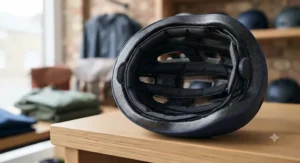
The analysis behind this table matters more than the numbers alone. Polycarbonate is injection-moulded as a single piece, which keeps manufacturing costs — and therefore purchase prices — dramatically lower than the labour-intensive layering process fibreglass and carbon shells require, without a corresponding drop in impact performance; several polycarbonate helmets in this guide match or beat pricier composite shells on independent SHARP testing. Where composite materials genuinely win is weight and, at the top end, marginally better heat dissipation on hot days, which matters more for high-mileage motorway commuters than for someone doing twenty minutes of stop-start town riding.
For most people reading this guide, the practical conclusion is straightforward: unless your commute regularly exceeds forty-five minutes at sustained speed, the weight saving of fibreglass or carbon rarely justifies the price jump, and polycarbonate remains the more rational choice.
Common Mistakes When You Buy a Polycarbonate Motorcycle Helmet
The single most common mistake is buying by head circumference alone without accounting for head shape — round, intermediate oval and long oval heads fit differently within the same stated size, and a helmet that measures “correct” on a tape can still create painful pressure points after twenty minutes. Try before you buy a polycarbonate motorcycle helmet wherever possible, and if buying online, check the manufacturer’s specific size chart rather than assuming sizes are standardised across brands.
A second frequent error is prioritising graphics and colourways over fit and features, then discovering after purchase that the plain-colour version was both cheaper and included the same specification. A third: assuming a helmet worn twice a week for a leisure ride will hold up the same way as one worn ten times a week commuting — daily use accelerates strap wear, liner compression and visor scratching, so budget helmets bought for occasional use often disappoint when pressed into full commuting duty. Finally, many riders skip checking the manufacture date sticker inside a new-old-stock helmet; EPS liners do degrade slowly even unused, so a helmet that’s sat in a warehouse for three years has less useful life ahead of it than the price might suggest.
Features That Actually Matter (And Those That Don’t)
Genuinely worth paying for: a Pinlock-ready visor (fog control on a commute is not optional in a British winter), an internal drop-down sun visor if you ride into low sun regularly, and multiple outer shell sizes, which improve fit across a size range far more than any amount of extra foam padding.
Largely marketing rather than substance for most commuters: elaborate spoiler designs promising aerodynamic gains that only matter above motorway speeds most urban riders rarely sustain, and premium paint finishes that add cost without touching the protective structure underneath. LED lighting systems like Shark’s Sharktooth sit in between — genuinely useful for dark winter commutes, but a legitimate optional extra rather than something to pay a premium for if your riding is entirely daylight hours.
Helmet Visibility and Urban Riding Safety
Helmet visibility is one of the few genuinely low-cost, high-impact safety upgrades available to any commuter, and UK guidance backs this up directly. The Highway Code’s rules for motorcyclists specifically advises riders to wear a light or brightly coloured helmet and reflective strips to improve how visible they are from the side as well as front and rear — a distinction that matters enormously in urban riding safety, since most collisions involving motorcyclists happen at junctions where a driver simply hasn’t registered a narrow silhouette approaching from an angle.
A white, fluorescent yellow or hi-viz-finish helmet genuinely does make a measurable difference in side-on conspicuity compared with matt black, and several helmets in this guide — including the HJC C10 and LS2 Storm II — are available in hi-viz colourways specifically for this reason. For riding after dark, reflective strips catch headlight beams from much further away than plain paint ever could, which is why the Highway Code separately recommends reflective clothing or strips specifically for night riding.
Beyond colour, the Shark D-Skwal‘s LED-ready shell represents the next step up in urban riding safety thinking: an active light source is visible in conditions where even the brightest passive colour struggles, particularly in low winter light or heavy rain when contrast against a grey sky drops dramatically. None of this replaces good positioning and defensive riding, but it stacks the odds meaningfully in your favour on every single commute.
Long-Term Cost & Maintenance of a Polycarbonate Shell
A polycarbonate helmet’s total cost of ownership extends well beyond the purchase price. Most manufacturers recommend replacement every five years regardless of visible damage, since UV exposure and general material fatigue reduce impact-absorbing performance gradually and invisibly — a helmet that looks pristine can still be past its safest working life. Budget roughly £15-£30 every year or two for a fresh Pinlock insert, and expect to replace the visor itself once scratches genuinely impair night-time visibility, typically £20-£45 depending on brand.
Cost-per-use tells a useful story here: a £90 helmet used daily for two years of commuting works out at roughly 12 pence per ride, cheaper than a single cup of coffee, which puts the “should I spend more” question into useful perspective. Where spending more genuinely pays off long-term is in reduced replacement frequency of consumables — better-quality liners and visor coatings on mid-range helmets like the LS2 Storm II or Nolan N60-6 tend to need replacing less often than the most basic budget options, narrowing the real-world cost gap over several years of ownership.
Frequently Asked Questions
❓ Is a polycarbonate helmet safe for commuting?
❓ How long does a polycarbonate motorcycle helmet last?
❓ What is the difference between a polycarbonate and fibreglass helmet?
❓ How much does a good polycarbonate full face helmet cost in the UK?
❓ Can I wear a polycarbonate helmet every day for commuting?
Conclusion
Picking a polycarbonate helmet for commuting really comes down to being honest about your own riding pattern rather than chasing the most expensive shell on the shelf. A twenty-minute urban hop to the office doesn’t need the same helmet as a forty-five-minute dual-carriageway slog through a British winter, and the seven helmets covered here — from the Vcan V151 at the budget floor to the Nolan N100-6 at the premium flip-front end — reflect that genuine spread of needs rather than a single “best” answer.
If pressed to pick one starting point, the MT Thunder 3 SV offers the strongest combination of independently verified safety data and real features for the money, while the HJC C10 wins on having the newest safety standard at an entry-level price. Whichever you choose, prioritise correct fit and current-standard approval over graphics and brand names, keep an eye on that five-year replacement clock, and remember that visibility — a light-coloured shell, reflective strips, dipped headlights in daylight — costs nothing extra but genuinely changes how safely you get seen on the road.
Recommended for You
- Injected Polycarbonate Helmet: 7 Best Picks for UK Riders 2026
- Cheap Polycarbonate Helmet Under £100: 7 Real 2026 Picks
- Multi-Fibre Helmet for Touring: 7 Best Composite Lids for 2026
Disclaimer: This article contains affiliate links. As an Amazon Associate, I earn from qualifying purchases. If you purchase products through these links, we may earn a small commission at no additional cost to you.
✨ Found this helpful? Share it with your friends! 💬🤗
