

In This Article
There’s a peculiarly British problem with motorcycling. You’ve organised a group run with your mates, mapped a glorious route through the Peak District or the Brecon Beacons, and fifteen minutes in — someone’s missed the turning, someone else is having a crisis with their satnav, and you’ve got absolutely no way to tell anyone without pulling over, removing your gloves, and frantically waving. Sound familiar?

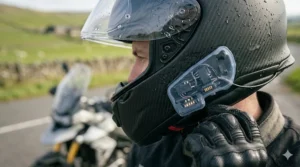
An intercom ready motorcycle helmet solves exactly that. In the simplest terms, it’s a helmet engineered from the ground up to accommodate a Bluetooth communication system — not as an afterthought, but as a genuine design priority. We’re talking pre-cut speaker pockets in precisely the right positions, routed cable channels hidden within the liner, microphone slots in the chin bar, and mounting points on the exterior shell that don’t compromise the helmet’s structural integrity or its ECE 22.06 certification. That last part matters more than most riders realise, and we’ll get into it shortly.
What separates a truly intercom ready motorcycle helmet from a standard lid with some speaker cavities bodged in is the level of integration. The better helmets in this category — the Shoei Neotec 3, the Schuberth C5 — are designed in active collaboration with brands like Sena and Cardo, meaning the comms system fits like it was born there. No rattling. No wind noise funnelled through poorly sealed gaps. No cable chafing against your cheek at 60 mph on the A1.
In 2026, group communication helmet technology has matured considerably. Mesh networking now connects up to eight riders seamlessly; noise cancellation has become genuinely impressive. Whether you’re a weekend tourer, a daily commuter navigating Manchester’s ring roads, or someone planning a multi-day run from Edinburgh to Cornwall, investing in the right lid is the difference between a ride you remember fondly and one you endure in frustrating silence.
This guide covers seven helmets available to UK buyers, all verified for Amazon.co.uk availability, all ECE 22.06 certified, and all reviewed with an honest eye on what they’re actually like to use on damp British roads.
Quick Comparison Table: Intercom Ready Motorcycle Helmets UK 2026
| Helmet | Type | Intercom System | Price Range (GBP) | SHARP Rating | Best For |
|---|---|---|---|---|---|
| Shoei Neotec 3 | Modular | Sena SRL3 | £590–£650 | 5-Star | Premium touring |
| Schuberth C5 | Modular | SC2 (Sena) | £520–£580 | 4-Star | Quiet distance riding |
| HJC RPHA 91 | Modular | SmartHJC/Sena | £300–£380 | 4-Star | Value-premium |
| HJC i91 | Modular | SmartHJC Sena | £200–£260 | N/A | Budget modular |
| LS2 Valiant II | Flip-Over | Universal | £200–£270 | N/A | Flexible everyday use |
| Shark EVO GT | Flip-Over | Sharktooth system | £290–£380 | N/A | Urban commuting |
| Nolan N100-6 | Modular | N-Com B901 R | £340–£450 | N/A | Italian style + function |
From the table above, the pattern is telling: the Shoei and Schuberth sit comfortably at the premium end with genuinely integrated systems, while HJC punches hard in the mid-range with the RPHA 91 representing arguably the best value for serious riders. The flip-over designs from LS2 and Shark offer a different kind of flexibility — useful in stop-start urban riding where you’re frequently chatting at lights or fuel stops without removing the whole lid. Worth noting that SHARP ratings aren’t available for every model (some international brands choose not to submit), but the SHARP safety programme, run by the UK’s Department for Transport, remains the most reliable independent benchmark for British buyers.
💬 Just one click — help others make better buying decisions too! 😊
✨ Don’t Miss These Exclusive Deals!
🔍 Take your group riding experience to the next level with these carefully selected helmets. Click any highlighted product name to check current pricing and availability on Amazon.co.uk. These picks have been chosen to suit every budget and riding style.
Top 7 Intercom Ready Motorcycle Helmets: Expert Analysis
1. Shoei Neotec 3 — The Benchmark Modular
The Neotec 3 is what happens when a helmet manufacturer takes rider communication seriously enough to co-engineer the entire system alongside the helmet, not bolt something on afterwards. It’s Shoei’s best-selling flip-front, and the 2025 revision made it even quieter through redesigned vents, closer-fitting cheek pads, and re-engineered chin switches that reduce wind turbulence at motorway speeds.
The key intercom spec is compatibility with the Sena SRL3 — a dedicated system offering both Mesh Intercom and Bluetooth 5.0, connecting up to 24 riders simultaneously. That’s not a small group ride; that’s an organised club run. The speakers sit in precisely moulded pockets, the boom microphone tucks into the chin bar without creating a pressure point, and the whole installation takes about twenty minutes. In terms of noise management, the Neotec 3 isn’t the absolute quietest modular available (the Schuberth C5 narrowly wins that crown), but its 5-star SHARP rating means it leads the pack for certified impact protection — an important distinction when buying at this price point.
Who is this for? The touring rider who logs serious miles — the type who rides from the Home Counties to the Scottish Highlands twice a year, wants crystal-clear group communication at 65 mph on the M6, and won’t accept compromise on safety certification. At this price range, fit should be the deciding factor over brand loyalty; Shoei’s interior geometry favours slightly longer oval head shapes, so try before you commit if at all possible.
UK reviewers on Amazon consistently praise the chin-bar mechanism as reassuringly solid, noting the build quality feels genuinely premium — “worth every penny for extended touring,” as one Lake District regular put it.
✅ Pros: 5-Star SHARP rating, excellent SRL3 mesh integration, outstanding build quality
✅ Pros: Pinlock Evo anti-fog visor included (vital for British weather)
✅ Pros: Five-year warranty via UK-authorised retailers
❌ Cons: Premium price point; heavier than some competitors at ~1,732g in medium
❌ Cons: SRL3 comms system is an additional significant investment
Price range: £590–£650 for the helmet alone — SRL3 system sold separately. A genuine investment, but one that pays dividends over years of use.

2. Schuberth C5 — The Quietest Road in Britain
If you’ve ever pulled up at a service station after three hours on the motorway and felt that peculiar tiredness that has nothing to do with driving — it’s wind noise fatigue. The Schuberth C5 addresses this more aggressively than almost any other modular helmet on the UK market. Remarkably, it’s also one of the few helmets to come with the intercom preparation hardware already installed from the factory: speakers, wiring, and antenna are built in, ready for the SC2 system (Sena-powered) to simply click into place.
That’s a meaningful advantage. Most intercom ready helmets still require you to route cables and position speakers yourself. The C5 removes that entirely — which matters on a wet Sunday in November when you’d rather not be fiddling with your lid in the garage. The SC2 offers Bluetooth and full Mesh connectivity for multi-rider group communication helmet scenarios, and Schuberth has announced additional compatibility with Cardo-based systems, giving buyers flexibility should your riding group favour a different platform.
The C5 holds ECE 22.06 certification and earns a solid 4-star SHARP rating. It fits a slightly rounder head oval than the Shoei, making it the natural choice for riders who’ve found Shoei products too narrow around the temples. UK touring riders consistently rank it as exceptional for comfort on extended runs — partly the premium lining, partly the wind-sealing geometry, partly the Pinlock 120 insert (included in the box) that genuinely eliminates visor fogging even in a Welsh November drizzle.
Who is this for? Long-distance tourers, particularly those planning overnight trips or multi-day routes, who prioritise comfort and quiet above all else and want the least fuss possible when setting up their communication system.
✅ Pros: Pre-installed intercom hardware; genuinely the quietest modular available
✅ Pros: Pinlock 120 (top-tier anti-fog) included; premium interior materials
✅ Pros: Supports both Sena and Cardo systems
❌ Cons: 4-star rather than 5-star SHARP rating compared to Neotec 3
❌ Cons: SC2 communication system is a significant additional cost
Price range: £520–£580 — impressive value when you consider the pre-installed hardware alone saves installation time and reduces fitment risk.
3. HJC RPHA 91 — The Smart Middle Ground
The RPHA 91 occupies a position that makes a lot of financial sense for British riders: premium engineering without the premium price tag of the German and Japanese flagships. The shell construction uses a proprietary PIM+ (Premium Integrated Matrix) composite — woven fibreglass reinforced with carbon and Dyneema — which keeps the weight down while maintaining the rigidity that matters in an impact. For a modular helmet, weight is always a compromise, and the RPHA 91 manages it better than most.
The intercom ready story here involves dedicated HJC SmartHJC Sena integration, with speaker pockets positioned for the system’s audio profile, cable channels routed through the liner, and a microphone slot in the chin bar. Independent compatibility with other systems (Cardo, standard Sena units) is also possible, though the manufacturer-matched system genuinely sounds better due to the speaker pocket geometry being tuned to those specific drivers.
What most UK buyers overlook about this model is the three-step internal sun visor — it’s adjustable to a degree that surprisingly few helmets achieve, which matters enormously on those low-sun late afternoon autumn rides through Surrey or the Cotswolds when the golden light sits precisely at visor height and turns your commute into a temporary adventure in blindness.
UK riders on Amazon.co.uk rate the RPHA 91 highly for comfort over three to four-hour rides, with particular praise for the moisture-wicking liner performance — important for anything more than a short summer jaunt.
✅ Pros: Excellent value; strong composite shell for the price
✅ Pros: Emergency cheek pad release system for first responders
✅ Pros: 4-Star SHARP rating; ECE 22.06 certified
❌ Cons: Less refined interior finish than Shoei or Schuberth at this price range
❌ Cons: Leans toward a rounded oval fit — may not suit longer oval head shapes
Price range: £300–£380, making it the standout choice for riders who want genuine premium-tier engineering without spending flagship prices.
4. HJC i91 — The Budget Modular Done Right
The i91 is the entry-level cousin in HJC’s modular range, and it’s worth discussing honestly: this is not a helmet that pretends to be something it isn’t. The polycarbonate composite shell is heavier and less aerodynamically refined than the RPHA 91’s composite construction, and you’ll notice it on longer runs. But for riders who primarily commute — think the M60 ring road in Manchester or the A406 North Circular in London — where rides rarely exceed ninety minutes and convenience matters more than weight optimisation, the i91 makes compelling sense.
The intercom credentials remain solid. Speaker pockets are purpose-built for the SmartHJC Sena system, cable channels are properly routed, and the chin bar microphone slot is cleanly integrated. The dynamic HJ-V12 sun visor drops cleanly via a left-hand thumb slider, eliminating the need for sunglasses on variable British days — and we do love a variable British day. What makes the i91 particularly sensible for urban riders is the chin-bar mechanism: it operates smoothly with one gloved hand, which matters when you’re stopping at pedestrian crossings in Soho or filtering through city traffic.
UK Amazon customers highlight the liner comfort as a genuine strength relative to the price, and the ventilation as adequate for everything except genuinely hot summer riding. At this price, in this climate, that’s a fair trade.
✅ Pros: Excellent price-to-features ratio; proper speaker pocket integration
✅ Pros: Clean sun visor operation; ECE 22.06 certified
✅ Pros: Prime-eligible on Amazon.co.uk for next-day delivery
❌ Cons: Heavier polycarbonate shell; not ideal for long-distance touring
❌ Cons: Less wind noise suppression than higher-tier models
Price range: £200–£260 — the most affordable genuine intercom ready entry point in this guide.
5. LS2 Valiant II — The Flip-Over Wildcard
The LS2 Valiant II takes a different architectural approach from conventional modular helmets. Rather than a chin bar that flips up (leaving you with a half-face profile), the Valiant II’s entire front section — chin bar and visor together — rotates rearward over the crown of the helmet. The result is a genuinely open-face helmet when deployed, which some riders find more comfortable for urban stops and petrol station conversations. It’s also rather useful for riders who wear spectacles and struggle with the smaller visor aperture of standard open-face positions.
For rider to rider communication helmet purposes, the Valiant II accepts universal Bluetooth systems — Sena, Cardo, Midland — through its speaker pockets and chin bar microphone slots. LS2’s own communication system is also compatible. The flip-over design does create slightly more aerodynamic noise at higher motorway speeds than a fixed-chin modular, so it’s genuinely best suited to mixed urban and A-road riding rather than sustained motorway touring.
The shell uses LS2’s KPA (Kinetic Polymer Alloy) composite, which delivers a good balance of weight and impact absorption. The Valiant II holds ECE 22.06 approval, is available across a wide size range on Amazon.co.uk, and comes in several colourways that don’t make you look like you’re wearing a traffic cone — an underrated criterion, frankly.
UK riders note the liner quality as a genuine highlight at this price point, describing it as “properly comfy for a two-hour run across the Pennines” in Amazon reviews.
✅ Pros: Unique flip-over design; genuine full open-face when deployed
✅ Pros: Excellent value; universal intercom compatibility
✅ Pros: Wide size range; good liner quality
❌ Cons: More aerodynamic noise at motorway speeds than conventional modulars
❌ Cons: Rotating mechanism adds complexity compared to traditional flip-front
Price range: £200–£270 — outstanding value for a genuinely clever design.

6. Shark EVO GT — Urban Commuting’s Best Friend
Shark is a French brand with a sensible approach to motorcycle helmets that suits the British market rather well: practical, well-priced, and quietly clever. The EVO GT is their premium flip-over offering, and it competes directly with the LS2 Valiant II whilst bringing a more refined interior and slightly more aggressive aerodynamic profile that reduces wind buffeting noticeably at speed.
The intercom story involves compatibility with the Sharktooth communication system, which integrates through dedicated speaker pockets and a pre-routed cable system. Universal comms (Sena, Cardo) are also supported, and most UK riders seem to pair it with Cardo products — the combination works well. Passenger intercom helmet scenarios are covered by the Sharktooth’s two-unit pairing, which performs reliably at up to about 800 metres range in open conditions, somewhat less when navigating city blocks.
What stands out about the EVO GT is the quality of the flip-over mechanism itself. Shark has engineered a positive click in both the closed and fully rotated positions, eliminating that slight wobble you sometimes feel in cheaper flip-over designs. The sun visor drops via a smooth slider, the ventilation moves meaningful air even at lower speeds, and the ECE 22.06 certification is current.
For London commuters dealing with ULEZ zones and frequent stop-start riding, the convenience of a flip-over design paired with reliable multi-rider communication genuinely improves daily riding quality.
✅ Pros: Refined flip mechanism; well-positioned for urban commuting
✅ Pros: Good aerodynamic profile; compatible with major comms brands
✅ Pros: ECE 22.06 certified; strong build quality relative to price
❌ Cons: Sharktooth system not as feature-rich as Sena/Cardo flagship units
❌ Cons: Wind noise marginally higher than fixed-chin modulars at sustained speed
Price range: £290–£380 — a thoughtful choice for riders who split their time between city commuting and weekend runs.
7. Nolan N100-6 — The Italian Thoroughbred
Nolan has been making motorcycle helmets since 1972 in Bergamo, Italy, and the N100-6 carries that heritage into the ECE 22.06 era with characteristic Italian pragmatism: it’s not flashy, but it’s impressively well-engineered for what it costs. The N100-6 holds dual homologation — certified for use as both a full-face and open-face helmet — which is actually a meaningfully useful real-world feature rather than a marketing claim. Many UK riders use the chin-bar-open position on slow-speed rural lanes, so having legal open-face homologation provides genuine reassurance.
The intercom credentials are built around Nolan’s own N-Com B901 R system, a Bluetooth and mesh communications platform that connects up to eight riders. The integration is impressive: the mounting bracket sits flush against the chin bar, the speakers fit the pre-cut pockets precisely, and cable management through the liner is cleaner than many competitors at this price. The N-Com system also pairs with a dedicated intercom app, offering music streaming, phone calls, and GPS audio alongside rider to rider communication without the need for external pairing gymnastics.
The polycarbonate shell is heavier than composite alternatives — Nolan is transparent about this trade-off, positioning the N100-6 as a comfort-and-features proposition rather than an ultralight performance option. For riders who prioritise multi-rider communication helmet functionality, Italian craftsmanship, and a five-year manufacturer warranty available through UK retailers, it’s a well-rounded proposition.
UK Amazon reviewers frequently mention the liner comfort as exceptional, particularly for riders with slightly wider face profiles who find Japanese-brand helmets (Shoei, HJC) too narrow in the temples.
✅ Pros: Dual homologation; excellent N-Com integration; five-year warranty
✅ Pros: Wide face accommodation; strong comfort over distance
✅ Pros: Available with UK warranty support through authorised retailers
❌ Cons: Heavier polycarbonate shell; less aerodynamically refined than composite competitors
❌ Cons: N-Com system proprietary — less cross-compatible than Sena/Cardo
Price range: £340–£450 — solid value from a brand with genuine depth of experience.
How to Set Up Your Intercom Ready Helmet: A UK Rider’s Practical Guide
Getting your intercom system installed correctly is where a lot of riders go wrong — and it’s where the difference between an intercom ready helmet and a standard lid with some holes in it becomes starkly obvious. Here’s how to do it properly.
Step 1 — Check compatibility before purchasing. This sounds obvious, but it isn’t. Since ECE 22.06 tightened the rules around accessories fitted to certified helmets, there’s now a genuine legal and safety consideration here. As Bennetts’ BikeSocial reported, an intercom must be specifically designed for your helmet model or hold ‘UA’ (Universal Accessory) certification to guarantee you’re not voiding the helmet’s homologation. The Shoei Neotec 3 with SRL3 and the Schuberth C5 with SC2 are manufacturer-paired examples; they’re co-engineered and legally sound.
Step 2 — Remove the liner and cheek pads carefully. Almost all intercom ready helmets in 2026 use a press-stud or press-and-slide system. Work methodically — don’t force anything. Lay the liner flat somewhere clean.
Step 3 — Route cable through dedicated channels. This is where the engineering of an intercom ready helmet reveals its value. Proper cable channels run from speaker cavities through to the chin bar microphone slot, with exit points designed to minimise cable exposure. On cheaper helmets without these channels, you’re improvising — and improvised cable routing creates wind noise and potential interference with the retention system.
Step 4 — Position speakers in the pockets. Don’t just drop them in. The speaker cavity geometry in a properly designed helmet positions the driver at the correct angle relative to your ear canal. Take a moment to ensure they’re seated correctly — it makes a notable difference to audio quality at speed.
Step 5 — Test before your first group ride. Pair to your phone in a quiet environment, calibrate the volume, and check the voice command trigger (most modern systems support it). British roads in the rain are not the place to discover your microphone isn’t seated correctly.
Wet weather note: British conditions being what they are, apply a light bead of silicone sealant around the external clamp housing before your first wet ride. Most systems carry an IPX4 or IPX5 water resistance rating, which handles rain perfectly well, but the helmet-to-clamp interface occasionally allows water ingress that the manufacturer’s rating doesn’t account for.

Choosing the Right Intercom Ready Helmet for Your Riding Style
Not all group communication helmet needs are equal. A weekend tourer has fundamentally different requirements from a daily London commuter or a pillion-carrying rider. Here’s a practical decision framework.
If you primarily tour solo or in pairs: The Schuberth C5 is your strongest option. The pre-installed hardware eliminates setup friction, the noise suppression reduces fatigue on long motorway sections, and the Pinlock 120 visor insert handles everything British weather can throw at a visor — which is considerable. If you find the Schuberth’s price difficult to justify, the Shoei Neotec 3 offers higher SHARP safety certification and exceptional build quality at a similar investment level.
If you organise or join group runs regularly (four or more riders): Prioritise Mesh intercom compatibility. The HJC RPHA 91 with the SmartHJC Sena system connects multiple riders on a Mesh network, which is categorically more reliable in group scenarios than point-to-point Bluetooth daisy-chaining. Mesh doesn’t drop out when the rider at the front turns a corner; Bluetooth sometimes does. This is not a theoretical difference — any rider who’s been cut off mid-conversation on a sweeping A-road bend will confirm it emphatically.
If you’re a daily urban commuter: The Shark EVO GT or LS2 Valiant II’s flip-over design offers practical advantages that touring riders might overlook. Stopping frequently — at crossings, in traffic, at the office — benefits enormously from the ability to flip the entire front section without disrupting your eye protection. Add a decent entry-level Cardo comms unit and you have a genuinely practical passenger intercom helmet setup for riding two-up through city traffic.
If budget is the governing consideration: The HJC i91 at the lower end of this guide delivers genuinely proper intercom ready credentials at the most accessible price point. Don’t assume budget means compromised safety — ECE 22.06 certification applies regardless of price, and that’s the minimum legal requirement for helmets sold in Great Britain, as confirmed by DVSA guidance.
The ECE 22.06 Question: What UK Riders Must Know About Intercom Legality
Here’s something the product listings generally don’t tell you, and it’s genuinely important.
ECE 22.06 — the current mandatory helmet safety standard in Great Britain — introduced tighter rules around accessories fitted to certified helmets. The Department for Transport’s SHARP programme rates helmets based on their certified configuration. Fit an intercom system that wasn’t specifically designed and tested for your helmet model, and you may technically be operating outside the certification parameters of your lid.
The practical reality for most UK riders: the grey area is real, and the enforcement situation remains unclear. As Bennetts’ BikeSocial noted in their investigation, an eagle-eyed officer could theoretically challenge a fitment that doesn’t meet the new standard, though widespread enforcement hasn’t yet materialised. The safest position — legally and practically — is to choose manufacturer-paired systems. The Shoei Neotec 3/SRL3, Schuberth C5/SC2, and Nolan N100-6/N-Com B901 R combinations are all co-engineered, co-tested, and co-certified. They represent the cleanest legal position currently available.
What about the ‘UA’ (Universal Accessory) certification that ECE 22.06 introduced? This allows manufacturers to certify their helmets for use with any intercom meeting a defined set of criteria, rather than only brand-matched systems. Schuberth’s 2025 ‘Concept’ helmet was the first to achieve UA certification — a meaningful innovation that will likely expand across the market over the next two to three years as intercom brands pursue the complementary certifications. For now, manufacturer-paired systems remain the safest approach for UK buyers who want zero ambiguity.
The spec sheet won’t tell you any of this. Which is precisely why it’s worth knowing before you spend several hundred pounds on a combination that turns out to be legally uncertain.
Common Mistakes UK Buyers Make When Choosing an Intercom Ready Helmet
Buying the helmet without budgeting for the comms system. The intercom ready helmet is the vessel; the comms system is the engine. These are separate purchases, and at the premium end, the Sena SRL3 or Cardo Packtalk Edge adds hundreds of pounds to your total investment. Plan the full budget before committing to a helmet.
Choosing a US-spec product. Several popular intercom-equipped helmets have different model designations for the UK market, and ECE 22.06 certification only guarantees compliance with European (and post-Brexit British) standards. DOT-only certified helmets are not legal for road use in Great Britain. Always verify ECE 22.06 before purchasing from any source, including Amazon.co.uk — most listings are correctly certified, but it’s worth confirming.
Ignoring head shape. An intercom ready helmet that fits poorly is worse than a well-fitted standard helmet by every measure: comfort, safety retention, noise suppression, and visor seal. Shoei fits a slightly longer oval; Schuberth suits rounder heads; Nolan accommodates wider faces. If at all possible, try before you buy. If buying online, check the retailer’s return policy — under Consumer Contracts Regulations, you have a 14-day cooling-off period for online purchases, which provides meaningful protection.
Underestimating UK weather impact on electronics. The Bluetooth units on all helmets in this guide carry water resistance ratings, but repeated heavy rain cycling can degrade seals over time. Remove your comms unit if the helmet is stored in a damp garage (which, let’s be honest, describes most British garages) and store it indoors. A small tube of silicone around external mounting points once a year takes five minutes and adds years to the unit’s life.
Buying an intercom designed for a different helmet. This loops back to the ECE 22.06 concern. The Which? consumer advice is clear on consumer rights if a product causes damage to another product, but that’s cold comfort if you’ve compromised your helmet’s safety certification in the meantime. Stick to manufacturer-recommended or UA-certified pairings.
Intercom Ready vs Standard Helmet: Does the Premium Make Sense?
A reasonable question, and worth treating honestly. A standard motorcycle helmet with speaker pockets — the kind where you improvise with adhesive-backed foam and cable ties — costs less and, in many cases, passes ECE 22.06 certification. So why spend the additional money on a genuinely intercom ready design?
Three reasons.
First, audio quality is measurably better. Speaker pockets engineered for specific drivers position the audio at the correct angle and distance from your ear canal. Improvised installations frequently result in speakers that point slightly away from the ear, losing substantial volume at speed — where you need it most.
Second, safety certification integrity. As discussed, the ECE 22.06 landscape around accessories is evolving, and manufacturer-certified intercom pairings represent the cleanest legal position. For riders who’ve invested significant money in premium helmets, protecting that certification makes financial and safety sense simultaneously.
Third, noise management. A properly integrated system seals gaps that improvised installations leave open. Every millimetre of unsealed gap in a helmet’s interior is a wind noise channel at motorway speeds. The cumulative effect across a three-hour motorway run — London to the Lake District, say — is genuinely significant in terms of rider fatigue.
The trade-off in GBP terms is real: a properly integrated setup from the Shoei or Schuberth end of this guide will cost considerably more than a mid-range helmet with a budget comms unit cable-tied to the exterior. But the total cost of ownership calculation shifts when you factor in longevity, legal clarity, and the simple fact that a well-designed system works reliably for years. Cheap comms units have a habit of failing at inconvenient moments — specifically, on group rides in places with limited phone signal and no nearby motorcycle dealer.
Frequently Asked Questions
❓ Are intercom ready motorcycle helmets legal on UK roads?
❓ How many riders can connect using group touring communication systems?
❓ Can I fit any Bluetooth comms system to any intercom ready helmet?
❓ What price should I expect to pay for a decent intercom ready motorcycle helmet in the UK?
❓ Do intercom ready helmets work in the rain? What's the situation with UK weather?
Conclusion: The Right Intercom Ready Helmet for British Roads
The days of hand-waving, tank-slapping, or pulling over to confer with your group are — genuinely, finally — behind us. A well-chosen intercom ready motorcycle helmet transforms group riding from an exercise in hopeful guesswork into something that actually resembles coordinated navigation. Which is particularly useful when three of your group have contradictory opinions about the best route through the Yorkshire Dales.
The Shoei Neotec 3 earns the top recommendation for riders who prioritise safety certification and premium engineering, while the Schuberth C5 is the standout choice for those chasing comfort and quiet over long distances. The HJC RPHA 91 offers the most compelling value proposition in the mid-range, and the HJC i91 makes proper intercom integration accessible without a significant financial commitment.
Whatever you choose, prioritise fit above everything else. A 5-star SHARP helmet that doesn’t fit your head is less safe than a 4-star helmet worn correctly. Check sizing carefully, use the 14-day Consumer Contracts return window if you need to, and take the ECE 22.06 compatibility of your comms system seriously. British roads are, in their wet and winding way, genuinely worth experiencing properly — and good communication makes every shared mile better.
✨ Ready to Ride Connected?
🔍 Check current pricing and Amazon.co.uk availability on all helmets listed above by clicking the product names throughout this guide. Happy to help if you have questions in the comments!
Recommended for You
- Best Motorcycle Vlogging Helmet UK 2026: Top 7 Picks Reviewed
- Best Helmet Camera Integrated: Top 7 Picks for UK Riders 2026
- Best GoPro Ready Motorcycle Helmet UK 2026: Top 7 Picks Reviewed
Disclaimer: This article contains affiliate links. As an Amazon Associate, I earn from qualifying purchases. If you purchase products through these links, we may earn a small commission at no additional cost to you.
✨ Found this helpful? Share it with your mates! 💬🤗
