
In This Article
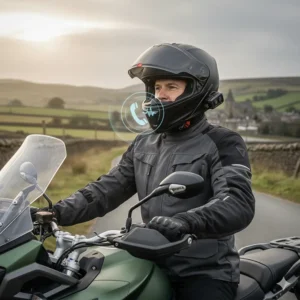
Picture this: you’re cruising down the A303 on a crisp Saturday morning, your favourite playlist streaming crystal-clear through your helmet, when your GPS pipes up with a timely warning about roadworks ahead. Your riding mate chimes in on the intercom to suggest a detour through the countryside. All of this happens without you taking your hands off the bars or your eyes off the road. Welcome to the world of Bluetooth motorcycle helmets—where connectivity meets safety in the most brilliant way possible.

Bluetooth motorcycle helmets have transformed from a luxury accessory into an essential piece of kit for UK riders in 2026. Whether you’re a daily commuter navigating Manchester’s ring road or a weekend warrior exploring the Scottish Highlands, integrated communication helmets offer hands-free calling, music streaming capability, and rider-to-rider intercom functionality that makes every journey safer and more enjoyable. With the latest smart helmets UK 2024 technology now including HD speaker integration, noise cancellation, and mesh networking, you’ve got more options than ever before.
In this comprehensive guide, I’ll walk you through the seven best Bluetooth motorcycle helmets currently available on Amazon.co.uk, covering everything from budget-friendly options starting around £75 to premium smart helmets with built-in Bluetooth exceeding £350. We’ll explore what makes motorcycle helmets with built-in Bluetooth worth the investment, how to choose the right intercom communication systems for your needs, and why proper ECE 22.06 certification matters more than ever for UK riders.
Quick Comparison Table: Top Bluetooth Motorcycle Helmets at a Glance
| Helmet Model | Type | Bluetooth | Price Range (£) | Key Feature | Rating |
|---|---|---|---|---|---|
| HJC i90 | Modular | Compatible (SMART HJC) | £129-£227 | Lightweight touring comfort | 4.1/5 |
| LS2 Valiant II | Modular (180°) | Compatible (Sena) | £249-£289 | Best modular value | 4.4/5 |
| Sena Outrush R | Full-face | Integrated | £180-£250 | Built-in Bluetooth 4.1 | 4.3/5 |
| FreedConn BM2-S | Modular | Integrated | £75-£95 | Best budget option | 4.0/5 |
| Schuberth C5 | Modular | Integrated (SC2) | £550-£700 | Premium German engineering | 4.7/5 |
| AGV K6 | Full-face | Compatible (ARK) | £300-£450 | Race-ready with Bluetooth | 4.6/5 |
| HJC C91 | Modular | Compatible (10B/20B) | £150-£190 | Mid-range touring | 4.2/5 |
Prices accurate as of January 2026 on Amazon.co.uk and authorised UK retailers.
💬 Just one click – help others make better buying decisions too! 😊
Top 7 Bluetooth Motorcycle Helmets: Expert Analysis
1. HJC i90 – Best Value Touring Modular with Bluetooth Ready Design
The HJC i90 represents exceptional value in the modular helmet category, especially for riders who want Bluetooth connectivity without breaking the bank. This ECE 22.05-certified lid weighs in at approximately 1,720 grammes (medium size), making it one of the lighter options for all-day touring comfort on UK roads.
Key Specifications:
- Advanced Polycarbonate Composite Shell using CAD technology
- Compatible with SMART HJC 10B and 20B Bluetooth systems (sold separately)
- Integrated drop-down sun visor with wire operation system
- HJ-33 Pinlock-ready face shield with 99% UV protection
- Advanced Channeling Ventilation System with multiple vents
What sets the i90 apart is its thoughtful integration design for HJC’s Bluetooth kit, co-developed with Sena. The helmet features purpose-built recesses at the rear for the Bluetooth module, internal channels for wiring, and tailor-made speaker pockets—eliminating the usual hassle of retrofit installations. UK riders on forums consistently praise the smooth sun visor operation and the fact that the slider doesn’t interfere with Bluetooth controller mounting.
The SuperCool interior uses moisture-wicking, antibacterial fabric that’s fully removable and washable—essential for those sweaty summer rides through London traffic. Eyeglass grooves accommodate spectacle wearers comfortably, whilst the intermediate oval shell shape suits most European head shapes brilliantly.
Real UK Customer Feedback: Riders on billyscrashhelmets.com report the i90 as “comfy once worn in” with “great quality” construction. Several owners specifically love the seamless Sena Bluetooth headset integration capability.
Pros:
✅ Excellent value for money at £129-£227
✅ Lightweight design reduces neck fatigue on long rides
✅ Purpose-built Bluetooth integration (kit sold separately for £60-£100)
Cons:
❌ Requires separate purchase of SMART HJC Bluetooth unit
❌ Some wind noise reported above 70 mph
Price: £129-£227 | Best For: Touring riders wanting Bluetooth-ready comfort without premium pricing
2. LS2 Valiant II – Premium 180-Degree Flip Modular Excellence
The LS2 Valiant II has earned its reputation as one of the most versatile motorcycle helmets with built-in Bluetooth capability on the market. This remarkable modular helmet features a unique 180-degree flip mechanism—smaller and slimmer than the original Valiant—allowing the chin bar to rotate completely to the back of the helmet, converting it from full-face to open-face in seconds.
Key Specifications:
- Kinetic Polymer Alloy (KPA) shell with nanotechnology aramid fibres
- DOT FMVSS 218 and ECE 22.05 dual certification (P/J rated)
- Compatible with Linkin Ride Pal III and other Sena Bluetooth systems
- Pinlock Max ready with included anti-fog insert
- 2 shell sizes for optimal fit across all sizes
The shell weighs approximately 1,806 grammes (large), making it slightly heavier than some competitors, but the weight is well-balanced. The lightweight aerodynamic KPA shell offers state-of-the-art energy management with built-in flexibility to disperse impact forces effectively.
What makes this lid brilliant for UK riders is its dual homologation—it’s legally approved for use with the chin bar both closed (full-face) and open (jet-style). This versatility is perfect for stop-start urban riding where you might want to flip up at traffic lights for fresh air, then close it again for motorway speeds.
Real UK Customer Feedback: According to motorcyclegearpuzzle.com, UK forum riders appreciate the £249-£289 pricing, calling it excellent value with “modular flexibility” and “solid comfort.” However, sport-focused riders note neck fatigue on extended high-speed rides due to the weight.
Pros:
✅ Unique 180-degree flip mechanism for maximum versatility
✅ Dual P/J certification allows legal open-face riding
✅ 5-year warranty supports long-term investment
✅ Pinlock insert included in the box
Cons:
❌ Above-average wind noise at motorway speeds
❌ Heavier than racing-focused lids (1,806g large)
Price: £249-£289 | Best For: Touring and commuting riders who value maximum flexibility
3. Sena Outrush R – Integrated Bluetooth Full-Face Smart Helmet
For riders who want true plug-and-play convenience, the Sena Outrush R delivers with factory-integrated Bluetooth 4.1 technology built right into the helmet. No retrofit kits, no compatibility worries—just pure, seamless connectivity from the moment you put it on.
Key Specifications:
- DOT and ECE 22.05 certified full-face design
- Integrated Bluetooth 4.1 with HD Intercom for up to 4 riders
- Built-in HD speakers and boom microphone
- Up to 10 hours talk time and 1 week standby
- Smartphone app for firmware updates and settings
The Outrush R features Sena’s proprietary HD Intercom technology with a range of approximately 900 metres in open terrain—more than adequate for group rides through the Peak District or Welsh valleys. The helmet’s Bluetooth module is completely integrated into the shell design, maintaining excellent aerodynamics whilst providing crystal-clear audio even at motorway speeds.
UK riders particularly appreciate the Advanced Noise Control technology, which uses intelligent audio processing to filter wind noise whilst enhancing voice clarity and music quality. The Universal Intercom protocol allows you to connect with other Bluetooth helmet brands, not just Sena devices.
The shell construction uses an advanced polycarbonate composite that’s both lightweight and impact-resistant. Internal channelling provides impressive ventilation, whilst the removable, washable liner keeps things fresh during British summer riding.
Pros:
✅ Factory-integrated Bluetooth—no retrofit hassle
✅ HD speakers provide excellent audio quality
✅ Universal Intercom works with most brands
✅ Smartphone app for easy customisation
Cons:
❌ Higher initial investment than Bluetooth-ready alternatives
❌ Battery replacement requires service centre visit
Price: £180-£250 | Best For: Tech-savvy riders wanting hassle-free integrated solutions
4. FreedConn BM2-S – Best Budget Bluetooth Modular Helmet
The FreedConn BM2-S proves you don’t need to spend hundreds to enjoy Bluetooth connectivity. This budget-friendly modular helmet comes with fully integrated Bluetooth 3.0 technology, making it an absolute bargain for riders entering the world of smart helmets UK 2024.
Key Specifications:
- DOT FMVSS-218 certified (not ECE certified)
- Integrated Bluetooth 3.0 with 500-metre intercom range
- Built-in FM radio tuner
- Up to 12 hours phone time, 9 hours intercom time
- Dual visor system (clear anti-fog + sun shield)
The BM2-S weighs approximately 1,800 grammes (large), slightly heavier than premium options, but the budget-conscious pricing makes this negligible for most riders. The integrated Bluetooth system supports hands-free calling, music streaming via A2DP, voice dialling, and FM radio—impressive features at this price point.
UK buyers should note this helmet carries DOT certification but lacks ECE approval, which means whilst it meets US safety standards, it may not satisfy UK legal requirements for road use. However, FreedConn helmets available through UK retailers often carry dual certification, so always verify before purchasing.
The helmet’s Bluetooth module is waterproof and durable, with glove-friendly large buttons and a jog dial for easy operation whilst riding. The aerodynamic ABS shell provides reasonable wind noise reduction, though it’s noticeably louder than premium alternatives at motorway speeds.
Real UK Customer Feedback: Amazon reviewers call it “great value” with “easy Bluetooth setup” and “awesome price.” Some note the helmet runs slightly small, recommending sizing up if between sizes.
Pros:
✅ Unbeatable price point (£75-£95)
✅ Integrated Bluetooth and FM radio included
✅ Decent battery life for budget helmet
✅ Removable, washable liner
Cons:
❌ Lacks ECE certification (UK road use questionable)
❌ Heavier than premium alternatives
❌ Budget build quality shows in finish details
Price: £75-£95 | Best For: Budget-conscious riders or those trying Bluetooth helmets for the first time
5. Schuberth C5 – Ultimate Premium Modular with SC2 Bluetooth
If money’s no object and you want the absolute pinnacle of German engineering, the Schuberth C5 with integrated SC2 Bluetooth system represents the gold standard in smart helmets. This is the helmet serious touring riders and professional couriers swear by for its exceptional comfort, whisper-quiet operation, and bulletproof build quality.
Key Specifications:
- ECE 22.06 certified (latest standard)
- Direct Fibre Processing shell (carbon, glass, aramid fibres)
- Integrated SC2 Bluetooth system (optional)
- Exceptional noise reduction (quietest in class)
- Anti-Roll-Off system for secure fit
The C5 achieves what many consider impossible: a modular helmet that’s genuinely quiet at speed. Schuberth’s decades of experience in helmet aerodynamics shine through, with wind noise levels significantly lower than competitors. UK riders doing long-distance touring or daily motorway commutes find this feature alone worth the premium.
The optional SC2 Bluetooth system integrates flawlessly with the C5’s internal design, featuring high-definition speakers, boom microphone with wind noise reduction, and mesh intercom technology for group rides. The system pairs instantly with smartphones and supports voice assistants like Siri and Google Assistant.
Build quality is exceptional—the shell feels substantial yet balanced, the visor mechanism operates with Swiss-watch precision, and the comfort liner uses antibacterial, moisture-wicking fabrics throughout. The helmet’s Anti-Roll-Off system provides additional security in impact scenarios.
Pros:
✅ Industry-leading noise reduction
✅ ECE 22.06 certified (latest safety standard)
✅ Exceptional build quality and materials
✅ Mesh intercom technology for group rides
✅ 5-year warranty
Cons:
❌ Premium pricing (£550-£700 with Bluetooth)
❌ Heavier than carbon alternatives (1,680g)
Price: £550-£700 | Best For: Professional riders, touring enthusiasts, and those who ride year-round
6. AGV K6 – Race-Ready Full-Face with ARK Bluetooth Compatibility
The AGV K6 brings MotoGP technology to the street, combining lightweight construction with impressive safety ratings and compatibility with AGV’s ARK Bluetooth system. This ECE 22.06-certified full-face helmet represents Italian design excellence with British practicality.
Key Specifications:
- ECE 22.06 and DOT certified
- Carbon-Aramid-Fibreglass shell (4 sizes)
- Compatible with ARK Bluetooth system
- 5-star SHARP safety rating
- Aerodynamic racing profile
Weighing just 1,320 grammes (medium), the K6 is one of the lightest Bluetooth-compatible helmets on the market. The multi-material shell construction uses carbon fibre reinforcement in key impact zones whilst keeping weight minimal—perfect for track day enthusiasts who also want street connectivity.
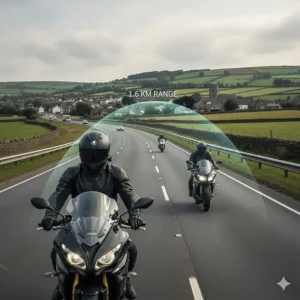
The ARK Bluetooth system (sold separately for £180-£220) integrates cleanly into the K6’s internal design, maintaining the helmet’s aggressive aerodynamic profile. The system features mesh intercom technology, allowing up to 6 riders to communicate with a range exceeding 1.5 kilometres in open terrain.
UK riders praise the K6’s exceptional ventilation system, which channels air efficiently even during summer rides. The Ultra-Wide Vision visor provides outstanding peripheral view, whilst the Pinlock Max Vision insert (included) prevents fogging during British winter commutes.
Pros:
✅ Exceptionally lightweight (1,320g medium)
✅ 5-star SHARP safety rating
✅ ECE 22.06 latest certification
✅ Racing-derived aerodynamics reduce wind noise
✅ Outstanding ventilation system
Cons:
❌ ARK Bluetooth sold separately (adds £180-£220)
❌ Aggressive sport fit may not suit touring riders
Price: £300-£450 (helmet only) | Best For: Sport riders and track day enthusiasts wanting street connectivity
7. HJC C91 – Affordable Mid-Range Touring Modular
The HJC C91 sits comfortably in the mid-range bracket, offering solid touring features and Bluetooth compatibility at a price that won’t make your wallet weep. This polycarbonate composite modular helmet provides excellent value for riders upgrading from basic lids to smart helmet territory.
Key Specifications:
- ECE 22.06 certified
- Advanced Polycarbonate Composite Shell
- Compatible with SMART HJC 10B and 20B systems
- Internal sun visor with easy operation
- ACS Advanced Channeling Ventilation
The C91 weighs approximately 1,706 grammes (medium), positioning it firmly in the comfortable middle ground between budget heavyweights and carbon featherweights. The helmet’s intermediate oval shape suits most British head shapes well, whilst the multi-density EPS liner provides effective impact protection.
Like the i90, the C91 features purpose-built integration for HJC’s Bluetooth systems, with recessed mounting areas and speaker pockets designed specifically for the SMART HJC units. The one-touch flip-up mechanism operates smoothly even with gloved hands, whilst the larger sun visor provides excellent coverage.
UK riders appreciate the C91’s versatility—it performs admirably for daily commuting, weekend touring, and occasional longer trips. The ventilation system keeps airflow moving effectively, though it’s not quite as sophisticated as the premium Schuberth C5.
Pros:
✅ ECE 22.06 latest safety certification
✅ Mid-range pricing with premium features
✅ Easy Bluetooth integration design
✅ Comfortable for all-day wearing
Cons:
❌ Bluetooth unit sold separately (£60-£100)
❌ Basic visor mechanism compared to premium alternatives
Price: £150-£190 | Best For: Touring commuters wanting modern safety standards without premium pricing
✨ Don’t Miss These Exclusive Deals!
🔍 Take your riding experience to the next level with these carefully selected Bluetooth motorcycle helmets. Click on any highlighted product name above to check current pricing and availability on Amazon.co.uk. These smart helmets will transform your communication capabilities and make every ride safer and more connected!
Understanding Bluetooth Motorcycle Helmet Technology
What Are Bluetooth Motorcycle Helmets?
Bluetooth motorcycle helmets are advanced protective headgear that incorporate wireless communication technology directly into their design. Unlike traditional helmets requiring aftermarket Bluetooth headset attachments, these smart helmets feature either fully integrated Bluetooth modules built into the shell during manufacture or purpose-designed spaces for seamless Bluetooth kit installation. Bluetooth technology, originally developed in 1994, has evolved dramatically to become the standard for short-range wireless communication in motorcycle applications.
The technology allows riders to connect wirelessly to smartphones, GPS devices, and other riders’ helmets within range, enabling hands-free phone calls, music streaming, GPS voice guidance, and rider-to-rider intercom conversations. Modern Bluetooth motorcycle helmets in 2026 typically use Bluetooth 4.1, 5.0, or 5.1 standards, offering improved connectivity range, better battery efficiency, and enhanced audio quality compared to earlier versions.
How Bluetooth Integration Works in Modern Helmets
There are two primary approaches to Bluetooth integration in motorcycle helmets:
Fully Integrated Systems like the Sena Outrush R or FreedConn BM2-S have Bluetooth modules, speakers, microphones, and batteries built directly into the helmet shell during manufacturing. The electronics are embedded within the EPS liner and outer shell, creating a streamlined profile without external clamps or protruding modules. These systems typically feature:
- Pre-wired speaker pockets with optimal audio positioning
- Internal microphone placement for clear voice pickup
- Charging ports integrated into the shell design
- Control buttons mounted flush with the helmet surface
Bluetooth-Ready Designs like the HJC i90 or LS2 Valiant II feature purpose-built recesses, speaker pockets, and cable channels designed specifically for compatible Bluetooth kits. Manufacturers like HJC collaborate with Bluetooth specialists such as Sena to develop custom-fitted communication systems that integrate seamlessly without compromising the helmet’s aerodynamic profile or safety structure.
Benefits of Integrated Communication Helmets
The advantages of motorcycle helmets with built-in Bluetooth extend beyond simple convenience:
🎧 Enhanced Safety: Hands-free communication keeps both hands on the bars and eyes on the road. Voice-activated controls allow you to manage calls, music, and navigation without distraction. According to UK Government road safety statistics, motorcyclists account for approximately 20% of all road deaths despite making up less than 1% of traffic, highlighting the importance of minimising distractions through hands-free technology.
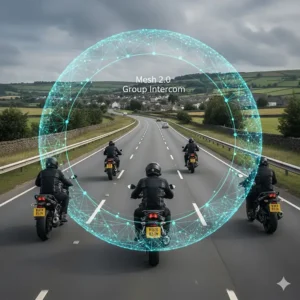
📡 Group Ride Coordination: Intercom communication systems enable real-time communication with riding groups, allowing instant warnings about hazards, navigation changes, or mechanical issues. Modern mesh network technology like that in the Schuberth C5 SC2 system maintains connections even when riders are beyond line-of-sight.
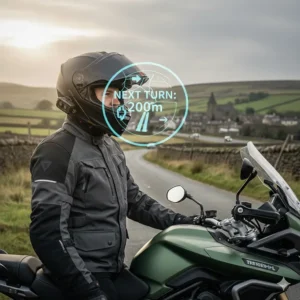
🗺️ Navigation Integration: GPS voice guidance delivered directly to your ears makes navigation effortless, eliminating the need to glance at handlebar-mounted screens. You can focus entirely on the road whilst receiving timely turn-by-turn directions.
🎵 Entertainment: Music streaming capability transforms long motorway slogs into enjoyable journeys. Modern Bluetooth systems support high-quality audio codecs like aptX, delivering surprisingly good sound quality even at speed.
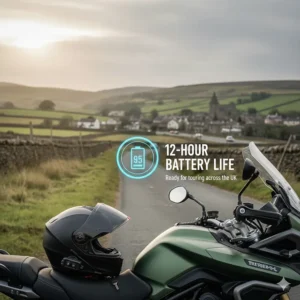
💪 Battery Performance: Contemporary Bluetooth helmets offer impressive battery life—typically 8-15 hours of talk time and several days of standby. Fast charging support means a 20-minute charge often provides 3-4 hours of usage.
Bluetooth Standards and Compatibility
Understanding Bluetooth versions helps you make informed choices:
- Bluetooth 3.0 (found in budget options like FreedConn): Adequate for basic calling and music streaming, with 10-30 metre pairing range. Battery life is reasonable but connectivity can be temperamental in high-interference areas.
- Bluetooth 4.1/4.2 (common in mid-range helmets): Improved energy efficiency, better audio quality, and enhanced range (30-100 metres). Supports multiple simultaneous connections—crucial for pairing phone, GPS, and rider intercoms simultaneously.
- Bluetooth 5.0/5.1 (premium systems): Doubled range (up to 240 metres in open space), quadrupled data transfer speed, and eight times the broadcast messaging capacity. Essential for mesh network intercom systems that maintain group communications even when riders spread out.
The latest mesh intercom technology transcends traditional Bluetooth limitations. Instead of point-to-point connections that break when riders move out of range, mesh networks create self-healing communication webs where each helmet acts as a relay point. If you’re riding with five mates and one drops back beyond direct Bluetooth range, their signal routes through other riders’ helmets automatically, maintaining the connection. Modern Bluetooth 5.0 technology offers significantly improved range, data transfer speeds, and energy efficiency compared to earlier versions, making it ideal for demanding motorcycle applications.
Key Features to Consider in Bluetooth Motorcycle Helmets
Safety Certifications: ECE, DOT, and SHARP Explained
Safety certification is the single most important consideration when choosing any motorcycle helmet, Bluetooth-equipped or not. In the UK, helmets must meet specific legal standards for road use.
ECE 22.05 and 22.06 Standards
The Economic Commission for Europe regulation ECE 22 is the legal requirement for motorcycle helmets sold in the UK and across Europe. From January 2024, helmet manufacturers can only gain approval for new designs complying with UN ECE R22-06, though ECE 22.05 helmets remain legal for sale and use indefinitely.
The ECE 22.06 standard introduces more stringent testing protocols that better simulate real-world accident scenarios:
- Linear impact tests at three speeds (6 m/s, 7.5 m/s, and 8.2 m/s)
- New rotational impact testing to assess protection against oblique forces
- Enhanced testing for modular helmets’ chin bar strength
- Stricter requirements for visor impact resistance
- Testing of integrated sun visors and Bluetooth accessories
All ECE-certified helmets display a label showing:
- Large “E” in a circle with a number (E11 indicates UK testing)
- Type approval standard (05 or 06)
- Helmet type: “J” (jet/open-face), “P” (full-face), or “PJ” (modular)
- Production serial number
DOT FMVSS 218 Standard
The US Department of Transportation standard is common on American-market helmets. Whilst DOT helmets meet rigorous safety requirements in the USA, they’re not automatically legal for UK road use. If importing a helmet or buying from US retailers, verify it carries ECE certification alongside DOT approval.
SHARP Safety Ratings
The UK government’s Safety Helmet Assessment and Rating Programme (SHARP) provides independent safety ratings from 1 to 5 stars based on comprehensive impact testing. SHARP tests helmets at higher velocities than legally required (8.5 m/s), subjecting them to 30 linear impacts and 2 oblique impacts across different head regions.
A 5-star SHARP rating (like the AGV K6) indicates exceptional protection exceeding minimum legal requirements. However, not all helmets undergo SHARP testing—absence of a rating doesn’t mean a helmet is unsafe, merely that it hasn’t been tested by this particular programme.
Speaker Quality and Audio Performance
Audio quality separates premium Bluetooth motorcycle helmets from budget alternatives. Superior speaker technology delivers clear music, intelligible GPS instructions, and natural-sounding conversations even at motorway speeds.
Speaker Types:
- Standard Dynamic Speakers: Found in budget systems, these deliver adequate audio for calls and navigation but struggle with music quality at high volumes.
- HD Speakers: Featured in helmets like the Sena Outrush R, HD speakers provide enhanced bass response, clearer midrange, and better overall sound quality.
- Premium Audio Systems: Top-tier helmets like the Schuberth C5 sometimes incorporate technology from audio specialists (Harman Kardon in some Sena premium models), delivering genuinely impressive sound quality approaching that of quality consumer headphones.
Noise Cancellation Technology: Advanced systems use DSP (Digital Signal Processing) to filter wind noise from microphone input whilst preserving voice clarity. This technology is essential for clear communication at motorway speeds where wind noise can exceed 100 decibels—loud enough to cause hearing damage over time.
Battery Life and Charging Considerations
Battery performance varies significantly across different Bluetooth helmet models:
Talk Time: Ranges from 8 hours (budget systems) to 15+ hours (premium units). For most UK riders, 10 hours covers a full day’s touring with comfortable reserve.
Standby Time: Quality systems maintain charge for 3-7 days between rides, whilst budget alternatives may require weekly charging even if unused.
Charging Methods: Most modern helmets use standard USB-C or micro-USB charging, allowing you to charge from phone adapters, power banks, or USB motorcycle accessory sockets. Fast-charging support is becoming common, providing several hours of use from 15-30 minutes of charging.
Battery Replacement: Integrated systems like the Sena Outrush R typically require service centre battery replacement after 3-5 years, whilst Bluetooth-ready helmets allow you to replace or upgrade the entire Bluetooth module when batteries degrade.
Pro Tip: Lithium-ion batteries last longer when kept between 20-80% charge rather than constantly cycled between 0-100%. Charge your Bluetooth helmet after every 2-3 rides rather than waiting for complete battery depletion.
Intercom Range and Group Communication
Intercom capabilities determine how effectively you can communicate with riding companions:
Traditional Bluetooth Intercom:
- Entry-level: 300-500 metre range (FreedConn BM2-S)
- Mid-range: 800-1,000 metre range (most systems)
- Premium: 1,200-1,600 metre range
These ranges assume open terrain. Urban environments, hills, and obstacles significantly reduce effective range. Traditional Bluetooth intercom typically supports 2-4 simultaneous rider connections.
Mesh Network Technology: Premium systems like those in the Schuberth C5 SC2 use mesh networking, where each helmet acts as a relay point. This extends effective range to several kilometres and supports groups of 6-15+ riders seamlessly. If one rider drops behind beyond direct range, their signal routes through other riders automatically, maintaining the connection.
Mesh technology self-heals when riders temporarily separate then rejoin, making it ideal for group touring where riders might spread out on motorways then regroup at junctions.
Weather Resistance and Durability
UK riding conditions demand robust weather protection. Quality Bluetooth systems feature:
IP Ratings: Look for at least IP67 water resistance (the “6” indicates complete dust protection, the “7” indicates protection against water immersion up to 1 metre for 30 minutes). This ensures your Bluetooth system survives typical British rain and the occasional unexpected downpour.
Operating Temperature Range: Premium systems function from -10°C to +55°C, covering everything from Scottish winter rides to summer touring in Spain.
Build Quality: Metal mounting clamps, reinforced cable connections, and sealed button mechanisms indicate long-term durability. Budget systems often use plastic components that become brittle and crack after exposure to UV radiation and temperature cycling.
How to Choose the Right Bluetooth Motorcycle Helmet
Assessing Your Riding Style and Needs
Different riding scenarios demand different helmet features:
Daily Commuting: For urban riding and motorway commutes, prioritise integrated Bluetooth with noise cancellation, quick-charging capabilities, and comfortable extended wear. Modular helmets like the HJC C91 offer convenience for urban riding where you frequently stop and start.
Touring and Long-Distance: Touring riders need exceptional comfort, superior audio quality, long battery life, and mesh intercom for group rides. The Schuberth C5 or LS2 Valiant II provide the features touring riders value most.
Sport Riding and Track Days: Sport riders should focus on lightweight construction, aerodynamic design, and excellent ventilation whilst maintaining Bluetooth connectivity for street use. The AGV K6 balances racing performance with street practicality brilliantly.
Adventure Riding: Off-road capable Bluetooth helmets require robust construction, superior weather sealing, and reliable intercom range. Look for helmets with easily cleanable interiors and durable mounting systems.
Budget Planning: Investment vs. Value
Bluetooth motorcycle helmets span a wide price spectrum in the UK market:
Budget Tier (£75-£150): Helmets like the FreedConn BM2-S provide basic Bluetooth functionality at accessible prices. Expect integrated Bluetooth with adequate audio quality, basic safety certifications, and heavier construction. Ideal for new riders experimenting with Bluetooth connectivity or those needing a budget backup helmet.
Mid-Range (£150-£350): This sweet spot includes options like the HJC i90, HJC C91, and Sena Outrush R. You get modern safety certifications (ECE 22.06), better audio quality, lighter construction, and more refined integration. Best value for most UK riders.
Premium (£350-£700+): Premium options like the Schuberth C5 or AGV K6 deliver exceptional build quality, whisper-quiet operation, advanced materials (carbon fibre), and sophisticated Bluetooth systems with mesh networking. Worth the investment if you ride frequently, cover high mileage, or demand the absolute best.
Cost of Ownership: Remember to factor in Bluetooth module costs for Bluetooth-ready helmets. SMART HJC systems cost £60-£100, whilst AGV’s ARK system costs £180-£220. Over a helmet’s 5-year lifespan, the ability to upgrade or replace Bluetooth modules independently can provide better long-term value.
Fit and Comfort: The Non-Negotiables
No amount of Bluetooth wizardry compensates for poor fit. A properly fitted helmet should:
- Feel snug but not painful when you first put it on. The helmet compresses slightly during the initial break-in period (typically 20-40 hours of wear), so it should feel quite firm initially.
- Sit level on your head with the front edge approximately 2.5 centimetres above your eyebrows. The helmet shouldn’t tilt back exposing your forehead or sit too low restricting vision.
- Prevent excessive movement when you shake your head side-to-side or up-and-down. A helmet that moves independently of your head won’t provide proper protection in an accident.
- Contact evenly across your head without pressure points. Pressure points cause discomfort after 30-60 minutes and indicate improper fit.
Head Shape Matters: European helmet manufacturers typically design for intermediate oval head shapes (slightly longer front-to-back than side-to-side), which suits most British riders. Asians often have rounder head shapes, Americans tend toward long oval. The HJC range generally suits intermediate oval shapes brilliantly.
Cheek Pad Fit: Your cheeks should compress noticeably but comfortably inside the helmet. You shouldn’t be able to easily insert fingers between the pads and your cheeks. Many manufacturers (including HJC and LS2) offer replacement cheek pads in different thicknesses for custom fit adjustment.
Try Before You Buy: Whenever possible, visit a physical motorcycle gear retailer to try helmets on. Wear each helmet for at least 5-10 minutes to identify any pressure points. If ordering online, verify the retailer offers hassle-free returns if the fit isn’t right.
Helmet Type: Full-Face, Modular, or Open-Face?
Bluetooth technology integrates into various helmet styles:
Full-Face Helmets like the AGV K6 or Sena Outrush R provide maximum protection by enclosing your entire head and face. They’re typically lighter and more aerodynamic than modular alternatives but less convenient for quick communications at petrol stations or traffic lights. Best for sport riding, track days, and riders prioritising maximum protection.
Modular (Flip-Up) Helmets like the HJC i90, LS2 Valiant II, or Schuberth C5 feature hinged chin bars that flip up for convenience whilst maintaining full-face protection when closed. Modern modular helmets with P/J certification (like the LS2 Valiant II) are legally approved for use with chin bar open, providing versatility for urban riding. Slightly heavier than full-face equivalents but brilliantly practical for touring and commuting.
Open-Face Helmets: Whilst some manufacturers offer Bluetooth-equipped open-face designs, these provide significantly less protection—particularly lacking jaw and face protection. Only consider open-face helmets for very low-speed urban riding or scooter use.
Maintenance and Care for Bluetooth Motorcycle Helmets
Cleaning and Maintaining Your Smart Helmet
Proper maintenance extends your Bluetooth helmet’s lifespan and ensures consistent performance:
Weekly Maintenance (for regular riders):
- Wipe exterior shell with microfibre cloth and helmet-specific cleaner
- Clean visor with dedicated visor cleaner or mild soap solution
- Inspect Bluetooth module buttons and charging port for debris
- Check intercom microphone for wind noise or mud buildup
Monthly Deep Clean:
- Remove and hand-wash interior liner in lukewarm water with mild soap
- Clean speaker grilles gently with soft brush to remove ear wax and debris
- Inspect all vents for blockages from insects or mud
- Apply silicone lubricant to visor pivots and modular chin bar hinges
Visor Care: Never use household glass cleaners containing ammonia or strong solvents—these damage anti-fog and anti-scratch coatings. Use only dedicated motorcycle visor cleaners or very mild soap solutions. Microfibre cloths prevent scratching.
Interior Liner Washing: Most modern helmets feature removable, washable liners. Hand-wash only in cool water with mild soap—machine washing destroys the liner’s shape and protective properties. Air-dry completely before reinstalling; never use tumble dryers or direct heat.
Bluetooth Module Care: Keep charging ports clean and dry. If your helmet gets soaked, remove the Bluetooth module (if detachable) and allow both helmet and module to air-dry completely before reassembly. Wipe buttons and controls with slightly damp cloth—never pressure-wash or fully submerge unless rated for immersion.
Battery Care and Firmware Updates
Bluetooth module batteries degrade over time but proper care extends their lifespan:
Optimal Charging Practices:
- Charge batteries when they reach 20-30% rather than completely depleting them
- Avoid leaving batteries at 100% charge for extended periods when not riding
- Use original or high-quality replacement chargers—cheap chargers can damage batteries
- Charge batteries at least once monthly during winter storage to prevent deep discharge damage
Firmware Updates: Many premium Bluetooth systems receive firmware updates via smartphone apps (Sena, Cardo, Schuberth all offer update apps). These updates often improve:
- Connectivity stability and range
- Battery management for extended life
- Audio quality and noise cancellation
- Bug fixes and new features
Check for firmware updates quarterly to ensure optimal performance. Updates typically take 5-10 minutes via smartphone connection.
When to Replace Components
Helmet Replacement: Safety experts and SHARP recommend replacing motorcycle helmets every 3-5 years even without obvious damage. The EPS foam liner gradually deteriorates from UV exposure, temperature cycling, and absorbed oils from your skin. Always replace your helmet immediately after any significant impact—even if external damage isn’t visible, internal structures may be compromised. Research from Transport Research Laboratory demonstrates that helmet materials degrade over time, reducing their protective capabilities.
Bluetooth Module Replacement: Integrated systems typically last 3-5 years before batteries degrade significantly. Bluetooth-ready helmets allow you to upgrade modules independently—excellent for extending helmet life whilst adopting new technology.
Visor Replacement: Replace visors when scratches affect visibility or anti-fog coatings deteriorate. Most manufacturers stock replacement visors for £20-£40. Pinlock inserts should be replaced every 12-18 months for optimal fog prevention.
Cheek Pads and Liner: Interior pads compress over time—particularly after 12-18 months of regular use. Replacement pads cost £15-£30 and restore original fit and comfort.
Installation and Setup Guide for Bluetooth Systems
Step-by-Step Bluetooth Installation (Bluetooth-Ready Helmets)
Installing aftermarket Bluetooth systems into ready-prepared helmets like the HJC i90 or LS2 Valiant II is straightforward:
Tools Required:
- Small Phillips screwdriver (included with most kits)
- Ruler or measuring tape
- Clean cloth
Installation Process:
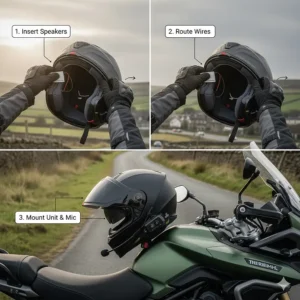
Step 1: Prepare the Helmet Remove the interior liner according to manufacturer instructions. Most helmets use snap-fastener systems requiring gentle pulling at specific points. Identify the pre-cut speaker pockets—they’re typically shallow recesses in the EPS liner positioned over your ears.
Step 2: Install Speakers Insert speakers into the designated pockets, ensuring they’re oriented correctly (most have L/R markings). The speakers should sit flush with the liner surface—if they protrude, they’ll press uncomfortably against your ears during wear. Route speaker cables through internal channels toward the rear mounting position.
Step 3: Mount Main Unit Attach the clamp or adhesive mounting plate to the helmet’s left rear (some systems mount on the right—check instructions). Position the mounting point in the recess provided, ensuring it doesn’t interfere with the modular chin bar mechanism on flip-up helmets.
Step 4: Microphone Installation Most systems offer two microphone options:
- Boom microphone: Extends from the module toward your mouth, offering clearest audio pickup but more visible
- Wired microphone: Runs along the chin bar, less visible but sometimes picks up more wind noise
Position the microphone approximately 1-2 centimetres from your lips when wearing the helmet. Secure it with the provided adhesive pad or Velcro, routing excess cable through internal channels.
Step 5: Cable Management Secure all cables using provided clips or channels to prevent them rattling or interfering with liner reinstallation. Excess cable length should be coiled neatly at the mounting point, not left loose where it might catch on the liner.
Step 6: Reinstall Liner Carefully reinstall the interior liner, ensuring no cables are pinched or preventing proper snapping of fasteners. Test all snap points to verify secure attachment.
Step 7: Test Fit Wear the helmet and verify the speakers align comfortably with your ears and the microphone positions correctly near your mouth. Adjust as needed before final adhesive bonding.
Common Mistakes to Avoid:
- Installing speakers backward (left in right pocket, vice versa)
- Over-tightening clamp screws (can crack helmet shells)
- Routing cables where they’ll interfere with chin bar operation
- Forgetting to pair the system before sealing everything up
Pairing Your Bluetooth Helmet with Devices
Pairing with Smartphones:
- Fully charge your Bluetooth module before first use
- Locate the pairing button (usually the main function button)
- Press and hold for 3-5 seconds until LED indicator flashes red and blue alternately
- On your smartphone, enable Bluetooth and scan for devices
- Select your helmet’s device name (e.g., “HJC SMART 20B” or “FreedConn BM2”)
- Confirm pairing (some systems require PIN code “0000” or “1234”)
- Test connection by making a call or playing music
Pairing with GPS Devices: Modern GPS units from Garmin, TomTom, and others support Bluetooth audio output. The pairing process mirrors smartphone pairing—put both devices in pairing mode and select the GPS from available devices list.
Pairing Multiple Devices: Premium Bluetooth systems support simultaneous connection to multiple devices (phone, GPS, action camera). Pair each device individually, following manufacturer instructions for multi-device priority settings. Typically, phone calls override music and GPS guidance—a safety feature ensuring you don’t miss important calls.
Configuring Intercom Settings for Group Rides
Setting up rider-to-rider intercoms requires coordination:
Traditional Bluetooth Intercom Pairing:
- Riders should position themselves within 10 metres
- Both riders activate pairing mode simultaneously (specific button combination varies by brand)
- Systems automatically discover and connect to each other
- Some systems require you to assign priority—Rider 1, Rider 2, etc.
- Test connection by speaking—most systems activate intercom on voice detection
Mesh Network Setup: Mesh systems like Schuberth SC2 or Cardo Packtalk are simpler:
- All riders turn on their systems
- Systems automatically discover nearby mesh networks
- One rider creates a new mesh group via button press or app
- Other riders join the mesh group with single button press
- The network self-organises—no manual pairing required
Group Ride Best Practices:
- Designate a ride leader who sets mesh network or manages traditional Bluetooth group
- Test all connections before departing
- Establish voice-activated (VOX) thresholds appropriate for your group’s riding style
- Use push-to-talk mode in very noisy environments or large groups
Troubleshooting Common Connection Issues:
- Connection Drops: Usually caused by interference from other Bluetooth devices or physical obstacles. Re-pair riders or move to less congested area.
- Poor Audio Quality: Adjust microphone position and check for wind noise entering the helmet through unsealed vents or chin bar.
- Battery Drain: Disable unused features (FM radio, voice activation) to extend battery life during long rides.
Legal Requirements and Safety Considerations in the UK
UK Motorcycle Helmet Laws
British motorcycle helmet legislation requires all riders and passengers to wear protective helmets meeting specific safety standards when riding on public roads. The legal requirements are clearly defined under the Motor Vehicles (Wearing of Helmets) Regulations.
Minimum Legal Standards: Helmets sold and worn in the UK must meet one of the following certifications:
- British Standard BS 6658:1985 with BSI Kitemark
- UNECE Regulation 22.05 (ECE 22.05)
- UNECE Regulation 22.06 (ECE 22.06) – from January 2024
- European Economic Area standard offering equivalent or superior protection
Verification: Legal helmets display a certification label, typically sewn into the chin strap or stuck to the helmet rear. The ECE label shows:
- “E” in a circle with country code (E11 = UK, E3 = Italy, E1 = Germany, etc.)
- Certification number (05 or 06)
- Helmet type: P (full-face), J (jet/open-face), or PJ (modular)
- Production serial number
DOT-Only Helmets: American DOT-certified helmets lacking ECE approval are not legal for UK road use, despite meeting rigorous US safety standards. If importing helmets or buying from US retailers, verify ECE certification. Many premium brands (Shoei, Arai, AGV) certify to both standards—check the specific model’s certification before purchasing.
Penalties: Riding without an approved helmet risks:
- On-the-spot fine up to £500
- Potential insurance invalidation if involved in accident
- Points on licence or prosecution if stopped by police
- Legal complications if accident occurs
The Motorcycle Action Group (MAG), the UK’s leading riders’ rights organisation with over 60,000 members, actively campaigns on motorcycle safety legislation and provides guidance on legal requirements for UK riders.
Safety Standards for Bluetooth-Equipped Helmets
The integration of Bluetooth technology must not compromise helmet safety:
ECE 22.06 Bluetooth Requirements: The latest ECE standard specifically addresses Bluetooth and communication accessories. Helmets certified under ECE 22.06 have undergone testing with Bluetooth modules installed, ensuring:
- Bluetooth mounting points don’t create penetration vulnerabilities
- Speaker recesses maintain sufficient EPS liner thickness for impact protection
- Cables and wiring don’t compromise shell integrity
- Visor and chin bar mechanisms function properly with Bluetooth modules installed
Impact on Protection: Quality integrated Bluetooth systems are designed from the ground up to maintain helmet safety. The Sena Outrush R and FreedConn BM2-S, for instance, position electronics in areas that don’t compromise the helmet’s energy-absorbing structures.
Retrofitted systems require more caution. Drilling holes, removing EPS material, or significantly modifying interior liners can compromise protection. Always use manufacturer-recommended Bluetooth kits designed specifically for your helmet model.
SHARP Testing: The UK’s SHARP programme tests some Bluetooth-equipped helmets to assess whether integrated systems affect safety performance. Results show that properly designed integrated systems have no measurable impact on protective capabilities. However, poorly designed aftermarket modifications can reduce protection significantly.
Using Bluetooth Safely While Riding
Whilst Bluetooth motorcycle helmets enhance safety through hands-free communication, misuse creates new hazards:
Legal Use of Communications: UK law permits hands-free mobile phone use whilst riding, provided the device is secured appropriately and you’re not handling it whilst in motion. Bluetooth helmets satisfy these requirements—your phone remains secured in a pocket or tank bag whilst you control it via voice commands or helmet-mounted buttons.
Distraction Management: Communication systems, whilst convenient, can distract. Follow these guidelines:
- Configure before riding: Set up playlists, navigation routes, and intercom connections before departing
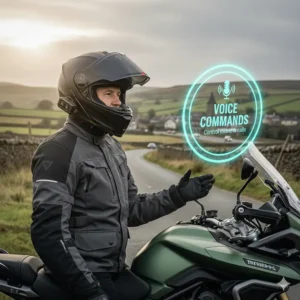
- Use voice commands: Minimise button presses whilst moving—voice control keeps your hands on the bars
- Limit conversation complexity: Save detailed conversations for stops—simple navigation updates and hazard warnings are appropriate whilst riding
- Disable notifications: Block non-essential notifications during rides to prevent distraction
Volume Levels: Set audio volume appropriately—you must maintain awareness of surrounding traffic noise, emergency vehicle sirens, and your motorcycle’s mechanical sounds. Excessive volume isolates you from environmental audio cues essential for safe riding.
Traffic Law Compliance: Using Bluetooth systems doesn’t exempt you from other traffic laws. You still cannot:
- Hold or operate a phone whilst riding
- Use handheld devices for taking photos or videos
- Watch videos whilst in motion
- Operate devices in ways that prevent proper control of your motorcycle
According to UK government road safety guidelines, riders should pull over safely if conversations or navigation adjustments require significant attention.
Insurance and Warranty Considerations
Insurance Coverage: Most UK motorcycle insurance policies cover Bluetooth-equipped helmets without additional premiums, as modern integrated systems are considered standard equipment. However:
- Verify with your insurer that modifications (if retrofitting Bluetooth) won’t affect coverage
- Some insurers offer small discounts for Bluetooth-equipped riders due to enhanced communication capabilities
- Ensure your gear is insured—Bluetooth helmets can exceed £500
Manufacturer Warranties: Premium Bluetooth helmet manufacturers typically offer:
- Helmet Structure: 3-5 year warranty covering manufacturing defects in shells, liners, and mechanical components
- Bluetooth Systems: 1-2 year warranty on electronic components, covering defects but not water damage, physical damage, or battery degradation
Extended Protection: Some retailers offer extended warranty programmes covering electronics beyond manufacturer warranties. Evaluate whether the cost justifies the protection—basic Bluetooth modules for helmets like the HJC i90 cost £60-£100 to replace, whilst integrated systems might warrant extended coverage.
Top Use Cases and Real-World Applications
Commuting with Bluetooth Connectivity
For the 1.3 million UK motorcyclists who commute daily, Bluetooth helmets transform the morning slog into a connected, informed journey.
Navigation Mastery: Miss your turning on the M25 and you’ve added 20 minutes to your commute. GPS voice guidance delivered directly to your ears means you’re always ahead of navigation changes, allowing you to position correctly in lanes well before junctions. The HJC C91 or Sena Outrush R provide clear, intelligible GPS audio even in heavy traffic.
Traffic Updates: Paired with Waze or Google Maps, your Bluetooth helmet alerts you to accidents, roadworks, and police checkpoints ahead. These real-time updates allow you to adjust routes dynamically, saving time and avoiding frustration.
Hands-Free Calls: When your boss rings as you’re filtering through London traffic, you can answer without stopping or fumbling for your phone. Voice-activated answering keeps both hands on the bars and your focus on the road.
Music for Monotony: The A1 between London and Edinburgh isn’t exactly thrilling. Music streaming capability makes long motorway stretches bearable, keeping your mood positive and alertness high. Research suggests moderate music volume can actually improve rider alertness on monotonous routes.
Real-World Scenario: Sarah, a pharmaceutical sales rep from Leeds, covers 300+ kilometres daily visiting clients across Yorkshire. Her LS2 Valiant II with Bluetooth connects to her phone for client calls, GPS for route optimisation, and Spotify for motorway entertainment. She reports the modular design perfect for quick flip-ups at client premises, whilst the Bluetooth integration means she never misses important calls during her riding hours. SHARP statistics show that on average, 6 motorcyclists die every week in the UK, emphasising the critical importance of safety equipment and distraction-free communication systems.
Long-Distance Touring Adventures
Touring riders spend hours in the saddle, where comfort and communication become paramount.
Rider-to-Rider Communication: Touring with mates is brilliant fun, but coordinating petrol stops, photo opportunities, or route changes without intercom means stopping every 30 minutes. Mesh network systems like those in the Schuberth C5 allow natural conversation between 6+ riders over several kilometres, making group tours flow smoothly.
Multi-Day Battery Management: Premium systems offering 12-15 hours of talk time handle full days of touring without charging anxiety. The HJC i90 paired with SMART HJC 20B provides sufficient battery for dawn-to-dusk rides through the Scottish Highlands.
Weather Updates: Touring in Britain means weather changes rapidly. Paired with weather apps, your Bluetooth helmet can alert you to approaching rain or storms, allowing you to don waterproofs before the deluge hits.
Emergency Communication: If you encounter mechanical issues or an accident in remote areas, hands-free phone access means you can summon help whilst remaining with your bike and gear.
Real-World Scenario: Mike and his touring group complete annual European adventures, typically covering 3,000 kilometres over two weeks. Their matching Schuberth C5 helmets with SC2 Bluetooth maintain group communication even when riders are spread across several kilometres on European autobahns. The mesh network self-heals when they separate then regroup at rest stops, whilst premium noise reduction means they arrive at day’s end without the fatigue caused by cheaper, noisier alternatives.
Group Rides and Social Motorcycling
Weekend blast-outs with your local riding club transform with proper intercom communication. According to UK Government motorcyclist casualty statistics, “failed to look properly” is the most common contributory factor in motorcycle accidents—real-time communication between riders helps mitigate this risk through instant hazard warnings.
Formation Riding Coordination: Maintaining safe spacing and positioning in groups requires communication. The ride leader can warn of upcoming hazards, signal speed changes, or notify riders of upcoming turns without hand signals that might not be visible to riders several positions back.
Hazard Communication: Spot diesel on the road? Pothole ahead? Cattle crossing? Instant voice warnings keep everyone safe. Traditional hand signals are easily missed in large groups or at speed.
Social Connection: Part of motorcycling’s joy is the social aspect. Intercom systems let you share the experience in real-time—commenting on fantastic views, exchanging banter, or sharing the excitement of superb roads as you ride them.
Cafe Stop Coordination: When groups separate temporarily (some riders fancy a photo stop, others prefer to press on), intercom keeps everyone coordinated for the eventual regroup at the next cafe or viewpoint.
Real-World Scenario: The Hampshire Riders Club organises monthly social rides attracting 12-20 riders of varying experience levels. They standardised on FreedConn and Sena systems for intercom compatibility. New riders receive mentoring from experienced riders via intercom—real-time advice about positioning, braking points, and hazard awareness that accelerates their development whilst maintaining safety.
Troubleshooting Common Bluetooth Helmet Issues
Connectivity Problems and Solutions
Issue: Helmet Won’t Enter Pairing Mode
Symptoms: Pressing pairing button doesn’t activate flashing LED indicators, or helmet appears unresponsive.
Solutions:
- Battery Deep Sleep: If the helmet hasn’t been used for weeks, the battery may have entered deep sleep mode to prevent damage. Charge for 30-60 minutes, then try again.
- Button Sequence: Verify you’re using the correct button hold duration—most systems require 3-5 seconds, not quick presses.
- Reset Required: Perform factory reset according to manufacturer instructions (usually involves holding multiple buttons simultaneously for 10+ seconds).
- Battery Failure: If the system still doesn’t respond after charging, the battery may have failed and requires replacement.
Issue: Frequent Connection Drops
Symptoms: Bluetooth connection between helmet and phone repeatedly disconnects and reconnects.
Solutions:
- Range Limitations: Ensure your phone is within 10 metres—metal motorcycle fuel tanks can block signals if the phone’s in a tank bag.
- Interference: Urban areas with heavy WiFi and Bluetooth traffic cause interference. Try re-pairing in a quieter location.
- Firmware Updates: Outdated firmware often causes connectivity issues. Update both helmet and phone via manufacturer apps.
- Battery Low: Low battery power degrades Bluetooth performance. Charge the helmet fully before long rides.
- Too Many Paired Devices: Some systems struggle with multiple paired devices. Delete old pairings you no longer use.
Issue: Cannot Pair with Riding Partner
Symptoms: Two helmets won’t connect for intercom despite successful phone pairing.
Solutions:
- Brand Compatibility: Some systems only intercom with the same brand. Verify your helmets support cross-brand pairing if using different manufacturers.
- Pairing Mode: Intercom pairing uses different button sequences than phone pairing. Consult both helmets’ manuals for specific intercom pairing instructions.
- Version Mismatch: Older firmware versions sometimes can’t intercom with newer versions. Update both helmets to latest firmware.
- Priority Assignment: Some systems require you to designate primary/secondary riders. Follow manufacturer instructions for group pairing hierarchy.
Audio Quality and Volume Issues
Issue: Excessive Wind Noise or Static
Symptoms: Constant background noise makes communication difficult or music quality poor.
Solutions:
- Microphone Position: Adjust microphone closer to your mouth but not touching—wind blowing directly across the mic creates noise.
- Foam Windscreen: Ensure the microphone’s foam windscreen is properly installed and not damaged. Replace if degraded.
- Helmet Fit: An ill-fitting helmet allows wind to enter, creating noise. Ensure proper fit with minimal gaps.
- Visor Seal: Check visor gaskets and chin bar seals for gaps allowing wind to enter the helmet.
- DSP Settings: If your system has adjustable noise cancellation, increase the DSP level through the companion app.
Issue: Insufficient Volume
Symptoms: Maximum volume still too quiet to hear clearly at speed.
Solutions:
- Speaker Position: Verify speakers align properly with your ear canals. Even 5mm misalignment significantly reduces volume.
- Speaker Debris: Ear wax and dust accumulate on speaker grilles, reducing output. Clean gently with soft brush.
- Phone Volume: Ensure your phone’s media volume is maximised separately from the Bluetooth volume—both affect output.
- Earplugs Interference: If wearing foam earplugs, they block Bluetooth speaker sound. Consider musician’s earplugs that attenuate high frequencies whilst passing speech frequencies.
- Speaker Upgrade: Budget helmets use low-power speakers. Premium replacement speakers from Cardo or Sena often fit into standard pockets and provide significant volume improvement.
Issue: Echo or Feedback
Symptoms: Your voice echoes back through the speakers during conversations.
Solutions:
- Volume Too High: Reduce speaker volume to prevent sound leaking from speakers back into the microphone.
- Microphone Sensitivity: Adjust voice-activated (VOX) sensitivity lower to prevent accidental activation from speaker sound.
- Partner’s System: Often echo originates from your riding partner’s helmet. Ask them to reduce their volume.
Battery and Charging Problems
Issue: Rapid Battery Drain
Symptoms: Fully charged battery depletes within 2-3 hours instead of expected 10+.
Solutions:
- Active Features: Disable unused features—FM radio, voice activation, and always-on intercom drain batteries quickly.
- Firmware Bug: Some firmware versions have battery management bugs. Update to latest version.
- Temperature Effects: Lithium batteries drain faster in cold weather. Keep helmet indoors overnight during winter.
- Battery Age: Batteries degrade over 3-5 years. If your helmet’s older, battery replacement might be needed.
- Background Connections: Multiple simultaneous Bluetooth connections (phone + GPS + action camera) drain batteries faster than single connection.
Issue: Won’t Charge or Charge Slowly
Symptoms: Helmet doesn’t charge when plugged in, or charging takes exceptionally long.
Solutions:
- Charging Port Contamination: Clean charging port with compressed air and dry cotton swab—dirt and moisture cause connection issues.
- Cable Damage: Try different USB cable—internal wire breaks are common.
- Charger Amperage: Some helmets require 1A or 2A chargers. Standard 0.5A phone chargers may charge too slowly or not at all.
- Deep Discharge: Batteries left completely flat for extended periods may refuse to charge initially. Leave plugged in for several hours—some systems require extended charging to revive deeply discharged batteries.
- Temperature: Lithium batteries won’t charge if too cold (below 0°C) or too hot (above 45°C). Bring the helmet to room temperature before charging.
Future Trends in Bluetooth Motorcycle Helmet Technology
Heads-Up Display Integration
The next evolution in smart helmets UK 2024 technology involves augmented reality (AR) heads-up displays projecting information directly into your field of vision. Several manufacturers are developing systems that display:
- Navigation arrows overlaid on your actual view
- Speed and gear position without looking down
- Incoming call/message notifications in peripheral vision
- Blind-spot warnings from radar systems
- Lean angle and cornering data for track riding
Companies like NUVIZ, Skully, and CrossHelmet have demonstrated prototype AR systems, whilst BMW Motorrad has shown concept helmets with integrated displays. The challenge remains creating displays bright enough for daylight visibility whilst maintaining battery life and not distracting riders.
Current AR systems typically add £600-£1,200 to helmet costs, but as technology matures and manufacturing scales increase, expect mainstream AR helmets within 3-5 years at £400-£600 premium over standard Bluetooth helmets.
Advanced Safety Features and Collision Avoidance
Future Bluetooth motorcycle helmets will integrate with vehicle-to-vehicle (V2V) communication systems and motorcycle safety technology:
Connected Safety:
- Emergency Braking Warnings: When a car ahead brakes hard, your helmet receives instant warning before you’ve physically seen brake lights
- Blind Spot Alerts: Radar systems on your motorcycle communicate with your helmet, providing audio warnings when vehicles enter blind spots
- Intersection Collision Alerts: V2V systems warn of vehicles approaching intersections at dangerous speeds
Crash Detection and Emergency Services: Premium helmets like Cosmo Connected’s smart systems already offer automatic crash detection that alerts emergency contacts and provides GPS coordinates to first responders. Expect this technology to become standard across mid-range Bluetooth helmets within 5 years.
Health Monitoring: Future helmets may incorporate sensors monitoring:
- Fatigue levels through eye movement tracking
- Heart rate and stress indicators
- Impact force measurement during accidents
- Thermal stress during extreme weather riding
Integration with Motorcycle Electronics
Modern motorcycles increasingly feature sophisticated electronics that future Bluetooth helmets will interface with seamlessly:
Motorcycle-to-Helmet Communication:
- Tyre pressure warnings delivered directly to your helmet
- Fuel range and consumption data
- Service interval reminders
- Performance data (lap times, power delivery, suspension settings)
Advanced Navigation: Instead of relying solely on smartphone GPS, future helmets will receive navigation data directly from motorcycle systems, displaying turn-by-turn directions, optimal routing based on your bike’s performance characteristics, and suggestions for petrol stations when fuel runs low.
Camera Integration: Action cameras will integrate more seamlessly with Bluetooth systems, allowing:
- Voice-controlled recording start/stop
- Instant replay of interesting moments
- Automatic incident recording triggered by sudden deceleration
- Live streaming of rides to social media
Smartphone Convergence: As smartphones become more powerful, expect them to become the central hub for all motorcycle connectivity, with helmets essentially acting as wireless peripherals providing audio output, voice input, and control interfaces.
Frequently Asked Questions
❓ What's the difference between integrated and Bluetooth-ready motorcycle helmets?
❓ How long does a Bluetooth motorcycle helmet battery typically last?
❓ Are Bluetooth motorcycle helmets legal to use in the UK?
❓ Can I use my Bluetooth motorcycle helmet with any smartphone?
❓ What's the typical range for Bluetooth motorcycle helmet intercoms?
Conclusion: Choosing Your Perfect Bluetooth Motorcycle Helmet
After exploring the landscape of Bluetooth motorcycle helmets available in the UK for 2026, the choice ultimately depends on your specific riding style, budget, and priorities.
For budget-conscious riders or those experimenting with Bluetooth connectivity for the first time, the FreedConn BM2-S at £75-£95 provides surprising functionality, though UK buyers should verify ECE certification carefully. Its integrated Bluetooth and FM radio deliver decent value, even if build quality doesn’t match premium alternatives.
Mid-range touring riders will find exceptional value in the HJC i90 (£129-£227) or HJC C91 (£150-£190), both offering ECE 22.06 certification, lightweight construction, and purpose-built integration for Sena Bluetooth kits. The LS2 Valiant II (£249-£289) deserves serious consideration for its unique 180-degree flip mechanism and dual homologation allowing legal open-face riding.
For riders wanting integrated convenience, the Sena Outrush R (£180-£250) eliminates retrofit hassles with factory-installed Bluetooth 4.1, HD speakers, and Universal Intercom compatibility, whilst maintaining reasonable pricing.
Premium riders investing in long-term quality should examine the Schuberth C5 (£550-£700) for its whisper-quiet operation, exceptional build quality, and mesh intercom technology. Sport enthusiasts who also commute might prefer the AGV K6 (£300-£450) for its lightweight racing pedigree combined with street connectivity.
Remember: helmet fit trumps all other considerations. The most technologically advanced Bluetooth helmet provides zero benefit if it doesn’t fit your head properly. Visit physical retailers when possible to try multiple options, verify comfort during extended wearing, and confirm speaker alignment with your ear canals.
As Bluetooth technology continues evolving toward augmented reality displays, advanced safety features, and deeper motorcycle system integration, today’s smart helmets represent a sensible investment in connected riding safety. Whether you’re navigating London’s congestion, touring the Scottish Highlands, or simply enjoying weekend blasts with mates, the right Bluetooth motorcycle helmet transforms your riding experience whilst keeping you safer and more connected.
Ride safely, stay connected, and choose the helmet that suits your needs—your perfect Bluetooth motorcycle helmet is out there waiting.
Recommended for You
- 7 Best Track Day Helmets UK 2026: ACU Gold Approved Guide
- AGV K6 vs Shoei RF-1400: 7 Premium Helmets Tested 2026
- Best Motorcycle Helmets for Glasses Wearers UK 2026
Disclaimer: This article contains affiliate links. If you purchase products through these links, we may earn a small commission at no additional cost to you. Prices shown are approximate and may vary.
✨ Found this helpful? Share it with your mates! 💬 🤗
