In This Article
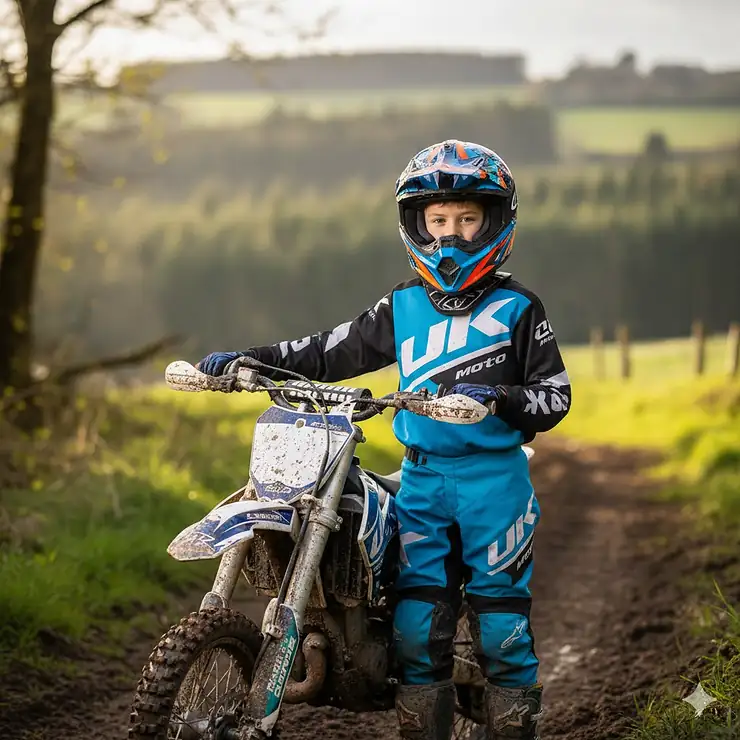
Choosing youth motocross helmets isn’t just about ticking a box—it’s about protecting what matters most. I still remember the knot in my stomach when my nephew took his first proper jump on his dirt bike. The relief I felt knowing he wore a properly fitted, safety-certified helmet was immeasurable.
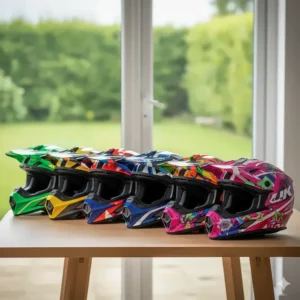
The UK market for youth motocross helmets has evolved dramatically since 2024, with manufacturers incorporating cutting-edge safety technologies like MIPS (Multi-directional Impact Protection System) and meeting the new ECE R22-06 standards. According to the UK government’s SHARP testing programme, around 80% of motorcyclist fatalities involve head injuries, making helmet selection absolutely critical for young riders.
Whether your child is just starting out on a 50cc bike or progressing to competitive racing, selecting the right youth motocross helmets means balancing safety certifications, proper fit, ventilation, and yes—finding something they’ll actually want to wear. From budget-friendly options under £60 to premium models with advanced multi-density foam liners, this guide covers everything you need to know before making that crucial purchase.
Quick Comparison Table
| Helmet Model | Safety Rating | Price Range | Best For | MIPS |
|---|---|---|---|---|
| Wulfsport Cub Off Road Pro | ECE 22.05 | £39.99-£54.99 | Budget-conscious families | No |
| Fox Youth V1 Shield | DOT/ECE | £189.99 | Intermediate riders | Yes |
| Bell MX-10 MIPS Youth | DOT/ECE 22.06 | £189.99-£209.99 | All-round protection | Yes |
| Troy Lee Designs GP Youth | ECE 22.05 | £111.99-£139.99 | Style & safety balance | No |
| Zorax Youth Predator | ECE 22.06 | £53.99-£64.99 | First-time riders | No |
| Fly Racing Formula S Carbon Youth | DOT/ECE | £549.99 | Competitive racing | Yes |
| Alpinestars Youth SM5 | DOT/ECE | £249.99-£299.99 | Advanced young riders | Optional |
💬 Just one click – help others make better buying decisions too!😊
Top 7 Youth Motocross Helmets: Expert Analysis
1. Wulfsport Cub Off Road Pro Youth Helmet
If you’re searching for youth motocross helmets that won’t break the bank whilst still delivering solid protection, the Wulfsport Cub Off Road Pro deserves serious consideration. This ECE 22.05 approved helmet has become a staple amongst UK families introducing children to off-road riding.
Key Specifications:
- ECE 22.05 certified and ACU approved for UK use
- Thermoplastic resin (TPR) shell construction
- Weight: 1,080g ±50g
- Sizes: Youth Small (48cm) through Youth XL (54-55cm)
The helmet features removable and washable inner lining and cheek pads—an absolute godsend after muddy weekend rides. UK buyers consistently praise its value proposition, with one parent noting it “provided excellent protection for my daughter’s first season without the premium price tag.” The quick-release micrometric buckle chin strap makes getting ready straightforward, even for younger children.
Pros:
✅ Exceptional value at £39.99-£54.99
✅ Meets UK safety standards (ECE/ACU)
✅ Lightweight for youth riders
Cons:
❌ No MIPS technology
❌ Basic ventilation system
The Wulfsport sits comfortably in the budget category for kids MX helmets SHARP rated alternatives, though it hasn’t been officially SHARP tested. For families just starting their motocross journey, it’s a sensible first purchase.
2. Fox Youth V1 Shield Motocross Helmet
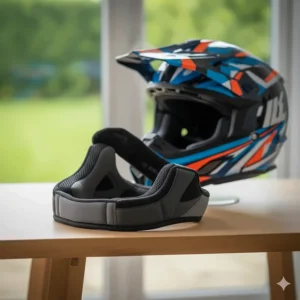
The Fox Youth V1 Shield represents the sweet spot between safety innovation and value for money. Fox Racing has earned its reputation in the motocross world, and this youth-specific model incorporates professional-grade features at a mid-range price point.
Key Specifications:
- MIPS (Multi-directional Impact Protection System) equipped
- Dual-density EPS liner for superior impact absorption
- 13 strategically positioned ventilation ports
- Sizes: Youth Small through Youth Large
- Price: £189.99
What sets the V1 Shield apart is its integration of MIPS technology, which adds a low-friction layer designed to reduce rotational forces during angled impacts—the most common type in motocross accidents. The helmet’s visor is engineered to release upon impact, preventing neck injuries that can occur from visor resistance.
UK customers highlight the helmet’s comfort during extended riding sessions. “My son wore it for a three-hour enduro event and didn’t complain once about discomfort,” shared one Surrey-based parent. The moisture-wicking liner manages sweat effectively, crucial for maintaining focus during competitive riding.
Pros:
✅ MIPS protection for oblique impacts
✅ Best-in-class airflow design
✅ Available in multiple colourways
Cons:
❌ Mid-range pricing may stretch some budgets
❌ Break-in period required for optimal fit
For junior motocross helmet sizing, Fox provides detailed charts on their website, ensuring you get the fit right first time.
3. Bell MX-10 MIPS Youth Helmet
Bell’s reputation in helmet safety is legendary, and the MX-10 MIPS Youth continues that legacy with cutting-edge protection designed specifically for younger riders. Launched in late 2025, this helmet meets the new ECE 22.06 standard whilst incorporating several features borrowed from Bell’s professional Moto-10 range.
Key Specifications:
- Dual DOT and ECE 22.06 certification
- Lightweight polycarbonate shell (1,300g)
- MIPS rotational impact protection
- Flying Bridge visor technology
- Antimicrobial liner with silver-based odour control
- Price: £189.99-£209.99
The Flying Bridge visor design eliminates the traditional centre post, allowing for better energy absorption in the crown impact zone whilst improving airflow across the helmet. Bell’s NMR (No Missed Races) bumpers use softer EPP material that compresses on impact but returns to form, potentially reducing secondary injuries.
“It’s the first helmet my daughter actually asks to wear,” commented a Manchester-based parent on Amazon.co.uk. The communication-ready design includes integrated speaker pockets, perfect for young riders using intercoms during training.
Pros:
✅ Meets latest ECE 22.06 safety standard
✅ Removable mouthpiece for versatility
✅ Communication system ready
Cons:
❌ Higher price point for entry-level riders
❌ Limited colour options in youth sizes
For families prioritising youth safety certifications, the MX-10 MIPS ticks every box whilst remaining accessible under £215.
4. Troy Lee Designs GP Youth Helmet
Troy Lee Designs (TLD) brings California cool to youth motocross helmets with the GP Youth, balancing eye-catching graphics with solid safety credentials. Available through UK retailers at competitive pricing, it’s become popular amongst young riders wanting to emulate their racing heroes.
Key Specifications:
- ECE 22.05 approved
- Injection-moulded polycarbonate shell
- Three shell sizes for optimal fit across youth range
- EPS liner with superior impact absorption
- Price: £111.99-£139.99 (sale pricing varies)
TLD’s approach to junior motocross helmet sizing uses three different shell sizes within the youth range, rather than just varying padding thickness. This means a Youth Small has genuinely smaller proportions than a Youth Large, providing better weight distribution and comfort.
The helmet’s ventilation system features large intake and exhaust vents positioned to create genuine airflow—not just decorative holes. UK reviewers note it performs particularly well in warmer months, though some find it slightly draughty during winter practice sessions.
Pros:
✅ Excellent graphics appeal to young riders
✅ Three-shell sizing for better fit
✅ Strong resale value
Cons:
❌ No MIPS option currently available
❌ Premium graphics command higher prices
Whilst lacking adjustable retention systems found on some competitors, the GP Youth’s overall build quality justifies its mid-range positioning.
5. Zorax Youth Predator Helmet with Goggles & Gloves
Perfect for families seeking complete starter packages, the Zorax Youth Predator bundle offers remarkable value. Meeting the new ECE 22.06 standards whilst including goggles, gloves, and a balaclava, it’s an all-in-one solution for youth dirt bike helmets under £150.
Key Specifications:
- ECE 22.06 certified
- Complete package includes: helmet, goggles, gloves, balaclava
- Multiple colour options
- Youth sizes: Medium (51-52cm) through Extra Large (55-56cm)
- Price: £53.99-£64.99
The helmet features a quick-release buckle system and washable interior components. Whilst the included accessories aren’t professional-grade, they’re perfectly adequate for beginners finding their feet. Amazon.co.uk reviews average 4.4 stars from over 30 UK buyers, with parents appreciating the complete package approach.
“My grandson received everything he needed to start riding for under £60—brilliant value,” noted one Yorkshire grandmother. The goggles feature anti-fog coating and the gloves include silicon grip palms, though serious riders will likely upgrade both within their first season.
Pros:
✅ Complete starter package
✅ Meets latest ECE 22.06 standard
✅ Multiple colour choices appeal to children
Cons:
❌ Accessories are entry-level quality
❌ Heavier than premium alternatives
For budget-conscious families exploring youth dirt bike helmets under £150, the Zorax bundle removes the guesswork from getting started.
6. Fly Racing Formula S Carbon Youth Helmet
At the premium end sits the Fly Racing Formula S Carbon Youth, a helmet that wouldn’t look out of place in professional competition. With a carbon fibre shell and advanced safety features, it represents the pinnacle of youth motocross helmets currently available in the UK market.
Key Specifications:
- Ultra-lightweight carbon composite shell
- Adaptive Impact System (AIS) technology
- Titanium buckle system
- Emergency Release System (ERS) cheek pads
- Conehead EPS technology for multi-density impact absorption
- Price: £549.99
The Formula S Carbon uses Fly Racing’s proprietary AIS technology, which functions similarly to MIPS but with Fly’s own engineering approach. The multi-density foam liner provides graduated impact absorption—softer foam for minor impacts, denser material for severe collisions.
UK stockists report strong interest from parents of competitive young riders. “Worth every penny for the weight savings alone,” commented one father whose son races in the British Youth Championship. The helmet weighs approximately 1,100g, noticeably lighter than equivalently sized polycarbonate alternatives.
Pros:
✅ Professional-grade construction
✅ Advanced multi-density foam liner
✅ Emergency responder-friendly features
Cons:
❌ Premium pricing (£549.99)
❌ Overkill for recreational riders
For families committed to competitive motocross, the Formula S Carbon’s advanced features justify the investment in youth safety certifications and performance.
7. Alpinestars Youth Supertech SM5 Helmet
Alpinestars brings decades of racing pedigree to the Youth SM5, a helmet designed using data from their adult championship-winning models. Available through specialist UK retailers, it offers adjustable retention systems and professional-level construction.
Key Specifications:
- DOT and ECE certified
- Multi-density EPS liner in five zones
- Adjustable visor positions
- A-Head fitting system for customised fit
- Sizes: Youth Small through Youth Large
- Price: £249.99-£299.99
The SM5’s A-Head fitting system allows micro-adjustments to helmet positioning, particularly useful as children grow. Rather than replacing the helmet immediately, the adjustable retention systems can accommodate head growth for an additional season.
The five-zone EPS construction places varying densities of foam strategically around the helmet—denser at common impact points, lighter where less protection is needed. This approach, validated through Alpinestars’ MotoGP programme, provides superior protection whilst managing weight effectively.
Pros:
✅ Adjustable retention systems extend usable life
✅ Professional-grade multi-zone protection
✅ Excellent ventilation system
Cons:
❌ Higher price point
❌ Complex adjustment may overwhelm younger children
UK parents investing in the SM5 appreciate its longevity, with some reporting two seasons of use thanks to the adjustable fitting system.
✨ Don’t Miss These Exclusive Deals!
🔍 Take your child’s riding safety to the next level with these carefully selected products. Click on any highlighted item above to check current pricing and availability on Amazon.co.uk. These helmets will provide authentic protection your family can trust!
Understanding Youth Safety Certifications: What Parents Must Know
Navigating youth safety certifications can feel overwhelming, but it’s essential knowledge for any parent purchasing youth motocross helmets. The UK operates under specific standards, and understanding them ensures your investment genuinely protects your child.
ECE R22-06: The New UK Standard
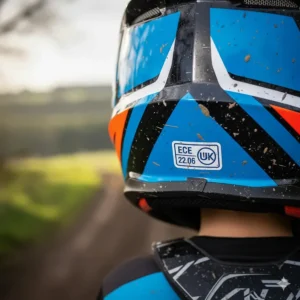
Since January 2024, helmet manufacturers can only obtain approval for new designs meeting UN ECE R22-06 requirements. This updated standard represents the most significant evolution in helmet testing in over two decades. The new tests replicate real-world accident scenarios more accurately, including both high-speed impacts and low-speed tumbles.
Crucially, ECE R22-05 helmets remain legal and safe to use—you don’t need to replace existing helmets immediately. However, when purchasing new youth motocross helmets, choosing R22-06 certified models provides enhanced protection through more rigorous testing protocols.
SHARP Ratings: Beyond Minimum Standards
The UK’s Safety Helmet Assessment and Rating Programme (SHARP) provides comparative safety data through a one-to-five star system. Operated by the Department for Transport, SHARP conducts 32 impact tests on each helmet model at speeds exceeding ECE requirements.
Research shows a 70% difference in protection between one-star and five-star rated helmets—despite all meeting minimum legal standards. As SHARP’s testing data reveals, “price of a helmet is not proportionate to the level of protection it provides.” Budget helmets can achieve high SHARP ratings whilst expensive models sometimes underperform.
Unfortunately, many kids MX helmets SHARP rated options remain limited, as SHARP focuses predominantly on road helmets. However, understanding the testing methodology helps inform decisions about youth safety certifications generally.
DOT vs ECE: What’s the Difference?
US DOT (Department of Transportation) certification differs from European ECE standards in testing methodology. DOT allows manufacturers to self-certify, whilst ECE requires independent laboratory testing. For UK families, ECE certification is legally required and generally considered more rigorous.
Many youth motocross helmets carry dual DOT/ECE certification, particularly those from American brands like Fox Racing and Bell. This dual certification doesn’t indicate superior safety—it simply allows the same helmet to be sold in both markets.
Junior Motocross Helmet Sizing: Getting It Right Every Time
Proper fit matters more than any other factor in helmet effectiveness. A poorly fitted five-star helmet provides less protection than a perfectly fitted three-star alternative. Here’s how to ensure you get junior motocross helmet sizing spot-on.
The Measurement Process
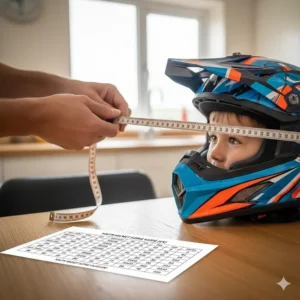
You’ll need a flexible fabric measuring tape (a tailor’s tape measure works perfectly). Position it approximately 2.5cm (1 inch) above your child’s eyebrows and ears, wrapping it around the widest part of their head. The tape should sit snugly but not compress the skin.
Take the measurement in both centimetres and inches, as different manufacturers use different systems. Most youth motocross helmets range from 47cm (Youth XS) through 56cm (Youth XL), though sizing varies between brands.
Youth Size Guide:
- 47-48cm: Youth Extra Small (XS)
- 49-50cm: Youth Small (S)
- 51-52cm: Youth Medium (M)
- 53-54cm: Youth Large (L)
- 55-56cm: Youth Extra Large (XL)
The Fit Test: Four Critical Checks
1. Initial Fitting: The helmet should feel snug—almost uncomfortably tight when new. Quality helmets “break in” over the first few weeks, with interior padding compressing approximately 15-20%. If it feels perfect in the shop, it’ll be too loose after breaking in.
2. Pressure Point Check: With the helmet on and straps unfastened, press gently around the entire interior. There should be even pressure across the forehead, temples, and back of the head—no specific “hot spots” causing discomfort.
3. Movement Test: Fasten the chin strap securely, then try rotating the helmet side-to-side and front-to-back whilst your child keeps their head still. The helmet should move their scalp and facial skin with it—not slide independently across the head surface.
4. Vision Check: Your child’s eyes should sit in the middle of the eye port opening when looking straight ahead. If they’re looking through the top or bottom portion, the helmet size is incorrect regardless of circumference measurements.
Adjustable Retention Systems: Worth the Investment?
Advanced models like the Alpinestars SM5 include adjustable retention systems allowing fine-tuning of fit. These systems work through ratcheting mechanisms or interchangeable padding, extending the helmet’s usable life as children grow.
For rapidly growing pre-teens, adjustable systems can be cost-effective despite higher initial purchase prices. A £280 adjustable helmet lasting two seasons represents better value than two £180 fixed-size replacements.
MIPS Technology: Understanding Rotational Impact Protection
Multi-directional Impact Protection System (MIPS) has transformed helmet safety, yet many parents remain unclear about what it actually does. Let’s demystify this critical technology.
How MIPS Works
Your brain floats within cerebrospinal fluid inside your skull—nature’s own slip-plane system. MIPS technology replicates this natural protection by incorporating a low-friction layer between the helmet’s foam liner and comfort padding.
During angled impacts (the vast majority of real-world crashes), this layer allows the helmet to rotate 10-15mm independently from your child’s head. This relative motion redirects rotational forces that would otherwise transfer directly to the brain, potentially reducing concussion risk and traumatic brain injury severity.
The Science Behind Rotational Injuries
Research from the Swedish COST 327 study—Europe’s most comprehensive motorcycle crash analysis—found that rotational acceleration causes different brain regions to move at different speeds during impact. This differential movement stretches brain tissue, potentially causing concussions or more severe injuries even when the skull remains intact.
Traditional helmet testing focused exclusively on linear impacts (imagine dropping something straight down onto your head). However, falling off a moving dirt bike creates oblique impacts involving both linear and rotational forces. MIPS addresses this previously overlooked rotational component.
Is MIPS Worth the Extra Cost?
MIPS typically adds £30-50 to a helmet’s price. Whether that investment makes sense depends on your child’s riding style and commitment level.
MIPS makes most sense for:
- Competitive riders taking regular risks
- Riders progressing to jumps and technical terrain
- Children riding frequently (weekly or more)
- Families prioritising absolute maximum protection
MIPS may be unnecessary for:
- Occasional recreational riders on gentle terrain
- Complete beginners still developing basic skills
- Riders on strict budgets where MIPS means compromising other safety features
Several manufacturers offer proprietary alternatives to MIPS—Fly Racing’s AIS, 6D’s ODS, Leatt’s 360° Turbine Technology. These systems approach rotational protection differently but aim for similar outcomes. Current research suggests various technologies provide benefit, though MIPS has the most extensive independent testing data.
Multi-Density Foam Liner Technology: Why It Matters
Walk into any bike shop and you’ll hear about “multi-density EPS liners,” but what does this actually mean for your child’s protection?
Single-Density vs Multi-Density Construction
Traditional helmets use single-density Expanded Polystyrene (EPS) foam throughout. This foam excels at one specific impact severity—crushing to absorb energy at its designed threshold. Below that threshold, the foam doesn’t compress enough; above it, the foam crushes completely (or “bottoms out”), providing no further protection.
Multi-density foam liners use varying foam densities in different helmet zones. Softer foam lines areas prone to minor impacts, whilst denser foam protects high-risk zones experiencing severe impacts. This graduated approach provides broader protection across different crash severities.
Real-World Benefits
Consider a child falling from a standing start (low-energy impact) versus hitting a tree at 25mph (high-energy impact). Multi-density foam liner technology can protect effectively in both scenarios, whilst single-density foam optimises for just one impact severity.
Premium models like the Fly Racing Formula S Carbon use “Conehead” technology with up to five different foam densities strategically positioned based on crash data analysis. The Alpinestars SM5 employs similar multi-zone construction derived from MotoGP research.
Budget helmets typically use single-density construction to reduce manufacturing costs. This doesn’t make them unsafe—they meet all legal requirements—but multi-density designs provide enhanced protection across broader impact scenarios.
Ventilation Systems: Keeping Young Riders Cool and Focused
Overheating affects concentration and increases fatigue, both significant safety concerns for young riders. Effective ventilation isn’t just comfort—it’s a safety feature.
How Proper Ventilation Works
Quality youth motocross helmets create genuine airflow through strategic inlet and outlet positioning. Cool air enters through front and top vents, flows across the scalp, and exits through rear exhaust ports. This constant circulation removes heat and humidity generated during physical exertion.
The Fox V1 Shield features 13 ventilation ports positioned to create this through-flow. Bell’s MX-10 MIPS incorporates their segmented shell design with large exhaust vents specifically engineered to expel hot air efficiently.
Warning Signs of Inadequate Ventilation
Watch for these indicators your child’s helmet ventilation isn’t adequate:
- Complaints of headaches after riding
- Excessive sweating beyond normal exertion
- Goggle fogging even with anti-fog treatment
- Requests to remove helmet during brief stops
UK riding typically involves cooler temperatures than many motocross markets, but summer months and indoor arena training still generate significant heat. Even in February, vigorous riding produces substantial perspiration.
Balancing Ventilation with Safety
More vents don’t automatically equal better ventilation—placement matters more than quantity. Additionally, excessive venting can compromise structural integrity. Reputable manufacturers use computer modelling and wind tunnel testing to optimise vent positioning without sacrificing safety.
Maintenance and Care: Extending Helmet Life Safely
Proper maintenance preserves both protective capability and hygiene. Here’s what every parent should know about caring for youth motocross helmets.
When to Replace a Youth Helmet
Replace immediately if:
- The helmet experiences any impact (even if damage isn’t visible)
- Cracks appear in the shell, however minor
- The EPS liner shows compression or damage
- Retention system components fail or crack
Replace after:
- Five years from purchase date (even with zero impacts)
- The helmet no longer fits properly despite being correctly sized initially
- Interior components deteriorate beyond cleaning
Many parents attempt to extend helmet life by passing them between siblings. Whilst this seems economical, it’s inadvisable. You cannot know an older child’s complete impact history, and internal damage may not be visible. Each child deserves a helmet with verified integrity.
Cleaning and Storage
After each ride:
- Remove and hand-wash liner and cheek pads in lukewarm water with mild soap
- Wipe shell exterior with damp cloth
- Allow all components to air dry completely before reassembly
Storage guidelines:
- Store in cool, dry location away from direct sunlight
- Avoid compression (don’t stack heavy items on helmets)
- Use the provided helmet bag to prevent scratches
- Never store in vehicles where temperatures fluctuate dramatically
UV exposure degrades helmet materials over time. A helmet left on a motorbike in summer sun deteriorates faster than one stored properly indoors.
The Impact Sticker Myth
Some riders place impact detection stickers inside helmets—these change colour after experiencing G-forces exceeding certain thresholds. Whilst interesting in theory, these stickers can’t reliably indicate whether a helmet requires replacement. Many impacts severe enough to compromise helmet integrity don’t generate G-forces detected by the stickers, whilst some detected impacts may not have affected the helmet at all.
The safe approach: replace after any significant impact, regardless of sticker readings or visible damage.
Comparison Table: Safety Features Across Price Points
| Feature | Budget (£40-£70) | Mid-Range (£150-£250) | Premium (£300+) |
|---|---|---|---|
| ECE Certification | ✅ R22-05/R22-06 | ✅ R22-05/R22-06 | ✅ Latest standards |
| MIPS/Rotation Protection | ❌ Rarely | ✅ Commonly | ✅ Always |
| Multi-Density EPS | ❌ Single density | ✅ 2-3 zones | ✅ 5+ zones |
| Adjustable Retention | ❌ No | ⚡ Sometimes | ✅ Advanced systems |
| Shell Material | Polycarbonate | Polycarbonate | Carbon fibre composite |
| Ventilation Ports | 6-8 basic | 10-13 optimised | 15+ engineered |
| Weight | 1,300-1,400g | 1,200-1,300g | 1,000-1,150g |
| Emergency Features | Basic padding | Removable cheek pads | ERS quick-release |
| Lifespan Value | 1-2 seasons | 2-3 seasons | 3-4 seasons |
Budget vs Premium: Making the Right Choice for Your Family
The £39.99 Wulfsport versus the £549.99 Fly Racing Formula S Carbon—both are legal, both pass safety standards, but which should you buy?
When Budget Models Make Perfect Sense
Choose budget youth motocross helmets (£40-£100) if:
Your child is just discovering whether they enjoy motocross. Many children try dirt biking briefly before moving on to other interests. Investing £500 in a helmet that gets 10 hours of use makes little financial sense.
Growth rate remains rapid. Pre-adolescent children can outgrow helmets within a single season regardless of quality. Replacing a £50 helmet annually is more economical than replacing a £300 helmet.
Riding remains recreational. Weekend rides on gentle terrain at moderate speeds don’t expose riders to the extreme impacts competitive racing involves. Budget helmets meeting UK safety standards provide adequate protection for this use case.
When Premium Investment Pays Off
Invest in premium options (£250+) when:
Your child competes regularly. The combination of higher speeds, bigger jumps, and wheel-to-wheel racing justifies maximum protection. Features like multi-density foam liner technology and MIPS genuinely matter in competitive scenarios.
You have multiple children who’ll use the same helmet over time. Whilst you shouldn’t pass helmets between children after impacts, a premium helmet carefully maintained and never crashed can serve multiple children as they reach appropriate size.
Advanced features align with your child’s needs. Adjustable retention systems, communication readiness, and superior ventilation benefit serious riders but represent unnecessary complexity for beginners.
The Mid-Range Sweet Spot
For most families, the £150-£250 range represents optimal value. Helmets like the Fox V1 Shield (£189.99) and Bell MX-10 MIPS (£189.99-£209.99) incorporate meaningful safety enhancements—MIPS protection, improved ventilation, better build quality—without premium pricing.
These mid-range options balance current safety with future growth. Your child gets enhanced protection whilst you avoid the sting of replacing a £500 helmet after a growth spurt.
FAQ
❓ How do I measure my child's head for a youth motocross helmet?
❓ Are SHARP ratings available for youth motocross helmets?
❓ What's the difference between kids MX helmets under £60 and £200+ models?
❓ How often should youth dirt bike helmets be replaced?
❓ What youth safety certifications should UK parents look for?
Conclusion: Protecting What Matters Most
Selecting from the dozens of available youth motocross helmets needn’t be overwhelming when you focus on what genuinely matters: proper fit, appropriate safety certifications, and features matching your child’s riding level.
For families just starting their motocross journey, the Wulfsport Cub Off Road Pro (£39.99-£54.99) or Zorax Youth Predator bundle (£53.99-£64.99) provide excellent entry points without financial stress. Both meet UK safety standards whilst offering the essential protection young riders need.
As skills and commitment develop, the Fox Youth V1 Shield (£189.99) and Bell MX-10 MIPS (£189.99-£209.99) represent ideal progressions. Their MIPS technology and enhanced build quality justify mid-range pricing for families whose children ride regularly or competitively.
For serious young racers, the Fly Racing Formula S Carbon (£549.99) or Alpinestars SM5 (£249.99-£299.99) deliver professional-grade protection with advanced multi-density foam liners and adjustable retention systems extending usable life.
Remember: the best helmet is one that fits properly, meets UK safety standards, and gets worn consistently. A £500 helmet left in the garage provides zero protection, whilst a properly fitted £50 helmet worn every ride offers genuine safety benefits.
Invest time in proper junior motocross helmet sizing, prioritise helmets with youth safety certifications appropriate for UK use, and replace helmets after impacts or as your child grows. These simple principles ensure your young rider enjoys their sport safely for years to come.
Recommended for You
- 7 Best Bluetooth Motorcycle Helmets UK 2026
- 7 Best Track Day Helmets UK 2026: ACU Gold Approved Guide
- AGV K6 vs Shoei RF-1400: 7 Premium Helmets Tested 2026
These comprehensive articles help you build complete protection packages for young riders at every experience level.
Disclaimer: This article contains affiliate links. If you purchase products through these links, we may earn a small commission at no additional cost to you. Prices shown are approximate and may vary.
✨ Found this helpful? Share it with your mates! 💬🤗
