In This Article
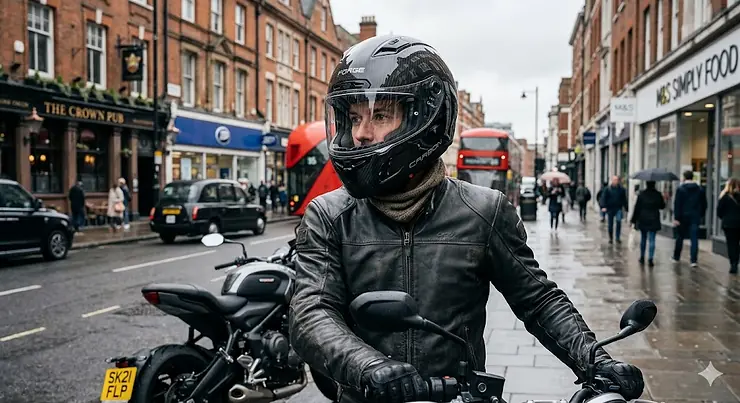
There’s a moment — usually somewhere on the A59 with the Pennines looming and a stiff Yorkshire crosswind trying to rearrange your head — when you realise that the lid strapped to your skull is either working with you or fighting you. A carbon fibre motorcycle helmet, worn for the first time, produces a different moment entirely. You put it on, and it feels almost criminally light. You think: is this actually doing anything? It is. It’s doing rather a lot.
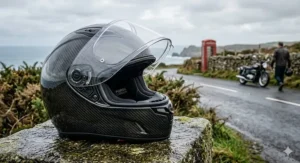
Carbon fibre is the darling of aerospace, Formula 1, and performance cycling for a reason. Thin crystalline filaments of carbon, bonded with resin and layered in precise weaves, produce a material that is — weight for weight — stronger than steel. In helmet form, that translates to shells weighing somewhere around 1.35–1.5 kg that absorb and disperse impact forces more effectively than heavier polycarbonate alternatives. For UK riders clocking up motorway miles on a Tuesday or threading through Bristol city traffic, the reduced neck fatigue alone is worth taking seriously.
What makes 2026 a particularly significant year for the British buyer is the full enforcement of the ECE 22.06 standard, administered here by the SHARP programme under the Department for Transport. New helmets must now carry ECE 22.06 certification to receive type approval in the UK — a standard that introduces oblique impact testing and 12 additional impact zones compared to the outgoing 22.05. In short: the bar has risen, and carbon fibre helmets are clearing it with room to spare.
This guide covers seven real carbon fibre motorcycle helmets available to UK buyers, with frank commentary on who each one actually suits — including whether the premium is justified for your particular style of riding.
Quick Comparison: Carbon Fibre Motorcycle Helmets at a Glance
| Helmet | Shell Material | Cert. | Weight (approx.) | Price Range | Best For |
|---|---|---|---|---|---|
| AGV Pista GP RR | Full Carbon | ECE 22.06 / FIM | ~1,450g | £900–£1,100+ | Track/performance purists |
| Arai RX-7V Evo | PB-SNC2 Composite | ECE 22.06 | ~1,560g | £700–£800 | Long-distance road riders |
| Shoei X-SPR Pro | AIM+ Composite | ECE 22.06 / FIM | ~1,440g | £700–£820 | Sport-touring, quiet ride |
| HJC RPHA 1 V2 Carbon | Full Carbon | ECE 22.06 / FIM | ~1,438g | £550–£700 | Value-conscious track riders |
| Shark Race-R Pro GP Carbon | Full Carbon | ECE 22.06 | ~1,250g | £350–£500 | Club racers & sporty commuters |
| Ruroc Atlas 4.0 Carbon | Full Carbon | ECE 22.06 | ~1,600–1,713g | £375–£475 | Style-forward street riders |
| LS2 Thunder Carbon | Full Carbon | ECE 22.06 | ~1,360g | £300–£420 | Budget entry into genuine carbon |
The numbers above tell only part of the story. The AGV and Shoei are ostensibly the lightest of the genuine race helmets, but real-world comfort depends enormously on head shape — and the Arai’s heavier composite shell is engineered around a philosophy of energy deflection rather than pure mass reduction. What that means in practice: if you’re doing a 250-mile run to Scotland and back, the Arai’s rounded shell and superb ventilation system may leave you feeling considerably fresher than a lighter lid that generates more turbulence. Budget buyers should note that the LS2 Thunder Carbon delivers genuine full-carbon construction at a price point that would have seemed remarkable five years ago — though you do sacrifice some interior refinement in the process.
💬 Just one click — help others make better buying decisions too! 😊
✨ Don’t Miss These Exclusive Deals!
🔍 Ready to upgrade your lid? Click any highlighted helmet name to check current pricing and availability on Amazon.co.uk. These are hand-picked for UK riders, with Prime-eligible options for next-day delivery.
Top 7 Carbon Fibre Motorcycle Helmets: Expert Analysis
1. AGV Pista GP RR Carbon — The One MotoGP Riders Actually Wear
The Pista GP RR is the lid that Valentino Rossi, Pecco Bagnaia, and Marco Bezzecchi have trusted at full MotoGP pace, and that lineage matters more than marketing copy. The full carbon shell — properly full carbon, not a composite blend — combined with multi-density EPS delivers extraordinary structural rigidity while the weight stays in the vicinity of 1,450g in a medium.
Here’s the practical angle for UK road riding: the aerodynamics are tuned for speeds that most of us will only see on a track day at Donington or Cadwell Park. On motorway runs at legal limits, the Pista GP RR can feel slightly more turbulent than dedicated touring helmets — a trade-off that’s absolutely worth it if your weekend involves lapping. The FIM and ECE 22.06 dual certification means it’s track-legal at virtually every UK circuit. UK reviewers consistently praise the visor mechanism’s precision, and the interior ventilation — particularly in the damp heat of a British summer — performs well above what you’d expect for a racing lid.
✅ Full carbon shell with no compromise
✅ FIM certified — track legal without question
✅ Exceptional aerodynamic stability at speed
❌ Premium price point puts it well above £900
❌ Race-optimised fit can fatigue on very long road rides
For the serious track-day enthusiast or the rider who simply wants the finest lid money can buy on Amazon.co.uk, the AGV Pista GP RR represents the current zenith. Check current price on Amazon.co.uk — well into the four figures for graphic variants, but justifiably so.
2. Arai RX-7V Evo — The Measured Choice for the Thinking Rider
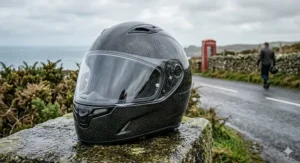
Arai makes helmets the way the Japanese make fine ceramics: with obsessive, almost philosophical attention to process. The RX-7V Evo is certified to ECE 22.06 using Arai’s proprietary PB-SNC2 shell — a Peripherally Belted Structural Net Composite that layers fibres, resin, and a mesh belt across the visor aperture for what Arai calls “glancing-off performance.” The idea is that a rounder, smoother shell encourages oblique impacts to deflect away from the head rather than grip and twist. Whether you subscribe to that theory fully or not, the SHARP rating system has historically scored Arai lids favourably, and ECE 22.06 now mandates the very oblique testing that Arai has been preparing for since the 1990s.
At approximately 1,560g (measured, not claimed) it’s heavier than the AGV, and that’s honest. But on a 300-mile run from Manchester to the Lake District and back — the kind of ride where neck fatigue starts compounding after two hours — the Arai’s ventilation system, featuring 11 adjustable intake paths and two internal visor exhaust ports, keeps things remarkably fresh. The VAS-V visor presses tightly to the shell, which means appreciably less wind noise than rival race lids. UK riders in the £700–£800 range will find the Arai RX-7V Evo on Amazon.co.uk — Prime-eligible in most sizes.
✅ ECE 22.06 certified, five shell sizes for precise fit
✅ Outstanding ventilation for UK’s variable temperatures
✅ Quieter than most race-focused competitors
❌ Heavier than full-carbon rivals
❌ Tight, performance-oriented fit — must be tried before buying
3. Shoei X-SPR Pro — Disarmingly Light, Surprisingly Versatile
The X-SPR Pro succeeded the beloved X-Spirit III and arrived with ECE 22.06 certification from the outset — Shoei didn’t try to squeeze the new standard into an old design. The AIM+ (Advanced Integrated Matrix+) shell isn’t technically full carbon in the way the AGV is, but it’s a sophisticated fibre composite across four shell sizes, weighing in at around 1,440g in a medium. That’s competitive.
What most UK buyers overlook about this model is how civil it is as a daily helmet. MCN’s long-term test noted it as “significantly more peaceful when cruising” than the AGV Pista GP RR — something that matters enormously when you’re grinding up the M6 in the rain with lorries drafting past you. The seven-position ventilation system, including a cheek vent that spreads airflow across your face rather than just blasting a cold jet into your chin, is genuinely clever engineering. The 3D Max-Dry interior is removable and washable — relevant for riders who’ve experienced the consequences of not washing their liner through a British summer. Available in the £700–£820 range on Amazon.co.uk; FIM certification makes it track-legal too.
✅ ECE 22.06 and FIM certified
✅ Exceptionally quiet for a sport/race lid
✅ Superior interior comfort and fit adjustment
❌ AIM+ shell, not full carbon — purists may notice
❌ Small vent switches can be tricky with gloves on
4. HJC RPHA 1 V2 Carbon — MotoGP Tech at a Price That Doesn’t Require a Second Mortgage
HJC has spent decades producing volume-market lids. The RPHA 1 V2 Carbon is not one of those. It was developed alongside HJC’s MotoGP and BSB programme riders — meaning it was tested at Misano and Assen before it was tested in a box warehouse. The full carbon shell comes in four sizes, weighing approximately 1,438g, making it one of the lightest genuinely race-worthy helmets in this group.
The HJ-35 visor is wide-field, Pinlock 120-prepared (the highest-grade insert), and the kit in the box includes tear-offs, a dark smoke visor, and emergency release cheek pads — features that typically live behind a premium surcharge on rival brands. For British club racers tackling Brands Hatch Indy or Thruxton, those tear-offs aren’t a novelty — they’re essential. At £550–£700 on Amazon.co.uk, the RPHA 1 V2 Carbon represents the best value-per-performance calculation in this list. UK customers report good stock availability and Prime next-day delivery on standard colourways.
✅ Full carbon shell, MotoGP racing heritage
✅ Superb ventilation — measured 0°C temperature difference in testing
✅ Generous box contents at this price point
❌ Can be slightly noisier than the Shoei at motorway speeds
❌ Fit suits intermediate oval heads — try before committing
5. Shark Race-R Pro GP Carbon — The Lightweight Puncher
At approximately 1,250g, the Shark Race-R Pro GP Carbon claims to be one of the lightest helmets in this roundup — and it delivers on that claim in a way that makes you question why you ever wore anything heavier. The full carbon construction is genuine, and ECE 22.06 certification is present. French brand Shark has a strong presence in UK motorcycling circles, and parts and accessories are widely available on these shores.
The Race-R Pro GP suits the sporty commuter who wants track capability without the eye-watering outlay of the Japanese flagships. In the £350–£500 price corridor on Amazon.co.uk, it’s excellent. Where it loses a little ground is interior finish — the lining isn’t quite as plush as Shoei’s, and the ventilation, while functional, doesn’t quite match the AGV’s more aggressive airflow in sustained high-speed use. For city riding and occasional club days, though, it’s a superb choice. UK reviewers specifically note the lightweight advantage during stop-start London riding, where nodding your head repeatedly at junctions accumulates fatigue across a long day.
✅ One of the lightest full-carbon lids in this price range
✅ ECE 22.06 certified
✅ Good UK availability and accessories ecosystem
❌ Interior refinement slightly behind Japanese rivals
❌ Less suitable for extended touring than sport use
6. Ruroc Atlas 4.0 Carbon — Designed in Britain, Deliberately Different
Ruroc is a Cheltenham-based company, which gives the Atlas 4.0 Carbon a particular resonance for UK riders. It’s an ECE 22.06 certified, full-carbon helmet with a “streetfighter” aesthetic that polarises opinions — you’ll either find it aggressively handsome or inexplicably odd-looking, with little middle ground. Raw Carbon variants showcase the weave beautifully.
Here’s the honest assessment: at 1,600–1,713g measured (heavier than claimed), the Ruroc is not the lightest full-carbon helmet in this group. But its RHEON impact technology — a rate-sensitive foam that stiffens under high-energy impacts — adds genuine rotational protection for oblique impacts. The optional Shockwave Bluetooth kit (around £150 extra) integrates neatly, though Bluetooth range is limited by the carbon shell. Ruroc’s crash replacement programme — an extra £30 at purchase allows 50% off a replacement lid for two years after an accident — is the kind of sensible British pragmatism that this list deserves more of. Available in the £375–£475 range on Amazon.co.uk and direct from Ruroc’s UK site.
✅ Designed and supported in the UK
✅ ECE 22.06 certified with added RHEON impact technology
✅ Crash replacement programme — excellent value-add
❌ Heavier than claimed; not the lightest option
❌ Bluetooth connectivity limited by carbon shell
7. LS2 Thunder Carbon — Budget Carbon That’s Actually Carbon
The LS2 Thunder Carbon is the answer to the question: “Can I get genuine carbon fibre construction without spending £500+?” As it turns out, yes — in the £300–£420 range on Amazon.co.uk, with ECE 22.06 certification and a claimed weight of approximately 1,360g. Chinese-manufactured but rigorously certified, the Thunder Carbon represents a generational shift in what entry-level means for the carbon category.
The interior fit and finish won’t make an Arai owner envious, and the ventilation is adequate rather than impressive. But for a rider transitioning from a polycarbonate helmet and wanting to experience carbon fibre construction before committing serious money upward, this is the logical starting point. UK buyers should note it is Prime-eligible on Amazon.co.uk, and the brand’s UK service network, while thinner than the Japanese majors, has improved considerably. The Thunder Carbon suits commuters in cities like Leeds or Birmingham who want the weight reduction benefit on daily rides without committing to a flagship budget.
✅ Genuine carbon fibre construction at accessible price
✅ ECE 22.06 certified
✅ Prime-eligible, fast UK delivery
❌ Interior finish and ventilation behind premium rivals
❌ Less head-shape variety than established European brands
How to Choose a Carbon Fibre Motorcycle Helmet in the UK: 6 Essential Criteria
Choosing a carbon fibre motorcycle helmet in 2026 requires more rigour than scanning a star rating and clicking “buy.”
1. Prioritise ECE 22.06 certification above all else. As of 2026, it is now illegal to sell new motorcycle helmets in the UK without ECE 22.06 approval. This standard introduced oblique impact testing and 12 additional impact zones compared to ECE 22.05. DOT-only helmets (common on cheaper imports) are not road legal for UK use — full stop.
2. Check the SHARP rating. The SHARP programme, run by the Department for Transport, independently tests helmets to destruction and awards one to five stars. A legal helmet and a safe helmet are different things. SHARP tells you which is which. Aim for four stars minimum; five stars represents best-in-class protection.
3. Fit matters more than brand. No helmet — at any price — protects you properly if it’s the wrong shape for your head. Intermediate oval (most Japanese brands), round oval (some European brands), and long oval heads all exist. Try the helmet on, move your head sharply side to side; if it shifts, it’s too large.
4. Consider your riding style honestly. A race-focused lid like the AGV Pista GP RR is optimised for tucked, high-speed positions. It can feel slightly unwieldy on an upright adventure bike through the Brecon Beacons. Match the helmet to how you actually ride, not to what you aspire to ride.
5. Weight distribution, not just total weight. A lighter lid placed poorly on your head generates more fatigue than a slightly heavier one balanced correctly. This is why some riders find an Arai RX-7V Evo more comfortable over long distances than a nominally lighter race lid.
6. Budget for the total cost. A Pinlock anti-fog insert (essential in the British drizzle), a quality visor, and potential intercom additions can add £80–£200 to any helmet purchase. Factor that in before selecting your ceiling.
Real-World Scenarios: Which Carbon Lid Fits Your Life?
The London Daily Commuter
Picture this: Alex, based in Hackney, rides a Yamaha MT-07 across zone 2 five days a week. Queuing through Shoreditch, filtering on the A10, occasional weekend blast to the Surrey Hills. The priority is weight reduction (neck ache from sustained stop-start riding is real) and quick visor changes between unpredictable British weather and sunshine.
Best match: Shark Race-R Pro GP Carbon. The sub-1,300g weight reduces cumulative fatigue dramatically over a five-day week. ECE 22.06 certification means no insurance grey areas. It’s not the quietest lid on the motorway, but Alex isn’t doing motorway miles.
The Club-Day Weekend Warrior
Priya rides a Kawasaki ZX-6R, tracks it at Snetterton and Silverstone GP quarterly, and uses the bike for longer weekend rides between track days. She needs a single helmet that’s FIM certified (required at most UK circuits) and comfortable enough for a 200-mile run to the venue.
Best match: HJC RPHA 1 V2 Carbon. FIM certified, genuinely track-legal, outstanding ventilation, and significantly more affordable than the AGV or Arai flagships — leaving budget for knee sliders and leathers.
The Long-Distance Tourer
James rides a BMW R 1300 GS and covers 12,000+ miles annually, including Scotland, Wales, and regular trips to the continent via the Channel Tunnel. Wind noise and neck fatigue over five-hour days are the enemy.
Best match: Shoei X-SPR Pro or Arai RX-7V Evo. Both are notably quieter than pure race lids, both ECE 22.06 certified, and both offer ventilation systems that genuinely breathe — critical when August in Provence is 35°C but the A9 through Pitlochry is 14°C the following week.
UK Regulations, Safety Standards & What You Actually Need to Know
Let’s be direct about the legal landscape in 2026 because there’s considerable confusion online, particularly regarding helmets purchased from US or non-EU marketplaces.
Under UK law, a motorcycle helmet must carry either the British Standard BS6658:1985 with BSI Kitemark, or meet UNECE Regulation 22.06. A DOT-only certification (the American standard, FMVSS 218) is not sufficient for UK road use. That “carbon fibre full face helmet” listed on Amazon for £55 with only a DOT sticker? Not road legal here. Riding with it would constitute a fine of up to £500 and, more worryingly, could complicate any insurance claim following an accident.
ECE 22.06 — the current modern standard — introduced several significant advances over the previous 22.05 standard, including:
- Oblique impact testing (simulating real-world angled crashes that generate rotational brain injury)
- 12 additional impact zones tested
- Stricter chin bar testing for modular/flip-front helmets
- Enhanced retention system checks
Existing ECE 22.05 helmets you already own remain legal to wear. But from January 2026, all newly manufactured helmets seeking type approval must meet 22.06. The practical upshot: when buying new in 2026, look for 22.06. It’s a meaningfully higher bar, not just a bureaucratic revision.
For track days specifically, most UK circuits now require FIM certification (held by the AGV Pista GP RR, Shoei X-SPR Pro, and HJC RPHA 1 V2 Carbon in this guide) or ACU Gold approval. Check your circuit’s specific requirements — Cadwell Park, Knockhill, and Brands Hatch have specific rules worth confirming before you arrive with the wrong lid.
Carbon Fibre vs Polycarbonate vs Composite: What the Shell Actually Changes
This is the section that Amazon product listings quietly avoid, because answering it honestly might complicate the sale.
Polycarbonate helmets — your typical budget helmet in the £80–£200 range — use a plastic thermoplastic shell that absorbs energy by deforming. They’re heavier (typically 1.5–1.8 kg for a full-face), less aerodynamically refined, but entirely legal and passably safe if SHARP-rated at three stars or above. For slow urban riding, they’re adequate.
Composite helmets (fibreglass, fibreglass-carbon hybrid, like the Arai RX-7V Evo’s PB-SNC2) sit in the middle. Lighter than polycarbonate, engineered for glancing-off performance, and frequently achieving excellent SHARP scores. The Arai philosophy is worth noting here: they argue that a rounder shell is more protective than raw shell lightness.
Full carbon fibre helmets — the AGV, HJC RPHA 1 V2, Shark Race-R Pro, LS2 Thunder Carbon, and Ruroc in this guide — offer the best strength-to-weight ratio of any commercially available material. Under impact, carbon fibre distributes force across the weave rather than concentrating it. The result is shells that can be thinner, lighter, and no less protective than equivalents in other materials. The average weight for a carbon motorcycle helmet sits around 1,360g — roughly 300–400g lighter than comparable polycarbonate lids. That saving adds up across a 200-mile day.
The catch: carbon fibre helmets cost more to manufacture. You’re paying for material cost, layup precision, and certification. What you get back is reduced fatigue, marginally better aerodynamics, and — in premium examples — a level of engineering that provides genuine confidence when the unthinkable happens.
✨ Don’t Miss These Exclusive Deals!
🔍 Upgrade your riding kit with the helmets above — click any highlighted model to check current pricing on Amazon.co.uk. Prime members get free next-day delivery on eligible items.
Common Mistakes When Buying a Carbon Fibre Helmet in the UK
Buying DOT-only helmets from US sellers. It happens more than you’d think on Amazon’s marketplace. A £60 “carbon” lid with a DOT sticker and no ECE marking is not road legal in the UK, regardless of how impressive the listing photographs look. Check for the ECE 22.06 stamp — it’s embossed or printed inside the helmet, not just on the box.
Ignoring SHARP ratings. Certification means “this helmet meets minimum standards.” SHARP tells you by how much. A one-star SHARP result helmet is legal. A five-star one is significantly safer. The database is free at sharp.dft.gov.uk — use it.
Buying based on size from another brand. A medium Shoei and a medium Arai are not the same shape or volume. Each brand calibrates differently. If you’re buying a first helmet from a new brand, try it in person or check the brand’s specific sizing guide and head shape compatibility chart carefully.
Underestimating the visor situation for British weather. A Pinlock insert is not a luxury in the UK — it’s essential. The temperature differentials between a damp 8°C morning and a heated head create fogging conditions that an unprotected visor can’t manage. Ensure your chosen helmet is Pinlock-ready (most premium options in this guide are), and budget for the insert separately if not included.
Forgetting about parts availability post-Brexit. Some European brands have longer lead times for replacement visors and parts since the UK left the single market. Shoei, Arai, AGV, HJC, and Shark all maintain strong UK distribution — parts availability is typically rapid. Lesser-known European brands occasionally have longer waits.
Long-Term Cost and Maintenance in the UK
Carbon fibre motorcycle helmets are an investment that rewards proper care. Here’s the honest cost picture.
A premium carbon helmet in the £700–£900 range should last five to seven years with proper maintenance — assuming no accidents. The five-year replacement guidance exists because the EPS liner slowly degrades with UV exposure, heat cycling, and compression from use, even without visible damage. Carbon fibre shells themselves are extraordinarily durable, but the interior is what you’re ultimately replacing.
Ongoing costs to budget for:
- Replacement visor: £40–£90 depending on brand and tint
- Pinlock insert: £25–£40 (replace annually or when yellowing)
- Replacement liner/cheek pads: £30–£80
- Helmet lock/carrier: £15–£40 (worth it — dropping a £700 helmet is a genuinely upsetting experience)
UK riders should store helmets away from direct sunlight and petrol fumes, which degrade the EPS liner faster than riding does. A cotton bag in a cool cupboard is ideal — not the shed, where British damp and temperature fluctuation accelerate material aging. The Ruroc crash replacement programme (mentioned above) is particularly clever for this reason: for an extra £30 at the point of purchase, you get 50% off a replacement for two years. For a helmet in the £400–£475 range, that’s worth factoring into the total cost calculation.
Frequently Asked Questions
❓ Are carbon fibre motorcycle helmets legal on UK roads?
❓ What does ECE 22.06 mean and do I need it in 2026?
❓ How much should I expect to spend on a carbon fibre motorcycle helmet in the UK?
❓ Can I use a carbon fibre motorcycle helmet on UK track days?
❓ Do carbon fibre helmets fog up more in British weather?
Conclusion: The Lid That Changes How You Ride
The first time you wear a properly fitting carbon fibre motorcycle helmet and pull out onto an A-road, something shifts. The reduction in neck load is palpable. The aerodynamics — even on a street helmet — feel tighter, more resolved. It’s not a placebo. It’s engineering.
For UK riders in 2026, the decision is cleaner than it’s ever been: ECE 22.06 certification is the non-negotiable foundation. Above that, the choice depends on whether you’re prioritising track legality (AGV Pista GP RR, Shoei X-SPR Pro, HJC RPHA 1 V2), touring comfort (Arai RX-7V Evo, Shoei X-SPR Pro), value (HJC RPHA 1 V2, Shark Race-R Pro GP), or British-made pride (Ruroc Atlas 4.0). The LS2 Thunder Carbon sits aside as the budget gateway to the category — a worthwhile starting point before you’re ready to commit £700+.
One final word: fit outranks everything. The finest carbon fibre motorcycle helmet in the world, worn incorrectly, provides no more protection than a polycarbonate budget lid worn properly. Measure your head, check head shapes, and try before you commit wherever possible. Your brain will thank you — preferably by remaining undamaged and intact.
✨ Don’t Miss These Exclusive Deals!
🔍 Click any product name above to check current prices and availability on Amazon.co.uk. Prime members enjoy free next-day delivery on eligible helmets — because waiting shouldn’t be part of safety kit procurement.
Recommended for You
- 7 Best All-in-One Smart Motorcycle Helmets UK 2026
- Best Bluetooth Motorcycle Helmet for Glasses Wearers UK 2026
- Best Smart Helmet for Winter Riding UK 2026 – 7 Top Picks
Disclaimer: This article contains affiliate links. As an Amazon Associate, I earn from qualifying purchases. If you purchase products through these links, we may earn a small commission at no additional cost to you.
✨ Found this helpful? Share it with your mates! 💬🤗
