In This Article
A bluetooth intercom for group rides with slow riders is a helmet-mounted communicator that keeps every rider talking even when the pace splits the pack. The best ones pair a relaying mesh network with automatic rider reconnection, so anyone who drops back on a climb or at a junction rejoins without fiddling with buttons.
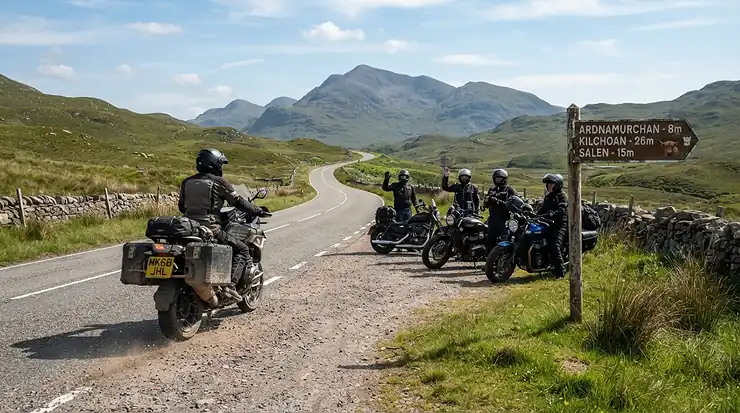
Every group has a slow rider. Sometimes it’s the newcomer on a first big day out, sometimes the pillion-laden tourer, sometimes you after a long week. Without an intercom, that gap becomes a guessing game of mirror checks, anxious lay-by stops and the dreaded “where’s Dave?” phone call.
With the right kit, the gap becomes a non-event. The slow rider says “pull over at the next pub” and the front rider hears it.
The catch is that not every intercom handles stretched-out groups gracefully. A cheap Bluetooth chain can go silent for the whole group when one link in the middle drops. A mesh system, by contrast, reroutes around the gap, and Bennetts BikeSocial’s testing notes that mesh will usually reconnect automatically once a rider drops out of range and returns.
A quick note on sourcing: this guide is built from manufacturer specifications, UK retailer listings and published reviews, with sources named where it matters. It makes no claim of hands-on testing, and prices are ranges that were checked at the time of research (November 2026), so check current prices before buying.
Quick Comparison: Which Intercom Suits Your Group?
Here are the seven units covered below at a glance. Ranges are rated, open-terrain figures, so expect less in real hills and traffic.
| Product | Connection | Group size (rated) | Rated range | Best For |
|---|---|---|---|---|
| Cardo Packtalk Edge | Dynamic mesh (2nd gen) | 15–31 riders (see note below) | Up to 1.6 km rider-to-rider; up to 8 km via relay | Strung-out club rides |
| Cardo Packtalk Neo | Dynamic mesh (2nd gen) | 15–31 riders | Up to 1.6 km; up to 8 km via relay | Budget entry to mesh |
| Cardo Packtalk Pro | Dynamic mesh (2nd gen) | 15–31 riders | Up to 1.6 km; up to 8 km via relay | Riders who often end up alone at the back |
| Sena 60S | Mesh 3.0 plus Wave (phone network) | 24 in group mesh; open mesh effectively unlimited | Up to 2 km; up to 8 km with 6+ riders | Spread-out groups with phone signal |
| Sena 50S | Mesh 2.0 | 24 in group mesh; open mesh effectively unlimited | Up to 2 km; up to 8 km with 6+ riders | Sena-loyal groups wanting great audio |
| Sena 30K | Mesh 2.0 | 24 in group mesh; open mesh effectively unlimited | Up to about 1.2 miles; up to 5 miles with 6+ riders | Cheapest route into Sena mesh |
| Cardo Freecom 4X | Bluetooth chain | Up to 4 riders | Up to 1.2 km | Small groups that stay close |
A note on group size. Cardo’s current 2026 buying guide says the second-generation mesh holds up to 31 riders, while many retailer listings and older reviews still quote 15. For most clubs either figure is plenty, but check the product page when you buy.
Looking at the table, the real dividing line is mesh versus chain, not brand. If your group is larger than four, or if the slow rider tends to drift out of sight, the Cardo Packtalk Edge, Cardo Packtalk Neo, Sena 60S and Sena 50S all keep the group stitched together. The Cardo Freecom 4X is excellent value but only for riders who stay in earshot of each other.
💬 Just one click — help others make better buying decisions too!😊
Top 7 Bluetooth Intercoms for Slow Riders and Mixed Groups: Expert Analysis
1. Cardo Packtalk Edge — best all-rounder for strung-out groups
The Cardo Packtalk Edge suits groups whose biggest enemy is distance, not headcount. Its second-generation Dynamic Mesh Communication lets any rider relay the signal. That means a slow rider two bends behind can still be heard through the rider between them.
On paper, you get up to 1.6 km between units, a group range stretching to around 8 km as the signal hops along, and IP67 weatherproofing. That rating is dust-tight and submersible to one metre for 30 minutes, which in practice means you stop worrying about a British downpour. The 13-hour talk time covers a full day, and the Edge can charge while you ride.
Based on the spec comparison, the Edge makes sense when the group is bigger than four and the pace varies. Published reviews back this up: Rider Magazine’s long US test noted occasional drop-outs on twisty canyon roads that healed once the gap closed, and Motorcycle News describes riders rejoining automatically.
Pros:
- ✅ Self-healing mesh reroutes around a dropped rider
- ✅ IP67 rating copes with sustained rain
- ✅ Charges on the move during long days
Cons:
- ❌ Native mesh only works with other Cardo units
- ❌ No crash detection, which is reserved for the Pro
Expect to pay in the £300-£400 range. Check current price. For most mixed-pace groups, that is the strongest value on the list.
2. Cardo Packtalk Neo — cheapest way into true mesh
The Cardo Packtalk Neo keeps the headline feature, the self-healing mesh network, while shedding the extras. It shares the second-generation mesh, 40mm JBL speakers and 13-hour talk time of its pricier siblings. It uses a clickable mount rather than the Air Mount, can’t charge while riding, and carries a shorter warranty according to Cardo’s US guide.
What does that mean in practice? On a day ride with a lunch stop, you will never notice the missing charge-on-the-move feature. On a long touring day with no stops, you might. The IP67 rating is the same as the Edge, so rain isn’t a concern.
Here’s what to weigh: if your group is four to ten riders and you ride short-to-medium days, the Neo delivers the same rider reconnection behaviour for noticeably less. We could not find a large pool of independent UK reviews for the Neo specifically, so its reputation rests largely on the shared mesh platform. Cardo’s own listings also confirm cross-brand Bluetooth compatibility, though mesh remains Cardo-only.
Pros:
- ✅ Full second-generation mesh at a lower price
- ✅ Same IP67 rating as pricier Packtalks
- ✅ 13-hour talk time handles most day rides
Cons:
- ❌ Cannot charge while riding
- ❌ Shorter warranty than the Edge or Pro
Expect roughly £230-£320. A smart pick for budget-conscious clubs.
3. Cardo Packtalk Pro — safety net for the rider who ends up alone
The Cardo Packtalk Pro adds the one feature the rest of the range lacks: Crash Detection. Sensors read an impact, the Cardo Connect app processes it, and the Cardo cloud sends your GPS location to a chosen contact automatically. That is Cardo’s description, and it is only available in selected regions, so confirm UK support before counting on it.
Why does this matter for slow riders? Because the slow rider is the one most likely to be alone when something goes wrong. The Pro also steps up to 45mm JBL speakers, plus the Air Mount, charge-while-riding and a three-year warranty per Cardo’s guide, with the same mesh as the Edge.
An honest take: if you are the sweep rider, or you regularly ride remote roads at the back, the safety net could justify the premium. If the group always rides within sight of each other, the Edge gives you the same communication for less. We could not verify independent UK reviews specific to the Pro, so treat its crash-alert claims as manufacturer-stated.
Pros:
- ✅ Crash Detection alerts a contact with your location
- ✅ Larger 45mm JBL speakers
- ✅ Three-year warranty per Cardo’s guide
Cons:
- ❌ Highest price in the Cardo range
- ❌ Crash alerts depend on regional availability
Expect around £380-£480. Worth it for solo-tail riders, otherwise the Edge wins on value.
4. Sena 60S — when mesh runs out, your phone network takes over
The Sena 60S is the only unit here that can keep a group connected beyond mesh range. Its Wave Intercom uses your phone’s data connection for group chat across any distance with coverage, then falls back to Mesh 3.0 when the signal drops.
Add the standard modes (open mesh, group mesh for 24 riders, Bluetooth for four) and a rated 2 km between units, and you have the most flexible kit on the list. Wave also displays group members on a live map, which neatly solves “where did Dave go?” The catch is rural dead spots: Wave depends on signal, and mesh still needs riders within reach.
Bennetts BikeSocial’s review tested the 60S with 50R, 50S and ST1 units and found they worked well after a firmware update and a quick toggle of Mesh 3.0 in the app. Ultimate Motorcycling warns that Mesh 2.0 and 3.0 units can’t talk to each other, so the whole group falls back to 2.0 if one rider hasn’t updated.
Pros:
- ✅ Wave extends range through the phone network
- ✅ Backward compatible with older Sena mesh models
- ✅ Group map shows where slow riders are
Cons:
- ❌ Wave needs mobile signal and a phone app
- ❌ Mixed Mesh 2.0 and 3.0 groups need setup care
Expect around £300-£360. Best for groups that want a safety net beyond mesh range.
5. Sena 50S — proven Mesh 2.0 with standout sound
The Sena 50S is the older flagship, but its Mesh 2.0 remains a solid foundation for group rides. You get open mesh with nine channels, group mesh for 24 riders, a Bluetooth mode for four, Harman Kardon audio and a jog dial that is easy to use in gloves.
Rated range is about 2 km, stretching to 8 km when at least six riders sit roughly 1.6 km apart. That condition is the fine print many buyers overlook. In a group of four with a slow tail-ender, you will not see that headline figure.
Reviews point both ways. A UK retailer customer who upgraded from the 30K praised longer battery life and better sound, while one comparison site reports around nine hours of real-world mesh use against a longer claimed figure, and shutdowns in heavy rain because the unit lacks an official IP rating. That second point comes from a single blog, so weigh it accordingly.
Pros:
- ✅ Harman Kardon speakers sound excellent
- ✅ Jog dial works easily with gloves
- ✅ Nine open mesh channels for large clubs
Cons:
- ❌ No official IP rating, so protect it in heavy rain
- ❌ Mesh battery life is shorter than Bluetooth-only use
Expect roughly £200-£300 for a single unit. Good value if your friends already ride Sena.
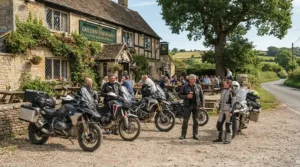
6. Sena 30K — cheapest door into Sena mesh
The Sena 30K was Sena’s first mesh-capable unit and has since been updated to Mesh 2.0. It supports group mesh for 24 riders, open mesh and Bluetooth intercom for four, with a rated range of around 1.2 miles in open terrain.
In practice, this is the pick for a Sena-based group on a budget. Mesh drains the battery faster than Bluetooth, with Sena’s own community figures putting mesh talk time at around 8 hours. One comparison blog describes real-world mesh range as under half a mile and audio as better suited to calls than music at motorway speeds. These are single-source impressions, so treat them as a warning, not a verdict.
A UK customer review on a retailer listing praised the seamless mesh connection because their riding friends already use Sena mesh. That is the 30K’s real strength: it joins the party cheaply. If you are starting from scratch, though, a Packtalk Neo may be the better buy.
Pros:
- ✅ Joins Sena mesh groups at a budget price
- ✅ Group mesh supports up to 24 riders
- ✅ Bluetooth fallback for four riders
Cons:
- ❌ Older hardware with shorter mesh battery life
- ❌ Audio is weaker for music at speed
Expect roughly £200-£300 for a single unit. A sensible buy only if your group already uses Sena.
7. Cardo Freecom 4X — best value when the group is four or fewer
The Cardo Freecom 4X is Cardo’s top Bluetooth-only unit, and it does not pretend to be a mesh system. It links up to four riders at a rated 1.2 km, with 40mm JBL speakers, Natural Voice Operation (“Hey Cardo”) and a 13-hour battery. Its IP65 rating means it resists water spray rather than full submersion.
Because it chains riders together over Bluetooth, the order of riders matters and a drop in the middle can silence the riders behind. Cardo’s Live Intercom auto-reconnect softens that, but the chain logic remains.
Motorcycle News gave it four out of five and singled out the sound quality, especially for music. Motorcycle.com’s reviewer flagged the four-rider limit, the daisy-chaining requirement and an echo on one unit that was replaced. A mixed picture, then, but a fair one for the price.
Pros:
- ✅ Excellent JBL sound, especially for music
- ✅ Voice control works well with gloves
- ✅ Lowest price of the Cardo units here
Cons:
- ❌ Four-rider ceiling with no mesh
- ❌ A middle-link drop can silence riders behind
Expect around £170-£250. Brilliant for settled foursomes, but not for a stretched-out group.
How the Top 7 Compare on Price, Reconnection and Fit
| Product | Price range (check current) | Reconnection behaviour | Best For |
|---|---|---|---|
| Cardo Packtalk Edge | £300-£400 | Self-healing mesh, auto rejoin | Mixed-pace clubs |
| Cardo Packtalk Neo | £230-£320 | Self-healing mesh, auto rejoin | Budget mesh buyers |
| Cardo Packtalk Pro | £380-£480 | Self-healing mesh plus crash alert | Solo tail riders |
| Sena 60S | £300-£360 | Mesh 3.0 plus Wave fallback | Spread-out groups with signal |
| Sena 50S | £200-£300 (single) | Mesh 2.0, usually auto-reconnects | Sena groups wanting sound |
| Sena 30K | £200-£300 (single) | Mesh 2.0, usually auto-reconnects | Budget Sena groups |
| Cardo Freecom 4X | £170-£250 | Bluetooth auto-reconnect, chain-dependent | Groups of four or fewer |
The pattern here is clear: paying more buys you resilience when the group stretches. The Cardo Packtalk Neo is the cheapest way to get true mesh, the Sena 60S adds a cellular safety net, and the Cardo Freecom 4X is the cheapest decent option when nobody gets left behind.
How to Choose a Bluetooth Intercom for Group Rides with Slow Riders
Follow these seven steps to narrow the field without overthinking it.
- Count your riders. More than four means mesh, full stop. Bluetooth chains cap at four and wobble when one link breaks.
- Find your slowest link. If they regularly fall out of sight, prioritise rider reconnection and a relay-capable network.
- Check what your friends already own. Mesh only works within a brand, so matching the group saves money and frustration.
- Be realistic about range. Ratings assume open terrain, and hills, traffic, buildings and tunnels cut them back sharply.
- Match battery to ride length. A 13-hour Cardo rating beats a roughly 8-9 hour Sena mesh figure on long touring days, though everyone’s real-world usage differs.
- Check weather resistance. IP67 on the Packtalks, IP65 on the Freecom 4X, and no official rating on the older Sena units.
- Think about controls. Voice commands or a jog dial matter more than button layouts once you’re wearing winter gloves.
Intercom for Riding Groups with Mixed Pace: Building the Right Setup
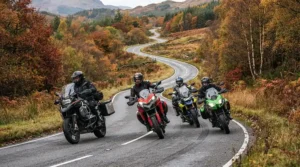
An intercom for riding groups with mixed pace has a different job from a gadget for friends who ride identically. The group stretches and compresses like an accordion. Fast riders wait at junctions, slow riders catch up on straights, and everyone’s distance from everyone else changes every minute.
That’s why relay matters. In a mesh network, the rider in the middle passes the signal along, so the slow rider at the back can still reach the leader as long as someone sits within range of both. In a Bluetooth chain, the connection depends on the order of riders and breaks when one link fails.
Group-riding etiquette helps too. Put the slowest rider second behind the leader so the pace sets itself, and let an experienced sweep ride last. Use the intercom to agree regroup points before the ride, then use it to adjust on the fly. A line like “next fuel stop in ten minutes” is worth more than any spec sheet.
If your mixed-pace group includes riders on different brands, Bluetooth is the fallback. Cardo and Sena pair for basic intercom, but mesh stays within one brand.
Multi Rider Bluetooth Intercom for Touring: What Changes on Long Days
A multi rider bluetooth intercom for touring faces tougher conditions than a Sunday blast. You’re riding eight-hour days, switching between sat-nav prompts, phone calls and group chat, and you’re probably carrying luggage that makes every pace difference bigger.
Battery is the first filter. The Packtalk Edge and Pro can charge while riding, which turns a power bank in the tank bag into an all-day solution. The Neo cannot. Sena’s 60S offers quick charge, with a 20-minute top-up giving around 3.5 hours of mesh use according to one UK-facing retailer listing.
Control is the second filter. Cardo’s voice commands let you answer a call or change the volume without lifting a hand. Sena’s jog dial does the same job through touch.
Third is audio versatility. The Freecom 4X offers two Bluetooth channels for phone and GPS, while mesh models multitask between intercom and music. For touring pairs and small convoys, the choice between a four-rider Bluetooth unit and a mesh unit comes down to how often your group changes. Groups that grow, shrink or meet new riders benefit from mesh.
Group Intercom Range: What the Box Doesn’t Tell You
Group intercom range is the most misunderstood spec in this market. Manufacturers quote rated distances measured in open terrain, and then riders compare them as if every road were a desert.
Here is how the numbers actually work. Cardo rates the Packtalks at up to 1.6 km between two units and up to 8 km across the group as the signal hops from rider to rider. Sena rates its mesh units at about 2 km between units, extending to around 8 km only with at least six riders spaced about 1.6 km apart.
Run the sums for a group of four with a slow rider trailing. You are unlikely to see 8 km of useful range, because there aren’t enough relay nodes. Your real-world number is closer to the rider-to-rider figure, shortened by hills, buildings and traffic.
Reviews reflect that. A Rider Magazine reviewer reported occasional drop-outs on winding canyon roads that healed when riders closed up, while Motorcycle News found the Packtalk Edge reliable even when riders were separated in forest. The takeaway: assume half the box figure on twisty UK roads, and brief your tail rider to stay within it.
Rider Reconnection: What Happens When Someone Drops Back
Rider reconnection is where mesh earns its money. With Cardo’s system, a rider who drops out of range rejoins automatically once they return to range, without anyone touching a button. Sena’s mesh behaves similarly, and Bennetts notes that mesh will usually reconnect on its own.
Bluetooth chains work differently. The Freecom 4X uses Cardo’s Live Intercom to reconnect automatically, but the chain depends on its weakest link. One retailer describes the process as sometimes needing manual re-bridging, so the experience may vary by situation.
When reconnection doesn’t happen, simple fixes usually help. Close the gap first, since most drops are physical. If that fails, toggle mesh off and on rather than rebooting the whole unit. Bennetts needed exactly that step in the app when mixing 60S and older Sena units.
Finally, remember that updates matter. Sena’s Mesh 2.0 and 3.0 don’t interoperate, so a single out-of-date unit can force the whole group onto the older standard. Update before the ride, not at the first fuel stop.
Four Rider Connectivity: When Bluetooth Is Enough
Four rider connectivity is the sweet spot for Bluetooth. If your regular crew is three or four friends who stay in earshot, a chain-based unit like the Cardo Freecom 4X does the job at a lower price than any mesh option.
Bennetts BikeSocial’s review is clear that the Freecom 4X is limited to four riders over a claimed three-quarters of a mile and is meant to sit alongside the mesh-equipped Packtalks. Sena’s own units can also run a four-rider Bluetooth mode, though they are mesh-first.
Here is the practical test. If your group is four now but might become six by next summer, buy mesh. If it’s four and always will be, Bluetooth saves real money. And if one of the four is the slow rider who regularly vanishes round a bend, mesh is worth the premium. A relay network keeps a chain of four stable, while a Bluetooth chain can leave the rider at the end talking to nobody.

Practical Usage Guide: Setting Up Your Group Before the First Ride
Great hardware can still fail on a bad setup. Run through this routine the night before.
- Update firmware on every unit. For Sena, make sure the whole group uses the same mesh generation. For Cardo, update over the air via the app.
- Choose your mesh type. Cardo’s Open Mesh lets any Cardo unit join, while Private Group Mesh stays closed to invited riders. Pick private for club rides to avoid strangers dropping in.
- Pair in the garage, not the lay-by. Pairing a group of ten takes seconds on Cardo’s system, but it’s far less stressful with a brew in hand.
- Do a sound check. Set volume low enough to hear traffic. UK guidance is about avoiding distractions, not banning devices.
- Agree roles. Leader at the front, an experienced sweep at the back, the slowest rider second.
- Set a regroup rule. For instance, “if you lose anyone for two minutes, pull over at the next safe spot.”
In the first 30 days, the common mistakes are forgetting to charge the night before, mismatched firmware and mounting the unit too far back on the helmet. Fix those three and you eliminate most early frustration.
Real-World Scenarios: Matching the Kit to Your Group
Scenario one: the club ride of eight. Eight riders, two newer members on smaller bikes, regular route through hilly country. Mesh is non-negotiable, and a unit like the Cardo Packtalk Edge keeps the relay alive when the group stretches. If the club has a modest budget, the Cardo Packtalk Neo delivers the same mesh for less.
Scenario two: four mates, one cautious rider. A weekend touring group of four where one rider prefers a gentler pace. If they stay within a mile of each other, the Cardo Freecom 4X is fine. If the cautious rider tends to disappear, the Sena 60S or a mesh Packtalk offers a safer net.
Scenario three: the Sena household. Everyone already owns Sena, and a new member joins on a tight budget. The Sena 30K slots straight into the group’s mesh at a lower cost, with the caveat that battery life is shorter than newer units. For a group with a modern unit like the Sena 50S, check that everyone uses the same mesh generation.
The same logic applies across budgets: decide by group size, then by pace spread, then by brand loyalty.
Problem and Solution: Fixing the Most Common Group Ride Headaches
Problem: the slow rider keeps dropping off at hills. Climbs and bends hurt range most. Solution: ride the slow rider second and use mesh so the relay stays alive. A unit like the Sena 60S adds Wave as a fallback.
Problem: one rider can’t hear the group. Usually it’s a mount or speaker placement issue. Solution: reposition the speakers inside the helmet and test at speed in a lay-by before blaming the unit.
Problem: batteries die at 3 pm. Solution: use charge-while-riding where available, as on the Cardo Packtalk Edge and Cardo Packtalk Pro, or carry a power bank. On the Sena 60S, quick charge can top up during a coffee stop.
Problem: the group uses two brands. Solution: pair over Bluetooth for basic intercom and accept the shorter range, or standardise on one brand for the club.
Problem: someone forgets to enable mesh. Solution: make “mesh on, volume low, sound check” part of every pre-ride briefing.
Mesh vs Bluetooth Chain vs Phone Apps vs Hand Signals
How does an intercom stack up against the old ways? This table compares the options for a stretched-out group.
| Option | Strength | Weakness | Best For |
|---|---|---|---|
| Mesh intercom | Self-healing, relays through the group | Brand-locked, higher cost | Cardo Packtalk Edge, Sena 60S groups |
| Bluetooth chain | Cheap, simple for small groups | Breaks when a middle link drops | Cardo Freecom 4X foursomes |
| Phone call or app | Works over long distance | Needs signal, can distract | Fallback or Wave via Sena 60S |
| Hand signals and stops | Costs nothing | Slow, no talk between riders | Short rides in close formation |
The comparison shows why mesh has taken over club riding: it is the only option that handles stretched groups without a fuss. Bluetooth chains are fine within their limits. Phone-based options are a useful backup but depend on coverage. And hand signals remain a worthwhile skill, but they cannot tell the leader you need a loo break.
Long-Term Cost and UK Rules: What to Budget and What to Know
Think in cost per ride, not sticker price. A unit costing around £300 and used on 30 rides a year for four years works out at roughly £2.50 per ride, before you account for warranty. Cardo’s US guide lists up to three years on the Edge and Pro, but check UK terms with the retailer.
Remember that every rider needs their own unit. Mesh can’t form until everyone has one, so a group of six means six units, or three dual packs. That makes the per-rider cost the number to compare.
On UK law, using an intercom is not illegal, but Highway Code Rule 148 asks you to avoid distractions such as loud music that may mask other sounds. Carole Nash’s guide to music rules for riders explains that listening may be allowed but should be avoided if it becomes a distraction. Keep volume modest, keep conversation brief in busy traffic and check your helmet manual before fitting any accessory.
✨ Ready to Ride Together?
🔍 Take your group rides to the next level with a bluetooth intercom for group rides with slow riders. Click any highlighted product name to check current pricing and availability, then pick the unit that keeps your whole pack connected, front to back!

FAQ
❓ Should I buy single units or a dual pack for group riding?
❓ Can Cardo and Sena intercoms talk to each other?
❓ What is the cheapest way to get mesh for a group ride?
❓ Will an intercom fit a flip-front or modular helmet?
❓ What happens if one rider's battery dies mid-ride?
Conclusion
Choosing a bluetooth intercom for group rides with slow riders comes down to one question: will your group stay close, or will it stretch? If it stays close and stays small, the Cardo Freecom 4X delivers sound and simplicity at a sensible price. If it stretches, mesh is the answer.
For most mixed-pace clubs, the Cardo Packtalk Edge offers the best balance of self-healing connection, weatherproofing and all-day battery. The Cardo Packtalk Neo trims the price, and the Cardo Packtalk Pro adds crash detection for riders who often end up alone at the back. On the Sena side, the Sena 60S brings Wave for extra reach, the Sena 50S offers great audio on proven Mesh 2.0, and the Sena 30K is the budget door into the Sena world.
The honest summary is this: the slow rider isn’t the problem. A connection that can’t cope with them is. Pick a network that reconnects without fuss, make sure everyone’s firmware matches, brief the group before you roll, and the gap between riders stops being a worry and becomes just another part of the ride.
✨ Don’t leave your slowest rider talking to themselves!
🔍 Click any highlighted product above to check current pricing and availability, then get the whole group connected for your next ride. 🏍️
Recommended for You
- Low Profile Bluetooth Intercom For Open Face Helmets: 7 Best (2026)
- Intercom For Modular Flip Front Helmets: 7 Best Buys (2026)
- Motorcycle Helmet Intercom For Two Up Riding: 7 Best Picks (2026)
Disclaimer: This article contains affiliate links. As an Amazon Associate, I earn from qualifying purchases. If you purchase products through these links, we may earn a small commission at no additional cost to you.
✨ Found this helpful? Share it with your friends! 💬🤗
