

In This Article
What is a low profile bluetooth intercom for open face helmets? It is a slimline communicator that clamps or sticks to a jet or three-quarter shell. It pairs a boom mic with thin speakers, so you can talk to a pillion or fellow riders, take calls and hear sat nav without a bulky pod catching the breeze.
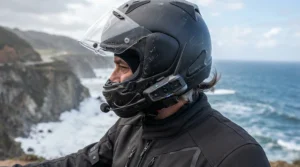
Open face lids are gloriously simple and gloriously awkward for tech. There’s no chin bar to hide a mic against, the ear pockets are often shallow, and the wind has a clear run at everything you bolt on. Add a chunky comms unit and you get a drag-inducing lump that looks glued on by an optimist. Hence the appeal of slim kit. 🎧
The wind isn’t just an annoyance either. Engineers at the University of Bath have studied helmet noise, as Inside Science reports. They say audible wind noise can reach 115 decibels or more. That’s why wind buffeting, mic placement and speaker fit matter more here than any Bluetooth version number.
To be upfront, this guide is research-led analysis built from spec sheets, retailer listings and published reviews. I haven’t ridden with any of these kits, and I’ll flag where I couldn’t verify owner feedback. Prices are indicative ranges only, so check the current price on amazon.co.uk.
Below you’ll find seven real kits, from a budget bluetooth headset for jet helmets to a mesh-ready premium unit. You’ll also get practical guides to boom mic for open face fitting, stick on speakers and taming wind buffeting.
Quick Comparison: Low Profile Bluetooth Intercom for Open Face Helmets at a Glance
| Product | Best For | Intercom | Price range (indicative) |
|---|---|---|---|
| FreedConn L1M | Solo sat nav on a tiny budget | None (audio only) | £25-£50 range |
| Sena 3S Plus Boom | Cheapest true intercom for jet helmets | 2 riders, about 400 m claimed | £70-£110 range |
| Cardo Spirit HD | Value all-rounder with long battery life | 2 riders, 600 m claimed | £110-£150 range |
| Sena SF4 | Small groups on a slim module | 4 riders, about 1.2 km claimed | £140-£200 range |
| Sena 10R | Ultra-light two-module classic | Up to 4 riders, about 900 m claimed | £150-£220 range |
| Cardo Packtalk Slim | Thinnest premium mesh unit | Mesh, up to 15 riders | £200-£300 range |
| Sena 50R | Large mesh groups, premium sound | Mesh plus Bluetooth | £250-£400 range |
Looking at the table, the Sena 3S Plus Boom is the cheapest genuine two-way option built as a bluetooth headset for jet helmets. The Cardo Spirit HD adds far longer talk time for a modest step up. Group riders should look at the Cardo Packtalk Slim or Sena 50R, where mesh removes the “who’s out of range now?” problem. The FreedConn L1M is the outlier because it’s audio only, but for solo navigation the price is hard to argue with.
💬 Just one click — help others make better buying decisions too!😊
Top 7 Low Profile Bluetooth Intercom for Open Face Helmets: Expert Analysis
I’ve ordered these from cheapest to priciest. Each entry sticks to published specs and reviews I could verify, and where owner feedback wasn’t verifiable, I say so.
1. FreedConn L1M — audio-only, with nothing on the shell
Strictly speaking this isn’t an intercom, but it earns its place by solving the open face problem with almost no hardware. Two earpieces are joined by a wire, and one carries a slim boom mic with two inset buttons. The kit uses sticky Velcro patches and a micro USB lead. There’s no external control pod to spoil a café-racer shell, which matters on a minimalist lid.
The trade-off is plain: no rider-to-rider talk, and the maker’s published detail is thin. That suits a solo rider who wants sat nav prompts and the odd call at a standstill, not someone chatting to a pillion. It’s not the best bluetooth headset for jet helmets, but it may be the best cheap one.
The most detailed review I could verify is Overland magazine’s 2020 test on a Hedon open face lid. Pairing worked first time and sat nav stayed audible at around 70 mph. The writer wouldn’t attempt calls on the move. I couldn’t verify a large pool of owner reviews for this exact model, so treat that as one data point.
Pros:
- ✅ Extremely cheap entry to helmet audio
- ✅ Buttons built into the boom, nothing on the shell
- ✅ Simple Velcro fit with tuck-away wiring
Cons:
- ❌ No rider-to-rider intercom
- ❌ Basic sound; calls at speed are a stretch
Around £25-£50 at the time of research; check current price. Superb value if navigation is the whole brief.
2. Sena 3S Plus Boom — controls built into the boom
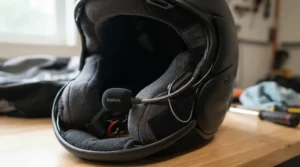
The two buttons live inside the boom mic itself, so the shell stays bare. Sena rates it for two-way HD intercom up to about 400 m, with up to eight hours of talk time and seven days of standby. It charges over USB-C and weighs roughly 55 g, according to WebBikeWorld. In practice, that’s plenty for rider and pillion, or two mates in single file. It isn’t enough for a convoy, and it covers a day’s riding rather than a weekend.
This is the most purpose-built bluetooth headset for jet helmets here. Sena designed it for jet and open face shells with a short boom and no external pod. The catch is a stripped-back feature set. There’s no audio overlay or music sharing, so a sat nav prompt interrupts your tunes rather than blending with them. If you’d rather have a shell-mounted control, the Sena 3S Plus Universal takes that route.
WebBikeWorld’s review praises its easy installation and reliable intercom, calling it a minimalist system. One roundup site reports left-speaker failures in a small number of units, though I couldn’t corroborate that at scale.
Pros:
- ✅ Controls in the boom, nothing on the shell
- ✅ HD two-way intercom at a budget price
- ✅ USB-C charging and Sena app support
Cons:
- ❌ No audio overlay or music sharing
- ❌ Two-rider limit, 400 m claimed range
Around £70-£110 at the time of research; check current price. It’s the best-value route to genuine intercom on a jet helmet.
3. Cardo Spirit HD — 13 hours of talk time on a budget
The main unit measures about 47 x 78 x 19 mm and weighs 35 g. It pairs 40 mm HD speakers with a claimed 600 m two-way intercom, 13 hours of talk time, ten days of standby and USB-C fast charging. There’s also an FM radio with six presets. Cardo ships a hybrid boom mic for open face and flip-up lids, a wired mic for full-face, and speaker booster pads. Those pads exist to bring speakers closer to your ears, which helps in shallow open face pockets.
My take is that it’s the sensible middle for riders who want a communication system without paying mesh money. Thirteen hours means a full day’s touring without anxiety, and Cardo says it connects with other major brands.
Buyer reviews I could verify, mirrored from Amazon listings, praise the easy install, battery life and intercom that cuts in over music. A couple report real-world range nearer half the 600 m claim. Another says sound is decent rather than JBL-class and fine for music up to about 90 km/h (roughly 56 mph), after which your helmet’s wind noise takes over.
Pros:
- ✅ 13 hours of talk time lasts a full day
- ✅ Boom and wired mics both in the box
- ✅ Booster pads help speaker placement
Cons:
- ❌ Real-world range reportedly well below the claim
- ❌ Two-rider limit
Around £110-£150 at the time of research; check current price. Strong value for a pillion pair.
4. Sena SF4 — four-way chat on a 16.6 mm module
The SF4‘s main module is 73.3 x 38.7 x 16.6 mm and 35 g, with Bluetooth 4.1 and a claimed four-way intercom up to 1.2 km. Sena quotes 13 hours of talk time and a quick charge where 30 minutes buys roughly four hours of intercom. The wired boom mic is 183 mm long. Listings also quote a very thin 4.5 mm standard speaker alongside the 11.6 mm HD set. That thin speaker matters on open face helmets with shallow ear pockets, where thickness decides comfort.
Analytically, this sits between the budget two-riders and the mesh models. You get small-group chat without mesh pricing, plus Audio Overlay, so music and intercom can coexist. It uses an external clamp or adhesive module, so it’s less invisible than the boom-controlled Sena 3S Plus Boom.
I couldn’t verify a meaningful pool of owner reviews in my research, so judge this one on the spec sheet and Sena’s two-year warranty approach rather than crowd sentiment.
Pros:
- ✅ Four-way intercom without mesh pricing
- ✅ Audio Overlay blends music and intercom
- ✅ Quick charge: 30 minutes gives about four hours
Cons:
- ❌ Bluetooth 4.1 and micro USB feel dated
- ❌ Shell-mounted module is more visible
Around £140-£200 at the time of research; check current price. Good value if three or four friends ride together.
5. Sena 10R — two thin modules weighing just 22 g
The headset module measures about 70.7 x 36.6 x 13.7 mm and weighs 22 g. It offers Bluetooth 4.1 and a claimed intercom range of up to 900 m, and both a boom mic and a wired mic are in the box. A separate battery module keeps each piece thin. WebBikeWorld’s review of its predecessor, the SMH10R, explains the two-module layout. The original listing quoted about eight hours of talk time.
Here’s what that means for you. Slim modules snag less wind and look tidier, but you have more wiring to hide: module, battery, speakers and boom. It suits riders who like clean hardware and don’t need mesh. One caution: RevZilla notes a newer version of the 10R page exists, so check which variant amazon.co.uk is actually stocking.
WebBikeWorld judged the SMH10R much thinner and easier to install than most intercoms. That’s the older model, though, and I couldn’t verify recent owner reviews for the current 10R.
Pros:
- ✅ Only 22 g for the headset module
- ✅ Boom and wired mics both included
- ✅ 900 m claimed intercom range
Cons:
- ❌ Two modules mean extra wiring to hide
- ❌ Older Bluetooth generation; check the stocked variant
Around £150-£220 at the time of research; check current price. Fair value for a featherweight setup.

6. Cardo Packtalk Slim — thinnest premium unit at 6.5 mm
At roughly 38 x 69 x 6.5 mm, the Packtalk Slim is barely a bump on the shell. It pairs JBL 40 mm speakers with Dynamic Mesh for up to 15 riders. It includes a hybrid boom mic and a corded mic, IP67 waterproofing, “Hey Cardo” voice control and about seven days of standby. Ultimate Motorcycling quotes 0.8 miles of mesh range, rising to 3.7 miles with six or more riders.
Analytically, a flush unit is harder to knock off an open lid and gives the wind less to grab. Voice control means gloves stay on. For boom mic for open face duty, the hybrid boom is the right choice.
Ultimate Motorcycling praised the JBL speakers’ easy mid-range and the near-flush mount. The reviewer found the separate battery unit awkward to fit and said range was challenged on twisty single-track. A buyer review notes neat wiring and solid-feeling boom mics. It’s an older platform (Bluetooth 4.1), so check current availability.
Pros:
- ✅ Only 6.5 mm thick on the shell
- ✅ JBL speakers plus hands-free voice control
- ✅ Dynamic Mesh for groups up to 15
Cons:
- ❌ Separate battery unit complicates fitting
- ❌ Premium price for older Bluetooth 4.1
Around £200-£300 at the time of research; check current price. Worth it if looks and mesh both matter.
7. Sena 50R — mesh and Harman Kardon sound, slimmed down
The 50R‘s main module is 97 x 48 x 27 mm and 65 g. Its speakers are 40 mm and just 7.2 mm thick, with a 150 mm boom mic and Bluetooth 5.0. Bluetooth intercom reaches up to 2 km across four riders. Open Mesh offers nine channels, and Group Mesh supports 24 riders. Talk time is up to 13 hours on Bluetooth and 8 hours on mesh, and the speakers and mic are tuned with Harman Kardon.
Honestly, “low profile” is relative here. It’s bulkier than the Cardo Packtalk Slim and Sena 10R, so it suits riders who prioritise mesh groups over minimalism. The thin speakers are a genuine plus for shallow ear pockets.
WebBikeWorld called the 50R an evolution of Sena’s 50 Series, with a notably smaller footprint than the 50S and both a wired boom and thin wired mic included. I couldn’t verify a statistically meaningful pool of owner reviews.
Pros:
- ✅ Open Mesh with nine channels for big groups
- ✅ Harman Kardon-tuned speakers and mic
- ✅ Bluetooth 5.0, USB-C and Wi-Fi firmware updates
Cons:
- ❌ Thickest and heaviest module here
- ❌ Top price tier
Around £250-£400 at the time of research; check current price. Best for riders who genuinely use mesh.
Spec Snapshot: How the Seven Compare
| Product | Module size and weight | Intercom claim | Battery | Mic type |
|---|---|---|---|---|
| FreedConn L1M | No external module | None | Not verified | Boom with built-in buttons |
| Sena 3S Plus Boom | About 55 g | 2 riders, 400 m | 8 h talk | Boom with buttons |
| Cardo Spirit HD | 47 x 78 x 19 mm, 35 g | 2 riders, 600 m | 13 h talk | Hybrid boom plus wired |
| Sena SF4 | 73.3 x 38.7 x 16.6 mm, 35 g | 4 riders, 1.2 km | 13 h talk | Wired boom plus wired |
| Sena 10R | 70.7 x 36.6 x 13.7 mm, 22 g | 4 riders, 900 m | Not verified | Boom plus wired |
| Cardo Packtalk Slim | 38 x 69 x 6.5 mm | Mesh, up to 15 | 7 days standby | Hybrid boom plus corded |
| Sena 50R | 97 x 48 x 27 mm, 65 g | Mesh plus Bluetooth, 2 km | 13 h BT, 8 h mesh | Wired boom plus wired |
The Cardo Packtalk Slim wins on sheer thinness, while the Sena 10R wins on lightness, and those are the two to shortlist if shell neatness is your priority. The Cardo Spirit HD and Sena SF4 quote the longest talk times, which suits touring. The Sena 50R gives up some slimness to buy mesh and Bluetooth 5.0.
How to Choose a Low Profile Bluetooth Intercom for Open Face Helmets
Short answer: match the kit to your shell, then to your riding party, then to your budget, in that order. Here’s the sequence I’d follow.
- Check your shell first. Look at the ear pockets and the gap between shell and padding. Shallow pockets favour thin speakers, such as the 4.5 mm standard set quoted for the Sena SF4.
- Insist on a boom mic. Wired button mics belong in full-face chin curtains, and boom mic for open face use is the norm. Every pick here ships with a boom or has one built in.
- Count your riding party. Solo means audio-only, a pillion means two-way, three or four riders means four-way, and bigger groups mean mesh.
- Decide where the controls live. Controls in the boom keep the shell clean, while an external module is easier with gloves on.
- Halve range claims. Buyer reports on the Cardo Spirit HD suggest real range nearer half the claim, and mesh range depends on terrain.
- Check battery and charging. Talk time runs from about 8 to 13 hours across these kits, and USB-C beats micro USB for cable sanity.
Work through those six checks and the seven picks should shrink to two.

Bluetooth Headset for Jet Helmets: What Changes Versus Full-Face Kits
A bluetooth headset for jet helmets faces three problems a full-face kit never meets. First, there’s no chin curtain, so the mic must hang on a boom in the airflow. Second, there’s no guaranteed ear recess, so speakers need thin profiles or boosters. Third, nothing shields the module from rain or wind, which is why waterproofing and low bulk matter.
Jet shells vary wildly. Some have generous ear pockets, others are barely padded. WebBikeWorld notes that fitting kits to shorty-style helmets was easier on models with side pieces designed to accommodate speakers. That’s a useful sanity check before you buy: press your fingers into the padding where speakers would sit and see whether there’s a pocket.
For a vintage or fixed-padding jet, the Sena 3S Plus Boom is the cleanest answer because the controls ride on the boom. The Cardo Packtalk Slim is the premium equivalent because it barely protrudes. If you ride a classic and hate visible hardware, start with those two. If you ride a sportier three-quarter lid, the Sena SF4 or Sena 10R give you more features, and the Cardo Spirit HD gives you the longest day out.
Open Face Helmet Communication System: Intercom, Audio-Only or Bluetooth Helmet?
An open face helmet communication system doesn’t have to be a full intercom. Here’s how the options compare.
| Option | Benefits | Drawbacks | Best For |
|---|---|---|---|
| Slim bluetooth intercom | Rider-to-rider talk, calls, navigation on any lid | Needs mounting on the shell; wind exposure | Pillion and group riders |
| Audio-only headset (e.g. FreedConn L1M) | Cheapest, almost invisible | No intercom | Solo navigation |
| Bluetooth-integrated helmet | Neat factory install | Locked to one lid; usually pricier | Riders who rarely change lids |
| Wired earphones from the phone | Very cheap | Cable snags; ear discomfort after hours | Emergency fixes only |
The Overland reviewer who fitted the FreedConn L1M explicitly rejected wired earbuds because of the pain of removing earphones and helmet after eight hours. So for long days, audio-only beats earbuds, and a proper intercom beats both if you ever want to talk to anyone. A Cardo buyer even noted saving money by fitting a Cardo Spirit HD to a cheaper lid rather than buying a Bluetooth helmet. Treat that as one buyer’s view, but the logic holds if you already own a helmet you love.
Features That Actually Matter (And Those That Don’t)
Features that matter on an open face lid: mic quality in wind, speaker thickness, battery life and control position. Features that matter less: Bluetooth version numbers, FM radio and headline range claims.
Volume headroom is the sneaky one. A University of Southampton study, summarised by Rider magazine, found in-ear wind noise averaging around 100 dB at 70 mph. It was similar across helmet designs, open face and full-face alike. So cranking your intercom to beat the wind is a fast road to tinnitus. Filtered rider earplugs, which many riders use alongside intercoms, are a better answer than more decibels.
Audio Overlay (on the Sena SF4) is genuinely useful if you stream music and chat. Mesh (on the Cardo Packtalk Slim and Sena 50R) is genuinely useful only if you ride with groups of five or more. FM radio, as on the Cardo Spirit HD, is a nice extra I’d not pay for.
Boom Mic for Open Face: Placement, Length and Wind Handling
A boom mic for open face lids lives or dies on placement. Aim for the corner of your mouth, close enough to pick up your voice but off the direct airstream. Most kits fit the boom under the cheek pad or along the lower edge with Velcro. Motorcycle.com’s helmet-communicator guide notes that open face and modular lids need a boom on an articulated arm under the cheek pad, whereas full-face lids take a mic stuck inside the chin bar.
Length matters. Listings quote a 183 mm boom on the Sena SF4 and 150 mm on the Sena 50R, with a shorter stem on the Sena 3S Plus Boom. Longer isn’t better, because a long arm flexes at speed. A buyer of a different FreedConn model complained of boom movement above 75 mph, which is a fair warning for any long boom.
Use the foam sponge, since it cuts the plosive thump. Test your setup by recording a voice note at 50 mph and playing it back. If you sound like you’re inside a washing machine, reposition by a few millimetres. Good boom mic for open face placement also helps keep your voice clear on the Cardo Packtalk Slim‘s hybrid boom.
✨ Don’t Miss These Top Picks!
🔍 Take your open face riding to the next level with these carefully selected communicators. Click on any highlighted item to check current pricing and availability. These kits will help you enjoy the clear, hands-free rides your pillion will love!
Stick On Speakers: Fitting, Pads and Comfort in Open Face Helmets
Stick on speakers are how almost every kit here sits in an open face lid. They go in the ear pockets, usually held by hook-and-loop pads. Sena packs include speaker pads in thick and thin options plus Velcro, and Cardo ships booster pads.
Fitting steps:
- Press the speaker lightly where your ear canal sits, then check with the helmet on.
- Clean the surface with an alcohol wipe (the Cardo Packtalk Slim box includes alcohol pads).
- Press the pad firmly, hold for 30 seconds and let it bed in before riding.
- Route wires between shell and padding, not across your neck.
Comfort depends on thickness. A thin speaker such as the 7.2 mm set on the Sena 50R disappears under padding, while thicker HD speakers need a deeper pocket. If stick on speakers press on your ears after an hour, swap to a thinner pad.
One caution: check your helmet manufacturer’s guidance before adhesive mounts or cutting padding. The Overland reviewer trimmed excess material to fit the FreedConn L1M, but that’s not a step I’d recommend without checking your warranty.

Wind Buffeting Fixes: A Problem-and-Solution Guide
Wind buffeting is the real boss fight for any open face helmet communication system. A paper from the Institute of Acoustics measured wind tunnel noise at the rider’s ear between about 90 and 109 dB(A), depending on airspeed. On the road it ranged from 78-90 dB(A) at 30 mph to 114-116 dB(A) at 120 mph. Tall windscreens can even direct turbulent air toward the face. Here are four common problems and fixes.
Problem 1: callers say you sound muffled. Move the boom to the corner of your mouth and fit a fresh foam sponge. Take important calls below 40 mph.
Problem 2: thumping in the speakers. Reduce volume, switch on noise control (Sena lists Advanced Noise Control) and check the boom isn’t sitting in the airstream.
Problem 3: music vanishes above 55 mph. One Cardo Spirit HD buyer reports music is fine to about 90 km/h. Beyond that, filtered earplugs and a better screen do more than volume.
Problem 4: the boom flaps. Secure it with the supplied holder or Velcro, and shorten the arm.
Fix wind buffeting at source first, and the electronics stop fighting it.
Real-World Scenarios: Which Kit for Which Rider
These are hypothetical riders, but they map the products to real budgets and habits.
The solo café-racer commuter. Eight miles each way on a Hedon-style open face, sat nav only, budget around £50. The FreedConn L1M fits: nothing on the shell, instant pairing, no frills.
The weekend pillion pair. Two people, Saturday rides of three to five hours, budget £150-£250 for two units. Buy two Cardo Spirit HD units or two Sena 3S Plus Boom kits. The Spirit HD wins on battery, while the 3S Plus Boom wins on a clean shell.
The small mixed-brand group. Three to four mates, mid-distance rides. The Sena SF4 gives four-way chat. Check the universal intercom if friends use other brands.
The club rider. Six or more riders, hilly roads, a premium budget. Choose between the Cardo Packtalk Slim (thinnest, up to 15 riders) and the Sena 50R (nine open channels, Harman Kardon sound). If looks matter most, the Slim wins. If group size and audio matter most, the 50R wins.
A bluetooth headset for jet helmets is only as good as the match between your helmet, route and riding party.
Safety and UK Law: Using a Bluetooth Headset While Riding
Is it legal to use a Bluetooth headset on a bike in Britain? Broadly yes, with caveats. Rule 149 of The Highway Code on GOV.UK sits in the section for all drivers and riders. It prohibits hand-held phone use and warns that hands-free equipment can still distract you. Hands-free use isn’t banned, but you’re still expected to keep proper control of the vehicle.
Practical habits:
- Set sat nav before you pull away.
- Use voice commands or glove-friendly buttons.
- Keep calls short and avoid them in heavy traffic.
- Keep intercom volume low enough to hear sirens.
Check your helmet maker’s guidance before using adhesive or clamp mounts, and never drill the shell. For electronics, look for CE or UKCA marking. Sena listings I checked cite CE certification. And wear earplugs, because at the volumes involved your ears can’t be replaced.
Long-Term Cost and Value: Price Range Analysis
| Tier | Examples | Price range (indicative) | Trade-off |
|---|---|---|---|
| Budget | FreedConn L1M, Sena 3S Plus Boom | £25-£110 range | Fewer features; two riders max |
| Mid-range | Cardo Spirit HD, Sena SF4, Sena 10R | £110-£230 range | Some older Bluetooth stacks |
| Premium | Cardo Packtalk Slim, Sena 50R | £200-£400 range | Price; separate battery (Slim) or thicker module (50R) |
A £150 unit used on 100 rides over three years costs £1.50 per ride, before you buy a second unit to talk to someone. Dual packs, such as the Cardo Packtalk Slim Duo and Sena 50R dual, usually lower the per-unit cost. Warranty, firmware and consumables matter too. Sena listings quote two-year warranties and free firmware downloads, and replacement mic sponges are cheap. Cardo pushes updates through its Connect app. A good open face helmet communication system should outlive two helmets, so pay for fit and firmware support, not just features.

FAQ
❓ Can I fit a full-face intercom on an open face helmet?
❓ How far will a low profile bluetooth intercom for open face helmets really reach?
❓ Will stick on speakers fall off in hot weather?
❓ Can I pair a Sena with a Cardo for rider-to-rider chat?
❓ Do I need two units to talk to my passenger?
Conclusion
Choosing a low profile bluetooth intercom for open face helmets comes down to three things: your shell, your riding party and your tolerance for wind. For solo navigation, the FreedConn L1M is a cheap, almost invisible answer. For pillion pairs, the Sena 3S Plus Boom and Cardo Spirit HD are the sensible value picks. Small groups should look at the Sena SF4 or Sena 10R, and the premium-and-mesh crowd will be happiest with the Cardo Packtalk Slim or Sena 50R.
Whichever you choose, get the fundamentals right. Place the boom at the corner of your mouth, fit stick on speakers carefully, wear filtered earplugs and keep volume sensible. A good bluetooth headset for jet helmets disappears into your riding, and a good open face helmet communication system should never make you think about wind buffeting.
🚀 Ready to ride connected?
Click on any highlighted product above to check current pricing and availability on amazon.co.uk, and pick the slim kit that fits your helmet, your friends and your budget!
Recommended for You
- Intercom For Modular Flip Front Helmets: 7 Best Buys (2026)
- Motorcycle Helmet Intercom For Two Up Riding: 7 Best Picks (2026)
- Helmet Bluetooth Headset For Glasses Wearers: 7 Proven Picks (2026)
Disclaimer: This article contains affiliate links. As an Amazon Associate, I earn from qualifying purchases. If you purchase products through these links, we may earn a small commission at no additional cost to you.
✨ Found this helpful? Share it with your friends! 💬🤗
