

In This Article
A helmet bluetooth headset for glasses wearers is a rider communication system built around thin, low-profile speakers and a slim controller. It delivers calls, music, navigation prompts and intercom chat without pushing your spectacle arms into your temples. The difference shows in the speaker thickness, the shape of its edges and how it sits against your cheek pads.

Here’s the problem nobody mentions on the box. A helmet is a tightly engineered space, and your glasses already occupy a strip of it. Add a 10 mm speaker puck in the wrong pocket and you’ve built a very small vice around your head. Over a two-hour ride, that’s how a slight irritation turns into a headache and then into a helmet you’d rather leave on the shelf.
Modern comms units run on Bluetooth, the short-range wireless standard, and most now add mesh or multi-rider intercom on top. The wireless side is rarely the challenge. The physical side is: speaker depth, edge shape, cable routing and how much room your helmet’s ear pockets really offer.
So this guide treats fit as the main spec. It covers seven real systems from Sena and Cardo, with their documented speaker dimensions. It explains how each interacts with spectacle arms. It also covers who should buy which, and what to check before you stick anything inside your lid. I haven’t tested any of these units myself. Everything below comes from published specifications, retailer listings and editorial coverage, framed as analysis. Where I couldn’t verify review data, I say so.
Quick Comparison: Helmet Bluetooth Headset for Glasses Wearers at a Glance
| Product | Speakers | Intercom style | Price range | Best For |
|---|---|---|---|---|
| Sena 50R | 40 mm HD, roughly 7 mm deep | Mesh 2.0 plus Bluetooth | Mid-£200s to low-£300s | Riders wanting premium kit with a slim look |
| Sena 50S | 40 mm Harman Kardon, 7.2 mm deep | Mesh 2.0 plus Bluetooth | Mid-£200s to low-£300s | Glove-friendly jog-dial fans |
| Sena 20S EVO | HD bevelled-taper (32 mm × 7 mm slim option) | Bluetooth, up to 8 riders | £165–£230 (single) | Value-minded group riders |
| Cardo Packtalk Edge | 40 mm JBL, 9.2 mm deep | Dynamic Mesh, up to 15 riders | £310–£360 (single) | Roomy ear pockets and big groups |
| Cardo Packtalk Neo | 40 mm JBL | Dynamic Mesh Gen 2, up to 15 riders | Upper-£200s | Mid-price mesh |
| Cardo Spirit | 32 mm | Bluetooth, 2 riders | £80–£155 | Tight helmets on a budget |
| Cardo Spirit HD | 40 mm HD | Bluetooth, 2 riders, FM radio | From around £120 | Rider-and-pillion pairs |
Looking at the table, the Sena 50R and Sena 50S pair 40 mm drivers with documented depths of about 7 mm. That is the clearest published evidence of slimness here. The Cardo Spirit takes the other route: a smaller 32 mm driver for tight pockets. The Cardo Packtalk Edge has the best-known audio branding but, going by retailer listings, the thickest 40 mm set at 9.2 mm. If your helmet is snug, that extra 2 mm can matter.
💬 Just one click — help others make better buying decisions too!😊
Top 7 Helmet Bluetooth Headsets for Glasses Wearers: Expert Analysis
1. Sena 50R — slimmest premium look, with fit spacers included
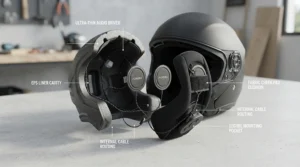
Sena built the Sena 50R around a slimmer main unit. Its 40 mm HD speakers are listed at roughly 7 mm deep, with retailer sheets giving 6.8 mm and editorial reviews 7.2 mm. The module weighs about 61 g, and Bluetooth intercom talk time is quoted at 13 hours (8 hours on mesh).
Here’s what that means in practice. A 7 mm driver leaves more room between your ear and the helmet’s EPS liner than a 9 mm one. That extra room is what keeps spectacle arms from being pinned. One editorial review noted that the 50R’s ear pockets suit 40–45 mm speakers, and that its included spacers can bring speakers closer to the ear if pockets are too deep. For glasses wearers, that adjustability counts for more than a spec-sheet headline.
Based on the spec comparison, this suits riders who want mesh intercom (up to 2 km in open terrain, per distributor data) without bulky hardware. Reviewer commentary I found is mostly editorial rather than aggregated buyer scores, so I can’t give a verified star average.
Pros:
- ✅ Roughly 7 mm speaker depth
- ✅ Spacers included for deep pockets
- ✅ Mesh range up to 2 km open terrain
Cons:
- ❌ Premium price tier
- ❌ Shorter talk time on mesh (about 8 hours)
Expect a price in the mid-£200s to low-£300s for a single (check current price). It’s strong value if fit is your priority.
2. Sena 50S — Harman Kardon speakers with a bevelled edge
The Sena 50S tackles the “ear rubbing on the edge” problem directly. Its Harman Kardon HD speakers are slimmer and trimmed around the edges. Retailer listings describe a bevel meant to reduce friction between ear and speaker rim.
Published dimensions are 40 mm across and 7.2 mm deep. The main module is about 64 g with Bluetooth 5.0 and Mesh 2.0, plus the jog dial that many riders prefer with gloves on. For glasses wearers, the bevel does more than the diameter does. A rounded rim means the speaker presses on the cartilage of your ear gently, rather than the edge of a disc digging in next to your spectacle arm.
This is the pick if you want mesh and the proven jog-dial interface. One retailer review flags that moving it to another helmet means disconnecting speakers and mic from within the lining, which is fiddly. Overall review sentiment from sources I found is positive on sound but I couldn’t verify a UK buyer-score sample.
Pros:
- ✅ Bevelled, trimmed speaker edge
- ✅ 7.2 mm speaker depth
- ✅ Jog dial works with gloves
Cons:
- ❌ Awkward to swap between helmets
- ❌ Bluetooth 5.0 is older than some rivals
Expect the mid-£200s to low-£300s range (check current price). A good-value choice where mesh matters.
3. Sena 20S EVO — best value, with a slim-speaker upgrade path
The Sena 20S EVO is the budget-friendliest route into HD audio from Sena. Its HD speakers have a bevelled taper to ease into helmet pockets. Sena also sells a slim-speaker clamp kit (listed for the 50S, 20S EVO, 20S and 30K) with 32 mm × 7 mm drivers that sit deeper in tapered pockets.
That upgrade path is the key point. If the standard set feels tight, you can swap to slim speakers without changing system. Talk time is up to 13 hours, and the Bluetooth intercom supports up to eight riders at up to 2 km in open terrain (the maker’s figure). Coverage in Visordown shows Sena moved to HD audio as standard here to compete on sound.
On reviews, one major UK retailer shows a 4.8 average across 26 verified customers. An independent test noted real-world range was a 10–15% improvement over the old 20S, short of the mile-plus claims. One UK commenter on that review was unhappy with after-sales help, so check the retailer’s returns policy.
Pros:
- ✅ Slim-speaker kit available
- ✅ Up to 13 hours talk time
- ✅ Strong UK retailer review average
Cons:
- ❌ Real-world range below claims
- ❌ Older Bluetooth generation than 50-series
Expect roughly £165–£230 for a single (check current price). Excellent value for the money.
4. Cardo Packtalk Edge — Cardo’s flagship, with the roomiest-pocket requirement
The Cardo Packtalk Edge is the most capable unit here. Its 40 mm JBL speakers are listed at 9.2 mm thick (retailer data for the compatible JBL set), with Dynamic Mesh for up to 15 riders. Talk time is 13 hours, and a 20-minute charge gives about two hours. Its listed certificates include UKCA.
The trade-off is thickness. At 9.2 mm, these drivers need pockets with some depth. Cardo also sells a smaller 32 mm replacement set that fits Packtalk, Freecom and Spirit models, which is a useful escape hatch if your cheek pads are tight. You then trade some bass and volume for comfort.
I couldn’t find enough verifiable review data to summarise aggregated buyer sentiment for this specific model. Treat the audio praise in marketing as positioning until you’ve read current buyer reviews.
Pros:
- ✅ Mesh for up to 15 riders
- ✅ 32 mm smaller speakers available
- ✅ UKCA certification listed
Cons:
- ❌ Thicker 9.2 mm JBL speakers
- ❌ Highest price here
Expect around £310–£360 for a single (check current price). Worth it for large groups with generous ear pockets.
5. Cardo Packtalk Neo — mid-price mesh with JBL sound
The Cardo Packtalk Neo sits below the Edge and above the Spirit line. It carries 40 mm JBL speakers, second-generation Dynamic Mesh for up to 15 riders, and Bluetooth 5.2. The compatibility list for Cardo’s 40 mm JBL set includes the Neo, which means similar depth to the Edge’s speakers.
So fit logic mirrors the Edge. Don’t expect a thinner speaker just because it’s cheaper. What you save is on the controller features and the price. A second-helmet kit is sold separately, which suits riders with more than one lid.
One UK retailer buyer, upgrading from a Spirit, reported that mesh and the JBL speakers made a real difference on the road. That’s a single review, so it’s a pointer, not a consensus.
Pros:
- ✅ Mesh intercom at a lower price
- ✅ 40 mm JBL speakers
- ✅ Second-helmet kit available
Cons:
- ❌ Same JBL speaker depth as Edge
- ❌ Fewer premium features
Expect the upper-£200s for a single (check current price). A balanced buy for mesh-minded riders with decent ear pockets.
6. Cardo Spirit — the 32 mm answer to tight helmets
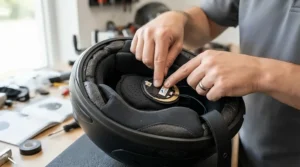
The Cardo Spirit is the simplest here and the one most clearly aimed at small spaces. It uses 32 mm speakers, connects to a phone and GPS simultaneously, and offers a 10-hour battery plus two-rider intercom (about 400 m range, per Cardo’s chart).
A smaller diameter helps where pockets are narrow or where cheek pads curve in. One review site reported that its 32 mm speakers fit comfortably inside the ear pockets of a full-face Arai and a budget HJC half helmet, though noticeably thicker than an ultra-slim rival. Good to know: “smaller” doesn’t automatically mean “thinner”, and Cardo doesn’t publish thickness in the sources I found.
If you ride solo or with one passenger, this is the cheapest sensible entry. Group riders will outgrow it quickly.
Pros:
- ✅ Compact 32 mm speakers
- ✅ Connects phone and GPS together
- ✅ Lowest price of the seven
Cons:
- ❌ Two-rider intercom only
- ❌ Basic speaker sound
Expect £80–£155 (check current price). Best value if your helmet is tight and your group is small.
7. Cardo Spirit HD — pair-riding sound with FM radio
The Cardo Spirit HD upgrades the Spirit with 40 mm HD speakers, Bluetooth 5.2, three audio profiles and an RDS FM radio. Retailer and press data suggest roughly 13 hours of talk time and about double the Spirit’s range, for two riders.
Because it uses 40 mm speakers, it needs more pocket room than the standard Spirit. That’s the honest trade-off: better sound, less forgiveness. The spec sheet won’t tell you this, but any 40 mm driver needs a sensible ear pocket, and a Spirit HD is no exception.
One retailer review mentions a six-week wait before a replacement unit was authorised, so check warranty handling before you buy. I couldn’t find a verifiable aggregate rating.
Pros:
- ✅ 40 mm HD speakers
- ✅ Built-in FM radio with RDS
- ✅ Simple two-rider setup
Cons:
- ❌ Needs more pocket space than Spirit
- ❌ Two-rider intercom limit
Expect from around £120 for a single, with duo packs toward £230 (check current price). Good value for rider-and-pillion pairs.
Slim Speakers for Riders Wearing Glasses: Why Depth Beats Diameter
When shopping for slim speakers for riders wearing glasses, most people compare diameter. It’s the number on the box. But your spectacle arm doesn’t care how wide the speaker is. It cares how far the speaker pushes the cheek pad inward.
Take the Sena 50R and Sena 50S: both 40 mm across but only about 7 mm deep. Compare that with the Cardo Packtalk Edge JBL set at 9.2 mm. That’s a gap of roughly 2 mm per side, and it sounds trivial until you remember cheek pads are compressed foam.
The sensible approach is to treat depth first, diameter second, and edge shape third. A bevelled rim, like on Sena’s HD speakers, lowers the chance of rubbing. A smaller diameter, like the 32 mm Cardo Spirit set, helps in narrow pockets. Slim speakers for riders wearing glasses should always be tested with the glasses on, in the helmet, before adhesive goes anywhere.

Bluetooth Intercom for Helmets With Tight Cheek Pads: What Actually Works
A bluetooth intercom for helmets with tight cheek pads has two jobs. It must not squeeze, and it must still deliver audio at motorway speed. These goals pull against each other, because slimmer speakers usually mean less bass.
The Sena 20S EVO has the most flexible answer: HD speakers for roomy helmets, or the 32 mm × 7 mm slim kit when pockets are shallow. The Sena 50R adds included spacers and an AirFit pad system whose bladders, in one reviewer’s helmet, slightly overlapped the speaker pockets for support. The Cardo Spirit simply uses a smaller driver.
Here’s what to weigh: a tight helmet usually has a pocket that’s shallow, narrow, or both. If it’s shallow, choose slim depth. If it’s narrow, choose smaller diameter. If both, start with the 32 mm options and accept a modest drop in volume.
Thin Speaker Profile: What the Published Numbers Really Mean
A thin speaker profile is only meaningful if the depth is documented. Here’s what I could verify.
| Product | Speaker diameter | Documented depth | Note |
|---|---|---|---|
| Sena 50R | 40 mm | ~6.8–7.2 mm | Spacers included |
| Sena 50S | 40 mm | 7.2 mm | Bevelled edge |
| Sena slim kit (for 20S EVO, 50S) | 32 mm | 7 mm | Sits deeper in tapered pockets |
| Cardo Packtalk Edge / Neo | 40 mm | 9.2 mm (JBL set listing) | Best for roomy pockets |
| Cardo Spirit | 32 mm | Not published in sources found | Compact diameter |
Looking at the table, the Sena speakers are the best-documented slim options. The Cardo JBL set is thicker by about 2 mm. The Cardo Spirit may be easy to fit thanks to its diameter, but I’d verify depth with the retailer. Best For: tight, shallow pockets, the Sena slim kit; roomy helmets, either brand.
One reviewer of Sena’s slim speakers said they were “fairly tinny” but fitted a helmet whose pockets rejected the standard set. That trade-off, a slimmer profile for slightly thinner sound, is the one you’re really choosing.
Spectacle Arm Comfort: The Helmet Matters as Much as the Headset
Spectacle arm comfort starts with the helmet, not the comms unit. Helmet makers know this. Shark’s Easy Fit system, for instance, provides dedicated channels in the cheek foam for glasses arms. Caberg likewise shapes its linings for glasses. MCN’s helmet-fitting advice notes that some makers offer different cheek-pad widths on most models, which is exactly the lever a glasses wearer should pull.
So the stack looks like this. First, the helmet needs a groove or generous cheek-pad opening. Second, your frames should have thin, straight arms. Third, the speaker should sit in the ear pocket, not under the arm. A good helmet bluetooth headset for glasses wearers respects that order.
If your arms still pinch, check whether the speaker is sitting low and pressing the pad into the groove. Often, moving it 3–5 mm toward the ear pocket centre fixes it.
Ear Pocket Clearance: Measure Before You Stick
Ear pocket clearance is the empty depth between your ear and the helmet liner, plus how much of it your glasses already consume. Many riders never measure it, then discover too late that the speaker is too deep.
Try this: with your glasses on, put the helmet on and press a finger gently into the pocket. If you can’t feel a gap, you’re near the limit. A speaker around 7 mm (Sena 50R, Sena 50S) leaves more headroom than one at 9.2 mm (Cardo Packtalk Edge).
Ear pocket clearance also changes with use. Foam compresses over weeks, so a pocket that felt tight in week one may ease. Treat that as a bonus, not a plan.
Practical Guide: Fitting a Headset Without Wrecking Spectacle Arm Comfort
Step 1: Dry-fit first. Put your glasses and the helmet on, then hold each speaker against the pocket without adhesive. Judge pressure for a minute.
Step 2: Check the pocket, not the pad. Peel back the cheek pad edge. Many helmets have a speaker cut-out under it. Use that rather than placing the speaker on top of the foam.
Step 3: Use spacers deliberately. The Sena 50R ships with spacers that bring speakers closer to the ear when pockets are deep. Fit only what you need; extra thickness hurts.
Step 4: Route cables away from the arm path. Cable bulges are the sneaky pressure point. Tuck them behind the liner so they don’t cross the glasses channel.
Step 5: Test with a real ride. Fit for 20 minutes, then ride 30. Take the helmet off and look for red marks behind the ear. That’s your answer.
Step 6: Re-check at 30 days. Foam settles. Re-seat speakers once, and recheck cable tension.
Common first-month mistakes: gluing before testing, using the thickest speaker “for better sound”, and ignoring cable bulge. Many manufacturers advise against cutting or modifying liners in unapproved ways, so check your helmet’s manual before any alteration.
✨ Ready to Find Your Fit?
🔍 Take your next ride from squeezed to seamless with these carefully selected systems. Click any highlighted product to check current pricing and availability. The right slim speakers will keep your glasses comfortable and your conversations clear!
Real-World Scenarios: Matching Glasses-Wearing Riders to the Right Headset
Scenario 1: The commuter in a full-face helmet. A rider covering 20 miles each way, ride-and-listen only, glasses on all day, budget around £150. The Cardo Spirit (32 mm) or Sena 20S EVO with the slim kit fits shallow pockets and keeps cost in check. They mainly need phone calls and navigation.
Scenario 2: The weekend touring group. Four to six riders, mixed helmets, long days, budget £250–£350 per unit. The Cardo Packtalk Neo or Sena 50S give mesh, and the group can mix brands only through universal Bluetooth pairing. Check each person’s ear pocket clearance first.
Scenario 3: The rider and pillion. Two people, one with thick-framed glasses, short trips, budget around £200 for a pair. The Cardo Spirit HD duo or Sena 20S EVO dual pack fits, with the glasses wearer getting the slimmer speaker set.
The pattern: match the system to the group size first, then pick speaker depth to fit the tightest helmet in the group.

Problem → Solution Guide: Five Fit Fixes
Problem 1: Pain behind the ear after an hour. Cause: speaker too thick or too far back. Solution: move it toward the pocket centre, or switch to the Sena slim kit (32 mm × 7 mm).
Problem 2: Glasses pushed off the nose. Cause: speaker pressing the pad into the arm. Solution: re-seat the speaker in the cut-out, and try straight-arm frames.
Problem 3: Muffled sound. Cause: speaker too far from the ear after fitting slim drivers. Solution: add a thin spacer, as the Sena 50R allows.
Problem 4: Cable pressure line on the temple. Cause: cable crossing the arm channel. Solution: reroute behind the liner.
Problem 5: Can’t swap helmets easily. Cause: wiring inside the lining. Solution: buy a second-helmet kit, such as the Cardo Packtalk Neo 2nd-helmet kit.
How to Choose a Helmet Bluetooth Headset for Glasses Wearers
- Measure ear pocket clearance first. Press a finger into the pocket with glasses on. No gap means choose slim.
- Prioritise speaker depth over diameter. Depth presses on your arms; diameter mostly affects pocket fit.
- Check edge shape. Bevelled rims, like Sena’s HD speakers, reduce rubbing.
- Decide on intercom size. Two riders: Spirit family. Three to eight: Sena 20S EVO. Up to 15: Cardo mesh.
- Confirm the upgrade path. Slim or smaller replacement speakers are a safety net.
- Check battery and charging. Thirteen hours (Edge) beats eight on mesh (50R) for touring.
- Verify returns. Fit is personal, so buy from retailers with a straightforward returns policy.
Helmet Headsets vs Alternatives for Glasses Wearers
| Option | Spectacle arm comfort | Sound at speed | Cost | Best For |
|---|---|---|---|---|
| Slim helmet headset | Good with correct fit | Strong | £80–£360 | Sena 50R, Cardo Spirit |
| Earbuds under helmet | Often poor with arms | Variable | Low | Occasional use |
| Bone conduction | Can clash with arms/pads | Moderate | Mid | Open-face wearers |
| Smart helmet | Depends on lid | Strong | High | Riders replacing a helmet |
A helmet-mounted system wins on sound and reliability, but only if the speaker depth is right. Earbuds can crowd the arms, and bone-conduction bands can collide with both arms and pads. If you’re replacing your helmet anyway, a smart helmet is worth a look, but it locks you into one lid.
Safety, Law and Compliance for UK Riders
Wearing a protective helmet is a legal requirement: Rule 83 of the Highway Code says riders and pillions on motorcycles, scooters and mopeds must wear one on all journeys. You can read the full Rules for motorcyclists on GOV.UK.
On distraction, the Highway Code has long warned that even hands-free equipment can draw attention from the road. Keep calls short, set navigation before you ride and use voice control where it’s offered.
For equipment, look for CE marking and, where listed, UKCA. The Cardo Packtalk Edge lists UKCA among its certificates, while the Sena listings I found show CE, FCC and IC. Finally, check your helmet maker’s guidance on fitting accessories, and never cut into the EPS liner.
Long-Term Cost & Maintenance
| Product | Price range | Ongoing cost | Value verdict |
|---|---|---|---|
| Cardo Spirit | £80–£155 | Low | Entry-level value |
| Sena 20S EVO | £165–£230 | Slim kit extra | Best all-rounder |
| Cardo Packtalk Neo | Upper-£200s | 2nd-helmet kit | Mid-price mesh |
| Sena 50R | Mid-£200s to low-£300s | Spacers included | Premium fit |
Looking at the numbers, the Sena 20S EVO offers the best cost per useful feature for most glasses wearers, because the slim kit solves fit later. The Sena 50R costs more but includes fit tools. The Cardo Spirit wins on pure price.
Maintenance is light: wipe speaker covers, re-check adhesive every few months, and update firmware.

FAQ
❓ How long does a helmet Bluetooth headset battery last on a long ride?
❓ Do slim speakers sound worse than standard ones?
❓ Can I move one headset between two helmets?
❓ Is a smaller speaker always better for tight cheek pads?
❓ Can different brands talk to each other on intercom?
Conclusion
Choosing a helmet bluetooth headset for glasses wearers comes down to one quiet number: how much depth your helmet’s ear pockets can spare once your spectacle arms are in place. The Sena 50R and Sena 50S have the best-documented slim profiles at about 7 mm, while the Sena 20S EVO gives you a budget route plus a slim-speaker fallback. The Cardo Packtalk Edge and Cardo Packtalk Neo suit roomier helmets and bigger groups. The Cardo Spirit and Cardo Spirit HD keep things simple for pairs.
Measure first, dry-fit second, stick last. Good ear pocket clearance and sensible spectacle arm comfort will matter more over a long ride than any bass boost. Bookmark this guide, check current prices, and read recent buyer reviews before you commit.
Recommended for You
- Waterproof Motorcycle Intercom For Wet UK Weather: 7 Best (2026)
- Motorcycle Intercom With FM Radio For Commuting: 7 Best Picks (2026)
- Visor Mechanism Replacement Kit: 7 Best Picks For UK Riders (2026)
Disclaimer: This article contains affiliate links. As an Amazon Associate, I earn from qualifying purchases. If you purchase products through these links, we may earn a small commission at no additional cost to you.
✨ Found this helpful? Share it with your friends! 💬🤗
