In This Article
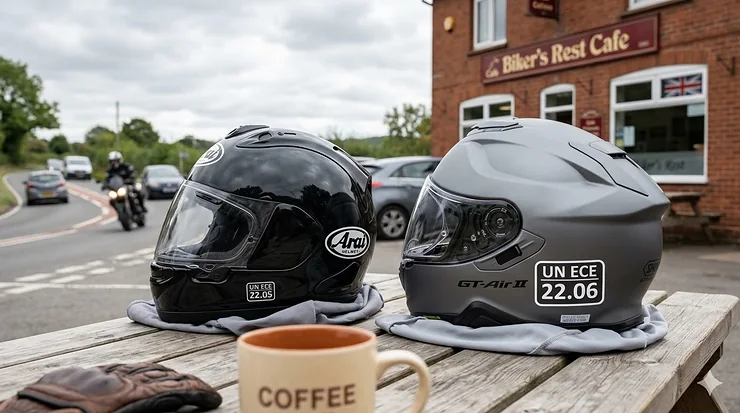
Choosing between an ECE 22.06 vs ECE 22.05 helmet isn’t just about ticking regulatory boxes—it’s about understanding how helmet safety technology has evolved to better protect your most valuable asset: your brain. If you’re in the market for a new motorcycle lid in 2026, you’ve probably noticed ECE 22.06 stickers appearing on helmets across UK retailers, whilst older stock still bears the familiar 22.05 certification. But what’s the actual difference, and should you care?
The short answer: ECE 22.06 helmets undergo significantly more rigorous testing than their 22.05 predecessors, particularly when it comes to rotational impact forces—the twisting motion that causes the most devastating brain injuries. The new standard introduces rotational acceleration testing, extended impact coverage across 18 test points instead of 6, and stricter quality control measures that weren’t part of the previous certification.
Since January 2024, manufacturers can only gain approval for new helmet designs that comply with UN ECE R22-06, meaning your next helmet purchase will almost certainly be to the higher standard. The good news? You don’t need to bin your trusty 22.05 lid just yet—older helmets remain perfectly legal to wear indefinitely. However, understanding the improvements in ECE 22.06 might just convince you that upgrading is worth it.
In this comprehensive guide, I’ll walk you through seven brilliant helmets available in the UK right now, explain exactly what changed between the standards, and help you decide whether upgrading to ECE 22.06 justifies the investment.
Quick Comparison: ECE 22.06 vs ECE 22.05 at a Glance
| Feature | ECE 22.05 (Old Standard) | ECE 22.06 (New Standard) |
|---|---|---|
| Impact Test Points | 6 locations | 18 locations |
| Rotational Testing | None | Oblique impact at 45° angle |
| Test Velocities | Single speed (7.5 m/s) | Multiple speeds (6.0, 7.5, 8.2 m/s) |
| Accessories Testing | Not included | Sun visors, intercoms tested |
| Visor Requirements | Basic penetration test | Enhanced scratch, optical tests |
| Modular Helmets | Basic chin bar test | Chin bar tested open & closed |
| Implementation Date | March 2005 | June 2020 (mandatory Jan 2024) |
| Typical Price Range (UK) | £80–£500 | £90–£700+ |
💬 Just one click – help others make better buying decisions too! 😊
Top 7 ECE 22.06 vs ECE 22.05 Helmet: Expert Analysis
1. HJC C10 – Best Budget ECE 22.06 Option
The HJC C10 has genuinely impressed me as one of the most affordable ways to access ECE 22.06 protection without sacrificing quality. At £90–£110, this polycarbonate full-face helmet punches well above its weight class.
Key Specifications:
- Advanced Polycarbonate Composite shell (4 shell sizes)
- Weight: Approximately 1,400g (medium)
- Advanced Channelling Ventilation System (ACS)
- Pinlock-ready HJ-34P visor with 10mm enhanced sight line
- ECE 22.06 certified
UK buyers consistently praise the HJC C10 for its comfortable fit, particularly for those with rounder head shapes. Customer feedback highlights the helmet’s quieter performance than previous models, quality construction, and effective ventilation, though some note the absence of an integrated sun visor. The removable, washable lining makes maintenance straightforward, and speaker cutouts accommodate Bluetooth systems without modification.
Pros:
✅ Exceptional value at under £110
✅ ECE 22.06 certified safety
✅ Bluetooth-ready with speaker pockets
Cons:
❌ No integrated sun visor
❌ Polycarbonate shell (heavier than composite alternatives)
Price Range: £89.99–£109.99 | Available on Amazon.co.uk
2. Shoei NXR2 – Premium Sports Touring Excellence
For riders seeking the absolute pinnacle of sports-touring protection, the Shoei NXR2 represents everything that’s brilliant about Japanese helmet engineering. Starting at £429.99 for solid colours and rising to £539.99 for graphics, this helmet was among the first to achieve ECE 22.06 certification.
Key Specifications:
- AIM+ composite fibre shell (4 shell sizes: XS–XXL)
- Weight: 1,392g (medium, tested)
- CWR-F2 Pinlock-ready visor with Max Vision 120 insert included
- Emergency Quick Release System (E.Q.R.S.)
- 5-star SHARP safety rating
The Shoei NXR2 excels in aerodynamics and noise reduction, two factors that genuinely matter on long motorway slogs. Independent testing confirms it achieves maximum 5-star SHARP ratings, with owners praising its particularly comfortable fit for neutral-shaped, rounder heads. The improved ventilation system delivers 50% more airflow than its predecessor, making it suitable for year-round British riding.
Pros:
✅ Exceptional build quality and 5-year warranty
✅ Outstanding noise reduction
✅ Personal Fitting System available at selected UK retailers
Cons:
❌ Premium price point
❌ No integrated sun visor (keeps weight down)
Price Range: £429.99–£539.99 | Available on Amazon.co.uk
3. AGV K6-S – World’s Lightest Full-Face Road Helmet
The AGV K6-S brings MotoGP technology to everyday road riding with its carbon-aramid fibre construction. At just 1,255g, it’s remarkably light, and AGV’s Extreme Safety design protocol means it exceeds ECE 22.06 requirements by 36%—offering protection well beyond the minimum legal standard.
Key Specifications:
- Carbon and aramid fibre shell (4 shell sizes)
- Weight: 1,255g (exceptionally light)
- 190° horizontal field of view
- 5-density EPS liner for optimal impact absorption
- Max Vision Pinlock 120 included
UK riders appreciate the AGV K6-S for its versatility across sport, touring, and urban riding scenarios. Customer reviews highlight its lightweight feel, excellent ventilation, and comfortable Shalimar fabric interior, though some note the snug Medium fit runs slightly small. The helmet’s wind-tunnel-optimised aerodynamics and integrated spoiler reduce turbulence brilliantly at motorway speeds.
Pros:
✅ Exceptionally lightweight carbon construction
✅ 36% safer than ECE 22.06 minimum requirements
✅ Panoramic 190° field of view
Cons:
❌ Premium pricing
❌ Sizing runs snug (consider trying before buying)
Price Range: £429.99–£529.99 | Available on Amazon.co.uk
4. LS2 Storm II – Outstanding Mid-Range Value
The LS2 Storm II proves you don’t need to spend £400+ for ECE 22.06 protection. At £130–£150, this Kinetic Polymer Alloy (KPA) helmet offers genuine mid-range quality with advanced aramid fibre integration.
Key Specifications:
- KPA shell with aramid fibres (2 shell sizes)
- Weight: 1,563g (medium)
- Integrated drop-down sun visor
- Pinlock-ready visor included
- ECE 22.06 certified
Independent testing shows the LS2 Storm II weighs 1,563g for a medium, comparable to the budget HJC C10 and only slightly heavier than premium options, with excellent build quality for the £130 price point. The integrated sun visor is particularly convenient for British weather’s unpredictable light conditions, though ventilation performance doesn’t quite match premium competitors.
Pros:
✅ Excellent value for ECE 22.06 protection
✅ Integrated sun visor
✅ Quality finish exceeds price point expectations
Cons:
❌ Ventilation could be improved
❌ Slightly noisier than premium alternatives
Price Range: £129.99–£149.99 | Available on Amazon.co.uk
5. LS2 Valiant II – Best Modular Flip-Front Option
For riders who appreciate the versatility of a modular helmet, the LS2 Valiant II delivers impressive value. Its 180-degree chin bar rotation creates a genuinely usable open-face configuration when stationary.
Key Specifications:
- Kinetic Polymer Alloy (KPA) construction (2 shell sizes)
- Weight: 1,700g (modular mechanism adds mass)
- Dual homologation: P/J certified (full-face & open-face)
- Integrated drop-down sun visor
- 4-star SHARP rating (original Valiant—II awaiting testing)
Priced at £250–£270, the LS2 Valiant II includes thoughtful extras like a padded helmet backpack and spare visor pocket. UK customer feedback highlights the 4-star SHARP rating matching or exceeding comparable flip-front products, with the chin guard remaining locked in over 97% of test impacts. However, at 1.7kg, the modular mechanism does add noticeable weight compared to full-face alternatives.
Pros:
✅ Dual P/J homologation for legal open-face use
✅ Smooth, reliable chin bar mechanism
✅ Pinlock insert and helmet backpack included
Cons:
❌ Heavier than full-face equivalents (1.7kg)
❌ Ventilation sealing could be tighter
Price Range: £249.99–£269.99 | Available on Amazon.co.uk

6. HJC V60 Scoby – Retro Style Meets Modern Safety
The HJC V60 Scoby offers something genuinely different: 1980s-inspired aesthetics with cutting-edge ECE 22.06 protection. This off-road styled helmet bridges classic design with contemporary safety technology.
Key Specifications:
- Fibreglass composite shell
- Internal IS-10 sun visor
- Removable 3-snap peak visor for classic look
- Emergency release cheek pads
- ECE 22.06 certified
Built with a lightweight fibreglass shell using advanced CAD technology, the HJC V60 includes practical modern features like speaker pockets for Bluetooth integration and moisture-wicking, removable interior padding. The retro aesthetic doesn’t compromise functionality—you get a goggle-friendly design that works brilliantly with vintage or modern adventure bikes alike.
Pros:
✅ Unique retro styling with modern safety
✅ Lightweight fibreglass construction
✅ Internal sun visor for versatility
Cons:
❌ Off-road styling may not suit all motorcycles
❌ Peak visor can create wind resistance at speed
Price Range: £155–£175 | Available on Amazon.co.uk
7. Alpinestars Supertech R10 – Premium Race-Ready Protection
For riders who demand FIM-level protection, the Alpinestars Supertech R10 represents the absolute cutting edge. With ECE 22.06 and FIM homologation, this 3K carbon helmet is engineered for serious performance.
Key Specifications:
- 3K carbon shell with advanced epoxy resin bonding
- Multi-density EPS liner (8 sections, 6 densities)
- Patented A-Head Fitment System for customisable fit
- 7 intake vents, 4 exhaust ports
- ECE 22.06 & FIM certified
Priced from £699.99, the Alpinestars Supertech R10 isn’t for casual riders—but if you’re serious about track days or aggressive road riding, its multi-layer composite carbon shell bonded with advanced epoxy resin ensures maximum strength whilst minimising weight, with emergency release cheek pads and stainless-steel D-ring strap enhancing safety. The A-Head System allows precise height and angle adjustment for a genuinely tailored fit.
Pros:
✅ FIM homologated for professional racing
✅ Cutting-edge 3K carbon construction
✅ Customisable A-Head fitment system
Cons:
❌ Premium pricing (£699.99+)
❌ Race-focused design may be overkill for casual riding
Price Range: £699.99–£799.99 | Available on Amazon.co.uk
✨ Don’t Miss These Exclusive Deals!
🔍 Take your motorcycle safety to the next level with these carefully selected helmets. Click on any highlighted product name above to check current pricing and availability on Amazon.co.uk. These certified ECE 22.06 helmets will provide the advanced protection your riding demands!
Should I Upgrade to ECE 22.06 Helmet: What Changed?
The transition from ECE 22.05 to 22.06 represents the most significant advancement in helmet safety standards in over two decades. Understanding what changed helps you appreciate why upgrading matters.
Rotational Impact Testing Added
Perhaps the most crucial improvement in ECE 22.06 is the introduction of oblique (rotational) impact testing. The new standard includes rotational impact testing at 45-degree angles, simulating the twisting forces that occur when a helmet slides along the road during impact—forces particularly dangerous because they cause brain injuries like concussions.
Previous ECE 22.05 testing only measured linear impacts—straight-on collisions. Real-world crashes rarely happen that way. When your helmet strikes tarmac at an angle, rotational forces can cause your brain to twist inside your skull, shearing delicate nerve fibres. This rotational acceleration is often more damaging than the initial impact itself.
ECE 22.06 addresses this by dropping test helmets onto a 45-degree anvil at 8.5 m/s, measuring the rotational forces transmitted to the head form inside. Helmets must limit both linear and rotational acceleration to pass certification—a significantly higher bar than 22.05 required.
Extended Impact Coverage Area
The number of helmet impact zones tested increased dramatically from 6 points under ECE 22.05 to 18 points under ECE 22.06, providing comprehensive assessment across the helmet’s entire surface. These additional test points include critical areas like the front lateral zones and rear lateral positions that weren’t previously examined.
Why does this matter? Different impacts strike different helmet areas. A frontal collision hits differently than a side impact or rear fall. By testing 18 locations instead of 6, ECE 22.06 ensures your helmet provides consistent protection regardless of impact angle. Vulnerable areas like temples and forehead receive particular attention, as these protect critical brain regions.
The expanded testing also includes multiple anvil shapes—flat surfaces, edges, and hemispheres—to simulate real-world impact scenarios. ECE 22.06 subjects helmets to impacts on different anvil shapes including flat, edge, and hemisphere surfaces to simulate a wider range of crash scenarios beyond the more limited testing of ECE 22.05.
Multiple Test Velocities: High and Low Speed
ECE 22.05 tested helmets at a single impact speed of 7.5 m/s. ECE 22.06 introduces three test velocities: 6.0 m/s for low-energy impacts, 7.5 m/s for standard testing, and 8.2 m/s for high-speed scenarios, reflecting diverse real-world collision speeds riders encounter.
This tiered approach better represents actual crashes. Not every accident happens at the same speed—you might tumble at low speed in traffic, or impact at higher velocity on a motorway. By testing across this range, ECE 22.06 ensures helmets perform adequately in both situations.
Interestingly, even the high-speed test (8.5 m/s for oblique impacts) equates to less than 20 mph. Helmet standards focus on survivable impacts where proper head protection makes the difference between walking away or sustaining life-changing injuries, rather than attempting to protect against unsurvivable high-speed collisions.
Stricter Quality Control Standards
ECE 22.06 doesn’t just test more rigorously—it requires more test samples. Where ECE 22.05 required 17 helmets for basic approval of a model offered in two shell sizes, ECE 22.06 now requires 33 test helmets, making the certification process significantly more comprehensive.
This expanded testing regime costs manufacturers considerably more, but ensures greater consistency across production batches. It’s not enough for one sample to pass—multiple helmets across all sizes must meet the standard, reducing the likelihood of quality variations reaching consumers.
The new standard also mandates testing of accessories like integrated sun visors and communication system mounting points. Previously, helmets were certified bare, then accessories added afterwards. ECE 22.06 ensures accessories don’t compromise helmet integrity during impacts—a welcome improvement for riders who use Bluetooth intercoms or tinted visors.
Modular Helmet Testing Enhancements
Flip-front modular helmets receive particular attention under ECE 22.06. Whilst ECE 22.05 only subjected flip helmets to rear-to-front roll-off testing, ECE 22.06 requires reverse front-to-rear roll-off tests, open-face position testing, and chin bar impact tests in both open and closed configurations.
This comprehensive testing addresses concerns about chin bar security—the mechanism most likely to fail in modular designs. Helmets like the LS2 Valiant II must prove their chin bars remain locked during impacts from multiple directions, providing confidence that P/J dual homologation genuinely offers protection in both configurations.
Visor and Sun Shield Requirements
Visor testing becomes substantially more demanding under ECE 22.06. All outer visors face enhanced penetration testing, optical assessment with Pinlock inserts fitted to ensure vision isn’t distorted, and new anti-scratch testing, whilst internal sun shields undergo testing for light transmission, diffraction, tint, and anti-scratch properties.
One practical benefit: road-legal tinted visors can now be manufactured slightly darker than ECE 22.05 allowed, with the standard permitting visors that transmit as low as 20% light whilst maintaining visibility of traffic signals and brake lights. This improves riding comfort in bright conditions without compromising safety.
According to official UNECE documentation, these visor requirements ensure optimal peripheral vision isn’t obstructed, with specific mandates for scratch resistance, optical clarity, and fog resistance for manufacturers claiming anti-fog features.
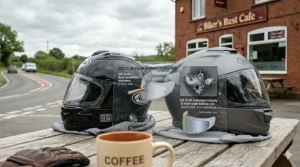
ECE 22.06 Safety Improvements Explained: The Science Behind Protection
Understanding why ECE 22.06 improves safety requires examining the biomechanics of traumatic brain injury (TBI) during motorcycle crashes.
How Brain Injuries Actually Occur
Your brain floats inside your skull, cushioned by cerebrospinal fluid. During sudden deceleration—like your head striking tarmac—your skull stops abruptly whilst your brain continues moving, colliding with the skull’s interior. This causes contusions (brain bruising) at the impact site.
However, rotational forces cause even more insidious damage. When your helmet slides across a surface at an angle, it rotates your skull rapidly. Your brain can’t keep pace with this rotation, causing it to twist inside the skull. This twisting motion stretches and tears delicate axons—the long nerve fibres connecting brain cells.
Diffuse axonal injury (DAI) from rotational forces is particularly devastating because these torn nerve fibres cannot regenerate. According to UNECE safety documentation, when brain cells are lost to tearing, there’s no replacement—resulting in permanent damage affecting intelligence, motor control, and behaviour.
ECE 22.05 testing only measured linear impacts, completely ignoring rotational forces. ECE 22.06’s oblique testing directly addresses this gap, ensuring helmets incorporate design features that reduce rotational acceleration—technologies like multi-directional impact protection systems (MIPS) or slip-plane liners that allow slight helmet rotation before it transfers to your skull.
Energy Management Across Multiple Impacts
Modern helmet design recognises that crashes often involve multiple impacts—your head might strike the ground, then bounce and hit again. ECE 22.06’s multi-velocity testing simulates this reality.
The 6.0 m/s low-speed test represents secondary impacts after initial collision energy is partially absorbed. Helmets must retain protective capacity even after the first hit. This testing reveals whether helmet materials maintain integrity or catastrophically fail, becoming ineffective after a single impact.
High-density EPS foam (the white styrofoam-like material inside helmets) typically crushes permanently upon impact, absorbing energy through controlled deformation. Multi-density EPS—like the 5-density liner in the AGV K6-S—uses different foam densities in strategic locations. Softer foam compresses during low-speed impacts, whilst denser foam protects against high-speed collisions, optimising energy absorption across the velocity spectrum ECE 22.06 tests.
Shell Construction and Deformation Limits
ECE 22.06 actually increases the maximum permitted deformation during rigidity testing from 15mm under ECE 22.05 to 50mm. The new standard allows greater deformation (50mm versus 15mm) to enhance structural integrity, recognising that controlled deformation absorbs energy more effectively than rigid shells that transfer force directly to the head.
This seems counterintuitive—surely less deformation is better? Actually, no. A helmet that deforms in a controlled manner dissipates impact energy through the shell and liner materials. An overly rigid shell transfers more force directly to your head and neck, potentially causing injury the helmet was meant to prevent.
Think of modern vehicle crumple zones—cars deliberately deform during crashes to absorb energy, protecting occupants. Helmets work similarly. The 50mm deformation limit ensures shells crush gradually rather than shattering catastrophically, whilst maintaining a safety margin preventing contact between your head and the impact surface.
Materials matter enormously here. Premium helmets use carbon-aramid fibre composite shells (like the AGV K6-S) that offer excellent strength-to-weight ratios whilst deforming progressively. Budget options use polycarbonate thermoplastic or fibreglass, which weigh more but still meet ECE 22.06’s stringent deformation requirements when properly designed.
Temperature and Environmental Testing
Helmets undergo conditioning at extreme temperatures before testing—both hot (50°C) and cold (-20°C) storage periods, followed by impact testing at ambient and extreme temperatures. This ensures EPS liners don’t become brittle in winter or overly soft in summer heat, maintaining protective performance across British weather’s full temperature range.
The UK’s SHARP testing programme supplements ECE requirements with additional tests, providing star ratings that help consumers identify helmets exceeding minimum standards. SHARP has employed high-speed and oblique testing since inception, meaning their protocols already resembled ECE 22.06 before the new standard’s introduction.
Difference Between ECE 22.05 and 22.06: Side-by-Side Analysis
Manufacturing and Cost Implications
The enhanced testing requirements of ECE 22.06 impose significant costs on manufacturers. Experts initially predicted price increases equivalent to around 5% on most helmets and accessories, though actual market prices suggest this impact has been absorbed differently across brands.
Premium manufacturers like Shoei and Arai likely found ECE 22.06 compliance easier—their helmets already incorporated advanced safety features and multi-density liners. Budget brands faced harder choices: either absorb increased testing costs (33 test samples versus 17) or raise prices modestly.
Interestingly, genuinely budget-friendly ECE 22.06 helmets like the £90 HJC C10 demonstrate that meeting the higher standard needn’t break the bank. Research by testing organisations shows that at the budget end, ECE 22.06 certification drove quality improvements, whilst at the premium end, manufacturers already exceeded the new standards before they became mandatory.
Timeline and Legal Requirements
From January 2024, helmet manufacturers can only obtain approval for new designs complying with UN ECE R22-06, though ECE R22-05 helmets remain compliant and legal to wear in the UK indefinitely. This phased implementation allows existing stock to sell through naturally without creating artificial scarcity.
In practice, most major manufacturers began offering ECE 22.06 models from late 2021 onwards. The Shoei NXR2 and Arai Quantic were among the first ECE 22.06 helmets available, capitalising on early-mover marketing advantages. By mid-2023, most new releases incorporated 22.06 certification as standard.
For UK riders purchasing helmets in 2026, virtually all new stock bears ECE 22.06 certification. However, you may still find discounted ECE 22.05 helmets—perfectly legal and safe, but worth considering the manufacturing date before purchase. As guidance from the UK Department for Transport’s SHARP programme advises, check the date of manufacture by removing helmet lining to reveal the production sticker, as every year a helmet sits on a shelf matters toward the recommended 5-year replacement interval.
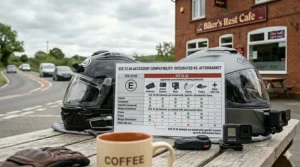
Compatibility with Existing Accessories
One aspect riders often overlook: ECE 22.06 changes how aftermarket accessories are regulated. Previously, you could add any visor, sun shield, or communication system without affecting your helmet’s certification. ECE 22.06 requires helmets to be tested with accessories fitted, or for accessories themselves to receive separate homologation.
This creates three categories:
- Integrated accessories (tested with the helmet, included at purchase)
- Universal accessories (separately homologated, marked “UA”, compatible with “ready for UA” helmets)
- Specific accessories (tested for particular helmet models, marked “SA”)
In practice, this means checking compatibility before adding aftermarket parts. Most quality helmet manufacturers provide lists of approved accessories, and retailers typically stock compatible options. The system protects you from unknowingly adding accessories that might compromise your helmet’s protective performance.
How to Choose Between ECE 22.05 and ECE 22.06 Helmets
When ECE 22.05 Still Makes Sense
Despite ECE 22.06’s improvements, ECE 22.05 helmets retain validity for certain buyers:
Budget constraints: If a discounted ECE 22.05 helmet from a quality manufacturer (Shoei, AGV, Arai) offers substantial savings, and the manufacturing date is recent (2022 or later), it remains a sound choice. Premium ECE 22.05 helmets from established manufacturers likely exceed many budget ECE 22.06 helmets in real-world protection, as quality of construction often matters more than minimum certification standards.
Replacement timeline: If you’re replacing a damaged helmet temporarily whilst saving for a premium model, an end-of-line ECE 22.05 bargain makes practical sense. Just ensure it’s genuinely new old stock, not shelf-worn inventory approaching its fifth birthday.
Specific model requirements: Occasionally, a particular helmet in ECE 22.05 specification fits your head shape perfectly, whilst the ECE 22.06 replacement has different internal sizing. Proper fit trumps certification level—an ill-fitting ECE 22.06 helmet offers less protection than a properly-fitted ECE 22.05 model.
When ECE 22.06 Is Worth Prioritising
For most riders in 2026, ECE 22.06 makes overwhelming sense:
New purchases at equivalent pricing: When ECE 22.05 and 22.06 versions cost similarly, or the price difference is marginal (£20–40), always choose 22.06. The rotational impact testing alone justifies the upgrade.
Long-term investment: If you’re buying a premium helmet expecting 5 years’ service, ECE 22.06 future-proofs your purchase. Whilst 22.05 remains legal indefinitely, having the latest standard provides peace of mind and potentially better resale value.
Track day usage: Some racing organisations and track day operators increasingly specify ECE 22.06 (or FIM homologation) as minimum requirements. If you participate in organised events, verify current requirements before purchasing.
Insurance considerations: Whilst UK insurers currently accept ECE 22.05 helmets without penalty, demonstrating use of the latest safety equipment may support claims if relevant. Consult your specific policy, but ECE 22.06 compliance can only help, never hinder, insurance matters.
The Fitting Test: Non-Negotiable Regardless of Standard
No amount of advanced certification compensates for poor fit. For maximum protection, helmets must fit properly—comfortable enough that you’re not constantly adjusting whilst moving, as any helmet’s protective capability depends entirely on correct fitting.
A correctly-fitted helmet should feel snug without pressure points, shouldn’t rotate independently of your head, and shouldn’t lift when you attempt to pull it off from the back. Cheek pads should contact your face firmly without causing discomfort, and the helmet shouldn’t shift when you move your jaw.
Many UK retailers offer helmet fitting services—particularly for premium brands like Shoei (Personal Fitting System) and Arai. These services map your head shape, identify the optimal shell size, and customise cheek pad and crown pad thickness for perfect fit. Worth utilising if available, as the difference between adequate and perfect fit dramatically affects both comfort and protection.
Rotational Impact Testing Added: Why It Matters Most
The Biomechanics of Rotational Brain Injury
Research into motorcycle crash injuries reveals that rotational forces cause more severe brain damage than linear impacts. Your brain’s structure—billions of neurons connected by delicate axons—makes it particularly vulnerable to twisting motion.
When your helmet impacts a surface obliquely (at an angle), it slides and rotates. Without adequate rotational force mitigation, this rotation transfers directly to your skull, which rapidly twists your brain. The brain’s grey matter (cell bodies) and white matter (axon fibres) have different densities and therefore different inertia—meaning they rotate at slightly different speeds during rapid acceleration.
This differential rotation shears axons, causing diffuse axonal injury (DAI). Unlike focal injuries (bruises or bleeding) that might heal, sheared axons cannot regenerate. The resulting disability—cognitive impairment, personality changes, motor function loss—often proves permanent and devastating.
ECE 22.05’s exclusive focus on linear impacts missed this entirely. You could wear a perfectly ECE 22.05-compliant helmet and still sustain severe rotational brain injury from an angled impact that the helmet wasn’t designed or tested to mitigate.
How ECE 22.06 Oblique Testing Works
The oblique impact test drops a helmeted head form onto a 45-degree anvil at 8.5 m/s, measuring both linear acceleration and rotational velocity/acceleration. Helmets must limit:
- Linear acceleration (straight-line forces)
- Rotational velocity (how fast the helmet/head rotates)
- Rotational acceleration (how quickly rotation increases)
This requires helmet manufacturers to incorporate rotational force management technologies. Common solutions include:
MIPS (Multi-directional Impact Protection System): A low-friction liner between the helmet shell and comfort padding allows 10–15mm of relative rotation before it transfers to your head. This slip-plane absorbs rotational energy.
Slip-plane liners: Similar concept to MIPS but manufacturer-proprietary designs integrated into the EPS liner structure rather than a separate layer.
Multi-density EPS zones: Strategic placement of different foam densities can influence how helmets deform during oblique impacts, affecting rotational force transfer.
Shell shapes and materials: Carbon fibre composite shells can be engineered to deform in specific ways during oblique impacts, managing energy more effectively than homogenous materials.
The oblique test doesn’t specify how manufacturers achieve rotational force reduction—only that they must. This encourages innovation whilst ensuring all ECE 22.06 helmets meet minimum rotational protection standards, something no ECE 22.05 helmet was required to demonstrate.
Price Comparison: UK Market Analysis 2026
Budget Tier (£80–£150)
ECE 22.05: Largely phased out by 2026, though some remaining stock from brands like Caberg, MT Helmets, or budget LS2 models may appear at clearance prices.
ECE 22.06: HJC C10 (£89.99–£109.99) leads this category, offering polycarbonate construction with Pinlock compatibility and Bluetooth readiness. LS2 Storm II (£129.99–£149.99) provides KPA construction with integrated sun visor at the upper end of budget pricing.
Value assessment: The gap between ECE 22.05 and 22.06 at budget pricing is minimal in 2026—often £10–20. Given equivalent pricing, ECE 22.06 makes obvious sense for the enhanced testing protocol.
Mid-Range (£200–£400)
ECE 22.06 dominance: By 2026, virtually all mid-range helmets bear ECE 22.06 certification. LS2 Valiant II (£249.99–£269.99) offers modular functionality with dual homologation. Brands like Scorpion, Bell, and mid-range HJC models populate this space.
Value sweet spot: This tier offers the best balance of features, weight, and protection for most UK riders. Materials upgrade from polycarbonate to fibreglass or basic composite shells, whilst retaining reasonable pricing.
Premium (£400+)
Shoei NXR2 (£429.99–£539.99) and AGV K6-S (£429.99–£529.99) represent premium sports-touring options with composite shells, multi-density liners, and exceptional build quality. Alpinestars Supertech R10 (£699.99+) serves performance-focused riders demanding FIM certification alongside ECE 22.06.
Premium justification: Beyond meeting ECE 22.06 minimums, premium helmets typically exceed requirements substantially. The AGV K6-S’s claimed 36% safety margin above ECE 22.06 requirements exemplifies this. You’re paying for materials (carbon fibre), construction quality (hand-built), warranty length (5 years), and performance exceeding minimum standards.
FAQ: Your ECE 22.06 vs ECE 22.05 Helmet Questions Answered
❓ Is ECE 22.05 still legal in the UK?
❓ How much safer is ECE 22.06 compared to ECE 22.05?
❓ Should I replace my ECE 22.05 helmet with ECE 22.06?
❓ What's the main difference between ECE 22.05 and 22.06 testing?
❓ Do ECE 22.06 helmets cost significantly more?
Conclusion: Making Your ECE 22.06 vs ECE 22.05 Helmet Decision
After analysing seven excellent helmets and examining the technical differences between ECE 22.06 vs ECE 22.05 certification, one truth emerges clearly: helmet safety has genuinely improved under the new standard, particularly regarding rotational brain injury protection that previous regulations completely ignored.
For UK riders purchasing helmets in 2026, ECE 22.06 makes overwhelming sense for new purchases. The enhanced testing protocol—18 impact points instead of 6, oblique testing for rotational forces, multiple test velocities—addresses real-world crash dynamics far more comprehensively than ECE 22.05 ever did. When prices between comparable ECE 22.05 and 22.06 helmets differ marginally, choosing the newer standard provides peace of mind and future-proofs your investment.
However, existing ECE 22.05 helmets needn’t be binned prematurely. If your current lid fits properly, shows no damage, and hasn’t exceeded the 5-year replacement guideline, it remains perfectly adequate and entirely legal. Helmet replacement timing should primarily consider age, condition, and fit rather than rushing to upgrade based solely on certification changes.
My top recommendations for UK riders:
- Best budget choice: HJC C10 at £89.99 delivers ECE 22.06 protection without premium pricing
- Best all-rounder: Shoei NXR2 at £429.99 combines 5-star SHARP ratings with exceptional build quality
- Best lightweight option: AGV K6-S at £429.99 offers carbon-aramid construction at just 1,255g
- Best mid-range value: LS2 Storm II at £129.99 provides KPA construction with integrated sun visor
Whichever helmet you choose, prioritise proper fit above all else—an ill-fitting ECE 22.06 helmet offers less protection than a correctly-fitted ECE 22.05 model. Visit retailers offering professional fitting services, try multiple sizes and models, and don’t compromise on comfort. Your brain deserves the best protection available, whether that’s cutting-edge ECE 22.06 technology or a perfectly-fitted premium ECE 22.05 helmet that works for your specific head shape.
Ride safe, and remember: the best helmet is the one you’ll actually wear consistently, fitted correctly, every single ride.
Recommended for You
- 7 Best ECE 22.06 Modular Helmets UK 2026: P/J Dual Certified
- 7 Best ECE 22.06 Helmet Under £200 UK | 2026 Updated Guide
- 7 Best ECE 22.06 Full Face Helmets UK 2026
Disclaimer: This article contains affiliate links to Amazon.co.uk. If you purchase products through these links, we may earn a small commission at no additional cost to you. All prices shown are approximate and were accurate at time of publication but may vary. We recommend checking current pricing before purchase.
✨ Found this helpful? Share it with your mates! 💬🤗
