In This Article
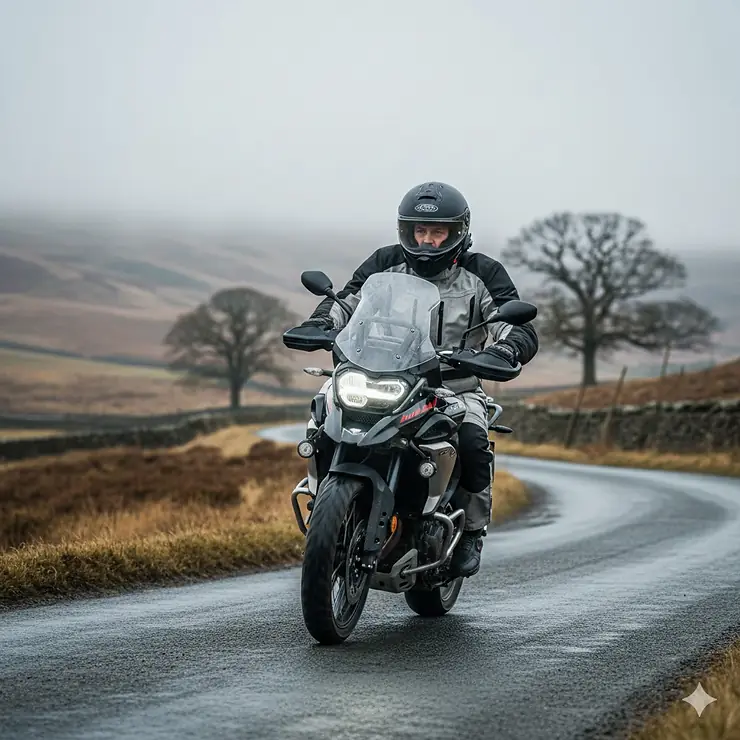
Picture this: It’s 6am on a frosty January morning in Manchester, and you’re about to embark on your daily commute. The temperature gauge reads -2°C, and your breath forms clouds in the crisp air. As you reach for your helmet, you realise that what protects your head in summer might not cut it when British winter throws everything at you—freezing winds, relentless rain, and that dreaded visor fog that appears the moment you close your shield.
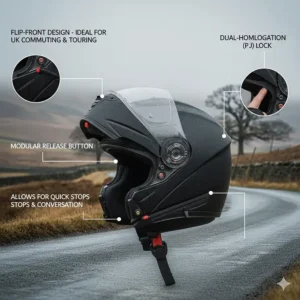
If you’ve ever pulled over to wipe condensation from your visor or felt that biting cold creep through your helmet vents, you already understand why choosing the right motorcycle helmets for winter isn’t just about comfort—it’s about safety. According to Lancashire County Council’s winter motorcycling guidelines, motorcyclists are over 40 times more likely to be killed or seriously injured per mile travelled compared to car occupants, with risks significantly heightened in winter conditions.
The good news? Modern helmet technology has evolved dramatically. We’re talking dual-pane visor systems that eliminate fog completely, thermal liner motorcycle helmets that trap warmth without adding bulk, and breath box technology that redirects moisture away from your vision. Whether you’re a year-round commuter braving the M25 or a weekend warrior exploring the Scottish Highlands, this comprehensive guide will help you find the perfect cold weather touring helmet that keeps you safe, warm, and fog-free throughout the harshest British winters.
Quick Comparison: Top Motorcycle Helmets for Winter
| Helmet Model | Type | Key Winter Feature | Anti-Fog System | Price Range (£) | Best For |
|---|---|---|---|---|---|
| Shoei Neotec II | Modular | Noise isolation cheek pads | Pinlock MaxVision | £450-£550 | Premium touring |
| HJC RPHA 11 | Full-Face | Breath guard & chin curtain | Pinlock 70 included | £280-£380 | Sport touring |
| AGV K3 SV | Full-Face | Drop-down sun visor | Pinlock ready | £180-£250 | Budget-conscious |
| Scorpion EXO-AT950 SD | Modular Adventure | Dual-pane visor & breath box | Electric/dual-pane | £220-£320 | Adventure riders |
| LS2 FF805 Thunder | Full-Face | Emergency release system | Pinlock ready | £200-£280 | Mid-range quality |
| Caberg Levante | Flip-Up | Adjustable ventilation | Pinlock MaxVision | £260-£340 | Urban commuting |
| Shoei GT-Air II | Full-Face | QSV-1 internal sun shield | Pinlock EVO | £400-£500 | Long-distance touring |
💬 Just one click – help others make better buying decisions too!😊
Top 7 Motorcycle Helmets for Winter: Expert Analysis
1. Shoei Neotec II – The Premium Modular Champion
When it comes to tackling British winters in style, the Shoei Neotec II stands as the gold standard. This Japanese-engineered marvel combines a flip-up design with Shoei’s Advanced Integrated Matrix (AIM) shell construction, offering unparalleled protection wrapped in whisper-quiet comfort.
Key Specifications:
- Advanced Integrated Matrix shell (multi-composite)
- Weight: 1,750g (±50g, size M)
- ECE 22.05 certified with 5-year warranty
- Built-in QSV-1 internal sun shield
What makes this helmet exceptional for winter? The all-new Noise Isolator cheek pads don’t just reduce wind roar—they create a thermal barrier that deflects cold air whilst the airtight window bead manages airflow brilliantly. UK riders consistently praise its fog-free performance, even during stop-start London commutes where temperature fluctuations are most challenging.
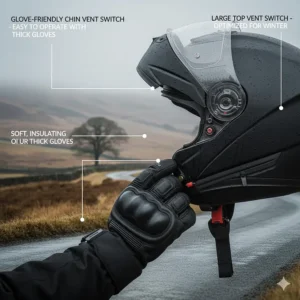
The modular chinbar employs a 360° Pivot Locking System with stainless steel components, ensuring secure closure even when wearing thick winter gloves. Opening the face cover automatically closes the face shield—a thoughtful touch that prevents cold air rushing in unexpectedly.
UK Customer Feedback: “Bought this to replace my 14-year-old Nolan. The padding is excellent, and it’s WAY quieter. At £600, it’s not cheap, but the build quality is simply superb,” reports a verified Amazon.co.uk buyer.
✅ Pros:
- Exceptional noise reduction for winter riding
- Pinlock MaxVision anti-fog system included
- Eyeglass-compatible cheek pads
❌ Cons:
- Higher price point (£450-£550)
- Slightly heavier than competitors
Price Range: £450-£550 | Available on Amazon.co.uk with free delivery
2. HJC RPHA 11 Pro – Premium Performance Without Breaking the Bank
HJC’s Premium Integrated Matrix Plus (P.I.M.+) shell technology brings race-proven engineering to winter riders at a more accessible price point. This cold weather touring helmet features a carbon-aramid-glass hybrid construction that’s both featherlight (1,300g ± 50g) and incredibly strong.
Key Specifications:
- P.I.M.+ shell in 3 sizes
- RapidFire shield replacement system
- Advanced Multicool interior with anti-bacterial fabric
- Emergency kit (cheek pads) for rescue situations
The RPHA 11’s winter credentials shine through its comprehensive ventilation system that you can completely close during freezing rides, whilst the detachable chin curtain and breath guard work in tandem to redirect warm exhaled air away from the visor. The included Pinlock Max Vision insert covers an impressive viewing area, and UK riders report zero fogging even during two-hour motorway slogs in December drizzle.
UK Customer Feedback: British riders on Amazon.co.uk note the helmet “fits perfectly with no pressure points” and appreciate the SHARP 3-star rating alongside ECE approval, making it fully road-legal throughout Europe.
✅ Pros:
- Lightweight carbon-hybrid shell
- Pinlock Max Vision anti-fog included as standard
- Glasses groove for spectacle wearers
❌ Cons:
- Ear pockets may require adjustment for Bluetooth speakers
- Premium model pricing
Price Range: £280-£380 | Free UK delivery available
3. AGV K3 SV – Outstanding Value for Winter Warriors
Italian design meets practical affordability with the AGV K3 SV. Don’t let the budget-friendly price fool you—this thermoplastic helmet packs serious anti-fog technology and has earned respect amongst UK commuters who refuse to compromise safety for savings.
Key Specifications:
- High-resistant thermoplastic resin shell (2 sizes)
- Integrated Ventilation System (IVS) with 5 vents
- Panoramic anti-scratch visor (Pinlock ready)
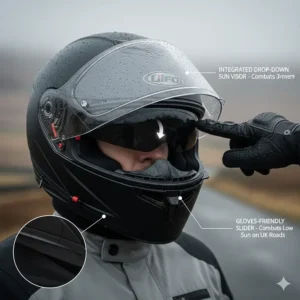
- Internal drop-down sun visor
The K3 SV’s IVS channels cold air through strategically placed intakes that you can fully close during winter, whilst two rear extractors maintain circulation without creating drafts. The integrated sun visor operates smoothly even with thick winter gloves—a detail that matters when you’re juggling bike controls at a motorway services.
What really impresses is AGV’s 2Dry liner material that wicks sweat away in record time. Combined with six helmet sizes and interchangeable cheek pads in five thicknesses, you get 30 possible configurations to nail that perfect fit that’s crucial for cold-weather seal.
UK Customer Feedback: “Comfortable helmet with good ventilation. The fit is snug initially but moulds perfectly after a few rides. Without a Pinlock insert, fogging occurs in winter—definitely buy the insert separately,” advises an Amazon.co.uk reviewer.
✅ Pros:
- Exceptional value (£180-£250)
- Wide field of vision
- Lightweight and comfortable
❌ Cons:
- Pinlock insert sold separately
- Ventilation less sophisticated than premium models
Price Range: £180-£250 | Prime delivery available
4. Scorpion EXO-AT950 Cold Weather Edition – Adventure-Ready Winter Specialist
Scorpion specifically engineered the EXO-AT950 SD (Snow/Dual-sport) variant for winter warriors who won’t let freezing temperatures end their riding season. This modular adventure helmet combines dual-pane visor technology with a dedicated breath box—features typically found on helmets costing twice as much.
Key Specifications:
- Advanced LG polycarbonate shell (3 sizes)
- Dual-pane no-fog faceshield included
- Amber-tinted drop-down visor for winter contrast
- Integrated cold-weather breath box
The dual-pane shield creates a thermal barrier similar to double-glazed windows, effectively eliminating condensation in temperatures down to -5°C. The amber-tinted internal visor enhances visual contrast in flat winter light—brilliant for spotting black ice or debris on grey British roads.
UK riders particularly appreciate the KwikWick II liner that manages moisture whilst maintaining warmth. The oversized eye port (11cm tall) accommodates most goggles if you remove the faceshield for milder days, and the removable peak visor transforms it into a sleek touring helmet for motorway miles.
UK Customer Feedback: Amazon.co.uk buyers report “solid mechanical feel” and praise the dual-position mouth vent that acts as both defroster and ventilation. One reviewer notes it “runs slightly small—consider sizing up.”
✅ Pros:
- Purpose-built for winter conditions
- Dual-pane visor eliminates fogging
- Versatile adventure-to-touring design
❌ Cons:
- Runs small in sizing
- Heavier than pure touring helmets (1,780g)
Price Range: £220-£320 | Currently available on Amazon.co.uk
5. LS2 FF805 Thunder GP Pro – Spanish Engineering Meets Winter Reliability
LS2 helmets have quietly built a reputation for delivering premium features at mid-range prices, and the FF805 Thunder GP Pro exemplifies this philosophy. The carbon fibre shell construction keeps weight impressively low whilst the comprehensive ventilation system gives you complete control over airflow during winter rides.
Key Specifications:
- Carbon fibre and KPA shell
- Weight: Approximately 1,300g (size M)
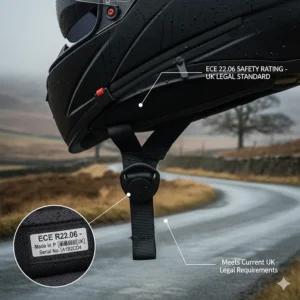
- ECE 22.06 approved
- Drop-down sun shield and emergency release system
The Thunder’s Pinlock-ready visor accepts MaxVision inserts, and the shell-integrated rear spoiler improves stability in crosswinds—a godsend when riding exposed moorland roads in gale-force winds. LS2’s attention to cold-weather details shows in the removable breath guard and fully adjustable ventilation that seals completely when temperatures plummet.
UK availability has improved dramatically over recent years, with major retailers stocking LS2 extensively. The 2-year warranty provides peace of mind, and many UK dealers offer Klarna financing for spreading the cost.
UK Customer Feedback: British motorcyclists highlight the “lightweight feel” and “excellent value proposition.” Some note that aftermarket Pinlock inserts are essential for UK winter riding.
✅ Pros:
- Lightweight carbon construction
- ECE 22.06 latest safety standard
- Excellent aerodynamics
❌ Cons:
- Pinlock insert not always included
- Limited colour options in UK market
Price Range: £200-£280 | Available through UK authorised dealers
6. Caberg Levante – The Commuter’s Winter Companion
Italian manufacturer Caberg designed the Levante specifically for riders who demand practicality without sacrificing style. This flip-up helmet excels in urban winter conditions where you’re constantly lifting the chinbar for communications at traffic lights or drive-throughs.
Key Specifications:
- Thermoplastic shell (2 sizes)
- Double visor system
- Pinlock MaxVision ready
- Microlock retention system
The Levante’s standout winter feature is its adjustable ventilation system that provides four distinct airflow settings. During freezing commutes, you can seal everything shut, whilst the Pinlock MaxVision insert maintains crystal-clear vision. The internal sun visor deploys with a single lever—crucial when winter sun sits low on the horizon, creating dangerous glare.
What British riders really value is the helmet’s compatibility with most Bluetooth communication systems. Caberg pre-cuts speaker pockets that accommodate Sena and Cardo units perfectly, letting you receive navigation prompts without fumbling with frozen fingers.
UK Customer Feedback: London commuters on forums praise its “comfortable all-day wear” and note the chinbar mechanism “operates smoothly even with winter gloves.”
✅ Pros:
- Quick-release chinbar mechanism
- Bluetooth-ready speaker pockets
- Versatile urban-to-touring capability
❌ Cons:
- Heavier than full-face equivalents
- Wind noise slightly higher at motorway speeds
Price Range: £260-£340 | Free UK delivery over £25
7. Shoei GT-Air II – Long-Distance Winter Tourer’s Dream
For riders who clock serious winter miles touring across Britain and Europe, the Shoei GT-Air II represents the pinnacle of cold-weather comfort. This full-face touring helmet combines Shoei’s legendary build quality with features specifically chosen for extended winter journeys.
Key Specifications:
- AIM+ (Advanced Integrated Matrix Plus) shell
- Weight: 1,610g (± 50g, size M)
- CNS-1 Pinlock EVO included
- QSV-1 internal sun shield
The GT-Air II’s Advanced Integrated Matrix Plus shell uses organic and inorganic fibres in a multi-composite layup that’s both incredibly strong and surprisingly light. The CNS-1 Pinlock EVO system sets new standards for fog resistance—even during multi-hour winter rides where temperature differentials are extreme.
Shoei’s attention to thermal management shows in the carefully sculpted neck roll that seals against cold draughts without restricting movement. The five-position ventilation system gives precise control, and in winter mode with everything closed, the helmet maintains impressive quietness that reduces fatigue on long motorway runs.
UK Customer Feedback: Veteran tourers on UK motorcycle forums consistently rate the GT-Air II as “the most comfortable helmet for winter touring” with particular praise for its “all-day wearability” and “exceptional fog resistance.”
✅ Pros:
- Premium comfort for long distances
- Outstanding noise reduction
- Five-year manufacturer warranty
❌ Cons:
- Premium pricing (£400-£500)
- Limited colour options
Price Range: £400-£500 | Widely available across UK retailers
✨ Don’t Miss These Exclusive Winter Helmet Deals!
🔍 Take your winter riding safety to the next level with these carefully selected motorcycle helmets for winter. Click on any highlighted product to check current pricing and availability on Amazon.co.uk. These helmets will help you create authentic fog-free riding experiences that British winters demand!
Understanding Thermal Insulation Properties in Winter Helmets
The science behind keeping your head warm whilst maintaining safety standards involves sophisticated thermal insulation properties that modern helmets incorporate without adding excessive bulk. Unlike traditional helmets that simply trap air, contemporary winter designs employ multi-layered systems that manage both heat retention and moisture control.
How Thermal Liner Motorcycle Helmets Work
Quality winter helmets utilise removable thermal liners constructed from advanced materials like Coolmax or proprietary fabrics that create insulating air pockets. These liners sit between your head and the helmet’s EPS (expanded polystyrene) safety liner, providing warmth without compromising the helmet’s ability to absorb impact energy during a collision.
The best thermal liners feature moisture-wicking properties that pull sweat away from your scalp—crucial because dampness conducts heat away from your body 25 times faster than dry fabric. This two-pronged approach keeps you both warm and dry, maintaining concentration levels that Devon and Somerset Fire and Rescue Service emphasises as critical for winter riding safety.
Ventilation Management Systems
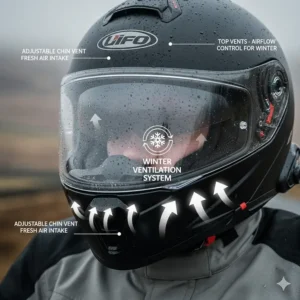
Contrary to intuition, effective winter helmets don’t eliminate ventilation—they make it controllable. Premium models feature variable vent systems with positive shut-off mechanisms that completely seal when temperatures drop below 5°C, preventing wind-chill from penetrating the helmet interior.
When temperatures rise or during physical exertion, these same vents open to release excess heat and moisture. The key lies in having intuitive controls that operate easily with winter gloves, allowing you to adjust airflow without removing your helmet or compromising safety.
Dual-Pane Visor Systems: The Technology Behind Fog-Free Vision
Perhaps the most revolutionary advancement in anti-fog helmets for winter riding comes from dual-pane visor systems that borrow technology from home double-glazing. Understanding how these systems work helps appreciate why they’ve become essential equipment for serious winter riders.
The Physics of Pinlock Technology
When your warm, moist breath contacts a cold visor surface, condensation forms instantly—the same principle that creates frost on windows. Pinlock technology solves this through dual mechanisms: a moisture-absorbing hydrophilic surface and an airtight silicone seal that creates an insulating air pocket between the insert and your helmet’s outer visor.
The Pinlock insert itself is engineered from a material that actively absorbs water molecules in humid conditions. During drier periods, stored moisture evaporates from the insert, resetting its absorption capacity. This self-regulating system provides consistent fog resistance across varying conditions—exactly what British winter weather demands.
Pinlock Performance Levels Explained
Pinlock manufactures three performance grades, each suited to different riding intensities:
Pinlock 30 offers basic anti-fog protection suitable for short urban commutes where you’re rarely exposed to temperature extremes for extended periods. It’s the entry-level option often included with budget-conscious helmets.
Pinlock 70 represents the sweet spot for most UK riders. This mid-tier insert handles typical winter commuting, weekend rides, and moderate touring. The moisture absorption capacity suffices for rides up to three hours in cold, damp conditions.
Pinlock 120 XLT delivers professional-grade performance used in MotoGP and Formula 1. If you’re riding multiple hours daily through harsh winter conditions, the 120’s superior absorption and wider viewing area justify the premium cost.
Breath Box Technology Integration
Sophisticated winter helmets combine Pinlock systems with breath box technology—a chin-mounted deflector that redirects exhaled air downward and away from your visor. The Scorpion EXO-AT950 SD exemplifies this approach, using a specially designed breath box that creates a microclimate inside the helmet where warm air circulates without directly contacting the visor.
This complementary system proves particularly effective during stop-start urban riding where you’re generating significant breath moisture but not enough forward motion to flush it away through ventilation. British riders tackling London’s congested streets report this combination virtually eliminates the need to crack visors open at traffic lights.
Essential Winter Helmet Features Beyond Anti-Fog
Whilst fog prevention dominates winter helmet discussions, several other features significantly impact your cold-weather riding experience and safety.
Neck Seals and Chin Curtains
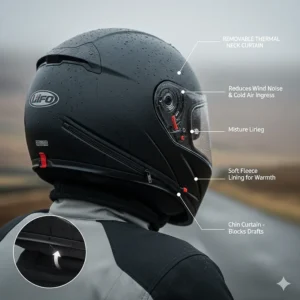
A well-designed neck seal acts as your helmet’s first line of defence against cold air infiltration. Quality helmets like the Shoei Neotec II incorporate sculpted neck rolls that conform to your collar, creating an airtight barrier that prevents wind from rushing up inside the helmet—a phenomenon that rapidly cools your head and creates uncomfortable drafts.
Removable chin curtains complement neck seals by blocking air entering from below. During severe cold snaps, both working together maintain a stable thermal environment. However, on milder winter days, removing the chin curtain improves ventilation without compromising overall warmth.
Emergency Quick-Release Systems
Winter riding introduces specific crash scenarios where rapid helmet removal becomes critical—hypothermia risk, for instance. Modern safety-conscious designs incorporate emergency quick-release cheek pads that allow first responders to extract an injured rider without rotating their head, potentially preventing secondary spinal injuries.
The HJC RPHA 11’s Emergency Kit represents this feature excellently, with clearly marked red tabs that emergency personnel can identify and operate instantly. Given that UK government data shows motorcyclists suffer disproportionately severe injuries, these thoughtful safety features could prove life-saving.
Reflective Elements and Visibility
British winter means riding in darkness—your morning and evening commutes occur in dim light where visibility becomes paramount. Helmets optimised for winter increasingly incorporate reflective striping or high-visibility colour schemes that dramatically improve your conspicuity to other road users.
Consider supplementing your helmet with reflective stickers, particularly on the rear and sides where vehicle headlights will catch them. Transport for London research demonstrates that motorcyclists with enhanced reflectivity experience 37% fewer close-call incidents during winter months.
Choosing the Right Winter Helmet for Your Riding Style
Not all winter riding is created equal—a London courier faces vastly different challenges than a Scottish Highlands tourer. Matching your helmet to your specific winter riding pattern ensures optimal performance and value.
Urban Commuters and City Riders
If you’re navigating congested urban environments with frequent stops, prioritise a modular helmet like the Caberg Levante or Shoei Neotec II. The flip-up chinbar functionality allows you to communicate easily at drive-throughs or security gates without fully removing your helmet—invaluable when you’re wearing multiple layers of cold-weather gear.
Bluetooth integration deserves serious consideration for urban riders. Modern communication systems let you receive navigation prompts, answer calls, and even stream music—all crucial for maintaining concentration during monotonous winter commutes where numbing cold can dull your awareness.
Long-Distance Tourers
Winter touring demands helmets that excel at noise reduction and all-day comfort. The Shoei GT-Air II and HJC RPHA 11 both shine here, offering superior acoustic insulation that reduces wind roar to manageable levels. Excessive noise causes fatigue that manifests as reduced reaction times—particularly dangerous on winter roads where grip is compromised.
Look for helmets with comprehensive padding adjustment systems. Your head shape changes subtly throughout a day’s riding as padding compresses and blood flow varies. Premium touring helmets include interchangeable cheek pads and crown padding that let you dial in perfect fit.
Adventure and Off-Road Riders
Adventure riders need versatility—the Scorpion EXO-AT950 exemplifies this category brilliantly. The removable peak visor transforms it from an off-road lid to a sleek touring helmet, whilst the oversized eye port accommodates goggles for serious dirt work. The dual-pane visor technology proves equally effective whether you’re tackling muddy trails or motorway miles.
Consider weight carefully if you’re adventure riding. A helmet that feels fine for an hour’s road ride becomes neck-achingly heavy after five hours of standing on footpegs. The LS2 FF805’s carbon construction keeps weight under 1,300g without sacrificing protection—a sweet spot for dual-sport winter warriors.
Maintaining Your Winter Helmet for Peak Performance
Even the most advanced cold weather touring helmets require proper maintenance to deliver consistent performance throughout multiple winter seasons. Regular care extends your helmet’s lifespan whilst ensuring critical safety features remain effective.
Cleaning and Storage Between Rides
Winter riding exposes your helmet to road salt, grit, and corrosive moisture—a combination that degrades materials faster than summer dust. After each ride, gently rinse your helmet with lukewarm water to remove salt deposits, paying particular attention to vents and shield mechanisms where salt crystals accumulate.
Never wipe a dirty Pinlock insert—doing so scratches the delicate surface and reduces its effectiveness. Instead, remove the insert and rinse it under running water, then air-dry completely before reinstalling. Quality Pinlock inserts last 2-3 years with proper care, but winter’s harsh conditions accelerate wear.
Store your helmet in a temperature-stable environment away from direct heating sources. Rapid temperature cycling causes the EPS liner to become brittle, potentially compromising its impact-absorption capabilities. A hallway closet or bedroom wardrobe maintains more consistent conditions than a garage or shed.
Shield and Pinlock Replacement Schedule
Replace your Pinlock insert annually if you ride year-round, or every two years for seasonal riders. Even with careful maintenance, the hydrophilic material gradually loses its moisture-absorption capacity. New inserts cost £20-40—a small investment compared to the safety risk of riding with fogged vision.
Inspect your helmet shield quarterly for scratches or crazing. Winter debris—gravel, salt, ice crystals—causes more shield damage than summer riding. Scratched shields create dangerous light refraction during night riding, especially problematic when facing oncoming headlights on wet roads.
Frequently Asked Questions
❓ What makes a helmet specifically suitable for winter riding in the UK?
❓ How effective is Pinlock technology in preventing visor fogging?
❓ Can I add Pinlock anti-fog capability to my existing helmet?
❓ What's the difference between modular and full-face helmets for winter riding?
❓ How often should I replace my motorcycle helmet, especially with winter use?
Conclusion: Investing in Winter Safety and Comfort
Choosing the right motorcycle helmets for winter represents one of the most important safety decisions you’ll make as a UK rider. The difference between arriving at your destination safely versus becoming another winter casualty statistic often hinges on whether you can maintain clear vision and concentration throughout your journey.
The seven helmets reviewed here represent the cream of current technology, each excelling in specific winter scenarios. Budget-conscious riders will find exceptional value in the AGV K3 SV, whilst those prioritising ultimate protection and comfort should seriously consider the Shoei Neotec II or GT-Air II despite their premium pricing. Adventure riders and dual-sport enthusiasts can’t go wrong with the purpose-built Scorpion EXO-AT950 SD that handles everything British winters throw at it.
Remember that your helmet is just one component of comprehensive winter riding preparation. Combine it with proper thermal clothing, heated grips or gloves, and rigorous motorcycle maintenance. Always monitor weather forecasts before riding, avoid unnecessary journeys during severe weather warnings, and never underestimate how quickly hypothermia can impair your judgement.
British motorcyclists are a hardy breed—we ride when others sensibly opt for four wheels. With the right equipment, knowledge, and respect for winter’s challenges, there’s no reason you can’t continue enjoying two-wheeled freedom year-round. Choose your winter helmet wisely, maintain it diligently, and ride safely through whatever our famously unpredictable weather brings.
Stay warm, stay visible, and most importantly, stay safe on Britain’s winter roads. The adventure continues, regardless of what the thermometer reads.
Recommended for You
- 7 Best Waterproof Motorcycle Helmets for Touring 2026 UK
- 7 Best Motorcycle Helmets for Women UK 2026
- 7 Best Lightweight Racing Helmets Under £300 UK – 2026 Expert Guide
Disclaimer: This article contains affiliate links. If you purchase products through these links, we may earn a small commission at no additional cost to you. Prices shown are approximate and may vary.
✨ Found this helpful? Share it with your mates! 💬🤗
