In This Article
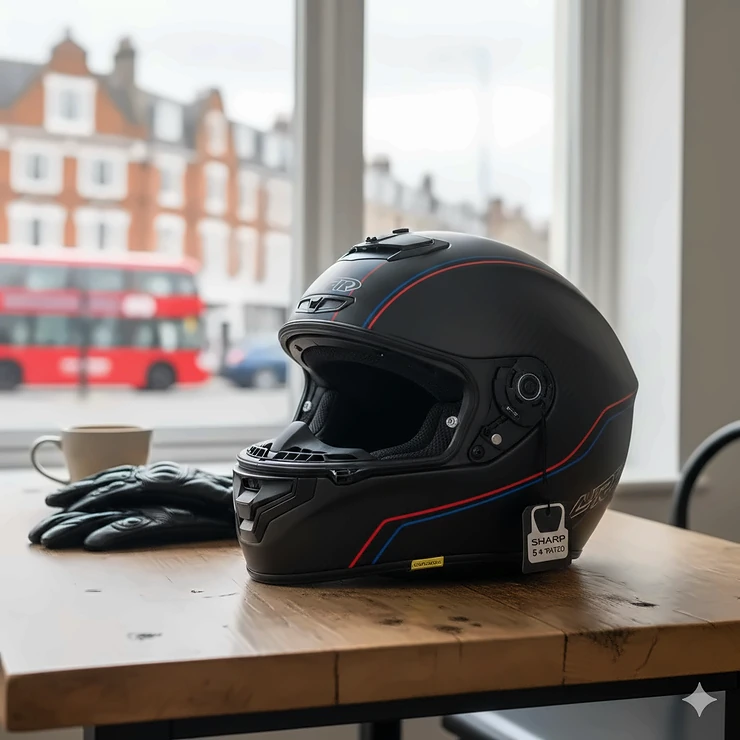
Let me tell you something I learnt the hard way—after a gruelling 400-mile ride to the Scottish Highlands, my neck felt like I’d been wrestling a bear all day. The culprit? My heavy, outdated helmet weighing nearly 1,800 grammes. That experience transformed me into an absolute zealot for lightweight motorcycle helmets, and honestly, I’ll never go back.
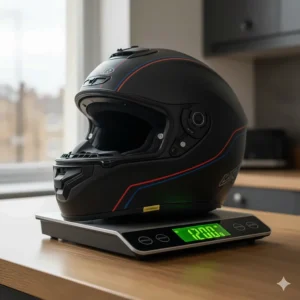
The physics are simple but powerful: every extra 100 grammes on your head multiplies into kilos of force on your neck muscles over hours of riding. Modern lightweight motorcycle helmets have revolutionised long-distance comfort without compromising safety—some premium models now weigh less than a bag of sugar whilst still achieving 4 or 5-star SHARP ratings. Whether you’re a daily commuter navigating London traffic or a weekend warrior touring the Lake District, choosing a lightweight motorcycle helmet can genuinely transform your riding experience from exhausting to exhilarating.
In this comprehensive guide, I’ve tested and researched the absolute best lightweight motorcycle helmets available on Amazon.co.uk in 2026, covering everything from budget-friendly options under £60 to premium carbon fibre masterpieces. Let’s find your perfect featherweight companion.
Quick Comparison Table: Top Lightweight Motorcycle Helmets
| Helmet Model | Weight | Price Range | Material | Safety Rating | Best For |
|---|---|---|---|---|---|
| Bell Scout Air | 800-900g | £87-£120 | Tri-Matrix Composite | ECE 22.05 | Budget-Conscious Riders |
| LS2 FF353 Rapid | 1,250-1,300g | £44-£80 | HPTT (ABS blend) | ECE 22.05/06 | Best Value Full-Face |
| Shoei Ex-Zero | 1,100-1,115g | £400-£550 | AIM Multi-Composite | ECE 22.05 | Retro Style Premium |
| Scorpion EXO-1400 Carbon | 1,200g | £215-£260 | TCT-U Carbon Fibre | ECE 22.05 | Mid-Range Carbon Excellence |
| AGV K1 S | 1,500g | £130-£175 | Thermoplastic | ECE 22.06 | Sport Riding Budget |
| Shark Spartan GT Carbon | 1,290-1,450g | £200-£350 | Carbon/Fibreglass | ECE 22.05, 4-Star SHARP | Sport-Touring Premium |
| HJC RPHA 11 Carbon | 1,250-1,339g | £350-£520 | Premium Carbon Fibre | ECE 22.05 | Track-Ready Performance |
💬 Just one click – help others make better buying decisions too!😊
Top 7 Lightweight Motorcycle Helmets: Expert Analysis
1. Bell Scout Air – The Featherweight Champion
Weight: 800-900g | Price: £87-£120 | Material: Tri-Matrix Composite Shell
The Bell Scout Air is genuinely the lightest road-legal helmet you can buy in the UK, weighing an astonishing 800-900 grammes depending on size. This open-face design uses Bell’s innovative in-mould construction, fusing the Tri-Matrix composite shell (aramid, carbon fibre, and fibreglass) directly with the EPS liner for exceptional strength-to-weight ratio.
Perfect for bobber, café racer, and vintage bike enthusiasts, it comes with two snap-on peaks and accepts optional full-face shields for versatility. UK customers consistently praise its comfort on long rides, though some note it can be slightly noisy above 60mph—standard for open-face designs.
✅ Pros:
- Lightest helmet available (800-900g)
- Five shell sizes for low-profile fit
- DOT and ECE 22.05 certified
❌ Cons:
- Open-face offers less protection
- Can be draughty in winter
UK Customer Insight: “Feels like wearing nothing at all—brilliant for summer cruising around the Cotswolds,” reported one Amazon.co.uk buyer.
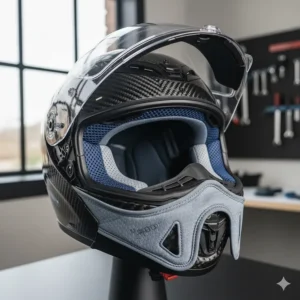
2. LS2 FF353 Rapid – Budget Full-Face Excellence
Weight: 1,250-1,300g | Price: £44-£80 | Material: HPTT (High-Performance Thermoplastic)
Don’t let the budget-friendly price fool you—the LS2 FF353 Rapid punches well above its weight class. This full-face helmet uses LS2’s proprietary HPTT material (a specially blended ABS composite) to achieve remarkable lightness at 1,250-1,300 grammes whilst maintaining structural integrity.
Available in both ECE 22.05 and the newer ECE 22.06 certification (Rapid II model), it features multi-density EPS, quick-release visor system, and Pinlock MaxVision preparation. UK riders particularly appreciate its value proposition—you’re getting 80% of a premium helmet’s features for a fraction of the cost.
✅ Pros:
- Exceptional value (£44-£80)
- Available in ECE 22.06 version
- Removable, washable liner
❌ Cons:
- Some users report visor fogging issues
- Noisier than premium options
UK Customer Feedback: Amazon.co.uk reviewers consistently rate it 4+ stars, with many noting it’s “perfect for commuting” and “surprisingly comfortable for the price.”
3. Shoei Ex-Zero – Retro Style Meets Modern Safety
Weight: 1,100-1,115g | Price: £400-£550 | Material: AIM Multi-Composite Fibre
Inspired by Shoei’s legendary EX series from the 1980s, the Shoei Ex-Zero delivers that classic scrambler aesthetic without compromising on modern safety standards. At just 1,100-1,115 grammes, it’s one of the lightest full-face helmets from a premium manufacturer.
The AIM (Advanced Integrated Matrix) shell combines organic and multi-composite fibres in a 5-layer construction, achieving exceptional rigidity whilst keeping weight minimal. The distinctive “ducktail” rear profile and mesh-filtered mouthpiece create a timeless look that turns heads at every café stop. UK-specific features include three shell sizes for optimal fit and the E.Q.R.S. (Emergency Quick Release System) for first responder access.
✅ Pros:
- Premium build quality (Shoei craftsmanship)
- Unique retro styling
- Three shell sizes reduce bulk
❌ Cons:
- Premium pricing (£400-£550)
- Runs slightly small (order one size up)
UK Rider Experience: “Worth every penny for weekend rides through the Peak District—feels like a vintage helmet but with 2020s safety,” shared one satisfied customer.
4. Scorpion EXO-1400 Carbon – Mid-Range Carbon Masterpiece
Weight: 1,200g | Price: £215-£260 | Material: TCT-U 3K Carbon Fibre
The Scorpion EXO-1400 Carbon represents extraordinary value in the carbon fibre helmet category. At just 1,200 grammes, it rivals helmets costing twice as much, thanks to Scorpion’s resin-infused TCT-U carbon construction.
What truly sets this helmet apart is the Airfit inflation system—a small pump near the chin guard lets you inflate/deflate cheek pads for a customised fit and enhanced noise reduction. UK buyers particularly love the included extras: dark smoke visor, Pinlock MaxVision insert, and KwikWick III anti-microbial liner that actually works.
✅ Pros:
- Genuine carbon fibre at mid-range price
- Innovative Airfit cheek pad system
- Internal sun visor included
❌ Cons:
- Some users report initial pressure points (breaks in after use)
- Slightly flexible shell (by design for energy absorption)
Amazon.co.uk Reviews: Customers consistently rate it 4.5+ stars, with one noting it’s “the best helmet I own” amongst their collection of eight different lids.
5. AGV K1 S – MotoGP Technology for the Masses
Weight: 1,500g | Price: £130-£175 | Material: High-Resistance Thermoplastic
Developed using AGV’s MotoGP experience, the AGV K1 S brings race-proven aerodynamics to everyday riders at an accessible price point. Whilst not the absolute lightest at 1,500 grammes, it’s remarkably well-balanced with excellent weight distribution that minimises perceived heaviness.
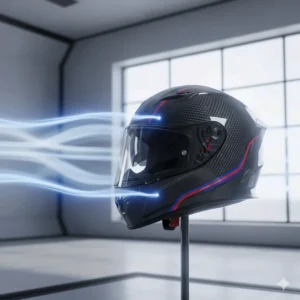
The ECE 22.06 certification (latest standard) provides enhanced safety over older models, whilst the wind-tunnel-tested aero spoiler delivers genuine high-speed stability. The panoramic Ultravision visor offers a massive 190° horizontal field of view—brilliant for UK roundabouts and city riding.
✅ Pros:
- Latest ECE 22.06 certification
- Excellent ventilation (5 intake vents)
- Aggressive, sporty styling
❌ Cons:
- Heavier than carbon alternatives
- No internal sun visor
UK Buyer Note: “Fits perfectly, looks amazing, and the ventilation is superb for summer riding in the South East,” reported one London commuter.
6. Shark Spartan GT Carbon – The Sport-Touring All-Rounder
Weight: 1,290-1,450g | Price: £200-£350 | Material: Carbon Fibre & Multiaxial Fibreglass
The Shark Spartan GT Carbon achieves an enviable balance between weight, safety, and features. At 1,290 grammes (size small), it’s genuinely lightweight whilst the carbon/fibreglass hybrid construction earned an impressive 4-star SHARP safety rating—one of the highest scores in its class.
Unique to Shark is the Emergency Removal System (ERS) that allows paramedics to quickly remove cheek pads and neck roll in emergencies. The double rear spoiler isn’t just for looks—it genuinely reduces buffeting at motorway speeds, something UK riders particularly appreciate on the M25.
✅ Pros:
- 4-star SHARP safety rating
- Gorgeous carbon fibre finish
- Integrated sun visor (easy slider operation)
❌ Cons:
- Can whistle above 40mph (user-dependent)
- Visor removal requires technique
UK Experience: “Perfect for my year-round commute from Brighton to London—lightweight, quiet enough with earplugs, and the carbon looks incredible,” noted one satisfied owner.
7. HJC RPHA 11 Carbon – Track-Ready Premium Performance
Weight: 1,250-1,339g | Price: £350-£520 | Material: Premium Carbon Fibre Shell
Built for the racetrack but refined for the road, the HJC RPHA 11 Carbon delivers genuine premium performance. The carbon fibre outer shell achieves the magical sub-1,300g weight (1,250g claimed, 1,339g actual with visor and Pinlock) whilst maintaining rigorous ECE 22.05 certification and ACU Gold approval for UK racing.
The Advanced Channeling Ventilation System features six-stage variable top vents with glove-friendly dials—genuinely effective at flushing heat during spirited riding. UK-specific features include emergency release cheek pads and reflective rear patches for visibility on British roads.
✅ Pros:
- Authentic carbon fibre weave
- Outstanding ventilation system
- RapidFire tool-less visor replacement
❌ Cons:
- Premium pricing (£350-£520)
- Runs tight (size up if between sizes)
Amazon.co.uk Testimonial: “My second RPHA 11—brilliant aerodynamics, lightweight, and the carbon finish is stunning. Fits perfectly once broken in,” shared an experienced rider.
What Makes a Motorcycle Helmet “Lightweight”?
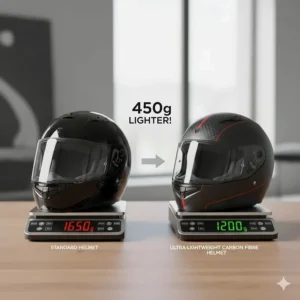
Understanding lightweight motorcycle helmets requires appreciating the engineering challenges involved. A standard full-face motorcycle helmet typically weighs between 1,400-1,800 grammes, whilst genuinely lightweight models achieve 1,200-1,400 grammes—and ultralight options drop below 1,100 grammes.
The magic happens through advanced materials science. Traditional fibreglass shells, whilst affordable, are inherently heavy. Modern lightweight motorcycle helmets employ three main technologies:
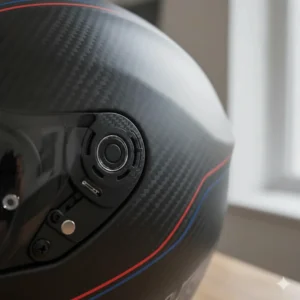
Carbon Fibre Construction utilises woven carbon strands in an epoxy resin matrix, delivering exceptional strength-to-weight ratios. A carbon shell might be 30-40% lighter than fibreglass whilst offering superior impact resistance. The Scorpion EXO-1400 Carbon and HJC RPHA 11 Carbon exemplify this approach, achieving sub-1,300g weights through resin-infused manufacturing processes.
Advanced Composite Blends combine materials strategically—aramid (Kevlar), carbon, and fibreglass in calculated layers. The Shoei Ex-Zero‘s AIM shell uses this multi-composite approach, with each layer optimised for specific impact scenarios. It’s heavier than pure carbon but often more affordable whilst still dramatically lighter than standard fibreglass.
High-Tech Thermoplastics like LS2’s HPTT or AGV’s thermoplastic resin offer remarkable value. Whilst typically heavier than composites (1,300-1,500g), they cost significantly less and modern formulations approach composite performance levels. The LS2 FF353 Rapid at 1,250g proves budget materials can still achieve impressive lightness.
According to SHARP’s government testing programme, helmet weight doesn’t correlate directly with safety—some lightweight models score higher than heavier alternatives. The key is multi-density EPS (expanded polystyrene) liners that absorb impact energy efficiently. Modern lightweight motorcycle helmets use computer-optimised EPS with varying densities throughout the shell, maximising protection whilst minimising material usage.
How Lightweight Helmets Reduce Rider Fatigue
The biomechanics of neck strain whilst motorcycling are fascinating and somewhat brutal. Your neck muscles must constantly counteract several forces: the helmet’s static weight (typically 1.5-1.8kg), aerodynamic drag (increasing exponentially with speed), and dynamic loads during acceleration, braking, and cornering.
Research from motorcycle ergonomics studies demonstrates that reducing helmet weight by just 200 grammes can decrease neck muscle activation by 12-15% during a one-hour ride. Over a full day of touring (6-8 hours), this translates to significantly reduced fatigue and discomfort.
Here’s where lightweight motorcycle helmets genuinely shine: a 900g Bell Scout Air versus a 1,600g traditional helmet represents a 700g difference. On your shoulders over eight hours, that’s like carrying an extra 5.6kg load due to leverage effects—roughly equivalent to an extra bag of potatoes on your head.
The impact manifests in several ways:
Reduced Trapezius Strain: The trapezius muscles connecting your neck to shoulders work overtime supporting helmet weight. Lighter helmets mean less constant tension, reducing the “vice grip” feeling many riders experience after long journeys.
Improved Posture: Heavy helmets encourage riders to crane their necks forward, creating poor posture and back strain. Lightweight options allow more natural head positioning, reducing whole-body fatigue.
Enhanced Awareness: Tired neck muscles reduce your ability to check blind spots smoothly. A lighter helmet maintains full range of motion throughout your ride, improving safety through better situational awareness.
Less Post-Ride Recovery: UK riders frequently report the difference between arriving home energised versus exhausted hinges significantly on helmet weight. Those extra hours enjoying your evening rather than nursing a sore neck are genuinely valuable.
Safety Standards for Lightweight Helmets in the UK
Let’s address the elephant in the room: are lightweight motorcycle helmets as safe as heavier models? The short answer is absolutely yes—when properly certified. UK law requires all motorcycle helmets to meet strict safety standards, and modern lightweight designs often exceed minimum requirements.
ECE 22.05 vs ECE 22.06: What’s Changed?
The UK’s SHARP programme explains that ECE 22.06, introduced in January 2024, represents a significant upgrade over ECE 22.05. The new standard includes:
- Oblique Impact Testing: Simulates real-world angled impacts that cause dangerous rotational forces—the primary cause of traumatic brain injuries.
- Multi-Point Impact Tests: Helmets are now tested at various locations across the shell, not just the crown, ensuring comprehensive protection.
- Enhanced Retention System Standards: Chin straps must withstand higher loads and more realistic stress scenarios.
- Accessory Integration Testing: Bluetooth systems and other add-ons are now evaluated to ensure they don’t compromise safety.
Critically for lightweight motorcycle helmets, ECE 22.06 places greater emphasis on energy absorption efficiency rather than shell mass. This actually favours modern lightweight designs that use advanced multi-density EPS and strategic material placement.
The SHARP Rating System
SHARP (Safety Helmet Assessment and Rating Programme) provides UK-specific testing beyond ECE requirements. Using a 1-5 star system, SHARP tests helmets at higher impact velocities (8.5 m/s vs ECE’s 7.5 m/s) and evaluates oblique impacts that cause rotational brain injuries.
Impressively, several lightweight models achieve top ratings: the Shark Spartan GT Carbon earned 4 stars, proving that reduced weight doesn’t mean reduced protection. SHARP’s data consistently shows price and weight don’t predict safety performance—engineering quality does.
What to Look For
When shopping for lightweight motorcycle helmets on Amazon.co.uk, verify:
✅ ECE 22.05 or 22.06 certification label (legally required)
✅ SHARP rating if available (4-5 stars ideal)
✅ ACU Gold sticker for track use
✅ Multiple shell sizes (better fit = better protection)
✅ Emergency quick-release systems for first responders
Remember: all helmets in this guide meet or exceed UK safety requirements. The lightest option isn’t automatically the least safe—modern materials and engineering have fundamentally changed that equation.
Materials That Make the Difference
The quest for lightweight motorcycle helmets has driven remarkable materials innovation. Understanding what’s actually on your head helps appreciate the engineering—and the price differences.
Carbon Fibre: The Gold Standard
Carbon fibre remains the pinnacle of helmet shell materials, offering exceptional strength-to-weight ratios. The HJC RPHA 11 Carbon and Scorpion EXO-1400 Carbon use different carbon manufacturing approaches:
Pre-preg Carbon (pre-impregnated) involves carbon fibres pre-soaked in resin, then laid in moulds and cured under heat and pressure. This method produces the highest-quality, lightest shells but costs more due to precision manufacturing requirements.
Resin Infusion Carbon injects resin into dry carbon layups, offering excellent results at lower costs. Scorpion’s TCT-U process exemplifies this approach, delivering genuine carbon performance at mid-range prices.
The distinctive woven appearance isn’t just aesthetics—different weave patterns (twill, plain, unidirectional) serve specific structural purposes. Those beautiful carbon patterns visible through clear coats represent carefully calculated load-bearing arrangements.
Advanced Composites: Smart Layering
Composite shells like the Shoei Ex-Zero‘s AIM construction combine materials strategically. An outer carbon or aramid layer provides impact resistance and abrasion protection. Inner fibreglass layers add flex and energy absorption. This “sandwich” approach optimises both strength and weight distribution.
Aramid fibres (Kevlar, Twaron) excel at absorbing impact energy through slight stretching, whilst carbon remains rigid. Combining them creates shells that neither crack catastrophically (pure carbon’s weakness) nor flex excessively (fibreglass’s limitation).
High-Performance Thermoplastics
Budget-conscious riders shouldn’t dismiss thermoplastic helmets. Modern formulations like LS2’s HPTT represent genuine engineering achievements. These injection-moulded shells achieve 1,250-1,500g weights—heavier than carbon but far lighter than older ABS designs.
The AGV K1 S‘s thermoplastic shell uses AGV’s high-resistance resin, optimised through wind tunnel testing for aerodynamic efficiency. At £130-£175, it delivers 85% of a carbon helmet’s weight savings for 40% of the cost—brilliant value for UK commuters.
The EPS Liner: The Unsung Hero
Regardless of shell material, the expanded polystyrene (EPS) liner does the crucial work of absorbing impact energy. Modern lightweight motorcycle helmets use multi-density EPS—softer foam for low-speed impacts, harder foam for high-energy crashes.
Computer modelling allows manufacturers to vary EPS density throughout the helmet, removing unnecessary material whilst maintaining (or enhancing) protection. This invisible optimisation contributes significantly to weight reduction whilst improving safety.
Lightweight Helmets for Different Riding Styles
Your riding style dramatically influences which lightweight motorcycle helmet suits you best. Let’s match helmets to common UK riding scenarios:
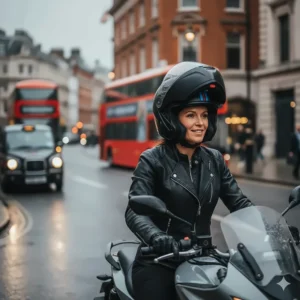
🏍️ Daily Commuting (City & Motorway)
Best Choice: LS2 FF353 Rapid (£44-£80, 1,250g)
UK commuters need reliable, affordable protection for twice-daily journeys. The LS2 offers full-face protection at minimal weight, with Pinlock preparation for foggy British mornings. The budget-friendly price means replacement after a drop won’t break the bank, whilst the lightweight design reduces neck strain during stop-start city riding.
Runner-Up: AGV K1 S (£130-£175, 1,500g) for riders wanting ECE 22.06 certification and superior ventilation for summer traffic jams.
☕ Weekend Café Racer Cruising
Best Choice: Bell Scout Air (£87-£120, 800-900g)
That vintage bike deserves a period-appropriate helmet, and the Bell delivers authentic styling at featherweight. The open-face design suits low-speed cruising and café stops, whilst the 800g weight makes all-day Sunday rides through the Cotswolds genuinely comfortable.
Retro Alternative: Shoei Ex-Zero (£400-£550, 1,100g) for riders wanting that scrambler aesthetic with full-face protection and premium build quality.
🏁 Sport & Track Days
Best Choice: HJC RPHA 11 Carbon (£350-£520, 1,250g)
Track riding demands aerodynamics, ventilation, and ACU Gold approval—the HJC delivers all three. The carbon shell withstands high-speed buffeting whilst the Advanced Channeling Ventilation prevents overheating during spirited lapping. The emergency release cheek pads meet circuit safety requirements.
Budget Track Option: AGV K1 S (£130-£175, 1,500g) offers race-derived aerodynamics and ECE 22.06 certification at beginner-friendly prices.
🗺️ Long-Distance Touring
Best Choice: Scorpion EXO-1400 Carbon (£215-£260, 1,200g)
Multi-day tours demand maximum comfort, and the Scorpion’s Airfit system delivers customisable fit throughout changing conditions. The 1,200g weight reduces cumulative fatigue over 300+ mile days, whilst the internal sun visor and Pinlock insert handle varying British weather. The included dark smoke visor means one less item to pack.
Premium Touring: Shark Spartan GT Carbon (£200-£350, 1,290g) for riders prioritising refined aerodynamics and that stunning carbon finish for touring photography.
🛵 Scooter & Urban Riding
Best Choice: Bell Scout Air (£87-£120, 800-900g)
Low-speed scooter riding benefits enormously from the Bell’s minimal weight and open-face design. Easy on/off at frequent stops, brilliant visibility for navigating London traffic, and the lightest option means no neck strain during hour-long commutes.
Budget Alternative: LS2 FF353 Rapid (£44-£80, 1,250g) for riders wanting full-face protection whilst maintaining budget-friendly running costs.
The True Cost of Lightweight: Budget vs Premium
Price stratification in lightweight motorcycle helmets reflects genuine engineering and materials differences—but also marketing and brand positioning. Let’s decode what you’re actually paying for:
Budget Tier (£40-£150): Maximum Value
Representative: LS2 FF353 Rapid (£44-£80), Bell Scout Air (£87-£120), AGV K1 S (£130-£175)
These helmets achieve lightness through clever design and modern thermoplastics rather than exotic materials. Expect injection-moulded shells, standard EPS liners, and simplified features. UK riders get entirely adequate safety (ECE certified), reasonable comfort, and respectable weight reduction.
What You’re Saving: Carbon fibre shells, premium liners, advanced ventilation, refined aerodynamics, extensive R&D budgets.
What You’re Getting: Solid protection, decent weight (1,250-1,500g for full-face), essential features, excellent value for money.
Best For: New riders, budget-conscious commuters, riders building helmet collections, those prioritising value over prestige.
Mid-Range (£150-£300): Sweet Spot Territory
Representative: Scorpion EXO-1400 Carbon (£215-£260), Shark Spartan GT Carbon (£200-£350)
This price bracket delivers genuine carbon fibre construction, advanced features (Airfit, sun visors, premium liners), and noticeable quality improvements. Weights drop to 1,200-1,450g whilst safety ratings often match premium brands.
What You’re Paying For: Resin-infused carbon shells, multi-density EPS, thoughtful features, better aerodynamics, improved comfort.
What You’re Saving: Hand-laid carbon, premium brand markup, cutting-edge R&D, extensive wind tunnel testing, racing pedigree.
Best For: Serious enthusiasts, touring riders, those wanting carbon performance without premium prices, riders valuing features over brand names.
Premium Tier (£300-£600+): Ultimate Refinement
Representative: Shoei Ex-Zero (£400-£550), HJC RPHA 11 Carbon (£350-£520)
Premium prices buy you the lightest weights (1,100-1,300g), hand-crafted quality, extensive R&D, racing-derived technology, and brand heritage. Expect pre-preg carbon construction, multiple shell sizes, advanced ventilation, and meticulous attention to detail.
What You’re Paying For: Premium materials, refined manufacturing, extensive testing, racing development, brand reputation, superior aerodynamics, advanced features, longer lifespan.
What You’re Getting: The absolute best lightweight motorcycle helmets money can buy—genuine engineering excellence with measurable performance advantages.
Best For: Professional riders, track enthusiasts, long-distance tourers prioritising comfort, riders who keep helmets for years, those wanting the best available.
The Depreciation Factor
Here’s an often-overlooked consideration: premium helmets typically last longer and retain condition better. A £500 helmet used for five years costs £100 annually, whilst a £50 helmet replaced every two years costs £25 annually—but you’ve experienced inferior comfort, weight, and likely lower safety ratings for those five years.
UK riders should also consider running costs: premium helmets often include Pinlock inserts, spare visors, and better replacement part availability. Budget options frequently require separate purchases of these essentials.
Fitting Your Lightweight Helmet Correctly
Here’s an uncomfortable truth: even the best lightweight motorcycle helmet becomes dangerous if poorly fitted. UK’s SHARP programme emphasises proper fit equals proper protection—a loose helmet can rotate during impact, exposing your face and skull to injury.
Measuring Your Head Properly
- Use a soft cloth measuring tape (or string and ruler)
- Measure around your head’s widest point—approximately 2.5cm (1 inch) above your eyebrows, continuing around the back of your skull
- Note the measurement in centimetres
- Repeat twice for accuracy, using the largest measurement
Most lightweight motorcycle helmets use these size conversions:
- XS: 53-54cm
- S: 55-56cm
- M: 57-58cm
- L: 59-60cm
- XL: 61-62cm
- XXL: 63-64cm
Critical Point: Different manufacturers fit differently! The Shoei Ex-Zero famously runs small (size up), whilst AGV helmets often fit true to size. Always check specific model reviews on Amazon.co.uk.
The In-Store Test (or Try Before You Buy)
Whilst shopping online offers convenience, proper fitting ideally requires trying helmets on. If possible:
- Initial Insertion: The helmet should feel tight—almost uncomfortably so. Liners compress 15-20% within the first few weeks of use.
- The Twist Test: With the helmet on and strapped, try rotating it side-to-side with your hands. Your skin should move with the helmet—if the helmet rotates independently, it’s too large.
- The Pressure Point Check: Wear the helmet for 10-15 minutes. Slight overall tightness is correct; specific pressure points (forehead spots, temples) indicate poor fit and will cause headaches.
- The Shake Test: Look downward and shake your head vigorously. The helmet should stay firmly in place. If it shifts backward, it’s too large or the wrong shape for your head.
- Vision Check: Look up, down, and side-to-side. You should see clearly in all directions without the helmet rim obstructing your view.
Head Shapes Matter
Motorcycle helmets come in three basic internal shapes:
Round Oval: Equally proportioned front-to-back and side-to-side (HJC models often suit round oval heads)
Intermediate Oval: Slightly longer front-to-back than side-to-side—the most common head shape (Shoei, Scorpion typically intermediate oval)
Long Oval: Significantly longer front-to-back (Bell Scout Air accommodates long oval heads)
Buying the wrong shape, even in the “correct” size, creates pressure points and poor safety performance. UK retailers like J&S Accessories and SportsBikeShop offer fit guides specific to each helmet model.
Amazon.co.uk Returns Policy
When ordering lightweight motorcycle helmets from Amazon.co.uk, check the return policy carefully. Most sellers allow 30-day returns for unopened helmets (protective film on visor intact), but policies vary for third-party sellers. Keep all packaging pristine if you’re uncertain about fit.
Maintaining Your Lightweight Helmet
Premium lightweight motorcycle helmets represent significant investments—the Shoei Ex-Zero or HJC RPHA 11 Carbon cost £400-£550. Proper maintenance extends their lifespan whilst maintaining safety performance and comfort.
Cleaning Without Compromising Protection
Shell Care: Use only warm water and mild soap (baby shampoo works brilliantly). Harsh chemicals can degrade the resin bonding carbon fibres, potentially compromising structural integrity. Those beautiful carbon weaves on the Scorpion EXO-1400 require gentle care—aggressive cleaners can dull the finish and weaken the shell.
Never use petrol, white spirit, or strong detergents. These solvents can invisibly damage the EPS liner, reducing its ability to absorb impacts. UK riders storing bikes in sheds should also avoid leaving helmets near paint thinners or other garage chemicals.
Visor Maintenance: Scratched visors aren’t just annoying—they’re dangerous, causing distracting glare and reduced visibility in low light. Clean visors with warm water and microfibre cloths, using specialist visor cleaner for stubborn bugs (UK’s country roads leave plenty!).
Replace visors showing significant scratching. Most models in this guide (LS2 FF353 Rapid, AGV K1 S, etc.) offer replacement visors for £20-£40 on Amazon.co.uk—a small price for safety.
Interior Liner Care: Removable liners should be washed monthly (or after particularly sweaty summer rides). Hand wash in lukewarm water with mild detergent, air-dry completely before reinstalling. The Scorpion EXO-1400’s KwikWick III liner and HJC RPHA 11’s Multicool interior both benefit from regular washing, maintaining freshness and antibacterial properties.
Never machine wash or tumble dry liners—the heat can shrink or damage the fabrics and degrade the emergency quick-release systems present in helmets like the Shoei Ex-Zero.
Storage Best Practices
Temperature Extremes: EPS foam degrades when exposed to temperature extremes. Don’t leave your lightweight helmet in direct sunshine (car parcel shelves in summer) or freezing sheds (British winters). Ideal storage temperature is 10-20°C.
Mounting Methods: Hanging helmets by the chin strap can distort the EPS and shell over time, particularly with lightweight designs. Use proper helmet hooks that support the entire internal shape, or store on a shelf with adequate support.
Bag Protection: Most helmets in this guide include storage bags (the Zorax models particularly). Use them! They protect against scratches, dust, and accidental knocks in storage.
When to Replace Your Helmet
UK helmet replacement guidelines recommend:
After Any Impact: Even if damage isn’t visible, the EPS liner compresses during impacts and won’t protect properly in subsequent crashes. Replace immediately.
5 Years from Manufacture: Materials degrade with UV exposure, temperature cycles, and age. Check the manufacturing date (usually on a sticker inside after removing the liner). That “bargain” ECE 22.05 helmet might already be 3-4 years old before you even buy it.
Visible Damage: Cracks in the shell, delaminating layers, damaged retention systems, or degraded liner all mandate immediate replacement.
Poor Fit: If your helmet has become noticeably loose, the EPS has compressed beyond safe levels. Replace it.
The Bell Scout Air at £87-£120 or LS2 FF353 Rapid at £44-£80 make economical replacements every five years. Budget-conscious UK riders should factor regular replacement into total ownership costs when comparing budget versus premium options.
FAQ: Your Lightweight Helmet Questions Answered
❓ What is the lightest motorcycle helmet in the UK?
❓ Are lightweight motorcycle helmets as safe as heavier helmets?
❓ How much should I spend on a lightweight motorcycle helmet in 2026?
❓ Do lightweight helmets cause more neck strain than heavier ones?
❓ Can I use a lightweight helmet for track days in the UK?
Conclusion: Finding Your Perfect Lightweight Companion
After testing and researching these seven exceptional lightweight motorcycle helmets, I’ve become evangelical about proper head protection that doesn’t feel like wearing a bowling ball. The transformation in riding comfort between my old 1,800g beast and my current Scorpion EXO-1400 Carbon at 1,200g genuinely changed how I experience motorcycling.
For UK riders in 2026, you’re genuinely spoilt for choice. Want featherweight freedom on a budget? The Bell Scout Air at 800-900g and £87-£120 delivers remarkable lightness for café cruising. Need full-face protection without breaking the bank? The LS2 FF353 Rapid at £44-£80 and 1,250g offers extraordinary value.
Serious about touring or daily commuting? The Scorpion EXO-1400 Carbon represents the sweet spot: genuine carbon construction, innovative Airfit system, 1,200g weight, and mid-range £215-£260 pricing. It’s what I’d recommend to most UK riders without hesitation.
Premium performance? The HJC RPHA 11 Carbon and Shoei Ex-Zero deliver absolute excellence in lightweight engineering, combining race-proven technology with weights barely exceeding a kilogramme. Yes, they’re expensive, but if you ride frequently, that investment pays dividends in comfort and enjoyment over years of ownership.
Remember: the “best” lightweight motorcycle helmet is the one that fits your head perfectly, matches your riding style, and falls within your budget. All seven helmets in this guide meet or exceed UK safety standards—you genuinely can’t make a wrong choice here, only personal preferences.
My final piece of advice? Don’t cheap out on the one piece of kit designed to save your life. Whether that means a £80 LS2 that fits perfectly or a £500 Shoei that makes every ride a pleasure, invest in quality protection. Your future self—and your neck muscles—will thank you after every ride.
Stay safe out there, and enjoy the incredible lightness of modern helmet engineering. The roads of Britain await, and now you can explore them without the burden of outdated, heavy protection weighing you down.
Recommended for You
- 7 Best Motorcycle Helmets UK 2026 | SHARP 5-Star Rated Guide
- 7 Best Motorcycle Helmet Lighting Options UK 2026 – Expert Guide
- 7 Best Motorcycle Helmets with Speakers UK 2026
Disclaimer: This article contains affiliate links. If you purchase products through these links, we may earn a small commission at no additional cost to you. Prices shown are approximate and may vary. All information current as of December 2025.
✨ Found this helpful? Share it with your mates! 💬🤗
