In This Article
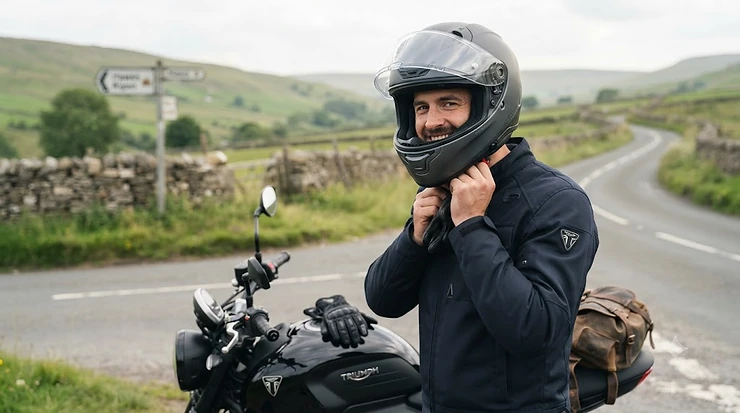
Your neck doesn’t lie. Two hours into a motorway slog with a heavy lid on, and you’ll feel exactly where every one of those extra grams has gone — straight into your trapezius muscles. An ultra-lightweight full face helmet is a full-face motorcycle helmet, typically built from carbon fibre or advanced composite, engineered to weigh under roughly 1,400 grams while still meeting UK safety certification. It sacrifices nothing on protection; it simply asks less of your body to carry it.
That distinction matters more than most buyers realise. Full-face helmets protect the chin and jaw in ways open-face lids simply can’t, but that coverage has always come with a weight penalty — until composite engineering caught up. Under UK law you must wear a certified helmet every time you ride, so the real question isn’t whether to wear a full-face helmet, it’s which one won’t wreck your neck by the time you reach Scotland.
This guide is built from real research into seven genuine, currently available helmets — their actual claimed and tested weights, their real shell materials, and honest analysis of who each one suits. No invented reviews, no puffed-up marketing copy lifted from a listing page. Just what the specs mean in practice, and which helmet fits which kind of rider. Whether you’re commuting daily, touring for a fortnight, or chasing lap times on a Sunday, there’s a genuinely lightweight option below that’s worth your money — and a few that, honestly, aren’t worth the premium unless you need what they offer.
Quick Comparison Table
Before the deep dive, here’s how the seven helmets stack up on the numbers that actually matter for neck fatigue and long-ride comfort.
| Helmet | Claimed Weight | Shell Material | Price Range | Best For |
|---|---|---|---|---|
| AGV Pista GP RR | ~1,450g | 100% Carbon | £1,300-£1,900 range | Track-day racers wanting MotoGP kit |
| Shoei X-SPR Pro | ~1,450-1,500g | Fibreglass AIM+ | £700-£800 range | Serious sportbike and circuit riders |
| Arai RX-7V Evo | ~1,568g | Composite PB-SNC2 | Around £750-£800 | Safety-first riders who want 5-star SHARP |
| X-Lite X-803 RS Ultra Carbon | As low as ~1,250g | Ultra Carbon | £400-£500 range | Weight-obsessed riders on a mid budget |
| HJC RPHA 11 Carbon | ~1,339g | Carbon/PIM+ | £350-£500 range | Best value genuine carbon helmet |
| LS2 Challenger Carbon | ~1,505g | Carbon fibre | Under £450 | Sport-touring riders wanting a sun visor |
| Caberg Drift Evo II Carbon | ~1,300-1,350g | Fibreglass + Carbon | Under £350 | Budget riders who still want carbon weight |
Prices shown are broad ranges based on research at time of writing; always check current pricing, as it fluctuates. Looking at the table, the gap between the lightest (X-Lite X-803 RS Ultra Carbon) and heaviest (Arai RX-7V Evo) is over 300 grams — roughly the weight of a full water bottle sitting permanently on top of your spine. That’s not a trivial difference on a three-hour ride. Budget-conscious riders should note that the HJC RPHA 11 Carbon and Caberg Drift Evo II Carbon both undercut the premium options by hundreds of pounds while staying under 1,350g, which tells you weight and price don’t move in lockstep the way marketing often implies.
💬 Just one click — help others make better buying decisions too!😊
Top 7 Ultra-Lightweight Full Face Helmets: Expert Analysis
1. AGV Pista GP RR — MotoGP-grade carbon shell
The AGV Pista GP RR is, quite literally, the helmet MotoGP riders wear on Sundays, which explains why it commands the price it does. Weighing around 1,450g ±50g in the smallest shell size, its 100% carbon fibre construction — branded “Extreme Carbon” by AGV — is built across four separate outer shell sizes so the helmet stays compact and light no matter your head size. That matters more than raw grams alone: a smaller shell means less rotational leverage on your neck in a crash, not just less mass to carry on a ride. Based on the spec comparison, this is a race-first design; the Ultravision visor’s 190° horizontal field of view and metal MotoGP-developed vents are optimised for a tucked riding position at genuine speed, not upright commuting. Riders shopping around this model consistently flag its aerodynamic stability at three-figure speeds, while several owner discussions on retailer sites note the race-oval fit runs unforgiving for anyone without a genuinely narrow, elongated head shape — try before you buy, always. Pros:
- ✅ FIM-homologated shell built for elite-level track protection
- ✅ 100% carbon construction keeps weight low despite the size
- ✅ Ultravision visor delivers a genuinely wide 190° field of view
Cons:
- ❌ Aggressive race-oval fit doesn’t suit round head shapes
- ❌ Premium pricing puts it out of reach for most road riders
Expect to pay well into four figures — this sits in the £1,300-£1,900 range depending on graphics and retailer. For anyone doing track days seriously, that’s a defensible spend; for a daily commuter, it’s overkill.
2. Shoei X-SPR Pro — FIM and ECE 22.06 dual homologation
The Shoei X-SPR Pro replaced the much-loved X-Spirit III and is tested to both FIM racing standards and the newer ECE 22.06 certification, which is now the legal minimum for helmets sold in the UK. It weighs a touch under 1,500g in a size medium, built from Shoei’s AIM+ fibreglass composite — several layers of fibreglass engineered for rigidity and shock absorption rather than pure carbon. What most buyers overlook about this model is that “lightweight” for Shoei doesn’t mean “lightest”: at nearly 1.5kg, it’s genuinely mid-pack for this category, trading a few extra grams for wind-tunnel-proven aerodynamic stability at speeds Shoei claims remain composed past 200mph. Seven intake vents and six exhaust ports keep the interior manageable even on a warm British bank holiday, which matters more than most spec sheets let on — overheating inside a helmet is its own kind of fatigue. Aggregated feedback from retailer review sections is consistently positive on build quality and finish, with the recurring caveat that the narrow eye port suits an aggressive, forward-leaning posture rather than an upright commuter stance.
Pros:
- ✅ FIM and ECE 22.06 dual certification for racing and road
- ✅ AIM+ fibreglass shell balances strength with genuine weight savings
- ✅ Seven intake and six exhaust vents manage heat impressively well
Cons:
- ❌ Not the lightest in its class despite the race pedigree
- ❌ Narrow eye port favours a tucked-in riding position only
Sitting in the £700-£800 range at time of research, this is a considered upgrade for riders who already know they want a race-focused lid, not an entry point.
3. Arai RX-7V Evo — the 5-star SHARP safety benchmark
Here’s an honest one: the Arai RX-7V Evo is not the lightest helmet in this guide, and Arai doesn’t pretend otherwise — independent testing measured it at 1,568g in a medium, roughly 300g heavier than the lightest entry here. So why does it make the list? Because its PB-SNC2 composite shell, built around Arai’s signature rounded “R75” shape, achieved a full 5-star rating in the UK government’s SHARP safety scheme, and that round profile is specifically engineered to glance off impacts rather than dig in and transfer rotational force to your neck — arguably a more important safety metric than raw weight alone. On paper this means Arai is making a different trade-off to everyone else on this list: slightly more mass, in exchange for a shell shape with a genuine, tested safety pedigree. Independent long-term testing from BikeSocial found the measured weight only 18g over Arai’s claimed figure — an honest spec sheet, which counts for something. Reviewers consistently note the plush, antimicrobial Eco-Pure liner holds up impressively well on multi-hour rides, even if the shell itself won’t win any weight-class contests.
Pros:
- ✅ Five-star SHARP safety rating, among the highest ever tested
- ✅ Renowned R75 round shell shape designed to glance off impacts
- ✅ Plush, antimicrobial liner suits genuinely long stints in the saddle
Cons:
- ❌ Heavier than every other helmet in this guide at over 1,500g
- ❌ Famously snug Arai fit runs small — try before you buy
Around £750-£800 at the time of research. If neck fatigue is your only concern, look elsewhere on this list; if crash protection is your priority and you can live with the extra grams, this is arguably the safest full-face helmet money can buy in the UK right now.
4. X-Lite X-803 RS Ultra Carbon — the lightest shell in this guide
The X-Lite X-803 RS Ultra Carbon is, on the numbers, the standout lightweight pick here. Nolan-owned X-Lite builds this as the high-carbon flagship of its X-803 racing platform, and the “Ultra Carbon” designation isn’t just branding — the manufacturer states it strips up to 110g off an already light standard X-803 shell, putting the smallest size in the region of 1,250g. What that means in practice is a helmet that genuinely disappears on your head during a long ride in a way heavier composites simply can’t match. Three separate outer shell sizes keep the helmet compact regardless of which size you order, which — as with the AGV above — reduces leverage on your neck as well as raw mass. Key specs worth noting: the Ultrawide visor gives an unusually generous field of view, and the NERS emergency release system lets first responders remove the cheek pads without twisting your neck if the worst happens. Based on the spec comparison against its nearest rivals, this is arguably the best grams-per-pound value in the entire premium bracket, though X-Lite’s smaller UK dealer footprint means fewer opportunities to try one on before buying — a real practical drawback for a helmet where fit-per-shell-size is such a selling point.
Pros:
- ✅ Ultra Carbon shell shaves up to 110g off the standard X-803
- ✅ Three outer shell sizes keep fit compact across head sizes
- ✅ Wide field-of-view visor with quick-change and Pinlock included
Cons:
- ❌ Smaller UK dealer network than the big four Japanese brands
- ❌ Race-focused ventilation can feel sparse in slow-moving traffic
Typically found in the £400-£500 range, which — for the lightest shell on this list — represents genuinely strong value.
5. HJC RPHA 11 Carbon — genuine carbon at a non-carbon price
The HJC RPHA 11 Carbon earns its spot by doing something few rivals manage: delivering an actual carbon fibre/aramid/fibreglass composite shell without an actual carbon fibre price tag. Independent testing measured a size medium at 1,339g with visor and Pinlock fitted — HJC’s own claimed figure is 1,250g, so there’s a real-world gap worth knowing about, but 1,339g still comfortably undercuts several helmets costing twice as much. What most buyers overlook about HJC’s Advanced Channelling Ventilation System is that it’s not just a spec-sheet bullet point — the routed air channels genuinely reduce the “sweaty scalp by junction three” problem that cheaper vented helmets struggle with. Here’s what to weigh: the standard fibreglass RPHA 11 (not the carbon version) only achieved three stars in independent SHARP safety testing, a genuinely useful data point that Amazon listings won’t surface for you, and one worth digging into before assuming carbon automatically means safer. Reviewers consistently praise the widened eye port for improved peripheral vision compared with the older RPHA 10, while several long-term owners flag that the cheek pad popper tabs loosen faster than on pricier Japanese rivals.
Pros:
- ✅ Genuine carbon fibre shell at a distinctly non-carbon price
- ✅ Advanced Channelling Ventilation copes impressively with UK summers
- ✅ Wide eye port meaningfully improves peripheral vision over the RPHA 10
Cons:
- ❌ Standard (non-carbon) RPHA 11 only scored three SHARP stars
- ❌ Cheek pad poppers can loosen faster than pricier rivals
Plain colourways sit toward the lower end of a £350-£500 range, with elaborate carbon graphic finishes pushing toward the top — a genuinely accessible entry into carbon-shell weight savings.
6. LS2 Challenger Carbon — sport-touring value with a sun visor
The LS2 Challenger Carbon targets sport-touring riders rather than track-day obsessives, and its spec sheet reflects that: a carbon fibre shell weighing around 1,505g ±50g, built across three outer shell sizes spanning eight overall sizes — genuinely broad coverage for a helmet at this price point. The standout practical feature here is the integrated drop-down sun visor, something none of the pure-race helmets above bother with, and which matters enormously on a British ride that starts under cloud and ends with low autumn sun straight in your eyes. On paper this means LS2 is chasing all-day usability over outright lightness, and at 1,505g it’s the second-heaviest helmet on this list — noticeably more than the carbon options above it, despite sharing the same shell material. What most buyers overlook about “carbon” as a marketing term is that shell material alone doesn’t guarantee the lightest result; layup, resin choice and shell sizing all matter just as much, and LS2’s more generous, road-friendly interior padding adds mass the pure racers skip. Owner discussions consistently rate the value proposition highly relative to Shoei and AGV equivalents, while some flag that older ECE 22.05-certified stock is still circulating alongside newer 22.06 batches — worth checking before you buy.
Pros:
- ✅ Carbon fibre shell at a genuinely accessible price point
- ✅ Integrated sun visor is genuinely handy for unpredictable British weather
- ✅ Three outer shell sizes across an eight-size range for better fit
Cons:
- ❌ Older ECE 22.05 stock still circulating alongside newer 22.06 runs
- ❌ Less brand cachet and resale value than the Japanese big three
Usually under £450, and often closer to the £350-£400 mark — a genuinely strong mid-range pick if a sun visor matters more to you than shaving the last 150g.
7. Caberg Drift Evo II Carbon — budget carbon, genuine weight savings
The Caberg Drift Evo II Carbon is the newest addition to this list, having only gone carbon in its current generation, and it undercuts every other helmet here on price while matching or beating most of them on weight — 1,300g ±50g in the small shell, 1,350g ±50g in the large. That’s a genuinely competitive figure against helmets costing three or four times as much, which is exactly why it deserves a place on this list rather than being dismissed as “just a budget brand.” Reviewers consistently praise the earlier fibreglass Drift Evo for offering track-developed handling with a sun visor at a price point almost nothing else matches, and the Carbon successor extends that reputation with genuine composite weight savings layered on top. Key specs worth flagging: the Caberg SOS Medical ID system lets first responders access emergency medical information stored inside the helmet, a small but genuinely thoughtful touch rarely seen below the premium bracket, and ECE 22.06 certification means it meets the current legal minimum for UK roads. Honest caveat: Caberg simply doesn’t have the decades of independent long-term reviews that Arai, Shoei or AGV can draw on, so buyers are trading brand pedigree for price — a reasonable trade for many, but worth knowing going in.
Pros:
- ✅ Lightest shell-for-price ratio of any helmet in this guide
- ✅ Caberg SOS Medical ID helps first responders in an emergency
- ✅ Integrated sunshade visor adds real versatility at no extra cost
Cons:
- ❌ Smaller, lesser-known brand with fewer independent long-term reviews
- ❌ Standard visor lacks the race-proven optics of pricier helmets
Typically under £350, making this the standout budget pick for anyone who wants genuine lightweight carbon performance without a four-figure price tag.
Practical Usage Guide: Breaking In and Maintaining Your Lightweight Helmet
A new full-face helmet doesn’t feel finished on ride one — the interior foam takes roughly ten to fifteen hours of wear to pack down to your specific head shape, so don’t panic if a fresh X-Lite X-803 RS Ultra Carbon or HJC RPHA 11 Carbon feels a shade tight in week one. What most buyers overlook is that pressure points which persist past that break-in window usually mean the wrong shell size or shape, not a helmet that “just needs more time” — don’t force it. During the first thirty days, check the retention strap tension every few rides; composite shells like carbon and fibreglass settle slightly as the foam compresses, and a strap that was snug on day one can loosen by day fifteen. Clean the interior liner every four to six weeks if you ride regularly — most of the helmets above, including the Caberg Drift Evo II Carbon and LS2 Challenger Carbon, use fully removable, washable padding specifically for this reason, and a sweat-soaked liner left unwashed both smells and degrades the foam’s shock-absorbing properties faster than manufacturers advertise. Pinlock inserts, fitted as standard on several helmets here including the Shoei X-SPR Pro and Arai RX-7V Evo, need an occasional wipe with a microfibre cloth rather than household glass cleaner, which can strip the anti-fog coating within weeks. Finally, store the helmet on a proper stand or padded shelf, never resting on the chin guard — a habit that quietly deforms cheaper composite shells over a year or two of daily use.
Real-World Scenarios: Which Rider Are You?
If you’re a graduate commuting eight miles into a UK city centre five days a week, weight and ventilation matter more than outright track performance — the HJC RPHA 11 Carbon or Caberg Drift Evo II Carbon make more financial sense than a race-homologated lid you’ll never push past 40mph. If you’re planning a two-week European tour covering 300+ miles some days, comfort over distance trumps everything else, and the LS2 Challenger Carbon‘s integrated sun visor plus broad size range will matter more on day nine than an extra 100g saved on paper. If you’re a weekend track-day regular chasing lap times at Cadwell Park or Donington, the AGV Pista GP RR or Shoei X-SPR Pro earn their price through aerodynamic stability and FIM homologation that road-focused helmets simply don’t offer. And if you’re a safety-first rider who values independent crash-test data above every other spec, the Arai RX-7V Evo‘s 5-star SHARP rating is worth its weight — literally — even though it’s the heaviest helmet on this list. Matching the helmet to the actual riding you do, rather than the riding you occasionally imagine doing, is the single biggest factor in whether you’ll still be happy with your choice in a year.
How to Buy a Lightweight Motorcycle Helmet: 7-Step Framework
Buying a lightweight motorcycle helmet properly takes more than reading a weight figure off a spec sheet. Here’s the process worth following:
- Confirm current UK certification first. Any helmet you buy lightweight motorcycle helmet or otherwise must carry ECE 22.05 or 22.06 approval as a legal minimum — check the sticker inside the chin strap before anything else.
- Measure your head properly, not by guesswork. Use a fabric tape measure around the widest point above your eyebrows; most manufacturer size charts are more accurate than “I usually wear a medium in trainers.”
- Shortlist by shell size, not just helmet size. A size small in a helmet with three outer shell sizes will genuinely weigh and fit differently to a size small on a single-shell budget helmet.
- Weigh the trade-off between grams and features. A sun visor, extra vents or a Pinlock-ready visor all add mass; decide which practical features are worth the weight penalty for your riding.
- Check independent safety data before brand reputation. SHARP star ratings and manufacturer claimed weights don’t always align with real owner experience — cross-reference where you can.
- Try before you buy wherever possible. Fit varies enormously between an intermediate oval (most Japanese brands) and a rounder fit (many European brands) — a helmet that’s perfect for a friend can be genuinely wrong for you.
- Budget for a Pinlock insert and a spare visor. Neither is usually included at the very cheapest end, and both are cheaper bought alongside the helmet than as an urgent replacement later.
Buyers who follow this framework consistently end up happier with their purchase than those who simply order the lightest helmet on paper, because fit and certification matter more to real-world comfort than the final fifty grams ever will.
What Makes the Lightest Full Face Motorcycle Helmet? Shell Materials Explained
Every genuinely lightest full face motorcycle helmet on the market today relies on the same basic principle: replacing heavier polycarbonate or single-layer fibreglass with carbon fibre’s exceptional strength-to-weight ratio, layered in a way that maintains — or in the best cases, improves — impact resistance while cutting mass. Woven carbon fibre sheets are roughly five times stronger than steel by weight, which is why a shell like the X-Lite X-803 RS Ultra Carbon can hit around 1,250g while still meeting the same ECE 22.06 impact standards as a 1,800g polycarbonate lid. But carbon isn’t automatically the lightest or safest choice by default — Shoei’s AIM+ fibreglass composite on the Shoei X-SPR Pro and Arai’s PB-SNC2 net-composite on the Arai RX-7V Evo both prove that intelligent fibreglass layup can rival or beat carbon on real-world weight, sometimes at a lower price. What most buyers overlook is that multiple outer shell sizes matter almost as much as the material itself: a helmet like the AGV Pista GP RR, built across four shell sizes, keeps every head size proportionally light and compact, whereas a single-shell-size budget helmet forces smaller-headed riders to wear excess shell material and padding just to make the fit work — adding weight exactly where it’s least needed.
Neck Fatigue and Helmet Weight Distribution: The Physics of Comfortable Riding
Why Neck Fatigue Happens
Neck fatigue isn’t simply a matter of total helmet weight — it’s a matter of leverage. Your neck holds your head roughly level with your spine, and any weight sitting above that pivot point creates a torque that your neck muscles have to constantly counteract, especially at speed when wind resistance adds further force against the front of the helmet. A helmet that’s 300g heavier doesn’t just feel “a bit more” tiring; because that extra mass sits well above your neck’s pivot point, the actual muscular effort required scales up disproportionately over a long ride. This is exactly why riders switching from a helmet like the Arai RX-7V Evo to something like the HJC RPHA 11 Carbon — a weight difference of roughly 230g — commonly report a genuinely noticeable reduction in shoulder and neck tension after a two-hour motorway stint, even though 230g sounds like almost nothing sitting on a kitchen scale.
Why Weight Distribution Matters More Than Total Grams
Here’s what the spec sheet won’t tell you: two helmets with identical total weight can feel completely different on the road if that weight is distributed differently. A helmet with a heavy chin bar and light rear shell will pull your head forward under braking and acceleration, while one with weight concentrated at the crown feels more neutral through corners. This is precisely why the AGV Pista GP RR‘s rear PRO Spoiler and metal MotoGP-developed vents aren’t purely cosmetic — they’re positioned to balance aerodynamic load and shift the centre of gravity backward slightly, reducing the sensation of “nodding” at speed that poorly balanced lightweight helmets can suffer from. Reviewers consistently note that a well-balanced 1,500g helmet can feel lighter in use than a poorly balanced 1,350g one — which is exactly why weight distribution, not just the number on the box, deserves your attention before you buy.
Ultra-Lightweight vs Standard Full Face Helmets
| Factor | Ultra-Lightweight Full Face | Standard Full Face |
|---|---|---|
| Typical weight | Under 1,400g | 1,500g-1,800g |
| Shell material | Carbon fibre or advanced composite | Polycarbonate or basic fibreglass |
| Typical price range | £350-£1,900+ | £100-£400 |
| Neck fatigue on long rides | Meaningfully reduced | More pronounced past 90 minutes |
| Best For | Commuters, tourers, track riders | Occasional, short-distance riders |
The written case for going lightweight is straightforward once you ride more than 45 minutes at a stretch: every one of the seven helmets above delivers a genuine, measurable weight saving over the polycarbonate-shell average, and that saving compounds hour after hour rather than being a one-off comfort bump. Standard full-face helmets remain a perfectly sensible choice for riders doing short urban hops where neck fatigue simply never becomes a factor, and the price difference — often several hundred pounds — is real money saved for genuinely low-mileage use. Where standard helmets fall down is exactly where lightweight ones earn their keep: sustained motorway riding, touring, and anything approaching a full day in the saddle, where the cumulative torque on your neck from an extra 400-500g adds up to genuine, measurable fatigue by the time you stop for fuel.
Common Mistakes When Buying an Ultra-Lightweight Full Face Helmet
The single most common mistake is buying on claimed weight alone without checking independently measured figures — as we’ve seen with the HJC RPHA 11 Carbon, real-world weight can run 50-90g over the manufacturer’s claim, and that gap matters when you’re comparing two helmets that are only 60g apart on paper. The second mistake is assuming “carbon” automatically means “safer,” when in fact SHARP testing has repeatedly shown well-engineered fibreglass composites, like Arai’s PB-SNC2 on the Arai RX-7V Evo, can outperform carbon shells on crash protection — material alone tells you about weight, not safety. A third frequent error is ordering online by helmet “size” rather than checking which outer shell size that falls into; two mediums from different multi-shell-size ranges can differ by over 100g and several millimetres of bulk. Riders also commonly underestimate how much a Pinlock insert, comms unit or tinted visor adds to a helmet’s effective on-head weight — genuinely lightweight helmets can lose much of their advantage once fully accessorised. Finally, many buyers skip trying a helmet on entirely when shopping online, relying on brand reputation alone; a Shoei X-SPR Pro that fits your riding mate perfectly can still be genuinely wrong for your head shape.
✨ Don’t Miss These Exclusive Deals!
🔍 Take your search for the perfect lightweight lid to the next level — click through on any helmet above to check current pricing and availability. These carbon-shell picks will help you protect your head without punishing your neck on every ride.
Long-Ride Comfort: What Actually Changes After 300 Miles
Long-ride comfort is where the theoretical grams-and-torque argument stops being abstract and starts being felt in your shoulders. Somewhere around the two-hour mark on a motorway, most riders in a heavier standard full-face helmet begin unconsciously shifting position every few minutes, rolling their shoulders or briefly tucking their chin — small, repeated adjustments that are actually your neck muscles fatiguing and searching for relief. Riders who’ve switched to a genuinely lightweight option like the X-Lite X-803 RS Ultra Carbon or Caberg Drift Evo II Carbon consistently report that this fidgeting starts noticeably later into a ride, or doesn’t happen at all on rides under three hours. Ventilation compounds the effect: a helmet that traps heat forces you to unconsciously tense your jaw and grip the bars slightly tighter as discomfort builds, so the well-vented designs among our seven picks — particularly the HJC RPHA 11 Carbon‘s Advanced Channelling system — contribute to long-ride comfort in ways that have nothing directly to do with weight at all. What most buyers overlook on their first long tour is that a slightly heavier but better-balanced helmet, like the Arai RX-7V Evo, can occasionally out-comfort a lighter but poorly ventilated one over an eight-hour day — which is exactly why weight alone was never going to be the whole story.
Safety, Regulations & Compliance: ECE 22.06 and SHARP Ratings Explained
Every helmet sold in the UK must meet a recognised safety standard, and as of January 2024, new helmet designs are only approved under the updated UN ECE R22-06 standard, which tests against a wider range of real-world impact scenarios — including oblique impacts that better replicate how riders actually fall — than the older 22.05 standard it replaces. Practically speaking, this means a genuinely 2026-relevant ultra-lightweight full face helmet should carry a 22.06 label, though older 22.05 stock (like some LS2 Challenger Carbon batches still circulating) remains legal to sell and use until existing stock clears. Beyond the legal minimum, the UK government’s independent SHARP scheme — separate from any manufacturer marketing — rates helmets from one to five stars based on real crash-test data, and it’s genuinely one of the only sources that isn’t trying to sell you anything. The Arai RX-7V Evo‘s five-star result is a meaningful, independently verified data point in a category where most marketing claims are impossible for a buyer to check themselves. SHARP’s own guidance on getting the right fit is worth reading in full before you buy anything on this list, because even a five-star-rated helmet performs worse than a lower-rated one if it doesn’t actually fit your head correctly.
Long-Term Cost & Maintenance: Is Ultra-Lightweight Worth the Premium?
Total cost of ownership on a full-face helmet extends well beyond the sticker price. Most manufacturers, including Shoei and Arai, recommend replacing a helmet every five years regardless of visible damage, since UV exposure and sweat gradually degrade the EPS liner’s shock-absorbing properties — meaning even the Shoei X-SPR Pro‘s £700-£800 outlay works out to roughly £140 a year over its useful life, before factoring in resale value. Cheaper carbon options like the Caberg Drift Evo II Carbon cost meaningfully less upfront but may hold less resale value given the brand’s smaller UK following, while premium Japanese names like Shoei and Arai typically retain a noticeably higher percentage of their original price on the second-hand market. Ongoing costs are broadly similar across the range: replacement visors typically run £30-£80 depending on brand and finish, Pinlock inserts another £15-£25, and a fresh interior liner — where available separately — adds £40-£60 every couple of years for riders putting in serious annual mileage. Here’s what to weigh: paying more upfront for a lightweight helmet with genuinely reduced neck fatigue can be false economy if you only ride 500 miles a year, but for anyone covering meaningful annual mileage, the cumulative comfort saved arguably justifies the premium far more convincingly than resale value alone ever could.
Frequently Asked Questions
❓ What is the lightest full face motorcycle helmet you can buy?
❓ Is a carbon fibre helmet actually worth the extra cost?
❓ How much can a lightweight helmet reduce neck fatigue?
❓ Does a lighter helmet mean less crash protection?
❓ How do I know if a full face helmet fits properly before buying?
Conclusion
There’s no single “best” ultra-lightweight full face helmet in this guide, because the honest answer depends entirely on how and where you ride. If neck fatigue on long motorway stints is your biggest concern, the X-Lite X-803 RS Ultra Carbon or HJC RPHA 11 Carbon deliver genuine, measurable weight savings without asking you to remortgage anything. If independently verified crash safety is your priority above all else, the Arai RX-7V Evo‘s five-star SHARP rating is worth carrying the extra grams for. Track-day regulars will find the AGV Pista GP RR and Shoei X-SPR Pro earn their premium price through race-proven aerodynamics and homologation that road helmets simply don’t offer, while budget-conscious riders shouldn’t overlook the Caberg Drift Evo II Carbon and LS2 Challenger Carbon, both of which prove genuine lightweight comfort doesn’t require a four-figure spend.
What matters most, across every price point on this list, is matching the helmet to your actual riding — not the riding you imagine doing on your best day. Check the current price, check the certification sticker, and above all, try it on before you commit. Your neck, several hundred miles from now, will thank you for the ten minutes it takes to get this right.
✨ Ready to Ride Lighter?
🔍 Compare these seven ultra-lightweight full face helmets and check today’s pricing before you buy. A lighter helmet on your next long ride starts with picking the right one today.
Recommended for You
- Thermoplastic Helmet for Everyday Riding: 7 Best Picks 2026
- Advanced Thermoplastic Helmet: 7 Best Picks for 2026
- Polycarbonate Helmet for Commuting: 7 Top Picks (2026 UK)
Disclaimer: This article contains affiliate links. As an Amazon Associate, I earn from qualifying purchases. If you purchase products through these links, we may earn a small commission at no additional cost to you.
✨ Found this helpful? Share it with your friends! 💬🤗
