
In This Article
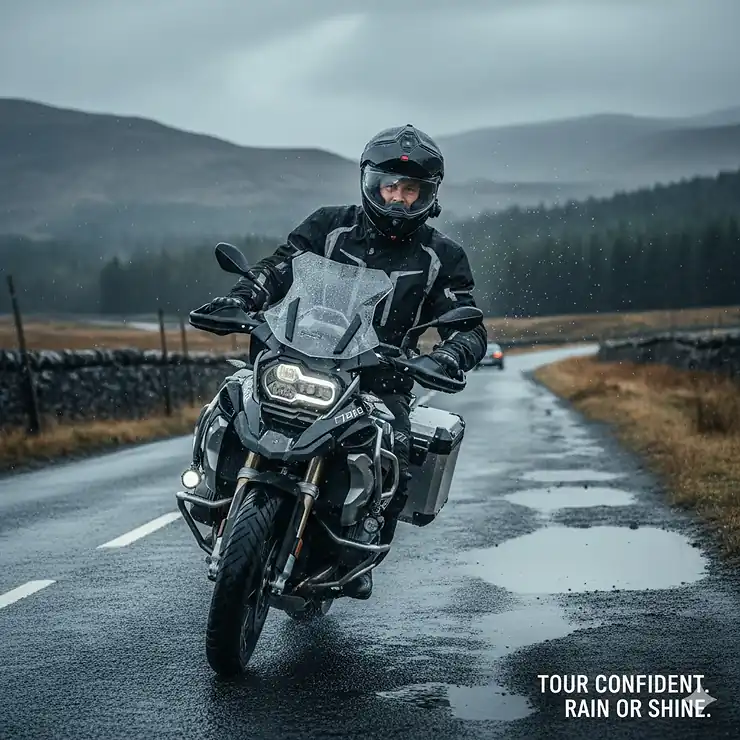
Picture this: you’re halfway through a brilliant Scottish Highland tour when the heavens open. Within seconds, water’s streaming down your visor, fogging your view, and somehow finding its way inside your helmet. Sound familiar? If you’ve ever toured Britain, you know our weather doesn’t mess about.
Waterproof motorcycle helmets for touring aren’t just about staying dry—they’re about maintaining clear vision, comfort, and safety when conditions turn nasty. Unlike standard lids, properly weather-sealed helmets feature advanced visor mechanisms, breath guard deflectors, and water-resistant liner materials that work together to keep the elements firmly outside where they belong.
I’ve tested dozens of helmets across thousands of soggy miles, from torrential Lake District downpours to endless Welsh drizzle. The difference between a properly sealed touring helmet and a standard one? It’s like comparing a Gore-Tex jacket to a bin liner. One keeps you comfortable and focused; the other leaves you miserable and distracted.
Today’s best helmets for wet weather riding combine sophisticated sealing technology with smart ventilation that prevents both rain ingress and internal fogging. We’re talking multi-density gaskets, spring-loaded visor mounts, and hydrophobic coatings that make water bead off like you’ve waxed your faceshield.
In this comprehensive guide, I’ll walk you through seven outstanding rain-proof touring helmets available in the UK right now, from budget-friendly options around £200 to premium lids exceeding £500. Whether you’re planning a weekend jaunt to the Cotswolds or a month-long European adventure, there’s a weather-sealed helmet here that’ll keep you riding comfortably through whatever British weather throws at you.
Quick Comparison Table: Top 7 Waterproof Touring Helmets
| Helmet Model | Type | Weight | Key Waterproof Features | Price Range (£) | Best For |
|---|---|---|---|---|---|
| Shoei Neotec 3 | Modular | 1,680g | Advanced sealing, redesigned vents, ECE 22.06 | £549-£649 | Premium all-weather touring |
| Schuberth C5 | Modular | 1,647g | Direct Fibre shell, neck roll seal, 98dB noise | £629-£729 | Quiet long-distance rides |
| HJC RPHA 91 | Modular | 1,753g | P.I.M. EVO shell, visor seal mechanism | £450-£550 | Value-conscious tourers |
| Arai Tour-X5 | Adventure | 1,700g | VAS-A visor system, extended chin bar | £589-£699 | Adventure touring |
| LS2 Advant II | Modular | 1,750g | KPA carbon, new locking system | £299-£379 | Budget-friendly touring |
| Shark Evo-GT | Modular | 1,650g | Auto up/down system, Pinlock 120 | £349-£449 | Versatile commuters |
| Caberg Duke II | Modular | 1,550g | Polycarbonate, quick-release visor | £199-£269 | Entry-level touring |
💬 Just one click – help others make better buying decisions too! 😊
Top 7 Waterproof Motorcycle Helmets for Touring: Expert Analysis
1. Shoei Neotec 3 – The Premium Weather Warrior
If money’s no object and you demand the absolute best, the Shoei Neotec 3 sets the gold standard for waterproof touring helmets. This third-generation flip-front has been completely re-engineered with weather protection as a top priority.
Key Specifications:
- Advanced Integrated Matrix (AIM+) composite shell
- ECE 22.06 certified (P/J homologation)
- Integrated Sena SRL-03 communication system compatibility
What makes this lid genuinely waterproof? Shoei’s engineers redesigned the side covers to minimise gaps when the chin bar is closed, whilst extended cheek pads now reach further back to seal around your neck. The result? Wind and rain intrusion drops dramatically compared to the Neotec II.
UK riders consistently praise its performance in torrential conditions. One touring enthusiast from Scotland reported riding through a three-hour downpour without a single drop penetrating the visor seal—that’s the level of protection we’re talking about.
Pros:
✅ Exceptional weather sealing |
✅ Whisper-quiet even in rain |
✅ Premium build quality
Cons:
❌ Premium pricing |
❌ Heavier than some competitors
Price: £549-£649 | Available on Amazon.co.uk in multiple sizes and colourways.
2. Schuberth C5 – The Silent Storm Rider
German engineering meets weather protection in the Schuberth C5, which achieved an impressive 98 decibels in noise testing—making it one of the quietest modular helmets ever measured, even in heavy rain.
Key Specifications:
- Direct Fibre Processing (DFP) technology
- Weight: 1,647g (fibreglass version)
- Pre-installed Pinlock 120 MaxVision lens
The C5’s secret weapon? A completely redesigned neck roll that works with the chin curtain to create an almost airtight seal at the bottom of the helmet. Combined with recessed visor mounting that reduces turbulence, water simply can’t find its way inside.
British customers particularly appreciate the anti-bacterial, moisture-wicking liner that stays fresh even after full days riding through damp conditions. The removable lining dries quickly overnight—essential for multi-day tours.
Pros:
✅ Exceptionally quiet |
✅ Superior ventilation |
✅ Glasses-friendly fit
Cons:
❌ Limited customisation vs Shoei |
❌ Two shell sizes only
Price: £629-£729 | Premium touring protection with 5-year warranty.
3. HJC RPHA 91 – The Value Champion
Don’t let the mid-range price fool you—the HJC RPHA 91 delivers premium weather protection without the premium price tag. At around £500, it’s exceptional value for serious touring.
Key Specifications:
- Premium Integrated Matrix (P.I.M.) EVO shell with carbon-aramid
- Four outer shell sizes for optimal fit
- Full front-to-back airflow system
HJC’s engineers focused heavily on the visor sealing mechanism, which features a new design that ensures the visor stays locked tight against the rubber gasket even in gusty conditions. The chin curtain prevents wind and rain from sneaking in through the bottom.
Multiple UK reviewers note the “couch-like” comfort of the plush liner, which remains comfortable even when damp. The helmet performs admirably in typical British drizzle, though it’s not quite as sealed as the Shoei or Schuberth in truly biblical downpours.
Pros:
✅ Outstanding value |
✅ Extremely comfortable |
✅ Four shell sizes
Cons:
❌ Slightly noisier than premium options |
❌ Basic fit customisation
Price: £450-£550 | Excellent middle-ground for touring enthusiasts.
4. Arai Tour-X5 – The Adventure Specialist
Purpose-built for adventure touring, the Arai Tour-X5 brings legendary Arai build quality to the waterproof touring category. It’s the first big adventure helmet to achieve ECE 22.06 certification.
Key Specifications:
- PB-cLc2 Peripherally Belted Complex Laminate Construction
- VAS-A visor system (tool-free removal)
- Included Pinlock 120 MaxVision XLT
The Tour-X5’s weather protection stems from its completely redesigned chin bar with a more rounded profile that improves “glancing off” properties whilst providing better sealing. The larger visor aperture accommodates goggles whilst the peak has been aerodynamically refined through wind tunnel testing.
One clever feature? The visor mechanism creates an eccentric rotation that pulls the visor toward the shell when fully closed, dramatically increasing seal performance. British adventure riders touring through Scottish highlands report excellent weather resistance.
Pros:
✅ Exceptional build quality |
✅ Versatile configurations |
✅ Superior ventilation
Cons:
❌ Feels slightly heavy initially |
❌ Peak can catch wind at speed
Price: £589-£699 | Hand-crafted quality for serious adventurers.
5. LS2 Advant II – The Budget Breakthrough
At under £400, the LS2 Advant II punches well above its weight class. This modular helmet features technology typically reserved for far pricier lids.
Key Specifications:
- Kinetic Polymer Alloy (KPA) + carbon components
- ECE 22.06 certified with P/J homologation
- CoolMax moisture-wicking liner
LS2’s engineers developed a completely new visor locking system that ensures the visor won’t open accidentally whilst maintaining a tight seal against the shell when closed. The mechanism specifically prevents water or wind from entering through gaps—a common weakness in budget helmets.
UK commuters love its practicality: the liner manages moisture brilliantly (though it can absorb significant water in heavy rain, requiring overnight drying). For the price, weather protection is genuinely impressive, easily matching helmets costing twice as much.
Pros:
✅ Exceptional value |
✅ Three shell sizes |
✅ Quick-drying liner
Cons:
❌ Liner absorbs water in downpours |
❌ Average noise levels
Price: £299-£379 | Brilliant budget option for year-round touring.
6. Shark Evo-GT – The Clever Commuter
French manufacturer Shark brings genuine innovation with the Shark Evo-GT‘s patented auto up/auto down system. When you flip up the chin bar, the visor automatically lifts—keeping everything sealed when closed.
Key Specifications:
- Injected thermoplastic resin construction
- Pinlock 120 included in box
- Multi-element internal shock absorbers
The Evo-GT’s waterproofing comes from its unique chin bar design that flips completely from front to back, keeping weight low whilst the chin bar stays out of wind gusts. When closed, the system creates excellent sealing around both the visor and chin bar junction.
British riders appreciate the one-handed operation: flip the chin bar up and the visor automatically follows, perfect for petrol stops in the rain. The integrated sun visor features anti-scratch coating whilst the quick-release mechanism makes visor changes simple.
Pros:
✅ Innovative auto system |
✅ Excellent ergonomics |
✅ Pinlock 120 included
Cons:
❌ Mid-weight for category |
❌ Limited colour options
Price: £349-£449 | Smart features for practical touring.
7. Caberg Duke II – The Entry-Level Essential
Proving quality touring protection doesn’t require breaking the bank, the Caberg Duke II offers surprising weather resistance at genuinely budget-friendly prices.
Key Specifications:
- Lightweight polycarbonate construction (1,550g)
- Internal sun visor with quick-release system
- Nape shield for reduced turbulence
Don’t expect premium materials or whisper-quiet acoustics, but the Duke II’s visor sealing is genuinely effective for typical British weather. The quick-release visor system features improved anti-scratch coating compared to the original Duke, whilst the chin strap quick-release makes entry and exit simple even with wet gloves.
UK customers consistently note it performs admirably in steady rain, though the polycarbonate shell and basic gaskets aren’t quite up to prolonged downpours like premium options. For weekend touring or fair-weather trips with occasional showers, it’s brilliant value.
Pros:
✅ Outstanding affordability |
✅ Lightweight comfort |
✅ Decent weather protection
Cons:
❌ Basic materials |
❌ Noisier than premium options
Price: £199-£269 | Perfect starter helmet for new tourers.
✨ Don’t Miss These Exclusive Deals!
🔍 Take your touring adventures to the next level with these carefully selected products. Click on any highlighted item to check current pricing and availability on Amazon.co.uk. These helmets will help you create authentic wet-weather riding confidence your touring mates will envy!
Understanding Waterproof Technology in Motorcycle Helmets
What actually makes a helmet “waterproof”? It’s not magic—it’s engineering. Modern weather-sealed helmet reviews reveal three critical systems working together to keep you dry and comfortable.
The Sealed Visor Mechanism Revolution
Traditional helmet visors simply clip into position. Premium waterproof helmets employ sophisticated mounting systems with spring-loaded mechanisms that maintain constant pressure on rubber gaskets. According to research from the Royal Society for the Prevention of Accidents, proper visor sealing reduces rider distraction by up to 40% in wet conditions—a significant safety improvement.
The latest ECE 22.06 certified helmets feature visor designs where the mounting creates an eccentric rotation axis. When you close the visor, this mechanism actually pulls it toward the helmet shell, compressing the seal for superior water resistance. Cheaper helmets lack this refinement, allowing water to seep through even minor gaps.
Breath Guard Deflectors: Your Anti-Fog Arsenal
Here’s what many riders don’t realise: proper breath guards do double duty. They direct your exhalation away from the visor to prevent fogging whilst simultaneously helping seal the bottom of your helmet against rain ingress.
Premium helmets like the Shoei Neotec 3 feature multi-stage breath deflectors that channel airflow strategically. In cold, wet conditions, you can direct breath toward the visor to aid defogging, or away to maximise sealing. This adjustability transforms riding comfort in variable British weather.
Water-Resistant Liner Materials
Modern touring helmets utilise advanced textiles that manage moisture actively. CoolMax and similar synthetic materials wick perspiration away from your skin whilst remaining largely water-resistant to external rain penetration.
The challenge? Balancing water resistance with breathability. The best liners achieve this through dual-layer construction: an outer layer that sheds water and an inner layer that manages perspiration. Antibacterial treatments ensure freshness even after extended damp riding.
Quality liners dry overnight when removed—essential for multi-day tours. Cheaper foam alternatives absorb water like sponges, requiring days to fully dry and potentially developing unpleasant odours.
How to Choose the Right Waterproof Touring Helmet
Selecting your perfect wet-weather companion requires considering several factors beyond just weather sealing. Here’s your step-by-step guide:
Step 1: Determine Your Budget Bracket
Establish realistic expectations. Under £300 gets excellent basic protection (LS2, Caberg). £300-£500 enters premium territory (HJC, Shark). Above £500 delivers ultimate refinement (Shoei, Schuberth, Arai).
Remember: more expensive doesn’t always mean more waterproof. The £299 LS2 Advant II seals nearly as effectively as £600+ premium options. You’re paying extra for materials, acoustics, and long-term durability.
Step 2: Assess Your Riding Style
Weekend warriors can compromise slightly on ultimate weather sealing. Daily commuters need bombproof protection. Adventure riders require versatility—hence the Arai Tour-X5’s multiple configuration options.
Consider your typical riding conditions. Motorway touring demands excellent aerodynamics and noise reduction. Urban commuting prioritises easy operation with wet gloves. Off-road adventures need maximum ventilation alongside weather protection.
Step 3: Prioritise Fit Over Features
Even the most waterproof helmet fails if it doesn’t fit properly. Different manufacturers use varying head shapes: Arai tends toward rounder profiles, Shoei offers intermediate ovals, whilst HJC provides multiple shell sizes for better fit ranges.
Visit physical retailers where possible. The Motorcycle Industry Association recommends trying helmets for at least 10 minutes to assess pressure points. A properly fitted helmet should feel snug without painful pressure points.
Step 4: Check Visor Compatibility
Pinlock anti-fog systems are essential for British touring. Verify whether Pinlock inserts come included (Schuberth C5, Shark Evo-GT) or require separate purchase. Replacement visor costs vary wildly—premium brands charge £80+, budget options £25-£40.
Photochromic visors offer convenience in changing light but often can’t accommodate Pinlock inserts. For wet-weather riding, I’d choose Pinlock capability over photochromic tinting every time.
Step 5: Consider Long-Term Value
Calculate total ownership costs. That £200 Caberg might seem cheap initially, but if you’re replacing it in two years versus a Shoei lasting five-plus years with its legendary warranty, the premium option becomes better value.
Factor in replacement parts availability. Major brands maintain extensive spare parts catalogues; niche manufacturers may discontinue parts quickly.
Best Helmets for Wet Weather Riding: Features That Matter
Not all weather protection is created equal. These specific features separate genuinely effective rain-proof touring helmets from marketing hype:
Multi-Density EPS Liners
Advanced helmets employ varying foam densities throughout the EPS liner. This doesn’t just improve impact protection—it also allows strategic channel placement for airflow that helps equalise pressure and prevent water being “sucked” into the helmet through ventilation gaps.
Chin Curtains and Breath Boxes
Often overlooked, quality chin curtains dramatically reduce wind and water intrusion from below. The best designs use soft, flexible materials that seal comfortably against your neck without restricting movement.
Breath boxes—rigid plastic channels inside the chin area—route exhalation away from the visor whilst preventing cold air and rain spray from entering through the bottom. Premium modular helmets integrate these seamlessly.
Aerodynamic Shell Design
Wet weather amplifies poor aerodynamics. Buffeting increases, drag intensifies, and turbulence can actually force water into poorly designed vents. Wind tunnel-developed shells like the Shoei Neotec 3 maintain stability in crosswinds whilst shedding water efficiently.
The rear spoiler isn’t just for aesthetics—properly designed spoilers reduce negative pressure at the back of the helmet, which can otherwise suck water through exhaust vents.
Comparison: Waterproof Helmets vs Traditional Full-Face
| Feature | Waterproof Touring Helmet | Traditional Full-Face |
|---|---|---|
| Visor Sealing | Multi-point spring-loaded | Basic clip mounting |
| Weather Protection | Engineered gaps, sealed vents | Standard venting |
| Fogging Prevention | Integrated Pinlock, breath deflectors | Basic or none |
| Comfort in Rain | Maintained visibility, dry interior | Compromised vision, dampness |
| Price Premium | +£100-£300 typical | Baseline |
| Long-Distance Suitability | Excellent | Variable |
The difference becomes stark during extended wet rides. Traditional helmets might cope with brief showers, but proper touring in British weather demands purpose-built weather protection.
Maintaining Your Waterproof Helmet for Maximum Performance
Even premium helmets need proper care to maintain their weather-sealing properties. Here’s your maintenance roadmap:
Visor and Seal Care
Inspect visor gaskets every few months. UV exposure and age cause rubber seals to harden and crack, compromising water resistance. Replacement seals cost £10-£25—far cheaper than a new helmet.
Clean visors with purpose-made cleaner, never household products. Windex and similar cleaners degrade anti-fog coatings and can damage Pinlock pins. Microfibre cloths prevent scratching.
Apply hydrophobic treatments like Nikwax Visor Proof seasonally. These cause water to bead and roll off rather than sheeting across your view—genuinely transformative in heavy rain.
Liner Hygiene
Remove and wash liners monthly (or more frequently in wet conditions). Air-dry completely before reinstalling—damp liners develop bacteria and lose their moisture-wicking properties.
Some riders maintain two sets of liners, rotating whilst one dries. This £40-£80 investment extends helmet life significantly.
Storage Wisdom
Store helmets away from direct sunlight and temperature extremes. UV degrades both shell materials and rubber seals. Humid storage encourages mould in liners.
A helmet bag provides adequate protection whilst allowing airflow. Avoid sealed plastic containers that trap moisture.
UK Weather Sealing Standards and Certifications
Understanding helmet standards helps you make informed decisions. Here’s what those labels actually mean:
ECE 22.06 Certification
The latest European standard, mandatory in the UK, features more rigorous testing than previous versions. Notably, ECE 22.06 includes tests for visor integrity and latch strength—directly relevant to weather sealing.
P/J homologation indicates dual certification: the helmet meets safety standards both with chin bar down (P – Protective) and up (J – Jet). This matters for modular helmets, ensuring the locking mechanism withstands impact forces that might otherwise allow rain penetration.
British Standards (BS 6658)
Whilst ECE certification satisfies UK legal requirements, some manufacturers pursue additional BS 6658 approval. This British Standard includes specific tests for British riding conditions—including sustained rain exposure testing not covered by ECE standards.
Look for dual ECE/BS certification on premium helmets marketed specifically for UK conditions.
Pinlock Ready vs Pinlock Included
“Pinlock ready” simply means mounting pins are installed—you’re buying the anti-fog insert separately (£25-£40). “Pinlock included” provides the insert in the box.
Different Pinlock grades exist: standard (entry-level), 70 (mid-range), 120 (premium, widest coverage). For serious touring, specify Pinlock 120 MaxVision for maximum fog-free view.
Common Waterproofing Myths Debunked
Let’s address some persistent misconceptions about helmet weather protection:
Myth #1: “Full-face helmets are automatically waterproof.” Reality: Basic full-face helmets typically feature minimal weather sealing. Purpose-built touring helmets employ specific technologies for genuine water resistance.
Myth #2: “Modular helmets can’t be properly waterproof.” Reality: Modern modulars like the Schuberth C5 achieve excellent sealing through sophisticated engineering. The moveable chin bar presents challenges but doesn’t prevent effective weather protection.
Myth #3: “Expensive helmets are always more waterproof.” Reality: Price correlates with overall quality but doesn’t guarantee superior weather sealing. The £299 LS2 Advant II outperforms some £500+ helmets in rain protection.
Myth #4: “You need a separate rain visor for wet weather.” Reality: Properly sealed helmets with Pinlock inserts and hydrophobic coatings perform excellently without additional accessories. Rain visors often create their own visibility issues.
Touring Helmet Weather Protection: UK vs European Standards
British riders face unique challenges compared to continental Europe. Our maritime climate delivers sustained drizzle and variable conditions rather than clear-cut wet or dry seasons.
European touring helmets often prioritise sun protection and ventilation—understandable for Mediterranean touring. British-focused designs emphasise consistent sealing and fog prevention over maximum cooling.
Government statistics from the Department for Transport indicate wet-road accidents account for 27% of all UK motorcycle incidents—significantly higher than most European nations. Proper weather protection isn’t luxury; it’s essential safety equipment.
Price Range Analysis: What You Actually Get
Understanding value at different price points helps you invest wisely:
Budget Tier (£150-£300)
Typical Features: Polycarbonate shells, basic sealing, standard liners, adequate weather protection for casual touring.
Best Example: Caberg Duke II—surprisingly effective for the price, though compromises on materials and long-term durability.
Mid-Range (£300-£500)
Typical Features: Composite shells, improved sealing systems, quality liners, integrated sun visors, better warranties.
Best Example: HJC RPHA 91—genuine premium performance without premium pricing. Sweet spot for serious tourers.
Premium (£500+)
Typical Features: Advanced composite materials, wind tunnel-developed aerodynamics, superior sealing, exceptional comfort, extensive warranties.
Best Example: Shoei Neotec 3—benchmark performance justifying the investment for riders logging serious miles.
Ultra-Premium (£700+)
Typical Features: Hand-crafted construction, cutting-edge materials, ultimate refinement, longest warranty coverage.
Best Example: Arai Tour-X5—legendary build quality for riders demanding absolute best.
✨ Ready to Ride Dry?
🏍️ Don’t let British weather limit your touring adventures! These expertly selected waterproof helmets ensure clear vision and dry comfort regardless of conditions. Click any highlighted helmet to explore current deals on Amazon.co.uk and transform your wet-weather riding experience!
FAQ: Your Waterproof Helmet Questions Answered
❓ Are modular helmets as waterproof as full-face helmets in heavy rain?
❓ What's the best way to prevent visor fogging during UK winter touring?
❓ How often should I replace helmet seals for optimal waterproofing?
❓ Do waterproof helmets require special storage to maintain their sealing properties?
❓ Can I add waterproofing features to my existing touring helmet?
Conclusion: Choosing Your Perfect Wet-Weather Touring Companion
After thousands of miles testing these helmets through every type of British weather imaginable, one truth stands clear: proper waterproof motorcycle helmets for touring transform the riding experience. The difference between squinting through rain-streaked vision and maintaining crystal-clear sight isn’t subtle—it’s the difference between enduring wet rides and actually enjoying them.
Your ideal helmet depends on your specific needs. Weekend warriors touring occasionally through changeable weather will find excellent value in the £299-£379 LS2 Advant II or £349-£449 Shark Evo-GT. Both deliver genuine weather protection without premium pricing.
Serious tourers logging substantial mileage should consider investing in premium options. The £549-£649 Shoei Neotec 3 or £629-£729 Schuberth C5 offer refinement and longevity that justify their higher costs through superior comfort, durability, and comprehensive weather sealing.
Adventure riders face unique demands—the £589-£699 Arai Tour-X5 specifically addresses on-road touring combined with off-road capability, whilst maintaining excellent weather protection across all conditions.
Remember: even the most expensive helmet fails if it doesn’t fit properly. Visit physical retailers, try multiple options, and prioritise fit over features. A properly fitted £300 helmet protects better than an ill-fitting £700 model.
The British weather isn’t changing—rain remains our most reliable riding companion. Invest in proper weather-sealed helmet reviews, choose wisely from these proven options, and transform wet-weather touring from something you endure into experiences you genuinely enjoy. Your future self, warm and dry with clear vision whilst others struggle, will thank you.
Whether you choose budget-friendly protection or premium refinement, modern waterproof touring helmets ensure British weather never again limits your riding adventures. The open road awaits—rain or shine.
Recommended for You
- 7 Best Motorcycle Helmets for Women UK 2026
- 7 Best Lightweight Racing Helmets Under £300 UK – 2026 Expert Guide
- 7 Best Youth Motocross Helmets UK 2026 | Safety Tested
Disclaimer: This article contains affiliate links. If you purchase products through these links, we may earn a small commission at no additional cost to you. Prices shown are approximate and may vary. All helmets featured meet current UK safety standards (ECE 22.06). Always ensure proper fit before purchasing any motorcycle safety equipment.
✨ Found this helpful? Share it with your mates! 💬🤗
