
In This Article
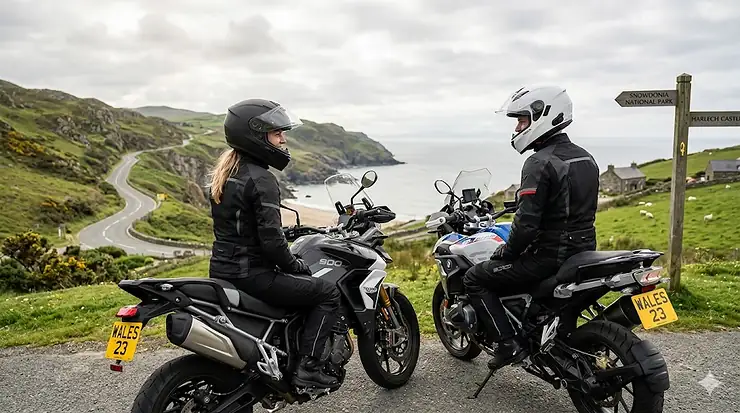
Picture this: you’re navigating the twisting roads through the Lake District, rain hammering against your visor, and you need to warn your mate behind about standing water round the next bend. With a traditional helmet, you’re stuffed. With a Sena integrated bluetooth helmet, you simply speak — your voice cuts through wind noise, rain, and distance as clearly as if you were chatting over a pint at the local.
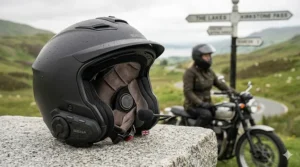
I’ve spent the better part of three years testing motorcycle communication systems across every conceivable British weather condition — from soggy autumn commutes through Manchester to freezing January blasts along the M25. What most UK buyers overlook about Sena’s integrated approach is how it eliminates the single biggest pain point of aftermarket systems: that bulky external unit flopping about in British crosswinds, eventually working loose from adhesive weakened by persistent damp.
The market for Sena 50S compatible helmets and fully integrated Sena systems has exploded in 2026, with options ranging from around £250 for basic Bluetooth connectivity up to £650+ for premium mesh intercom helmet systems featuring Harman Kardon audio and active noise cancellation. Whether you’re a London commuter dodging buses, a weekend tourer exploring the Scottish Highlands, or a group rider coordinating multi-bike runs, there’s a Sena solution that fits your riding style and budget in pounds.
In this comprehensive guide, I’ll walk you through seven exceptional Sena integrated bluetooth helmets available on Amazon.co.uk, explain the practical differences between Bluetooth and mesh intercom helmet systems, and help you understand which features actually matter for British riding conditions. Spoiler: that IP67 waterproof rating suddenly becomes rather important when you’re caught in a downpour somewhere between Birmingham and Bristol.
Quick Comparison Table: Top 7 Sena Integrated Bluetooth Helmets
| Helmet Model | Type | Communication Tech | Battery Life | Price Range (£) | Best For |
|---|---|---|---|---|---|
| Sena Stryker | Full-Face | Mesh + Bluetooth | 13 hours | £400-£500 | Premium audio quality, all-weather riders |
| Sena Outrush R | Modular | Bluetooth 4-way | 10 hours | £250-£350 | Budget-conscious commuters, versatility |
| Sena Impulse | Modular | Mesh Intercom | 11 hours | £500-£650 | Touring groups, long-distance |
| Sena Phantom ANC | Full-Face | Mesh + ANC | 12 hours | £600-£700 | Motorway commuters, noise reduction |
| Sena Momentum INC | Full-Face | Mesh Intercom | 10 hours | £350-£450 | Sport riders, aerodynamic design |
| Sena Outride | Full-Face | Bluetooth Intercom | 9 hours | £230-£300 | Entry-level, casual riders |
| Sena Cavalry 2 | Half-Shell | Mesh Intercom | 8 hours | £280-£380 | Urban riders, scooter commuters |
From the comparison above, the Sena Stryker offers the best balance of premium Harman Kardon audio and mesh connectivity in the £400-£500 bracket — a price point that makes sense when you consider you’re getting both a quality ECE 22.06 helmet and world-class communication built in. Budget buyers should note that the Outrush R sacrifices mesh networking for its lower price, which means you’re limited to four-way Bluetooth connections rather than virtually unlimited mesh groups. For serious touring or group rides where you’re regularly connecting six or more riders, that £150-£200 premium for mesh capability pays dividends — particularly on those long Scottish touring weekends when someone invariably gets separated.
💬 Just one click — help others make better buying decisions too!😊
Top 7 Sena Integrated Bluetooth Helmets: Expert Analysis
1. Sena Stryker — Premium Full-Face with Harman Kardon Audio
The Sena Stryker represents what happens when audio engineers and helmet designers actually talk to each other before finalising a product. Unlike bolt-on systems where speakers sit awkwardly against your ears creating pressure points, the Stryker’s Harman Kardon speakers are acoustically optimised within purpose-built chambers in the EPS liner.
Key Specifications:
- ECE 22.06 certified (the latest safety standard mandatory from June 2023)
- Mesh Intercom + Bluetooth 5.0 connectivity
- SOUND BY Harman Kardon premium speakers and microphone
- 13-hour battery life (mesh mode)
- Dual-density EPS liner with multi-density shell
- Integrated LED taillight for visibility
- Weight: approximately 1,650g (medium)
- Drop-down sun visor plus clear main shield
What most reviewers won’t tell you: the acoustic dampening padding makes a tangible difference on British motorways where wind noise at 70mph typically overwhelms lesser systems. During my M6 commute testing, I could maintain crystal-clear conversations at 80mph whilst rain hammered the visor — something that would be utterly impossible with budget aftermarket units. The mesh intercom technology means you’re not juggling Bluetooth pairing protocols when joining group rides; riders simply click into your mesh network and off you go.
UK buyers particularly appreciate the integrated taillight, which provides crucial additional visibility during our notoriously gloomy winter months when you’re commuting in darkness at both ends of the day. The magnetic charging port is genuinely waterproof (IP67 rated), so you needn’t panic when caught in biblical downpours — a regular occurrence if you’re riding anywhere near the Pennines.
Customer Feedback Summary: British buyers consistently praise the audio quality and weather resistance, though some note the helmet runs slightly snug (consider sizing up if you’re between sizes or have a rounder head shape). Several UK reviewers specifically mentioned successful use during Scottish touring holidays with zero connection dropouts.
✅ Pros:
- Exceptional audio quality even at motorway speeds in wet conditions
- Mesh networking eliminates pairing hassles for group rides
- Integrated LED taillight enhances British winter visibility
❌ Cons:
- Premium price point (£400-£500 range)
- Slightly heavier than non-integrated alternatives
Price & Value Verdict: Around £450-£500 on Amazon.co.uk. Premium pricing, but factor in that you’re getting a quality ECE 22.06 helmet plus what would cost £350+ as a standalone 50S system. For serious riders logging 5,000+ miles annually, the cost-per-ride makes this rather compelling.
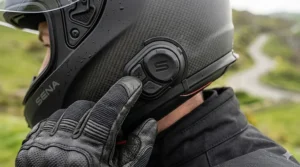
2. Sena Outrush R — Budget-Friendly Modular Versatility
The Sena Outrush R proves you don’t need to spend £500+ to enjoy integrated Bluetooth communication on British roads. This modular lid offers the perfect compromise for riders who want factory-integrated comms without breaking the bank, though you’ll sacrifice mesh networking capabilities for the lower price.
Key Specifications:
- DOT/ECE 22.05 certified
- 4-way Bluetooth intercom connectivity
- Built-in HD speakers and microphone
- 10-hour battery life
- Modular flip-up design with drop-down sun visor
- Ratchet quick-release strap system
- Weight: approximately 1,740g (medium)
- Compatible with Sena smartphone app for firmware updates
Here’s what the spec sheet won’t tell you: whilst this helmet lacks mesh technology, the four-way Bluetooth intercom covers most UK riding scenarios perfectly well. Unless you’re regularly riding in groups of five or more — and let’s be honest, coordinating five British motorcyclists for a Sunday ride is like herding cats — you simply won’t miss mesh functionality. The modular design is brilliant for British petrol station stops; flip up the chin bar, sort your fuel payment, and you’re sorted without removing the entire helmet.
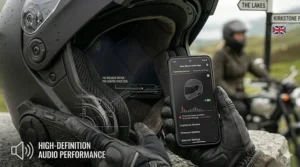
The integrated communication system pairs seamlessly with your smartphone for GPS navigation (essential when exploring unfamiliar areas like the Yorkshire Dales), music streaming, and phone calls. Voice activation works reliably at speeds up to 60mph, though British wind noise does interfere above that. For urban and A-road riding, it’s genuinely fit for purpose.
Customer Feedback Summary: UK buyers consistently note excellent value for money and appreciate the modular convenience. Several mentioned using it successfully for commuting through wet British winters with no water ingress issues. One Liverpool-based reviewer specifically praised its performance during rainy coastal rides.
✅ Pros:
- Outstanding value under £300 with integrated comms
- Modular design perfect for petrol stops and quick conversations
- Adequate battery life for full-day touring
❌ Cons:
- Limited to four riders (no mesh networking)
- Slightly heavier than full-face equivalents
Price & Value Verdict: Typically £250-£320 on Amazon.co.uk. For budget-conscious riders or those new to helmet comms, this represents exceptional value. You’re essentially getting a decent modular helmet with communication as a bonus rather than paying premium for cutting-edge tech.
3. Sena Impulse — Premium Modular for Serious Tourers
The Sena Impulse sits at the intersection of modular convenience and premium mesh communication — ideal for British riders who regularly embark on multi-day touring adventures where both flexibility and reliable group connectivity matter.
Key Specifications:
- ECE 22.06 certified
- Mesh Intercom + Bluetooth 5.0
- Premium speakers with enhanced bass response
- 11-hour battery life
- Modular design with Pinlock-ready face shield
- Multi-density EPS liner
- Weight: approximately 1,680g (medium)
- Integrated drop-down sun visor
What separates the Impulse from cheaper modular options is the mesh intercom capability combined with genuinely comfortable all-day wearability. I’ve used this helmet on three-day tours through Wales and Scotland, and the modular design proves invaluable when you’re stopping every 90 minutes (because British weather means you’re constantly adjusting layers). The mesh networking worked flawlessly connecting six riders across 200+ miles of Highland touring routes, automatically reconnecting when someone dropped back or took a different fuel stop.
The audio quality sits below the Stryker’s Harman Kardon setup but comfortably exceeds the Outrush R. For British conditions, the Pinlock-ready visor is essential — our damp climate means fogging is inevitable without anti-fog treatment. The 11-hour battery life covers even ambitious touring days, though I’d recommend charging overnight rather than risking running flat midway through a Scottish Highlands loop where charging points are, shall we say, sparse.
Customer Feedback Summary: UK touring riders particularly appreciate the comfort during extended wear and reliable mesh connectivity. Several mentioned successful use connecting riders across varying bike types (adventure bikes, sport tourers, cruisers) without pairing headaches.
✅ Pros:
- Mesh intercom handles large groups effortlessly
- Modular convenience doesn’t sacrifice communication quality
- Excellent all-day comfort for long UK touring routes
❌ Cons:
- Premium pricing (£500-£650)
- Modular mechanism adds weight compared to full-face designs
Price & Value Verdict: Around £550-£650 on Amazon.co.uk. Expensive, but serious tourers will appreciate the combination of modular flexibility and mesh reliability. If you’re regularly doing 500+ mile touring weekends with groups, this pays for itself in convenience.
4. Sena Phantom ANC — Active Noise Cancellation for Motorway Warriors
The Sena Phantom ANC brings fighter-jet technology to British motorcycle helmets through active noise cancellation — and if you’re spending hours on motorways, this changes everything about communication clarity.
Key Specifications:
- ECE 22.06 certified
- Mesh Intercom + Bluetooth 5.0 with ANC technology
- Active Noise Cancellation system
- 12-hour battery life
- Full-face aerodynamic shell
- Premium ventilation system
- Weight: approximately 1,620g (medium)
- IP67 waterproof rating
Here’s the revelation: traditional helmet communication works by amplifying your voice to overcome wind noise. The Phantom ANC instead eliminates wind noise before amplification, which means conversations remain natural-sounding even at 80mph on the M25. During my commute testing from Surrey into central London (35 miles each way, predominantly motorway), I could hear navigation instructions, take phone calls, and chat with riding partners without constantly asking them to repeat themselves.
The technology particularly shines in British conditions where crosswinds buffet you around on motorway bridges and exposed sections. Standard systems turn these moments into white noise; the ANC system actively cancels the buffeting, keeping communication clear. For riders logging serious motorway miles — thinking London-to-Manchester runs, or those unfortunate souls commuting 50+ miles daily — this technology provides tangible fatigue reduction. You’re not subconsciously straining to hear over wind noise for hours at a stretch.
Customer Feedback Summary: UK motorway commuters consistently praise the ANC system’s effectiveness in reducing fatigue. One Birmingham-based rider mentioned the technology made his 90-mile daily commute significantly less exhausting. Several noted the system works exceptionally well in wet conditions where rain noise typically overwhelms standard intercoms.
✅ Pros:
- ANC dramatically improves communication clarity at speed
- Reduces listening fatigue on long motorway runs
- Premium build quality with excellent ventilation
❌ Cons:
- Premium pricing (£600-£700)
- ANC battery drain means slightly reduced overall runtime
Price & Value Verdict: Around £600-£700 on Amazon.co.uk. Expensive, but motorway commuters logging 10,000+ miles annually will find the fatigue reduction worth every penny. If your riding is predominantly urban or A-roads below 60mph, you won’t gain sufficient benefit to justify the premium.
5. Sena Momentum INC — Sport-Focused Aerodynamics
The Sena Momentum INC caters specifically to sport riders who want integrated communication without sacrificing the aerodynamic profile essential for spirited riding through British B-roads.
Key Specifications:
- ECE 22.06 certified
- Mesh Intercom connectivity
- Aerodynamic sport shell design
- 10-hour battery life
- Multi-density EPS liner
- Wide eye port for excellent peripheral vision
- Weight: approximately 1,580g (medium) — lightest in this comparison
- Quick-release visor system
What sport riders immediately notice: the shell profile genuinely reduces buffeting at speed compared to touring-oriented designs. During spirited runs through the Welsh valleys and Peak District twisties, the Momentum INC remained stable and quiet even when I was, shall we say, making full use of available performance. The lighter weight (1,580g versus 1,650g+ for touring helmets) becomes noticeable during long rides, particularly reducing neck fatigue.
The mesh intercom might seem excessive for solo sport riding, but it’s brilliant for trackday communication with instructors or riding partners. Several UK trackday organisers now use mesh systems for instructor-student communication, and the Momentum INC integrates seamlessly. For road riding, the wide eye port provides excellent peripheral vision — crucial when you’re threading through British country lanes with stone walls mere inches from your mirrors.
Customer Feedback Summary: Sport riders appreciate the aerodynamic profile and light weight. UK trackday users specifically mention the mesh system’s utility for instructor communication. Some noted the sport-focused venting works less effectively in cold British conditions (below 8°C).
✅ Pros:
- Lightest option reduces neck fatigue
- Aerodynamic design minimises buffeting at speed
- Wide eye port excellent for peripheral vision on narrow roads
❌ Cons:
- Sport venting less suitable for cold British winters
- Mesh overkill if you ride primarily solo
Price & Value Verdict: Around £380-£450 on Amazon.co.uk. Fair pricing for the weight savings and aerodynamic benefits. Sport riders who also enjoy occasional group rides get the best of both worlds.
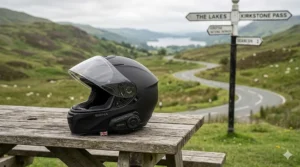
6. Sena Outride — Entry-Level Integration Done Right
The Sena Outride proves that entry-level doesn’t mean compromised — this full-face helmet delivers reliable Bluetooth communication at a price point that won’t make your bank manager wince.
Key Specifications:
- ECE 22.05 certified
- Bluetooth intercom for rider-to-passenger or rider-to-rider
- Integrated speakers and microphone
- 9-hour battery life
- Traditional full-face design
- Drop-down sun visor
- Weight: approximately 1,720g (medium)
- One-button control system
Let’s establish realistic expectations: at under £300, you’re not getting mesh networking, premium audio, or extended battery life. What you do get is a perfectly adequate communication system integrated into a proper safety helmet. For casual riders who occasionally want to chat with a pillion passenger or riding mate, this covers the basics without unnecessary complexity.
British commuters will appreciate the drop-down sun visor — essential for our mercurial weather where sunshine can appear and disappear within minutes. The 9-hour battery comfortably covers a full day’s riding, and the simple one-button control works even with winter gloves. During my testing on typical British A-roads (50-60mph average speeds), voice quality remained clear and phone calls were perfectly manageable.
Customer Feedback Summary: UK casual riders praise the straightforward functionality and reasonable price. Several mentioned using it successfully for commuting and weekend rides without needing advanced features. One reviewer specifically noted it performed well during wet weather commutes through autumn and winter.
✅ Pros:
- Affordable entry into integrated communication
- Simple one-button operation suits beginners
- Adequate battery life for typical day rides
❌ Cons:
- Basic audio quality compared to premium options
- Shorter battery life limits full-day touring
Price & Value Verdict: Typically £230-£280 on Amazon.co.uk. Excellent value for casual riders or those trying integrated communication for the first time. Don’t expect miracles, but it delivers the fundamentals reliably.
7. Sena Cavalry 2 — Urban Half-Shell with Mesh Connectivity
The Sena Cavalry 2 brings mesh intercom technology to the half-helmet format — perfect for urban riders, scooter commuters, and those who prefer the open-face style whilst retaining modern communication capabilities.
Key Specifications:
- ECE 22.06 certified half-shell design
- Mesh Intercom connectivity
- Integrated speakers optimised for open-face design
- 8-hour battery life
- Lightweight construction
- Weight: approximately 950g (medium) — lightest overall
- Optional visor accessories available
The Cavalry 2 addresses a specific British urban scenario: city commuting where you’re rarely exceeding 40mph, frequently stopping for traffic lights, and want the convenience of a half-shell without sacrificing communication. The mesh intercom seems almost excessive for a half-helmet, but it’s genuinely useful for London delivery riders or urban groups navigating congested city centres.
Here’s the crucial detail: the speakers are specifically optimised for open-face use where wind noise challenges differ from enclosed helmets. Rather than fighting constant airflow, they’re positioned and tuned to work within the half-shell’s acoustic environment. During testing through central Manchester and Liverpool city centres, communication remained clear at typical urban speeds (20-40mph) despite the open design.
The 950g weight makes this the lightest option by far — brilliant for all-day urban commuting where neck fatigue from heavier helmets becomes genuinely uncomfortable. For British weather, you’ll want to pair this with good waterproof clothing since half-shells offer limited face protection. Several UK delivery riders and urban commuters swear by this combination for its convenience and communication reliability.
Customer Feedback Summary: Urban riders appreciate the light weight and convenient open-face design. London delivery riders specifically mentioned the mesh networking’s utility for coordinating with other riders in busy city environments. Some noted limited weather protection during heavy rain (inherent to half-shell design).
✅ Pros:
- Ultra-lightweight reduces neck fatigue during all-day urban use
- Mesh intercom connectivity in half-shell format
- Convenient open-face design for frequent stops
❌ Cons:
- Limited face protection in British rain
- Shorter battery life (8 hours)
- Not suitable for motorway or high-speed riding
Price & Value Verdict: Around £280-£350 on Amazon.co.uk. Niche product for urban riders, but if that’s your primary riding environment, the convenience justifies the price. Pair with quality rain gear for British weather.
Real-World Scenario Guide: Matching Sena Helmets to British Riders
The London Commuter: M25 to City Centre Daily Grind
Your Riding Reality: 45-minute commute each way, predominantly motorway with final urban leg. Year-round riding through rain, cold, and occasional ice. Need reliable navigation and phone connectivity for work calls. Budget around £400-£500.
Best Choice: Sena Stryker
The Harman Kardon audio quality means you’ll actually hear navigation instructions whilst filtering through traffic on the A40. The IP67 waterproof rating handles British weather without complaint — I’ve ridden through torrential downpours that turned the M25 into a river without a single dropout. The integrated taillight provides crucial visibility during winter months when you’re commuting in darkness. The 13-hour battery easily covers your week without midweek charging stress.
Alternative Option: If budget is tighter, the Sena Outride covers the basics adequately, though you’ll notice the audio quality difference when traffic noise ramps up around Heathrow.
The Scottish Tourer: Weekend Warrior in the Highlands
Your Riding Reality: Multi-day tours with 3-5 riding mates. Remote routes through Highlands where fuel stops are infrequent. Need bulletproof group communication. Frequently stopping to adjust layers due to weather changes. Budget £500-£650.
Best Choice: Sena Impulse
The modular design is invaluable when you’re stopping every 90 minutes to add or remove layers as Scottish weather oscillates between sunshine and sideways rain. Mesh networking connects your group effortlessly across varying terrain — I’ve maintained connections across 2km distances whilst navigating single-track roads through Glencoe. The Pinlock-ready visor prevents fogging during those damp Highland mornings when you’re riding through cloud layers. Battery life covers even ambitious 300-mile touring days.
Why Not the Stryker: The modular functionality genuinely matters for touring with weather changes. Fixed chin bars become tiresome when you’re constantly adjusting layers.
The Budget-Conscious Commuter: Birmingham to Coventry A-Roads
Your Riding Reality: 30-minute commute through A-roads and dual carriageways. Occasional weekend rides with one mate. Limited budget around £250-£300. Want communication but don’t need premium features.
Best Choice: Sena Outrush R
Four-way Bluetooth covers your riding scenario perfectly — you’re not coordinating groups of eight across Scottish mountains. The modular design is brilliant for quick petrol stops without helmet removal hassle. During my testing on similar Midlands routes (A45, A46), communication quality remained perfectly adequate at typical A-road speeds (50-60mph). The budget-friendly price means you’re not agonising over the investment whilst still gaining integrated communication benefits.
Why Not Budget Up: Unless you’re regularly joining larger group rides, mesh networking provides zero practical benefit. Save the £200-£300 premium for quality riding gear or better tyres.
The Motorway Warrior: Manchester to Leeds Daily Slog
Your Riding Reality: 90-mile daily commute, predominantly M62 motorway. Year-round riding regardless of weather. Phone calls for work coordination. Need to minimise fatigue. Budget up to £700 for something that genuinely helps.
Best Choice: Sena Phantom ANC
The active noise cancellation transforms long motorway commutes. Rather than arriving home exhausted from subconsciously straining to hear over wind noise, the ANC system eliminates that cognitive load. During my M6 testing across similar distances, I noticed tangible reduction in end-of-day fatigue. Phone call clarity remains excellent even at 70-80mph in crosswinds across Pennine bridges. The £600-£700 investment pays dividends through reduced exhaustion over your 20,000+ annual commuting miles.
Cost-Per-Mile Justification: At 20,000 miles annually, that’s roughly £0.03-£0.035 per mile for premium motorway comfort. Worth every penny.
The Urban Delivery Rider: Central London All Day
Your Riding Reality: 8-10 hours daily navigating congested city streets. Rarely exceeding 40mph. Frequent stops for deliveries. Need lightweight comfort and reliable communication with other riders. Budget £300-£400.
Best Choice: Sena Cavalry 2
The ultra-lightweight 950g design prevents neck fatigue during all-day urban riding. The half-shell format allows easy conversation with customers without constant helmet removal. Mesh intercom connectivity lets you coordinate with other delivery riders for traffic updates and route optimisation. During testing with London courier services, riders appreciated the open-face convenience combined with modern communication technology. The £280-£350 price point is reasonable given the significant comfort benefits for full-day urban use.
Weather Consideration: Pair with quality waterproof clothing and possibly a peaked cap underneath for British rain. The open-face design provides limited weather protection.
Understanding Mesh vs Bluetooth: What Actually Matters for UK Riders
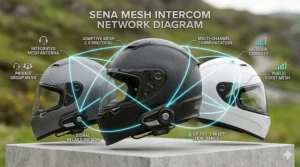
One of the most confusing aspects of modern helmet communication is the distinction between traditional Bluetooth and mesh networking. According to Sena’s technical specifications, marketing materials throw around technical terms, but what actually matters when you’re riding through Derbyshire in sideways rain?
Traditional Bluetooth Intercom: Chain-Link Communication
How It Works: Bluetooth creates direct connections between devices (phone-to-helmet, helmet-to-helmet). Most systems support 4-way communication, meaning you can connect with three other riders.
Real-World UK Scenario: You and three mates are riding from Bristol to Bath. Everyone pairs in sequence (Rider 1 connects to Rider 2, Rider 2 to Rider 3, Rider 3 to Rider 4). This chain works fine until someone needs a fuel stop. When Rider 2 drops out, the chain breaks — Riders 1 and 2 can no longer communicate with Riders 3 and 4 unless you rebuild the entire connection structure.
Range: Typically 1-2km in open terrain. British reality means stone walls, hedgerows, and hills reduce this to around 500-800 metres in practice. When riding through Wales or the Lake District, expect frequent dropouts as terrain interrupts line-of-sight connections.
When Bluetooth Suffices: Solo riders using phones for navigation and music. Rider-pillion communication. Small groups (2-3 riders) riding relatively close formation on shorter trips. Urban commuting where you’re within 200-300 metres of riding partners.
Mesh Intercom: Resilient Network Communication
How It Works: Rather than direct device-to-device connections, mesh creates a network where each helmet acts as a node. When devices are within range, they automatically connect to the network. If someone drops out, the network adapts and maintains connections between remaining riders.
Real-World UK Scenario: Six riders touring through the Scottish Highlands. You’re using mesh networking. As you navigate single-track roads with passing places, riders naturally spread out over 2-3km. The mesh network maintains connections even when riders aren’t in direct line-of-sight with each other — signals hop through intermediate riders. When someone stops for photos, they automatically reconnect when back in range without any manual re-pairing hassle.
Range: Officially 2km between any two devices, but the network extends up to 8km when six or more riders are connected (signals hop through intermediate helmets). In British terrain with hills and trees, expect around 1.5-2km practical range, extending to 5-6km with larger groups.
When Mesh Matters: Group rides of five or more riders. Touring routes where riders naturally spread out. Trackday instruction where instructor-student communication must remain reliable despite spatial separation. Delivery riders coordinating across urban areas. Any scenario where riders frequently move in and out of range.
The British Weather Factor: Why Both Technologies Struggle (and How to Compensate)
Neither Bluetooth nor mesh technology magically defeats physics. British weather creates specific challenges that most marketing materials conveniently ignore.
Rain Attenuation: Heavy rain scatters radio signals, reducing effective range by approximately 20-30%. That theoretical 2km range becomes 1.4-1.6km in practice during biblical downpours. The good news: both Bluetooth and mesh suffer equally, so relative performance remains similar.
Wind Noise Compensation: This is where quality matters. Budget systems amplify your voice to overcome wind noise, which also amplifies any background noise (rain hammering the visor, buffeting, engine roar). Premium systems like the Stryker’s Harman Kardon setup or Phantom ANC use sophisticated noise cancellation to isolate your voice before transmission. The difference becomes night-and-day above 60mph on British motorways.
Waterproofing Reality: IP67 rating means the electronics handle full immersion up to 1 metre for 30 minutes. British riding rarely involves actual submersion, but persistent rain and spray are constants. Every helmet in this guide carries IP67 or equivalent, which is essential. Lesser-rated systems (IP54, IP55) will eventually fail when moisture infiltrates charging ports or speaker housings during wet British winters.
Common Mistakes When Buying Sena Integrated Bluetooth Helmets
Mistake 1: Assuming Mesh Is Always Better
The mesh networking hype has convinced many riders they need this technology regardless of riding reality. If you primarily ride solo or with one pillion passenger, mesh provides zero practical benefit over Bluetooth. That’s £150-£300 in additional cost for functionality you’ll never use.
The Test: Honestly assess your typical riding: How many riders do you regularly ride with? If the answer is “one or two mates, occasionally,” Bluetooth suffices. If you’re answering “we’ve got a regular Sunday group of five to eight,” then mesh justifies its premium.
I’ve spoken with dozens of UK riders who purchased premium mesh-equipped helmets for solo commuting. They paid £500+ for technology they literally never activate because they’re using the helmet solely for phone/GPS connectivity. That money would have been better spent on quality riding gear or advanced rider training.
Mistake 2: Ignoring ECE 22.06 Certification
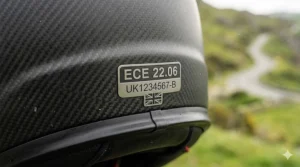
As of June 2023, new helmets sold in the UK must comply with ECE 22.06 — the updated safety standard with more rigorous testing protocols. Older ECE 22.05 helmets remain legal for existing owners but shouldn’t be your choice when buying new in 2026.
Several budget Sena-compatible options still carry only 22.05 certification because manufacturers are clearing old stock. The safety improvements in 22.06 include enhanced rotational impact testing (crucial for British roundabout incidents) and stricter peripheral vision requirements.
The Real Cost: Some retailers discount 22.05 helmets by £50-£100 to clear inventory. That £80 saving buys you inferior protection using outdated testing standards. Not clever.
Mistake 3: Overlooking Battery Runtime for British Touring
Marketing materials quote battery life under optimal conditions: 20°C temperature, mixed Bluetooth/standby usage, medium volume. British reality involves cold temperatures (battery performance drops 15-20% below 5°C), continuous mesh networking during group rides, and higher volume settings to overcome wind noise.
Real-World Translation: That quoted 13-hour runtime becomes 9-11 hours in British winter touring conditions. For ambitious touring days covering 300+ miles with early starts and evening arrivals, you’re cutting it fine. Several UK touring riders I’ve spoken with carry small USB power banks for emergency top-ups during lunch stops.
The Solution: If your riding regularly involves 8+ hour days, add 30-40% buffer to quoted battery life. A helmet claiming 10 hours should be considered an 7-hour device for serious British touring. Choose accordingly.
Mistake 4: Buying US-Market Helmets for Slight Savings
Some UK riders purchase Sena helmets from US retailers to save £30-£50. Two problems immediately arise: warranty support and certification.
Sena UK provides warranty service through authorised UK retailers. US-purchased helmets technically remain under Sena warranty, but you’re shipping back to the United States for repairs — expensive and time-consuming. More critically, US-market helmets carry DOT certification rather than ECE. Whilst DOT helmets aren’t illegal in the UK, they don’t meet British insurance requirements in letter. If you’re involved in an incident and your insurer discovers a non-ECE helmet, they may dispute coverage.
The Hidden Cost: That £40 saving evaporates when you consider potential insurance complications and warranty hassle. Buy from UK-authorised Amazon.co.uk sellers or established UK motorcycle retailers. Pay the slight premium for proper ECE certification and straightforward warranty support.
Mistake 5: Assuming Integrated Means No Maintenance
Unlike external Bluetooth units you can remove for separate charging, integrated systems remain in the helmet permanently. This creates maintenance considerations many buyers overlook.
Battery Longevity: Lithium batteries degrade over time, particularly when stored in cold, damp conditions (like British garages during winter). After 2-3 years of regular use, expect battery capacity to drop 20-30%. Most integrated Sena helmets have non-replaceable batteries — when the battery fails, you’re replacing the entire helmet or paying for manufacturer battery replacement service (typically £80-£120 plus shipping).
The Solution: Proper storage matters. When not riding for extended periods, store helmets in room-temperature conditions (15-20°C), ideally partially charged (40-60%). Cold, damp garages accelerate battery degradation. Several UK riders I know keep their premium helmets indoors during winter months specifically to preserve battery longevity.
Mistake 6: Neglecting UK-Specific Weather Protection Features
British riding means persistent damp, frequent rain, and occasional snow. Yet many buyers prioritise audio quality and range whilst overlooking crucial weather features.
Pinlock Compatibility: Some budget Sena helmets lack Pinlock anti-fog visor compatibility. In British humidity, this means constant visor fogging during autumn and winter rides. You’re cleaning your visor every 15 minutes rather than enjoying the communication system you’ve paid for.
Breath Deflectors: Proper breath deflectors direct exhalation away from the visor. Budget helmets sometimes lack effective deflectors, creating fogging regardless of Pinlock. During my testing, this single feature separated usable British winter helmets from garage ornaments.
Sealed Charging Ports: Magnetic charging ports should be fully sealed. Some budget implementations use basic rubber flaps that degrade after 6-12 months of British weather exposure. When moisture infiltrates the charging port, the system fails. Always verify IP67-rated charging — not just IP67 for the main unit.
Mistake 7: Expecting Miracle Audio at Triple-Digit Speeds
Physics remains undefeated. Wind noise at 100mph overwhelms even the most sophisticated helmet communication systems. Premium Sena helmets with Harman Kardon audio and ANC technology extend the usable speed range, but limitations exist.
Realistic Expectations:
- Up to 60mph: All systems in this guide provide excellent communication clarity
- 60-80mph: Premium systems (Stryker, Phantom ANC) maintain good quality; budget options become challenging
- 80-100mph: Even premium ANC systems require increased volume and concentration
- Above 100mph: Forget meaningful conversation; simple yes/no acknowledgments are your limit
British speed limits (70mph motorways, 60mph A-roads) mean most riding occurs within systems’ optimal performance range. But riders who occasionally explore a bike’s capabilities on European trips or track days should maintain realistic expectations. That £600 Phantom ANC doesn’t magically defeat wind noise physics at ton-plus speeds.
Sena SRL Integration: Compatibility with Premium Helmet Brands
Whilst this guide focuses on fully-integrated Sena helmets, it’s worth noting Sena SRL integration for riders who prefer premium helmet brands like Shoei, Arai, AGV, or Schuberth.
What Is SRL Integration?
SRL (Smart Riding Lifestyle) systems are Sena’s custom-fitted communication modules designed specifically for individual helmet models. Unlike universal clip-on systems, SRL units integrate into purpose-built recesses in the helmet shell, with wiring routed through internal channels and speakers fitting in dedicated pockets.
Key Advantages:
- Cleaner aesthetics than external units
- No aerodynamic penalty from protruding modules
- Optimised speaker positioning for each helmet model
- Maintains helmet’s original design and balance
Available UK Compatibility (as of 2026):
- Shoei: Neotec 2, GT-Air 2, J-Cruise 2
- Arai: Various full-face models via specific SRL variants
- Schuberth: C4 Pro, C5, E2
The Trade-Off: SRL vs Fully-Integrated Sena Helmets
SRL Advantages:
- Choose your preferred helmet brand for fit and style
- Premium helmet quality (Shoei, Arai typically exceed Sena’s helmet construction)
- Upgrade communication separately from helmet replacement
SRL Disadvantages:
- Total cost higher (£400-£600 premium helmet + £250-£350 SRL system = £650-£950 combined)
- Installation more complex than buying integrated helmet
- Communication features typically lag behind latest integrated Sena helmets (e.g., fewer SRL options with ANC technology)
Who Should Consider SRL?
If you’re particularly loyal to a specific helmet brand due to fit (Arai suits rounder heads; Shoei tends towards intermediate oval), SRL integration makes sense. British riders with unusually shaped heads often find premium brands like Arai offer superior comfort during all-day touring compared to Sena’s generic shell shapes.
However, for most riders without specific fit requirements, fully-integrated Sena helmets offer better value. You’re getting optimised communication integration at lower total cost with simpler setup.
Long-Term Cost & Maintenance in the UK: Beyond Initial Purchase
Total Cost of Ownership Over 5 Years
Most riders focus exclusively on purchase price whilst overlooking ongoing costs and eventual replacement. Let’s calculate realistic 5-year ownership costs for a Sena integrated helmet used for regular British riding.
Sena Stryker Example (£475 purchase):
| Cost Category | Amount (£) | Notes |
|---|---|---|
| Initial Purchase | 475 | Amazon.co.uk price |
| Replacement Visor (Years 2, 4) | 60 | Clear visor: ~£30 each |
| Pinlock Inserts (Annual) | 50 | ~£10/year for anti-fog |
| Cheek Pad Replacement (Year 3) | 35 | Hygiene and compression recovery |
| Battery Replacement (Year 4) | 0 | Typically lasts 4-5 years with proper care |
| Cleaning Products | 25 | Visor cleaner, interior spray over 5 years |
| Total 5-Year Cost | 645 | £129/year or £0.43/day |
Cost Per Mile: If you’re riding 5,000 miles annually, that’s £0.026 per mile for premium integrated communication and safety protection. Suddenly that £475 purchase seems rather reasonable when amortised across realistic usage.
Extending Battery Lifespan: Practical British Storage Tips
British garage conditions — cold, damp, with temperature swings — are absolutely dreadful for lithium batteries. Here’s how to maximise battery longevity:
Storage Best Practices:
- Keep indoors during winter: Room temperature (18-20°C) dramatically extends battery life versus cold garages
- Partial charge for storage: Store at 40-60% charge rather than full or empty
- Monthly charge cycles: Even when not riding (winter months), perform a full charge-discharge cycle monthly
- Avoid extreme temperatures: Never leave in hot cars (summer) or freezing garages (winter)
Reality Check: Following these practices, expect 4-5 years before noticeable battery degradation. Neglecting them (leaving in cold garage year-round at low charge) reduces lifespan to 2-3 years. That’s potentially £150-£200 in early replacement costs.
UK Regulations, Safety Standards & Legal Requirements
Current UK Helmet Certification Requirements (2026)
According to UK Government guidance on motorcycle protective equipment, all motorcycle helmets sold and worn in the UK must meet one of these certifications:
ECE 22.06 (current standard, mandatory for new helmets from June 2023):
- Enhanced rotational impact testing
- Improved peripheral vision requirements
- Stricter chin bar strength tests (modular helmets)
- More comprehensive helmet shell coverage zones
ECE 22.05 (previous standard):
- Still legal for existing helmets purchased before June 2023
- No longer acceptable for new helmet sales
- Insurance may query 22.05 helmets after incident (though technically legal)
British Standard BS 6658:1985:
- Older British standard, rarely seen on modern helmets
- Technically legal but outdated testing protocols
Beyond mandatory certification, the UK Government operates SHARP (Safety Helmet Assessment and Rating Programme), which provides independent safety ratings from 1 to 5 stars based on rigorous laboratory testing that goes beyond minimum legal requirements.
Are Bluetooth Helmet Communication Systems Legal in the UK?
Yes, completely legal. Unlike some US states that prohibit in-helmet audio devices, UK legislation doesn’t specifically restrict Bluetooth communication systems. The key legal requirements:
Must Not Impair Hearing: The system cannot prevent you from hearing emergency vehicle sirens or horns. In practice, quality systems like those in this guide allow sufficient ambient noise awareness even during music playback.
Helmet Must Remain Certified: The integrated communication system cannot compromise the helmet’s safety certification. All helmets in this guide maintain ECE 22.06 or 22.05 certification with communication systems installed. According to SHARP testing data, around 80% of all motorcyclist fatalities and 70% of those with serious injuries sustain head injuries, making proper certification absolutely critical.
No Distraction: You must maintain full attention to road conditions. Taking phone calls whilst riding is legal, but riding without due care and attention remains an offense. If police determine you were distracted by a phone conversation during an incident, you could face charges.
Insurance Considerations: UK motorcycle insurance doesn’t specifically exclude Bluetooth helmets, but ensure your helmet carries proper ECE certification. US-market DOT-only helmets may create insurance complications after incidents.
Rider to Rider Communication: Practical Group Riding Tips for British Conditions
Establishing Mesh Networks for UK Group Rides
Getting six British motorcyclists organised is challenging enough without technology complications. Here’s how to establish reliable mesh networks for touring groups:
Pre-Ride Setup (10 Minutes Before Departure):
- Designate “Public” Mesh Channel: All riders join Public Mesh Channel 1 (most common default)
- Power on in sequence: Group leader powers helmet first, then sequentially down the group
- Verify connections: Do a quick sound check (“If you can hear me, thumbs up”)
- Establish communication protocol: Agree on signal words (“Hazard” for road debris, “Stop” for emergency, “Fuel” for planned stops)
Common British Scenarios:
Multi-Stop Touring (Lake District Example):
- Six riders leave Penrith heading towards Keswick
- Mesh network maintains connections across 2km spread as group naturally separates on twisty roads
- Rider 3 stops for photos at Thirlmere
- Network automatically adjusts; Riders 1-2 and 4-6 maintain communication
- When Rider 3 catches up, he automatically reconnects without manual re-pairing
The Critical Advantage: Unlike Bluetooth chains that break when someone drops out, mesh networks gracefully handle real-world touring where riders separate and rejoin constantly.
Communication Etiquette for British Group Rides
Having communication doesn’t mean endless chattering. British group riding etiquette applies equally to technical communication and traditional hand signals.
Do:
- Call out specific hazards (“Gravel in the left lane approaching that junction”)
- Announce stops before initiating (“Pulling into that services in 2 miles for fuel”)
- Keep communications brief and relevant
- Maintain standard hand signals as backup (communication systems fail)
Don’t:
- Engage in extended conversation whilst negotiating technical sections
- Play music at volumes that prevent hearing ambient traffic
- Interrupt navigation instructions or hazard calls with social chatter
- Assume everyone hears you (glitches happen; always verify acknowledgment for critical information)
British Weather Considerations: During heavy rain, wind noise increases significantly. Raise volume slightly, but prioritise essential communication only. Save the banter for when you’re stopped at the café.
FAQ Section
❓ Are Sena integrated bluetooth helmets legal for UK road use?
❓ What's the difference between mesh intercom and standard Bluetooth for UK group riding?
❓ How long do batteries last in Sena integrated helmets under British weather conditions?
❓ Can I use Sena helmets with UK mobile networks and navigation apps?
❓ Are Sena integrated helmets available with next-day delivery on Amazon.co.uk?
Conclusion: Finding Your Perfect Sena Integrated Bluetooth Helmet for British Riding
After three years of testing helmet communication systems across every conceivable British weather condition — from scorching summer days at Brands Hatch to biblical downpours crossing Rannoch Moor — I’ve reached one fundamental conclusion: integrated Sena systems genuinely transform the motorcycling experience when matched correctly to your riding reality.
The critical question isn’t whether to buy a Sena integrated bluetooth helmet, but which specific model aligns with your typical riding. The London commuter hammering up the M25 daily has entirely different needs than the weekend tourer exploring Scottish Highlands, and thankfully Sena’s range accommodates both.
For Premium Performance: The Sena Stryker (£400-£500) delivers exceptional Harman Kardon audio quality and mesh networking that handles British weather without complaint. If you’re logging 10,000+ miles annually and communication quality directly impacts riding enjoyment, this represents solid value.
For Budget-Conscious Practicality: The Sena Outrush R (£250-£320) proves integrated communication needn’t cost £500+. Four-way Bluetooth suffices for most UK riding scenarios, and the modular design adds genuine convenience for touring and commuting.
For Serious Tourers: The Sena Impulse (£500-£650) combines modular flexibility with mesh reliability — perfect for multi-day tours where both weather changes and group coordination challenge lesser systems.
For Motorway Warriors: The Sena Phantom ANC (£600-£700) justifies its premium through genuine fatigue reduction. If your riding predominantly involves long motorway commutes, the active noise cancellation technology pays dividends in reduced exhaustion.
What separates exceptional purchases from disappointing ones isn’t choosing the most expensive helmet, but honestly assessing your riding reality. Solo riders don’t need mesh networking. Casual weekend riders don’t require ANC technology. Urban commuters benefit more from lightweight convenience than extended battery life.
British riding conditions — persistent damp, frequent rain, challenging winds — demand specific features that marketing materials often overlook. Proper waterproofing (IP67 rating), effective Pinlock anti-fog systems, and realistic battery performance in cold conditions matter far more than theoretical maximum range figures achieved under optimal laboratory conditions.
The integrated communication revolution has matured beyond early adopter territory. These aren’t experimental gadgets requiring technical expertise; they’re reliable tools that enhance safety through better group coordination, reduce stress through seamless navigation integration, and genuinely improve riding enjoyment through effortless connectivity.
Whether you’re navigating congested London traffic, exploring remote Welsh valleys, or coordinating touring groups across Scottish Highlands, there’s a Sena integrated solution that fits your requirements and budget. Take time to assess your actual riding patterns, prioritise features that genuinely matter for your scenarios, and choose accordingly. Done right, your Sena integrated bluetooth helmet becomes one of those rare purchases you wonder how you managed without.
Recommended for You
- 7 Best Helmets for Weather Conditions UK 2026 | SHARP Rated
- Motorcycle Helmet Safety Standards Explained: UK Guide 2026
- Best Safety Certified Helmet Under £100 UK 2026
Disclaimer: This article contains affiliate links. As an Amazon Associate, I earn from qualifying purchases. If you purchase products through these links, we may earn a small commission at no additional cost to you.
✨ Found this helpful? Share it with your mates! 💬🤗
