In This Article
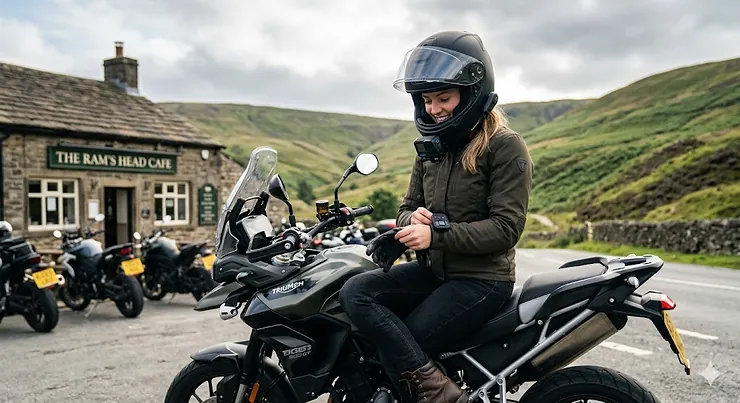
You’ve just crested the Pennines on a crisp Sunday morning, mist still sitting in the valley below, the road completely clear ahead. It’s exactly the kind of ride you want to remember — and share. Which is precisely why you’re here, looking for a GoPro ready motorcycle helmet that won’t wobble the footage into an unwatchable blur, yank your neck at 70 mph, or compromise the protection your skull rather depends on.
A GoPro ready motorcycle helmet, in practical terms, is any helmet specifically designed or widely proven to accommodate an action camera mounting system — whether via a smooth chin bar suited to 3M adhesive mounts, integrated mounting points, or a streamlined profile that keeps wind drag manageable at speed. It’s not just about slapping a sticky pad somewhere and hoping for the best. It’s about the whole system working together: helmet aerodynamics, camera angle, mount stability, and — critically in Britain’s famously damp climate — the ability to keep shooting reliably in everything from a Dorset drizzle to a full Yorkshire downpour.
For UK riders, there’s an extra layer of complexity. Helmet safety in Britain is governed by ECE 22.06 — the most rigorous international standard currently in force — and the SHARP helmet safety scheme, run by the Department for Transport, provides independent star ratings that UK buyers should use as a primary reference. Any helmet you buy should carry ECE 22.06 approval as a baseline. Full stop.
In this guide, we’ve researched and analysed seven of the best GoPro ready motorcycle helmets available on Amazon.co.uk right now — covering budget, mid-range, and premium options — alongside everything you need to know about mounting positions, UK regulations, and getting genuinely usable footage from British roads.
Quick Comparison: GoPro Ready Motorcycle Helmets at a Glance
| Helmet | Type | Price Range | Safety Rating | Camera Mount Compatibility | Best For |
|---|---|---|---|---|---|
| Shoei NXR2 | Full-face | £400–£520 | ECE 22.06 | Excellent (dedicated chin mount) | Premium touring/sport |
| HJC RPHA 12 | Full-face | £300–£450 | ECE 22.06 | Excellent (smooth chin bar) | Value premium |
| AGV K6 S | Full-face | £250–£380 | ECE 22.06 | Very good | Sport & commuting |
| Shark Spartan GT Pro | Full-face | £200–£320 | ECE 22.06 | Very good | Mid-range touring |
| LS2 FF808 Stream 2 | Full-face | £130–£200 | ECE 22.06 | Good (budget-friendly setup) | Beginners & commuters |
| Ruroc Atlas 4.0 | Full-face | £400–£500 | ECE 22.06 | Good (bespoke chin mount available) | Style-conscious riders |
| Scorpion Exo-R1 Air | Full-face | £280–£400 | ECE 22.06 | Very good | Track & fast road |
The comparison above immediately tells you something useful: every helmet in this guide holds ECE 22.06 approval, which is non-negotiable for UK road use. What separates them is the quality of that camera integration experience. The Shoei NXR2 and HJC RPHA 12 sit at the top of the camera-compatibility rankings simply because their chin bar geometry plays nicely with purpose-made 3D-printed and injection-moulded chin mounts — meaning your GoPro ends up precisely where you want it, not hanging at an awkward angle. Budget riders will find the LS2 FF808 a surprisingly capable performer once paired with an adhesive chin mount kit, though the setup requires a bit more patience.
💬 Just one click — help others make better buying decisions too! 😊
✨ Don’t Miss These Exclusive Deals!
🔍 Take your action camera helmet setup to the next level with these carefully selected picks. Click on any highlighted product below to check current pricing and availability on Amazon.co.uk. These choices are here to save you hours of research and a few costly mistakes.
Top 7 GoPro Ready Motorcycle Helmets: Expert Analysis
1. Shoei NXR2 — The Benchmark for Camera-Compatible Sports Touring
If any single helmet has earned its reputation as the GoPro ready motorcycle helmet of choice among serious UK motovloggers, it’s the Shoei NXR2. The smooth, flowing geometry of its chin bar is essentially purpose-built for third-party chin mounts — specifically the injection-moulded designs made for the NXR2/RF-1400 platform. Your camera ends up sitting at true eye level, in what engineers call the aerodynamic “dead air zone,” which means significantly less wind resistance and a noticeably more stable image at motorway speeds.
Key specs worth understanding in context: the NXR2’s AIM+ shell construction uses a combination of fibreglass, organic fibres, and Shoei’s proprietary reinforcement — it’s not merely light, it’s light while maintaining a shell stiffness that directly contributes to mount stability. A rigid shell means less flex, less vibration transmitted to the camera. In damp British conditions, that matters. The Pinlock 120 EVO lens-ready visor system is equally thoughtful — fog-free vision matters as much as good footage.
This is a helmet for the experienced UK rider who commutes three days a week and disappears to the Peak District on weekends. It’s not cheap, sitting in the £400–£520 range, but the five-year Shoei warranty and genuinely exceptional noise suppression (relevant on Britain’s often blustery motorways) make the investment logical.
UK reviews consistently praise the fit and finish; the quietness on long A-road stints is repeatedly mentioned. One recurring observation from British buyers: the internal padding runs slightly narrow — try before you buy, or order from an Amazon.co.uk seller with a straightforward returns policy under the Consumer Rights Act 2015.
✅ Superb aerodynamics for chin-mount filming
✅ Premium build quality with five-year warranty
✅ Quiet shell — vital for long British motorway runs
❌ Premium price point
❌ Narrower fit may not suit rounder head shapes
Price range: £400–£520 — an investment, but one that holds its value.
2. HJC RPHA 12 — Premium Carbon Engineering at a More Honest Price
The HJC RPHA 12 quietly does something rather clever: it offers genuinely premium carbon/glass fibre shell construction and full ECE 22.06 compliance at a price point that undercuts its Shoei and Arai rivals by a meaningful margin. For the GoPro-equipped rider, the RPHA 12’s curved, cleanly sculpted chin bar is a well-known quantity — dedicated chin mounts exist for it, and they lock on with reassuring solidity.
The PIM Evo (Premium Integrated Matrix) shell uses multi-axial carbon fibre weaving. In practical terms: lighter weight means less neck fatigue on long filming days, and a lower overall centre of gravity for the camera system — which matters if you’re doing twisty B-road footage in North Wales or the Scottish Highlands where your head moves a lot. The integrated sun visor is a nice touch for British summer days when the sun does occasionally appear, low and blinding, at the precise moment you least expect it.
The RPHA 12 suits UK riders who want serious kit without paying Shoei prices. Track day enthusiasts, spirited A-road regulars, and experienced commuters in cities like Bristol or Edinburgh — where terrain varies dramatically — will appreciate the combination of stiff shell and precise ventilation. Less suitable for casual weekend riders who don’t need the sharper fit envelope.
UK buyers report the sizing runs slightly generous compared to earlier HJC models — something worth noting when ordering on Amazon.co.uk. Prime-eligible stock means next-day delivery for most UK postcodes.
✅ Carbon/glass shell — lighter and more rigid than fibreglass-only rivals
✅ Competitive pricing for premium specification
✅ Sun visor useful in variable UK light conditions
❌ Tight ventilation at low speeds in traffic
❌ Graphics range more limited than some rivals
Price range: £300–£450 — outstanding value for the construction quality involved.
3. AGV K6 S — Italian Aerodynamics, British Roads
The AGV K6 S is the sort of helmet you’d describe as elegant if you weren’t talking about safety equipment. Designed in Italy with an aggressively aerodynamic profile, it was built to perform at speed — which, perhaps counterintuitively, also makes it an excellent action camera platform. Aerodynamic helmets experience less lift and less drag, meaning your GoPro is fighting less turbulence and producing smoother footage at 60–70 mph than it would on a blunter design.
The K6 S uses AGV’s Integrated Padding System — a fully removable and washable interior that’s worth its weight in gold if you’re riding in July heat or, more relevantly for British riders, pulling off a sweat-soaked helmet in a service station car park after two hours on the M6. Camera mount compatibility is achieved via a smooth curved chin bar that accepts standard 3M adhesive mounts cleanly. Not a custom-precision fit like the Shoei NXR2, but entirely workable and popular among AGV motovloggers.
For the urban London commuter or the Oxford-to-Manchester touring rider, the K6 S’s lightweight construction — one of the lightest helmets in its price bracket — reduces fatigue on longer days. SHARP-rated, ECE 22.06 certified, and available in multiple shell sizes so fitment is genuinely optimised rather than one-size-compromised.
UK buyers comment positively on the visor mechanism and the ventilation system, though a few note the chin curtain (essential in British wind) is sold separately — factor that in.
✅ Outstanding aerodynamics — ideal for camera stability at speed
✅ Lightweight design reduces neck fatigue
✅ Fully removable, machine-washable interior
❌ Chin curtain sold separately
❌ Premium pricing for some colourways
Price range: £250–£380 — good value for an Italian-made premium sports lid.
4. Shark Spartan GT Pro — The French Contender with Character
The Shark Spartan GT Pro is, frankly, underrated in the GoPro-compatible helmet conversation. French brand Shark has a long history in UK motorcycle gear, and the Spartan GT Pro represents their current sports-touring flagship — a category perfectly suited to the mixed riding conditions most British motorcyclists face. Long motorway stints, twisty country lanes, occasional commuting through city centres: this helmet handles all of it without complaint.
For camera mounting, the Spartan GT Pro’s chin bar geometry is well-proven with standard adhesive chin mount kits. The smooth profile minimises wind interference with the mounted camera, and Shark’s carbon and aramid blend shell keeps weight low — which in turn reduces the pendulum effect that makes top-mounted cameras so unpleasant to watch back. The integrated Pinlock-ready visor is essential for British winters; arrive at your destination with clear, fog-free vision.
The GT Pro sits in an interesting market position — more capable than the budget options below, but priced accessibly enough to attract riders who won’t sacrifice quality for cost. Manchester commuters, touring riders heading up to the Lake District, or riders in Glasgow who deal with unpredictable weather year-round will find the GT Pro’s combination of rain seal quality and ventilation well-balanced for changeable conditions.
UK reviews highlight the improved noise reduction compared to earlier Shark models. Prime delivery available on Amazon.co.uk for most sizes and colourways.
✅ Excellent value in the mid-range bracket
✅ Pinlock-ready for Britain’s fog-heavy mornings
✅ Proven camera mount compatibility
❌ Heavier than carbon rivals at similar price
❌ Ventilation less effective at low urban speeds
Price range: £200–£320 — the smart pick for riders who want quality without the premium.
5. LS2 FF808 Stream 2 — The Budget GoPro Helmet That Actually Works
Let’s address the elephant in the room: most camera-compatible helmets covered in online guides are priced north of £300, which leaves a significant portion of UK riders — particularly newer riders, students, and urban commuters — without a clear recommendation. The LS2 FF808 Stream 2 fixes that.
LS2 is a Spanish brand with a strong UK following precisely because they build ECE 22.06 certified helmets at prices that don’t require a finance plan. The FF808’s injection-moulded thermoplastic shell isn’t as exotic as carbon, but it’s rigid enough to provide a stable platform for adhesive chin mounts. At the speed most British commuters actually ride — 30–50 mph through cities and towns — the camera footage is entirely usable.
The FF808’s real strength for the GoPro-equipped rider is its clean, smooth chin bar profile. Budget helmet brands sometimes cut corners on external shell finishing, resulting in awkward contours that make adhesive mounts unreliable. LS2 has avoided this; the FF808 takes standard curved adhesive mounts cleanly and holds them with confidence.
This is the helmet for the 22-year-old student in Birmingham doing a daily commute on a 125cc, or the retired teacher in Cornwall who’s recently found motorcycle touring and doesn’t yet know whether the hobby will stick. A proper ECE 22.06 certified lid with camera capability, under £200. That’s a genuinely good deal.
UK reviewers consistently note exceptional value for money; some mention the lining runs warm, which is actually a feature in a British autumn.
✅ ECE 22.06 certified at an accessible price
✅ Smooth chin bar — accepts standard GoPro adhesive mounts cleanly
✅ Good range of sizes and colourways on Amazon.co.uk
❌ Heavier than premium alternatives
❌ Ventilation less sophisticated at this price point
Price range: £130–£200 — the budget pick that doesn’t feel like a compromise.
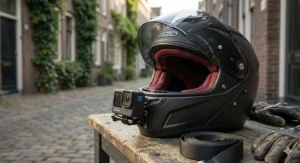
6. Ruroc Atlas 4.0 — The British Brand Doing Things Differently
There’s something gratifying about a British brand — Ruroc, based in the Cotswolds — making helmets that serious riders actually want to wear. The Ruroc Atlas 4.0 is striking in appearance, distinctive in design, and genuinely ECE 22.06 certified. It is also, for the GoPro-curious rider, a slightly different proposition: Ruroc’s own design aesthetic means standard off-the-shelf chin mounts don’t always play nicely, but bespoke Ruroc-specific chin mount solutions are available and well-regarded.
The Atlas 4.0 uses a fibreglass composite shell with magnetic visor attachment — genuinely useful for quick visor swaps on unpredictable British days where you might start in fog and end in harsh sunshine. The interior uses an anti-bacterial liner, which matters more than most people admit after a week of daily riding. Camera mount compatibility is very good once you use the correct Ruroc-specific solutions.
The Atlas 4.0 is, bluntly, a statement helmet. It suits the rider who cares about the full aesthetic of their setup — matching GoPro footage with an unmistakably styled lid. The Bristol creative who commutes by motorcycle and makes weekend touring content will feel right at home here. Less suited to conservative touring riders who want understated kit.
Being a British brand, Ruroc’s customer support for UK buyers is notably more responsive than some European or Asian competitors. Returns under the Consumer Rights Act 2015 are straightforward.
✅ British brand with strong UK customer support
✅ Magnetic visor — quick-change for variable British weather
✅ Genuinely distinctive design
❌ Bespoke mount solutions needed — not standard off-the-shelf
❌ Premium price for a fibreglass (rather than carbon) shell
Price range: £400–£500 — justified for the design and British provenance.
7. Scorpion Exo-R1 Air — Track Capability, Road Practicality
The Scorpion Exo-R1 Air is the track-day rider’s compromise: capable enough to follow a knee-scraping session at Brands Hatch, practical enough to ride home on the A2 afterwards. For GoPro integration, the R1 Air’s well-sculpted chin bar is one of the cleaner profiles in this price bracket, making adhesive chin mount application straightforward. The helmet’s track-focused aerodynamics also translate to reduced wind drag on the camera system at higher speeds.
Shell construction uses Scorpion’s Ellip-Tec II visor mechanism — fast, tool-free visor changes that matter when you’re filming in variable conditions and need to switch between clear and tinted visors mid-ride. The carbon aramid/fibreglass shell offers a reasonable weight-to-rigidity ratio, and the VX30 ventilation system provides proper airflow during spirited riding.
The R1 Air is best suited to experienced UK riders who do a mix of track and road riding, and who want their camera footage to reflect genuinely fast, committed riding — the kind of content that performs well on YouTube and doesn’t bore the viewer in the first ten seconds. Less practical for everyday commuting in heavy city traffic, where the aggressive riding position becomes uncomfortable quickly.
UK buyers praise the visor quality and the overall premium feel relative to the price. Prime-eligible on Amazon.co.uk.
✅ Track-focused aerodynamics benefit camera stability at higher speeds
✅ Tool-free visor change — practical for variable British conditions
✅ Strong value proposition in the mid-premium bracket
❌ Aggressive fit less comfortable for long upright commutes
❌ Ventilation noise at speed can affect audio if recording sound
Price range: £280–£400 — excellent for riders wanting a credible track-to-road helmet.
Setting Up Your GoPro on a British Motorcycle Helmet: A Practical Guide
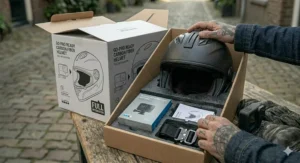
Getting the mount right is, truthfully, half the battle. Here’s what years of motovlogging wisdom — distilled for UK roads and conditions — actually looks like in practice.
Step 1: Choose your mounting position wisely. The chin mount is overwhelmingly preferred by experienced motovloggers, and for good reason: it sits at near-eye level, captures the road ahead and the handlebars simultaneously, and sits in the aerodynamic shadow of the chin bar. Top-of-helmet mounts create a “sky-high” perspective that makes even fast riding look oddly sedate, and they introduce far more wind resistance. As detailed testing on British and European roads has shown, chin mounting in the “dead air zone” directly behind the chin bar dramatically reduces camera shake at motorway speeds.
Step 2: Surface preparation is everything — especially in the UK. British garages are damp. Helmets stored in them pick up moisture and residual oils from gloves and hands. Before applying any 3M adhesive mount, clean the surface thoroughly with isopropyl alcohol and allow it to dry completely — ideally for 30 minutes. Then warm both the mount and the helmet surface gently with a hairdryer. This dramatically improves bond strength. Several UK riders have reported adhesive failure in winter precisely because they skipped this step in a cold garage.
Step 3: Allow 24 hours cure time before riding. The 3M VHB adhesive used in quality chin mounts reaches full strength after 24 hours. Mounting at 10pm and riding to work at 7am the next morning is asking for trouble. A camera bouncing down the M25 is neither recoverable nor cheap.
Step 4: Use a camera tether. No matter how well your mount is applied, a tether from the camera body to the chin strap D-ring is essential. If the mount ever fails — and at some point, something always does — your GoPro stays with the helmet rather than becoming a road hazard.
Step 5: Enable HyperSmooth stabilisation. GoPro’s in-camera stabilisation compensates for the remaining vibrations that even a well-mounted helmet transmits at speed. For British roads — which, with the greatest of respect to the relevant highway authorities, are not always as smooth as one might hope — this is not optional.
UK Rider Profiles: Which GoPro Ready Helmet Suits You?
The London Commuter 🏙️ — Daily Zone 2 riding, occasional A-road jaunts, wants camera capability for incident recording (increasingly sensible on London’s busier roads) and perhaps some casual content. Budget: £150–£280. Best pick: LS2 FF808 Stream 2 with a standard adhesive chin mount kit. Practical, affordable, proven in city conditions.
The Weekend Tourer 🛣️ — Lives in the Midlands or the North, rides Peak District and Yorkshire Dales routes on weekends, wants footage that actually looks good. Budget: £250–£420. Best pick: Shark Spartan GT Pro or AGV K6 S. Both offer mid-premium shell quality, good aerodynamics, and clean chin bar geometry for quality camera footage.
The Serious Motovlogger 🎬 — Produces regular riding content, needs consistently professional footage quality, rides in all British weather. Budget: £400+. Best pick: Shoei NXR2 paired with a purpose-made NXR2/RF-1400 chin mount. The combination delivers the most stable, lowest-drag camera setup available at a non-race price point.
The Track Day Enthusiast 🏁 — Mixed track and road riding, wants a helmet that functions at the full performance envelope. Budget: £300–£450. Best pick: HJC RPHA 12 or Scorpion Exo-R1 Air. Both offer track-capable construction with road-practical camera compatibility.
The Style-First Rider 🇬🇧 — Wants their helmet to be as distinctive as their riding content. Budget: £400–£500. Best pick: Ruroc Atlas 4.0 — unapologetically British, genuinely striking, fully ECE 22.06 certified.
How to Choose a GoPro Ready Motorcycle Helmet in the UK: 6 Key Criteria
1. Safety certification first, always. Only buy helmets carrying ECE 22.06 approval — the current mandatory standard for UK road use. Cross-reference with the SHARP scheme for independent impact testing data. A helmet can be ECE 22.06 certified and still score two stars on SHARP; aim for four or five.
2. Assess chin bar geometry. Run your hand along the chin bar. Is it smooth and gently curved? Good. Does it have deep ridges, air scoops, or abrupt contours? You’ll need a bespoke mount solution. Smooth profiles like the Shoei NXR2 and HJC RPHA 12 accept third-party chin mounts most cleanly.
3. Shell rigidity matters for mount stability. Carbon and multi-axial fibreglass shells transmit less vibration to the camera than cheaper thermoplastic shells. If footage quality is a priority, this is a real-world difference, not marketing copy.
4. Consider overall weight. A heavier helmet amplifies the rotational momentum of an attached camera. For long filming sessions on Britain’s motorways, extra weight means neck fatigue and less natural head movement — which makes footage look awkward.
5. Think about British weather — genuinely. Fog-resistant Pinlock-ready visors, quality chin curtains, and moisture-sealed linings matter more in the UK than almost anywhere in Europe. The best camera footage in the world is useless if you can’t see where you’re going.
6. Check Amazon.co.uk availability and returns policy. For helmets, fit is personal. Buy from a Prime-eligible seller where possible to benefit from easy returns. Under the Consumer Contracts Regulations, you have 14 days to return an unworn, undamaged helmet purchased online — use this if the fit isn’t right.
Common Mistakes When Buying a GoPro Compatible Helmet in the UK
Buying on looks alone. The motovlogging world has a minor epidemic of riders purchasing photogenic helmets that perform terribly as camera platforms. That sharply sculpted lid with complex external geometry? It’ll make your chin mount stick out at an angle and introduce dramatic wind buffeting on the M6. Function precedes form.
Ignoring ECE 22.06. Some helmets — particularly certain imported designs and older stock — still carry only ECE 22.05 approval. While these remain legal on UK roads at the time of writing, ECE 22.06 represents a significant safety improvement, particularly in oblique impact scenarios. According to research published by the Transport Research Laboratory (TRL), the newer standard better reflects real-world accident conditions. Don’t compromise here.
Skipping the SHARP rating check. Two helmets can both hold ECE 22.06 approval and perform completely differently in impact testing. The SHARP scheme exists precisely to make this information accessible to British riders — it’s a free resource funded by the Department for Transport, and it would be genuinely remiss not to use it.
Using the wrong adhesive mount type. Curved helmets need curved adhesive bases; flat surfaces need flat ones. Using a flat mount on a curved chin bar reduces the adhesion surface area dramatically — and in British autumn temperatures, that reduced contact area combined with thermal contraction can result in mount failure. Check the mount curvature matches your helmet before applying.
Neglecting the camera tether. Mentioned in the setup guide, worth repeating here: a camera safety tether is not optional. At £3–£8 on Amazon.co.uk, there is no excuse.
✨ Don’t Miss These Exclusive Deals!
🔍 Ready to gear up? Click any highlighted helmet in this guide to check current pricing and availability on Amazon.co.uk. Prime members enjoy next-day delivery on most lines — ideal if you’ve got a ride planned this weekend and the forecast is almost promising.
UK Regulations, Safety Standards & What You Need to Know Before You Mount
The legal position on camera-mounted helmets in the UK is straightforward: there is no specific law prohibiting a GoPro or other action camera on a motorcycle helmet, provided the camera mounting does not compromise the helmet’s structural integrity. This means no drilling. Adhesive and strap-based mounts are perfectly legal. The relevant guidance from the DVSA does not specifically address camera mounts, but the Highway Code’s general principle of not allowing equipment to compromise your ability to ride safely applies.
What does matter legally and practically:
ECE 22.06 is the current mandatory standard. Helmets sold new in the UK must carry this approval.
UKCA marking — in the post-Brexit regulatory landscape, this replaces CE marking for products sold in Great Britain (not Northern Ireland, which operates under different arrangements). Most major helmet brands have updated their UK-market products accordingly, but worth checking when purchasing.
Wind noise and audio recording. British motorcyclists are increasingly using helmet cameras for incident recording — a sensible precaution given the state of some UK drivers. The audio quality of road sound from chin-mounted cameras is generally good enough for evidential purposes, though it varies considerably by helmet design and speed.
Insurance. If your camera footage captures an incident, it can be highly valuable as evidence. Several UK insurers now actively welcome dashcam and helmet camera footage in claims. Check with your insurer whether your policy covers the camera as an accessory.
One final note: if you’re crossing into Europe with your camera-equipped helmet — Scotland-to-continent ferry trips, for instance — camera mounts are generally accepted across EU jurisdictions under the same principle as UK rules: no structural modification, no problem.
Long-Term Cost & Maintenance: Getting Value From Your GoPro Helmet Setup
The full cost of a GoPro ready motorcycle helmet setup isn’t just the helmet price. Here’s a realistic breakdown for UK buyers:
The helmet itself — anywhere from £130 for the LS2 FF808 to £520 for the Shoei NXR2. Then a quality chin mount: expect to pay £15–£35 for an injection-moulded model-specific mount, or £8–£20 for a universal adhesive kit. A GoPro HERO13 Black — currently the camera of choice for serious motovloggers — sits in the £300–£350 range on Amazon.co.uk. Add a tether (under £10), a spare battery (£20–£30), and a 256GB microSD card (£25–£35), and a complete entry-level camera helmet setup starts at around £280–£300 for a budget configuration, or £850–£900 for a premium one.
Maintenance in British conditions: Adhesive mounts benefit from reapplication every 12–18 months in the UK climate. Moisture ingress between the mount base and the helmet surface is the primary cause of long-term bond degradation. A yearly clean-and-inspect takes ten minutes and saves you the irritation of discovering mount failure at the wrong moment. GoPro lens protectors — a few pounds on Amazon.co.uk — are essential; British road grit is unkind to exposed glass. Helmet liners should be washed monthly during active riding seasons; most premium helmets accept a gentle 30°C machine wash cycle.
Replacing a helmet: the general guidance from UK safety organisations is every five years from date of manufacture, or immediately after any significant impact — whether or not visible damage is apparent. The expanded polystyrene liner compresses on impact and doesn’t recover.
Frequently Asked Questions
❓ Are camera mounts legal on motorcycle helmets in the UK?
❓ What is the best mounting position for a GoPro on a motorcycle helmet?
❓ Do I need ECE 22.06 certification for UK road use in 2026?
❓ Will my GoPro adhesive mount work in cold British weather?
❓ Can I use a GoPro ready motorcycle helmet for incident recording in the UK?
Conclusion: Find Your Ideal GoPro Ready Motorcycle Helmet
There’s no single perfect GoPro ready motorcycle helmet — there’s the right one for your riding style, your budget, and the particular combination of British roads and weather you spend your weekends on. The Shoei NXR2 remains the premium benchmark. The HJC RPHA 12 offers the most value per pound in the upper bracket. The LS2 FF808 Stream 2 is the sensible budget answer. And the Ruroc Atlas 4.0 exists for riders who want their content to be as distinctive as the roads they ride.
Whatever you choose, prioritise ECE 22.06 certification, check the SHARP rating, and invest in a proper chin mount rather than relying on a top-of-helmet sticky pad that’ll make your footage look like it was filmed by someone on a very energetic trampoline. And always — always — fit a camera tether.
Britain’s roads are exceptional for riding. Capture them properly.
✨ Don’t Miss These Exclusive Deals!
🔍 Click any helmet in this guide to check current prices and availability on Amazon.co.uk. Prime members get next-day delivery on most lines — and if your first choice doesn’t fit right, the Consumer Contracts Regulations give you 14 days to return it hassle-free.
Recommended for You
- Best Motorcycle Helmet with Built In Camera: 7 Top Picks for UK Riders (2026)
- Best Motorcycle Helmet Navigation Systems UK 2026
- Best AR Motorcycle Helmet UK 2026: 7 Futuristic Smart Lids Reviewed
Disclaimer: This article contains affiliate links. As an Amazon Associate, I earn from qualifying purchases. If you purchase products through these links, we may earn a small commission at no additional cost to you.
✨ Found this helpful? Share it with your mates! 💬🤗
