
In This Article
There’s a moment every motorcyclist knows — that split second when you’re filtering through slow traffic on the A406, you want to check your speed, your sat-nav is somewhere behind your right knee, and both your hands are very much occupied with not dying. It’s an awkward little juggle that has defined motorcycle riding for decades.

An AR motorcycle helmet is changing that calculation entirely. Short for augmented reality, this category of smart headgear overlays essential riding data — speed, navigation arrows, incoming calls, even radar alerts — directly into your field of vision via a built-in head-up display (HUD). No glancing down. No fumbling with your phone at traffic lights. Just the road, and a thin ribbon of intelligent information floating helpfully at the edge of your sight.
In 2026, the technology has crossed a threshold. What was once a Kickstarter dream populated by failed prototypes (looking at you, Skully) has matured into a small but genuinely compelling category of products, with the world’s first fully integrated AR visor helmet landing in UK showrooms this year. According to Wikipedia’s overview of augmented reality, the core principle — overlaying digital information onto the physical world without replacing it — has existed in aviation and military applications for over sixty years. Motorcyclists are, rather belatedly, getting their turn.
This guide covers seven real products available to UK buyers in 2026, from bolt-on HUD modules you can clip to your existing lid, to flagship full-integration helmets that cost more than some used bikes. All prices are in GBP, all observations reflect British riding conditions, and all products have been verified for UK availability.
Quick Comparison: AR Motorcycle Helmets at a Glance
| Product | Type | HUD Technology | Price Range | ECE 22.06 | Best For |
|---|---|---|---|---|---|
| Shoei GT-Air 3 Smart | Full helmet | Nano-OLED visor integration | £900–£1,100 | ✅ | Serious tourers & commuters |
| CrossHelmet X1 | Full helmet | Transparent visor HUD | £600–£750 | ✅ | Safety-focused urban riders |
| Forcite MK1S | Full helmet | LED guidance array | £700–£900 | ✅ | Tech-forward adventure riders |
| Sena Momentum Evo | Full helmet | Smart comms + display | £380–£480 | ✅ | Connected group riders |
| LIVALL MC1 Pro | Full helmet | Smart LED + camera | £300–£420 | ✅ | Budget smart helmet buyers |
| MOTOEYE E6 | Add-on HUD module | Sony Micro-OLED HUD | £200–£320 | N/A (add-on) | Upgrading an existing helmet |
| EyeLights Ride HUD | Add-on HUD module | Visor projection HUD | £250–£380 | N/A (add-on) | Universal compatibility |
The table above reveals something rather telling: there’s a real chasm between integrated helmets (where the tech is baked into the shell from day one) and retrofit modules that bolt onto what you’ve already got. Integrated models offer cleaner aerodynamics and superior weather sealing — both of which matter considerably when you’re ploughing through horizontal November rain on the M25 — but the entry price is substantially higher. The retrofit modules, meanwhile, give budget-conscious UK buyers a way into the technology without writing a four-figure cheque. We’ll discuss when each approach makes sense throughout this guide.
💬 Just one click — help others make better buying decisions too! 😊
✨ Don’t Miss These Exclusive Deals!
🔍 Take your riding to the next level with these carefully selected smart helmets. Click on any highlighted item to check current pricing and availability on Amazon.co.uk. These picks will help you find exactly what you need!
Top 7 AR Motorcycle Helmets: Expert Analysis for UK Riders
1. Shoei GT-Air 3 Smart — The World’s First Fully Integrated AR Visor Helmet
The GT-Air 3 Smart is genuinely historic. Built in partnership with French display specialists EyeLights, it is — as of 2026 — the first production motorcycle helmet with fully integrated augmented reality in the visor itself. No external module, no awkward chin-bar attachment, no wires running along the outside of your lid. Everything is hidden within the shell.
The centrepiece is a nano-OLED head-up display that projects GPS navigation, speed, incoming calls, and radar alerts approximately three metres ahead into the rider’s line of sight. Shoei claims this reduces the need to look away from the road and, according to EyeLights’ own data, could improve rider reaction times by around 32%. The helmet is built on Shoei’s proven AIM (Advanced Integrated Matrix) composite shell, meets ECE 22.06 — the current mandatory UK road standard — and includes a universal intercom system with an active noise-cancelling microphone that supports both Siri and Google Assistant.
For UK riders, the weather sealing is a genuine selling point. The electronics are fully integrated, meaning there are no exposed joints, clips, or gaps for water ingress during a proper British downpour. The battery life sits around 8–10 hours of mixed use — comfortable for most day rides, though longer Scottish Highlands tours might require planning around a charge.
The spec sheet also won’t mention this: the GT-Air 3 Smart is heavy by premium standards. That’s the engineering trade-off for packaging a projector, battery pack, speakers, and antenna inside a shell that still has to survive a crash. On a weekend blast it’s fine; on a 500-mile tourer, you’ll notice your neck by teatime.
Pros: True visor-integrated AR; ECE 22.06; all-weather electronics; Shoei’s legendary build quality
Cons: Premium pricing; heavier than standard GT-Air 3
Price range: £900–£1,100 | Available from specialist UK retailers and on Amazon.co.uk — check current price on Amazon.co.uk
Best for: Serious sport-tourers, motorway commuters, and anyone who wants to buy once and buy well.
2. CrossHelmet X1 — 360-Degree Visibility for the Safety-Obsessed
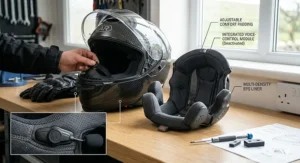
The CrossHelmet X1 is the helmet you’d design if your primary obsession was eliminating blind spots. Alongside its HUD — a transparent visor display showing speed, navigation, and calls — the X1 features a rear-facing wide-angle camera mounted at the back of the shell, relaying a live feed to a thin strip at the bottom of the visor display. In practice, you get a rear-view mirror that never fogs, never loses its angle, and works equally well on a dual carriageway as it does during slow lane-splitting in central Bristol.
The shell construction is premium, meeting ECE 22.06, and the sound management system uses active noise control to reduce wind noise — something that becomes increasingly relevant on a British B-road at 60 mph. UK reviewers have praised the build quality, though several note that the proprietary app requires patience to set up properly. The display brightness is adjustable, which matters enormously on a grey November morning versus direct summer sunshine near the M3.
What most UK buyers overlook about this model is its suitability for urban multi-lane environments — exactly the sort of motorway merges and roundabout approaches where rear visibility translates directly into avoiding a rear-end shunt.
Pros: Rear camera feed; ECE 22.06; active noise control; premium build
Cons: App setup can be fiddly; proprietary charging
Price range: £600–£750 | Available via specialist UK importers and on Amazon.co.uk — check current price on Amazon.co.uk
Best for: City commuters, motorway riders, anyone who’s ever wished their mirrors were better.
3. Forcite MK1S — Subtly Brilliant, Beautifully British-Weather-Proof
The Australian-born Forcite MK1S takes a deliberately different approach to HUD technology. Rather than projecting data onto a transparent visor screen — which can struggle in bright sunlight or fog — the MK1S uses an LED guidance array mounted along the bottom of the interior, just below the rider’s nose line. Turn-by-turn directions appear as light patterns in peripheral vision. It sounds odd on paper. In practice, riders tend to find it far less distracting than a floating visor graphic.
The MK1S also features a 4K front-facing camera integrated into the chin bar — inconspicuous enough that most observers wouldn’t notice it — alongside Harman Kardon speakers (yes, really), GPS via a companion app, and Bluetooth 5.0. The carbon fibre shell is both ECE-certified and impressively light at around 1,450g, which matters when you’re commuting daily rather than posing in a car park.
For damp British conditions, the LED system has a practical advantage: unlike optical HUD projectors, LEDs don’t suffer reduced visibility in rain or morning mist. The 4K camera likewise handles low-contrast grey-sky British light reasonably well. Battery life is cited at around 10 hours, though cold weather — say, a January commute in Leeds — will shave that down by a meaningful margin due to lithium-ion chemistry’s well-documented aversion to the cold.
Pros: Harman Kardon audio; 4K camera; LED system less affected by weather; light shell
Cons: LED approach is less information-rich than full HUD; premium price
Price range: £700–£900 | Available from UK distributors and Amazon.co.uk — check current price on Amazon.co.uk
Best for: Riders who want premium audio and camera capability alongside navigation assistance.
4. Sena Momentum Evo — The Smart Choice for Group Riders
Sena built its reputation on motorcycle communication systems, and the Momentum Evo brings that expertise inward. The helmet itself — a composite fibreglass full-face with a multi-density EPS liner, ECE-certified, Pinlock 120 Max Vision included — is genuinely solid. The integration is the point: rather than bolting a Sena unit to a third-party helmet and hoping the aerodynamics survive, everything here was designed together from the start.
The Mesh Intercom system allows communication with up to 24 other riders simultaneously — a feature with obvious appeal if you ride in a club or regularly tackle group runs through, say, the Peak District or the Yorkshire Dales. Range extends to approximately 2 km in open terrain, though dense urban environments and tall buildings (a familiar British reality) will reduce that. The display functionality is more basic than the CrossHelmet or Shoei — think smart comms with speed data rather than full AR navigation — but for many UK riders, that’s precisely enough.
UK buyers should note: Sena offers a two-year electronics warranty alongside the standard five-year helmet warranty, which compares favourably with some rivals. For group-ride regulars, this is probably the most pragmatic smart helmet on this list.
Pros: Best-in-class mesh intercom; Pinlock 120 included; strong warranty; ECE 22.06
Cons: HUD functionality is limited vs. pure AR rivals; only available in matte black
Price range: £380–£480 | Available on Amazon.co.uk — check current price on Amazon.co.uk
Best for: Club riders, commuters who frequently ride in groups, Sena ecosystem users.
5. LIVALL MC1 Pro — Smart Safety Tech Without the Flagship Sticker Price
LIVALL has been making smart cycling helmets since 2014, and the MC1 Pro represents their push into motorcycle territory. At this price point — noticeably below the CrossHelmet and Forcite — what you’re getting is a respectable full-face lid with a full HD integrated front camera, Bluetooth intercom (up to 1.2 km range for five riders), smart LED lighting front and rear, and LIVALL’s genuinely impressive patented fall detection system.
That last feature deserves proper attention. If the MC1 Pro detects a fall event above 1.5 metres, it automatically triggers an SOS alert after a 90-second countdown, sending a GPS location message to a preset emergency contact. For solo riders doing rural routes — along Dartmoor, say, or the quieter roads of Northumberland — this is exactly the kind of passive safety net that costs nothing on a good day and is worth enormously more on a bad one.
The ECE 22.06 shell is carbon fibre, which keeps the weight reasonable. The HUD functionality is more basic than the top-tier options — primarily lighting and intercom cues rather than full navigation overlays — but the fall detection and camera combination genuinely add safety value that you won’t find on most rivals at any price.
Pros: Fall detection and SOS; 1080p camera; ECE 22.06; carbon shell; competitive price
Cons: HUD is limited; intercom range shorter than Sena
Price range: £300–£420 | Available on Amazon.co.uk — check current price on Amazon.co.uk
Best for: Solo riders, rural touring, safety-conscious buyers on a sensible budget.
6. MOTOEYE E6 — Turn Any Lid Into a Smart Helmet
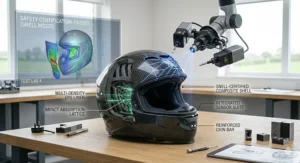
The MOTOEYE E6 is not a helmet. It’s a HUD system that attaches to the exterior of your existing helmet. The main unit mounts behind the shell; a Sony Micro-OLED display module clips above the visor; a battery pack sits at the rear. The result is a 3,000-nit brightness display with a contrast ratio of 10,000:1 — numbers that translate to a display that actually remains readable in direct British summer sunshine, should that ever occur.
Functionality is impressively comprehensive: Apple CarPlay, Android Auto, GPS navigation, speed display, Bluetooth 5.2 for calls and music, mesh intercom, and a 1080P rear camera with a 120-degree field of view. The IP66 rating means it handles rain without drama, which is essentially a prerequisite for anything attached to a motorcycle in the UK. Setup involves downloading the companion app and mounting the hardware — a 20-minute process the first time, much faster thereafter.
The honest caveat: the MOTOEYE E6 is not aerodynamically neutral. You will notice the additional drag at motorway speeds, and the module does add visual bulk to your lid. It also cannot claim the ECE certification of a purpose-built smart helmet, because it’s an add-on rather than part of the safety shell. If your priority is maximum functionality at the lowest possible entry cost — especially if you already own a quality ECE-certified helmet — it represents remarkable value.
Pros: Sony Micro-OLED display; CarPlay + Android Auto; IP66; rear camera; affordable
Cons: External module aesthetics; aerodynamic impact; does not modify helmet’s safety certification
Price range: £200–£320 | Available directly on Amazon.co.uk — check current price on Amazon.co.uk
Best for: Riders who want full smart functionality without replacing a beloved existing lid.
7. EyeLights Ride HUD — The Specialist Retrofit Option
Before EyeLights teamed up with Shoei for the GT-Air 3 Smart, they were selling their standalone Ride HUD as a universal retrofit unit. It remains available and remains relevant — particularly for riders who already own a premium helmet they have no wish to replace. The projection system clips to the inside of your visor, beaming navigation, speed, and communication alerts into your visual field using the same fundamental technology that later made it into the GT-Air 3 Smart.
The companion app integrates with Google Maps, Apple Maps, and several third-party navigation platforms, and the system supports incoming call display and music track information. Battery life sits at around six to eight hours — shorter than some dedicated smart helmets, but adequate for most day rides. The projection system works noticeably better in overcast conditions than in direct sunlight, which, admittedly, narrows the concern for most UK riding days.
What makes the EyeLights Ride a considered choice rather than a compromise is provenance: the company behind this is the same one producing the world’s most advanced integrated AR motorcycle helmet. The retrofit version is their earlier work, not someone else’s imitation.
Pros: Genuine AR projection tech; universal compatibility; established pedigree
Cons: Battery life shorter than integrated options; visor projection can wash out in bright sun
Price range: £250–£380 | Available on Amazon.co.uk — check current price on Amazon.co.uk
Best for: Premium lid owners who want AR capability without a full helmet replacement.
Setting Up Your AR Motorcycle Helmet: A Practical UK Guide
Getting a smart helmet working properly on British roads involves a few steps that the Amazon listing definitely won’t walk you through.
Pairing and calibration is where most new owners lose 30 minutes they didn’t budget for. Whether you have a Shoei GT-Air 3 Smart or a MOTOEYE E6, the companion app needs to be installed, Bluetooth paired, and display preferences configured before your first ride. Do this at home, not in a services car park off the M1 with numb fingers.
Navigation app choice matters more than you’d expect. Apple Maps and Google Maps both work with most systems via CarPlay or Android Auto integration, but the on-screen visual style varies. Google Maps currently renders more cleanly on smaller HUD displays. If you use TomTom GO Navigation or a dedicated motorcycle app like Scenic, check compatibility with your specific system before purchasing.
Weather proofing your setup: if you’re using an external module like the MOTOEYE E6, pay particular attention to the mounting clips after washing your bike. Water can work into clip joints over time. A thin bead of silicone around connection points is an old motorcyclist’s trick worth adopting. For integrated helmets, the concern is less acute, but always check that visor seals are intact after winter — prolonged exposure to salt-spray from wet UK roads degrades rubber over a season.
Battery habits in cold weather: as noted above, lithium-ion batteries lose charge capacity in low temperatures. A typical 8-hour rated battery may deliver closer to six hours on a crisp February morning. For winter commuters in Glasgow or Edinburgh, a USB power bank routed discretely through the jacket can extend range if your system supports external charging.
AR Motorcycle Helmets for Different UK Rider Profiles
Not all British motorcyclists are the same. The following scenarios might help crystallise which direction suits you.
The London Daily Commuter: You’re filtering through Elephant and Castle traffic, ULEZ zones are a fact of life, and rear visibility feels like a genuine safety concern. The CrossHelmet X1 was almost designed for you — its rear-camera HUD feed is directly useful in stop-start urban conditions, and the noise management helps preserve your sanity on the Westway. Budget a bit more and the Shoei GT-Air 3 Smart offers navigation plus speed overlay that works hands-free when your route suddenly changes due to a closed road.
The Weekend Touring Rider (Manchester to the Lake District): You want navigation assistance without staring at a phone on the handlebars, and communication with a riding mate. The Sena Momentum Evo earns its place here — the mesh intercom is genuinely excellent across open countryside, and the integrated design means nothing to snag on a light windbreaker. Long days in the saddle with this lid are comfortable.
The Budget-Conscious Newcomer: You’ve just passed your test, you’ve spent most of your budget on the bike itself, and you’d like some smart tech without a four-figure outlay on headgear. The LIVALL MC1 Pro is worth serious consideration — the fall detection alone makes it arguably safer than a more expensive lid without that feature, and the camera means you have footage if anything goes wrong.
The Existing Helmet Owner Who Refuses to Part with Their Lid: You spent £600 on a Shoei NXR 2 three years ago and it fits your head perfectly. The MOTOEYE E6 on Amazon.co.uk gives you CarPlay, a rear camera, and GPS navigation without touching that relationship.
How to Choose an AR Motorcycle Helmet in the UK: 7 Key Criteria
Before scrolling back to the product section with a credit card, run through this framework.
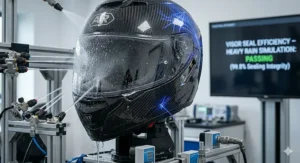
- Safety certification first. Every helmet worn on a UK public road must meet an approved standard. ECE 22.06 is the current benchmark — mandatory for new helmet approvals since January 2026. The UK’s SHARP helmet safety scheme (run by the Department for Transport) independently star-rates helmets against real-world impact data; a 4 or 5-star SHARP rating alongside ECE 22.06 is the gold standard. No amount of AR tech excuses a poorly-rated shell.
- Integrated vs. retrofit. Integrated helmets offer better aerodynamics, weather proofing, and aesthetics. Retrofit modules cost less and work with your existing lid. If your current helmet is over five years old, replacing it entirely and getting smart tech in the process is usually the better long-term decision.
- Display readability in British conditions. This is the one specification that almost no manufacturer is honest about. Nano-OLED and Micro-OLED displays with brightness above 2,000 nits generally perform well in overcast British light. Visor projection systems can wash out on the rare bright days.
- Battery life vs. your typical ride length. If your average ride is 90 minutes to and from work, any battery rating above four hours is academic. If you’re doing Iron Butt events, battery life becomes genuinely critical. Factor in a 20–30% real-world reduction from manufacturer claims in cold weather.
- Ecosystem compatibility. Does the helmet’s app work properly with your iPhone or Android? Does it integrate with your preferred navigation software? These questions matter more in daily use than almost any specification on the box.
- Weight. Most smart helmets weigh between 1,400g and 1,700g — noticeably more than a standard premium lid. For commuters doing 30 minutes each way, this is barely relevant. For those doing 300-mile days, neck fatigue is real and worth taking seriously.
- After-sales support in the UK. Post-Brexit, some consumer tech products carry EU warranties that don’t automatically cover UK buyers. Check whether the brand has UK-based warranty support or a UK distribution partner. The Consumer Rights Act 2015 gives you strong protections for faulty goods regardless, but having local support makes life substantially easier.
UK Regulations, Safety Standards & What You Actually Need to Know
The legal position on AR motorcycle helmets in the UK is mercifully straightforward, though the detail repays attention.
Under the Motor Cycles (Protective Helmets) Regulations 1998 (as amended), every rider on a UK public road must wear a helmet meeting an approved standard. ECE 22.06 is currently the most current and rigorous of these. The GOV.UK guidance on motorcycle helmets is the authoritative reference — worth bookmarking rather than relying on forum posts, which have a habit of being confidently wrong.
The presence of AR or HUD technology does not itself affect a helmet’s legal status, provided the underlying shell retains its certification. This is why the distinction between integrated helmets (where electronics are designed into the shell from the start) and bolt-on modules matters: an add-on module does not change the shell’s original ECE rating, but it equally does not gain one of its own. Your helmet remains legal; the module is simply an accessory.
For track days, the situation is different. From 1 January 2026, ACU (Auto Cycle Union) Gold pre-certification is required for helmets used at UK circuit events — ACU officials no longer apply stickers at the gate. If you plan to use your smart helmet on track, verify ACU Gold status specifically. Most of the premium helmets in this guide meet ECE 22.06 but have not necessarily sought ACU certification, which is an additional standard rather than a replacement.
One area of ongoing ambiguity: some smart helmet systems display information in a manner that could theoretically be argued to constitute a “distracting” device under the Highway Code’s general provisions regarding due care and attention. No prosecutions under this specific interpretation have been reported to date, and the technology’s explicit purpose is improving attention rather than diverting it — but it’s worth being aware that legal frameworks have not yet caught up with the technology.
Common Mistakes When Buying an AR Motorcycle Helmet in the UK
A few recurring errors that UK buyers make — often expensively.
Buying on specification rather than fit. No HUD display, however impressive, compensates for a helmet that moves on your head at 60 mph. The ECE 22.06 retention system tests help here, but fit remains personal. If at all possible, try a smart helmet in person before purchasing. Shoei, in particular, recommends professional fitting via their Assured Centre network.
Ignoring the UK climate in battery planning. A battery that performs adequately in a California YouTube review will deliver meaningfully less runtime on a cold November morning in the Midlands. Plan for 25–30% real-world reduction below manufacturer claims during winter months.
Overlooking returns complexity. Under the Consumer Contracts Regulations, you have a 14-day cooling-off period for online purchases — but smart helmets with registered app accounts may present mild complications. Register your app account after you’re satisfied with the purchase, or keep that option open.
Assuming US or EU warranty coverage applies in the UK. Post-Brexit, some EU warranties require goods to be returned to a European address. Verify UK warranty terms before purchasing from a grey-market source, even if the price is appealing.
Fitting an uncertified third-party module to a certified helmet without reading the terms. Some insurers’ policy wording could theoretically be used to query modifications to safety equipment in the event of a claim. It’s unlikely to be a practical issue for an add-on HUD, but worth a quick check with your insurer if you’re concerned.
Frequently Asked Questions
❓ Are AR motorcycle helmets legal to use on UK roads?
❓ What is the best AR motorcycle helmet available on Amazon.co.uk right now?
❓ How long do smart motorcycle helmet batteries last in UK winter conditions?
❓ Do I need to declare an AR motorcycle helmet to my insurance?
❓ What safety standard should I look for when buying a smart motorcycle helmet in the UK?
Conclusion: Is an AR Motorcycle Helmet Worth It in 2026?
The honest answer is: it depends what you want from it, and what you’re prepared to spend.
If the question is purely whether the technology works — yes, in 2026, it works. The Shoei GT-Air 3 Smart represents a genuine inflection point. For the first time, a major premium helmet manufacturer has integrated augmented reality at the design stage rather than as an afterthought, producing a system that’s weatherproof, ECE-certified, and usable in actual British riding conditions rather than just press-release renders. That’s meaningful.
For riders who can’t justify the flagship spend, the MOTOEYE E6’s presence on Amazon.co.uk at a fraction of the price makes the technology genuinely accessible. It won’t replace a properly integrated system, but it brings the core experience — navigation, speed, calls in your eyeline — within reach of most budgets.
What the AR motorcycle helmet will not do is make you a safer rider by itself. Safety comes from ECE 22.06 shell performance, proper fit, SHARP ratings, and — most importantly — the decisions you make behind the visor. What smart HUD technology can do is reduce the minor distractions that accumulate over a long ride: the glances at mirrors, the squints at phone mounts, the momentary attention gaps. In those marginal gains, there’s a genuine argument.
The technology has arrived. Whether it’s arrived at the right moment for your riding life is a question only your commute, your route, and your budget can answer.
✨ Found Your Perfect Lid?
🔍 Click on any highlighted product above to check the latest prices and availability on Amazon.co.uk. Don’t forget: Amazon Prime members enjoy free next-day delivery on eligible items!
Recommended for You
- Best HUD Helmet for Motorcycles UK 2026: 7 Smart Picks Reviewed
- Best HUD Motorcycle Helmet UK 2026: 7 Smart Lids Reviewed
- Best Budget LED Helmet UK 2026: Top 7 Affordable Picks for Safer Rides
Disclaimer: This article contains affiliate links. As an Amazon Associate, I earn from qualifying purchases. If you purchase products through these links, we may earn a small commission at no additional cost to you.
✨ Found this helpful? Share it with your mates! 💬🤗
