In This Article
There’s a moment every motorcyclist knows. You’re filtering through Oxford Street traffic, rain just starting to smear your visor, and you desperately need the next turn — but your phone is mounted somewhere your neck can’t quite reach at a sensible angle. You glance down for a fraction of a second. That fraction is exactly what every road safety expert loses sleep over.

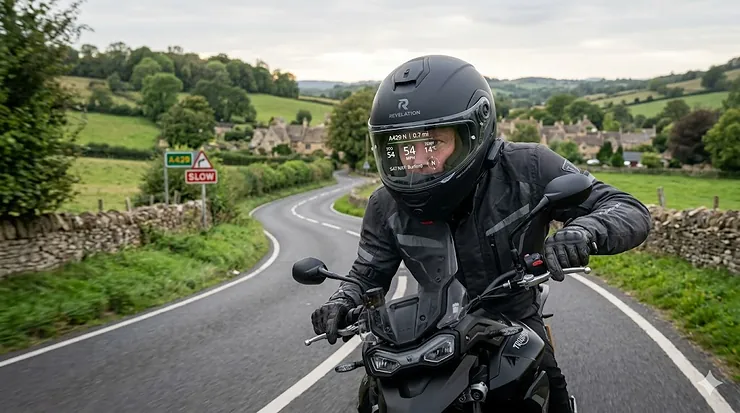
Enter the HUD motorcycle helmet. Short for heads-up display, this technology takes navigation data, speed readings, speed camera alerts, and incoming calls and projects them directly into your field of vision — no looking down, no fumbling with handlebar mounts, no gambling with your attention. The concept has been kicking around since fighter pilots used it in the 1960s, and it’s been promised to motorcyclists for decades. In 2026, it has genuinely, finally arrived.
What is a HUD motorcycle helmet, exactly? In simple terms, it’s a helmet that integrates or connects to a miniaturised display projecting ride-critical information at arm’s-length visual distance — roughly 2 to 3 metres ahead of your eye line — so your pupils never have to refocus away from the tarmac in front of you. Some helmets have the HUD factory-built into the visor itself. Others accept clip-on modules that retrofit to your existing lid. Both approaches have their merits, and both have their compromises.
In this guide, we’ve researched and analysed seven of the most compelling options currently available to UK riders in 2026 — from the stratospheric (and rather brilliant) Shoei GT-Air 3 Smart to budget-conscious add-on units that could transform the helmet already gathering dust on your shelf. Prices are in GBP, products verified on Amazon.co.uk and leading UK retailers, and every spec comes with an honest assessment of what it actually means for riding Britain’s particular mix of motorways, singletrack lanes, and perpetually damp roundabouts.
Quick Comparison Table: Best HUD Motorcycle Helmets UK 2026
| Product | Type | HUD Tech | ECE Rating | Price Range (GBP) | Best For |
|---|---|---|---|---|---|
| Shoei GT-Air 3 Smart | Integrated full-face | Nano-OLED visor projection | ECE 22.06 | £1,000–£1,300+ | Premium tourers |
| MOTOEYE E6+ | Add-on HUD unit | AR transparent display | N/A (fits any helmet) | £300–£450 | Tech enthusiasts |
| EyeLights EyeRide HUD | Add-on HUD unit | OLED prism | N/A (fits any helmet) | £200–£320 | Budget HUD buyers |
| Sena Outrush R | Smart modular helmet | Bluetooth display-link | ECE 22.06 | £230–£290 | Commuters & tourers |
| Cardo Beyond GTS | Integrated full-face | Smart audio + display | ECE 22.06 | £700–£900 | Sporty commuters |
| CrossHelmet X1 | Full-face HUD | 170° rear-view display | ECE 22.05 | £600–£800 | Urban tech riders |
| Sena Momentum Pro | Full-face smart | Built-in camera & BT | ECE 22.06 | £380–£500 | Documenting riders |
The table above tells an interesting story. There’s a clear divide between integrated HUD helmets — where the display is baked into the helmet’s architecture — and add-on systems that clip onto the helmet you already own. Integrated options like the Shoei GT-Air 3 Smart are the most seamless experience, but they demand a significant investment. Add-on units like the MOTOEYE E6+ offer remarkable functionality at a fraction of the price, though the experience of retrofitting electronics to a helmet shell is rarely quite as clean. Budget-minded UK buyers should weigh the total cost honestly: buying a quality ECE 22.06-rated helmet and an add-on HUD unit can actually rival some premium integrated options once you do the maths in pounds.
💬 Just one click — help others make better buying decisions too! 😊
✨ Don’t Miss These Exclusive Deals!
🔍 Take your riding tech to the next level with these carefully selected smart helmets. Click on any highlighted item to check current pricing and availability on Amazon.co.uk. These picks will help you find exactly what you need!
Top 7 HUD Motorcycle Helmets: Expert Analysis
1. Shoei GT-Air 3 Smart — The World’s First Integrated AR Visor Helmet
You know a product has arrived when Japanese engineering perfectionists like Shoei — a brand that has spent decades refusing to compromise on shell quality — decide it’s finally worth putting their name on. The GT-Air 3 Smart is the result of Shoei’s partnership with French display specialists EyeLights, and it is, quite straightforwardly, the most significant motorcycle helmet development in a generation.
The HUD uses third-generation nano-OLED projection technology embedded within the helmet’s sun visor. Rather than a clunky clip-on module blocking your peripheral vision, the display projects information — speed, turn-by-turn navigation via Google Maps or Waze, speed camera warnings, incoming call alerts — so that it appears roughly 3 metres ahead of your eye line. The 3,000-nit brightness means it remains legible in direct sunlight, which matters enormously on a sunny dual carriageway outside Leeds. EyeLights claims a 32% improvement in rider reaction time; the underlying logic (keeping eyes trained forward rather than flicking to a dashboard) is, frankly, difficult to argue with.
The underlying GT-Air 3 shell carries full ECE 22.06 certification, making it entirely road-legal in the UK. It also features an integrated Bluetooth intercom with what EyeLights describes as unlimited rider-to-rider range and active noise cancellation.
UK buyers should note: at the time of writing, the GT-Air 3 Smart is available through specialist UK retailers including Moto Central and major motorcycle shops, with Amazon.co.uk listings also appearing. Expect to pay in the £1,000–£1,300 range for the full Smart package — a fair amount, certainly, but consider what you’re replacing: a dedicated satnav, a Bluetooth intercom, and potentially a dashcam, all in one lid.
Pros:
- ✅ World’s first mass-produced integrated HUD visor — genuinely transformative
- ✅ Full ECE 22.06 certification; built on a proven, premium Shoei shell
- ✅ 3,000-nit nano-OLED display visible in British summer sunshine (yes, both days)
Cons:
- ❌ Premium price point — this is a serious financial commitment
- ❌ Relies on smartphone app ecosystem; battery management requires planning on longer tours
Price range: £1,000–£1,300+ | Check current price on Amazon.co.uk.

2. MOTOEYE E6+ — The All-In-One HUD That Fits Any Helmet
Not everyone wants to retire a perfectly good helmet for the sake of smart tech. The MOTOEYE E6+ takes a different philosophy entirely: a self-contained HUD and connectivity unit that clips onto virtually any existing full-face, flip-up, or 3/4 helmet. It’s confirmed available on Amazon.co.uk with Prime eligibility, making next-day delivery entirely plausible.
The E6+ packs in an AR transparent display with automatic brightness adjustment, Bluetooth 5.2 via a Qualcomm chip, CarPlay and Android Auto compatibility, mesh intercom (meaning you can communicate with riders using different devices, not just other MOTOEYE users), a rearview camera, remote control, and IP66 weather sealing. That last point deserves a moment’s consideration: IP66 means the unit can handle sustained rain without issue — genuinely relevant when you’re tackling the M6 northbound in November and the Pennines have decided to test your resolve.
The host unit mounts at the back of the helmet (reducing aerodynamic drag compared to front-mounted rivals), while the display clips to the visor area inside. Setup takes about 30 minutes the first time, but once paired to your phone, the CarPlay integration in particular is impressively slick — Google Maps directions appearing in your eyeline without requiring you to fiddle with a handlebar mount at traffic lights.
UK customers report solid build quality in Amazon.co.uk reviews, with particular praise for the rearview camera functionality in urban riding. A few note that the initial app setup could be smoother.
Pros:
- ✅ Retrofits to any existing ECE 22.06 helmet — no need to replace your current lid
- ✅ CarPlay & Android Auto plus rearview camera in one unit
- ✅ IP66 waterproofing — a must-have for British weather, not a nice-to-have
Cons:
- ❌ Adds roughly 150g to your helmet — noticeable on longer motorway stints
- ❌ App setup can be fiddly; initial pairing requires patience
Price range: £300–£450 | Check current price on Amazon.co.uk.
3. EyeLights EyeRide HUD — The Pioneering French Add-On
Before Shoei came knocking, EyeLights was already selling what is arguably the world’s most road-tested aftermarket motorcycle HUD. The EyeLights EyeRide HUD is a clip-on module — no drilling required — that attaches to most helmets and projects GPS navigation, speed readings, and call notifications onto a small OLED prism in your eyeline. It’s available through EyeLights’ own Amazon.co.uk store page, making it accessible to UK riders without the complexity of importing from the EU.
The EyeRide connects to your smartphone via Bluetooth and works with the EyeLights app alongside Google Maps. The display appears roughly 2 to 3 metres ahead of your eyes — the same optical trick as the Shoei integration, just in a separate module. It’s notably lighter than the MOTOEYE at around 80g, which matters considerably if you’re already wearing a relatively heavy touring helmet.
For riders who’ve invested in a quality ECE 22.06 helmet and simply want to add navigation tech without the full smart-helmet ecosystem, the EyeRide HUD represents a sensible, well-proven entry point. It’s the gateway drug of motorcycle HUD technology, if you will — enough to demonstrate why the concept is worthwhile, without the commitment of a full system overhaul.
UK buyers should check the specific model variant on Amazon.co.uk, as EyeLights has updated its product line. Post-Brexit, some EU-manufactured electronics carry marginally higher UK prices, though Amazon.co.uk typically absorbs or minimises this on this product.
Pros:
- ✅ Lightweight at ~80g — barely noticeable on the helmet
- ✅ Fits almost any helmet without drilling or modification
- ✅ Proven technology from the team behind the Shoei GT-Air 3 Smart
Cons:
- ❌ Display brightness can be challenged in very bright direct sunlight
- ❌ Narrower feature set than MOTOEYE E6+ — navigation-focused rather than all-in-one
Price range: £200–£320 | Check current price on Amazon.co.uk.
4. Sena Outrush R — The Smart Modular for Everyday British Riding
The Sena Outrush R is not technically a HUD helmet in the purest sense — it won’t project navigation data onto your visor. What it does represent is the category of smart helmet that forms the foundation of the modern HUD ecosystem: a quality, ECE 22.06-certified modular helmet with deeply integrated Bluetooth 5.1 communication that pairs beautifully with HUD add-on units. Think of it as the sensible British compromise.
Available on Amazon.co.uk with good Prime delivery coverage, the Outrush R offers 4-way intercom for up to four riders, 900-metre intercom range (2-way HD), 12 hours of talk time, and smartphone pairing for music and calls. The modular flip-up design is particularly well suited to UK riding conditions — being able to flip the chin bar up at a petrol station or café without removing the entire helmet is one of those small quality-of-life improvements that becomes quietly essential after a few months.
Pair it with the EyeLights EyeRide HUD add-on mentioned above, and you have a complete smart-riding setup for well under £600 — a compelling alternative to a single premium integrated helmet. UK reviewers on Amazon.co.uk frequently highlight the communication system as class-leading, though a handful note the absence of Pinlock anti-fog as a genuine omission for winter British riding.
Pros:
- ✅ ECE 22.06 certified; solid Sena build quality with proven longevity
- ✅ Modular design — practical for UK café stops, petrol stations, and conversations
- ✅ Pairs seamlessly with EyeRide and similar HUD add-ons
Cons:
- ❌ No HUD display built in — requires a separate add-on for navigation projection
- ❌ No Pinlock included; an essential addition for damp British autumn mornings
Price range: £230–£290 | Check current price on Amazon.co.uk.
5. Cardo Beyond GTS — When Carbon Fibre Meets Connectivity
Cardo Systems spent two decades building the world’s most popular motorcycle intercom systems before going all-in on the helmet market. The Cardo Beyond GTS is their flagship integrated helmet, featuring a carbon fibre shell, multi-density EPS liner, precision ventilation, and a Pinlock 200 anti-fog lens — with all of Cardo’s communication expertise baked in from the ground up. It represents a compelling middle ground between raw HUD functionality and the premium build quality UK touring riders typically demand.
The Beyond GTS isn’t strictly a heads-up display helmet in the MOTOEYE sense — it integrates Cardo’s class-leading audio and communication system, with smartphone connectivity that can pair with dedicated HUD units. The carbon shell keeps weight down, and the aerodynamic development (extensive wind-tunnel work, Cardo claims) means it’s notably quieter than most helmets at motorway speeds, which genuinely matters on long UK A-road runs. ECE 22.06 certified throughout.
UK availability through specialist retailers is strong; Amazon.co.uk listings were appearing from late 2025 onwards. Premium carbon tech commands a premium price, but the long-term durability of carbon over polycarbonate shells justifies the investment if you’re covering serious annual mileage.
Pros:
- ✅ Carbon fibre shell — lightweight, strong, and genuinely impressive at this price point
- ✅ Pinlock 200 included — a rare and genuinely welcome inclusion for UK winter riding
- ✅ Cardo’s intercom system is best-in-class; well worth the premium over generic alternatives
Cons:
- ❌ Not a standalone HUD helmet — a dedicated add-on unit needed for navigation projection
- ❌ Premium price; harder to justify if you prioritise HUD functionality over communication
Price range: £700–£900 | Check current price on Amazon.co.uk.

6. CrossHelmet X1 — The Futuristic Vision Problem
The CrossHelmet X1 is the HUD helmet that looks like it belongs in a science-fiction film and occasionally behaves like one too. Its party trick is a 170° rear-view camera projecting onto a curved visor display — not just turn-by-turn navigation, but a genuine wide-angle view behind you, piped directly to your eyeline. In theory, this eliminates the motorcyclist’s most dangerous blind spot entirely. In practice, the experience is more nuanced.
UK buyers can find the CrossHelmet X1 on Amazon.co.uk, typically in the mid-to-upper price range. The helmet carries ECE 22.05 certification — note this is the previous standard, not the current ECE 22.06 requirement for newly manufactured helmets sold in the UK. At time of research, existing stock with 22.05 marking remains legal to wear in the UK, but we’d advise checking the specific listing for certification details before purchasing. The SHARP programme — the UK’s government-backed helmet safety rating system at sharp.dft.gov.uk — hasn’t rated this model, which is worth factoring into your safety calculus.
Honest assessment: the CrossHelmet X1 is a fascinating product that divides opinion. The rear-view camera concept is genuinely clever, and the wide-angle display delivers real situational awareness benefits in busy urban traffic. But the build quality at this price point invites scrutiny, and the software ecosystem requires ongoing app support that long-term reliability depends on. Best suited to tech-forward urban riders who want the most futuristic-looking lid on the road, with eyes open to the trade-offs.
Pros:
- ✅ 170° rear-view camera is genuinely useful in London traffic
- ✅ Turn-by-turn HUD navigation; weather and speed alerts
- ✅ Unmistakably futuristic design — you will attract questions at every café stop
Cons:
- ❌ ECE 22.05 rather than 22.06 — worth verifying current legal compliance before purchase
- ❌ Build quality and long-term software support have attracted mixed UK reviews
Price range: £600–£800 | Check current price on Amazon.co.uk.
7. Sena Momentum Pro — The Documenting Rider’s Smart Helmet
For riders who want a clean, integrated smart helmet without the full HUD ecosystem — perhaps as a solid foundation before adding display tech — the Sena Momentum Pro makes a compelling case. It combines an ECE 22.06 full-face shell with a built-in front-facing camera, Sena’s excellent Bluetooth 4.1 communication system, eight-way mesh intercom, and noise-cancelling microphone technology.
The camera integration is the Momentum Pro’s USP. Rather than a GoPro dangling off your chin bar (look, we’ve all been there), the camera is built flush into the helmet, recording in 1080p. It pairs with a dedicated remote control and the Sena Ride app, giving you hands-free video capture, voice commands, and turn-by-turn audio navigation on UK roads. It won’t project anything onto your visor, but the audio navigation combined with the intercom system covers the safety fundamentals smartly.
UK Amazon.co.uk availability is solid, with multiple size options and Prime delivery. UK reviewers note the helmet runs slightly narrow — if you’re between sizes, err generous. For the touring rider who wants video evidence of those spectacular Peak District runs and the ability to chat to riding mates, this is a thoughtful, practical package.
Pros:
- ✅ Integrated 1080p camera — clean, flush-mounted, no mounts required
- ✅ ECE 22.06 certified; eight-way mesh intercom is excellent for group rides
- ✅ Strong value proposition for the features included
Cons:
- ❌ No visor HUD — audio navigation only, which some riders find less intuitive
- ❌ Runs narrow; careful size selection essential
Price range: £380–£500 | Check current price on Amazon.co.uk.
How to Choose a HUD Motorcycle Helmet in the UK: 5 Key Criteria
Buying a smart helmet requires a different thought process from buying a conventional lid. Here’s how to frame the decision.
1. Integrated versus add-on? Integrated HUD helmets offer a seamless experience and clean aesthetics, but they lock you into a single ecosystem. Add-on units work with your existing helmet, which is useful if your current lid fits perfectly and cost £400. The honest answer is: if you’re starting fresh, integrated is preferable. If you have a quality helmet you love, an add-on makes far more financial sense.
2. ECE 22.06 certification — non-negotiable for UK roads. As of January 2026, newly manufactured helmets sold in the UK must carry ECE 22.06 certification. The SHARP programme at the Department for Transport provides independent star ratings that go beyond the minimum legal standard — a helmet with ECE 22.06 and a SHARP 5-star rating is meaningfully safer than one that merely meets the legal floor. Always check both marks. The DVSA and police can enforce compliance; it’s not worth the risk or the consequences.
3. Display brightness for British conditions. Counterintuitively, the dull overcast conditions common in northern England, Scotland, and Wales in autumn and winter are not the biggest challenge for HUD displays. Sudden bright sunshine breaking through clouds — particularly at low angles in October and March — creates the most demanding contrast scenarios. Look for displays rated at 2,000 nits or above.
4. Weather sealing — not optional, it’s mandatory. IP66 or better is the standard worth targeting. The British riding season involves rain in June, rain in August, and rain in the other months. A HUD unit that has never encountered Yorkshire weather is merely untested. Any electronic system on your helmet needs to handle sustained heavy rain without complaint.
5. Battery life and charging practicality. Smart helmets and HUD units consume power. Before buying, establish: how long does a full charge last? Can the unit charge via USB-C while in use (via a power bank)? What happens when the battery dies — does the display simply go blank, or does it interfere with the helmet’s other functions? On long UK touring days covering 400+ km, these are not hypothetical questions.
Setting Up Your HUD Motorcycle Helmet: A UK Practical Guide
Getting the most from your smart helmet on British roads takes a little preparation — most of which Amazon listings won’t mention.
Pairing and initial setup: Do this at home, not in the car park of the first petrol station. Most HUD systems require app installation, Bluetooth pairing, and account registration before first use. Allow a full evening. Trying to configure CarPlay integration on the hard shoulder of the A1(M) is an exercise in frustration.
Wet weather care: Even IP66-sealed units benefit from a quick wipe after exposure to persistent rain, particularly around connectors. Road spray carries salt and grit — the enemy of any electronics. A dry cloth and five minutes after every wet ride will extend your unit’s life considerably.
UK-specific navigation setup: Set your preferred navigation app (Google Maps, Waze, Apple Maps) to use UK speed limit warnings and speed camera alerts. Waze’s crowdsourced speed camera data is particularly valuable on UK A-roads. The Highway Code’s guidance on safe following distances remains relevant regardless of how sophisticated your HUD is — the technology assists judgment, it doesn’t replace it.
Visor care: HUD projection quality depends partly on a clean, scratch-free visor. UK roads throw more grit and insects at your helmet than many riders expect. A Pinlock anti-fog insert is strongly recommended for the October-to-March period; the difference between a clear HUD display and a fog-obscured one at 0700 on a motorway is not subtle.
Storage: Most smart helmets should be stored away from direct sunlight when not in use, as prolonged UV exposure degrades both the visor optics and the display unit’s calibration. In the damp British climate, a ventilated helmet bag beats a sealed case for preventing moisture build-up.
Real UK Rider Profiles: Which HUD Helmet Suits You?
Matching a helmet to a rider type makes the difference between technology that genuinely helps and expensive kit that becomes an annoyance.
The London commuter: You’re filtering through zones 1-3 every morning, navigating the ULEZ zone on a daily basis, and the primary need is urban navigation and call management without taking your hands off the bars. The MOTOEYE E6+ retrofitted to your existing ECE 22.06 helmet is the pragmatic choice — CarPlay navigation in your eyeline, rearview camera for filtering safety, and IP66 protection for the guaranteed-to-rain 7am commute.
The weekend tourer, Midlands or North: You cover 300-500 km on Saturdays exploring the Yorkshire Dales or the Peak District. Communication with riding companions matters, audio quality at motorway speed matters, and the helmet needs to be comfortable over six-hour riding days. The Shoei GT-Air 3 Smart is the helmet you deserve if the budget stretches, or the Cardo Beyond GTS if you prioritise communication quality and want to add HUD capability incrementally.
The budget-conscious new rider: You’ve just passed your test, you’re not about to spend four figures on a helmet, but you want the safety benefits of heads-up navigation. Start with a quality ECE 22.06 full-face helmet in the £150–£250 range and add the EyeLights EyeRide HUD module. Total outlay under £500, full navigation HUD capability, and you haven’t compromised on the safety certification that actually matters legally on UK roads.
UK Regulations, Safety Standards & What the HUD Market Doesn’t Always Tell You
The UK motorcycle helmet regulatory landscape shifted significantly at the start of 2026. Since January 2026, all newly manufactured helmets sold in the UK must carry ECE 22.06 certification — a meaningfully stricter standard than its predecessor ECE 22.05, incorporating rotational impact testing, more rigorous modular chin bar tests, and updated real-world crash simulations. The DVSA and Trading Standards enforce this; purchasing a helmet online from outside the UK that carries only a US DOT certification does not meet UK road-legal requirements.
Beyond the legal minimum, the SHARP programme (sharp.dft.gov.uk) remains the most useful tool for UK helmet buyers. Run independently by the Department for Transport, SHARP provides five-star safety ratings based on independent laboratory testing — and the results are sometimes surprising. Two helmets can both carry ECE 22.06 certification while one offers demonstrably better head protection in real-world impact scenarios. According to SHARP data, there is measurable variance in protection levels between one-star and five-star rated helmets despite both meeting the legal standard. Worth checking before you buy.
For riders doing track days, the ACU Gold standard has been mandatory in its pre-certified form from January 2026 — officials no longer apply stickers at circuit events. Check any HUD or smart helmet against the ACU’s approved list if track use is planned.
One further point: HUD add-on units are helmet accessories, and under ECE 22.06 (Regulation 22, Annex 20), accessories must not compromise the helmet’s certified performance. Reputable add-on manufacturers design their products to comply with this requirement — but it’s worth confirming when purchasing cheaper alternatives with unverified origins.
HUD Motorcycle Helmet vs Traditional Setup: Is the Upgrade Actually Worth It?
Let’s address the elephant at the petrol pump. Is a HUD motorcycle helmet meaningfully better than a phone mount, a Bluetooth intercom, and a decent conventional lid?
The honest answer is: yes, and the margin is larger than the marketing suggests.
A handlebar-mounted phone requires your eyes to travel 80–120 cm downward and then refocus on the road ahead. At 60 mph (approximately 97 km/h), that 1-2 second attention shift translates to 27–54 metres of road covered with divided concentration — roughly the length of two double-decker buses. On a roundabout, at a junction, overtaking a lorry: those are not moments you want 27 metres of uncertainty.
| Feature | HUD Helmet | Traditional Setup (phone mount + intercom) |
|---|---|---|
| Eye refocus needed | None (information in field of view) | 1-2 seconds per glance |
| Navigation visibility in rain | High (display in eyeline) | Low (screen often unreadable wet) |
| Total cost (mid-range) | £400–£600 (add-on + ECE 22.06 helmet) | £150–£300 (mount + budget intercom) |
| Certification compliance | Confirmed ECE 22.06 | Varies; phone mount has no certification |
| Reaction time improvement | Up to 32% (EyeLights data) | Baseline |
The cost gap between setups has narrowed considerably as add-on HUD units have become more affordable. For a rider covering significant annual mileage on UK roads — A-roads, motorways, rural lanes — the safety case for HUD technology is, in our assessment, compelling. The Road Safety GB organisation and wider road safety research consistently identifies attention distraction as a primary contributory factor in motorcycle incidents. A technology that reduces the frequency and duration of diverted attention deserves serious consideration.
Common Mistakes When Buying a HUD Motorcycle Helmet in the UK
Avoid these — some are expensive, others are just deeply frustrating.
Buying on display resolution alone. A headline 1080p figure means nothing if the display unit’s brightness cannot compete with a bright British afternoon at 4pm in February, when the sun sits agonisingly low on the western horizon directly in your eyeline. Always prioritise nit rating over resolution.
Ignoring the app ecosystem. Your HUD is only as useful as the software supporting it. Check: Is there an active UK user community? When was the app last updated? Is the manufacturer still actively developing the platform? A beautiful HUD unit running abandoned software in eighteen months is a rather expensive paperweight.
Assuming ‘waterproof’ means ‘UK weather proof’. There is a meaningful difference between IP44 splash resistance and IP66 sustained rain protection. The latter is the standard appropriate for British riding; the former is adequate for a light drizzle over a barbecue. Check IP ratings carefully.
Forgetting to check SHARP. ECE 22.06 is the legal floor, not the safety ceiling. Spend two minutes on sharp.dft.gov.uk cross-referencing any helmet you’re considering. The results occasionally overturn expectations, in both directions.
Buying US-spec models from overseas sellers. Some Amazon marketplace sellers list US-specification helmets (carrying DOT certification only) at attractive prices. These do not meet UK legal requirements for road use and may not carry appropriate ECE 22.06 markings. Always verify the specific listing confirms ECE certification for the UK market.

Frequently Asked Questions
❓ Are HUD motorcycle helmets legal to use on UK roads?
❓ Do I need ECE 22.06 or is my older ECE 22.05 helmet still legal?
❓ How much should I budget for a HUD motorcycle helmet in the UK?
❓ Will a HUD display work in the rain? I ride year-round in the UK.
❓ Can I check whether a HUD helmet model has a SHARP safety rating?
Conclusion: The Roads Are Getting Smarter — Your Helmet Should Too
The HUD motorcycle helmet has moved from the realm of concept and crowdfunding into the mainstream in 2026, and it’s rather overdue. The case for keeping your eyes on British roads — rather than glancing repeatedly at a handlebar-mounted screen that the rain is steadily rendering illegible — has never been more straightforward.
For riders with budget to match their ambitions, the Shoei GT-Air 3 Smart is the landmark product that demonstrates how good integrated HUD technology can actually be when done properly. For the majority of UK riders who want the safety and navigation benefits without replacing an already-loved helmet, the MOTOEYE E6+ and EyeLights EyeRide HUD represent excellent, practically-minded solutions available directly on Amazon.co.uk. And for those building a smart-riding setup incrementally, the Sena Outrush R provides the Bluetooth foundation onto which HUD tech can be layered as budget allows.
Whatever you choose: check for ECE 22.06 certification, consult SHARP ratings, insist on IP66 weather sealing, and resist the temptation of suspiciously cheap listings from sellers who can’t confirm UK-specification compliance. This is the kit that protects your head. It warrants the same considered approach you’d apply to any serious purchase — perhaps more so.
Ride safe. Ride smart. And for goodness’ sake, use the HUD next time you’re navigating Spaghetti Junction in the rain.
✨ Don’t Miss These Exclusive Deals!
🔍 Browse all seven HUD motorcycle helmets featured in this guide on Amazon.co.uk. Check current pricing, Prime delivery availability, and customer reviews. Click any highlighted product name to view the latest deals.
Recommended for You
- Best Budget LED Helmet UK 2026: Top 7 Affordable Picks for Safer Rides
- 7 Best High Visibility Motorcycle Helmets UK 2026 — Be Seen, Stay Safe
- 7 Best Motorcycle Helmet with Turn Signals UK 2026 — Ride Safer
Disclaimer: This article contains affiliate links. As an Amazon Associate, I earn from qualifying purchases. If you purchase products through these links, we may earn a small commission at no additional cost to you.
✨ Found this helpful? Share it with your mates! 💬🤗
