In This Article
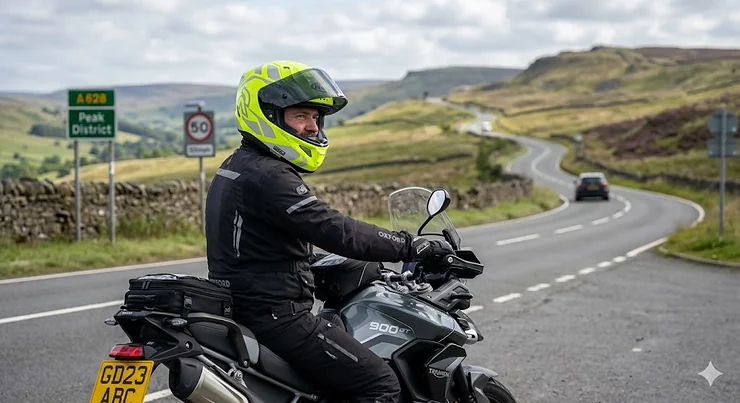
There’s a particular kind of British morning that puts everything into perspective: overcast, drizzly, the sky the precise colour of a damp flannel, and every car on the A-road wearing that glazed, distracted expression that makes a motorcyclist’s heart sink. In conditions like these — which is to say, in conditions that describe roughly two-thirds of the year on British roads — a high visibility motorcycle helmet isn’t a vanity purchase. It’s arguably the single most cost-effective safety upgrade you can make.
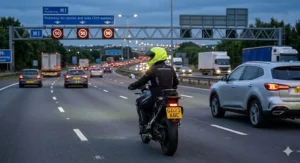
The statistics make uncomfortable reading. According to research cited by Wikipedia’s analysis of high-visibility clothing, wearing reflective or fluorescent gear correlates with a 37% lower risk of crash-related injury, while white helmets alone demonstrate a 24% reduction in crash risk compared to dark-coloured lids. Meanwhile, the UK Government’s SHARP programme — the independent helmet safety initiative funded by the Department for Transport — estimates that up to 50 lives could be saved each year if all riders wore high-rated helmets.
So what exactly is a high visibility motorcycle helmet? It’s any helmet engineered primarily around conspicuity: fluorescent shells (yellow-green, orange, or white) that maximise daytime detection, combined with retroreflective panels, integrated LED systems, or high-contrast graphics that ensure you remain visible when headlights sweep your way at dusk. It sounds simple. The execution, however, varies wildly.
In this guide, I’ve researched seven real high visibility motorcycle helmets currently available on Amazon.co.uk — from budget lids that punch well above their price to premium helmets with integrated lighting technology. All are ECE 22.06 certified or confirmed legal for UK road use, all prices are in GBP, and every spec comes with an honest assessment of what it actually means for riding in Britain. Let’s get into it.
Quick Comparison: High Visibility Motorcycle Helmets at a Glance
| Helmet | Type | Key Hi-Viz Feature | Approx. Price | Best For |
|---|---|---|---|---|
| JDC PRISM | Full-face | Fluorescent yellow shell | Under £70 | Budget commuters |
| LS2 Storm II | Full-face | High-contrast reflective graphics | £60–£90 | Value-focused riders |
| HJC C10 | Full-face | Hi-viz yellow ECE 22.06 | £90–£130 | All-round commuters |
| Bell Qualifier DLX Turnpike | Full-face | Hi-viz yellow/navy contrast | £130–£180 | Motorway touring |
| Shark Evo-One 2 Hi-Vis | Modular | Fluorescent shell + reflective | £200–£270 | Urban flip-up riders |
| AGV K3 SV Hi-Vis | Full-face | Fluorescent shell + Pinlock ready | £140–£200 | Sport-touring riders |
| Shark Skwal i3 | Full-face | Integrated active LED lighting | £280–£340 | Night riders / commuters |
Analysis: The table above reveals a clear price-to-feature pattern: below £100, you’re buying conspicuous colour; above £200, you start getting active visibility technology like integrated LEDs and reflective inserts. For most UK urban commuters — riding in and out of city centres through autumn and winter — the sweet spot sits in the £90–£180 range, where ECE 22.06 protection meets meaningful reflective detailing. The Shark Skwal i3 is in a category of its own if night riding is a priority: no passive reflective material matches the impact of an active LED visible from 200 metres.
💬 Just one click — help others make better buying decisions too! 😊
✨ Don’t Miss These Exclusive Deals!
🔍 Take your visibility and safety to the next level with these carefully selected helmets. Click on any highlighted item to check current pricing and availability on Amazon.co.uk. These picks will help you find exactly what you need — and make sure other drivers can find you, too!
Top 7 High Visibility Motorcycle Helmets: Expert Analysis
1. JDC PRISM Full-Face Helmet — Fluorescent Yellow
The JDC PRISM is where sensible budgeting and genuine conspicuity converge. The fluorescent yellow shell is unashamedly bright — not in a “I’m trying to look like a banana” way, but in the purposeful, I’d-like-to-get-home-tonight way that serious commuters appreciate.
The shell is constructed from a polycarbonate composite, which is entirely appropriate at this price, and the helmet carries ECE 22.06 certification — the current legal minimum standard for helmets sold in the UK since January 2024. The visor offers a clear, reasonably distortion-free view, though you’ll want to add a Pinlock insert for the foggier months (and in Britain, that’s a lot of months). The removable, washable liner is a thoughtful touch for daily riders.
Where the PRISM earns its keep isn’t in the spec sheet — it’s in the simple, unavoidable fact that fluorescent yellow is among the most conspicuous colours available in overcast conditions. Research consistently shows fluorescent yellow-green performs best under Britain’s characteristically grey skies, and the PRISM delivers that without asking you to spend triple figures.
UK buyers consistently rate this lid warmly, with reviewers noting it’s “well constructed and excellent value” — high praise considering the asking price. It won’t turn heads in a premium sense, but it might stop a distracted driver from failing to notice you on the A406.
✅ Pros:
- Genuine fluorescent yellow for maximum daytime conspicuity
- ECE 22.06 certified — legally current
- Outstanding value under £70
❌ Cons:
- No Pinlock insert included
- Ventilation modest in summer heat
Price range: Under £70 | Widely available on Amazon.co.uk, typically Prime-eligible for next-day delivery.
2. LS2 Storm II Full-Face Helmet — Hi-Viz Graphics
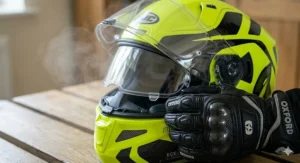
LS2 has quietly become one of the most reliable names in accessible motorcycle helmets, and the Storm II is a fine example of why. It’s the first helmet on this list to carry meaningful reflective graphics alongside its high-contrast colourway — small retroreflective panels integrated into the shell design that catch vehicle headlights and throw them back with surprising intensity.
The Storm II uses a multi-fibre composite shell, which offers a better strength-to-weight ratio than pure polycarbonate at only a modest price premium. The ECE 22.06 certification is current, the visor mechanism is smooth, and the internal sun visor — a feature you’ll deploy constantly during low winter sun on the M62 — is genuinely useful rather than an afterthought.
For UK commuters specifically, the ventilation system is worth noting: it’s efficient enough for dry summer days but won’t create an ice-wind problem in January. The liner is removable and machine-washable — important when you’re wearing this five days a week through autumn rain and sweating under a heated jacket.
The Storm II is the sensible upgrade from purely fluorescent-only options. The reflective element means it works in both daylight and low light, which matters enormously when British winter means commuting home in complete darkness. UK reviewers frequently praise the build quality as punching above its price point.
✅ Pros:
- Reflective graphics active in low light as well as day
- Multi-fibre composite shell — lighter than polycarbonate
- Internal sun visor ideal for low winter sun
❌ Cons:
- Hi-viz variants can sell out; check availability
- Pinlock insert sold separately
Price range: £60–£90 | Available on Amazon.co.uk; Prime delivery typically next-day.
3. HJC C10 Full-Face Helmet — Semi-Flat Hi-Viz Yellow
The HJC C10 in its semi-flat hi-viz yellow MC-3HSF colourway is what happens when a major international manufacturer takes visibility seriously. HJC — a Korean brand with an enormous global footprint and genuine race-programme heritage — brings proper quality control to an accessible price point, and the result is a helmet that competes firmly against rivals costing £30–£40 more.
The matte fluorescent yellow finish avoids the slightly toy-like appearance of some glossy competitors, while the Advanced Polycarbonate Composite shell is engineered to a tighter specification than most budget lids. The ECE 22.06 rating is current, and the ACS (Advanced Channelling Ventilation System) — HJC’s proprietary airflow design — works notably better than the token vents you find on purely budget lids.
For UK commuters, the C10’s practical highlights are two-fold: a wide-opening chin mechanism for easy on/off at traffic lights, and a rear spoiler that measurably reduces wind noise at motorway speeds. Riding the M1 from Leeds to Sheffield on a Tuesday morning is grim enough without a howling headache by the time you arrive. The washable interior liner keeps things fresh through back-to-back riding days.
This is the helmet I’d recommend to a colleague who commutes daily in a northern city where visibility is compromised six months of the year. It’s not flashy. It works.
✅ Pros:
- Semi-flat finish looks professional, not gimmicky
- Excellent ECE 22.06 protection at price
- Effective ventilation reduces fatigue on longer runs
❌ Cons:
- No integrated sun visor
- Comms-system installation requires aftermarket preparation
Price range: £90–£130 | Available on Amazon.co.uk, often Prime-eligible.
4. Bell Qualifier DLX MIPS — Turnpike Hi-Viz Yellow/Navy
The Bell Qualifier DLX Turnpike is where the conversation shifts from “visible” to “seriously protected and visible.” The MIPS (Multi-directional Impact Protection System) brain-protection liner — a thin, low-friction layer that allows the helmet shell to rotate slightly on impact, reducing rotational forces transmitted to the brain — elevates this lid beyond the typical conspicuity-focused range.
The Turnpike graphic is Bell’s hi-viz offering: a high-contrast yellow and navy design that’s visually distinctive at distance in a way that plain fluorescent yellow isn’t. Where a single-colour lid blends into a fluorescent jacket, the graphic creates a recognisable silhouette. It’s a subtler form of visibility engineering, but an effective one.
Bell’s Velocity Flow Ventilation system is genuinely impressive for motorway riding — the dual intake/exhaust design keeps airflow moving even on slower A-roads. The included Nutrax anti-fog insert (Bell’s Pinlock-compatible system) is a meaningful inclusion for British conditions; the number of accidents that occur because a rider’s visor fogged in a downpour is not an insignificant statistic.
For riders who cover regular motorway miles — commuters from outer London into the centre, or those doing the M4/M5 corridor regularly — the MIPS addition and anti-fog provision justify the mid-range price.
✅ Pros:
- MIPS rotational impact protection
- Anti-fog insert included — genuinely essential in UK
- Distinctive graphic creates standout silhouette
❌ Cons:
- No integrated sun visor
- Slightly heavier than composite-shell alternatives
Price range: £130–£180 | Available on Amazon.co.uk; check for Prime eligibility.
5. Shark Evo-One 2 Hi-Vis Modular Helmet
The Shark Evo-One 2 solves a specific British commuter problem beautifully: you need to stop at petrol stations, have conversations at traffic lights, and occasionally deal with parking wardens without removing your helmet entirely. The modular flip-front design handles this gracefully, and the Shark Evo-One 2 Hi-Vis version wraps the whole package in a fluorescent shell with integrated reflective panels that activate in low-light conditions.
Shark is a French brand with serious motorsport credentials, and the build quality here reflects that lineage. The shell uses a Duo Composite construction — a blend of fibreglass and Twaron fibres — that achieves a notably lower weight than polycarbonate modulars at similar prices. Lower weight matters more on a modular helmet because the chin-piece mechanism adds mass that a full-face avoids; Shark manages the balance intelligently.
The chin-guard lock mechanism scores highly for UK riding because it can be fully closed in sub-zero temperatures with gloved hands — something that sounds obvious but which several rivals get wrong. The visor is Pinlock 70 compatible, and the integrated sun visor deploys smoothly with a thumb lever.
What most UK buyers overlook about the Evo-One 2 is its certification: it’s rated as a full-face helmet even with the chin guard open, meeting ECE 22.06 in both configurations. Cheaper modular helmets often carry certification only when fully closed.
✅ Pros:
- Certified full-face protection in both open and closed modes
- Fluorescent shell + reflective panels: day and night visibility
- Pinlock-ready visor — essential for British autumn/winter
❌ Cons:
- Higher price point than full-face alternatives
- Slightly complex fit — try before buying if possible
Price range: £200–£270 | Available on Amazon.co.uk.
6. AGV K3 SV Hi-Vis Full-Face Helmet
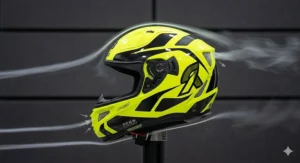
The AGV K3 SV in hi-vis yellow represents Italian style meeting British practicality in a way that actually makes sense. AGV’s racing heritage — Valentino Rossi’s preferred manufacturer for much of his career — filters into every aspect of the shell design, and the result is a sport-touring lid that looks purposeful rather than merely garish.
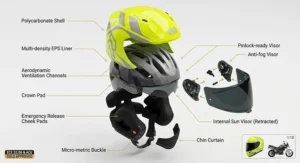
The thermoplastic resin shell strikes a good balance: tougher than polycarbonate, not as featherlight as carbon-fibre composite, but priced appropriately for a daily commuter who needs durability over boutique lightness. The emergency release system on the cheek pads — allowing paramedics to remove the helmet without excessive head movement in an accident — is a detail worth noting and one that AGV implements cleanly.
For UK riders, the Pinlock 120 compatibility (Pinlock insert included on most UK retail variants) is the standout practical feature. The K3 SV’s visor is optically excellent — better than you’d expect at this price — and the drop-down internal sun visor helps manage the unpredictable British light: full sun one minute, complete overcast the next, low winter sun blinding you on a westward A-road at 4pm.
The hi-vis colourway is vibrant without being gaudy, and AGV’s finish quality means it holds its colour better under UV exposure than some budget fluorescent options that fade to a washed-out yellow within a season.
✅ Pros:
- Pinlock 120 typically included — outstanding anti-fog
- Emergency cheek-pad release for safety
- Premium optics in the visor for a mid-range price
❌ Cons:
- Sport-fit shell runs narrower — not ideal for wider/round head shapes
- Ventilation effective only at higher speeds
Price range: £140–£200 | Available on Amazon.co.uk; check size availability.
7. Shark Skwal i3 — Integrated Active LED Lighting
This is the helmet that changes the conversation entirely. The Shark Skwal i3 doesn’t just reflect light — it generates it. Integrated LED strips embedded directly into the shell produce active, powered illumination: tail-light behaviour, brake detection, and constant running lights that make this helmet visible from distances that passive reflective materials simply cannot match.
The Skwal i3’s LED system is connected via a micro-USB port concealed within the shell. Battery life is excellent — multiple days of commuting from a single charge — and the LEDs are water-resistant to a standard appropriate for British weather (which, as any rider knows, can transition from “light mist” to “apocalyptic downpour” in approximately four minutes on the M62). The system activates automatically based on ambient light sensors, so you’re not fumbling for a switch at dusk.
The helmet itself uses Shark’s Duo Composite shell — the same fibreglass/Twaron blend as the Evo-One 2 — and the ECE 22.06 certification covers both the helmet and the LED system. The visor is Pinlock-ready, and the internal sun visor is particularly well-engineered.
For night commuters in British cities — particularly those navigating poorly-lit suburban B-roads, roundabouts, or the kinds of unlit country lanes that connect rural villages to market towns — this is arguably the most impactful visibility purchase available. The £280–£340 price range is substantial, but consider the alternative.
✅ Pros:
- Active LED system: visible at distances passive helmets cannot match
- Automatic light activation via ambient sensor
- Premium Duo Composite shell, ECE 22.06 certified
❌ Cons:
- Premium price — significant investment
- LED system requires regular charging (USB)
Price range: £280–£340 | Available on Amazon.co.uk; Prime delivery available.
How to Choose a High Visibility Motorcycle Helmet in the UK: A Practical Framework
Buying a helmet is not like buying a jacket or a pair of boots. The stakes are categorically different — which is worth saying plainly before getting into the checklist.
1. Prioritise ECE 22.06 certification. From January 2024, the UK requires all new helmets entering the market to meet ECE 22.06 — a stricter standard than the previous ECE 22.05. Helmets with the old rating remain legal to wear, but when buying new, there’s no reason to settle for less. The SHARP programme (sharp.dft.gov.uk) goes further, independently testing helmets above the minimum legal threshold and publishing star ratings — it’s the NCAP of motorcycle helmets, and worth consulting before you buy.
2. Choose colour based on your primary riding conditions. Fluorescent yellow-green performs best in overcast daylight — which covers most of Britain most of the time. Fluorescent orange is particularly effective at dawn and dusk, and white performs well across all conditions. If you commute in full darkness (October through February for most UK riders), supplement any colour choice with reflective panels or active LEDs.
3. Don’t neglect the visor. A fogged visor in a British downpour is a safety issue as serious as any impact protection failing. Look for Pinlock compatibility — ideally with the insert included — in any helmet you’re considering for year-round UK use.
4. Consider the modular option if you ride urban routes. Flip-front modulars add weight and complexity, but for riders stopping frequently in city traffic, the convenience can reduce the temptation to ride without the chin guard fully secured.
5. Check SHARP ratings, not just ECE markings. ECE 22.06 is pass/fail — it tells you the minimum is met. SHARP tells you by how much. A 5-star SHARP lid at £150 may offer meaningfully better protection than a 3-star one at £200.
6. Fit is non-negotiable. According to SHARP, helmets frequently come off in accidents because they’re too large for the wearer. A fluorescent helmet that flies off on impact isn’t protecting anyone. If ordering from Amazon.co.uk, check the brand’s size chart carefully and note the 14-day returns window under UK Consumer Contracts Regulations.
Real-World Rider Profiles: Which Helmet Suits Which UK Rider?
The London Commuter (Daily, Zone 2–4, M–F)
You’re navigating congestion zones, filtering through standing traffic, and stopping at petrol stations on Rotherhithe New Road with your helmet on because parking takes thirty seconds. The Shark Evo-One 2 Hi-Vis is made for you — the modular chin guard, full-face certification, and fluorescent shell with reflective panels cover every scenario from the Blackwall Tunnel to a drizzly November night on the South Circular.
The Northern Town Commuter (Sheffield, Leeds, Manchester)
Hilly cities, variable weather, and a lot of unlit suburban A-roads at 6am and 6pm through winter. The HJC C10 Hi-Viz or Bell Qualifier DLX Turnpike serve you best: solid ECE 22.06 protection, meaningful fluorescent visibility, and — in the Bell’s case — MIPS protection for the kinds of oblique collisions that happen at roundabouts in low visibility.
The Rural or Touring Rider (Peak District, Yorkshire Dales, Cotswolds)
Country lanes, National Speed Limit roads, and the occasional lorry that hasn’t noticed you approaching a blind bend. The AGV K3 SV covers this beautifully: the optics are excellent, the Pinlock 120 handles the mist rolling off hillsides, and the hi-vis colourway is visible against the green-and-grey backdrop of British countryside in a way that a white lid sometimes isn’t.
The Night Rider / Late-Shift Commuter
If a meaningful portion of your riding happens in genuine darkness — October through March means most commuters qualify — then the Shark Skwal i3 is the only genuine upgrade over a standard reflective lid. Active LEDs aren’t a gimmick at night; they’re a different category of visibility entirely.
Maintaining Your Hi-Viz Helmet in British Conditions: A Practical Guide
A fluorescent helmet that’s faded to dishwater yellow isn’t doing its job. Here’s what most riders overlook.
Visor care is weekly, not monthly. British roads spray a particular cocktail of salt, diesel mist, and grit that films onto visors with remarkable efficiency. A misted or scratched visor isn’t just an annoyance — it’s a hazard. Use a dedicated visor cleaner (avoid household glass cleaners; they damage anti-scratch coatings) weekly during commuting season. If your visor has a Pinlock insert, rinse and re-seat it monthly.
Fluorescent UV degradation is real. Fluorescent pigments — the chemistry that makes yellow-green helmets glow under daylight — degrade under UV exposure. Most manufacturers recommend replacing helmet shells after five years regardless of condition; for hi-viz helmets worn in strong sun (yes, even British sun), consider four years a more honest limit. A faded fluorescent helmet may still look yellow but can have lost a significant portion of its conspicuity advantage.
Reflective panels need occasional inspection. The retroreflective microprismatic materials used in helmet panels can degrade if contaminated with petrol, chain lube, or aggressive cleaning products. Check that reflective areas still throw back a bright white when caught by a torch beam. If they look cloudy or dim, the material has degraded.
Storage matters for LED-equipped helmets. If you own a Shark Skwal i3 or similar active-LED helmet, charge the LED system monthly even through winter lay-up periods — lithium batteries degrade faster when stored fully discharged.
Common Mistakes When Buying a High Visibility Motorcycle Helmet in the UK
Mistaking brightness for certification. A lurid fluorescent paint job is not the same as a properly tested, ECE 22.06 certified lid. There are helmets on Amazon.co.uk that look impressively hi-viz but carry outdated certifications or, in rare cases, no certification at all. Always verify the ECE marking stamped inside the helmet before purchase.
Ignoring the SHARP database. Most UK riders know SHARP exists but relatively few actually use it before buying. This is a free, government-funded resource that tells you precisely how your candidate helmet performs above the legal minimum. The SHARP website at sharp.dft.gov.uk is worth bookmarking alongside any Amazon product page.
Buying a US-specification helmet. This is more common than you’d think. Some Amazon marketplace sellers list US-specification helmets — carrying DOT rather than ECE certification — at attractive prices. DOT helmets are not legal for UK road use. Always confirm ECE 22.06 marking before purchase.
Treating the UK Highway Code as optional reading. The Highway Code explicitly encourages enhanced visibility, advising riders to wear “a light or brightly coloured helmet and fluorescent clothing or strips” for daytime riding, and reflective clothing for night riding. It’s guidance rather than law — but it’s also the framework against which fault is apportioned in an accident. Worth knowing.
Prioritising colour over fit. A fluorescent helmet that doesn’t fit will come off in a crash. No colour in the world compensates for that. The UK Consumer Contracts Regulations give you 14 days to return online purchases — use this right if the fit isn’t correct.
FAQ: High Visibility Motorcycle Helmets in the UK
❓ Do I legally have to wear a high visibility motorcycle helmet in the UK?
❓ What colour motorcycle helmet is most visible on UK roads?
❓ Are ECE 22.06 helmets required on UK roads in 2026?
❓ What is the SHARP rating and why does it matter for UK buyers?
❓ Do LED motorcycle helmets like the Shark Skwal i3 comply with UK road law?
Conclusion: Make Yourself Unmissable
There’s a phrase that circulates in British motorcycling circles — “SMIDSY” — which stands for “Sorry Mate, I Didn’t See You.” It’s the most common explanation offered by drivers involved in collisions with motorcyclists, and it contains within it both the problem and the solution. The problem is perceptual: motorcycles are narrow, and human visual attention prioritises large, bright, moving objects. The solution, then, is straightforward — become a large, bright, moving object.
A quality high visibility motorcycle helmet doesn’t guarantee safety. Nothing does. But for an investment of £50 to £340, depending on your budget and requirements, you can dramatically shift the odds in your favour on British roads. Combine your hi-viz lid with reflective clothing, effective lighting, and proper ECE 22.06 protection, and you’ve done everything within your power to be seen.
Check the SHARP database before you finalise your choice, verify the ECE marking inside any helmet you purchase, and use Amazon.co.uk’s 30-day returns policy to ensure the fit is correct before committing.
✨ Don’t Miss These Exclusive Deals!
🔍 Ready to upgrade your road visibility? Click on any highlighted helmet above to check current pricing and stock on Amazon.co.uk. Prime members typically enjoy next-day or same-day delivery — so you could be riding safer tomorrow.
Recommended for You
- 7 Best Motorcycle Helmet with Turn Signals UK 2026 — Ride Safer
- Best Motorcycle Helmet with Brake Light UK 2026: Top 7 Picks
- 7 Best Motorcycle Helmet with LED Lights UK 2026
Disclaimer: This article contains affiliate links. As an Amazon Associate, I earn from qualifying purchases. If you purchase products through these links, we may earn a small commission at no additional cost to you.
✨ Found this helpful? Share it with your mates! 💬🤗
