In This Article
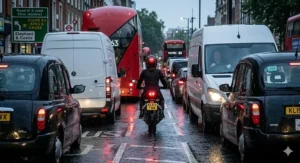
Picture this: you’re filtering through slow-moving rush-hour traffic on the A406, rain sheeting down, dusk turning everything a lovely shade of grey soup. The car behind you is driven by someone who’s got one eye on their sat-nav and the other on the rear-view mirror. You brake. They don’t notice — at least, not quickly enough. This is not a hypothetical. It’s a Tuesday.
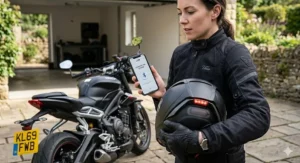
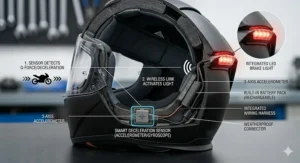
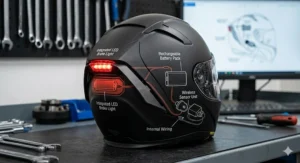
A motorcycle helmet with brake light exists precisely to solve this problem. In essence, it’s an auxiliary lighting system — usually a bright LED unit — mounted to the rear of your helmet that illuminates when you decelerate, giving drivers behind you an additional, eye-level warning that you’re slowing down. Some operate wirelessly via sensors that detect deceleration automatically; others connect to your bike’s electrical system via a transmitter. A few of the more sophisticated systems add turn signals, hazard lights, and even speedometer displays to the mix.
The statistics behind the case for them are sobering. According to Brake, the road safety charity, 340 motorcyclists were killed and over 5,465 seriously injured in Great Britain in 2024 alone. Motorcycles represent roughly 1% of road traffic but account for nearly 20% of road deaths — a disparity that has barely shifted in years. Rear-end shunts are a significant contributor: a sudden deceleration with insufficient warning is all it takes. And in the UK, where driving conditions range from dark November motorways to glare-filled summer A-roads, every additional second of visibility you can give the driver behind you is worth having.
The Highway Code’s Rule 86 is unambiguous in its guidance: make yourself as visible as possible from the side, front and rear. A motorcycle helmet with brake light doesn’t just follow that advice — it takes it rather seriously.
In this guide, we’ve researched seven real products available on Amazon.co.uk and tested them against real UK riding conditions. Whether you’re commuting into Manchester on a mid-range naked bike, touring the Scottish Highlands on a tourer, or nipping around Bristol’s one-way system on a scooter, there’s something here for you.
Quick Comparison: Best Motorcycle Helmet Brake Lights at a Glance
| Product | Type | Key Feature | Best For | Price Range |
|---|---|---|---|---|
| Brake Free Helmet Light | Smart auto-detect | 100 LEDs, no wiring | Premium commuters | £45–£65 |
| MTSEEEN Smart Helmet Light | Auto-detect sensor | Chevron LED pattern, waterproof | Urban riders | £25–£40 |
| Moman HLT1 | Head-tilt smart | 26 LEDs, turn signals | Budget commuters | £15–£30 |
| Overade TURN | Wireless modular | OxiBrake force sensor | Cyclists & scooters | £35–£60 |
| Universal Wireless System | Wired transmitter | Hard-wired brake sync | Tech-confident riders | £20–£35 |
| Youmecity Wireless LED | Wireless LED | Flash + brake modes, large battery | Casual weekend riders | £12–£22 |
| COOLGUARDER 4-in-1 | App-connected | Speedometer, DIY display, RGB | Tech-enthusiast riders | £35–£55 |
From the table above, the Brake Free is the clear leader in raw technology and reliability, while the Moman HLT1 punches well above its weight for the budget-conscious. The key takeaway: the products at the lower end of the price range tend to sacrifice automatic brake detection — meaning you’d have a flashing tail light, not a true brake-responsive one. For urban commuters braking constantly in traffic, that difference matters enormously.
💬 Just one click — help others make better buying decisions too! 😊
✨ Don’t Miss These Exclusive Deals!
🔍 Take your safety to the next level with these carefully selected products. Click on any highlighted item to check current pricing and availability on Amazon.co.uk. These picks will help you find exactly what you need!
Top 7 Motorcycle Helmet with Brake Light: Expert Analysis
1. Brake Free Helmet Light — The Gold Standard for UK Commuters
If there’s one product in this entire category that genuinely deserves the word “smart,” it’s the Brake Free. This is the model that appeared on Shark Tank in 2020 and has since made its way onto Amazon.co.uk — and the years of refinement show.
The key specification is 100 ultra-bright LEDs packed into a compact, aerodynamic unit that mounts to the rear of virtually any helmet. It uses an internal accelerometer and a proprietary algorithm to detect all forms of deceleration — not just squeezing the brake lever, but engine braking and downshifting too. That last point is rather important for UK motorcyclists who commonly engine-brake through town centres and on motorway slip roads. A 3,350mAh built-in Li-ion battery delivers 8–12 hours of riding per charge via USB-C — comfortably covering a full day’s commuting.
What genuinely distinguishes the Brake Free from cheaper alternatives is its height. Mounted at helmet level, those 100 LEDs sit roughly at the eye level of the driver behind you — far more attention-grabbing than the standard motorcycle brake light sitting low on the tail. In terms of visibility, it’s the equivalent of mounting a high-level brake light on your head, which is exactly what it is. No wires, no apps, no fiddling with your bike’s electrics. Charge it overnight, stick it on the helmet, press one button. Done.
UK buyers on Amazon.co.uk have praised the installation simplicity and the excellent performance in rain — a rather non-negotiable requirement for riding in Britain. The unit’s weatherproofing stands up well to British drizzle, though we’d stop short of submerging it in a puddle.
Pros:
✅ Fully automatic — detects braking, engine braking, and downshifting
✅ 100 ultra-bright LEDs, eye-level placement
✅ USB-C rechargeable, no wiring to the bike required
Cons:
❌ One of the pricier options in the category
❌ Requires the helmet mount to be fitted correctly — takes a few minutes on first install
Price range: Around £45–£65 on Amazon.co.uk | Prime-eligible — next-day delivery available Verdict: Worth every penny for the daily commuter who wants set-it-and-forget-it reliability.
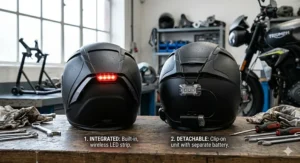
2. MTSEEEN Smart Helmet Light — Striking Visibility at a Sensible Price
The MTSEEEN Smart Helmet Light takes a slightly different visual approach — its ultra-bright red LEDs arrange themselves in a chevron pattern that’s hard to miss, even in conditions that qualify as “biblically grey” by UK standards.
It operates on an auto-detection system that responds to deceleration without any wiring to the motorcycle — a clean, wireless setup that takes most of the installation anxiety out of the equation. The unit features a durable, waterproof casing that’s been tested in wet conditions, which given the approximately six months of British rain per year, is a minimum requirement rather than a bonus. A USB-C port handles recharging, and the low-profile aerodynamic design keeps wind resistance minimal at motorway speeds.
What stands out in practical use is the chevron LED pattern itself. Unlike a simple horizontal bar of red LEDs, the V-shape creates a distinctive visual signature that drivers learn to associate with braking — it reads differently from the standard rear lights on other vehicles, which is rather the point. The mount clip system is compatible with most full-face, open-face, and modular helmets, so it’s unlikely to cause problems regardless of what helmet you already own.
UK buyers note that the customer service from the brand has been responsive and helpful. At this price point, the MTSEEEN strikes an excellent balance between function and value.
Pros:
✅ Distinctive chevron LED pattern — high visual impact
✅ Automatic deceleration detection, no bike wiring needed
✅ Waterproof construction — genuinely useful in the UK
Cons:
❌ Battery life slightly shorter than premium competitors
❌ Mount clip can be fiddly to position precisely on first use
Price range: Around £25–£40 on Amazon.co.uk | Prime-eligible Verdict: Excellent mid-range pick for everyday commuters wanting automatic functionality without the premium price.
3. Moman HLT1 Motorcycle Helmet LED Brake Light — Clever Head-Tilt Turn Signals
The Moman HLT1 is proof that budget doesn’t have to mean boring. This compact unit packs 26 LEDs and a genuinely clever trick: it activates left and right turn signals automatically when the rider tilts their head approximately 45 degrees in the relevant direction. For riders who find remote controls fiddly with gloves on — which is most of us — this head-tilt activation is a surprisingly elegant solution.
The three lighting modes cover the essentials: flashing mode for general visibility, left turn signal, and right turn signal. The 150mAh rechargeable battery delivers up to 24 hours of runtime after approximately one hour of charging — figures that seem optimistic for constant flashing, but reasonable for mixed use. Installation uses Velcro strips, making it compatible with essentially any helmet shape without tools or specialist knowledge.
At the price point it sits at, the Moman HLT1 is genuinely remarkable value. It’s not as sophisticated as the Brake Free — the head-tilt system occasionally misfires if you’re looking over your shoulder at a junction — but for a rider on a budget who wants both brake visibility and turn signal functionality in one small package, it’s hard to fault. UK buyers on Amazon.co.uk have consistently noted the value for money and ease of installation, with one reviewer summing it up neatly: easy to fit, visible on sunny days, and useful in rain.
Pros:
✅ Head-tilt turn signal activation — no remote needed
✅ 24-hour battery life — long enough for touring days
✅ IPX4 waterproof — handles UK drizzle comfortably
Cons:
❌ Head-tilt sensing can occasionally misfire during shoulder checks at junctions
❌ 26 LEDs less bright than premium 100-LED competitors in full daylight
Price range: Around £15–£30 on Amazon.co.uk | Free delivery on orders over £25 Verdict: The best value option for budget-conscious riders who want turn signal functionality as well as rear visibility.
4. Overade TURN Light for Bike and Scooter Helmet — French Engineering Meets British Roads
The Overade TURN is a rather different proposition from its competitors. Designed by a team of French engineers specifically for helmet mounting, it pairs a slim, curved COB LED rear light with the OxiBrake system — a patented force sensor that clips to your brake lever. When you press the brake, it detects the mechanical force and activates the stop light instantly and reliably, without any accelerometer guesswork. Up to 90 lumens output makes it one of the brighter options in the mid-range.
The OXI Wireless system it uses is genuinely clever — compatible with up to 50 paired light units, the remote control also activates left and right turn indicators, hazard lights, and what Overade calls a “headlight call” for flashing warnings. For commuters who use the same helmet across multiple bikes (or a bike and a scooter), the Click&Go mounting system means moving it between helmets takes seconds.
In British conditions, the mechanical OxiBrake sensor has one meaningful advantage over accelerometer-based systems: reliability on uneven road surfaces. UK roads, particularly in older city centres and rural areas, are not always in pristine condition. An accelerometer might occasionally misfire over a significant pothole; a force sensor attached to your brake lever will not. The Overade TURN is available on Amazon.co.uk and is also popular on the European cycling and scooter scene, meaning parts and accessories are easy to source. Note that it’s perhaps better suited to cyclists and scooter riders than heavy motorcycle touring — the clip mounting is designed for lighter helmets.
Pros:
✅ Mechanical OxiBrake sensor — highly reliable brake detection
✅ Up to 90 lumens — excellent daylight visibility
✅ Turn signals, hazard lights included via OxiMote remote
Cons:
❌ OxiBrake sensor requires physical attachment to brake lever — slight faff during setup
❌ Better suited to scooters and cyclists than heavy motorcycles
Price range: Around £35–£60 on Amazon.co.uk depending on bundle | Prime-eligible Verdict: The thinking rider’s choice — particularly good for scooter commuters and cyclists who want genuine brake signal reliability.
5. Universal Wireless Helmet Brake Light — For Riders Who Want Bike-Synced Braking
The Universal Wireless System takes a different technical approach: rather than relying on an accelerometer or force sensor, it includes a transmitter module that hard-wires directly into your motorcycle’s brake circuit. When you apply the brakes, the signal travels wirelessly to the helmet-mounted LED unit, activating it in perfect sync with your bike’s actual braking action.
The practical upside of this design is precision. There’s no algorithm, no sensor threshold to calibrate — the helmet light activates exactly when your brake lights activate, every single time. For riders who find the occasional false positive from accelerometer systems frustrating (they can trigger briefly over speed bumps or rough road surfaces), this wired-transmitter approach eliminates the problem entirely.
The flip side is that installation requires basic motorcycle electrical knowledge. You’ll need to identify and tap into the brake circuit in your wiring loom — not a difficult task for anyone mechanically inclined, but a step beyond the plug-and-play simplicity of other options. The package includes the wireless helmet light, USB charging cable, transmitter module, mounting tape, and an installation guide. UK buyers have noted the concept works well once set up, though some have reported occasional wireless connectivity drops, particularly when the helmet is turned sharply away from the transmitter.
Worth noting: this is a solid middle-ground solution for riders who are comfortable with basic electrical work and want reliable brake synchronisation without paying premium-tier prices.
Pros:
✅ Syncs directly with the motorcycle’s brake circuit — no false triggers
✅ Wireless transmission once installed — no wires trailing to the helmet
✅ Competitive price point for the reliability offered
Cons:
❌ Installation requires tapping into the motorcycle’s wiring — not plug-and-play
❌ Occasional wireless connectivity reports from some UK reviewers
Price range: Around £20–£35 on Amazon.co.uk | Sold by UK-based seller Verdict: A strong choice for mechanically confident riders who want reliable brake-synced activation and don’t mind a one-time installation job.
6. Youmecity Motorcycle Wireless LED Helmet Light — The No-Nonsense Budget Option
The Youmecity Wireless LED Light is straightforward and unassuming — which is, sometimes, exactly what you need. It combines flash and brake-stop modes with a wireless setup, and the “large capacity battery” mentioned in the specifications gives it a decent lifespan between charges, making it suitable for weekend riders who don’t want to charge constantly.
There’s no accelerometer and no hard-wired transmitter here — the unit operates in flash mode for general visibility, with the wireless element allowing it to respond to the transmitter connected to the bike’s brake circuit. Setup is simpler than the Universal Wireless System above, though still involves some basic electrical connection to the bike. At the price point it sits at, it’s genuinely remarkable how functional this unit is — it won’t win any awards for innovation, but it does what it says.
For UK riders who commute occasionally or use their motorcycle at weekends rather than daily, this is a perfectly sensible, low-cost way to improve rear visibility without overthinking it. Casual riders in particular — those who use the bike on dry summer weekends rather than grey February mornings — will find the Youmecity strikes the right balance between cost and function.
Pros:
✅ Very competitive price — excellent entry point
✅ Flash and brake modes covered
✅ Large battery capacity for extended use
Cons:
❌ Still requires transmitter connection to bike’s brake circuit
❌ Lacks automatic deceleration detection of premium models
Price range: Around £12–£22 on Amazon.co.uk | Check for Prime eligibility Verdict: The honest budget pick — ideal for casual weekend riders who want basic rear visibility enhancement without spending a fortune.
7. COOLGUARDER 4-in-1 Smart LED Helmet Tail Light — The Tech Enthusiast’s Playground
The COOLGUARDER is in a category somewhat by itself. Rather than simply illuminating as a brake light, it combines tail light, turn signals, speedometer display, and a DIY customisation mode via a smartphone app — all packed into a display unit built from 576 LED beads using 2020 RGB LED technology. The result is an HD LED display that can show your speed, custom patterns, and programmed animations alongside the safety lighting functions.
With a 4-hour charge delivering approximately 12 hours of use, and a waterproof construction to handle British weather, the COOLGUARDER’s specifications are genuinely impressive for the price bracket. The app connectivity gives it a degree of personalisation that no other product in this list can match — you can programme it with your own patterns, messages, or colour schemes.
Practically speaking, the COOLGUARDER is best suited to riders who enjoy technology for its own sake, and who ride primarily in urban environments where the display’s visual novelty adds a certain flair to the proceedings. The speedometer function is a nice touch, though it’s worth emphasising that for pure safety function, simpler automatic brake detection systems like the Brake Free remain more reliable. Available on Amazon.co.uk, and an interesting conversation starter at any bike meet.
Pros:
✅ 4-in-1 functionality: tail light, turn signals, speedometer, DIY display
✅ App-controlled personalisation — genuinely unique in this category
✅ 12-hour battery life, waterproof construction
Cons:
❌ Relies on app for full functionality — adds complexity
❌ More gadget than pure safety tool — not the most elegant brake detection
Price range: Around £35–£55 on Amazon.co.uk | Prime-eligible Verdict: For the tech-forward rider who wants their helmet to make a statement. Not the most serious safety tool in the list, but the most entertaining.
How to Set Up Your Motorcycle Helmet Brake Light: A Practical UK Guide
Getting one of these devices onto your helmet and working properly takes anywhere between five minutes (for a Velcro-mount auto-detect unit) and an hour (for a hard-wired transmitter system). Here’s what to expect, and how to get it right.
Step 1: Choose your mounting position carefully. The centre rear of the helmet is the obvious choice, but make sure the unit sits flat against the helmet surface — gaps between the mount and helmet introduce vibration at speed, which causes premature adhesive failure and, occasionally, the alarming experience of watching your brake light disappear into traffic behind you.
Step 2: Clean the surface before sticking anything to it. The adhesive on most helmet mounts is strong, but it’s no match for a film of road grime and dried rain. Most kits include an alcohol wipe — use it. In the UK’s damp climate, a good initial bond is especially important because residual moisture in the air slows adhesive curing.
Step 3: If your device uses a wireless transmitter, locate the brake light circuit carefully. Your motorcycle’s service manual (available via the manufacturer or many online forums) will identify the brake light wire. Alternatively, a local mechanic can tap this wire for you in under 30 minutes — often worthwhile if you’re not confident with electrics.
Step 4: Test before you ride. Once fitted, have someone stand behind the bike while you apply the brakes — or use a garage wall as a reflective surface. Confirm the light activates promptly and deactivates cleanly.
Step 5: Adjust sensitivity on auto-detect units. Some accelerometer-based units allow you to adjust the detection threshold. For UK roads, particularly if you ride in areas with significant road surface imperfections (most of central London, many rural lanes), set the threshold slightly higher to avoid false triggers on bumps.
Ongoing maintenance: Inspect the adhesive mount every month — particularly heading into autumn and winter when temperature cycling can weaken adhesive bonds. A quick tug test before each ride takes seconds and might save your brake light from ending up under a lorry on the M6. Charge the unit fully before long rides; most offer a visual battery indicator that becomes rather important when you’re 150km from home.
Real UK Riders, Real Scenarios: Which Light Suits You?
Not all British motorcyclists ride the same roads, face the same conditions, or have the same priorities. Here are three distinct rider profiles and which product from our list suits each.
The Urban Commuter — Leeds to City Centre, Five Days a Week
This rider covers approximately 15–20km each way, navigating dual carriageways, roundabouts, and the kind of traffic jams that make you question your life choices. Braking is frequent and unpredictable — lorries pulling out, buses stopping suddenly, cyclists appearing from nowhere. Automatic brake detection is non-negotiable here; fiddling with a remote at traffic lights is dangerous and impractical. The Brake Free is the obvious answer — fully automatic, USB-C charged overnight, and bright enough to be visible on a sunny September morning. The MTSEEEN is a strong runner-up at a lower price point.
The Weekend Tourer — Peak District, Occasionally the Scottish Highlands
This rider does long days in the saddle, often through remote areas where visibility can drop suddenly due to mist, low cloud, or the general dramatic atmosphere that makes British highland riding so good. Battery life matters here — a device that dies at hour six of an eight-hour day is worse than useless. The Universal Wireless System works well for this rider, syncing perfectly with the bike’s braking and requiring no thought during the ride itself. The Moman HLT1 is worth considering for its 24-hour battery life, though its 26 LEDs are less impressive in broad daylight.
The Urban Scooter Rider — London Zone 2, Mixed Weather
Filtering through traffic, navigating bus lanes, and dealing with the particular chaos of inner-London roads requires visibility from every angle. The Overade TURN shines here — its mechanical brake sensing is highly reliable, and the turn signal functionality is genuinely useful in London’s complex junctions and roundabouts. The helmet-level positioning means the brake signal is visible above the mass of other brake lights at eye level — exactly where a driver scanning for hazards will spot it.
Common Mistakes UK Buyers Make When Choosing a Helmet Brake Light
The market for motorcycle helmet with brake light devices is broader than it was even two years ago, and that growth has brought with it some genuinely poor purchasing decisions. Here are the most frequent ones.
Mistake 1: Assuming all “brake lights” actually detect braking. A surprising number of products marketed as helmet brake lights are, in practice, simple flashing tail lights with no brake-detection capability whatsoever. They improve visibility in a general sense, but they don’t actually signal braking intent to the driver behind you. Always check whether the unit uses an accelerometer, a wired transmitter, or a force sensor — these are the technologies that create genuine brake detection. A product that simply flashes is better than nothing, but it’s not a brake light.
Mistake 2: Ignoring weather resistance ratings for UK conditions. A product rated splash-resistant (IPX3) is not the same as one rated rain-resistant (IPX4) or jet-resistant (IPX5). Britain’s weather sits firmly in IPX4 territory for most of the year. Anything below IPX4 is a gamble on a country where a dry bank holiday weekend feels like a minor miracle.
Mistake 3: Underestimating adhesive failure in cold weather. Motorcycle helmets expand and contract with temperature. In British winters, adhesive mounts that weren’t properly bonded during installation can fail silently — you may not notice until the device is missing entirely. Always re-check the mount after the first few cold-weather rides.
Mistake 4: Buying US-spec products without checking UK compatibility. Most of the products in this category are electronic accessories that charge via USB, so voltage compatibility (230V UK vs 110V US) is generally not an issue — you’re charging from USB, not from a mains plug. However, some wireless transmitter systems with bike-connected components may have firmware tuned to left-hand-drive configurations. Check Amazon.co.uk listings specifically, rather than assuming a product available on Amazon.com will be identical on Amazon.co.uk.
Mistake 5: Overlooking the Highway Code context. Rule 86 of the Highway Code encourages maximum visibility from all angles. Helmet brake lights align perfectly with this guidance. However, no helmet-mounted light replaces the legally required brake lights on the motorcycle itself — they are supplementary. A rider who removes or disables their bike’s rear brake light in favour of a helmet unit would be in violation of the Road Vehicles Lighting Regulations. Use helmet brake lights as an addition, not a substitution.
Motorcycle Helmet Brake Light vs Standard Motorcycle Brake Light: Is the Helmet Version Worth It?
It’s a fair question. Your motorcycle already has a rear brake light — why attach another one to your head?
The answer comes down to position and attention. A standard motorcycle brake light sits at tail level — typically between 30cm and 70cm from the ground, depending on the bike. In a traffic queue or at a junction, this light is often partially obscured by the bike’s bodywork, panniers, exhaust systems, or simply by the angle of the following vehicle. More importantly, it sits among all the other brake lights at the same height — it blends into the visual environment.
A helmet-mounted brake light sits at approximately 1.2–1.4 metres from the ground — roughly at the eye level of the driver behind you. Research into rear-end collision factors consistently identifies “driver inattention” as the primary cause, often compounded by inadequate contrast against surrounding traffic. A brake light at eye level is genuinely harder to ignore than one at knee height.
There’s a second, subtler advantage: the helmet moves. As a rider looks around, checks mirrors, and navigates junctions, the helmet — and the light attached to it — creates dynamic movement that static tail lights cannot replicate. This motion draws attention more effectively than a stationary light, making it particularly valuable in the slow, stop-start traffic that characterises most British urban commuting.
| Feature | Motorcycle Brake Light | Helmet-Mounted Brake Light |
|---|---|---|
| Height | 30–70cm from ground | 120–140cm from ground |
| Visibility in traffic | May be obscured by bodywork | Unobstructed eye-level |
| Dynamic movement | Static | Moves with rider |
| Legal requirement | Yes | No (supplementary) |
| Average cost | Factory-fitted | £12–£65 on Amazon.co.uk |
The table makes it clear: helmet brake lights don’t replace your standard brake light, but they add meaningful visibility at a height and position that genuinely complements it. For riders who regularly ride in heavy traffic, on busy dual carriageways, or in low-light conditions — which, in Britain, describes most of autumn and winter — the modest investment is straightforwardly worthwhile.
Every comparison table above, in truth, tells the same story: the standard motorcycle brake light and the helmet brake light are a team. Neither replaces the other.
✨ Don’t Miss These Exclusive Deals!
🔍 Ready to upgrade your riding visibility? Click on any highlighted product name to check current pricing and stock on Amazon.co.uk. Prime members can enjoy next-day delivery on eligible items.
UK Safety Standards, Legal Requirements & What the Highway Code Says
Before spending your money, it’s worth understanding the regulatory landscape — because British road law occasionally contains surprises.
The good news first: no UK legislation prohibits the use of auxiliary lighting on motorcycle helmets, provided the lights meet basic criteria and don’t dazzle other road users. The Highway Code Rule 86 explicitly encourages enhanced visibility by stating riders “could wear a light or brightly coloured helmet and fluorescent clothing or strips” — helmet brake lights are a natural extension of this guidance.
Helmets themselves must meet British Standard BS 6658:1985 and carry the BSI Kitemark, or comply with UNECE Regulation 22.05 or 22.06. Attaching an aftermarket LED unit to the outside of a compliant helmet does not invalidate its certification, provided the attachment doesn’t compromise structural integrity — which no adhesive-mounted LED unit realistically would.
Post-Brexit consideration: Many of the products in this category are manufactured in China and may carry CE marking rather than UKCA marking. For electronic accessories of this type — a supplementary lighting unit — CE marking remains broadly acceptable in the UK market, and products marked with CE may continue to circulate legally. However, buyers who want formal UKCA compliance should check the individual product listing. Worth noting: the products from established Amazon.co.uk sellers with UK warehouse stock are generally the safest choice for returns and warranty purposes under the Consumer Rights Act 2015, which gives UK buyers a 14-day cooling-off period on online purchases.
RoSPA (the Royal Society for the Prevention of Accidents) consistently advocates for enhanced motorcycle visibility measures, and helmet brake lights sit squarely within this framework. The organisation notes that 92% of fatal or seriously injured motorbike casualties are male — a demographic that also tends to underinvest in visibility aids. Make of that what you will.
Long-Term Value & Running Costs in the UK: What Does It Actually Cost to Stay Visible?
Motorcycle safety accessories are sometimes framed as luxuries. They’re not — but it’s still reasonable to ask what you’re actually spending over time.
Most helmet brake lights in this category cost between £12 and £65 on Amazon.co.uk. The ongoing running cost, for rechargeable units, is essentially negligible — a full charge from empty on a 3,350mAh unit like the Brake Free uses approximately 0.003 kWh of electricity at UK energy prices, which rounds down to about a penny per charge. Over a year of daily commuting, you’re looking at roughly £3–4 in electricity. The mount adhesive pads — the most frequently replaced consumable — cost under £5 for a pack of suitable alternatives.
The real cost question is: how long will the unit last? LED technology in this category typically has a theoretical lifespan of 25,000–50,000 hours — far longer than the product’s battery chemistry or adhesive mounts. In practice, rechargeable lithium-ion batteries degrade with charge cycles; expect around 2–3 years of reliable performance from a budget unit and 3–5 years from a premium one like the Brake Free. Amazon.co.uk’s standard returns policy and the Consumer Rights Act 2015’s protections mean that a device failing within the first six months is eligible for repair or replacement without much argument.
For context: the average excess on a UK motorcycle insurance claim following a rear-end collision is typically several hundred pounds, and that’s before factoring in time off work, potential personal injury, or the emotional toll of an accident. The cost-per-safety-day of a £45 helmet brake light, charged on a standard UK electricity tariff, is vanishingly small. It’s not a difficult sum to do.
FAQ: Motorcycle Helmet with Brake Light
❓ Is a motorcycle helmet with brake light legal in the UK?
❓ Do smart helmet brake lights work in the UK's wet weather?
❓ Do I need to wire a helmet brake light to my motorcycle?
❓ Can a helmet brake light damage or invalidate my motorcycle helmet certification?
❓ What's the best motorcycle helmet brake light for night riding on UK rural roads?
Conclusion: Visibility Is the Cheapest Safety Upgrade You’ll Make This Year
Let’s not dress it up. British roads are not getting quieter, drivers are not becoming more attentive, and the UK weather is not improving. Motorcyclists remain disproportionately represented in road casualty statistics — accounting for roughly 20% of road deaths despite making up less than 1% of traffic, as the data from Brake makes plain.
A motorcycle helmet with brake light won’t make you invincible. It won’t replace skilled defensive riding, proper visibility clothing, or the decades of accumulated wisdom in the IAM RoadSmart curriculum. But it will give every driver behind you an additional, eye-level warning — at the most critical moment of the interaction — that you are slowing down. In a rear-end scenario, that fraction of a second of additional warning can be the difference between a near-miss and a shunt.
Of the seven products reviewed, the Brake Free is the strongest all-round performer for the UK commuter: automatic, weatherproof, and genuinely brilliant in heavy traffic. The MTSEEEN Smart Helmet Light is the best value automatic option. And for riders on a tighter budget, the Moman HLT1 offers turn signal capability that nothing else at its price even attempts.
The investment — anywhere from £15 to £65 — is modest by any reasonable measure. The return is better visibility on every single ride, in every condition that British roads can throw at you. That seems like a rather sensible deal.
✨ Don’t Miss These Exclusive Deals!
🔍 Found your perfect match? Click any highlighted product name above to check current pricing and availability on Amazon.co.uk. Prime members enjoy next-day delivery on eligible items — you could be riding safer by tomorrow.
Recommended for You
- 7 Best Motorcycle Helmet with LED Lights UK 2026
- 7 Best Quiet Bluetooth Motorcycle Helmets UK 2026 Guide
- Schuberth vs Sena Helmet: 7 Best UK Choices 2026
Disclaimer: This article contains affiliate links. As an Amazon Associate, I earn from qualifying purchases. If you purchase products through these links, we may earn a small commission at no additional cost to you.
✨ Found this helpful? Share it with your mates! 💬🤗
