In This Article
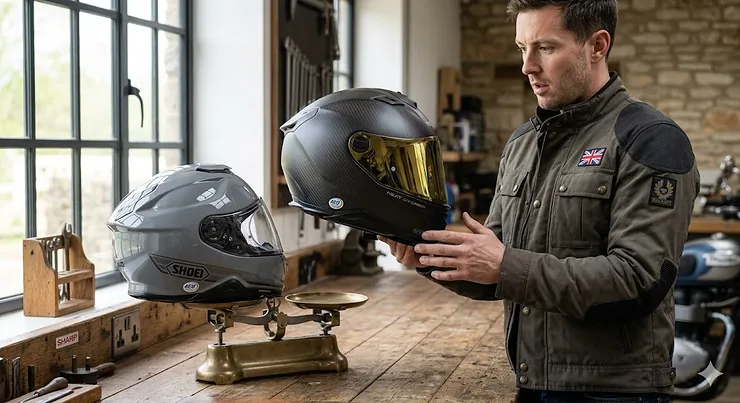
There’s a moment every motorcyclist reaches — usually somewhere between their second bike and their third close call with a pothole on the A-road — when they stop treating their helmet as an afterthought. The carbon fibre vs fibreglass helmet question is precisely where that moment tends to land. It sounds technical, almost academic. It isn’t. What you’re really asking is: how much does my neck matter, and what am I willing to pay for it?
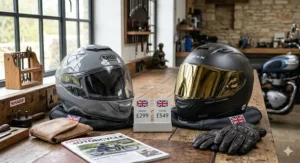
Here’s the short version, since Google’s algorithm apparently loves a direct answer: carbon fibre helmets are lighter, typically between 1.3–1.4 kg for a size medium, while fibreglass shells weigh in around 1.45–1.58 kg. That’s roughly 130–200 grams difference — about the weight of a medium-sized orange. Not life-changing on a twenty-minute commute. Absolutely noticeable after four hours on the M6 in October drizzle.
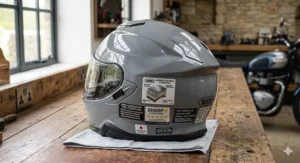
Both materials can achieve SHARP 5-star safety ratings, the UK government’s independent helmet testing scheme and probably the most useful resource you’ll find when narrowing down your lid. The real differences come down to price, impact behaviour, and a few nuances the spec sheet won’t mention. That’s what this guide is for.
We’ve researched seven real helmets available on Amazon.co.uk — from sensible fibreglass touring lids to MotoGP-derived carbon shells — and broken down exactly who should buy what.
Quick Comparison: Carbon Fibre vs Fibreglass Helmet at a Glance
| Feature | Carbon Fibre | Fibreglass | Best For |
|---|---|---|---|
| Average weight (size M) | ~1.36 kg | ~1.49 kg | Long-distance riders → Carbon |
| Average SHARP score | ~4.1 / 5 | ~3.9 / 5 | Safety-focused → Carbon |
| Average price (UK) | ~£300–£700+ | ~£180–£550 | Budget-conscious → Fibreglass |
| Impact behaviour | Stiffer, distributes force | More flexible, absorbs gradually | Track riders → Carbon; Touring → Either |
| Durability | Very high | High | Both excellent with proper care |
| Typical certification | ECE 22.06, SHARP 4–5★ | ECE 22.06, SHARP 3–5★ | Both legal for UK roads |
The numbers tell a clear story — but with an important caveat. According to SHARP, the outer shell material is only part of what determines a helmet’s safety rating; the inner EPS liner construction matters just as much. A beautifully engineered fibreglass helmet like the Shoei NXR2 scores identically to some carbon lids in independent testing. The gap is real but not as dramatic as the marketing might suggest. Budget buyers especially should note: a SHARP 5-star fibreglass helmet at £350 will protect your head more reliably than a dubious “carbon” helmet from an unknown brand at £90.
💬 Just one click — help others make better buying decisions too! 😊
✨ Don’t Miss These Exclusive Deals!
🔍 Ready to upgrade your lid? Click any highlighted product below to check current pricing and availability on Amazon.co.uk. Every pick has been researched for UK availability, ECE 22.06 certification, and real-world British riding conditions.
Top 7 Carbon Fibre & Fibreglass Helmets: Expert Analysis
1. AGV K6 S — Best Overall Carbon Fibre Helmet
The AGV K6 S is arguably the most talked-about sports-touring helmet in Britain right now, and the fuss is genuinely warranted. Its shell is a carbon-aramid fibre blend — not pure carbon, but a carefully engineered composite that delivers near-carbon weight with improved flexibility under impact. Tipping the scales at around 1,255 grams, it’s remarkably light for a full-face lid certified to ECE 22.06.
What does that weight mean in practice? On a long motorway run from London to Edinburgh (a real British riding scenario, not a hypothetical), the reduced neck load becomes perceptible somewhere around the third hour. Your shoulders stop aching quite as much. You arrive less fatigued. For commuters on the A3 or A406, the difference is smaller — but it’s there.
The K6 S carries ECE 22.06 certification and has achieved SHARP 5-star ratings, confirming it exceeds the UK’s mandatory safety baseline by a meaningful margin. UK reviewers on Amazon.co.uk consistently praise the 190° field of vision — wider than most road helmets — and the integrated spoiler that actually reduces buffeting rather than just looking aggressive.
Who is this for? Sport-touring riders who split their week between urban commuting and weekend blasts through Derbyshire or the Brecon Beacons. It’s arguably too premium for pure city work where speeds rarely exceed 40 mph, but for anyone covering 150+ miles regularly, the comfort dividend justifies the spend.
✅ Carbon-aramid shell exceeds ECE 22.06 by ~36%
✅ 190° Ultravision visor — exceptional peripheral awareness
✅ Available on Amazon.co.uk, Prime-eligible
❌ Runs slightly small in Medium — size up if between sizes
❌ Premium price point in the £380–£530 range
2. Shoei NXR2 — Best Fibreglass Helmet for British Conditions
If the AGV K6 S is the featherweight champion, the Shoei NXR2 is the craftsman’s choice — less flashy, more quietly excellent. Built on Shoei’s AIM (Advanced Integrated Matrix) shell, a multi-ply matrix of fibreglass with lightweight organic and high-performance fibres, it weighs around 1,380–1,420 grams. Heavier than carbon, yes. But still comfortably lighter than polycarbonate alternatives, and with a balance and shell geometry that makes it wear lighter than the numbers suggest.
The NXR2 holds ECE 22.06 certification and SHARP 5 stars — Shoei’s first ECE 22.06-certified product in this range, and the result of extensive wind tunnel testing specifically for the head-down, sport-riding position. In British terms: this helmet is exceptional on motorway miles. Wind noise at 70 mph (yes, that motorway legal limit that everyone apparently doesn’t exceed) is perceptibly quieter than helmets costing £100 less. That matters on a three-hour slog up the M1.
The Emergency Quick Release System (EQRS) is worth mentioning. It allows paramedics to remove cheek pads before removing the helmet — a detail you hope never to test but appreciate knowing exists. Amazon.co.uk Prime delivery available; price sits around the £430–£540 range depending on colourway.
✅ SHARP 5 stars — independently verified superior protection
✅ Quietest shell geometry in its class
✅ ACU Gold approved for UK track days
❌ Heavier than carbon alternatives at ~1,400g
❌ Aerodynamics tuned for sport position — slightly busy upright in town
3. LS2 Thunder Carbon FF805 — Best Value Full Carbon
The LS2 Thunder Carbon is what happens when a brand takes the premium market seriously. Built from full carbon fibre — not a composite with a surface carbon weave, but a genuine full-carbon shell using a minimum of 6K carbon fibre with no mixed materials — it weighs in at approximately 1,280 grams. That’s carbon territory without the premium brand markup.
At under £400 for most colourways on Amazon.co.uk, the Thunder Carbon sits in a remarkably competitive space. Motorcycle News tested it over 14 months and 3,000 miles and concluded the quality feels comparable to helmets from Shoei and HJC costing significantly more. The Pinlock insert comes included in the box — that’s the anti-fog double-glazing effect that’s non-negotiable in a British autumn. You will encounter fog on your visor. You just will.
LS2 is a Spanish brand with strong UK stockist presence and straightforward returns through Amazon. UK reviewers note the snug fit in the chin area compared to Arai or Shoei — try before you buy if possible, or take advantage of Amazon’s 14-day return right under the Consumer Contracts Regulations.
✅ Genuine full-carbon shell, not surface weave
✅ Pinlock included in box — essential for British weather
✅ Outstanding value in the £350–£400 range on Amazon.co.uk
❌ Chin area runs snug — sizing can be inconsistent
❌ Less retail fitting support than Shoei/Arai dealers
4. HJC RPHA 71 — Best Carbon-Fibreglass Hybrid
HJC occupies a fascinating middle ground in the carbon fibre vs fibreglass helmet debate: their RPHA 71 uses a P.I.M. (Premium Integrated Matrix) shell that blends carbon, fibreglass, and organic fibres. The result is a shell weighing approximately 1,420 grams — solidly mid-range — with the impact behaviour characteristics of a composite rather than pure carbon.
What distinguishes the RPHA 71 for British riders is its dual ACU Gold + ECE 22.06 certification. If you ride to work on weekdays and occasionally do track days at Brands Hatch or Silverstone on weekends, this is one of the few helmets that works for both without compromise. ACU Gold establishes stricter impact requirements than the mandatory ECE minimum, particularly regarding chin bar rigidity.
Amazon.co.uk lists the RPHA 71 in the £380–£450 range with Prime delivery. UK reviewers consistently rate the ventilation system as exceptional — the Advanced Channelling Ventilation System creates deep internal channels that genuinely move air across your head during stop-start London traffic. In British summer conditions (both of them), that matters.
✅ Dual ACU Gold + ECE 22.06 — road and track certified
✅ Best-in-class ventilation for urban riding
✅ Three shell sizes — better fit across head shapes
❌ Heavier than pure carbon alternatives
❌ Carbon-composite, not full carbon — purists note
5. Arai Quantic — Best Premium Fibreglass Composite
The Arai Quantic represents a philosophical statement as much as a product. Arai’s handmade fibreglass composite shell — their proprietary PB e-cLc (Peripherally Belted e-Complex Laminate Construction) — is built on a rounded shell philosophy designed to glance off impacts rather than stopping them dead. This is a meaningful engineering distinction: a rounded shell redirects force away from your neck; a sharper-edged shell can snag and rotate.
At around 1,520 grams, the Quantic isn’t lightweight. But Arai’s argument — backed by decades of crash data — is that shell geometry and liner construction matter more than shell material in real-world accidents. The ECE 22.06 certification confirms this isn’t just marketing. The multi-density EPS liner places seven different foam densities across the helmet’s expanded impact zones.
Price sits in the £500–£600 range on Amazon.co.uk and specialist UK retailers. This is a helmet for riders who’ve tried everything else and decided the handmade Japanese build quality justifies the premium. UK reviewers particularly praise the long-term fit — Arai liners compress and mould slightly over 6–12 months, creating a custom feel that cheaper helmets never achieve.
✅ Handmade construction — exceptional long-term fit
✅ Rounded shell geometry — superior oblique impact management
✅ ECE 22.06 certified — Arai’s first to meet new standard
❌ Heavier at ~1,520g — noticeable on long rides
❌ Premium pricing in the £500–£600+ range
6. Scorpion EXO-1400 Evo Carbon — Best Sports Carbon at Mid-Range
Scorpion often gets overlooked in the carbon fibre helmet conversation — which is frankly odd given how well their EXO-1400 Evo Carbon performs. The carbon-fibre shell delivers a weight around 1,300–1,350 grams, ECE 22.06 certification, and Scorpion’s KDF (Kwik-Fit Dynamic Fit) system that adapts to head shape variations without needing padding swaps.
For British riders specifically: Scorpion has designed genuine anti-fog visor preparation into this helmet, with Pinlock 120 MaxVision ready from the box (Pinlock insert included). The ventilation channels are designed for variable conditions — you can close everything down on a motorway in November sleet and open it back up for a sunny Peak District run in June. UK Amazon pricing sits in the £300–£420 range — noticeably below comparable Shoei or AGV models for similar carbon construction.
UK reviewers note that Scorpion’s intermediate oval internal shape suits a broader range of British head geometries than some Italian brands that favour longer oval fits.
✅ Pinlock 120 MaxVision included — best anti-fog preparation
✅ ECE 22.06 certified with excellent SHARP performance
✅ Competitive pricing in the £300–£420 range on Amazon.co.uk
❌ Less brand prestige than Shoei/AGV for resale value
❌ Aerodynamics less refined than top-tier sport lids
7. Ruroc Atlas 4.0 Carbon — Best Full-Carbon Designed in the UK
Ruroc is a Cheltenham-based brand that’s earned a genuinely devoted following among British riders. The Atlas 4.0 Carbon is their flagship road helmet — a full carbon fibre shell with RHEON impact technology integrated into the liner, the same material used in professional rugby headgear. DOT FMVSS 218 and ECE 22.06 certified.
The RHEON liner is worth explaining: it’s a non-Newtonian material that behaves differently at different impact speeds, absorbing low-speed impacts (car park drops, slow falls) more efficiently than standard EPS foam while remaining rigid under high-speed crash forces. For UK urban riding, where statistically most incidents occur at lower speeds, this matters.
Available directly from Ruroc’s UK website and on Amazon.co.uk, pricing sits in the £450–£550 range. The brand’s 14-day home-pickup exchange policy makes sizing straightforward. Bluetooth audio via Ruroc’s Shockwave unit is compatible. UK reviewers particularly appreciate the strong British customer support — a genuine advantage post-Brexit for warranty and returns compared to some European-only brands.
✅ Designed in the UK — excellent domestic customer support
✅ RHEON impact technology in liner — genuine innovation
✅ ECE 22.06 + DOT dual certified
❌ Less independent safety data than established brands (no SHARP rating yet)
❌ Heavier than some competitors at ~1,450g for full carbon
Top 7 Helmets: Quick Specs Comparison
| Helmet | Shell | Weight (approx.) | Price Range (Amazon.co.uk) | SHARP | ECE 22.06 |
|---|---|---|---|---|---|
| AGV K6 S | Carbon-aramid | ~1,255g | £380–£530 | ★★★★★ | ✅ |
| Shoei NXR2 | Fibreglass (AIM) | ~1,400g | £430–£540 | ★★★★★ | ✅ |
| LS2 Thunder Carbon | Full carbon | ~1,280g | £350–£400 | ★★★★ | ✅ |
| HJC RPHA 71 | Carbon-fibreglass | ~1,420g | £380–£450 | ★★★★ | ✅ |
| Arai Quantic | Fibreglass composite | ~1,520g | £500–£600 | ★★★★★ | ✅ |
| Scorpion EXO-1400 Evo C | Carbon fibre | ~1,320g | £300–£420 | ★★★★ | ✅ |
| Ruroc Atlas 4.0 Carbon | Full carbon | ~1,450g | £450–£550 | N/A | ✅ |
Looking at this table, two things stand out. First, the lightest helmets are the carbon options — but the weight gap between carbon and a quality fibreglass lid like the NXR2 is far smaller than most riders expect. Second, SHARP 5-star ratings appear across both materials, confirming that a top-tier fibreglass helmet can match carbon on safety. Budget really is the key differentiator here: if you’re working with under £400, the LS2 Thunder Carbon and Scorpion EXO-1400 Carbon deliver carbon construction at fibreglass prices.
How Carbon Fibre and Fibreglass Actually Behave in an Impact
This is what the spec sheet almost never tells you. Understanding the material science turns this from a consumer choice into an informed decision.
Carbon fibre is exceptionally stiff. Under impact, a carbon shell resists deformation and distributes force outward across the shell surface quickly. This is excellent for high-energy, high-speed impacts — which is why carbon dominates racing helmets. The trade-off is that carbon is more brittle than fibreglass; it disperses energy by fracturing microscopically, which is exactly what you want in a crash but means a dropped helmet — even from handlebar height — warrants inspection.
Fibreglass is more flexible. It absorbs and dissipates impact energy more gradually, bending slightly before transferring force to the EPS liner. SHARP data shows fibreglass helmets performing exceptionally across the low-to-medium speed impacts that statistically make up the majority of UK road accidents — slower urban collisions, roundabout incidents, junction prangs.
According to independent research from Billy’s Crash Helmets, a UK-based helmet review resource, carbon helmets tested by SHARP score approximately 0.7 stars better than polycarbonate equivalents on average — but composite fibreglass helmets sit close behind, scoring 3.76 out of 5 against carbon’s higher average. The spec sheet won’t tell you this, but the difference between a premium fibreglass lid and a mid-range carbon one is often smaller than the difference between a quality and a budget helmet within the same material category.
The practical upshot: for touring, urban commuting, and general British road riding, a SHARP 5-star fibreglass helmet protects your head as effectively as most carbon alternatives. For track days, long-distance sport riding, and anyone riding at higher speeds regularly, carbon’s stiffness and weight advantage become genuinely meaningful.
Real-World UK Rider Profiles: Which Shell Should You Choose?
Let’s cut through the theory and talk about actual British riding scenarios.
The Manchester Commuter: Riding 18 miles each way through stop-start traffic, mostly 20–40 mph, five days a week regardless of whether it’s horizontal rain or a rare Manchester summer. Budget matters. Neck fatigue matters. For this rider, a fibreglass helmet in the £200–£350 range — the Shoei NXR2 if budget stretches, or a SHARP 4-star fibreglass option around £200 — is perfectly rational. The weight saving of carbon isn’t transformative at commuting speeds, and the money saved buys better waterproofs.
The Weekend Sport Tourer from Bristol: Saturday mornings through the Mendips, 80–100 miles, genuine motorway speeds, longer rides into Wales for lunch. This rider will feel the weight difference. Carbon or carbon-composite, in the AGV K6 S or LS2 Thunder Carbon range, makes a genuine quality-of-life difference. The reduced neck fatigue after 150 miles is real.
The Occasional Track Day Rider from Surrey: Brands Hatch on a Friday, A3 the rest of the time. ACU Gold certification is mandatory for UK circuit riding. The HJC RPHA 71’s dual-certification makes it the logical choice — one helmet, two contexts, no compromise.
The Mature Rider in the Cotswolds: Touring at a relaxed pace, prioritising comfort and build quality, riding in all weathers because British weather makes planning impossible. The Arai Quantic’s long-term fit progression and engineering philosophy suit this rider perfectly. The extra weight is less relevant at touring pace; the fit and build quality compound over years of use.
How to Choose a Carbon Fibre vs Fibreglass Helmet in the UK: A Practical Framework
Here’s a numbered decision framework, because sometimes you just need someone to tell you what to do.
- Set your budget honestly. Carbon helmets average around £318 in the UK market; fibreglass averages around £205. If your budget is under £250, fibreglass is where the best value lives. Between £300–£450, carbon becomes genuinely competitive.
- Check SHARP ratings first. Visit sharp.dft.gov.uk and filter by shell material and star rating. A 5-star fibreglass helmet beats a 3-star carbon helmet every time, regardless of what the marketing says.
- Confirm ECE 22.06 certification. Since January 2024, ECE 22.05 helmets can no longer be newly sold in the UK. Any legitimate UK retailer on Amazon.co.uk will confirm certification. Don’t accept ECE 22.05 on a new purchase.
- Match shell behaviour to your riding. Predominantly urban at lower speeds? Fibreglass’s gradual absorption is well-suited to real-world UK incident speeds. Regular motorway miles and sport riding? Carbon’s weight and stiffness advantages compound with distance.
- Verify it’s actually carbon, not cosmetic. As Scootering Magazine notes, some helmets use a carbon fibre surface weave over a polycarbonate or fibreglass shell. LS2 explicitly certifies a minimum of 6K full carbon fibre with no mixed materials. Check the product description carefully on Amazon.co.uk — “carbon look” or “carbon graphic” is not the same as a carbon shell.
- Try before you buy if possible. Amazon’s 14-day return right under the Consumer Contracts Regulations is genuinely useful here — but a helmet fitting at a specialist retailer remains the gold standard. Head shapes vary. An intermediate oval AGV feels entirely different to a rounder Arai.
- Factor in UK climate and storage. Carbon degrades less under UV exposure than some materials, but both fibreglass and carbon helmets should be stored away from direct sunlight. In a damp British garage or shed, keep your helmet in the supplied bag and away from moisture — both materials can experience liner degradation if stored in persistently damp conditions.
Common Mistakes When Buying a Motorcycle Helmet in the UK
Mistake 1: Buying “carbon look” and expecting carbon performance. Surface carbon weave looks identical to a full carbon shell in photographs. It performs nothing like one. If the Amazon listing says “ABS shell with carbon fibre design,” that’s a polycarbonate helmet with a carbon pattern. Cross-reference with the SHARP database.
Mistake 2: Ignoring ECE 22.06 on a new purchase. The older ECE 22.05 standard doesn’t include rotational impact testing — the type of force that causes the most serious brain injuries. In 2026, there is no good reason to buy new stock certified only to 22.05.
Mistake 3: Prioritising weight over fit. A 1,255-gram carbon helmet that fits poorly will fatigue your neck faster than a 1,450-gram fibreglass one that fits perfectly. Fit determines how the helmet stays on your head during an impact and how evenly it distributes its own weight across your head and neck.
Mistake 4: Assuming all “full carbon” helmets are equivalent. Carbon comes in grades — 3K, 6K, 9K and higher, indicating fibre strength. The weave pattern (plain vs twill) also affects shell performance on curved surfaces. An entry-level brand claiming “carbon shell” may be using lower-grade material than a premium brand’s composite that includes fibreglass layers.
Mistake 5: Replacing after five years regardless of shell material. Both carbon and fibreglass degrade over time. UV exposure weakens the resin matrix; helmet foam compresses; retention systems fatigue. The Department for Transport-supported SHARP scheme advises replacement after any significant impact and a maximum lifespan of five years.
✨ Don’t Miss These Exclusive Deals!
🔍 Every helmet on this list ships to UK addresses — most via Prime with next-day delivery. Check current pricing on Amazon.co.uk using the highlighted product names above. Prices fluctuate regularly, and Prime members often find significantly better availability on premium sizes.
Long-Term Cost & Maintenance: Carbon vs Fibreglass in British Conditions
Over a five-year helmet lifespan — the recommended replacement interval — the cost picture shifts from purchase price to ongoing ownership.
Both carbon and fibreglass shells are broadly similar in maintenance requirements, with one important difference: carbon is more susceptible to micro-fractures from low-energy impacts (the kind you accumulate parking your bike in a tight city-centre spot). The AGV K6 S’s carbon-aramid construction is more resilient than pure carbon to this kind of everyday abuse, which is partly why manufacturers like AGV and HJC favour composite shells over full carbon for road helmets.
For UK-specific care: visor cleaning matters enormously given road spray, motorway mist, and persistent drizzle. Most premium helmets come with Pinlock anti-fog inserts, but the seal condition degrades over 18–24 months. Replacement Pinlock inserts cost around £15–£25 on Amazon.co.uk — factor that into total cost of ownership.
Liner washing is straightforward on all helmets listed above — every product here has fully removable, machine-washable liners. In British autumn, expect to wash liners every four to six weeks if commuting. Antibacterial liner sprays (around £8–£12) between washes extend freshness considerably.
Total five-year cost comparison: a £350 fibreglass helmet with £50 in maintenance items over five years versus a £450 carbon helmet similarly maintained represents a real difference of under £100 spread across 1,800+ days of potential use. Put in those terms, the carbon premium is rather modest.
FAQ: Carbon Fibre vs Fibreglass Helmet
❓ Is a carbon fibre helmet safer than fibreglass in the UK?
❓ Are carbon fibre helmets worth the extra money for UK commuters?
❓ Do I need ECE 22.06 certification on a helmet bought in the UK in 2026?
❓ Can I spot a fake carbon helmet on Amazon.co.uk?
❓ How long do carbon and fibreglass helmets last in UK conditions?
Conclusion: Which Shell Wins for British Riders?
The carbon fibre vs fibreglass helmet debate doesn’t have a single answer — which is mildly annoying but actually reassuring. It means both technologies are genuinely excellent, and the “correct” choice depends almost entirely on how you ride and how much you’re willing to spend.
Carbon wins on weight, and weight matters proportionally to how far you ride. It earns its premium for sport-touring riders, longer-distance commuters, and track enthusiasts who’ll genuinely appreciate the reduced neck fatigue. The AGV K6 S and LS2 Thunder Carbon are the standout Amazon.co.uk options in this category.
Fibreglass holds its own on value, impact absorption at road speeds, and in premium form — the Shoei NXR2, Arai Quantic — achieves identical safety scores to carbon at slightly lower weight. For urban commuters and riders who prioritise build quality and long-term fit over maximum lightness, fibreglass composite remains a thoroughly sensible choice.
What matters more than shell material: ECE 22.06 certification, a SHARP 4–5 star rating, and a fit that doesn’t move when you try to rotate the shell while wearing it. Get those three right, and you’ll be well protected regardless of whether your lid is woven from carbon fibre or glass.
✨ Don’t Miss These Exclusive Deals!
🔍 Find your perfect lid — check current pricing and availability on Amazon.co.uk using the product names highlighted throughout this guide. Prime members get next-day delivery on most sizes.
Recommended for You
- Best Carbon Fibre Motorcycle Helmets UK 2026: 7 Expert Picks
- 7 Best All-in-One Smart Motorcycle Helmets UK 2026
- Best Bluetooth Motorcycle Helmet for Glasses Wearers UK 2026
Disclaimer: This article contains affiliate links. As an Amazon Associate, I earn from qualifying purchases. If you purchase products through these links, we may earn a small commission at no additional cost to you.
✨ Found this helpful? Share it with your mates! 💬🤗
