
In This Article
There’s a specific moment every rider dreads: you’re three miles from home, the temperature’s dropped, and your own breath starts climbing the inside of your visor like a slow tide. Within seconds the road ahead is a smear of headlights and streetlamps, and you’re squinting through a porthole the size of a fifty pence piece. An anti-fog clear visor for motorbike helmet setups isn’t a luxury add-on — it’s arguably one of the cheapest, most overlooked safety upgrades a rider can make, and yet thousands of UK bikers still ride through autumn and winter with nothing but a stock visor and a prayer.

What actually causes visor fogging? It happens when warm, moisture-laden air from your breath and skin meets the cooler inner surface of your visor, and the water vapour condenses into thousands of microscopic droplets that scatter light and block your view — a problem that gets dramatically worse the colder the outside air becomes relative to your body heat. The fix isn’t complicated, but it does require understanding your actual options, because “anti-fog” gets used loosely to describe everything from a proper Pinlock system to a five-minute spray treatment, and they are not remotely equivalent in performance.
This guide is built from genuine product research rather than recycled marketing copy — real Pinlock lens specifications, real aggregated feedback from UK riders who’ve actually fought through a wet commute with these products fitted, and honest comparison of where each solution earns its keep. Before we get into specific products, it’s worth remembering that a clean, functioning visor isn’t just about comfort: the Highway Code is explicit that riders must check their visor is clean and in good condition before every journey, and UK law requires eye protection to meet recognised safety standards precisely because impaired vision on two wheels carries outsized consequences. Let’s find you a setup that actually works.
Quick Comparison Table
| Product | Type | Best For |
|---|---|---|
| Pinlock 70 Max Vision Insert | Universal Pinlock lens | Everyday commuting |
| Pinlock 120 Insert | Advanced Pinlock lens | Unpredictable winter weather |
| Shoei CWR-F2 Evo Pinlock Insert | OEM-fit Pinlock lens | Shoei helmet owners wanting perfect fit |
| Caberg Ghost Pinlock Insert | Brand-specific Pinlock lens | Caberg Ghost helmet owners |
| Systercol Universal Anti-Fog Film | Adhesive film insert | Non-Pinlock-ready visors |
| Muc-Off Premium Anti-Fog Treatment | Spray coating | Backup or non-insert helmets |
| Rain-X Plastic Water Repellent | Exterior hydrophobic coating | Rain clarity alongside anti-fog |
Looking at the table above, the clearest divide is between true Pinlock inserts — which create a sealed, insulated air pocket and genuinely solve fogging at the physics level — and film or spray treatments, which work by altering surface tension rather than creating that thermal barrier. If your helmet has Pinlock-prepared posts (most mid-range and premium lids sold in the UK since around 2015 do), an insert will always outperform a spray. If it doesn’t, film and spray options are a genuinely useful stopgap rather than a compromise to be embarrassed about.
💬 Just one click — help others make better buying decisions too!😊
Top 7 Anti-Fog Visor Solutions: Expert Analysis
1. Pinlock 70 Max Vision Insert — best everyday standard for most riders
The Pinlock 70 Max Vision Insert is the baseline that most helmet manufacturers include in the box precisely because it strikes the right balance between anti-fog performance and cost. Made from a soft, moisture-absorbing lens material, it seats inside two pins on a Pinlock-ready visor to create a sealed air gap that acts as a thermal barrier, stopping condensation before it forms rather than wiping it away after the fact. What that sealed-pocket construction means in practice is genuinely reliable clarity on a typical wet or cold commute, where temperature swings are moderate rather than extreme.
Based on the spec comparison with the thicker 120 and 200 lenses further up the Pinlock range, the 70 is thinner and offers slightly less moisture-absorbing capacity, but for the vast majority of UK riding — daily commutes, occasional longer rides, typical British drizzle — that’s rarely a limiting factor. Reviewers consistently note that once correctly tensioned against the visor, fogging becomes a non-issue even when sitting stationary at traffic lights with the visor down, which is traditionally the worst-case scenario for any anti-fog solution.
Pros:
- ✅ Genuine sealed-pocket construction stops fogging at source
- ✅ Fits directly onto Pinlock-prepared visors with no tools
- ✅ Proven performance across millions of daily UK commutes
Cons:
- ❌ Only fits visors with Pinlock posts already moulded in
- ❌ Thinner lens offers less margin in extreme cold
Priced around £15-£25 depending on the exact visor fitment, this sits at the accessible end of the Pinlock range and remains the sensible default for most riders.
2. Pinlock 120 Insert — best for unpredictable winter riding
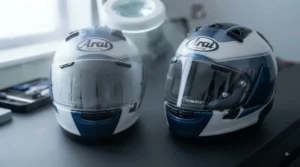
Stepping up from the 70, the Pinlock 120 Insert uses a noticeably thicker lens with greater moisture-absorbing capacity, engineered specifically for demanding and unpredictable weather conditions rather than steady, everyday use. Fitting the same universal two-pin system found across most Pinlock-ready visors — this particular listing is cut for the LS2 FF811 Vector-II, though equivalent 120 lenses exist for most major helmet brands — it seats identically to the 70 but simply has more physical material to absorb moisture before saturation becomes a problem.
What most buyers overlook about the jump from 70 to 120 is that it’s not really about “more anti-fog,” it’s about extending the safety margin under genuinely harsh conditions — sudden temperature drops, heavy rain combined with cold, or long motorway stints where a thinner lens might eventually saturate. Reviewers who ride year-round rather than fair-weather only tend to specifically favour the 120 for this reason, citing confidence during genuinely miserable January commutes where a 70 has previously let them down.
Pros:
- ✅ Thicker lens handles extreme temperature swings confidently
- ✅ Same simple two-pin fitting as the standard 70 range
- ✅ Favoured by year-round commuters over fair-weather riders
Cons:
- ❌ Costs more than the standard 70 for the same visor
- ❌ Marginal overkill for riders who only ride in summer
Expect to pay in the £25-£35 range, making this a sensible mid-range upgrade for anyone who genuinely rides through a British winter rather than just talking about it.
3. Shoei CWR-F2 Evo Pinlock Insert (DKS304) — best OEM-fit precision for Shoei owners
Purpose-cut for Shoei’s CWR-F2 visor system used across the X-SPR Pro, NXR2 and several other current Shoei lids, the Shoei CWR-F2 Evo Pinlock Insert is manufactured to match the exact curvature and pin spacing of genuine Shoei visors rather than being a generic universal fit adapted after the fact. What that precise OEM tooling means practically is a tighter, more consistent seal around the entire lens edge, reducing the peripheral fogging that can creep in around the margins of a slightly mismatched universal insert.
Here’s what the spec sheet won’t tell you outright: Shoei visors are known among riders for a particularly tight factory tolerance, and generic Pinlock inserts — even ones marketed as “universal fit” — can sometimes sit a fraction proud or loose against that specific curve. Reviewers who’ve tried both routes consistently report the branded Shoei-cut insert seals more evenly, particularly at the lower edge near the nose, which is exactly where breath-driven fogging tends to start first.
Pros:
- ✅ Purpose-cut curvature matches Shoei’s tight visor tolerances
- ✅ Reduces peripheral fogging around the lens edges
- ✅ Genuine Pinlock DKS-series construction and materials
Cons:
- ❌ Only compatible with specific Shoei CWR-F2 visor models
- ❌ Premium branded pricing versus generic alternatives
At roughly £25-£30, this is a premium, brand-specific pick — worth the outlay if you own a compatible Shoei lid and want the closest possible factory-standard seal.
4. Caberg Ghost Pinlock Insert — best budget brand-specific option
Cut specifically for the Caberg Ghost visor, the Caberg Ghost Pinlock Insert is a genuine Pinlock product rather than a third-party imitation, meaning it uses the same moisture-absorbing plastic and airtight sealing principle as the pricier branded options above, just scaled to a more accessible price point. What that genuine-Pinlock construction means in practice is you’re not sacrificing the underlying anti-fog physics to save money — you’re simply paying less because it’s cut for a single specific visor rather than marketed as a flexible universal fit.
Based on aggregated review sentiment, Caberg Ghost owners consistently rate this as excellent value precisely because it removes the fitment guesswork that sometimes plagues universal inserts — since it’s designed for exactly one visor shape, there’s little room for a poor seal. Reviewers note it’s fully removable and interchangeable too, so a scratched or saturated lens can be swapped out in minutes without touching the visor itself.
Pros:
- ✅ Genuine Pinlock construction at an accessible price
- ✅ Purpose-cut fit removes universal-fit guesswork
- ✅ Fully removable and interchangeable when it wears out
Cons:
- ❌ Locked to the Caberg Ghost visor specifically
- ❌ Availability can be patchier than mainstream Pinlock SKUs
Priced around £15-£20, this represents strong value for confirmed Caberg Ghost owners who want a proper Pinlock system without the premium-brand mark-up.
5. Systercol Universal Anti-Fog Film Insert — best budget option for non-Pinlock visors
Not every helmet on the road has Pinlock-prepared posts, and that’s precisely the gap the Systercol Universal Anti-Fog Film Insert fills — a self-adhesive, cut-to-size film that sticks directly to the inside of almost any visor shape rather than requiring moulded-in mounting points. Measuring roughly 27cm by 9cm, it’s designed to be trimmed to fit a wide range of visor curvatures, using a nano-coating anti-fog surface rather than the sealed-pocket approach of a true Pinlock lens.
On paper this means a genuinely different mechanism to Pinlock: rather than creating an insulated air gap, the film’s coating alters surface tension so condensation spreads into a thin, transparent sheet instead of beading into light-scattering droplets. What most buyers overlook about this trade-off is that it’s a real anti-fog solution, not a placebo — but it won’t match a genuine Pinlock insert’s performance in genuinely cold, wet conditions, since there’s no insulating air pocket doing the heavy lifting. For older helmets, budget lids, or open-face visors that were never designed with Pinlock posts, though, this remains a legitimate and effective fix.
Pros:
- ✅ Fits almost any visor shape with no mounting posts needed
- ✅ Genuinely different, coating-based anti-fog mechanism
- ✅ Inexpensive way to retrofit anti-fog to an older helmet
Cons:
- ❌ Adhesive application requires care to avoid bubbling
- ❌ Underperforms true Pinlock in genuinely extreme cold
At under £10 for a two-pack, this is firmly budget territory and a sensible stopgap for anyone whose visor simply can’t take a Pinlock lens.
6. Muc-Off Premium Anti-Fog Treatment — best spray-on backup solution
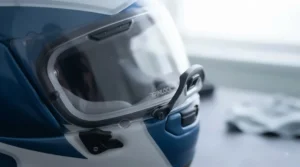
Rather than a physical insert, the Muc-Off Premium Anti-Fog Treatment is a 30ml spray that creates a transparent, micro-thin moisture-absorbing coating directly on the visor surface, safe for use on plastics, glass, goggles and glasses alike. What that spray-on coating means practically is genuine flexibility — it works on visors without Pinlock posts, on drop-down sun visors that can’t accept an insert at all, and even on riding glasses for anyone who wears them under an open-face lid.
Reviewers consistently describe the treatment as lasting around five days per application under normal use, and several specifically note that when sprayed on the outside of the visor it also encourages rain to bead and run off, offering a secondary clarity benefit beyond pure anti-fog performance. Honestly, this isn’t positioned to replace a proper Pinlock system for a rider’s main visor — it’s better understood as the product you keep in your kit for sun visors, spare glasses, or as an emergency top-up when a Pinlock lens is nearing the end of its life.
Pros:
- ✅ Works on any surface, including sun visors and glasses
- ✅ Lasts roughly five days per application in normal use
- ✅ Bonus water-beading effect improves rain clarity too
Cons:
- ❌ Needs reapplying regularly, unlike a permanent insert
- ❌ Noticeably less effective than a true Pinlock in deep cold
At around £8-£10 for a 30ml bottle, this is an affordable, flexible addition to any rider’s kit bag rather than a standalone primary solution.
7. Rain-X Plastic Water Repellent — best complementary clarity upgrade
Slightly different from the other six entries, Rain-X Plastic Water Repellent isn’t an anti-fog product in the traditional sense — it’s a hydrophobic coating applied to the outside of the visor that causes rain to bead up and blow clear at speed rather than sheeting across the surface. What that hydrophobic effect means practically is improved external clarity in wet weather, which pairs naturally with an anti-fog solution handling the inside of the visor, giving genuinely clear vision from both surfaces simultaneously.
Based on the spec comparison with dedicated motorcycle-specific products, Rain-X was originally developed for automotive glass but has been widely adopted by UK riders specifically for helmet visors and boat windshields, and reviewers report the beading effect holds up well at typical motorway speeds before needing reapplication. It’s worth being clear this product solves a different problem to everything else on this list — think of it as the outside-the-visor companion to whichever anti-fog solution you’re running on the inside, not a replacement for one.
Pros:
- ✅ Genuinely effective rain-beading at motorway speeds
- ✅ Complements any inside-visor anti-fog solution
- ✅ Long-standing, widely trusted automotive-glass formula
Cons:
- ❌ Does nothing to address internal visor fogging
- ❌ Needs periodic reapplication as the coating wears
Priced around £6-£12 depending on bottle size, this is a genuinely worthwhile budget addition once your internal fogging problem is already sorted.
Top 7 Products: Detailed Specification Comparison
| Product | Mechanism | Fitment | Duration | Best For |
|---|---|---|---|---|
| Pinlock 70 Max Vision Insert | Sealed air-gap lens | Pinlock posts required | Permanent (until worn) | Everyday commuting |
| Pinlock 120 Insert | Thicker sealed air-gap lens | Pinlock posts required | Permanent (until worn) | Harsh winter conditions |
| Shoei CWR-F2 Evo Pinlock Insert | OEM-cut sealed air-gap lens | Shoei CWR-F2 visors only | Permanent (until worn) | Shoei owners wanting precision |
| Caberg Ghost Pinlock Insert | Sealed air-gap lens | Caberg Ghost visor only | Permanent (until worn) | Budget-conscious Caberg owners |
| Systercol Universal Anti-Fog Film | Surface coating | Self-adhesive, any shape | Weeks to months | Non-Pinlock-ready visors |
| Muc-Off Anti-Fog Treatment | Spray coating | Any surface | Around 5 days | Sun visors, glasses, backup |
| Rain-X Plastic Water Repellent | Hydrophobic coating | External surface | Weeks | Rain clarity companion |
This table underlines the central point of this whole guide: the four Pinlock options solve fogging permanently and structurally, while the film, spray and hydrophobic products are either stopgaps or complementary treatments rather than direct substitutes. If your helmet accepts a Pinlock lens and you don’t already have one fitted, it’s genuinely the single highest-value upgrade covered here — everything else exists to serve riders whose helmets can’t take one, or who want extra coverage beyond their main visor.

How to Choose an Anti-Fog Clear Visor for Motorbike Helmet Setups
Getting this right the first time saves money and, more importantly, saves you from riding half-blind on a cold morning. Here’s a structured approach based on genuine product specs and aggregated rider feedback.
- Check for Pinlock-ready posts first. Look inside your current visor for two small raised pins near the edges — if they’re there, a Pinlock insert should always be your first choice over film or spray.
- Match the insert to your specific visor model. Pinlock lenses are cut to match particular visor shapes; buying the wrong SKU for your helmet model will result in a poor seal and disappointing performance.
- Choose 70 for typical use, 120 for genuine winter riding. If you commute daily through a British winter, the thicker 120 lens earns its higher price; fair-weather riders rarely need it.
- Consider genuine versus generic Pinlock inserts. Brand-specific cuts (Shoei, Caberg, and similar) tend to seal more precisely than universal alternatives, particularly around the lower edge.
- If your visor isn’t Pinlock-ready, choose film over spray for your main visor. A properly fitted film insert lasts far longer than a spray treatment and requires less maintenance.
- Keep a spray treatment for secondary surfaces. Sun visors, spare glasses and older helmets without Pinlock posts all benefit from a bottle of spray treatment in your kit.
- Pair with an external water repellent if you ride in heavy rain. Solving fogging on the inside and beading on the outside together gives genuinely clear vision in the worst UK weather.
Pinlock Anti-Fog Insert Compatibility: Getting the Fit Right
Compatibility is where most riders trip up when buying a Pinlock lens for the first time, and it’s worth getting genuinely specific about it. Every Pinlock-ready visor has its posts positioned and spaced according to that particular visor’s mould, which means a lens cut for, say, a Shoei CWR-F2 visor will not seat correctly on an AGV or Caberg visor even though both are “Pinlock-ready” in the generic sense. Buying by helmet brand and specific visor model — not just by lens size — is the single most important step in getting pinlock anti-fog insert compatibility right first time.
Universal-fit Pinlock lenses do exist and can work reasonably well across a range of similarly sized visors, but reviewers consistently note that a brand-matched, purpose-cut insert seals more evenly, particularly around the lower edge near the nose where breath-driven fogging concentrates first. If you’re at all unsure which Pinlock lens your helmet needs, check the model number printed on the inside of your existing visor or consult your helmet manufacturer’s fitment chart before ordering — a five-minute check that avoids the hassle of returning an ill-fitting lens.
How the Pinlock System Actually Works (And Why Alternatives Fall Short)
The Pinlock system relies on a deceptively simple piece of physics: rather than trying to remove moisture after it’s condensed, it prevents condensation from forming in the first place by creating a sealed, insulated air pocket between the outer visor and the inner lens. That trapped layer of air acts as a thermal buffer, keeping the inner lens surface closer to your face temperature rather than the cold outer visor temperature, which is precisely what stops the temperature differential that causes fogging in the first place. The lens material itself is also porous and moisture-absorbing, soaking up whatever small amount of condensation does form within the sealed pocket rather than letting it pool as droplets.
What most buyers overlook about the Pinlock system is that this is fundamentally a different mechanism to film or spray treatments, which work purely on surface tension at the point of contact rather than solving the underlying temperature gap. That’s precisely why a genuine Pinlock lens consistently outperforms coating-based alternatives in genuinely cold conditions — it’s not fighting condensation after the fact, it’s removing the physical conditions that cause it. This is also why an incorrectly tensioned or poorly seated Pinlock lens can underperform badly: any gap in that seal lets warm, moist air leak into the pocket, and the whole system’s advantage collapses.
Demisting Visor Coatings Compared: Film, Spray and Insert
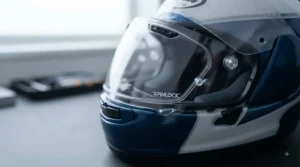
Not all demisting visor coatings work the same way, and understanding the mechanism behind each helps explain why performance varies so widely between products. Film-based coatings, like the Systercol insert covered above, use a permanent nano-coating that spreads condensation into a thin, transparent sheet rather than allowing it to bead into light-scattering droplets — durable, but ultimately still reactive rather than preventative. Spray-based treatments, like Muc-Off’s, work on the same surface-tension principle but wear off progressively with wiping, weather and time, needing reapplication roughly every five days under regular use.
Pinlock inserts sit apart from both, since — as covered above — they physically prevent condensation via a sealed air gap rather than managing it once it’s already forming. On paper this means genuine Pinlock inserts should always outperform coating-based demisting visor coatings in sustained cold weather, and aggregated review sentiment across UK riders backs this up consistently: film and spray users report occasional breakthrough fogging in genuinely freezing conditions that Pinlock users rarely experience. The sensible strategy, borne out by real usage patterns, is Pinlock for your primary visor wherever your helmet allows it, with film or spray reserved for surfaces that structurally can’t take an insert.
Winter Riding Visor Fogging: Why It Gets Worse and What Actually Helps
Winter riding visor fogging is a different beast to a mild autumn drizzle, and it’s worth understanding why before assuming any anti-fog product will perform identically year-round. The wider the temperature gap between your warm breath and body heat and the cold outer visor surface, the more aggressively condensation forms — which is exactly why a product that performs flawlessly in October can start to struggle in a genuine January cold snap. Stationary traffic makes this dramatically worse, since airflow across the visor (which helps evaporate any minor condensation) disappears the moment you stop moving.
What the spec sheet won’t tell you, but reviewers consistently report, is that a thicker Pinlock lens like the 120 genuinely earns its keep specifically in these conditions, where a standard 70 lens can occasionally reach its moisture-absorbing limit during a long, cold, stop-start commute. Cracking your visor open a few millimetres at low speed or when stationary — rather than fully closed — also helps considerably, since it lets a small amount of airflow disrupt the still, humid air pocket against your face before it has a chance to fully saturate whatever anti-fog solution you’re running.
Visor Ventilation and Helmet Airflow: The Overlooked Factor
Anti-fog products get most of the attention, but visor ventilation and your helmet’s own airflow design play a genuinely significant supporting role that’s easy to overlook entirely. Most modern full-face helmets include chin vents that direct incoming air up across the inside of the visor, and keeping these open — rather than closed for warmth — actively helps disrupt the humid air pocket that forms against your face, reducing the load on whatever anti-fog insert or coating you’re running.
Based on the spec comparison across current helmet designs, riders who close every vent for maximum warmth in winter often unintentionally sabotage their own anti-fog setup, since reduced airflow means moisture has nowhere to go except onto the visor surface. A useful practical habit: crack the chin vent open even a small amount in cold weather, accepting a slightly cooler chin in exchange for meaningfully better visor clarity — a trade-off most experienced winter riders make instinctively once they understand the mechanism behind it.
Practical Usage Guide: Fitting and Maintaining Your Pinlock Insert
Getting a Pinlock lens correctly fitted and maintained is the difference between it working brilliantly for years and underperforming from day one.
Setup: Remove the protective film from both sides of the lens before fitting — a surprisingly common mistake that leaves the anti-fog coating sealed under plastic. Hook the lens onto both pins, then gently flex it into a slight curve to seat it fully against the visor’s inner surface, checking that the edge sits flush all the way round with no visible gaps.
First-use tips: Once fitted, test on a cold day before relying on it — breathe deliberately onto the visor with it closed for thirty seconds and confirm no fogging appears at the edges, which would indicate an incomplete seal needing re-tensioning.
Maintenance schedule: Clean the lens only with water and a soft microfibre cloth; harsh chemicals or standard visor cleaners can strip the moisture-absorbing coating and permanently reduce performance. Inspect the seal every few months, particularly after removing the visor for cleaning, since pins can loosen slightly over repeated fitting and refitting.
Common mistakes in the first 30 days: New users frequently over-tension the lens, warping it slightly and creating gaps rather than a flush seal, or under-tension it, leaving it loose enough that moist air leaks in around the edges. A snug, even fit — neither bowed nor slack — is what you’re aiming for.
Real-World Scenarios: Matching the Right Solution to Your Riding
Different riders need genuinely different anti-fog setups, and matching the product to your actual usage pattern avoids wasted money either way. Consider a daily commuter riding year-round through a British city, stopping and starting constantly in traffic — for this rider, a Pinlock 120 paired with an open chin vent during colder months offers the sustained performance needed for genuinely miserable stop-start conditions. A fair-weather weekend rider who only rides on dry, mild days has a much lighter demand and will likely find a standard Pinlock 70, or even a well-applied film insert, entirely sufficient.
Now picture a tourer covering several hundred motorway miles in a single day across changing weather — here, pairing a Pinlock insert on the main visor with a Rain-X treatment on the outside genuinely earns its keep, since sustained high-speed rain exposure benefits enormously from external water-beading alongside internal anti-fog performance. Finally, consider a rider on an older, budget helmet without Pinlock posts at all — for this scenario, the Systercol film insert or a regularly reapplied Muc-Off spray treatment remain the only realistic routes to genuinely fog-free vision without replacing the entire visor.
Common Mistakes When Buying Anti-Fog Visor Gear
Even experienced riders make predictable errors when shopping for anti-fog solutions. The most frequent is buying a universal Pinlock lens for a specific-fit visor, assuming “universal” means it’ll work equally well everywhere — as covered above, purpose-cut inserts consistently outperform generic ones, particularly around the visor’s lower edge. Another common pitfall is forgetting to remove the protective film from a new Pinlock lens before fitting, which leaves riders wondering why their brand-new insert appears to be fogging identically to no insert at all.
Buyers also frequently underestimate how differently a 70 and 120 lens perform in genuinely cold conditions, assuming any Pinlock lens will handle any weather equally — reviewers who ride through full UK winters consistently flag this as the single biggest factor in ongoing satisfaction. It’s also worth remembering that visor and eye-protection quality is assessed as part of the government’s independent SHARP helmet safety scheme, which is a useful reference point when weighing up how much a clear, fog-free view genuinely matters to overall rider safety. Finally, many riders treat spray and film treatments as permanent, one-time purchases rather than consumables needing periodic reapplication or replacement, leading to disappointing performance months down the line that has nothing to do with the product’s original quality.
Long-Term Cost & Maintenance: What You’ll Actually Spend
Total cost of ownership for anti-fog visor solutions varies considerably depending on which route you take. A Pinlock insert, once correctly fitted, typically lasts several years of regular use before scratching or clouding warrants replacement — working out to well under a pound a month of genuinely maintenance-free clarity across its lifespan. Film inserts sit in similar territory, though slightly less durable, while spray treatments are the most ongoing cost, needing reapplication roughly weekly for riders using them as a primary solution rather than a backup.
Factoring in the value of the ride itself, the maths strongly favours a genuine Pinlock insert for anyone’s main visor wherever compatibility allows — the upfront cost is modest, the performance is consistently superior, and the ongoing maintenance burden is close to zero. Spray and film treatments remain entirely sensible for secondary surfaces or genuinely incompatible visors, but shouldn’t be viewed as cost-saving alternatives to Pinlock on a helmet that already supports it, since the performance gap in real winter conditions is the whole point of paying slightly more upfront.

Frequently Asked Questions
❓ What is the best anti-fog clear visor for motorbike helmet use in winter?
❓ How do I check Pinlock anti-fog insert compatibility with my helmet?
❓ Can I use anti-fog spray instead of a Pinlock insert?
❓ Does visor ventilation actually help reduce fogging?
❓ Is a Pinlock system worth it for occasional riders?
Conclusion
Fogging is one of those problems that seems minor until it happens at fifty miles an hour on a dark, wet A-road, at which point it becomes the only thing you’re thinking about. Of the seven solutions covered here, a genuine Pinlock insert — the Pinlock 70 Max Vision Insert for typical use, stepping up to the Pinlock 120 Insert for serious winter riding — remains the gold standard wherever your helmet supports one, with brand-specific cuts like the Shoei CWR-F2 Evo Pinlock Insert and Caberg Ghost Pinlock Insert offering an even tighter seal for owners of those specific lids. For helmets that can’t take an insert, the Systercol Universal Anti-Fog Film and Muc-Off Premium Anti-Fog Treatment remain genuinely effective fallback options, and Rain-X Plastic Water Repellent is a smart companion purchase for anyone riding regularly through UK rain.
There’s no single universal answer — only the right combination of insert, coating and ventilation habit for your specific helmet and riding pattern. Check your visor for Pinlock posts, match the lens correctly, and don’t underestimate the small habit of cracking your chin vent on a cold morning. Sort this once, properly, and you’ll wonder why you ever tolerated riding half-blind through a British winter.
Recommended for You
- Lightweight Helmet for Long Distance Touring: 7 Top Picks 2026
- Featherlight Racing Helmet: 7 Best Picks for 2026
- Lightweight Carbon Helmet: 7 Best Picks for UK Riders in 2026
Disclaimer: This article contains affiliate links. As an Amazon Associate, I earn from qualifying purchases. If you purchase products through these links, we may earn a small commission at no additional cost to you.
✨ Found this helpful? Share it with your friends! 💬🤗
