

In This Article
There’s a specific kind of dread that hits every rider who’s ever pulled out of a petrol station at 9pm with a scratched, hazy visor and three miles of unlit B-road ahead. Headlights smear into starbursts. Road markings blur. Your eyes strain so hard chasing clarity that you arrive home more tired than the ride should have made you. A clear visor for night riding isn’t a luxury add-on — it’s the single piece of kit standing between you and a genuinely readable road once the sun drops.

Here’s the thing nobody tells new riders: not all “clear” visors are created equal. Some are optically distorted at the edges, some fog the second the temperature dips, and some pick up micro-scratches that scatter oncoming headlights into a blinding haze. On UK roads, where drizzle, unpredictable street lighting and long winter nights are practically a personality trait, the visor sat in front of your eyes does more heavy lifting than most riders realise.
This guide walks through seven real, currently available clear visors and anti-fog inserts, from budget-friendly aftermarket lenses to premium OEM shields, with honest analysis of what each one actually does for your night vision — not just a spec sheet dump. What is a clear visor for night riding? In short, it’s an untinted, optically accurate helmet shield (often paired with an anti-fog insert) designed to maximise light transmission and minimise distortion and glare after dark, unlike tinted or mirrored visors which are restricted for use in low light. We’ll cover the products, the comparisons, and the practical know-how — cleaning routines, buying mistakes, regulations — so you can ride home relaxed instead of squinting.
Quick Comparison: Best Clear Visors For Night Riding At A Glance
| Product | Type | Price Range | Best For |
|---|---|---|---|
| Shoei CWR-1 Pinlock-Ready Clear Face Shield | OEM replacement shield | £55-£75 range | Premium optical clarity |
| AGV K1/K3 SV/K5 Compatible Clear Visor | Budget aftermarket shield | £15-£25 range | Tight budgets, spares |
| Pinlock DKS241 Pinlock 70 Insert (Clear) | Anti-fog insert | £20-£30 range | Fog-prone commutes |
| Oxford Ultra Clear Anti-Fog Visor Insert | Anti-fog insert | £15-£25 range | UK-brand budget fix |
| HJC HJ-09 Clear Pinlock-Ready Visor | OEM replacement shield | £40-£60 range | Modular/flip-front helmets |
| Muc-Off Premium Anti-Fog Treatment | Spray coating | under £10 | Quick, no-fuss touch-ups |
| Muc-Off Helmet Visor & Goggle Cleaner Kit | Cleaning kit | £10-£15 range | Streak-free optical clarity |
Looking at the table, there’s a clear pattern: the cheapest route to better night vision usually isn’t buying a whole new visor. Reviewers and industry commentary consistently point to fogging and micro-scratching, not tint, as the biggest complaints about night visibility, which is why three of the seven picks here are inserts or sprays rather than full shields. If your existing clear visor is optically sound but keeps misting up on the ride home, an insert like the Pinlock DKS241 or the Oxford Ultra Clear Anti-Fog Visor Insert will do more for your night riding than swapping the whole shield. If the visor itself is scratched, scuffed, or simply the wrong optical grade for your helmet, that’s when a full replacement like the Shoei CWR-1 or HJC HJ-09 earns its keep.
💬 Just one click — help others make better buying decisions too!😊
Top 7 Clear Visors For Night Riding: Expert Analysis
1. Shoei CWR-1 Pinlock-Ready Clear Face Shield — distortion-free 3D-molded optics
The standout here is Shoei’s 3D injection-molding process, which keeps the lens curvature consistent edge to edge instead of warping your peripheral vision the way cheaper flat-molded shields do. That distortion at the edges is exactly what makes oncoming headlights smear into long white streaks on lesser visors — so this is a genuine night-riding feature, not just marketing copy. It’s built for Shoei’s RF-1200, RF-SR and X-Fourteen helmets, uses a reinforced top-and-bottom rib design to resist wind-pressure bending at motorway speeds, and blocks over 99% of UV rays for daytime rides too. Based on the spec comparison with budget aftermarket shields, the injection-molding difference is where most of that price premium actually goes, rather than into branding. This is the pick for commuters and tourers who already own a compatible Shoei lid and want the sharpest possible optical clarity without switching to an insert-based fix. Reviewers consistently report that the shield swap mechanism is quick enough to do at a petrol station, and one recurring theme in aggregated feedback is that riders specifically praise its performance riding into low sun and headlight glare, though a common complaint is that it doesn’t include a Pinlock insert out of the box — that’s sold separately.
Pros:
- ✅ Distortion-free 3D-molded lens improves edge clarity
- ✅ Reinforced ribs resist bending at speed
- ✅ Tool-free quick-change shield mechanism
Cons:
- ❌ Pinlock insert not included, sold separately
- ❌ Only fits specific Shoei helmet models
At around £55-£75, this sits at the premium end of a shield-only purchase, but for riders who already own a compatible Shoei helmet, it’s genuinely better value than buying a whole new lid for better night optics.
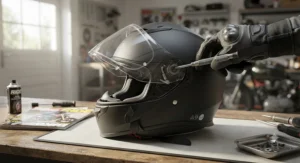
2. AGV K1/K3 SV/K5 Compatible Clear Visor — budget-friendly anti-scratch PC lens
What stands out about this one is simple accessibility — it’s a polycarbonate replacement shield compatible across several popular AGV budget and mid-range helmets, meaning one product covers a wide range of riders without hunting for a model-specific part. The lens is treated for anti-fog and anti-scratch resistance and made from flexible PC material, which in practice means it tolerates the odd knock or drop far better than a rigid glass-style lens would. Based on the spec sheet, this isn’t going to match a premium OEM shield’s optical precision at the far edges of your peripheral vision, but for straight-ahead night riding clarity, it does the fundamental job. It’s the sensible pick for new riders building a first kit, or anyone who wants an affordable spare clear visor to swap in once the sun sets, since UK guidance recommends carrying one for exactly this reason. Aggregated Amazon.co.uk review sentiment for this style of replacement visor skews positive on ease of fitting and value, with a recurring theme that buyers appreciate the quick tool-free swap; a common complaint is that fit tolerances can vary slightly between production batches.
Pros:
- ✅ Fits several AGV helmet models from one purchase
- ✅ Genuinely budget-friendly for a spare visor
- ✅ Anti-fog and anti-scratch treatment as standard
Cons:
- ❌ Optical clarity not on par with premium OEM shields
- ❌ Occasional fit-tolerance inconsistency reported by buyers
Priced in the £15-£25 range, this is arguably the best-value entry point on this list if your main goal is simply having a genuinely clear (not scratched, not tinted) visor ready for dusk.
3. Pinlock DKS241 Pinlock 70 Insert (Clear) — the anti-fog fix for shields you already own
The standout feature is the double-lens air-gap principle: rather than treating your existing visor, this clips onto the inside and creates an insulating pocket of air that stops the temperature differential which causes fogging in the first place. That’s a fundamentally different (and more durable) approach than a spray coating, because it doesn’t wear off after a few washes. Compatible with any Pinlock-ready shield using the “70” pin spacing, it’s moisture-absorbing and factory-fitted with silicone pins for a secure, low-profile seal. What most buyers overlook about this insert is that it solves the single biggest night-riding hazard that has nothing to do with tint or scratches: sudden fogging when you stop at traffic lights on a cold, damp evening and your visor mists over in seconds. It’s the pick for anyone doing regular winter or damp-weather night commutes, where temperature swings between a warm engine and cold air are constant. Reviewers on UK retail sites consistently report that once correctly tensioned, fogging essentially stops being a problem, though a recurring complaint is that fitting it slightly loose leads to condensation trapped between the layers.
Pros:
- ✅ Genuinely stops fogging rather than just delaying it
- ✅ Reusable and long-lasting compared with sprays
- ✅ Fits any Pinlock-ready 70-pin shield
Cons:
- ❌ Fiddly to fit correctly the first time
- ❌ Needs precise tensioning or it fogs between layers
At £20-£30, this is genuinely one of the best-value upgrades on this entire list — it transforms a visor you already own rather than requiring a full replacement.
4. Oxford Ultra Clear Anti-Fog Visor Insert — a trusted British-brand fogging fix
Oxford Products is a long-standing UK motorcycle accessories brand, and the standout with this insert is that it’s a universal option rather than being locked to one helmet manufacturer’s pin spacing, which makes it a flexible fallback if you can’t source an OEM-specific Pinlock lens. It works on the same principle as other anti-fog inserts — a secondary internal lens creating an air gap — but Oxford’s version uses adhesive or clip-style fitting depending on the pack, so it suits older or non-Pinlock-ready visors too. Here’s what the spec sheet won’t tell you, but owner reports suggest: fitting quality varies more with universal inserts than with brand-matched Pinlock lenses, since the curvature isn’t engineered for one specific shield shape. Still, for budget-conscious commuters riding an older helmet without factory Pinlock posts, this is often the only anti-fog route available short of buying an entirely new visor. Aggregated reviews consistently praise the price point and the fact it noticeably reduces misting on cold mornings and evenings, while a common thread in feedback is that achieving a bubble-free fit takes a bit of patience on the first attempt.
Pros:
- ✅ Works on visors without factory Pinlock posts
- ✅ Trusted, established UK motorcycle brand
- ✅ Noticeably reduces cold-weather misting
Cons:
- ❌ Universal fit means curvature isn’t visor-specific
- ❌ First-time fitting can be fiddly
In the £15-£25 range, it’s a smart budget move for riders on older helmets who want a fogging fix without a full visor upgrade.
5. HJC HJ-09 Clear Pinlock-Ready Visor — wide field of view for modular helmets
What stands out is the field-of-view engineering — HJC’s HJ-09 shield is designed to maximise peripheral visibility, which matters more at night than most riders assume, since your ability to catch a cyclist or pedestrian in your side vision drops sharply once ambient light falls. It’s Pinlock-ready out of the box for the post spacing used across several HJC helmet lines, including popular modular and flip-front models, and uses an anti-scratch hard coating on the outer face. Based on the spec comparison with entry-level shields, the wider peripheral cut-out is the genuine differentiator here rather than raw UV blocking, which most clear visors handle adequately regardless of price. This is the pick for riders on modular or flip-front helmets who want a shield genuinely built for that mechanism rather than a universal aftermarket lens that only sort-of fits. Reviewers consistently note that the seal against wind noise is tighter than on cheaper alternatives, and a repeated theme in feedback is appreciation for how easily it locks down at speed; a common complaint is that replacement pins and hardware sold separately can be hard to track down locally.
Pros:
- ✅ Wider peripheral field of view than standard shields
- ✅ Pinlock-ready without needing separate adapters
- ✅ Tighter wind-noise seal at motorway speeds
Cons:
- ❌ Replacement hardware not always readily available
- ❌ Limited to specific HJC helmet compatibility
Priced around £40-£60, it sits comfortably in the mid-range and represents solid value for modular helmet owners who ride year-round.
6. Muc-Off Premium Anti-Fog Treatment — spray-on clarity for any visor
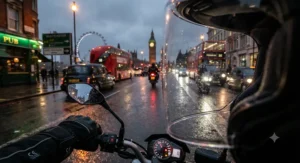
The standout feature is versatility: this is a spray treatment rather than a hardware fix, so it works across visors, goggles and even glasses, creating a transparent micro-thin anti-fog coating that reportedly lasts several days per application. Unlike a Pinlock insert, there’s nothing to fit or tension — you clean the surface, mist it lightly, and wipe with a dry cloth. What most buyers overlook is the bonus effect: applied to the outside of a visor, it also encourages rain to bead and roll off rather than smearing across your field of view, which is arguably as valuable for night visibility as the anti-fog effect itself, since smeared rain droplets scatter oncoming headlights badly. This is the pick for riders who don’t want to commit to a hardware insert, or who want a backup treatment for a visor that already has one fitted. Aggregated reviews consistently describe it as effective for demisting and safe on both plastic and glass lenses, with several buyers specifically noting it works well combined with a Pinlock insert rather than as a replacement for one; a recurring complaint is that the anti-fog effect fades faster in heavy, sustained rain than the multi-day claim suggests.
Pros:
- ✅ Works on visors, goggles and glasses alike
- ✅ Also encourages rain to bead and clear
- ✅ Quick spray-and-wipe application, no fitting needed
Cons:
- ❌ Effect wears off faster than claimed in heavy rain
- ❌ Needs reapplying more often than a Pinlock insert
At under £10 a bottle, this is the cheapest single item on this list and a sensible companion product rather than a standalone fix for serious fogging problems.
7. Muc-Off Helmet Visor & Goggle Cleaner Kit — keeps optical clarity streak-free
The standout here isn’t fogging at all — it’s the pH-neutral, solvent-free formula that removes bug splatter, road grime and oily residue without degrading the anti-scratch coating the way ammonia or alcohol-based cleaners can over time. That matters directly for night riding: a visor covered in a thin film of dried insects and dust doesn’t just look dirty, it scatters oncoming headlight beams into a hazy glow that genuinely reduces how far ahead you can see clearly. Using de-ionised water and a biodegradable formula, it’s designed to be safe across polycarbonate, glass and plastic lens materials, and pairs with a microfibre cloth in the kit version to avoid the fine scratches a rough cloth would leave. Here’s what most riders overlook until it’s too late: cheap all-purpose glass cleaners often contain exactly the alcohol and ammonia compounds that strip anti-fog and anti-scratch coatings over repeated use, quietly shortening the life of an otherwise good visor. This is the pick for anyone who wants to protect the investment already made in a quality shield rather than degrading it through careless cleaning. Reviewers consistently report a genuinely streak-free finish and appreciate that the formula is gentle enough for everyday use without residue buildup.
Pros:
- ✅ pH-neutral formula preserves anti-scratch coatings
- ✅ Removes grime that scatters headlight glare
- ✅ Includes microfibre cloth to avoid fine scratches
Cons:
- ❌ Not an anti-fog product on its own
- ❌ Needs topping up more often with daily commuting
At £10-£15 for the kit, this is less exciting than a hardware upgrade, but arguably the single highest-ROI item here for protecting whichever visor or insert you choose from this list.
Practical Usage Guide: Setting Up Your Clear Visor For Night Riding
Getting a new clear visor or Pinlock insert isn’t a case of unboxing and riding off — a few first-30-days habits determine whether you get years of clear night vision or a fogged, scratched mess within a season. Start with the fit check: before your first proper ride, cycle the visor through its full range of motion in daylight to confirm it seats fully and locks at every detent, since a slightly misaligned shield is far more noticeable — and dangerous — after dark than in daylight. If you’ve fitted a Pinlock insert, do this indoors under warm conditions first; breathe onto the inner lens deliberately and watch for any fogging at the edges, which signals the tension needs adjusting before you rely on it at 3am on the motorway.
A common first-30-days mistake is cleaning a brand-new visor with whatever cloth is lying around the garage — paper towel, an old t-shirt, anything abrasive leaves micro-scratches that only become obvious the first time headlights hit them at night. Stick to a dedicated microfibre cloth and a pH-neutral cleaner from day one. Build a simple maintenance rhythm: a quick wipe-down after every ride to clear insect debris and road film before it dries and bonds to the surface, a proper clean with a visor-specific solution weekly during regular use, and a fresh anti-fog treatment reapplication roughly every one to two weeks if you’re using a spray rather than a Pinlock insert. Store the helmet visor-up or in a breathable bag rather than sealed in plastic, since trapped moisture is a common cause of premature misting and even mould growth on the inner lens surface — a genuinely underrated cause of long-term optical clarity loss that most owners never connect back to storage habits.
Real-World Scenarios: Matching The Right Visor To Your Riding Life
Picture three different riders and it becomes obvious there’s no single “best” answer here — only the best fit for how and when you actually ride.
Take the London commuter doing an 8-mile ride home through rush-hour traffic that stretches well past sunset for half the year. Stop-start traffic means constant temperature swings between a warm engine bay and cold evening air — the exact conditions that cause sudden fogging. For this rider, a Pinlock DKS241 Pinlock 70 Insert paired with regular use of Muc-Off Helmet Visor & Goggle Cleaner Kit solves the two biggest problems: fog at standstill and grime-scattered glare from city streetlights and headlights.
Now consider the weekend tourer covering 150-plus miles on unlit A-roads and B-roads, often in a single sitting. Distance and sustained high-beam exposure from oncoming traffic make optical distortion the priority over fog resistance alone, since a warped edge-of-lens view becomes genuinely fatiguing over hours. The Shoei CWR-1 Pinlock-Ready Clear Face Shield or HJC HJ-09 Clear Pinlock-Ready Visor, both engineered for edge-to-edge clarity, are the stronger match here, ideally with a Pinlock insert added for the inevitable temperature drop after dark.
Finally, the budget-conscious new rider, perhaps still on CBT or a first bike, who simply needs a reliable spare clear visor to swap in once daylight fades, without a big spend. The AGV K1/K3 SV/K5 Compatible Clear Visor combined with the low-cost Muc-Off Premium Anti-Fog Treatment spray covers the fundamentals — genuine optical clarity and basic fog resistance — without committing to premium OEM pricing before they’ve settled on a long-term helmet.

How To Choose A Clear Visor For Night Riding
- Check Pinlock compatibility first. If your current shield already has Pinlock posts, an insert is almost always better value than a full replacement — you’re solving fog, not optics.
- Prioritise optical grade over brand name. Look for shields explicitly described as distortion-free or 3D-molded; cheaper flat-molded lenses distort peripheral headlights into streaks.
- Match the anti-scratch coating to your storage habits. If the helmet lives on a hook near a door or in a pannier, a harder anti-scratch coating pays for itself quickly.
- Factor in cleaning compatibility. A visor is only as clear as the last thing you cleaned it with — pair any purchase with a pH-neutral, solvent-free cleaner from the start.
- Confirm it’s genuinely clear, not lightly tinted. UK guidance restricts heavily tinted visors after dark, so double-check product listings specify full light transmission.
- Think about replacement cost, not just purchase price. A £60 shield that lasts three years of grime-free clarity often beats three £20 shields replaced annually due to scratching.
- Read aggregated fitment reviews for your exact helmet model. Universal and “compatible with” listings vary in tolerance — real owner feedback catches fitment issues spec sheets don’t.
Common Mistakes When Buying A Night Riding Visor
The single most common mistake is buying based on tint percentage rather than optical grade — riders assume “clear” automatically means “good,” when a scratched or flat-molded clear visor can distort night vision worse than a lightly toned one in daylight. A close second is skipping the Pinlock insert entirely to save money, then discovering the shield fogs solid the first cold evening it’s actually needed. Reviewers across UK retail sites repeatedly flag buyer’s remorse over this exact false economy. Another frequent error is mismatching pin spacing — buying a generic “Pinlock 70” insert for a helmet that actually uses a different post configuration, leading to a poor seal and worse fogging than no insert at all; always cross-check the exact model compatibility before purchasing. Finally, plenty of riders treat a visor as a lifetime purchase and never replace it despite visible pitting from years of stone chips and road grit — even faint scratches you can’t see head-on become genuinely dangerous starburst patterns the moment a headlight hits them directly.
Anti-Glare Clear Visor Coating vs Standard Clear Visor Coating: What’s The Real Difference?
Every clear visor technically has some coating — at minimum, a basic UV-stabilised polycarbonate treatment — but “anti-glare” coatings go a step further by reducing internal light scatter specifically at oblique angles, which is exactly the angle oncoming headlights hit your visor at on a dark road. On paper this means a genuine anti-glare coating minimises the halo effect around bright light sources rather than eliminating brightness itself; it won’t dim a headlight, but it stops that light bleeding outward into a diffuse glow that swallows the road detail around it. Standard clear coatings, by contrast, are mostly engineered for scratch resistance and basic UV filtering rather than glare-specific optics. Based on the spec sheets across the products in this guide, premium OEM shields like the Shoei CWR-1 and HJC HJ-09 tend to specify distortion-free, 3D-molded construction as their glare-reduction mechanism, while budget aftermarket options like the AGV K1/K3 SV/K5 Compatible Clear Visor rely on simpler flat anti-scratch treatments. What most buyers overlook is that a genuinely clean, unscratched visor with a standard coating will usually out-perform a scratched premium anti-glare shield for headlight glare reduction, because surface damage is the single biggest cause of light scatter regardless of the coating underneath it.
What To Expect: Real-World Night Riding Performance
Specs on a listing page rarely translate directly into what you experience at 60mph on an unlit road, so here’s the honest translation. A genuinely distortion-free shield means oncoming headlights stay as compact points of light rather than smearing sideways as they cross your peripheral vision — the difference is most obvious at roundabouts and junctions where your eyes are scanning laterally rather than straight ahead. A properly fitted Pinlock insert means the first ten minutes of a cold-evening ride, historically the worst window for sudden fogging as your visor cools from room temperature to ambient, stay genuinely clear rather than requiring you to crack the visor open for airflow — which itself lets in wind noise and road spray. A freshly cleaned, undamaged surface means wet-weather night riding, arguably the hardest visibility condition UK riders face, stays manageable because rain beads and clears rather than smearing across old grime and turning every streetlight into a starburst. None of this is dramatic on a dry, mild evening — it’s on the cold, wet, glary commute that the difference between a well-maintained clear visor and a neglected one becomes genuinely safety-relevant.
High Visibility Night Visor Options For Different Riders
“High visibility” in the context of a clear visor isn’t about fluorescent colour — that’s the job of your jacket — it’s about how much usable light reaches your eyes and how cleanly that light resolves into detail. For new and occasional riders, a high-visibility outcome is best achieved simply: a genuinely clear, unscratched budget shield like the AGV K1/K3 SV/K5 Compatible Clear Visor, replaced before it accumulates meaningful pitting, will outperform a premium visor that’s three seasons overdue for replacement. For high-mileage commuters, the combination of a Pinlock insert and a regular cleaning routine does more for effective visibility than any single “premium” purchase, since consistency of clarity matters more than peak optical spec on any one ride. For riders with any degree of night-specific glare sensitivity — a genuinely common and underdiscussed issue, particularly for riders over 40 as natural pupil response slows with age — prioritising a distortion-free, anti-glare coated shield like the Shoei CWR-1 or HJC HJ-09 is worth the extra spend, since reduced light scatter directly reduces the discomfort and fatigue associated with oncoming headlight glare.
Headlight Glare Reduction: Features That Actually Matter (And Those That Don’t)
Marketing copy loves to claim broad “glare reduction,” but only a handful of features genuinely move the needle for headlight glare specifically. Distortion-free, 3D-molded optics matter — they keep light sources compact rather than smeared, which is the single biggest factor in perceived glare intensity. A clean, unscratched surface matters enormously, arguably more than any coating claim, since every scratch acts as a tiny prism scattering light in random directions. Anti-fog performance matters indirectly, because a slightly misted visor diffuses light exactly the way a scratched one does. What doesn’t matter nearly as much as the marketing suggests: exotic coating names with no independent verification, since most “advanced” clear coatings boil down to a similar UV-stabilised hard coat regardless of branding, and heavier, thicker visor material, which adds weight and sometimes slight optical warping without meaningfully reducing glare. The honest takeaway, grounded in how these products actually perform rather than how they’re marketed, is that optical geometry and surface condition do the real work — coating buzzwords are a distant third factor.
Low-Light Riding Safety: Regulations & Compliance Guide
UK law requires any visor or goggles worn on a motorcycle to meet British Standard BS 6658:1985 with a BSI Kitemark, or UNECE Regulation 22.05 or 22.06, and this is a genuine legal requirement worth checking on any product you buy rather than assuming — official guidance on motorcycle helmets, visors and goggles sets this out clearly. Beyond the shield itself, there’s no specific UK statute banning tinted visors outright, but riding after dark with a heavily tinted or mirrored visor that restricts your vision can be treated as careless or dangerous riding under general road traffic law, which is precisely why carrying or switching to a genuinely clear visor for low-light conditions is the safer and more defensible choice, not just a comfort preference. On the visibility side, keeping your headlight on at all times — most modern bikes do this automatically — is a recommendation road safety bodies consistently reinforce as one of the most effective ways to be seen by other traffic, alongside good riding position and hazard awareness, as covered in RoSPA’s guidance for safer, more confident riding. It’s also worth noting that conspicuity and glare research consistently link visual detection failures — both a driver’s failure to spot a motorcycle and a rider’s own reduced visual clarity — to a meaningful share of low-light collisions, a pattern discussed in peer-reviewed research on motorcycle conspicuity interventions.
Night Commuting Gear: Building The Full Kit Around Your Visor
A clear visor is the centrepiece of night commuting gear, but it works best as part of a small, deliberate kit rather than in isolation. Alongside the visor itself, a genuinely useful night commuting setup includes a compact anti-fog spray or wipes stashed in a jacket pocket for mid-ride top-ups, since even a good Pinlock insert can benefit from occasional reinforcement on genuinely miserable evenings. A dedicated microfibre cloth kept somewhere accessible — not loose in a tank bag where it picks up grit — prevents the classic mistake of wiping a dirty visor with whatever’s nearest and grinding debris into the surface. Reflective or high-visibility elements on the jacket and helmet exterior complete the picture, since a perfectly clear visor only helps you see; it does nothing to help other road users see you, and that’s a separate, equally important half of the low-light safety equation. Finally, a spare visor genuinely worth keeping in a pannier or top box — something like the budget AGV K1/K3 SV/K5 Compatible Clear Visor — means a scratched or lost shield never turns into a ride home with genuinely dangerous vision, a small investment that pays for itself the one time it’s actually needed.
Visor Optical Clarity: Long-Term Cost & Maintenance
Thinking about visor optical clarity as a one-off purchase rather than an ongoing cost misses where the real money and safety trade-offs sit. A premium shield bought once and neglected — cleaned with rough cloths, stored carelessly, never treated for fog — will typically need replacing within a single riding season due to scratching, effectively erasing its price advantage over a cheaper visor properly maintained. Conversely, a budget shield paired with consistent maintenance — a proper pH-neutral cleaner, a breathable storage bag, and a Pinlock insert or anti-fog spray reapplied on schedule — can comfortably outlast a neglected premium equivalent. Total cost of ownership over two to three years therefore usually favours whichever combination gets the most consistent care, not necessarily the highest sticker price. As a rough framework: budget for one visor-specific cleaner every few months, a Pinlock insert replacement roughly every one to two years depending on riding frequency, and a full shield replacement the moment pitting becomes visible under direct light — waiting until it’s obvious in normal daylight means it’s already been compromising your night vision for weeks or months beforehand.
Frequently Asked Questions
❓ Is a clear visor legal for night motorcycle riding in the UK?
❓ Do I need a Pinlock insert if my visor is already anti-fog treated?
❓ How often should I replace a clear motorcycle visor?
❓ What's the difference between anti-fog and anti-scratch visor coatings?
❓ Can I use car glass cleaner on my motorcycle visor?
Conclusion
Getting genuinely clear vision at night comes down to fewer variables than the marketing around motorcycle visors suggests: optical geometry, surface condition, and fog resistance, in roughly that order of importance. Whether that means a premium shield like the Shoei CWR-1 Pinlock-Ready Clear Face Shield, a smart budget swap like the AGV K1/K3 SV/K5 Compatible Clear Visor, or simply pairing what you already own with a Pinlock DKS241 Pinlock 70 Insert and a proper cleaning routine using something like the Muc-Off Helmet Visor & Goggle Cleaner Kit, the goal is the same — arriving at your destination with your eyes doing less work, not more. None of these products are magic; a scratched, neglected premium shield will always underperform a cheap, well-maintained one. Treat maintenance as part of the purchase, not an afterthought, and whichever option from this list you choose, current prices and availability are always worth checking before you buy, since stock and pricing shift regularly across retailers.
Recommended for You
- Clear Motorcycle Visor: 7 Best Picks for UK Riders in 2026
- 7 Best Replacement Clear Visor for Full Face Helmets (2026)
- Pinlock Ready Clear Visor Guide 2026: 7 Best Picks Compared
Disclaimer: This article contains affiliate links. As an Amazon Associate, I earn from qualifying purchases. If you purchase products through these links, we may earn a small commission at no additional cost to you.
✨ Found this helpful? Share it with your friends! 💬🤗
