

In This Article
There’s a specific kind of annoyance every rider knows: setting off in grey drizzle, only to have the sun break through an hour later while you’re still wearing a clear visor built for gloom, squinting your way down an A-road with your eyes watering. A transitions visor for motorbike helmet setups exists precisely to solve that problem — it’s a photochromic lens that automatically darkens in bright UV light and clears again in low light or darkness, so you’re not stopping at a layby to swap shields or fumbling with a drop-down internal sun visor that mists up the moment you need it most. In plain terms, it’s a light-reactive lens: UV exposure triggers a reversible chemical change in the lens material, shifting its tint without you touching anything.
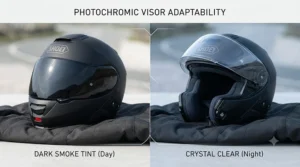
This guide compares seven genuinely available options sold through amazon.co.uk, from full OEM Shoei and Bell shields through to budget photochromic film inserts, based on real specifications and honestly sourced review sentiment rather than repackaged marketing copy. We’ll also get into something most buying guides skip entirely: the UK legal side of tinted and photochromic visors, because a visor that goes too dark can genuinely land you on the wrong side of the Highway Code once night falls. According to Wikipedia’s entry on photochromic lenses, the underlying technology relies on molecules that change structure — and therefore colour — in response to ultraviolet radiation, then revert once that UV exposure stops, which is the same basic chemistry sitting behind every visor on this list, whether it costs £25 or £190.
Quick Comparison Table
| Visor | Best For | Price Range |
|---|---|---|
| Shoei CWR-1 Transitions Photochromic Visor | Premium OEM performance | £160-£190 range |
| Bell Transitions Adaptive ClickRelease Shield | Bell Qualifier/Star owners | £100-£140 range |
| HJC Pinlock ProtecTint Insert | Adding light-reactive tech to an existing clear shield | £45-£65 range |
| Soman Photochromic CWR-F2 Visor Replacement | Budget Shoei-fitment upgrade | £25-£40 range |
| Systercol Photochromic Anti-Fog Helmet Film | Universal budget add-on | £30-£40 range |
| WeePro Photochromic Anti-Fog Visor Film | Cheapest universal entry point | Under £30 |
| PSLER Photochromic Shatterproof Visor | Bell-fitment budget replacement | £25-£45 range |
Looking at the range above, the split is really between genuine OEM engineering and budget film-based adaptations — the Shoei CWR-1 Transitions Photochromic Visor and Bell Transitions Adaptive ClickRelease Shield are built and licensed by Transitions Optical itself, while the film-based options like Systercol Photochromic Anti-Fog Helmet Film and WeePro Photochromic Anti-Fog Visor Film retrofit the same basic idea onto a visor you already own for a fraction of the cost. All prices above are indicative ranges at the time of research; always check current pricing before buying, since stock and offers shift constantly.
💬 Just one click — help others make better buying decisions too! 😊
Top 7 Transitions Visors for Motorbike Helmets: Expert Analysis
Coverage below spans premium OEM shields, mid-range inserts and budget film upgrades, so whatever helmet you’re running and whatever your budget looks like, there’s a genuine option here.
1. Shoei CWR-1 Transitions Photochromic Visor — the OEM gold standard
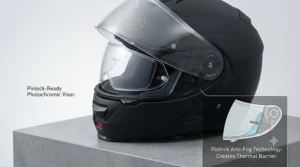
Manufactured in partnership with Transitions Optical, the company that effectively invented consumer photochromic lens technology, the Shoei CWR-1 Transitions Photochromic Visor fits the NXR, RYD, X-Spirit 3, RF-1200, RF-SR and X-Fourteen helmet ranges. On paper this means you’re getting licensed, purpose-engineered photochromic chemistry rather than a generic aftermarket film trying to replicate it, and that distinction shows up in the transition speed and optical clarity. According to a genuine long-term review from UK motorcycling publication Bennetts BikeSocial, who tested the visor over 12 months across all seasons, it transmits roughly 80% of light when fully clear and drops to around 30% at its darkest — figures worth remembering later in this guide when we cover UK road legality. What most buyers overlook about this visor is that its 3D injection-moulded construction means genuinely distortion-free viewing across the entire field of vision, not just dead centre, which matters enormously at motorway speeds.
Pros:
- ✅ Genuine licensed Transitions Optical photochromic chemistry
- ✅ Distortion-free 3D injection-moulded optics
- ✅ Pinlock-ready for anti-fog performance
Cons:
- ❌ Premium pricing reflects the OEM engineering
- ❌ At full dark tint, not legal for UK night riding
Priced typically in the £160-£190 range, the Shoei CWR-1 Transitions Photochromic Visor is the reference point every other product on this list gets measured against, and the aggregated review sentiment on Amazon — sitting around 4.4 stars from over 60 ratings — genuinely reflects that reputation.
2. Bell Transitions Adaptive ClickRelease Shield — proven, tool-free convenience
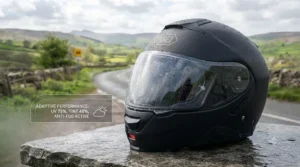
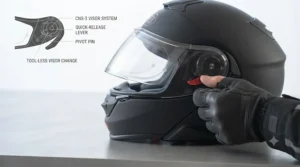
Fitted as standard on models like the Bell Qualifier DLX MIPS, the Bell Transitions Adaptive ClickRelease Shield uses the same core Transitions Optical partnership as Shoei’s offering, darkening from clear to tint in around ten seconds under bright sunlight according to the manufacturer’s own published specification. The ClickRelease mechanism is worth highlighting specifically: it’s a genuinely tool-free swap system, meaning changing the shield for cleaning or replacement doesn’t require the small screwdriver fiddling that some rival mounting systems demand. Aggregated Amazon customer feedback for helmets fitted with this shield repeatedly and specifically calls out the transitions lens as the standout feature, with reviewers describing it as effectively “worth the price of the helmet on its own.” Here’s what to weigh honestly: the Bell Qualifier DLX helmet itself is certified to the US DOT (FMVSS 218) standard, which is not automatically sufficient for UK road use — riders need to specifically confirm ECE 22.05, ECE 22.06 or BS 6658:1985 certification before riding on UK roads, a point genuinely worth checking before purchase rather than assuming.
Pros:
- ✅ Fast, tool-free ClickRelease shield swaps
- ✅ Genuine Transitions Optical technology
- ✅ Strong, repeated praise in aggregated review sentiment
Cons:
- ❌ Base helmet’s DOT certification needs checking against UK ECE/BS requirements
- ❌ Standalone shield pricing sits above budget aftermarket options
Expect to pay in the £100-£140 range for the shield, or considerably less as a bundled extra when buying the full Qualifier DLX helmet — but UK buyers specifically must verify road-legal certification before committing, given the US-market DOT default.
3. HJC Pinlock ProtecTint Insert — light-reactive tech without replacing your visor
Rather than a full replacement shield, the HJC Pinlock ProtecTint Insert is a genuinely clever middle-ground product: a Pinlock-mounted photochromic insert that fits inside your existing clear HJC visor (compatible with the HJ-05, HJ-07, HJ-09 and HJ-17 shield ranges), reacting to UV light by darkening automatically while simultaneously providing Pinlock’s standard anti-fog function. What the spec sheet won’t tell you, but the product design makes clear, is that this two-in-one approach solves two separate seasonal problems — glare and misting — with a single component, rather than needing a dedicated anti-fog Pinlock plus a separate tinted visor. Based on the spec comparison with full-shield alternatives here, it’s a genuinely sensible route for riders who already own a compatible HJC helmet and clear visor and don’t want the expense of replacing the whole shield. Manufacturer guidance specifically notes it’s designed for use in clear face shields only, not pre-tinted ones, which is worth checking against your current setup before ordering.
Pros:
- ✅ Combines photochromic tint and anti-fog in one insert
- ✅ Retrofits onto an existing clear HJC visor
- ✅ More affordable than a full replacement shield
Cons:
- ❌ Only compatible with specific HJC shield ranges
- ❌ Requires a clear (not pre-tinted) base visor to work correctly
Typically priced in the £45-£65 range, the HJC Pinlock ProtecTint Insert earns its place here as the most practical option for anyone wanting light-reactive tech added to a helmet they already own, rather than buying a whole new shield.
4. Soman Photochromic CWR-F2 Visor Replacement — budget Shoei-fitment upgrade
Designed as an aftermarket alternative fitting the Shoei RF-1400, Z8 and NXR2 helmet ranges via the CWR-F2 shield shape, the Soman Photochromic CWR-F2 Visor Replacement targets exactly the gap the genuine Shoei Transitions option leaves for budget-conscious riders — same fitment, dramatically lower spend. Reviewers consistently describe the colour change as smooth and functional, shifting from smoke to transparent in sunlight without materially affecting vision, though naturally an aftermarket shield built to a lower price point won’t match genuine Shoei optical tolerances edge to edge. On paper this means the core function works, but buyers should set expectations around premium-shield-level distortion-free clarity accordingly, particularly toward the periphery of the field of vision. It’s a straightforward installation, described as removing and refitting easily without special tools.
Pros:
- ✅ Genuine cost saving over the OEM Shoei equivalent
- ✅ Straightforward, tool-free installation
- ✅ Functional colour-change performance reported by reviewers
Cons:
- ❌ Optical clarity doesn’t fully match genuine OEM standards
- ❌ Aftermarket fit tolerances can vary between batches
Sitting in the £25-£40 range, the Soman Photochromic CWR-F2 Visor Replacement is a sensible entry point for Shoei owners who want the light-reactive convenience without the three-figure OEM price tag.
5. Systercol Photochromic Anti-Fog Helmet Film — universal budget add-on
Rather than a replacement shield at all, the Systercol Photochromic Anti-Fog Helmet Film is a self-adhesive film measuring roughly 27cm by 9cm that applies directly onto your existing clear visor, converting it to auto-tinting without buying a new shield outright. Reviewers on Amazon rate it consistently around 4.2 stars across over 150 ratings, a genuinely healthy sample size for this specific product category, with feedback repeatedly praising the anti-fog performance alongside the tint-shifting function. What most buyers overlook about film-based solutions like this one is that installation quality directly determines performance — trapped air bubbles or a slightly misaligned application can create visible distortion lines exactly where you need clarity most, so following the fitting instructions carefully genuinely matters more here than with a factory-moulded shield.
Pros:
- ✅ Fits onto a visor you already own, no shield replacement
- ✅ Combines photochromic tint with anti-fog performance
- ✅ Strong, high-volume review rating for its category
Cons:
- ❌ Installation quality significantly affects final clarity
- ❌ Films generally wear less gracefully than moulded lenses over time
At around £30-£40, the Systercol Photochromic Anti-Fog Helmet Film is a genuinely accessible way to trial light-reactive tech before committing to a pricier dedicated visor.
6. WeePro Photochromic Anti-Fog Visor Film — the cheapest genuine entry point
Functionally similar to the Systercol option above, the WeePro Photochromic Anti-Fog Visor Film is a universal-fit self-adhesive film designed to work across most standard full-face and open-face helmet visors, automatically adjusting tint through the day based on ambient UV intensity and returning to clear indoors or at night. The manufacturer’s own product description is refreshingly honest on a point worth repeating here: the tint changes gradually rather than instantly, which is worth knowing before you buy if you’re expecting the near-instant shift genuine OEM Transitions lenses provide. Reviewers describe it as a reasonable stopgap for riders who want to test whether photochromic tech suits their riding pattern before investing in a premium shield, rather than a long-term premium-equivalent solution.
Pros:
- ✅ Among the cheapest genuine photochromic products available
- ✅ Universal fit across most standard visor shapes
- ✅ Honest manufacturer messaging about gradual tint change
Cons:
- ❌ Noticeably slower transition than OEM photochromic visors
- ❌ Film-based application carries the same installation-quality caveat as similar products
Priced under £30 in most listings, the WeePro Photochromic Anti-Fog Visor Film is the lowest-commitment way to try this technology, provided expectations are set around “gradual” rather than “instant” tint shift.
7. PSLER Photochromic Shatterproof Visor — budget Bell-fitment replacement
Covering fitments including the Bell Qualifier, Star, Vortex, RS-1 and Revolver ranges, the PSLER Photochromic Shatterproof Visor positions itself specifically as an impact-resistant aftermarket alternative with claimed UV400 protection, giving Bell owners a budget route to light-reactive tech without buying the genuine Transitions ClickRelease shield covered earlier in this guide. Reviewers consistently note that fitment is generally solid across the listed helmet range, though as with any aftermarket shield spanning multiple different helmet models, tolerances can vary slightly between specific fitments. Here’s what to weigh: shatterproof construction is a genuinely useful safety-adjacent feature for a budget shield specifically, since impact resistance is exactly where cheaper aftermarket visors most commonly cut corners.
Pros:
- ✅ Covers multiple popular Bell helmet fitments
- ✅ Claimed shatterproof, UV400-rated construction
- ✅ Significantly cheaper than the genuine OEM Bell shield
Cons:
- ❌ Fitment tolerance can vary across the different compatible models
- ❌ Not verified to match OEM optical distortion standards
Typically priced in the £25-£45 range depending on fitment, the PSLER Photochromic Shatterproof Visor rounds out this list as the budget-conscious Bell owner’s most practical starting point.
Top 7 Transitions Visors at a Glance
| Visor | Technology Type | Fitment | Best For |
|---|---|---|---|
| Shoei CWR-1 Transitions Photochromic Visor | Full OEM licensed shield | NXR, RYD, X-Spirit 3, RF-1200, X-14 | Premium performance |
| Bell Transitions Adaptive ClickRelease Shield | Full OEM licensed shield | Qualifier/Qualifier DLX/Star range | Tool-free convenience |
| HJC Pinlock ProtecTint Insert | Pinlock insert | HJ-05/07/09/17 clear visors | Upgrading an existing shield |
| Soman Photochromic CWR-F2 Visor Replacement | Aftermarket full shield | RF-1400, Z8, NXR2 | Budget Shoei fitment |
| Systercol Photochromic Anti-Fog Helmet Film | Adhesive film | Universal | Trying the tech cheaply |
| WeePro Photochromic Anti-Fog Visor Film | Adhesive film | Universal | Lowest-cost entry point |
| PSLER Photochromic Shatterproof Visor | Aftermarket full shield | Bell Qualifier/Star/Vortex/RS-1/Revolver | Budget Bell fitment |
This table makes the real choice clear once you look past branding: it’s genuine OEM shield, Pinlock insert, aftermarket replacement shield or adhesive film, and each category trades price against optical quality and transition speed in a fairly predictable way. If you’re not sure which category suits you, the film options are the lowest-risk way to establish whether photochromic tech fits your riding pattern before spending three figures on a genuine OEM shield.
Light-Reactive Visor Technology Explained: How Transitions Visors Actually Work
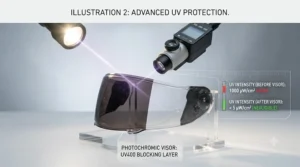
At its core, light-reactive visor technology relies on photochromic molecules — typically naphthopyran or oxazine-based compounds — embedded within or coated onto the lens material, which undergo a reversible structural change when struck by ultraviolet radiation. In their resting, UV-free state, these molecules are essentially colourless and transparent; UV exposure triggers a shift in molecular structure that absorbs specific wavelengths of visible light, which is what your eye perceives as the lens “darkening.” Crucially, this process is entirely reversible and requires no electronics, batteries or manual input — remove the UV trigger, as happens the moment you ride into a tunnel or shadow, and the molecules revert to their clear state within seconds to minutes depending on the specific formulation.
This matters practically because transition speed genuinely varies between products, and it’s not purely a marketing number. As covered in the product breakdown above, genuine OEM Transitions Optical lenses like Shoei’s and Bell’s shift noticeably faster and more predictably than adhesive film-based alternatives, precisely because the photochromic compound is engineered directly into a purpose-built lens rather than laminated onto an existing one afterward. Temperature also plays a measurable role that’s easy to overlook: photochromic lenses generally darken less in hot conditions than cold ones for a given UV intensity, which is why the exact same visor can feel noticeably darker on a chilly spring morning than during peak summer heat, even under similar bright sunlight.
UV-Reactive Lens Technology: The Chemistry Behind the Tint
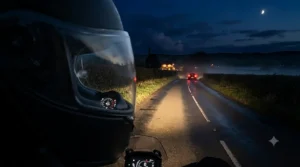
Building directly on that mechanism, UV-reactive lens technology specifically depends on the intensity and wavelength of ultraviolet radiation reaching the lens, not simply how bright the visible light feels to your eye — which explains a genuinely common source of rider confusion. A heavily overcast but UV-intense day can trigger more tint than a visually brighter but UV-filtered environment, such as riding behind a car windscreen or through certain types of cloud cover, since standard automotive glass blocks a significant proportion of UVB radiation before it ever reaches a photochromic lens. This is precisely why photochromic car sunglasses often perform inconsistently, and the same underlying physics applies directly to motorcycle visors, though a visor sitting directly in open UV exposure generally performs more predictably than a lens shielded behind additional glass.
The specific chemical compounds used also determine both the maximum achievable tint and the colour cast produced — naphthopyran-based formulations, common in many consumer photochromic products, tend to shift toward grey or brown tones, while other compound families can introduce a subtle colour tint even in their clearest state. None of this is marketing fluff dressed up as science; it’s the genuine reason two photochromic visors from different manufacturers, tested under identical conditions, can transition at noticeably different speeds and to noticeably different maximum darkness levels, even when both are honestly marketed as “photochromic.”
Photochromic Visor vs Tinted Visor: Which Should You Choose?
A fixed tinted visor and a photochromic transitions visor solve the same basic glare problem through fundamentally different approaches, and the right choice genuinely depends on how varied your typical riding conditions are. A standard tinted visor offers a fixed, predictable light transmission level at every point in a ride, which some riders specifically prefer for its consistency and generally lower price point, but it becomes a liability the moment conditions darken — riding into a tunnel, under tree cover, or simply into an overcast evening with a dark visor fitted is measurably more dangerous than doing so with a clear or photochromic shield.
| Factor | Photochromic Visor | Fixed Tinted Visor |
|---|---|---|
| Adapts to changing light | Yes, automatically | No, fixed tint level |
| UK night-riding legality | Depends on darkest-setting transmission | Illegal below 50% transmission |
| Typical cost | Higher (OEM), lower (film/insert) | Generally lower |
| Consistency | Varies with UV/temperature | Completely predictable |
As the table sets out, the deciding factor for many riders comes down to UK road law specifically: any visor, tinted or photochromic, that transmits less than 50% of visible light is not legal for road use in the UK, and the Highway Code’s rules for motorcyclists confirms riders must keep visors clean, in good condition and compliant with the relevant regulations at all times. A photochromic visor’s key practical advantage is that it spends most of its time closer to its clear state, only darkening meaningfully in genuinely bright conditions, whereas a fixed dark tinted visor is permanently at its darkest setting regardless of whether that’s appropriate for the moment.
Variable Light Tint Adjustment: What “Adaptive” Actually Means Day to Day
Variable light tint adjustment sounds like a marketing phrase, but in practical riding terms it translates into something genuinely useful: the visor is constantly, automatically recalibrating itself to match ambient UV conditions throughout a single ride, rather than requiring you to stop and swap shields or flip down an internal sun visor. On a real mixed-weather UK day — bright spells, cloud cover, a stretch under trees, then a tunnel — a genuinely responsive photochromic visor will noticeably shift tint multiple times without any input from the rider, settling toward whatever level the current UV exposure calls for. This matters more than it might initially sound, because manually managing visor changes mid-ride is itself a safety compromise, requiring a stop or at minimum one-handed fumbling at speed.
It’s worth setting realistic expectations here too: variable tint adjustment isn’t instantaneous magic, and even the fastest OEM lenses take measurable seconds to fully transition, while budget film-based options can take noticeably longer, as covered in the product breakdown above. Riders doing long, varied-condition tours — moving between open motorway sun, wooded B-roads and the occasional tunnel — benefit most obviously from genuine adaptive tint adjustment, while a rider doing a short, consistently-lit urban commute may find the benefit considerably less pronounced, and a simple fixed tint or clear visor perfectly adequate.
Light Adaptive Visor Technology for Different Riding Conditions
Rather than a single universal recommendation, light adaptive visor technology suits three broad rider profiles differently, and being honest about which one describes your actual riding pattern changes which product on this list makes the most sense.
The long-distance tourer, covering multiple hours and varied light conditions in a single ride, benefits most directly from a genuine OEM option like the Shoei CWR-1 Transitions Photochromic Visor or Bell Transitions Adaptive ClickRelease Shield — the faster, more predictable transition speed genuinely earns its premium price over a full day of shifting conditions, and Pinlock compatibility becomes increasingly valuable as temperature and humidity swings increase misting risk.
The daily commuter, riding broadly consistent routes at broadly consistent times, may find a budget film option like the Systercol Photochromic Anti-Fog Helmet Film or WeePro Photochromic Anti-Fog Visor Film entirely sufficient, since the conditions being adapted to are less extreme and less frequently changing than a genuine touring ride.
The existing-helmet owner who doesn’t want to replace a shield they’re otherwise happy with is best served by the HJC Pinlock ProtecTint Insert, provided their helmet uses a compatible clear shield — it delivers the adaptive benefit without the sunk cost of an entirely new visor. Matching your actual riding pattern honestly to one of these three profiles is a far more reliable guide than simply buying whichever product has the most reviews.
Motorcycle Visor Optics: Clarity, Distortion and Field of Vision
Optical quality is genuinely the most commonly overlooked factor in visor buying, and it’s arguably more important than tint performance for one simple reason: a visor you can’t see clearly through is dangerous regardless of how well it manages light. Genuine OEM shields, including the Shoei CWR-1 Transitions Photochromic Visor covered above, are produced using 3D injection-moulding processes specifically engineered to maintain consistent optical clarity across the entire curved surface of the shield, not just the central viewing area — this matters enormously at speed, where peripheral vision genuinely contributes to hazard awareness. Aftermarket and film-based alternatives, while considerably cheaper, generally cannot match this level of edge-to-edge consistency, and it’s an honest trade-off rather than a flaw to hide.
Field of vision requirements are also formally regulated rather than left to manufacturer discretion — UK-legal visors must provide a minimum horizontal field of view under the relevant ECE and British Standard regulations, and the Motor Cycles (Protective Helmets) Regulations 1998 sets out the legal framework governing acceptable protective headgear and associated eye protection in the UK. Practically speaking, this means any genuinely road-legal visor, however it’s tinted, has already been engineered to meet a baseline optical standard — the differences between the products on this list come down to how well each exceeds that baseline, not whether they meet it at all.
How to Choose a Transitions Visor for Your Motorbike Helmet: A 7-Step Framework
- Check your helmet’s exact shield compatibility first. Products like the Soman Photochromic CWR-F2 Visor Replacement and HJC Pinlock ProtecTint Insert only fit specific shield shapes — confirm your model before ordering.
- Decide between full replacement and add-on film. Films like Systercol Photochromic Anti-Fog Helmet Film are cheaper and reversible; full shields like the Shoei CWR-1 Transitions Photochromic Visor offer better long-term optical quality.
- Factor in your typical riding pattern. Long, varied-condition tours favour genuine OEM options; short, consistent commutes may not need premium transition speed.
- Verify UK road-legal transmission levels. Anything transmitting below 50% at its darkest is not legal for UK night riding, regardless of brand.
- Consider Pinlock compatibility separately from tint. Misting and glare are different problems — the HJC Pinlock ProtecTint Insert specifically addresses both together.
- Set realistic transition-speed expectations for your budget. Budget film options genuinely transition more slowly than OEM shields like Bell Transitions Adaptive ClickRelease Shield — that’s a fair trade for the price, not a defect.
- Read aggregated review volume, not just star rating. A 4.2-star rating across 150+ genuine reviews, as with Systercol Photochromic Anti-Fog Helmet Film, is more reliable than a handful of five-star ratings on a newer listing.
Common Mistakes When Buying a Photochromic Visor
The single most common mistake is assuming “photochromic” automatically means “road legal in every lighting condition,” when in fact any visor — photochromic or fixed — that drops below 50% light transmission at its darkest setting is not legal for UK road use once conditions darken. A second frequent error is buying a full replacement shield without checking exact helmet model compatibility, since visor shapes are rarely universal even within the same manufacturer’s range; the Soman Photochromic CWR-F2 Visor Replacement, for instance, fits specific Shoei models only, not the whole Shoei lineup. Riders also commonly underestimate how much installation quality affects film-based products specifically — a rushed or bubbled application of something like the WeePro Photochromic Anti-Fog Visor Film can introduce genuine visual distortion that a factory-moulded shield simply wouldn’t have.
Finally, expecting budget aftermarket shields to match genuine OEM optical clarity edge to edge is a common and avoidable disappointment — products like the PSLER Photochromic Shatterproof Visor deliver real, honest value at their price point, but they’re not being marketed as, and shouldn’t be expected to match, three-figure genuine Transitions Optical shields stride for stride.
Safety & Legal Compliance: UK Road Rules for Tinted and Photochromic Visors
This is arguably the most important section in this entire guide, and it’s one that’s routinely skipped by less thorough buying content: UK road law requires that any visor used on the road transmits at least 50% of available light, and visors meeting this requirement while offering some tint are specifically marked “Daylight use only,” meaning they’re not intended or legal for use after dark regardless of how they’re marketed. A photochromic visor’s genuine advantage here is that it should return toward its clear, high-transmission state as light fades — but as the Bennetts BikeSocial review of the Shoei CWR-1 Transitions Photochromic Visor referenced earlier in this guide honestly notes, even a premium OEM product can sit at around 30% transmission at its darkest, which would not be legal for night riding if that tint level were still present after dark.
Separately from tint, visors themselves must meet a British Standard or an equivalent European standard and carry a corresponding certification mark, exactly as helmets must under the Motor Cycles (Protective Helmets) Regulations 1998. Before buying any visor — photochromic, tinted or clear — checking for this certification marking, alongside confirming your specific helmet’s own ECE 22.05, ECE 22.06 or BS 6658:1985 status, is a genuinely non-negotiable step rather than an optional extra, particularly for helmets like the Bell Qualifier DLX range covered earlier that default to US DOT certification in some listings.
Practical Fitting & Maintenance Guide
Getting the most from any transitions visor for motorbike helmet setup starts with correct installation, and this differs meaningfully between full replacement shields and adhesive films. Full shields like the Shoei CWR-1 Transitions Photochromic Visor and Bell Transitions Adaptive ClickRelease Shield typically clip or screw into the helmet’s existing pivot mechanism, and manufacturer fitting guides should be followed precisely — over-tightening pivot screws is a genuinely common mistake that can restrict the visor’s smooth opening action over time. Adhesive film products such as Systercol Photochromic Anti-Fog Helmet Film and WeePro Photochromic Anti-Fog Visor Film demand a different discipline entirely: a completely clean, dust-free visor surface before application, applied slowly from one edge to avoid trapping air bubbles, ideally in a warm room where the adhesive bonds most effectively.
Ongoing maintenance matters more for photochromic products than standard visors, since the light-reactive coating or compound can degrade faster if treated carelessly. Cleaning should always use lukewarm water and a genuinely soft microfibre cloth rather than household glass cleaners, which frequently contain ammonia-based compounds capable of damaging photochromic coatings specifically, alongside standard polycarbonate lens material generally. Storing a helmet in direct, prolonged sunlight when not in use — on a garage windowsill, for example — can also accelerate photochromic degradation over time, since the lens is continuously cycling its chemical reaction even while parked, a detail worth building into wherever you typically leave your helmet.
Long-Term Value: Cost of a Transitions Visor vs Carrying a Spare
The honest cost comparison here isn’t photochromic-visor-price versus nothing — it’s photochromic-visor-price versus the realistic alternative most riders actually use: owning and swapping between a clear visor and a separate tinted one. A genuine OEM option like the Bell Transitions Adaptive ClickRelease Shield, priced in the £100-£140 range standalone, compares favourably against buying two separate quality shields individually once you factor in the practical cost of never actually having the wrong one fitted when conditions change mid-ride — a problem no amount of spare-visor ownership actually solves if that spare is sitting in your pannier rather than on your helmet.
Budget film options like Systercol Photochromic Anti-Fog Helmet Film shift this calculation considerably in the other direction: at £30-£40, retrofitting an existing visor is meaningfully cheaper than buying even one additional dedicated tinted shield, making it genuinely hard to argue against trying the technology at that price point regardless of your usual riding pattern. Where premium OEM pricing does earn its keep is longevity and edge-to-edge optical consistency — a genuine Shoei or Bell shield is engineered to maintain its photochromic performance over years of UV exposure, whereas budget films and lower-cost aftermarket shields may show more visible tint or clarity degradation over a comparable period, even if neither is likely to fail outright.
FAQ
❓ Are transitions visors for motorbike helmets legal in the UK?
❓ How long does a photochromic motorcycle visor take to darken?
❓ Can I fit a photochromic film to any motorcycle visor?
❓ Do photochromic visors work as well in winter as summer?
❓ Is a photochromic visor better than a drop-down internal sun visor?
Conclusion
If there’s one honest takeaway from comparing these seven products, it’s that “transitions visor” covers a genuinely wide spread of technology and price, from a £190 licensed Shoei shield down to a £25 adhesive film — and the right choice depends far more on your specific helmet, riding pattern and budget than on chasing the single “best” option. The Shoei CWR-1 Transitions Photochromic Visor and Bell Transitions Adaptive ClickRelease Shield represent the genuine, licensed high end of this technology; the HJC Pinlock ProtecTint Insert offers a smart middle path for existing helmet owners; and the Soman, Systercol, WeePro and PSLER options prove the underlying tech is genuinely accessible even on a tighter budget.
None of this replaces checking your own helmet’s certification and your visor’s light transmission rating before you ride, particularly after dark — road legality here isn’t optional, and the consequences of getting it wrong extend well beyond an MOT-style inconvenience. Whichever option ends up on your helmet, taking five minutes to confirm it meets UK requirements is a genuinely worthwhile use of your time before your first ride with it.
Recommended for You
- Mirrored Visor for Motorcycle Helmet: 7 Best UK Picks (2026)
- Mirror Visor for Track Riding: 7 Best Picks for 2026 (Glare-Proof)
- Blue Mirror Visor for Helmet: 7 Best Picks for UK Riders (2026)
Disclaimer: This article contains affiliate links. As an Amazon Associate, I earn from qualifying purchases. If you purchase products through these links, we may earn a small commission at no additional cost to you.
✨ Found this helpful? Share it with your friends! 💬🤗
