
In This Article
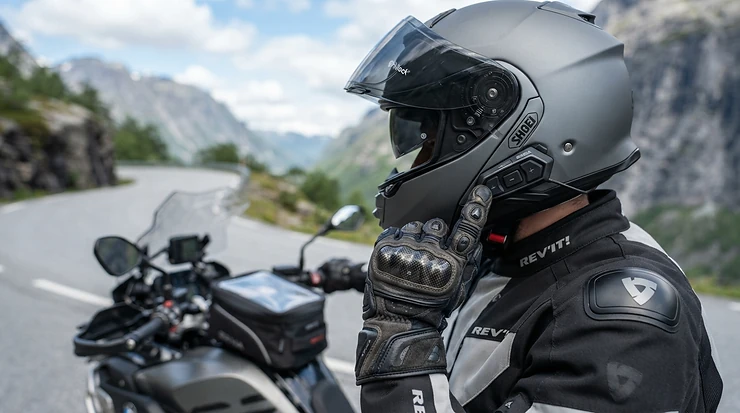
An intercom for modular flip front helmets is a helmet-mounted Bluetooth communicator with ear-pocket speakers, a shell-mounted control unit and a boom microphone that travels with the lifting chin bar. It lets you talk to a pillion, a group and your phone while the flip-up mechanism keeps working.
Here’s the awkward truth. Most intercoms are designed around a fixed full-face shell, where a slim wired microphone sits inside a chin bar that never moves. Flip-up riders live in a different world. Your chin bar swings up at fuel stops, drops at the lights, and objects to anything stuck on it. Pick the wrong kit and you’ll get a mic that scrapes the chin curtain, a clamp that fouls the latch, or a cable that’s one careless flip from a tangle.
Independent testers split the market into universal clamp-on units and helmet-specific integrated systems, a distinction MCN’s Bluetooth headset guide lays out clearly. This guide sticks with the universal kind, because it fits the widest range of modular lids and moves between helmets. Whether you call it an intercom or a bluetooth headset for flip up helmets, the same physical rules apply. We’ll cover seven real units, the boom microphone question, the jaw mounted microphone question, chin bar clearance, and how to fit a clamp mount intercom for modular helmets properly.
A quick note on method. I haven’t ridden with these units, so nothing below is a personal test. It’s built from manufacturer specs, independent UK test coverage and aggregated retailer reviews, and I’ll say plainly where the evidence is thin. Prices are ranges at the time of research (November 2026), so check current price before you buy.
Quick Comparison: Seven Intercoms That Suit a Flip-Up Chin Bar
Before the deep dives, here’s the lot at a glance. I’ve judged each on three things for this brief: a modular-friendly microphone in the box, sensible mounting, and value.
| Product | Modular-friendly mic in the box | Typical price range (single) | Best For |
|---|---|---|---|
| Cardo Packtalk Edge | Boom + wired | £290–£360 | Premium group touring |
| Sena 60S | Boom (clamp kit) | £250–£360 | Big groups, long distances |
| Cardo Packtalk Neo | Boom + wired | £220–£320 | Edge-style mesh for less |
| Cardo Freecom 4X | Hybrid boom + wired | £190–£250 | Pillion and small groups |
| Midland BTX2 Pro S-LR | Boom + wired | Under £200 | Value, cross-brand chats |
| Sena 20S Evo | Boom + wired | £165–£230 | Proven 8-rider Bluetooth |
| Sena 5S | Boom + wired | £110–£150 | Budget pillion link |
Looking at the table, the Cardo Packtalk Edge and Sena 60S cost the most, and their mesh networks only pay off if you ride with groups. If you mostly talk to one pillion or one friend, the Cardo Freecom 4X or Sena 20S Evo give you the same chin-bar-friendly microphone for far less. Budget buyers should note that the Sena 5S trades range and group size for its low price.
💬 Just one click — help others make better buying decisions too!😊
Top 7 Intercoms for Modular Flip Front Helmets: Expert Analysis
Each entry below turns the spec sheet into what it means on a modular shell, then adds what independent testers and retail reviewers have reported.
1. Cardo Packtalk Edge — magnetic mount, premium mesh, boom mic included
The Cardo Packtalk Edge earns flagship status with a magnetic Air Mount. The unit clicks off the clamp in a second, which helps when you’re lifting a chin bar at every fuel stop and don’t want an expensive gadget dangling off your shell.
On paper it’s a slim 47 g unit, roughly 84 × 46 × 23 mm, with Bluetooth 5.2, second-generation Dynamic Mesh for up to 15 riders over about a mile, and IP67 waterproofing. That slimness means less bulk beside the chin-bar pivot, and the 40 mm JBL speakers should cope better with a flip-up shell’s typically noisier airflow than cheap drivers. The box includes boom and wired microphones plus clamp and glue-plate options. On a modular, use the boom: Cardo’s own install guide notes that the wired mic isn’t an option when the jaw section lifts.
Based on the spec comparison, this suits riders who tour in mixed-brand groups, since it connects with other manufacturers’ intercoms. If you only ride two-up, you’re paying for mesh you’ll barely use.
Independent test coverage is broadly positive. MCN’s tester praised the audio and connection reliability on a four-day Black Forest trip, but found speech harder to follow at motorway speeds because of wind noise, and called the unit fiddly to remove in gloves. Visordown’s review also noted that battery status is announced in coarse 25% steps.
Pros:
- ✅ Magnetic mount makes removal and helmet swaps quick
- ✅ Boom mic plus clamp or glue-plate mounting included
- ✅ Connects with other brands’ intercoms
Cons:
- ❌ Premium price for a mesh feature solo riders skip
- ❌ Three buttons to learn, fiddly with gloves
Expect the mid-£300s at list price, with some retailers lower. Verdict: the best all-rounder if you ride in groups and can stretch to it.

2. Sena 60S — Mesh 3.0 plus phone-based Wave group chat
The Sena 60S is Sena’s flagship, and its party trick is Wave Intercom. Group chat runs over your phone’s data connection and, according to Bennetts BikeSocial, falls back to Mesh when the signal drops.
Key specs: Mesh 3.0 with Mesh 2.0 compatibility, Harman Kardon 40 mm speakers, a 68 g unit measuring about 94 × 52 × 27 mm, and a claimed 2 km range in open terrain. Retailers list it as IPX7 waterproof. It’s a chunkier body than the Cardo Packtalk Edge, so on a modular shell the clamp position matters more. The kit ships with a boom microphone and helmet clamp, and Bennetts notes that most UK riders will fit it to flip-front or full-face lids using the boom or wired mic.
The analysis here is simple. This is for riders whose group might scatter across a motorway junction and who want a safety net when mesh range runs out. Solo or pillion-only riders won’t use half of it.
Review sentiment is mostly positive, with caveats. Bennetts reported early difficulty connecting to older Mesh 2.0 Sena units, since fixed by firmware. Ultimate Motorcycling points out that Mesh 3.0 and 2.0 don’t talk automatically, so you switch to 2.0 in the app. One UK retail reviewer found Bluetooth firmware updates easy. Retailers also list a 60S Evo revision, so check which one you’re buying.
Pros:
- ✅ Mesh 3.0 with backward-compatible Mesh 2.0
- ✅ Wave extends group chat beyond mesh range
- ✅ Boom microphone and clamp supplied
Cons:
- ❌ Bulkier than the slimmest rivals
- ❌ Mesh versions must match across the group
Budget around £250–£360 depending on retailer. Verdict: best for large, spread-out groups.
3. Cardo Packtalk Neo — Edge-style mesh with a clip-on cradle
The Cardo Packtalk Neo replaced the Packtalk Bold and sits between the Freecom 4X and the Edge. It offers the same Dynamic Mesh (up to 15 riders, about 1.6 km claimed), Bluetooth 5.2 and IP67 sealing, in the same 47 g, 84 × 46 × 23 mm body.
The difference is the mount. The Cardo Packtalk Neo uses a clip cradle rather than the Air Mount, so it won’t pop off magnetically. Its mount is also reportedly not interchangeable with other Cardo models, which matters if you buy a second-helmet kit. The box includes a boom and a wired microphone, a clamp and cradle, and a glue plate, so a modular helmet is covered.
Here’s what to weigh: you keep the headline features and lose a convenience. For many riders, saving a chunk of money beats a magnetic party trick. A hands-on reviewer at WebBikeWorld said the clips held up better than feared and that the speakers and mic performed well. UK retail reviewers on Sportsbikeshop praised the sound and waterproofing, and one buyer who upgraded from an Edge reported clearer quality.
Pros:
- ✅ Edge-level mesh for up to 15 riders
- ✅ Boom mic, clamp and glue plate all included
- ✅ Noticeably cheaper than the Edge
Cons:
- ❌ No magnetic Air Mount
- ❌ Neo-specific mount limits accessory sharing
Expect roughly £220–£320, with retailer pricing often well below list. Verdict: the sweet spot for mesh on a modular helmet.
4. Cardo Freecom 4X — simple, proven Bluetooth with JBL sound
The Cardo Freecom 4X is the grown-up’s choice when you don’t need mesh. It’s a slim 78 × 48 × 20 mm unit with Bluetooth 5.2, a four-rider intercom and a claimed 1.2 km range, and at around 20 mm deep it’s among the thinnest here.
That thinness helps chin bar clearance, where every millimetre counts. It ships with 40 mm JBL speakers and a hybrid boom microphone, with a wired microphone also in the box, and mounts by clamp or adhesive plate. Cardo’s Natural Voice Operation means you can answer calls or change tracks without hunting for buttons.
On my reading of the specs, this is the right pick for a rider plus a pillion plus one or two friends. The four-device cap is the honest limit. Beyond that, step up to the Cardo Packtalk Neo.
MCN’s RiDE tester rated the sound as exceptional and the voice control as reliable, with the four-device network as the main drawback. A UK retailer’s Feefo page showed ratings averaging about 4.5 out of 5, though from a small sample.
Pros:
- ✅ Very slim body, kind to chin-bar space
- ✅ Reliable voice control
- ✅ Hybrid boom mic suits flip-fronts
Cons:
- ❌ Capped at four riders, no mesh
- ❌ Older-generation battery and features
Think around £190–£250. Verdict: the best-value Cardo for small groups.
5. Midland BTX2 Pro S-LR — lesser-known value with cross-brand chat
The Midland BTX2 Pro S-LR is the outsider on this list. It’s a compact 90 × 45 × 18 mm unit, the thinnest in the roundup, with dual Bluetooth 4.2 chipsets and conference intercom for up to eight people (four bikes).
Spec sheets claim 1.2–1.6 km range, IPX6 waterproofing, a six-station FM radio and a long battery claim of up to about 23 hours of talk time. Treat that as a best-case number. The box includes boom and wired microphones plus a slide-in clamp and double-sided tape mounts, so modular fitment is covered. It also advertises compatibility with Cardo, Sena and Interphone units, which is useful when your riding mates own different brands.
The trade-off is generation: Bluetooth 4.2 and no mesh. I couldn’t find enough verified UK reviews to summarise honestly, so judge it on specs and the retailer’s price match policies rather than a consensus.
Pros:
- ✅ Slimmest body here, great for clearance
- ✅ Boom and wired mics with clamp or tape mounts
- ✅ Talks to Cardo, Sena and Interphone units
Cons:
- ❌ Older Bluetooth 4.2, no mesh
- ❌ Thin pool of verifiable reviews
It’s available for under £200 as a single. Verdict: a smart value buy for mixed-brand riding groups.

6. Sena 20S Evo — dependable 8-rider Bluetooth with a flip-front mic
The Sena 20S Evo is the veteran. MCN’s tester notes it comes with an adhesive mic for full-face lids and a boom mic for flip-fronts, a sensible pairing.
Specs: Bluetooth 4.1, up to eight riders, a claimed 2 km range, up to 13 hours of talk time, a 61 g body at about 94.7 × 48.3 × 25.5 mm, and a 190 mm boom microphone. MCN’s tester also noted the clamp bracket hangs lower than many rivals. On a modular helmet that low-hanging bracket sits nearer the chin bar’s travel, so dry-fit it first. The HD version has no FM radio, and mesh needed a separate adapter at the time of MCN’s review.
Independent and retail feedback is solid. MCN scored it 4 out of 5. One UK retail reviewer in April 2026 said it fitted a Shark Evo ES perfectly, though another found the app weak.
Pros:
- ✅ Boom mic included for flip-fronts
- ✅ Long battery, strong reported audio
- ✅ Bluetooth group chat for up to eight
Cons:
- ❌ Lower-hanging bracket needs a clearance check
- ❌ App draws mixed comments
Roughly £165–£230. Verdict: great value if you want group chat without mesh.
7. Sena 5S — budget pillion link with a jog dial
The Sena 5S is the entry ticket. It’s a light 48 g unit (76 × 48 × 30 mm) with Bluetooth 5.0, a jog dial and a 183 mm boom microphone, with a clamp kit and adhesive plate in the box.
Its limits matter. It’s a two-way intercom with a claimed 700 m range and roughly seven hours of talk time. That’s plenty for a city commute or a pillion, but not for a long group tour. The bigger 30 mm depth also calls for care around the chin bar.
Retail sentiment is mixed. One UK buyer wanted simple calls and music over short city hops and was happy, while another was disappointed enough to avoid future Sena purchases. For a casual rider, that spread is typical of a budget unit.
Pros:
- ✅ Boom mic, clamp and adhesive plate included
- ✅ Jog dial is easy to use with gloves
- ✅ Light and affordable
Cons:
- ❌ Two-way intercom only
- ❌ Shorter range and battery than rivals
Expect around £110–£150. Verdict: the budget pick for rider-and-pillion chats.
Here’s how the seven stack up on the numbers that matter most for a flip-up shell.
| Product | Connectivity | Claimed range | Size (mm) | Mount options | Best For |
|---|---|---|---|---|---|
| Cardo Packtalk Edge | Bluetooth 5.2 + Dynamic Mesh (15 riders) | ~1 mile (1.6 km) | 84 × 46 × 23 | Air Mount, clamp, glue plate | Mixed-brand touring groups |
| Sena 60S | Mesh 3.0/2.0 + Wave | Up to 2 km | 94 × 52 × 27 | Clamp, glued plate | Large, spread-out groups |
| Cardo Packtalk Neo | Bluetooth 5.2 + Dynamic Mesh (15 riders) | ~1 mile (1.6 km) | 84 × 46 × 23 | Clip cradle, clamp, glue plate | Edge features, lower spend |
| Cardo Freecom 4X | Bluetooth 5.2, 4 riders | ~1.2 km | 78 × 48 × 20 | Clamp or adhesive | Pillion and small groups |
| Midland BTX2 Pro S-LR | Dual Bluetooth 4.2, 8 people | 1.2–1.6 km | 90 × 45 × 18 | Slide-in clamp, tape | Value, cross-brand chats |
| Sena 20S Evo | Bluetooth 4.1, 8 riders | Up to 2 km | 94.7 × 48.3 × 25.5 | Clamp, adhesive adapter | Proven value groups |
| Sena 5S | Bluetooth 5.0, 2-way | ~700 m | 76 × 48 × 30 | Clamp, adhesive plate | Budget pillion link |
All range figures are manufacturer claims in open terrain, so expect less in towns and in valleys. The Cardo Packtalk Neo matches the Cardo Packtalk Edge on size and mesh capability, which is why it’s the pick for most mesh buyers. If chin bar space is your top concern, the Midland BTX2 Pro S-LR and Cardo Freecom 4X are the slimmest.
✨ Ready to Upgrade Your Ride?
🔍 Take your intercom for modular flip front helmets setup to the next level with these carefully selected units. Click any highlighted product name to check current pricing and availability. The right kit will help you enjoy clear, hands-free rides your whole group will love!
How to Fit a Clamp Mount Intercom for Modular Helmets in Eight Steps
A good clamp mount intercom for modular helmets goes on in about an hour; MCN’s Packtalk Edge tester reported roughly that long. Here’s the order that avoids rework.
- Dry-fit everything with the chin bar open and closed. Hold the clamp and boom mic against the shell and check nothing blocks the pivot or latch.
- Clean the surfaces. Use the alcohol pads and let them dry before sticking anything.
- Position the clamp on the lower shell edge. Keep it behind the chin-bar pivot, and tighten it only after the latch test.
- Seat the speakers in the ear pockets. Use the Velcro pads, and add speaker booster pads if sound is distant.
- Mount the boom microphone inside the chin bar. Aim it near the corner of your mouth, not directly in front of it. Fit the foam sponge to tame wind.
- Route the cable with a little slack. Cardo’s guide suggests tucking cable under the chin pad. Leave a small loop near the hinge so flipping doesn’t tug the wire.
- Run the full-travel test. Flip the chin bar open and shut ten times with the helmet on.
- Pair, update firmware and test. Do a speech test in the garage before you commit to a ride.
The same steps apply whether you’re fitting a Sena 20S Evo or a Cardo Freecom 4X; only the clamp size changes.
Problem → Solution: Fixing Five Classic Flip-Up Intercom Headaches
Most modular-helmet intercom complaints fall into a few predictable buckets. Here’s how to tackle them.
Wind noise swamps your voice. MCN’s Edge tester found speech hardest to follow at motorway speeds. Solution: fit the foam sponge, reposition the boom nearer your mouth, and consider earplugs, since the same tester suggested a quieter helmet and experimenting with plugs.
The boom mic rubs your chin curtain. Move it a few millimetres and re-stick the Velcro. A shorter boom like the Sena 5S‘s 183 mm arm can help.
The chin bar won’t latch cleanly. Stop riding with it. Re-check clamp position against the latch, and consider a slimmer unit such as the Midland BTX2 Pro S-LR or Cardo Freecom 4X.
Mesh groups can’t connect. With Sena kits, check whether everyone is running the same mesh generation. The Sena 60S needs switching to Mesh 2.0 to talk to older units.
The unit is hard to remove in gloves. MCN flagged this on the Cardo Packtalk Edge. Practise the removal indoors with your riding gloves on, and charge at home rather than on the bike.
Buyer’s Decision Framework: If You Ride Like This, Choose That
Strip away the specs and the choice comes down to how you ride. Use these shortcuts.
- If you ride alone and just want calls and navigation, choose the Sena 5S. It’s the cheapest way to get a boom mic on a flip-up lid.
- If you ride with one pillion or one regular friend, choose the Cardo Freecom 4X or Sena 20S Evo. Both are proven and well-reviewed.
- If your group has mixed brands, choose the Midland BTX2 Pro S-LR or Cardo Packtalk Edge, both of which advertise cross-brand connection.
- If you tour in groups of five or more, choose the Cardo Packtalk Neo for value, or the Cardo Packtalk Edge if you want the magnetic mount.
- If your group spreads out over long distances, choose the Sena 60S for Wave, and make sure everyone’s mesh version matches.
- If you swap between two helmets, budget for a second-helmet kit, typically around £90–£130, so the main unit moves while the speakers and mic stay put.
How to Choose an Intercom for Modular Flip Front Helmets
Here are six steps, in the order that saves the most regret:
- Decide your group size. Pillion-only needs a basic Bluetooth intercom; five or more riders points to mesh.
- Confirm the microphone fits a lifting chin bar. A boom microphone is the standard answer for a modular helmet.
- Check unit thickness. Slimmer units, like those around 18–23 mm deep, leave more room near the chin bar.
- Pick your mount. A clamp keeps things reversible, while an adhesive plate is permanent. Check your helmet manual.
- Match brands to your riding mates. Cross-brand connection matters if friends own different kits.
- Set a budget including accessories. Add a second-helmet kit or spare sponges if you’ll swap lids.
If one rule matters most, it’s this: always pick the intercom for modular flip front helmets that clears the chin bar first, and shop for features second.
Boom Microphone vs Jaw Mounted Microphone: What Works When the Chin Bar Lifts
Two terms cause confusion, so let’s pin them down. A boom microphone is a rigid or semi-flexible arm that holds the mic element in a fixed spot in front of your mouth. A jaw mounted microphone is simply any mic fixed to the chin-bar section, which on a modular is exactly where the boom lives. The wired “button” microphone, by contrast, is meant for a fixed full-face chin bar.
Why does this matter? Cardo’s install guide states that on modulars the jaw section lifts, so the wired mic isn’t an option, and the rigid boom is the correct choice because there’s no enclosed chin bar to contain a wire. That’s why every unit in this roundup ships with a boom.
In practice, length varies. Sena quotes 190 mm for the Sena 20S Evo‘s boom and 183 mm for the Sena 5S. Longer isn’t automatically better; a long arm needs more chin bar space and can touch the cheek pad. Fit the supplied foam sponge, because the boom sits close to your breath and to the airflow around the chin bar. Finally, leave a cable loop near the hinge, so the jaw mounted microphone follows the chin bar rather than being yanked by it.
Chin Bar Clearance: The Make-or-Break Measurement
Chin bar clearance is the gap between your intercom hardware and the parts of the helmet that move. It’s the single most overlooked spec. Think of three zones.
Zone 1: The shell clamp area
The clamp grips the lower edge of the shell near the chin-bar pivot. If it sits too far forward, it can foul the release or stop the chin bar opening fully. MCN noted that the Sena 20S Evo‘s bracket hangs lower than many rivals, so that unit deserves extra care.
Zone 2: The interior boom path
The boom microphone must clear the chin curtain, cheek pads and breath deflector as the chin bar swings. A thin cable running through that arc needs slack.
Zone 3: The speaker pockets
Cheek pads and ear pockets vary in depth. Speakers that are too thick press on your ears; too thin and you lose bass.
Thickness is your friend here. The Midland BTX2 Pro S-LR is about 18 mm deep, the Cardo Freecom 4X about 20 mm, the Cardo Packtalk Edge about 23 mm, and the Sena 60S about 27 mm. Dry-fit, then run the chin bar through its full travel. A chin bar that doesn’t latch firmly is a safety problem, not an audio problem.
Clamp Mount Intercom for Modular Helmets: Clamp, Adhesive or Magnetic?
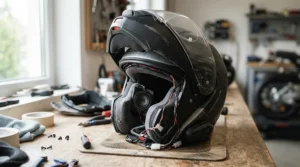
A clamp mount intercom for modular helmets grips the shell edge with a bracket and screws. An adhesive mount sticks a plate to the shell. The Cardo Packtalk Edge adds a magnetic Air Mount on top of either.
The clamp’s advantage is reversibility. It doesn’t permanently mark the helmet, and you can shift it between lids with a second-helmet kit. Its downside is bulk and the need for a clean fit around the chin bar mechanism.
Adhesive plates are sleeker and sit flatter, but they’re permanent-ish, so check your helmet maker’s guidance before sticking anything to the shell. Some brands restrict what you can attach.
One example shows how kit choices vary. According to Bennetts’ Sena 60S review, the 60S only offers a clamp kit with a boom microphone, with no adhesive mount, at around £130 as an add-on. That suits a modular fitment well, but it limits flexibility.
Our recommendation: start with a clamp, test through full chin bar travel, and only switch to adhesive if the clamp cannot sit properly.
Bluetooth Headset for Flip Up Helmets vs Integrated Helmet Systems
A bluetooth headset for flip up helmets is a universal, clamp-on unit you can move between lids. An integrated system is built into one helmet model, with speakers, mic and antenna fitted into custom apertures.
MCN’s tester said Sena’s Sena SRL2 for the Shoei Neotec 2 installs neatly inside the helmet and doesn’t disturb comfort or add turbulence. The catch is commitment: the battery is built in, so you have to charge the whole helmet, and it only works with that helmet family.
| Option | Chin bar clearance | Helmet swaps | Best For |
|---|---|---|---|
| Universal clamp-on, e.g. Cardo Packtalk Edge | Needs a careful dry-fit | Easy with a second-helmet kit | Riders with multiple helmets |
| Integrated, e.g. Sena SRL2 | Designed into the shell | Not possible | One-helmet loyalists |
| Earbuds under the helmet | No mounting issues | Instant | Occasional calls only |
Integrated systems win on tidiness, but universal units win on flexibility. If you own one modular helmet you plan to keep, integration is tempting. For everyone else, a clamp-on is the safer bet.
Long-Term Cost and Maintenance
A single price tag hides the real cost. Spread a mid-£300s purchase over a typical three-year warranty period, such as the Cardo Packtalk Edge‘s, and you’re looking at roughly £100–£120 a year. A £150 Sena 5S works out cheaper per year, but only if its features match how you ride.
Here’s how the tiers compare.
| Tier | Examples | Typical single price | Best For |
|---|---|---|---|
| Budget | Sena 5S | £110–£150 | Pillion and commuting |
| Mid-range | Sena 20S Evo, Midland BTX2 Pro S-LR, Cardo Freecom 4X | £165–£250 | Small groups |
| Premium | Cardo Packtalk Neo, Cardo Packtalk Edge, Sena 60S | £220–£360 | Group touring |
Value-wise, the mid-range tier hits the sweet spot: you give up mesh but keep the boom mic and decent audio. The premium tier only justifies itself if you ride in sizeable groups.
Maintenance is cheap. Replacement boom microphones are under £20 at UK retailers, and foam sponges and speaker pads cost little. Re-stick Velcro when it weakens, update firmware every few months, and charge at home before long rides.
Safety, Legal and Helmet Guidance for UK Riders
Using a hands-free intercom is legal in the UK, but the Highway Code sets the rules for hand-held devices. Rule 149 stresses that you must keep proper control of your vehicle, and it warns that even hands-free equipment can distract you. In practice, that means setting up voice commands and presets before you set off rather than fiddling at speed.
Keep your volume low enough to hear traffic and sirens. Earplugs help with wind noise, but check you can still hear your surroundings.
On the helmet side, many modular lids carry ECE 22.06 homologation, and some are certified for both open and closed use; that’s the case for the Shoei Neotec 3 according to Helmet City. Whatever you fit, check your helmet manual before attaching anything permanent. Don’t let any bracket stop the chin bar latching.
Finally, check the unit carries the relevant UK or EU conformity mark. For example, one retailer lists UKCA among the Cardo Packtalk Neo‘s certifications.

FAQ
❓ Can I use a bluetooth headset for flip up helmets with the chin bar open?
❓ Will a clamp mount damage my helmet?
❓ Do I need a second-helmet kit for two lids?
❓ Is an intercom legal on a UK motorbike?
❓ Can Cardo and Sena intercoms talk to each other?
Conclusion
The best intercom for modular flip front helmets is the one that clears your chin bar first and impresses your ears second. Among the seven, the Cardo Packtalk Neo is the best all-round mesh buy, the Cardo Packtalk Edge is the premium choice for mixed-brand touring, and the Sena 60S suits big, spread-out groups.
If you only ride with a pillion, the Cardo Freecom 4X, Sena 20S Evo and Midland BTX2 Pro S-LR offer proven boom-mic setups for far less, while the Sena 5S keeps the entry price low. Whichever you choose, dry-fit the clamp, route the boom microphone with slack, and test the chin bar through its full travel before you ride.
Keep in mind that prices move and models get refreshed, so check current price and the exact version before you buy. Wind noise at motorway speeds is the one complaint that hit even the premium units, so plan on earplugs and a quiet helmet.
Recommended for You
- Motorcycle Helmet Intercom For Two Up Riding: 7 Best Picks (2026)
- Helmet Bluetooth Headset For Glasses Wearers: 7 Proven Picks (2026)
- Waterproof Motorcycle Intercom For Wet UK Weather: 7 Best (2026)
Disclaimer: This article contains affiliate links. As an Amazon Associate, I earn from qualifying purchases. If you purchase products through these links, we may earn a small commission at no additional cost to you.
✨ Found this helpful? Share it with your friends! 💬🤗
