In This Article
Picture this: you’ve just invested in track day sessions, sorted your riding kit, and arrived at the circuit gates brimming with anticipation—only to be turned away because your helmet lacks that distinctive gold sticker. Frustrating, isn’t it? ACU Gold racing helmets aren’t just another marketing gimmick; they’re your passport to UK motorsport venues and represent a genuinely higher safety threshold for competitive riding.
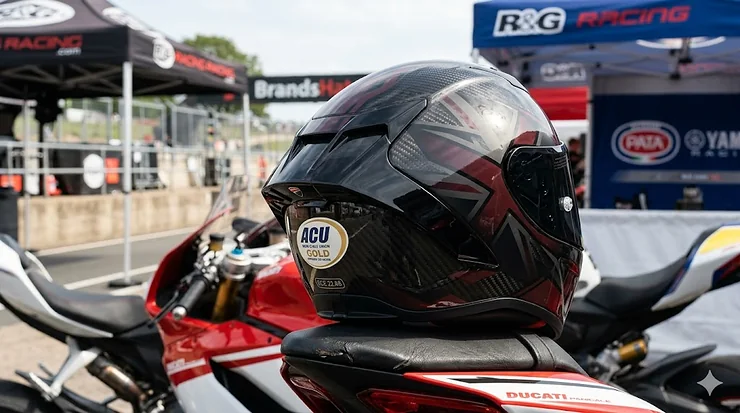
The Auto-Cycle Union, established back in 1903, governs motorcycle sport across Great Britain and sets some of the most rigorous helmet testing protocols available. Unlike standard ECE 22.06 certification that keeps you legal on public roads, the ACU Gold standard evaluates helmets under race conditions—think higher velocities, smoother tarmac surfaces, and different impact dynamics than your typical roundabout collision. According to the official ACU documentation, only helmets bearing that distinctive gold sticker are permitted for road racing, sprints, drag racing, and hill climbs on bound metalled surfaces.
What distinguishes these lids from everyday street helmets? They’ve undergone independent testing demonstrating they can withstand the extreme forces experienced during high-speed racing scenarios. Whether you’re a seasoned racer gunning for podium finishes or a track day enthusiast looking to extract maximum enjoyment from your machine, understanding ACU Gold certification helps you make informed decisions about head protection that could literally save your life.
Quick Comparison Table: Top ACU Gold Racing Helmets
| Helmet Model | Weight | Price Range (£) | Key Feature | Best For |
|---|---|---|---|---|
| MIDA MV-151 | 1,350g | £79-£99 | Dual visors included | Budget-conscious riders |
| LS2 Thunder Carbon | 1,280g | £349-£399 | Carbon aramid composite | Performance seekers |
| HJC RPHA 11 | 1,300g | £349-£519 | P.I.M. Plus shell | All-rounder racers |
| AGV K6 | 1,255g | £289-£349 | Ultra-lightweight | Weight-conscious riders |
| Airoh GP 550 S | 1,290g | £299-£379 | Aviator MX heritage | Versatile track use |
| MT Thunder 3 | 1,420g | £99-£149 | Internal sun visor | Track day beginners |
| Shark Race-R Pro | 1,305g | £399-£549 | Pro racer pedigree | Championship racing |
💬 Just one click – help others make better buying decisions too!😊
Top 7 ACU Gold Racing Helmets: Expert Analysis
1. MIDA MV-151 Full Face ACU Gold Helmet
Starting our roundup is the MIDA MV-151, a proper bargain that doesn’t compromise on certification. Available on Amazon UK for £79-£99, this helmet delivers ACU Gold approval alongside ECE 2206 road certification. The MIDA MV-151 features a lightweight polycarbonate shell weighing approximately 1,350g, making it comfortable for extended track sessions without causing neck fatigue.
The helmet comes standard with both clear and dark 3D moulded anti-scratch visors—a thoughtful touch that eliminates the immediate need for aftermarket purchases. Its advanced ventilation system pulls cool air through front intakes whilst exhausting warm air via rear vents, with closable options for colder British weather. UK buyers particularly appreciate the quick-release ratchet strap system that makes donning and doffing genuinely effortless, even with gloved hands.
Customer feedback from British riders reveals mixed experiences. One reviewer praised its crash-tested credentials after a track incident: “Got sent flying by a car, hit my head on concrete and against a solid bollard, and the helmet didn’t crack fully—certified helmet crash tested.” However, some users report gaps between the visor top and helmet shell where water ingress compromises the Pinlock anti-fog system during wet conditions.
✅ Pros:
- ACU Gold and ECE 2206 dual certification
- Exceptional value under £100
- Dual visors included as standard
❌ Cons:
- Visor seal issues in wet weather
- Build quality inconsistencies
Best for: Novice track riders seeking affordable ACU Gold certification.

2. LS2 Thunder Carbon Racing Helmet
The LS2 Thunder Carbon represents the sweet spot between performance and affordability in the ACU Gold market. Priced between £349-£399 at UK retailers, this LS2 Thunder Carbon punches well above its weight class with build quality rivalling helmets costing hundreds more. According to Motorcycle News testing, it compares favourably with the £699 Shoei X-SPR Pro and £649 HJC RPHA 1.
Weighing just 1,280g in medium size, the carbon aramid composite shell provides exceptional strength-to-weight ratios. The helmet achieved a SHARP 3-star rating whilst meeting ECE 22.06 regulations with full ACU Gold approval for UK track use. LS2 includes a Pinlock insert, breath guard, chin curtain, and storage bag as standard—kit that premium manufacturers often charge extra for.
The visor deserves special mention. It’s one of the largest on any sporting helmet, providing excellent frontal and peripheral vision crucial for track riding when you’re threading from apex to apex. A central HJC-style locking button operates smoothly even mid-corner with gloved hands. British riders report the helmet excels on circuit, though wind noise at motorway speeds proves louder than ultra-premium alternatives. As one UK reviewer noted: “Great bashhat, comfortable, but noisier than others—however it protected my head when I came off at the track!”
✅ Pros:
- Outstanding value for carbon construction
- Comprehensive accessory package included
- Excellent visor visibility for track work
❌ Cons:
- Higher wind noise levels
- Occasional pressure points on specific head shapes
Best for: Intermediate riders wanting carbon performance without premium pricing.
3. HJC RPHA 11 Championship Helmet
HJC’s flagship RPHA 11 delivers race-specification technology at prices between £349-£519 depending on graphics choice. The RPHA 11 wears its racing pedigree proudly—it’s worn by professional MotoGP riders and carries full ACU Gold certification alongside ECE 22.05 approval. According to Bennetts BikeSocial, this lid meets both recreational and competitive track requirements.
The P.I.M. Plus composite shell combines carbon fibre with aramid reinforcement across three shell sizes, ensuring proper fitment across the sizing spectrum. At just 1,300g, it’s remarkably light for a composite construction. The helmet achieved a SHARP 3-star rating, which whilst not the absolute highest, reflects its focus on track-specific protection rather than general road crash scenarios where impacts occur at different angles and velocities.
Advanced features include an adjustable chin vent, multi-stage top ventilation, and rear extractors working in harmony to regulate temperature during spirited riding. The RapidFire II shield replacement system allows tool-free visor changes trackside—invaluable when British weather turns unexpectedly. UK customers consistently praise the comfort liner that remains plush even during extended sessions, with moisture-wicking properties keeping you fresh lap after lap.
✅ Pros:
- Professional-grade construction
- Three shell sizes for precise fitting
- Tool-free visor change system
❌ Cons:
- Premium pricing on graphic versions
- Limited colour choices compared to budget options
Best for: Serious racers wanting proven championship-level protection.
4. AGV K6 Ultralight Track Helmet
The AGV K6 stands amongst the lightest full-face road helmets globally, tipping the scales at merely 1,255g in medium size. Available from UK stockists between £289-£349, this AGV K6 demonstrates that Italian design flair and motorsport engineering needn’t drain your wallet entirely. The helmet carries full ACU Gold approval, making it suitable for both spirited road riding and UK circuit use.
AGV developed the K6 using knowledge gleaned from their Pista GP R championship helmet worn by MotoGP legends. The result is a helmet that balances aggressive track-focused aerodynamics with all-day wearability for Sunday blast enthusiasts. According to testing by Billy’s Crash Helmets, a respected UK helmet authority, the K6 represents AGV’s top-flight sports touring offering with race-derived technology.
The helmet features a five-density EPS liner optimised for varying impact velocities, whilst the Integrated Ventilation System channels fresh air efficiently without generating excessive noise. British riders appreciate the inclusion of a Pinlock Max Vision insert as standard—essential for our characteristically damp climate. The quick-release visor mechanism proves intuitive even during spirited riding, and the integrated speaker pockets accommodate most Bluetooth communication systems without uncomfortable pressure points.
✅ Pros:
- Exceptionally lightweight construction
- MotoGP-derived aerodynamics
- Pinlock Max Vision included
❌ Cons:
- Narrower internal dimensions suit oval head shapes
- Graphics options limited in UK market
Best for: Riders prioritising minimal weight and Italian styling.
5. Airoh GP 550 S Track Specialist
Airoh GP 550 S brings Italian passion and engineering prowess to the ACU Gold market segment, priced between £299-£379 at UK retailers. This Airoh GP 550 S leverages Airoh’s legendary Aviator MX heritage—those impossibly light motocross lids worn by world champions like Antonio Cairoli and Jeffrey Herlings. According to Moto Central, one of Britain’s leading motorcycle gear specialists, Airoh helmets combine advanced materials with accessible pricing.
The shell construction utilises Airoh’s proprietary HRT (High Resistant Thermoplastic) composite, balancing impact resistance with competitive weight at approximately 1,290g. The helmet achieves ACU Gold certification alongside ECE 22.06 approval for road legality. Airoh’s engineers clearly prioritised ventilation—the GP 550 S features aggressive chin intakes, forehead vents, and rear extractors that generate impressive airflow even at lower velocities around technical sections.
British customers consistently highlight the helmet’s comfortable fit straight from the box, with hypoallergenic interior padding that’s fully removable and machine washable. The wide eye port provides excellent peripheral vision crucial for track riding when you’re checking your mirrors for faster traffic or scanning for corner workers’ flags. One UK reviewer noted: “Never had Airoh before—well made, comfortable, looks the part, definitely recommend them.”
✅ Pros:
- Excellent ventilation system
- Competitive pricing for composite construction
- Wide field of vision
❌ Cons:
- Graphics styling polarises opinions
- Slightly heavier than premium carbon options
Best for: Track day regulars seeking Italian engineering at sensible prices.
6. MT Thunder 3 Entry-Level Racer
The MT Thunder 3 delivers ACU Gold certification at genuinely accessible pricing between £99-£149, making track riding financially viable for budget-conscious enthusiasts. This MT Thunder 3 represents exceptional value from Spanish manufacturer MT Helmets, a brand that’s steadily built reputation since 1968 for offering premium features at democratic price points. According to Maximo Moto, MT’s UK distributor, the Thunder 3 combines modern safety standards with rider-focused practicality.
The High Impact Resistant Polymer (HIRP) shell construction keeps weight manageable at approximately 1,420g whilst achieving both ACU Gold and ECE 22.06 certifications. MT includes an internal drop-down sun visor—a feature typically reserved for more expensive helmets—that deploys smoothly via a slider mechanism. British riders appreciate this inclusion during those characteristically changeable UK summer track days when sunlight and clouds alternate lap by lap.
The comfort liner uses moisture-wicking fabric that’s fully removable and washable, essential for maintaining hygiene during regular track use. Ventilation proves adequate rather than exceptional, with chin and crown vents providing reasonable airflow. UK customer feedback highlights impressive bang-for-buck: “Quality nice looking helmet for this price along with another visor.” The micrometric strap closure operates smoothly and securely, though some riders prefer traditional double-D rings for ultimate reliability.
✅ Pros:
- ACU Gold certification under £150
- Internal sun visor included
- Removable washable liner
❌ Cons:
- Heavier than carbon alternatives
- Ventilation adequate rather than exceptional
Best for: First-time track riders needing affordable ACU Gold compliance.
7. Shark Race-R Pro Championship
Crowning our selection is the Shark Race-R Pro, a helmet originally developed for professional racers including Stefan Bradl and Scott Redding. Priced between £399-£549 at UK stockists, this Shark Race-R Pro represents the pinnacle of Shark’s racing helmet development with full ACU Gold approval for UK competition use. According to Billy’s Crash Helmets, the Race-R Pro stands amongst the finest track-focused lids available to British riders.
The carbon aramid glass shell construction achieves remarkable strength whilst maintaining competitive weight at approximately 1,305g. Shark’s engineers obsessed over aerodynamic efficiency, developing the shell shape in wind tunnels to minimise drag and enhance stability at championship-level velocities. The helmet features Shark’s proprietary Auto-Seal visor system that automatically adjusts sealing pressure based on riding speed—clever engineering that reduces wind noise and water ingress.
Advanced ventilation comprises multiple adjustable intake and exhaust vents working harmoniously to regulate temperature during intense riding. The Emergency Release System allows medical personnel to remove cheek pads quickly following accidents—a feature increasingly mandated at professional racing events. British customers praise the helmet’s race-ready feel straight from the box, with minimal break-in period required. The included Pinlock Max Vision insert and breath deflector demonstrate Shark’s attention to real-world usability on UK circuits.
✅ Pros:
- Professional championship-level protection
- Advanced aerodynamic development
- Auto-Seal visor technology
❌ Cons:
- Premium pricing reflects race pedigree
- Aggressive fit suits experienced riders
Best for: Championship racers demanding absolute performance.
✨ Don’t Miss These Exclusive Deals!
🔍 Take your track riding to the next level with these carefully selected ACU Gold racing helmets. Click on any highlighted product to check current pricing and availability on Amazon.co.uk. These professionally certified helmets will help you achieve authentic performance and safety your racing demands!
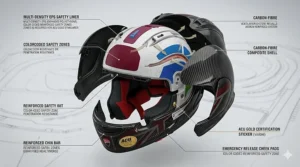
Understanding ACU Gold Certification Standards
The ACU Gold sticker represents more than simple bureaucratic compliance—it’s your assurance that a helmet has survived genuinely rigorous independent testing specifically designed for motorsport conditions. But what exactly does this certification entail, and why does it matter beyond keeping track day marshals satisfied?
The Testing Protocol Explained
According to the Auto-Cycle Union’s official documentation, ACU Gold approval requires helmets to meet minimum standards for road racing, sprints, drag racing, hill climbs, and any speed events held wholly or partially on bound metalled surfaces. The testing evaluates impact resistance, penetration resistance, retention system strength, and visor integrity under conditions simulating high-velocity crashes onto smooth tarmac.
This differs fundamentally from ECE 22.06 testing, which assesses helmet performance across broader accident scenarios typical of public roads—think glancing blows against kerbs, impacts with vehicle panels, and slides across varied road surfaces. The ACU methodology focuses specifically on high-speed impacts onto relatively smooth track surfaces where riders typically crash at greater velocities than street accidents.
Historical Context and Evolution
The ACU, established in 1903, predates most motorsport governing bodies and helped found the Fédération Internationale de Motocyclisme (FIM) in 1904. According to Wikipedia, the organisation has evolved from its early days as a branch of the Royal Automobile Club to become the definitive authority on British motorcycle sport safety standards.
Originally, two ACU standards existed: Silver for off-road disciplines and Gold for tarmac-based competition. The Silver designation has since been discontinued, leaving ACU Gold as the recognised track standard. Manufacturers and importers seeking approval must submit helmets for independent testing alongside type approval documentation, with successful models earning the right to display that distinctive gold sticker.
Why It Matters for Serious Riders
Beyond mandatory track day compliance, ACU Gold certification offers genuine peace of mind. These helmets have demonstrated they can withstand the specific impact dynamics you’ll experience if things go pear-shaped during spirited riding. The testing philosophy aligns with your actual risk profile when circulating at competitive velocities.
However, it’s worth noting that ACU Gold doesn’t automatically mean “superior to everything else.” As highlighted by automotive safety experts, different standards address different use cases. An ACU Gold lid optimised for track crashes might not necessarily outperform a premium road helmet in typical street accident scenarios involving lower speeds and more varied impact angles.
How to Choose the Right ACU Gold Racing Helmet
Selecting your ideal racing lid involves balancing multiple factors beyond simply grabbing whatever bears that gold sticker. Here’s a systematic approach to finding head protection that genuinely suits your requirements, budget, and skull shape.
Determining Your Head Shape
British riders often underestimate head shape’s critical importance. Helmets generally fall into three internal profiles: round oval, intermediate oval, and long oval. Measure your head’s width and length using a soft tape measure, then calculate the ratio. Round oval heads measure roughly equal front-to-back and side-to-side, whilst long oval heads run noticeably longer front-to-back than side-to-side.
Most manufacturers design helmets around intermediate oval shapes, but brands like Arai traditionally favour rounder profiles whilst Shoei often suits longer heads. According to J&S Accessories’ comprehensive guide, proper fitment trumps every other consideration—even the finest helmet proves useless if it doesn’t sit correctly on your particular noggin.
Budget Considerations and Value Analysis
ACU Gold helmets span from under £100 to well over £500, but expensive doesn’t automatically equal better for your specific needs. Entry-level options like the MIDA MV-151 and MT Thunder 3 deliver legitimate ACU certification at accessible prices, making track riding financially viable for enthusiasts without limitless budgets.
Mid-range helmets between £250-£400 often represent the sweet spot, offering composite shell construction, advanced ventilation, and quality liners without the premium charged for championship-level exotica. The LS2 Thunder Carbon and HJC RPHA 11 exemplify this segment, delivering performance that satisfies all but the most demanding professional racers.
Premium options above £400 justify their pricing through ultra-lightweight carbon construction, wind tunnel-developed aerodynamics, and cutting-edge features like the Shark Race-R Pro’s Auto-Seal system. Consider whether these advantages genuinely benefit your riding or whether you’re paying for bragging rights rather than functional improvements.
Shell Material Science
Modern racing helmets employ various shell materials, each offering distinct advantages. Polycarbonate thermoplastic construction delivers excellent impact resistance at competitive pricing and weight, though it requires careful handling around solvents and petroleum products that can degrade the material. The MIDA MV-151 and MT Thunder 3 exemplify quality polycarbonate designs.
Composite shells combining fibreglass, carbon fibre, Kevlar, and aramid fibres provide superior strength-to-weight ratios and enhanced energy absorption. These materials flex and deform progressively during impacts, dissipating forces more effectively than purely rigid structures. The LS2 Thunder Carbon and Shark Race-R Pro showcase advanced composite engineering at varying price points.
Pure carbon fibre construction achieves the ultimate weight reduction, with helmets like premium AGV models tipping scales under 1,300g. However, carbon’s benefits prove most noticeable during extended sessions where reduced mass minimises neck fatigue—less critical for occasional track day participants.
Ventilation Requirements
British weather demands versatile ventilation that adapts to our characteristically changeable conditions. Look for helmets offering multiple adjustable intake vents at the chin, forehead, and crown positions, working alongside rear exhaust vents to generate through-flow even at modest velocities around technical sections.
The best systems allow you to fine-tune airflow based on conditions—fully open during scorching summer track days, partially closed during spring sessions, and sealed entirely when autumn brings colder temperatures. The LS2 Thunder Carbon and Airoh GP 550 S particularly excel in this regard, offering comprehensive adjustment options.
Safety Rating Considerations
Whilst ACU Gold certification confirms track suitability, additional safety ratings provide valuable context. The UK’s SHARP (Safety Helmet Assessment and Rating Programme) tests helmets independently, awarding 1-5 stars based on extensive impact testing. According to government SHARP data, higher star ratings correlate with better protection across varied accident scenarios.
However, SHARP ratings shouldn’t be your sole criterion. A 3-star helmet optimised specifically for track conditions might serve you better than a 5-star lid designed primarily for general road use. Consider your actual riding profile when interpreting safety data.
ACU Gold vs ECE 22.06: Key Differences
Understanding how ACU Gold certification relates to ECE 22.06 road approval helps you make informed decisions about helmet purchases and usage scenarios. These standards serve different purposes, and grasping their distinctions proves valuable for British riders navigating both track and street environments.
| Aspect | ACU Gold | ECE 22.06 |
|---|---|---|
| Primary Purpose | Track/competition use | Road legal compliance |
| Testing Focus | High-speed smooth surface impacts | Varied road accident scenarios |
| Legal Requirement | Mandatory for UK racing | Required for UK road use |
| Impact Velocities | Higher test speeds | Moderate street speeds |
| Surface Types | Bound metalled surfaces | Mixed road surfaces |
| Mandatory Features | Race-specific protection | Broad safety criteria |
Legal Requirements for Road and Track
ECE 22.06 (or the older 22.05 standard) remains legally mandatory for helmets used on public UK roads. According to official government guidance, you face fines up to £500 for riding without properly certified head protection. The ECE standard ensures helmets provide adequate protection across typical street accident scenarios involving varied impact angles, speeds, and surfaces.
ACU Gold approval isn’t required for road legality but becomes mandatory when you roll onto UK circuit tarmac for track days or competitive events. Track day organisers typically check for the distinctive gold sticker during technical inspection, and lacking proper certification means sitting out the day regardless of your helmet’s road credentials.
Dual Certification Benefits
Most modern ACU Gold helmets carry both certifications, offering versatility for riders who enjoy spirited road riding alongside occasional track outings. This dual approval means you can legally commute to the circuit wearing your racing lid, eliminating the need to transport multiple helmets or change in the paddock.
However, some ultra-focused racing helmets prioritise track performance over road versatility, occasionally lacking ECE certification. Always verify both standards if you intend using your helmet across both environments.
Testing Methodology Differences
ECE 22.06 testing evaluates helmets against impacts at various points around the shell, assessing performance when striking flat anvils, kerbstone-shaped surfaces, and hemispherical objects. This variety reflects the unpredictable nature of street accidents where you might contact vehicle panels, road furniture, or other obstacles.
ACU Gold testing specifically addresses high-velocity impacts onto smooth surfaces characteristic of circuit crashes. According to industry analysis, this focused approach ensures helmets perform optimally under race-specific conditions rather than attempting to cover every conceivable accident scenario.

Maintenance and Care for Racing Helmets
Proper maintenance extends your helmet’s protective lifespan whilst ensuring it performs optimally when you need it most. Racing helmets face harsher conditions than street lids—higher speeds, more aggressive impacts during crashes, and regular exposure to track debris demands conscientious care.
Cleaning and Storage Protocols
Clean your helmet’s exterior after every track session using mild soap and warm water with a soft microfibre cloth. Avoid petroleum-based cleaners, solvents, or aggressive chemicals that can degrade polycarbonate shells or compromise adhesive bonds in composite constructions. The ACU explicitly warns that substances like petrol, paint thinners, and certain cleaning agents seriously damage thermoplastic materials.
Interior liners require regular washing, particularly after sweaty track sessions. Most modern helmets feature fully removable comfort liners—hand wash these in lukewarm water with gentle detergent, then air dry completely before reinstallation. Never machine wash or tumble dry helmet liners, as aggressive action can distort foam shapes and damage moisture-wicking fabrics.
Store helmets in cool, dry locations away from direct sunlight. UV radiation gradually degrades both polycarbonate and composite materials, weakening protective properties over time. Use the provided helmet bag or invest in a dedicated helmet box that shields against dust whilst allowing air circulation.
Visor Care and Replacement
Scratched visors compromise vision and increase dangerous glare, particularly problematic when braking hard into corners whilst the sun sits low on the horizon. Clean visors using dedicated helmet visor cleaner or mild soapy water, never window cleaning products containing ammonia that can craze polycarbonate.
Replace visors showing significant scratching, crazing, or damage. Most ACU Gold helmets use quick-release visor mechanisms allowing tool-free changes—familiarise yourself with your specific helmet’s system so you can swap visors trackside when conditions change unexpectedly.
Pinlock anti-fog inserts require periodic replacement as the hydrophilic coating degrades with age and repeated cleaning. Budget approximately £25-£35 for quality Pinlock replacements available through UK retailers.
When to Replace Your Helmet
Replace helmets immediately following any significant impact, even if external damage isn’t visible. The energy-absorbing foam liner compresses during crashes, permanently reducing its protective capacity. According to ACU guidelines, helmets involved in accidents should be retired regardless of apparent condition—internal structural damage often remains invisible externally.
Even without crashes, replace helmets every five years maximum. Adhesive bonds weaken, foam liners compress through normal use, and materials degrade chemically over time. Some manufacturers recommend shorter replacement intervals for race-spec helmets experiencing regular high-speed use.
ACU Sticker Validity
Never remove or tamper with ACU approval stickers, as doing so invalidates certification. The ACU explicitly states that modification to helmet structure—cutting, drilling, or puncturing the shell—immediately invalidates approval and results in sticker removal during technical inspection.
Custom painting remains permitted for composite helmets (fibreglass, Kevlar, carbon), provided you don’t remove bonded components like visor surrounds or energy-absorbing liners. Mask carefully around sprung components and bonded items. Professional custom painters familiar with helmet painting should handle such work to avoid compromising structural integrity.
Top UK Retailers for ACU Gold Racing Helmets
Sourcing your helmet from reputable UK retailers ensures genuine products, proper warranties, and often invaluable fitting expertise. Here’s where savvy British riders shop for ACU Gold certified protection.
Specialist Motorcycle Retailers
SportsBikeShop ranks amongst Britain’s largest online motorcycle gear specialists, offering comprehensive ACU Gold helmet selections from brands like LS2, Airoh, and HJC. Their website provides detailed sizing guides, and customer service staff offer telephone advice for uncertain buyers. Free UK delivery on orders exceeding £25 makes them particularly attractive for riders outside major cities.
Moto Central operates both online and physical showrooms, allowing riders to try helmets before purchasing—invaluable given head shape variations. Their staff receive extensive product training, providing knowledgeable guidance beyond simple sales pitches. The 365-day return policy demonstrates confidence in customer satisfaction.
Infinity Motorcycles serves as official UK stockist for multiple premium brands including Simpson and Nolan, offering manufacturer warranties alongside competitive pricing. Their price promise pledge—matching competitor pricing—ensures you’re getting fair deals without extensive comparison shopping.
Online Marketplaces
Amazon UK increasingly stocks ACU Gold helmets, particularly budget-friendly options like the MIDA MV-151. Prime members enjoy rapid delivery, though fitting advice proves limited compared to specialist retailers. Always verify seller authenticity and check return policies carefully when purchasing safety equipment through marketplace platforms.
eBay UK offers both new and used helmets, occasionally providing genuine bargains from sellers clearing previous season’s stock. However, exercise extreme caution with secondhand helmets—you cannot verify their crash history, and internal damage remains invisible. The modest savings rarely justify the risk when protecting your brain.
Physical Showrooms Worth Visiting
Visiting brick-and-mortar retailers allows trying multiple sizes and brands, essential for determining your optimal fit. Staff can assess how helmets sit on your particular head shape, identifying pressure points or gaps that online descriptions cannot convey. Major cities including London, Birmingham, Manchester, and Glasgow feature dedicated motorcycle gear showrooms stocking comprehensive ACU Gold selections.
✨ Ready to Hit the Track?
🏁 These ACU Gold racing helmets represent the finest protection available for UK circuit riding. Whether you’re chasing lap records or simply enjoying spirited track sessions, proper head protection proves non-negotiable. Click any highlighted helmet to explore current availability and secure your track-approved protection today!
Frequently Asked Questions About ACU Gold Racing Helmets
❓ Is ACU Gold certification mandatory for all UK track days?
❓ Can I use my ACU Gold racing helmet for daily road riding?
❓ How long does ACU Gold certification remain valid?
❓ What's the price difference between ACU Gold and standard road helmets?
❓ Do I need different helmets for different types of track riding?
Conclusion: Choosing Your Perfect Track Companion
Selecting the right ACU Gold racing helmet ultimately balances certification requirements, budget constraints, and personal fit preferences. Whether you’re investing in the budget-friendly MIDA MV-151 for occasional track days or splashing out on the championship-proven Shark Race-R Pro for serious racing, proper head protection remains non-negotiable when circulating at competitive velocities.
The helmets featured in this guide represent genuinely worthy options across the pricing spectrum, each delivering legitimate ACU Gold certification backed by rigorous independent testing. Remember that expensive doesn’t automatically equal better for your specific requirements—the £99 MT Thunder 3 protects your brain just as effectively as premium carbon alternatives, albeit with some compromises in weight and features.
Prioritise proper fitment above all else. A perfectly fitting mid-range helmet outperforms an ill-fitting premium lid every time, as gaps and pressure points compromise both comfort and protection. Visit physical retailers when possible to try multiple sizes and brands, ensuring your chosen helmet sits snugly without uncomfortable pressure.
British riders enjoy access to comprehensive ACU Gold helmet selections from reputable retailers offering expert advice, genuine warranties, and hassle-free returns. Whether you shop online through specialists like SportsBikeShop and Moto Central or visit physical showrooms for personalised fitting, take time to make informed decisions about equipment that could literally save your life.
Track riding delivers unparalleled excitement and skill development, but it demands appropriate protection. Invest in proper ACU Gold certified head protection, maintain it conscientiously, and replace it when necessary. Your future self will thank you for prioritising safety alongside speed—because the best laps are the ones you walk away from with all your marbles intact.
Recommended for You
- 7 Best ACU Gold Helmets for Track Days UK 2026
- 7 Best SHARP 5 Star Helmet with Sun Visor UK 2026
- 7 Best SHARP Tested Modular Helmets UK 2026
Disclaimer: This article contains affiliate links. If you purchase products through these links, we may earn a small commission at no additional cost to you. Prices shown are approximate and may vary.
✨ Found this helpful? Share it with your mates! 💬🤗
