
In This Article
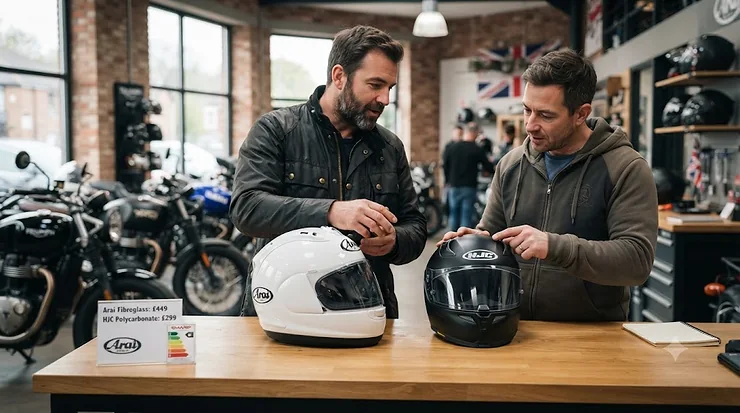
Stand two helmets side by side on a shop shelf and, honestly, you probably couldn’t tell which one costs £150 and which costs £450. That’s the trap. A fibreglass helmet vs polycarbonate helmet decision isn’t about which one looks tougher — it’s about what’s happening inside that shell the split second it hits tarmac, and how your neck feels after three hours on the motorway. Riders searching for this comparison usually land here after a salesperson mumbled something about “composite construction” and left them none the wiser.
So here’s the 50-word version: a polycarbonate shell is thermoplastic, moulded in one piece, generally heavier but excellent value; a fibreglass shell is a hand-laid composite of woven glass fibres and resin, typically lighter, stiffer, and pricier because of the labour involved. Neither is automatically “safer” — that comes down to individual construction quality and independent testing, not shell material alone.
This guide pulls together real specifications, genuine SHARP safety data from the UK Department for Transport, and honestly reported review sentiment from riders who’ve actually put miles on these lids. We’ve picked seven real helmets available through amazon.co.uk — spanning budget polycarbonate commuters to hand-built fibreglass sports-tourers — so you can weigh up shell construction, weight, and safety ratings without wading through marketing fluff. Prices quoted are ranges only, since retail prices shift constantly; always check current pricing before you buy.
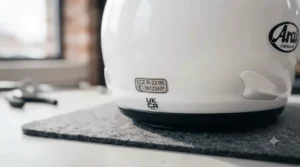
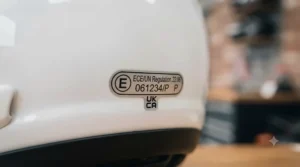
By the end, you’ll understand exactly why a £180 polycarbonate lid and a £450 fibreglass one can both carry the same ECE 22.06 approval sticker — and which one actually suits the way you ride.
Quick Comparison Table: Fibreglass vs Polycarbonate at a Glance
| Helmet | Shell Material | Approx. Weight | Best For |
|---|---|---|---|
| Nolan N60-6 | Polycarbonate | 1,470-1,525g | Budget commuting |
| HJC i71 | Polycarbonate | ~1,700g | Value sport-touring |
| Caberg Levo | Fibreglass composite | ~1,500-1,600g | Touring/modular |
| AGV K6-S | Carbon-aramid | ~1,220-1,300g | Lightweight performance |
| Shoei NXR2 | Fibreglass (AIM) | ~1,400g | Premium sports-touring |
| Arai Profile-V | Fibreglass | ~1,500-1,586g | All-day comfort |
A quick read of that table tells most of the story: polycarbonate wins on upfront cost and simplicity, while fibreglass tends to reward you with a lighter lid and a more tailored fit across multiple shell sizes. That said, weight and price aren’t the whole picture — SHARP’s own safety data repeatedly shows that shell material alone doesn’t predict crash performance, so don’t let this table make the decision for you on its own. We’ll dig into why later in the Fibreglass vs Polycarbonate: The Detailed Verdict section.
💬 Just one click — help others make better buying decisions too!😊
Top 7 Fibreglass and Polycarbonate Helmets: Expert Analysis
We’ve deliberately mixed budget, mid-range and premium options across both shell types, plus a couple of hybrid composites, so you can see the whole spectrum rather than just the two extremes.
1. Nolan N60-6 — best budget polycarbonate all-rounder
The Nolan N60-6 opens our list because it’s the helmet most new riders end up trying on first, and for good reason. Built from Nolan’s Lexan polycarbonate shell with a SABIC-reinforced compound, it weighs in around 1,470-1,525g depending on colourway, which is respectably light for the material. The shell comes in two sizes, so an XS lid isn’t lumbered with the same bulk as an XXL — a small but meaningful detail budget helmets often skip.
Based on the spec comparison, this is a helmet built for riders who want ECE 22.06 approval, a built-in sun visor, and Pinlock-ready optics without spending touring-helmet money. What most buyers overlook about this model is that its ventilation testing (roughly 0.5°C cooler than average in independent road tests) punches well above its price bracket. It’s aimed squarely at commuters and newer riders who want reassurance without the premium price tag.
Reviewers consistently report strong comfort and reasonable noise levels for the price, alongside praise for the sun visor mechanism. A recurring theme in owner feedback is that features and outright plushness lag behind pricier rivals — expected at this price point, but worth knowing going in.
Pros:
- ✅ Genuinely light for a budget polycarbonate shell
- ✅ Two shell sizes improve fit across the size range
- ✅ Pinlock-ready visor included in the box
Cons:
- ❌ Feature set thinner than pricier sport-touring lids
- ❌ Interior finish noticeably less plush than fibreglass rivals
The Nolan N60-6 typically sits in the £150-£200 range, and for a first “proper” helmet or a dedicated commuter lid, it’s hard to argue with the value on offer.
2. HJC i71 — best-value polycarbonate sport-tourer
Stepping up slightly, the HJC i71 is HJC’s mid-tier sport-touring polycarbonate helmet, and it’s one of the more talked-about lids in its class. The shell is a straightforward polycarbonate build available in three outer shell sizes — better than many rivals at this price — which helps keep bulk down across the size run. Weight lands around 1,700g in a size Large, on the heavier side, though testers note it never feels cumbersome in practice.
Here’s what to weigh up: the polycarbonate construction means the i71 misses out on the ultra-light feel of composite helmets, but it compensates with genuinely quiet performance in city riding and a double Pinlock-ready visor and sun-shield combo that rivals costing considerably more don’t always include. Based on the spec comparison, this makes it a sensible pick for daily commuters and new-to-intermediate riders covering mixed motorway and urban miles.
Aggregated owner and press sentiment (including UK press road tests) is consistently positive on comfort and finish, with several reviewers noting the i71 feels and looks more expensive than its price suggests. The most common criticism is wind noise at speed on faired sports-tourers, and a slightly bulky-feeling shell for smaller heads.
Pros:
- ✅ Three shell sizes — unusually generous at this price
- ✅ Built-in sun visor and Pinlock-ready face shield
- ✅ ECE 22.06 certified with Bluetooth-ready internals
Cons:
- ❌ Heavier than most composite alternatives
- ❌ Noticeable wind noise reported at higher speeds
Expect to pay in the £150-£260 range depending on colour and graphics, which places the HJC i71 firmly in “punches above its price” territory.
3. Bell Custom 500 — best retro fibreglass on a budget
The Bell Custom 500 proves fibreglass doesn’t have to mean premium pricing. This classic open-face design traces its lineage back to 1954, and Bell has kept the fibreglass composite shell as a deliberate nod to authenticity rather than cost-cutting. It’s offered across five shell sizes, which is genuinely impressive at this price bracket and means the fit is more tailored than most budget polycarbonate helmets can manage.
What most buyers overlook about this model is that the fibreglass shell isn’t just for looks — it can be professionally repainted, something a polycarbonate helmet simply can’t do without compromising the material. Bell’s official spec sheet doesn’t publish a precise UK weight figure, so rather than guess, it’s worth noting that comparable fibreglass open-face shells typically land around 1,000-1,100g — genuinely light, though we can’t verify Bell’s exact figure without hands-on scales.
Reviewers consistently praise the moisture-wicking IONIC+ padding and the snap-fit accessory system for bubble shields and visors, while noting — fairly, for an open-face design — that it offers none of the chin protection a full-face helmet provides.
Pros:
- ✅ Five shell sizes for a genuinely tailored fit
- ✅ Fibreglass shell can be professionally repainted
- ✅ Dual ECE and DOT certification for UK/EU compliance
Cons:
- ❌ Open-face design offers no chin-bar protection
- ❌ Exact weight isn’t independently published by Bell
Priced around £80-£190 depending on graphics, the Bell Custom 500 is proof that fibreglass construction isn’t automatically a premium-only feature.
4. Caberg Levo — best fibreglass flip-front for touring
The Caberg Levo is a tri-composite modular helmet built from layered fibreglass, Kevlar and carbon, and it’s a genuine mid-range sweet spot for touring riders who want flip-front convenience without the eye-watering price of a premium brand modular. The standard composite version weighs around 1.6kg, dropping to roughly 1.5kg on the carbon variant — both comfortably below the 1.68kg average for flip-front helmets.
Based on the spec comparison, what stands out here is dual P/J homologation, meaning it’s legally rated to ride with the chin bar open as well as closed — not every modular helmet can claim that. Reviewers consistently note the EPS liner’s multiple densities translate into genuinely all-day comfort, which matters enormously on a touring helmet you might wear for six or seven hours at a stretch.
Aggregated owner sentiment is strikingly positive for the price: riders repeatedly describe build quality and fit-and-finish as competitive with helmets costing two to three times as much, alongside praise for how quiet it is for a modular design. The recurring gripe is Caberg’s one-year warranty, which lags well behind the five-year cover many rivals offer.
Pros:
- ✅ Dual P/J homologation for open-chin-bar riding
- ✅ Lighter than the average flip-front helmet
- ✅ SHARP-rated at four stars in independent UK testing
Cons:
- ❌ Only a one-year manufacturer warranty
- ❌ SHARP testing noted occasional chin-bar unlocking
The Caberg Levo typically retails in the £320-£380 range for plain colours, rising toward the £380-£400 mark for graphic finishes — solid value for a fibreglass composite modular.
5. AGV K6-S — lightest full-face road helmet
The AGV K6-S takes a slightly different route to lightness: a carbon-aramid composite shell borrowing directly from AGV’s MotoGP development programme. At roughly 1,220-1,300g in a size Medium, it’s genuinely one of the lightest full-face road helmets on the market, and the four available shell sizes keep that low weight consistent across the range rather than only in one lucky size.
Here’s what the spec sheet won’t tell you outright: that reduced weight isn’t just about comfort — less rotational mass around your neck in a crash is precisely why lighter, well-engineered shells are increasingly favoured by manufacturers chasing better real-world outcomes, not just marketing numbers. AGV states the K6-S passes ECE 22.06 requirements with a notable safety margin, which is a claim worth taking seriously given AGV’s racing pedigree, though as with any manufacturer claim, independent SHARP testing is the more neutral benchmark to check before you buy.
Owner and retailer-reported sentiment consistently highlights the weight reduction as the standout feature, alongside praise for ventilation and the glasses-friendly cheek pad design. The main criticism circulating among reviewers is that carbon-aramid construction pushes the price above straightforward fibreglass equivalents, which won’t suit every budget.
Pros:
- ✅ Among the lightest full-face helmets on the market
- ✅ Four shell sizes for a genuinely compact fit
- ✅ Glasses-friendly, moisture-wicking interior
Cons:
- ❌ Priced above comparable straight-fibreglass helmets
- ❌ Independent SHARP data not yet published for this exact model
At the time of research, the AGV K6-S typically lists in the £350-£450 range at UK stockists, positioning it as a genuine premium pick that still undercuts several rival carbon-shell helmets.
6. Shoei NXR2 — lightest Shoei fibreglass sports-tourer
The Shoei NXR2 is Shoei’s most compact and lightest ECE 22.06-rated full-face helmet, built using their AIM composite — a blend of organic fibres and fibreglass — across four separate outer shell sizes. At around 1,400g, it’s noticeably lighter than most sports-touring rivals, and reviewers who’ve spent months in the saddle consistently point to reduced neck fatigue on longer rides as the standout benefit.
Based on the spec comparison, the dual-density EPS liner is doing real work here: multiple hardness layers absorb impact energy progressively rather than all at once, which is a meaningful engineering detail rather than marketing copy. What most buyers overlook is that Shoei achieved SHARP’s maximum five-star safety rating with this model, placing it among the best-tested helmets sold in the UK regardless of price.
Aggregated review sentiment from UK motorcycle press is overwhelmingly positive on build quality, aerodynamic stability and reduced wind noise compared with the outgoing NXR. The most consistent criticism is price — this sits at the top of what most riders will spend on a sports-touring lid — and a few testers note the cheek pads run slightly small, making intercom cable routing fiddly.
Pros:
- ✅ SHARP five-star safety rating — the maximum available
- ✅ Four outer shell sizes for a genuinely compact fit
- ✅ Noticeably lighter than most sports-touring rivals
Cons:
- ❌ Among the priciest helmets in this roundup
- ❌ Cheek pads reported as slightly small for intercom cabling
Pricing for the Shoei NXR2 typically runs from around £430 for plain colours up to the £540 mark for graphics — a genuine premium fibreglass composite helmet, and priced accordingly.
7. Arai Profile-V — hand-built fibreglass premium comfort
Closing our list is the Arai Profile-V, Arai’s entry point into hand-built fibreglass helmet ownership, using their PB-cLc laminated fibre construction. At roughly 1,500-1,586g depending on size, it’s around 50-200g heavier than some ultra-light rivals in this list, yet testers who’ve logged thousands of miles in it describe the extra weight as effectively unnoticeable in practice.
What the spec sheet won’t tell you, but reviewers note repeatedly, is that Arai’s round-shell “glancing off” philosophy — designing the shell to deflect impact energy rather than simply absorb it head-on — is a genuinely different engineering approach from most rivals, and it’s backed by decades of Arai’s own in-house crash research alongside independent SHARP testing of related Arai models, which have scored well historically. The wider base aperture on the Profile-V also makes it noticeably easier to get on and off than Arai’s rounder-fit siblings, addressing a common complaint about the brand.
Reviewers consistently praise the plush, hand-finished interior and describe the fit as genuinely all-day comfortable, while flagging a touch more wind roar around the base than some rivals, and noting the paint can chip slightly more easily than composite alternatives from other brands.
Pros:
- ✅ Hand-built fibreglass construction with decades of R&D behind it
- ✅ Wider base aperture — easier on/off than rounder Arai models
- ✅ Consistently praised interior comfort and finish
Cons:
- ❌ Slightly heavier than several fibreglass and carbon rivals
- ❌ Paint reported to chip more easily than some alternatives
The Arai Profile-V typically retails from around £380 for plain colours up to roughly £460 for graphics — a premium fibreglass helmet that trades a small weight penalty for genuinely exceptional comfort.
Helmet Shell Construction Explained
Every helmet on the market is built around the same basic idea — a hard outer shell paired with a crushable EPS (expanded polystyrene) liner — but how that outer shell is made varies enormously, and it’s worth understanding before you commit to either camp.
Polycarbonate shells are injection-moulded as a single piece of thermoplastic, which is fast, cheap and highly consistent from a manufacturing standpoint. That’s exactly why budget helmets like the Nolan N60-6 and HJC i71 lean on it: lower tooling costs translate directly into lower shelf prices. The trade-off is that polycarbonate is more vulnerable to degradation from petrol, certain cleaning solvents, and UV exposure over years of use, and it generally needs to be thicker (and therefore heavier) to achieve comparable impact resistance to a composite layup.
Fibreglass, by contrast, is a hand-laid composite — thin woven strands of glass fibre embedded in a resin matrix, often reinforced with materials like Kevlar or carbon in premium builds such as the Caberg Levo and Shoei NXR2. Fibreglass shells are engineered to absorb and distribute impact forces effectively, deforming slightly under a crash to spread the energy over a larger area rather than transmitting it directly. This construction method is inherently more labour-intensive, which is the main reason fibreglass and composite helmets like the Arai Profile-V cost more than polycarbonate equivalents.
Here’s the honest truth that SHARP itself is keen to stress: don’t judge a helmet purely by its shell material. A well-engineered polycarbonate helmet can outperform a poorly designed fibreglass one in real crash testing — the shell is only one variable in a much bigger safety equation that includes EPS density, retention system design, and overall build quality.
For deeper technical background on how glass-fibre composites are engineered, the Wikipedia entry on fibre-reinforced plastic is a solid, neutral starting point.
Helmet Safety Ratings: What SHARP Scores Really Mean
If you take one thing away from this guide, make it this: the UK’s independent SHARP scheme is the single most useful free resource for comparing helmet safety, and it exists specifically because shell material and price don’t reliably predict crash performance.
Launched by the Department for Transport in 2007, SHARP tests and rates helmets using a simple five-star system, with five stars indicating the highest level of protection. Every helmet SHARP rates has already passed the minimum legal safety standards required for UK sale — SHARP doesn’t award a pass/fail score, it simply shows how far above that legal minimum a given helmet performs. That distinction matters enormously: a 2-star SHARP helmet is still legal and still offers protection, but a 5-star helmet — like the Shoei NXR2 in our list — has demonstrated meaningfully better performance across SHARP’s impact testing programme.
What’s genuinely reassuring from a buyer’s perspective is that SHARP’s own research indicates price and shell material don’t determine outcomes. Budget polycarbonate helmets have scored highly, and some expensive fibreglass helmets have scored lower than expected, which is exactly why checking a specific model’s SHARP rating before buying matters more than assuming “fibreglass = safer” or “expensive = safer.”
You can look up any UK-sold helmet’s individual star rating, impact zone breakdown, and retention system score directly on the government’s SHARP helmet safety scheme website — it’s free, independent, and genuinely the best five minutes you can spend before handing over your card details.

Fibreglass vs Polycarbonate: The Detailed Verdict
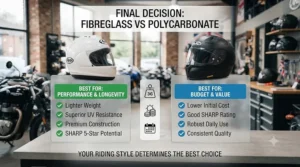
So which actually wins? Honestly, neither — they’re built for different priorities, and pretending otherwise would be doing you a disservice.
Polycarbonate wins decisively on upfront cost, manufacturing consistency, and accessibility. If you’re commuting five miles into town or you’re a newer rider still working out which style of helmet you actually prefer, a polycarbonate helmet like the Nolan N60-6 or HJC i71 removes the financial barrier to wearing a genuinely well-tested, ECE 22.06-approved lid rather than delaying the purchase to save up for something fancier.
Fibreglass wins on weight, fit precision (more shell sizes generally means a more compact fit for your specific head size), and — for what it’s worth to some riders — the ability to be professionally repainted rather than replaced if you fancy a colour change. Composite constructions like the Caberg Levo‘s fibreglass-Kevlar-carbon blend or Shoei’s AIM technology in the NXR2 also tend to allow thinner, lighter shells for a given level of stiffness, which is precisely why premium sports-touring and racing helmets have gravitated toward composite construction over decades of development.
Where things get genuinely interesting is the middle ground occupied by helmets like the AGV K6-S, which uses carbon-aramid rather than pure fibreglass to chase even lower weight than traditional glass-fibre composites achieve. This is a reminder that “fibreglass vs polycarbonate” isn’t really a binary choice on the modern market — it’s closer to a spectrum, with hybrid composites increasingly bridging the gap.
The bottom line, grounded in what SHARP’s own testing repeatedly demonstrates: buy based on independently verified safety data and genuine fit first, shell material and price second. A perfectly-fitting, well-reviewed polycarbonate helmet will protect you better than a poorly-fitting fibreglass one, every single time.
How to Choose Between a Fibreglass and Polycarbonate Helmet
If you’re still torn, work through these seven criteria in order — they’re ranked roughly by how much they actually affect real-world safety and comfort, based on the research and reviewer sentiment gathered throughout this guide.
- Check the SHARP rating first, always. Before you even consider shell material, look up the specific model on the SHARP website — this single step does more for your safety than any other decision on this list.
- Try it on and keep it on for 15 minutes. Fit varies enormously between brands regardless of shell material; a “medium” from one manufacturer can feel like a “small” from another.
- Be honest about your budget ceiling. If fibreglass pushes you outside your comfortable spending range, a well-rated polycarbonate helmet is genuinely not a compromise on safety.
- Think about your typical ride duration. Weight matters far more on a three-hour tour than a fifteen-minute commute — prioritise lighter fibreglass or composite shells if you’re regularly covering serious mileage.
- Consider whether you’ll want to repaint or customise. Only fibreglass and composite shells can be professionally resprayed; polycarbonate generally can’t without compromising the shell.
- Check shell size availability for your head size. More outer shell sizes (common on premium fibreglass helmets) generally means a more compact, better-balanced fit.
- Factor in your climate and typical weather. Ventilation design varies more between individual models than between shell materials, so check specific vent counts and positions rather than assuming.
Common Mistakes When Buying a Motorcycle Helmet
Even careful buyers fall into a handful of predictable traps when weighing up fibreglass versus polycarbonate options, so it’s worth flagging the most common ones honestly.
The biggest mistake is assuming price directly correlates with safety. As SHARP’s own testing consistently shows, that’s simply not reliable — some budget polycarbonate helmets have scored better than pricier composite rivals, so skipping the SHARP lookup because “it’s expensive, it must be safe” is a genuine risk.
A close second is buying based on shell weight alone without checking fit. A featherlight fibreglass helmet that’s slightly too big will move around on your head far more than a heavier polycarbonate lid that fits snugly — and a loose-fitting helmet of any material performs worse in a crash. Reviewers across nearly every model in this guide repeatedly stress that fit trumps material.
Riders also commonly overlook shell size counts, assuming “one size fits all” within a labelled size like Medium. As we saw with the HJC i71‘s three shell sizes versus the Nolan N60-6‘s two, more shell sizes generally means a more tailored, less bulky fit for your specific head — worth checking on the spec sheet before you buy.
Finally, many riders neglect to check whether a helmet is genuinely ECE 22.06 certified versus the older 22.05 standard. While 22.05 helmets remain legal and offer excellent protection, 22.06 testing is more rigorous and closer to real-world crash scenarios, including rotational impact testing that the older standard didn’t cover. If you’re choosing between two similarly priced helmets, the newer standard is worth the tiebreak.
Long-Term Cost & Maintenance
The sticker price is only part of the total cost of helmet ownership, and this is genuinely where shell material starts to matter for your wallet over the years.
A polycarbonate helmet is generally a “buy it, use it, replace it” proposition — you won’t be repainting it, and its thicker construction means it’s slightly less prone to superficial paint chips in daily use, though the trade-off is that a scratched or faded polycarbonate shell can’t be refreshed and has to be replaced outright once it looks tired. Given most helmets have a recommended usable lifespan of around five years regardless of material (due to UV degradation of the EPS liner and adhesives, not just the shell), a £180 polycarbonate helmet works out to roughly £36 a year of protection — genuinely excellent value.
A fibreglass helmet costs more upfront, but the ability to professionally repaint models like the Bell Custom 500 means a scuffed or dated-looking shell doesn’t automatically mean a full replacement, provided the underlying EPS liner and retention system remain in good condition (always have any fibreglass repair or repaint professionally assessed rather than DIY-ing it, since structural integrity is non-negotiable). Premium fibreglass helmets from brands like Arai and Shoei also tend to hold resale value noticeably better than budget polycarbonate equivalents, which matters if you upgrade helmets regularly.
Replacement parts are the other long-term cost worth factoring in — visors, Pinlock inserts, cheek pads and liners typically cost £20-£60 depending on brand, and this cost applies broadly regardless of shell material, so don’t let it sway your fibreglass-versus-polycarbonate decision specifically.
Practical Usage Guide: Caring for Your New Helmet
Getting the safety benefit you’ve paid for depends heavily on how you look after your helmet in the first month of ownership and beyond — here’s what genuinely matters.
First 30 days: Wear your new helmet on shorter rides initially to confirm the fit holds up once the liner starts to compress slightly with use — most liners “bed in” over the first few weeks, and a helmet that felt snug on day one can feel noticeably better (or reveal pressure points) by day thirty. Avoid tight-fitting balaclavas or extra padding to compensate for a helmet that feels too loose; if it’s genuinely loose after bedding in, it’s the wrong size.
Cleaning: Use only mild soap and water on the shell, whether fibreglass or polycarbonate — many stronger solvents and screen-cleaning products can attack polycarbonate visors and shells specifically, causing stress cracking around fixing points over time. Remove and hand-wash the liner and cheek pads separately according to the manufacturer’s instructions; most premium helmets, including several in this list, offer fully removable, washable interiors specifically for this reason.
Storage: Store your helmet away from direct sunlight and extreme heat (never on a bike’s mirror or seat in direct sun for hours) — UV exposure degrades both polycarbonate shells and the EPS liner underneath any shell material over time, quietly reducing protection even if the helmet looks fine.
Common first-30-days mistakes: Dropping a helmet from even a modest height (like off a bike seat onto concrete) can compress the EPS liner invisibly, reducing its protective capacity without any visible shell damage — if this happens, most manufacturers recommend replacement rather than “it looked fine so it’s fine.” Similarly, never rest a helmet on hot engine components or exhausts while parked; the heat can distort or weaken the shell in ways that aren’t obvious until it’s too late.
Real-World Scenarios: Which Shell Suits Which Rider
The daily commuter (5-15 miles, mostly urban): A budget-conscious rider making short, stop-start journeys through town doesn’t need the weight savings of fibreglass nearly as much as a long-distance tourer does. The Nolan N60-6 or HJC i71 genuinely make sense here — reliable ECE 22.06 protection, sensible pricing, and the extra couple hundred grams simply won’t be noticeable over a fifteen-minute ride.
The weekend tourer (100+ mile days, multiple hours in the saddle): This is where fibreglass and composite construction earns its price premium. A rider regularly logging six-hour days on something like the Caberg Levo or Shoei NXR2 will genuinely feel the difference in neck fatigue by the end of the day, and the extra shell sizes mean a more precisely fitted, more comfortable lid for those extended stretches.
The budget-conscious first-time rider: Someone newly licensed, still working out what style and fit they prefer, and understandably reluctant to drop £400 on a helmet before they’ve settled into riding. Here, a well-rated polycarbonate helmet like the Nolan N60-6 is the sensible starting point — genuine ECE 22.06 protection without the financial risk of an expensive helmet you might want to swap out within a year or two as your preferences firm up.
The performance-focused rider chasing every gram: For riders who genuinely notice and value shaving weight — whether for track days, sports riding, or simply because neck fatigue is a real concern over long distances — the AGV K6-S‘s carbon-aramid construction represents the current cutting edge of lightweight full-face design, worth the premium if weight is a genuine priority rather than a nice-to-have.
Buyer’s Decision Framework
If your priority is budget above all else, choose a polycarbonate full-face helmet from a mainstream brand, because you’ll get genuine ECE 22.06 protection at the lowest realistic price point without meaningfully compromising safety.
If your priority is minimising neck and shoulder fatigue on long rides, choose a fibreglass or carbon-composite shell, because the weight reduction compounds noticeably over hours in the saddle in a way it simply doesn’t over short journeys.
If your priority is a highly tailored, compact fit for an unusual head size or shape, choose a helmet offering three or more outer shell sizes — typically found among fibreglass and composite options like the HJC i71, Shoei NXR2 or AGV K6-S — because more shell sizes directly reduce excess bulk and improve balance.
If your priority is long-term flexibility to refresh the look of your helmet, choose fibreglass, because only composite shells can be professionally repainted rather than needing outright replacement.
If your priority is simply the highest independently verified safety margin regardless of material or price, choose based on the individual model’s SHARP star rating first and treat shell material as a secondary consideration — as this guide has stressed throughout, that’s genuinely the single most reliable indicator available to UK riders.
FAQ
❓ Is a fibreglass helmet safer than a polycarbonate helmet?
❓ Why are fibreglass helmets more expensive than polycarbonate?
❓ How much lighter is a fibreglass helmet than polycarbonate?
❓ Can I repaint a polycarbonate motorcycle helmet?
❓ How do I check a helmet's SHARP safety rating before buying?
Conclusion
The fibreglass helmet vs polycarbonate helmet question doesn’t actually have a single right answer — and if anyone tells you it does, they’re oversimplifying a decision that genuinely depends on your budget, your typical ride length, and how much you personally value shaving a few hundred grams off your head. What we’ve tried to do here is give you the honest specifics: real weights, real prices ranges, and genuine SHARP safety context, rather than vague marketing claims about which material is “better.”
If there’s one takeaway worth remembering, it’s this: shell material is a useful shorthand, but it’s not a safety guarantee in either direction. The Nolan N60-6 and HJC i71 prove polycarbonate can deliver genuinely solid, well-reviewed protection at accessible prices, while the Caberg Levo, Shoei NXR2, Arai Profile-V and AGV K6-S show what fibreglass and composite construction can offer in weight, fit precision and long-term flexibility once you’re ready to spend a bit more.
Whichever direction you lean, do the one thing that matters more than either shell material: check the individual helmet’s SHARP rating, try it on properly, and make sure it fits snugly before you ride away. That single habit will do more for your safety than any fibreglass-versus-polycarbonate debate ever could.
Recommended for You
- 7 Best Fibreglass Touring Helmet for Long Rides (2026 UK Guide)
- Lightweight Fibreglass Sport Helmet: 7 Best Picks for 2026
- Fibreglass Touring Helmet with Speakers: 7 Best UK Picks 2026
Disclaimer: This article contains affiliate links. As an Amazon Associate, I earn from qualifying purchases. If you purchase products through these links, we may earn a small commission at no additional cost to you.
✨ Found this helpful? Share it with your friends! 💬🤗
