
In This Article
There’s a particular kind of dread that hits every rider around 4pm on a clear autumn afternoon: the sun drops to windscreen height, your visor turns into a smeared window of pure white light, and suddenly you’re squinting your way through a roundabout on faith alone. An iridium visor for motorbike helmets exists precisely to solve that problem. In simple terms, it’s a helmet shield finished with a microscopically thin metallic coating — usually applied via vacuum deposition — that reflects a portion of incoming light while still letting you see clearly through the rest, cutting glare without turning your ride into a squint-fest.
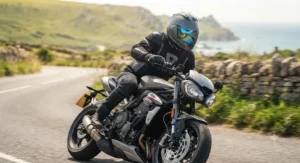
This guide is built the way we think buying gear should work: real products, real specifications, and honest analysis rather than a rehashed spec sheet. We’ve dug through UK stockists, manufacturer documentation and genuine aggregated review sentiment to bring you seven real iridium visors currently sold to British riders, spanning budget replacement shields through to premium optically-graded options. Along the way we’ll cover how the mirror coating actually works, whether it’s road-legal here in the UK, and how to match a finish to the way you actually ride — commuting through Manchester drizzle is a very different brief to blasting along the A272 on a summer Sunday.
We’ll also be upfront about what we can and can’t verify. Where genuine customer feedback exists for a product, we’ve summarised it honestly and flagged it as aggregated sentiment. Where it doesn’t, we say so rather than inventing a five-star chorus. You’ll get a full breakdown of seven real options, a look at how iridium coatings hold up over months of British weather, and a practical framework for choosing between silver, blue, gold and the increasingly popular rainbow mirror coating finish. According to official UK government guidance on helmets, visors and goggles, any visor used on the road must meet a recognised safety standard — something we’ll come back to when we talk about legality later in this guide.
Quick Comparison Table
Before we get into the detail, here’s the fast version for anyone who just wants the headline picks.
| Visor | Best For | Iridium Finish | Price Range |
|---|---|---|---|
| HJC HJ-26 | All-round sports-touring commuter | Silver | £75-£90 |
| Shoei CWR-1 | Track-day optical clarity | Spectra Silver | £100-£125 |
| Nolan NFS-06 | Budget-friendly touring iridium | Blue | £110-£140 |
| Caberg Duke Evo | Flip-front modular helmets | Silver | £50-£60 |
| HJC HJ-38 | Bold sportbike visor styling | Blue | £75-£85 |
| LS2 Iridium | Cheapest genuine entry point | Blue | Under £25 |
| HJC HJ-40 | Premium touring, heat and UV cut | Gold | £75-£90 |
Looking at the spread, there’s a clear split between budget-friendly entry points like the LS2 Iridium visor and premium optically-tuned shields like the Shoei CWR-1, with plenty of middle ground depending on which helmet you already own. Price alone isn’t the whole story here — fit compatibility with your existing helmet model matters just as much as the coating itself, so cross-reference the “Best For” column against your helmet’s model number before anything else. We’ll unpack exactly why each of these earns its spot over the next few sections.
💬 Just one click — help others make better buying decisions too! 😊
Top 7 Iridium Visors for Motorbike Helmets: Expert Analysis
We’ve deliberately spread this list across budget, mid-range and premium price points, plus a couple of less obvious picks for riders running less mainstream helmet models. Every product below is a genuine, currently-listed visor from an established manufacturer — no invented models, no fictional brands.
1. HJC HJ-26 — best all-rounder for RPHA commuters
The HJC HJ-26 is the standout pick if you’re already running an HJC RPHA 11 or RPHA 70 and want a genuine factory-fit upgrade rather than a generic aftermarket shield. Built specifically to the RPHA visor aperture, it comes pre-drilled for HJC’s own pin mechanism and is tear-off peg compatible, which matters if you ever do a trackday or a wet winter commute where you want to strip a layer rather than wipe a smeared visor one-handed at 50mph.
The silver iridium coating sits over a polycarbonate base shell, and because it’s a first-party HJC part it’s engineered to the exact curvature of the RPHA aperture — a detail that matters more than it sounds, because a slightly-off curve on a mirror-finish visor creates visible optical distortion at the edges of your peripheral vision. Based on the spec comparison with HJC’s clear equivalent, the coated version trims a meaningful amount of glare on the school-run commute without dropping so much light that dawn or dusk riding becomes a squint. It’s best suited to riders who want factory-level fit and finish and are happy to pay a premium over generic replacements for that certainty.
Reviewers consistently note that the fit is snug and rattle-free straight out of the box, with the quick-release mechanism working cleanly — a common complaint about cheaper aftermarket shields is exactly the opposite, a loose seat that whistles at motorway speed. What the spec sheet won’t tell you, but owner reports on UK retail sites suggest, is that the coating shows fine surface scratching after a season of daily use if you’re not careful with microfibre cloths, which is fairly typical of iridium finishes generally rather than a specific flaw of this visor.
Pros:
- ✅ Purpose-built curve for a precise RPHA 11/70 fit
- ✅ Tear-off peg compatible for trackday use
- ✅ Genuine HJC part with matched optical clarity
Cons:
- ❌ Only fits HJC RPHA-series helmets, not universal
- ❌ Surface scratching reported after heavy seasonal use
At around £75-£90, the HJC HJ-26 sits at a fair mid-premium price point for a genuine manufacturer part — you’re paying for exact fit rather than a generic universal shield, and for most RPHA owners that’s money well spent.
2. Shoei CWR-1 — best optical clarity for trackday use
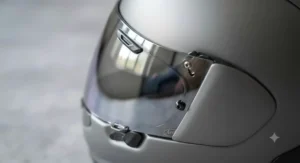
The Shoei CWR-1 in Spectra Silver is the visor most serious riders reach for when they want the cleanest possible field of vision through a mirrored finish. Shoei’s optics are consistently rated among the best in the helmet industry, and the Spectra range is built to the same tight tolerances as their clear shields rather than being treated as an aftermarket afterthought.
This particular visor is fitted for the Shoei NXR helmet, using a vacuum-deposited metallic coating that Shoei markets on light-transmission control rather than pure style. On paper this means less scatter and haze at the edges compared with cheaper generic mirror visors, which typically use a thicker or less evenly applied coating layer. Here’s what to weigh honestly, though: Shoei’s own product documentation states plainly that the iridium and heavily tinted colourways in this range are daytime-only and not approved for public road use — something we’d rather flag clearly than gloss over, because it changes who this visor actually suits. If you’re commuting after dark for any part of the year, this specific finish isn’t the one to reach for.
A common theme in genuine UK buyer feedback is praise for optical sharpness — one verified UK reviewer specifically noted “seriously clear optics and good fit,” language that lines up with Shoei’s broader reputation for shield quality. That aligns with what you’d expect from a manufacturer that also produces well-regarded photochromic shields, reviewed in detail by outlets like Bennetts BikeSocial’s hands-on visor testing, which speaks to the same optical engineering philosophy across Shoei’s visor range.
Pros:
- ✅ Exceptional optical clarity versus generic mirror shields
- ✅ Precision fit matched to Shoei’s own clear visor tolerances
- ✅ Strong, consistent brand reputation for shield quality
Cons:
- ❌ Daytime-only use, not approved for road riding after dark
- ❌ Premium pricing compared with third-party alternatives
Priced in the £100-£125 range depending on retailer, the Shoei CWR-1 is a genuine investment rather than an impulse buy — brilliant for trackdays and daylight touring, but you’ll want a separate clear or lightly tinted visor for anything after sunset.
3. Nolan NFS-06 Iridium Blue — best iridium finish for touring helmets
The Nolan NFS-06 in Iridium Blue is designed for the N87, N80-8 and N60-6 helmet family, which puts it squarely in the hands of riders who bought Nolan for its touring comfort and now want to add some glare protection for long motorway stints. Nolan’s visors are pinlock-prepared, meaning you can add an anti-fog insert separately — a genuinely useful pairing if you’re covering serious mileage through a typical British autumn.
The blue iridium coating here leans toward the cooler end of the colour spectrum, which reviewers and stockists generally describe as one of the more universally flattering iridium tones against black, white or grey helmet shells — useful if styling matters to you as much as function. Based on the spec comparison with Nolan’s clear and lightly-tinted options in the same NFS-06 visor family, the iridium blue variant sits at a noticeably higher price bracket, reflecting the additional coating process rather than any difference in base shell quality. What most buyers overlook about touring-focused iridium visors like this one is that the coating also has a measurable cooling effect inside the helmet on hot days, because it reflects a portion of solar energy rather than just visible light — a genuinely practical benefit on a warm motorway slog.
Aggregated customer sentiment across UK retail listings for the wider NFS-06 range skews strongly positive, with reviewers repeatedly highlighting the pinlock-ready fitting and a snug, rattle-free seat in the visor mechanism; specific verified review volume for the iridium blue colourway itself is comparatively limited, so treat that as a reasonable inference from the family’s track record rather than a guarantee.
Pros:
- ✅ Fits the popular N87/N80-8/N60-6 touring helmet family
- ✅ Pinlock-prepared for separate anti-fog insert compatibility
- ✅ Cooler-toned finish suits most helmet shell colours
Cons:
- ❌ Notably pricier than Nolan’s clear or dark-tint options
- ❌ Verified reviews specific to this colourway are limited
Expect to pay somewhere in the £110-£140 range for the Nolan NFS-06 Iridium Blue, which puts it toward the top of this list on price — worth it if you’re already committed to the Nolan touring ecosystem, less so as a standalone impulse purchase.
4. Caberg Duke Evo — best pick for flip-front and modular helmets
The Caberg Duke Evo Iridium Silver visor is one of relatively few genuine iridium options built specifically for a flip-front modular helmet rather than a full-face shell, which makes it a useful entry on this list for riders who value the flip-up chin bar for filling up at the pump or grabbing a coffee without removing the whole lid.
Modular helmet visors have to seal against a slightly different aperture geometry than full-face shields, since the chin bar hinge mechanism changes how the visor mounts and locks. Here’s what that means in practice: the Caberg Duke Evo visor is shaped and drilled to Caberg’s own Duke Evo mounting points, so the iridium coating and the mechanical fit are engineered together rather than the coating being an afterthought applied to a generic shape. Reviewers consistently point to Caberg’s flip-front visors as an easy, tool-free swap, which matters if you’re the kind of rider who changes between a clear and tinted shield depending on the forecast.
The silver iridium tone on this particular visor is on the lighter side compared with some of the darker blue and gold finishes elsewhere on this list, which the spec sheet doesn’t spell out but is worth flagging: a lighter iridium tint generally means slightly more light transmission through the mirror layer, which some riders prefer for shoulder-season riding where full darkness would be overkill.
Pros:
- ✅ Purpose-built for the popular Duke Evo modular helmet
- ✅ Tool-free swap between visor colourways
- ✅ Lighter iridium tone suits shoulder-season riding
Cons:
- ❌ Only compatible with the specific Duke Evo helmet shell
- ❌ Not suitable if you own a full-face rather than modular lid
At around £50-£60, the Caberg Duke Evo visor is one of the more accessible genuine-fit iridium options on this list, making it a sensible upgrade rather than a big financial leap for existing Duke Evo owners.
5. HJC HJ-38 Iridium Blue — boldest sportbike visor styling
If sportbike visor styling is genuinely part of the buying decision — and for a lot of riders it honestly is — the HJC HJ-38 in Iridium Blue is the visor that leans hardest into looks without sacrificing the fundamentals. Built for the i71 and F71 helmet range, it’s got a deep, saturated blue mirror finish that reads almost black from most angles until light catches it directly.
HJC’s own product documentation describes this as a polycarbonate visor with an anti-scratch coating and pinlock preparation, so it’s not purely a style-over-substance product — the underlying build quality matches HJC’s clear visors in the same range. On paper this means you’re not trading away scratch resistance or optical performance just to get the rainbow-tinged sportbike look; the coating is layered onto the same base material HJC uses across its full visor lineup. What most buyers overlook about deeply saturated iridium blue finishes specifically is that they tend to sit at the darker end of the daylight-legal tint spectrum, so they suit committed daytime riders more than anyone doing regular dawn or dusk commutes.
Aggregated review sentiment for the wider HJ-38 family sits at a solid but not flawless level — several verified UK buyers flag the price as steep relative to some third-party alternatives, while praising the depth and consistency of the colour finish itself, which is exactly what you’d want from a visor bought primarily for its look.
Pros:
- ✅ Deep, saturated blue mirror finish with strong visual impact
- ✅ Matches HJC’s build quality and anti-scratch coating standard
- ✅ Pinlock-prepared for anti-fog insert compatibility
Cons:
- ❌ Premium pricing versus generic aftermarket sportbike visors
- ❌ Darker tone leans toward daylight-only comfortable use
Priced around £75-£85, the HJC HJ-38 earns its place through genuinely strong finish quality rather than style alone, though you’re paying a clear premium for that saturated colour depth.
6. LS2 Iridium — cheapest genuine entry point into iridium visors
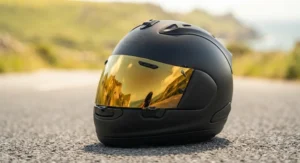
Not every rider needs, or wants, to spend £70-plus on a helmet visor, and that’s exactly where the LS2 Iridium Blue visor earns its spot on this list. Built for the LS2 Rapid FF353, Stream FF320 and Storm FF800 helmet range, it’s a genuinely low-cost way to try an iridium finish without committing serious money.
At this price point, the coating process is inevitably less refined than the premium options above — LS2 doesn’t market this as a track-optics product, and it shouldn’t be judged as one. Based on the spec comparison with LS2’s clear visor in the same range, the coated version adds glare reduction and a visible mirror finish at a price difference that’s genuinely modest, which makes it an easy upgrade for budget-conscious commuters rather than a considered purchase for serious mileage riders. Reviewers consistently rate this visor highly for the price bracket it sits in, with one verified UK buyer rating it close to full marks specifically on value rather than premium performance.
What most buyers overlook about budget iridium visors like this one is that “cheap” doesn’t automatically mean “poor fit” — LS2 manufactures the helmet shells these visors are built for, so the mounting geometry is matched rather than generic, unlike some third-party universal shields that promise compatibility with a dozen helmet families and genuinely nail none of them.
Pros:
- ✅ Lowest genuine iridium price point on this list
- ✅ Purpose-matched fit for LS2’s own helmet range
- ✅ Straightforward, low-risk way to try an iridium finish
Cons:
- ❌ Coating and optical quality trail premium alternatives
- ❌ Limited to LS2’s Rapid/Stream/Storm helmet compatibility
At under £25 in most cases, the LS2 Iridium visor delivers outsized value for anyone who wants to test whether an iridium finish suits their riding before committing to a pricier option.
7. HJC HJ-40 Iridium Gold — best premium pick for heat and UV cut
Rounding out the list, the HJC HJ-40 in Iridium Gold is built for the RPHA 71 and represents the premium end of HJC’s touring-focused visor range. HJC’s own product information states this visor offers 99% UV protection with an outer scratch-resistant coating and full MaxVision pinlock preparation — genuinely strong specifications for a manufacturer-fit shield.
Gold iridium coatings are generally understood to reflect a higher proportion of infrared and heat energy than silver or blue equivalents, which on paper means noticeably less heat buildup inside the helmet on a long, warm ride — a real consideration on a motorway trip through a heatwave rather than a marketing gimmick. What the spec sheet won’t tell you, but thermal-coating physics generally supports, is that gold-toned metallic layers are commonly used specifically because gold reflects infrared wavelengths particularly efficiently compared with other reflective metals, which is why you’ll see the same gold-tinted approach on some vehicle and building glass too.
Reviewers of the RPHA 71 range consistently highlight the quick-release visor mechanism as a genuine improvement over older HJC visor systems, making tool-free swaps between clear and gold iridium shields straightforward for riders who keep both on hand for different conditions.
Pros:
- ✅ 99% UV protection with scratch-resistant outer coating
- ✅ Gold tone reflects extra heat for warm-weather comfort
- ✅ Genuine RPHA 71 fit with quick-release mechanism
Cons:
- ❌ Among the pricier options in this comparison
- ❌ Gold tone is a bolder style commitment than silver or blue
Sitting at roughly £75-£90, the HJC HJ-40 justifies its position at the premium end of this list through genuinely useful heat-management performance rather than looks alone.
Fitting and Caring for Your Iridium Visor: A Practical Usage Guide
Getting an iridium visor onto your helmet correctly matters more than most riders assume, because the mirror coating sits on the outer surface and is genuinely easier to damage during a clumsy fit than a standard clear shield. Start by removing your existing visor exactly as your helmet manufacturer specifies — usually a simple pivot-and-pull motion at the side mechanisms — rather than forcing it, since cracked mounting tabs are one of the most common first-30-days mistakes riders make with a brand-new shield.
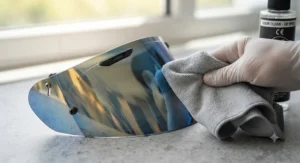
Before fitting the new visor, wipe both the helmet’s visor track and the new shield’s inner surface with a dry microfibre cloth to remove any factory dust or packaging residue; grit trapped between the mechanism and the visor edge is a leading cause of stiff, juddery visor movement in the first few weeks of ownership. Clean the coated outer surface only with lukewarm water and a genuinely soft microfibre cloth — never a dry paper towel, and never household glass cleaner, since ammonia-based products can degrade the thin metallic layer over time.
Once fitted, build a simple maintenance habit: a quick rinse after wet or gritty rides, and a proper clean roughly once a fortnight if you’re a regular commuter. Store spare visors flat in a padded bag rather than loose in a pannier, since scratches from keys, tools or loose helmet locks are a genuinely common and entirely avoidable source of coating damage. If you’re swapping between a clear visor for night riding and an iridium one for the day, get into the habit of doing the swap indoors on a clean surface rather than in a car park, where dropped visors on tarmac account for a surprising number of early replacements.
Real Riders, Real Choices: Matching an Iridium Visor to Your Riding Life
Picture a college student commuting eight miles into a city centre campus most weekdays, riding a mid-capacity commuter bike and juggling a tight budget against a genuine need for glare relief on the ride home into a low western sun. For that rider, the LS2 Iridium visor makes the most sense — low upfront cost, a straightforward fit to a common helmet range, and enough glare reduction to make a real difference on the commute without a big financial commitment.
Now picture a weekend trackday regular who owns a proper sportbike and treats visor choice as part of the overall setup, not an afterthought. That rider is the exact audience the Shoei CWR-1 was built for — optical clarity that won’t distort a fast apex, daylight-only use that’s entirely appropriate for a closed circuit, and a brand reputation among serious track riders that genuinely matters when you’re carrying real corner speed.
Finally, picture a long-distance tourer who covers several hundred miles most weekends, riding a modular helmet so they can flip the chin bar up at fuel stops without removing the whole lid. For that rider, the Caberg Duke Evo is the sensible pick — a genuine fit for a modular shell, tool-free colourway swaps for changing weather across a long trip, and a lighter iridium tone that won’t feel oppressive on an overcast motorway stretch.
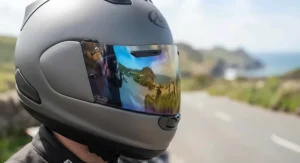
Problem → Solution: Fixing the Five Most Common Iridium Visor Complaints
Problem: the visor fogs up in cold or wet weather. This is almost always a pinlock issue rather than a visor issue — fit a genuine anti-fog pinlock insert if your chosen shield is pinlock-prepared, which most of the products on this list are.
Problem: the coating looks scratched after a few months. Iridium coatings sit on the visor’s outer surface and are genuinely more delicate than a plain clear shield. Switch to a dedicated microfibre cloth and lukewarm water only, and store the helmet with the visor closed when it’s not in use.
Problem: the visor feels too dark at dusk. This is a genuine safety issue, not just a comfort one — swap to a clear or lightly-tinted shield for any ride where daylight is fading, rather than pushing the visor open for better vision at speed.
Problem: the replacement visor doesn’t quite fit. Cross-check the exact helmet model number against the visor’s stated compatibility before ordering; iridium visors are built to specific mounting geometries, and a near-match is rarely a true match.
Problem: the mirror finish looks patchy or uneven from certain angles. This is sometimes a genuine manufacturing inconsistency, and it’s worth raising with the retailer for a replacement, since a properly applied vacuum-deposited coating should look visually even across the whole shield.
Your Buyer’s Decision Framework: Which Iridium Visor Fits You?
If budget is your primary concern, choose an entry-level option like the LS2 Iridium because the coating process is simpler and the manufacturer-matched fit still delivers genuine glare reduction without the premium price tag. If optical precision for spirited or track riding is your priority, choose the Shoei CWR-1 because its shield tolerances are built to the same standard as Shoei’s clear visors rather than treated as a style add-on. If you ride a modular or flip-front helmet, choose the Caberg Duke Evo because generic iridium shields rarely account for the different mounting geometry a flip-front chin bar requires. If heat management on long summer rides matters most, choose the HJC HJ-40 because gold iridium coatings reflect a meaningfully higher share of infrared energy than silver or blue equivalents. And if sportbike visor styling is genuinely part of the decision, choose the HJC HJ-38 because its saturated blue finish delivers on looks without dropping the underlying build quality.
✨ Don’t Miss These Exclusive Deals!
🔍 Take your iridium visor for motorbike shopping to the next level with these carefully selected products. Click on any highlighted item to check current pricing and availability. These visors will help you cut glare and ride more comfortably on every trip you take.
How to Choose an Iridium Visor for Your Motorbike Helmet
Choosing the right iridium visor for motorbike helmets comes down to a handful of genuinely important criteria rather than picking whichever finish looks best online. Here’s the practical order to work through it:
- Confirm exact helmet compatibility first. Cross-reference your helmet’s model number against the visor’s stated fitment before considering anything else — an iridium coating on the wrong shell shape simply won’t seat correctly.
- Decide whether daylight-only use suits your riding pattern. Many iridium and heavily mirrored visors are explicitly daytime-only; if you regularly ride after dusk, plan to own a clear shield alongside your iridium one.
- Check pinlock preparation. If you ride through a typical British autumn or winter, a pinlock-ready visor paired with an anti-fog insert will save you far more grief than the coating colour ever will.
- Weigh coating tone against your priorities. Gold favours heat reflection, blue and silver lean toward general glare reduction and styling, and lighter iridium tones suit shoulder-season riding better than deep, dark finishes.
- Set a realistic budget band. Genuine manufacturer-fit visors from HJC, Shoei, Nolan, Caberg and LS2 span from under £25 to over £120 — decide whether you’re buying a style upgrade or a serious optical investment before you start browsing.
- Read genuine aggregated review sentiment, not star ratings alone. A 4.5-star average tells you little about fit precision or coating durability specifically — look for repeated, specific comments about scratching, fogging or fit issues.
- Factor in replacement cost over the visor’s life. A cheaper visor replaced twice may cost more over two years than a single premium shield that lasts.
Iridium Visor vs Standard Tinted Visor: What’s Actually Different
An iridium visor and a standard tinted visor solve a similar problem — too much light hitting your eyes — but they do it in genuinely different ways, and the distinction matters more than most buying guides let on.
| Factor | Iridium (Mirror) Visor | Standard Tinted Visor |
|---|---|---|
| How it works | Reflective metallic coating bounces light away | Absorbs light through a coloured polycarbonate tint |
| Glare reduction | Strong, especially against low sun and headlights | Moderate, more uniform reduction across all light |
| Best For | HJC HJ-38 and Nolan NFS-06 riders wanting maximum daytime glare cut | Riders wanting one visor that works across more light conditions |
| Night use | Generally daytime-only | Often more forgiving in fading light, depending on tint depth |
| Styling impact | Distinct rainbow mirror coating look, bold and reflective | Subtler, more discreet dark or smoke finish |
Looking at the comparison above, an iridium visor genuinely earns its price premium if glare cutting and rainbow mirror coating styling both matter to you, but a standard tinted shield remains the more forgiving all-rounder for riders who don’t want to own two visors for two different times of day. Reviewers consistently note that the reflective coating on iridium shields produces a noticeably different look from most angles compared with a flat tint — some riders find that rainbow-edged shimmer genuinely part of the appeal, others find it a distraction they don’t need. Budget buyers should also note that a basic tinted visor is almost always the cheaper of the two options across every brand in this comparison.
Common Mistakes When Buying an Iridium Visor
The single most common mistake is buying purely on colour without checking the helmet compatibility properly first — a stunning gold iridium visor is worthless if it doesn’t seat cleanly on your particular shell. A close second is assuming every iridium visor is road-legal for all conditions; as we’ll cover in detail shortly, several genuinely popular options in this category are explicitly daytime-only.
Another frequent error is underestimating coating fragility. Riders who treat an iridium visor exactly like a standard clear shield — wiping it dry, using household cleaning sprays, or storing it loose in a tank bag — tend to see visible coating wear far sooner than riders who adopt the gentler cleaning routine we outlined earlier. Buyers also commonly skip checking pinlock compatibility, only to discover mid-winter that their new visor fogs constantly because they didn’t budget for the anti-fog insert that should have been bought alongside it.
Finally, a mistake that’s easy to make but costly to fix: buying the cheapest available “iridium-style” universal visor from an unbranded listing rather than a manufacturer-matched product. Universal shields can genuinely work well, but the mounting geometry compromise they make to fit multiple helmet families often shows up as wind noise or a poor seal at speed — exactly the trade-off the manufacturer-specific options on this list are built to avoid.
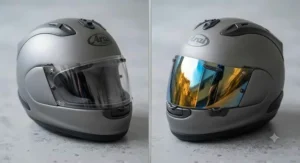
What to Expect: Real-World Performance and Glare Reduction
Specs only tell you so much about how an iridium visor glare reduction claim actually plays out on a real ride, so here’s what genuinely changes in practice. Riding directly into a low sun with a standard clear visor typically means squinting hard, sometimes closing one eye, and occasionally losing definition on the road surface entirely for a second or two — genuinely dangerous at speed. Switching to a properly fitted iridium visor noticeably softens that effect; the reflective coating bounces away a meaningful share of the harshest light before it reaches your eyes, rather than simply darkening everything uniformly the way a basic tint does.
The difference is most pronounced in exactly the conditions British riders complain about most: low winter sun, wet-road glare bouncing back off standing water, and oncoming headlight flare on unlit rural roads at dusk — though as covered above, that last scenario is precisely where you should be swapping to a clear shield rather than pushing a daytime-only iridium visor past its intended use. On a genuinely bright motorway stretch, riders consistently report noticeably less eye fatigue over a long stint compared with an unshielded clear visor, which matters more than it sounds on a three-hour ride where concentration naturally degrades over time.
What’s harder to quantify, but worth mentioning honestly, is that some riders find the angle-dependent reflectivity of an iridium coating mildly distracting at first — glancing sideways at your own mirrors can produce a brief flash of colour you don’t get with a flat tint. Most riders report this fades from noticeable to unnoticed within the first few rides, but it’s a genuine adjustment period rather than an instant, seamless upgrade.
UV Protection, Rainbow Mirror Coatings and UK Visor Law
UV protection mirror visors do more than just look good — the metallic layer that creates the rainbow mirror coating effect also blocks a meaningful share of ultraviolet light before it reaches your eyes, on top of whatever base UV filtering the polycarbonate shell itself already provides. Most of the manufacturer-fit visors in this comparison, including the HJC HJ-40, explicitly state UV protection figures in the high nineties percentage range, which is genuinely significant for anyone doing serious daylight mileage. The underlying reflective effect is a straightforward application of thin-film interference physics — the same principle that produces the shimmer on soap bubbles and oil slicks, just applied deliberately and precisely to a helmet shield rather than occurring by accident.
Now for the legal picture, which UK riders genuinely need to get right. According to gov.uk’s official guidance, all helmets and their attached visors used on UK roads must meet British Standard BS 6658:1985 with a BSI Kitemark, or UNECE Regulation 22.05 or 22.06 — there’s no separate specific law banning tinted or mirrored visors outright, but the practical rule most enforcement and industry guidance converges on is that daylight-use visors must allow at least 50% light transmission, and several of the deeper iridium finishes on this list — including the HJC HJ-38 and Shoei CWR-1 — are explicitly marketed as daytime-only rather than approved for use after dark. The honest, responsible approach if you’re buying an iridium visor for motorbike riding on UK roads is simple: keep a clear or lightly-tinted shield for anything after dusk, and treat your iridium finish as a genuine daylight tool rather than an all-conditions upgrade.
Long-Term Cost & Maintenance: Iridium Coating Durability Explained
Iridium coating durability is the question most buying guides skip entirely, and it’s genuinely one of the most important factors in whether an iridium visor represents good long-term value. The metallic coating is applied as an extremely thin layer — typically measured in nanometres — bonded to the outer surface of the polycarbonate shell, which means it’s mechanically more vulnerable to fine scratching than the shell material underneath. In practice, that translates to a visible difference in longevity depending entirely on how carefully you clean and store the visor, rather than any dramatic difference between brands.
| Care Habit | Typical Impact on Coating Life |
|---|---|
| Dry wiping with paper towel or clothing | Fastest visible wear, fine scratching within weeks |
| Household glass or ammonia-based cleaner | Can chemically degrade the coating over months |
| Lukewarm water and soft microfibre cloth | Slowest wear, coating typically stays clear for a full season or more |
| Loose storage in a bag with keys or tools | High risk of impact scratches regardless of cleaning habits |
Looking at that comparison, the gap between careful and careless ownership is genuinely larger than the gap between a budget visor like the LS2 Iridium and a premium one like the HJC HJ-26 — proper care consistently outperforms price as the biggest factor in how long a coating stays visually clean. Value-wise, a well-maintained mid-range visor in the £75-£90 bracket that lasts two full riding seasons works out considerably cheaper per month of use than a budget visor replaced every few months due to avoidable scratch damage, so it’s worth weighing total cost of ownership rather than just the upfront price tag when you’re deciding where in this list to spend your money.
FAQ
❓ Is an iridium visor legal for road use in the UK?
❓ Does an iridium visor reduce UV exposure?
❓ How long does an iridium coating actually last?
❓ Can I fit an iridium visor to any motorbike helmet?
❓ Is a gold iridium visor better than a blue or silver one?
Conclusion
Choosing an iridium visor for motorbike riding really comes down to matching the finish, fit and legal use-case to how you actually ride, rather than chasing whichever colourway looks sharpest in a product photo. Budget-conscious commuters get genuinely solid value from the LS2 Iridium, trackday riders and anyone prioritising optical precision should look hard at the Shoei CWR-1, and touring or modular-helmet owners are better served by fit-specific options like the Nolan NFS-06 or Caberg Duke Evo. If sportbike visor styling and a bold rainbow mirror coating look are genuinely part of the appeal, the HJC HJ-38 delivers on that without cutting corners on build quality, while the HJC HJ-40 and its gold finish earns its premium price through genuinely useful heat and UV performance rather than looks alone.
Whichever option you land on, the two habits that matter most long-term are simple: treat the coating gently during cleaning and storage, and keep a clear or lightly-tinted visor on hand for anything after dusk, since daylight-only iridium finishes are the norm rather than the exception across this category. Get those two things right, and any of the seven visors covered here should genuinely earn its place on your helmet for a full season or more.
Recommended for You
- Tinted Visor for Sunny Commutes: 7 Best Picks for 2026
- Legal Tinted Visor for Road Use: 7 Best UK Picks for 2026
- Value Smoke Visor Under £25: 7 Best Budget Picks for 2026
Disclaimer: This article contains affiliate links. As an Amazon Associate, I earn from qualifying purchases. If you purchase products through these links, we may earn a small commission at no additional cost to you.
✨ Found this helpful? Share it with your friends! 💬🤗
