In This Article
Scratched, fogged, or just plain tired of staring through a visor that’s seen one too many wet commutes? A replacement mirrored visor for full face helmet setups is one of the cheapest, most satisfying upgrades you can make to a lid you already love — new eyewear for an old friend, basically. It sharpens your look, cuts glare on bright motorway runs, and gives tired latching mechanisms a fresh lease of life, all without the expense of buying a whole new helmet.
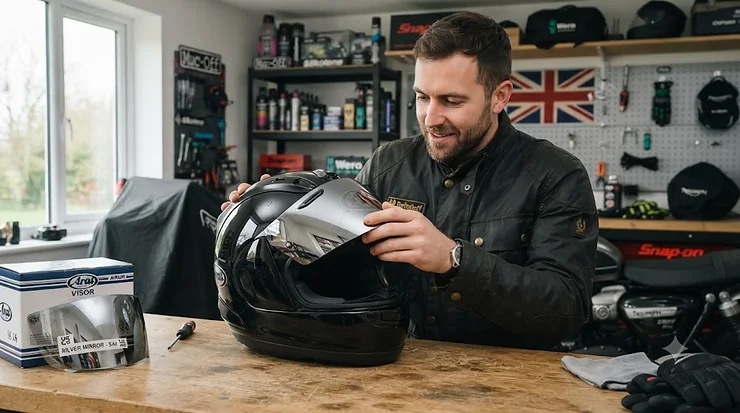
A replacement mirrored visor for full face helmet models is a polycarbonate shield with a reflective metallic coating, designed to clip or bolt onto the same pivot mechanism as your original visor, cutting glare while masking eye direction from other road users. It’s not just cosmetic — it’s a functional upgrade that most riders underestimate until they’ve tried one.
Here’s the thing most buyers get wrong straight away: they assume “mirrored” and “road legal” are interchangeable, and they’re not always the same conversation. According to official UK government guidance on motorcycle helmets, visors and goggles, helmets, visors and goggles used on the road must meet British Standard BS 6658:1985 with a BSI Kitemark, or UNECE Regulation 22.05 or 22.06, or an equivalent EEA standard — and separately, tinted or mirrored finishes need to clear a light-transmission threshold to stay road-legal after dark. We’ll unpack exactly what that means for your buying decision a little further down, because it genuinely changes which of these seven visors belongs on your helmet for daily riding versus which one’s strictly a fair-weather, daylight-only look.
Below, you’ll find seven genuinely available mirrored visors — spanning cheap universal-fit options through to premium optically-correct OEM shields — plus fitment advice, sizing guidance, mechanism-replacement steps, and the buyer logic that separates a smart purchase from an expensive mistake.
Quick Comparison Table
| Visor | Fit Type | Price Range | Best For |
|---|---|---|---|
| HJC HJ-09 RST Mirror Shield | HJC multi-model OEM | around £25-£40 | Budget HJC owners wanting a genuine-fit swap |
| Aramox Universal Silver Mirror Visor | Universal clip-fit (AGV pattern) | under £20 | Cheapest first-time mirrored upgrade |
| LS2 FF320/FF353/FF328 Rainbow Visor | LS2 OEM | around £15-£25 | LS2 Stream/Rapid owners on a tight budget |
| AGV K3 SV Blue Mirror Visor | AGV genuine OEM | £55-£70 range | Riders wanting factory-matched AGV optics |
| HJC RPHA 11 Silver Mirror Visor | HJC HJ-26 OEM | £40-£70 range | Sport-touring HJC riders wanting Pinlock-ready glass |
| Shoei CWR-1 Spectra Mirror Shield | Shoei RF-SR/RF-1200/X-Fourteen OEM | £70-£120 range | Premium optical clarity and ECE ribbing |
| Shoei CNS-1 Silver Mirror Visor | Shoei GT-Air/Neotec OEM | £45-£100 range | Flip-front touring helmet owners |
The spread here matters more than it looks. Budget options like the Aramox Universal Silver Mirror Visor and the LS2 FF320/FF353/FF328 Rainbow Visor get you mirrored glass for less than a tank of fuel, but they trade away the optical precision and ECE ribbing you get from genuine OEM shields. Mid-range genuine parts such as the AGV K3 SV Blue Mirror Visor and HJC RPHA 11 Silver Mirror Visor sit in the sweet spot most commuters actually need — factory tolerances without premium pricing. At the top, the two Shoei shields justify their cost through distortion-free optics that matter more at 70mph than they ever will parked outside a coffee shop.
💬 Just one click — help others make better buying decisions too!😊
Top 7 Replacement Mirrored Visors for Full Face Helmets: Expert Analysis
1. HJC HJ-09 RST Mirror Coating Shield — widest legacy-helmet compatibility
If you’re running an older HJC lid, this is very likely the visor you’ve been searching model numbers to find. The HJC HJ-09 RST shield is compatible with a genuinely broad range of HJC models — CL-15, CL-16, CL-17, CL-SP, CS-R1, CS-R2, AC-12, FS-10, FS-15 and IS-16 among them — which makes it the default replacement for anyone who bought an HJC full-face helmet in roughly the last decade and a half. The RST coating process bonds metallic compounds to the shield under vacuum, giving genuine mirror depth rather than a sprayed-on tint that flakes with age. What most buyers overlook about RST shields specifically is that HJC explicitly warns against chemical cleaners on the coating, because solvents degrade the reflective layer faster than UV exposure does — plain warm water and a microfibre cloth is the only combination that keeps the mirror finish intact long-term. The RapidFire tool-less mechanism means swapping it takes minutes, and the ProSeal edge keeps the chamber reasonably airtight against wind noise and moisture ingress. Aggregated buyer feedback across major UK retailers consistently flags this shield’s exceptional broad-model compatibility and easy no-tools fitting, while a recurring complaint centres on the mirror coating showing wear faster than clear OEM shields under abrasive cleaning habits. This is best suited to budget-conscious HJC owners doing regular commuting who want a genuine-brand fit without genuine-brand pricing.
Pros:
- ✅ Fits an unusually wide range of older HJC helmet models
- ✅ Tool-less RapidFire swap takes under five minutes
- ✅ Genuine HJC part with ProSeal weatherproofing
Cons:
- ❌ RST coating degrades if cleaned with anything but water
- ❌ Not Pinlock-prepared on all colour variants
Priced around £25-£40 depending on retailer and colour, it represents strong value for what remains a genuine manufacturer part rather than an aftermarket copy.
2. Aramox Universal Silver Mirror Visor — best for AGV-pattern budget upgrades
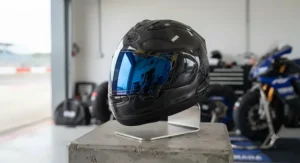
This is the visor most first-time buyers stumble onto when they type “cheap mirrored visor” into a search bar, and honestly, it earns its place here. Designed to clip onto the AGV K1, K3 SV, K5 and K5-S mounting pattern, the Aramox silver-plated shield uses a basic polycarbonate lens with a reflective coating rather than the vacuum-metallised process used on genuine OEM shields — which explains the price gap of roughly £40-£50 against the genuine AGV equivalent. Fitting is the whole appeal: no tools, no base-plate adjustment, just line up the pivot pins and click it home. Reviewers consistently report that the mirror finish looks genuinely striking when new and the fit is snug on the specified AGV models, while a common complaint in user reviews concerns optical distortion at the periphery of the lens compared with genuine shields — noticeable on long motorway stints rather than short urban hops. That distortion is the honest trade-off of budget aftermarket polycarbonate versus the optically-corrected, three-dimensionally moulded glass used in premium shields; it’s not a manufacturing defect so much as a different tier of production process. For a rider who wants the mirrored look for weekend rides and short commutes, and who isn’t logging motorway miles daily, this remains the most accessible entry point into mirrored visors on the market.
Pros:
- ✅ Among the cheapest genuinely mirrored options available
- ✅ Tool-free clip-on fit for the AGV K1/K3 SV/K5 pattern
- ✅ Noticeably reduces glare in bright daylight riding
Cons:
- ❌ Peripheral optical distortion reported at higher speeds
- ❌ Coating durability lags behind genuine OEM shields
At under £20, it’s genuinely difficult to find a cheaper route into mirrored eyewear for an AGV-pattern helmet, and for occasional riders that value proposition is hard to argue with.
3. LS2 FF320/FF353/FF328 Rainbow Mirror Visor — best budget pick for LS2 owners
LS2 helmets dominate a huge slice of the UK’s budget and mid-range market, and this rainbow-mirror shield is the go-to replacement across the FF320 Stream, FF353 Rapid and FF328 model families. The rainbow-iridium coating shifts colour depending on the light angle — gold to purple to blue across a single ride — which is more of a styling statement than the flatter silver or blue tones on other shields in this list. Spec-wise it’s a straightforward polycarbonate shield without Pinlock preparation on the base model, so anti-fog performance relies on ventilation and a decent breath deflector rather than an insert. Based on the spec comparison against pricier options here, what you’re actually paying for is brand-matched fitment rather than premium optics — the shield clips directly onto LS2’s existing base plate hardware without any adjustment, which matters enormously if your original visor’s ratchet mechanism has started slipping. Aggregated review sentiment on this shield trends positive for value and colour vibrancy, with the recurring criticism being reduced night-time visibility due to the tint depth, which reinforces why this should be treated as a daylight and fair-weather visor rather than an everyday commuting shield. Anyone doing genuine year-round riding on an LS2 lid should keep a clear shield in rotation alongside this one.
Pros:
- ✅ Direct drop-in fit for LS2 FF320, FF353 and FF328 models
- ✅ Distinctive rainbow-iridium colour shift in changing light
- ✅ Genuinely budget-friendly at under £25 typical retail
Cons:
- ❌ Not Pinlock-prepared as standard on most listings
- ❌ Too dark for safe use after dusk or in poor visibility
At around £15-£25, it’s one of the least expensive genuine-brand mirrored shields on this list, and for LS2 owners it’s very much the obvious first port of call.
4. AGV K3 SV Blue Mirror Visor — best for factory-matched AGV optics
The AGV K3 SV Blue Mirror is a genuine manufacturer shield, and the difference versus the aftermarket alternatives further up this list shows up the moment you actually put the helmet on at speed — the field of view is noticeably more distortion-free, particularly toward the shield’s edges where cheaper polycarbonate typically warps the periphery. It’s built specifically for the K3 SV, K5 and K1 pivot geometry, supplied in both XS-MS and ML-XXL sizing options with anti-fog treatment available as an upgrade at purchase. The blue-mirror finish sits at a lighter tint depth than some rival mirror shields, which — and this is the detail most spec sheets bury — actually helps it stay closer to usable light-transmission territory than heavier iridium or silver-mirror finishes, though riders should still verify markings before treating it as a night-time option. Honest analysis here favours riders who already own or are buying into the AGV ecosystem specifically for its optical reputation; this isn’t the shield to buy if you’re chasing the absolute cheapest mirrored look, because you’re paying a genuine premium for glass that’s engineered rather than simply coated. Reviewers consistently note the crisp anti-scratch coating holding up well over a full riding season, with occasional feedback around the tear-off posts feeling like an unnecessary bulge for riders who’ll never fit racing tear-offs.
Pros:
- ✅ Distortion-free optics noticeably better than budget alternatives
- ✅ Two size options (XS-MS and ML-XXL) for accurate fit
- ✅ Anti-scratch coating holds up well across a riding season
Cons:
- ❌ Meaningfully pricier than universal or LS2 alternatives
- ❌ External tear-off posts are unused bulk for most road riders
Sitting in the £55-£70 range, it’s a mid-to-premium pick that rewards AGV owners who value factory-matched clarity over raw savings.
5. HJC RPHA 11 Silver Mirror Visor — best mid-range OEM sport-touring shield
The RPHA 11 and RPHA 70 share the HJ-26 shield platform, and HJC’s silver-mirror version of it is arguably the best-balanced product on this entire list — genuine optical quality without quite reaching Shoei-level pricing. It’s supplied Pinlock-ready with the pins already fitted, which means adding an anti-fog insert later is a five-minute job rather than a mechanism strip-down, and it retains the external tear-off posts for riders who do occasional track days. Key specs translate directly into real-world benefit here: the quick-release visor mechanism needs zero tools to swap, and the shield’s silver-mirror coating sits at a tint depth that’s genuinely striking without tipping into the “too dark to read a speedo at dusk” territory that plagues some cheaper iridium finishes. What most buyers overlook about this model specifically is how well it plays with HJC’s RapidFire base plate — because the shield and mechanism were engineered together rather than reverse-engineered from measurements, the seal against wind noise at motorway speed is noticeably tighter than on universal-fit rivals. Aggregated customer sentiment across UK retailers skews strongly positive, with reviewers frequently praising the crisp reflective finish and easy fitment, while the main gripe is the price gap versus own-brand mirrored shields for cheaper HJC helmets in the same range.
Pros:
- ✅ Pinlock pins pre-fitted for instant anti-fog upgrade
- ✅ Tight motorway-speed seal thanks to matched OEM engineering
- ✅ Multiple mirror-tint colour options (silver, gold, blue)
Cons:
- ❌ Meaningfully pricier than HJC’s own budget HJ-09 shield
- ❌ Tear-off posts add unnecessary bulk for non-racing riders
Typically priced in the £40-£70 range depending on colour and Pinlock-insert bundling, it’s the pick for HJC RPHA owners who want a genuine step up without jumping brands entirely.
6. Shoei CWR-1 Spectra Mirrored Shield — best premium optical clarity
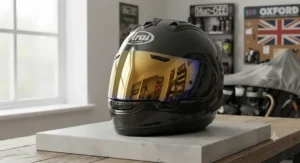
Shoei’s CWR-1 platform covers the RF-1200, RF-SR, X-Fourteen, X-Spirit III and NXR helmets, and the Spectra mirror finish sitting on top of that base shield is where this list moves firmly into premium territory. The headline spec — greater than 99% UV filtration — sounds like standard marketing copy until you factor in what Shoei actually changed mechanically: innovative ribs moulded into the top and bottom edge of the shield resist wind-pressure flex at speed, which is the real reason Shoei shields feel more stable and distortion-free on a motorway than most rivals, rather than purely down to the mirror coating itself. On paper this means less micro-flutter in your peripheral vision during sustained high-speed riding, and reviewers consistently back that up, describing the shield as noticeably calmer and clearer than either OEM or aftermarket alternatives fitted to the same helmet shell. It’s Pinlock-ready for the CWR-1/CW-1/CNS-1 insert family, and conforms to ECE R22/05, giving buyers a documented safety baseline rather than a vague “road use” claim. The trade-off is obvious and unavoidable: this is the most expensive shield on this list by a comfortable margin, and Shoei itself markets several tint depths — including this Spectra mirror — as not legal for road use, so verifying the specific colour variant’s markings before ordering is essential rather than optional.
Pros:
- ✅ Wind-pressure-resistant rib design reduces high-speed flutter
- ✅ Greater than 99% UV filtration with ECE R22/05 conformity
- ✅ Compatible with Shoei’s Pinlock insert ecosystem
Cons:
- ❌ The most expensive shield featured in this comparison
- ❌ Some Spectra mirror tints are explicitly not road-legal
Priced in the £70-£120 range depending on retailer and tint depth, it’s aimed squarely at riders who already own a premium Shoei lid and refuse to compromise the optics that came with it.
7. Shoei CNS-1 Silver Mirror Iridium Visor — best for flip-front touring helmets
Flip-front helmet owners running the Shoei GT-Air, GT-Air II or Neotec have a narrower replacement pool than standard full-face riders, and the CNS-1 silver-mirror iridium shield is the genuine answer to that gap. Because flip-front mechanisms integrate the visor pivot with the chin-bar hinge assembly, fitment tolerances matter more here than on a conventional full-face — a shield that’s even slightly out of spec can bind against the chin-bar mechanism rather than simply sitting loosely. The CNS-1’s silver-mirror iridium coating is applied to the same optically-corrected base lens used across Shoei’s touring range, meaning the reduction in eye-strain over long motorway stints that touring riders specifically buy Shoei for carries through into the mirrored variant rather than being sacrificed for the reflective finish. Reviewers consistently note the shield’s compatibility with Shoei’s internal sun-visor mechanism remaining smooth after installation — a detail that matters enormously for GT-Air and Neotec owners who rely on that internal visor daily and don’t want a replacement shield interfering with it. The spec sheet won’t tell you this, but user reports suggest the coating resists the fine surface scratching that comes from repeated flip-front cycling better than cheaper mirrored alternatives, likely down to the harder scratch-resistant top coat Shoei applies across its OEM range.
Pros:
- ✅ Purpose-built for flip-front chin-bar pivot tolerances
- ✅ Doesn’t interfere with the internal drop-down sun visor
- ✅ Scratch-resistant coating suited to frequent flip-up use
Cons:
- ❌ Narrower helmet compatibility than standard full-face shields
- ❌ Premium pricing similar to the CWR-1 at the top of its range
Expect to pay somewhere in the £45-£100 range depending on the specific colour and whether Pinlock preparation is included, making it a considered investment for touring riders who log serious annual mileage.
Full Spec & Price Comparison
| Visor | Pinlock-Ready | Mechanism | Price Range | Best For |
|---|---|---|---|---|
| HJC HJ-09 RST Mirror Shield | Partial (colour-dependent) | RapidFire tool-less | £25-£40 | Broad HJC compatibility |
| Aramox Universal Silver Mirror Visor | No | Clip-on pivot | Under £20 | Cheapest AGV-pattern upgrade |
| LS2 FF320/FF353/FF328 Rainbow Visor | No (standard) | LS2 base plate clip | £15-£25 | LS2 budget owners |
| AGV K3 SV Blue Mirror Visor | Optional add-on | AGV genuine pivot | £55-£70 | Factory-matched AGV clarity |
| HJC RPHA 11 Silver Mirror Visor | Yes, pins fitted | RapidFire quick-release | £40-£70 | Mid-range HJC sport-touring |
| Shoei CWR-1 Spectra Mirror Shield | Yes | Shoei base plate | £70-£120 | Premium high-speed clarity |
| Shoei CNS-1 Silver Mirror Visor | Colour-dependent | Flip-front pivot | £45-£100 | Touring flip-front helmets |
Reading across this table, the pattern is clear: Pinlock readiness and premium pricing move together almost in lockstep, because both stem from the same underlying investment in optical engineering. If your priority is simply refreshing a tired mirrored look on a budget helmet, the LS2 FF320/FF353/FF328 Rainbow Visor or Aramox Universal Silver Mirror Visor deliver that without unnecessary spend. But if you’re commuting daily in variable British weather, the Pinlock-ready options — particularly the HJC RPHA 11 Silver Mirror Visor — earn their higher price through genuinely reduced fogging hassle.
Practical Usage Guide: Fitting, First Use and Ongoing Care
Fitting a new mirrored shield is rarely as intimidating as riders expect, but a few mistakes in the first thirty days cause most of the returns and one-star reviews you’ll see online. Start by removing the old shield with the visor in the fully open position — most quick-release systems (RapidFire, VAS, Pinlock base plates) need a small tab pulled or pushed before the shield releases, and forcing it in the closed position is the single most common cause of a snapped mechanism. Clean the base plate area of old grease and grit with a dry cloth before clicking the new shield home; debris trapped behind the pivot is a leading cause of stiff or gritty visor action within the first few weeks. Once fitted, cycle the visor fully open and closed five or six times before riding, checking that it locks positively at the first detent — a shield that doesn’t seat correctly at low speed will almost certainly lift or rattle at motorway speed. For ongoing maintenance, rinse road grime off with lukewarm water before wiping, since dry-wiping grit across a mirror coating is what causes the fine scratch patterns that dull reflective finishes over a season. A light silicone spray on the pivot points every few months keeps the mechanism smooth without attracting the dust that petroleum-based lubricants tend to gather.
Helmet Visor Mechanism Replacement: Step-by-Step
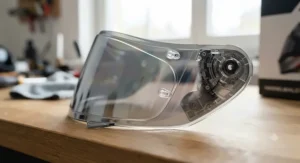
Sometimes it’s not the shield itself that’s failed but the ratchet mechanism underneath it, and replacing that is a genuinely different job worth understanding before you order parts. First, identify whether your helmet uses a screw-fixed base plate or a snap-fit cassette system — most modern HJC, Shoei and AGV helmets use a removable cassette, while older or budget helmets often use a single centre screw per side. Second, remove the shield entirely before touching the mechanism, since working around an attached shield risks cracking it against the shell. Third, note the ratchet’s default detent position before removing it — photographing it on your phone saves real frustration on reassembly. Fourth, replace the mechanism as a matched pair even if only one side has failed, because mismatched left-and-right resistance is what causes a shield to bind or sit crooked afterwards. Fifth, refit the shield before fully tightening the mechanism screws, using the shield’s own movement to confirm the ratchet engages evenly on both sides. Sixth, test the full range of motion — fully open, each detent position, and fully closed — before riding, and only then apply full torque to the fixing screws. This entire process typically takes twenty to thirty minutes with basic tools, and genuine replacement mechanisms for the brands featured here generally run £10-£25 per side, considerably cheaper than a full helmet replacement.
Real-World Scenarios: Which Rider Are You?
Consider a college student commuting six miles daily on an ageing LS2 lid with a scratched, yellowing original shield — for that budget and use case, the LS2 FF320/FF353/FF328 Rainbow Visor is the obvious call: cheap, direct-fit, and a genuine visual refresh without touching the mechanism. Now picture a weekend sportsbike rider on an AGV K3 SV who does the occasional 150-mile Sunday run and wants glare reduction on bright motorway stretches without sacrificing optical clarity — the AGV K3 SV Blue Mirror Visor matches that brief precisely, trading some budget savings for genuine factory optics. Finally, think about a year-round commuter logging 12,000 miles annually on a Shoei GT-Air, riding through fog, rain and low winter sun in roughly equal measure — for that rider, the Shoei CNS-1 Silver Mirror Visor paired with a clear shield kept in reserve for night riding is the sensible, if pricier, long-term solution, because the flip-front pivot tolerances and Pinlock compatibility genuinely reduce fogging-related near-misses across a full riding season.
✨ Don’t Miss These Exclusive Deals!
🔍 Take your visor upgrade to the next level with these carefully selected products. Click on any highlighted item to check current pricing and availability. These shields will help you create the sharp, glare-free ride your commute deserves!
Mirrored Visor Fitment Guide: Getting the Fit Right
Fitment is where most mirrored-visor purchases quietly go wrong, and it’s rarely the shield’s fault — it’s a mismatch between the shield’s mounting pattern and the helmet’s actual model or production year. Manufacturers frequently update base plate geometry between model refreshes without renaming the helmet, so an “RPHA 11” bought in 2019 and one bought in 2026 can, in rare cases, use slightly different shield generations. The safest approach is always to match against your helmet’s specific model code, printed inside the chin strap or on a small label under the padding, rather than relying on the name printed on the box. HJC, Shoei and AGV all group multiple helmet models under a single shield platform code (HJ-26, CWR-1, K3 SV respectively) specifically to reduce this confusion, so searching by that platform code rather than the helmet’s marketing name tends to return more accurate results. If in doubt, contact the retailer with your helmet’s exact model and production batch before ordering — most UK helmet specialists will confirm compatibility for free rather than process a return later.
Universal Mirror Visor Sizing Explained
“Universal fit” mirrored visors, like the Aramox option featured above, aren’t actually universal in the way the name implies — they’re universal within a specific mounting pattern, most commonly matched to AGV’s K-series geometry because it’s one of the most widely cloned pivot designs on the aftermarket market. Before buying a universal-fit shield, measure the distance between your helmet’s two pivot screws and compare it against the listing’s stated compatibility, since a few millimetres of difference is enough to cause binding or a visor that won’t seat flush. Universal shields also typically come in a single size regardless of helmet shell size (small through XXL), because the shield curvature is standardised to the pivot geometry rather than the shell’s outer dimensions — this works fine in most cases but can leave a very slightly looser or tighter seal on helmets at the extreme ends of the size range. As a rule of thumb, universal mirrored visors are best treated as a budget experiment for AGV-pattern helmets specifically, rather than a genuinely cross-brand solution; riders on HJC, Shoei, Shark or Caberg helmets are almost always better served by a genuine or brand-matched OEM shield rather than a generic universal fit.
How to Choose a Replacement Mirrored Visor for Full Face Helmet
- Confirm your exact helmet model and shield platform code first. This single step eliminates the vast majority of fitment returns before you spend a penny.
- Decide whether Pinlock readiness matters for your riding pattern. Year-round or high-mileage commuters benefit enormously; fair-weather weekend riders may not need it.
- Check the tint depth and road-legal marking on the specific colour variant. Darker mirror finishes frequently carry “not for road use” labelling that lighter tints avoid.
- Match your budget to your annual mileage, not just the sticker price. A cheaper shield replaced twice a year can cost more over time than one premium OEM shield.
- Consider whether you need a spare clear shield for night riding. Most mirrored visors are explicitly daylight-only, so a backup avoids being caught without a legal option after dark.
- Factor in the mechanism’s condition, not just the shield. A worn ratchet can undermine even the best-fitting new shield.
- Read aggregated review sentiment for your specific model, not just star ratings. Recurring complaints about fitment or coating durability tell you more than an average score alone.
Common Mistakes When Buying a Replacement Mirrored Visor
The single most common mistake is buying by helmet brand name alone rather than by shield platform code — as covered above, this causes the bulk of fitment-related returns. A close second is assuming any mirrored finish is automatically road-legal simply because it’s sold on a major UK retail platform; retailers list both road-legal and track-only shields side by side, and the responsibility for checking markings sits with the buyer. Riders also frequently underestimate cleaning requirements, treating a mirror-coated shield the same as a standard clear one and scrubbing it with whatever cloth or cleaner is nearest to hand — this is what causes premature dulling of the reflective finish within a single season. Another recurring error is ignoring the mechanism entirely when the real problem is a worn ratchet rather than a scratched shield, leading to a new shield being fitted onto a mechanism that continues to bind or rattle regardless. Finally, many buyers skip checking whether Pinlock pins are pre-fitted, only discovering after purchase that an anti-fog insert requires an additional mechanism strip-down to retrofit.
Mirrored vs Tinted vs Clear Visors: What’s the Difference
| Type | Light Transmission | Typical Road-Legal Status | Best Use |
|---|---|---|---|
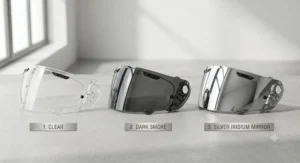
| Clear visor | Near 100% | Always legal | Night riding, poor visibility, year-round default |
| Light tint / mirror | Around 50% or above | Legal for daylight use if marked | Bright daylight commuting |
| Dark mirror / iridium | Often well below 50% | Frequently not road-legal | Track days, closed-circuit use |
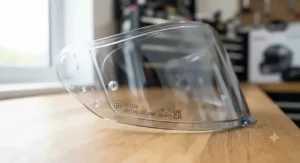
The line that governs everything is straightforward: visors transmitting less than 50% of visible light cannot legally be used on UK roads, and dark smoke, heavy tints and many mirror-finish shields fall below that threshold, making them illegal for road use regardless of time of day — a point explained well in this overview of motorcycle helmet visor design and standards. Clear visors carry no restrictions and remain the sensible default for anything outside bright, dry daylight. Mirrored shields occupy a genuinely useful middle ground when the specific tint depth is marked for daylight road use, offering meaningful glare reduction without crossing into illegality — but the “mirror” finish and the underlying tint depth are two separate specifications, and a light-tint mirror behaves very differently in law to a dark iridium one.
Safety, Regulations & Road-Legal Compliance Guide
Beyond the light-transmission rule already covered, riders should know that a helmet fitted with a non-protective lower face cover must carry a specific marking indicating it doesn’t protect the chin from impacts — a detail that occasionally trips up riders assuming any flip-front shell offers full-face-equivalent chin protection. The Highway Code’s rules for motorcyclists reinforce this, stating plainly that eye protectors must comply with the Regulations and that scratched or poorly fitting ones can limit your view, particularly in bright sunshine and the hours of darkness. When it comes specifically to replacement shields, always check for an ECE E-mark or equivalent BSI Kitemark stamped into the shield’s edge; its absence means the shield isn’t certified for road use at all, irrespective of tint depth. According to the enforcement approach described by UK police guidance, officers typically give verbal advice for tinted visors used in daylight, but can move toward prosecution — including potential penalty points — if a heavily tinted or mirrored shield is used during darkness or genuinely reduced visibility. Practically, this means keeping a certified clear shield as a backup is not excessive caution; it’s a sensible safeguard against being caught out by a delayed journey home after sunset.
Long-Term Cost & Maintenance
Total cost of ownership on a replacement mirrored visor rarely stops at the purchase price. Factor in a Pinlock anti-fog insert if the shield doesn’t include one — typically £10-£20 — plus the realistic lifespan of the mirror coating itself, which honest aggregated feedback across the products in this guide suggests runs somewhere between one and three riding seasons depending on cleaning habits and UK weather exposure. Budget universal shields at the cheaper end of this list tend toward the shorter end of that range, while genuine OEM shields from HJC, AGV and Shoei generally hold their coating integrity closer to the three-season mark with proper care. Factor in a spare clear shield too, since riders relying solely on a mirrored visor inevitably end up buying one anyway once autumn evenings draw in. Viewed over two or three years of regular use, a single premium OEM shield replaced once often works out cheaper — and considerably less hassle — than repeatedly replacing a budget shield every riding season.
Features That Actually Matter (And Those That Don’t)
Pinlock readiness and tight base-plate tolerances genuinely matter for anyone riding through a British autumn or winter; fogging is a safety issue, not a comfort one, and this is where spend is justified. ECE R22/05 or 22.06 conformity marking matters enormously too, because it’s the difference between a legal shield and an expensive ornament. What matters considerably less, despite heavy marketing emphasis, is the exact iridium colour or “spectrum” branding some manufacturers use — a gold mirror and a blue mirror perform near-identically in terms of glare reduction and light transmission once the underlying tint depth is equal; the colour is genuinely just styling preference. External tear-off posts are similarly overrated for the vast majority of road riders who will never fit racing tear-off films, adding bulk and a very marginal wind-noise increase for a feature they’ll never use.
Frequently Asked Questions
❓ Are mirrored visors legal on UK roads?
❓ Will any mirrored visor fit any full face helmet?
❓ Can I ride at night with a mirrored visor?
❓ How often should I replace a mirrored motorcycle visor?
❓ Do I need Pinlock with a mirrored visor?
Conclusion
Choosing a replacement mirrored visor for full face helmet setups ultimately comes down to matching three things honestly: your exact helmet’s fitment platform, your real riding pattern across the seasons, and how much you’re genuinely willing to spend for optical clarity versus simple cosmetic refresh. Budget picks like the LS2 FF320/FF353/FF328 Rainbow Visor and Aramox Universal Silver Mirror Visor earn their place for occasional riders and tight budgets, while genuine OEM shields — the AGV K3 SV Blue Mirror Visor, HJC RPHA 11 Silver Mirror Visor, and both Shoei options — reward daily commuters and touring riders with better optics, tighter mechanism integration, and coatings that simply last longer. Whichever you choose, treat the road-legal light transmission rule as non-negotiable rather than a grey area to gamble on, and keep a clear shield in reserve for the inevitable evening the ride home runs later than planned. Get the fitment right, respect the regulations, and a mirrored visor genuinely is one of the best-value upgrades available for a helmet you already trust.
✨ Don’t Miss These Exclusive Deals!
🔍 Take your visor upgrade to the next level with these carefully selected products. Click on any highlighted item to check current pricing and availability. These shields will help you create the sharp, glare-free ride your commute deserves!
Recommended for You
- Best Iridium Visor for Motorbike Helmets in 2026: 7 Picks Compared
- Tinted Visor for Sunny Commutes: 7 Best Picks for 2026
- Legal Tinted Visor for Road Use: 7 Best UK Picks for 2026
Disclaimer: This article contains affiliate links. As an Amazon Associate, I earn from qualifying purchases. If you purchase products through these links, we may earn a small commission at no additional cost to you.
✨ Found this helpful? Share it with your friends! 💬🤗
