

In This Article
Somewhere around mile 150 of a motorway slog, most riders stop thinking about horsepower and start thinking about their neck. A fibreglass touring helmet is a helmet with a glass-fibre or glass-fibre composite outer shell, valued for combining a lighter weight than polycarbonate with a more forgiving, energy-spreading way of absorbing an impact. That’s the textbook definition, but it doesn’t capture what actually matters on a wet Tuesday commute to Leeds or a fortnight touring the Alps: how quiet it is at 70mph, whether the cheek pads still feel friendly after hour four, and whether you’ll be fishing for paracetamol by the time you reach the services. This guide digs into seven real, current fibreglass touring helmets sold in the UK, weighing up genuine specs against aggregated rider feedback, so you can work out which one actually earns its place on your head rather than just your credit card statement. We’ll cover comfort, wind noise decibel behaviour, long-distance stamina, and what separates a helmet that merely fits from one that disappears once you’re moving. Somewhere between “impulse buy” and “five-year investment”, there’s a smarter way to choose — and that’s what we’re building towards here. Buckle in; there’s a fair bit of ground to cover, and — like most touring helmets — this one’s better appreciated in full than skimmed at speed.

Quick Comparison Table
| Helmet | Shell | Type | Weight (approx.) | Price Range |
|---|---|---|---|---|
| HJC F70 | Advanced Fibreglass Composite | Full-face | ~1.55kg | Under £270 |
| Caberg Levo | Tri-composite (fibreglass/kevlar/carbon) | Modular | ~1.65kg | £250-£350 range |
| Shoei GT-Air 3 | AIM+ fibreglass composite | Full-face | ~1.5kg | Around £500 |
| Arai Quantic | PB-cLc2 fibreglass composite | Full-face | ~1.5kg | From around £500 |
| Shoei Neotec 3 | AIM+ fibreglass composite | Modular | ~1.6kg | £650-£750 range |
| Schuberth C5 | Direct Fiber Processing glass-fibre + carbon | Modular | ~1.66kg | £340-£540 range |
| Shoei J-O | Composite fibreglass | Open-face | ~1.5kg | £450-£550 range |
Reading across that table, the spread tells its own story: HJC F70 proves fibreglass doesn’t have to mean premium pricing, while Shoei Neotec 3 and Schuberth C5 sit at the top for riders who’ve decided quiet, all-day comfort is worth paying for. Weight differences look small on paper — a few hundred grams — but multiplied by eight hours in the saddle, that difference becomes very real neck fatigue. None of these are budget bargain-bin helmets in the polycarbonate sense; fibreglass at this price point already buys you a meaningfully lighter, more refined shell than the thermoplastic options crowding the same shelf.
💬 Just one click — help others make better buying decisions too!😊
Top 7 Fibreglass Touring Helmets: Expert Analysis
1. HJC F70 — proof fibreglass doesn’t have to break the bank
The HJC F70 is the helmet that made a lot of riders raise an eyebrow, because fibreglass shells at this price point are genuinely rare — most manufacturers keep composite construction for their £400+ range. HJC calls its material Advanced Fibreglass Composite, and independent SHARP testing rated the HJC F70 four stars out of five for safety, a solid result for a mid-priced lid. The shell weighs around 1.55kg, which is a touch heavier than the class average but shouldn’t cause discomfort on its own. Where the HJC F70 earns its keep is in what it’s built for: sport-touring riders who want a wide, Pinlock-ready visor, an internal drop-down sun shield, and Bluetooth-ready speaker pockets for HJC’s own Smart Intercom system, without needing to remortgage anything. Aggregated owner reviews consistently praise the ventilation and finish for the money, though a recurring theme is that the old-style screw-fixed visor (rather than a quick-release mechanism) feels dated, and a handful of owners report water pooling at the top of the visor seal in heavy rain. This is a helmet for riders who want fibreglass performance on a polycarbonate budget, and who don’t mind a slightly old-fashioned visor mechanism in exchange.
Pros:
- ✅ Fibreglass shell at a genuinely budget-friendly price point
- ✅ SHARP 4-star safety rating with wide, Pinlock-ready visor
- ✅ Bluetooth-ready speaker pockets and washable anti-bacterial lining
Cons:
- ❌ Visor uses old-style screws, not quick-release
- ❌ Some owners report water pooling in wet weather
Prices for the HJC F70 typically sit under £270, and at that level it represents excellent value — you’re paying for the shell material other brands reserve for their premium range.

2. Caberg Levo — the value-focused modular for touring miles
The Caberg Levo is Caberg’s dedicated touring flip-front helmet, and it’s built from a tri-composite shell blending fibreglass, kevlar, and carbon fibre — a construction typically found on helmets costing considerably more. Caberg, an Italian manufacturer, has historically leaned on polycarbonate for its everyday range, so the decision to bring composite construction to a touring-focused modular signals where this model is aimed: riders who want dual-homologation (meaning you can legally ride with the chin bar raised) without paying flagship prices. Based on the spec sheet, the multi-material shell should offer a lighter, more flexible impact response than a straight fibreglass build, while keeping weight around 1.65kg. Aggregated review sentiment on Caberg’s modular range generally highlights strong value and a snug, secure fit, though — as with most flip-fronts — riders who prioritise absolute silence tend to note that modular mechanisms introduce more opportunities for wind whistle around the chin bar seal than a fixed full-face shell. What most buyers overlook about this model is that dual homologation matters enormously for touring: being legally able to ride with the chin bar up at a fuel stop, without removing the whole helmet, adds up over a multi-day trip.
Pros:
- ✅ Tri-composite fibreglass/kevlar/carbon shell at a mid-range price
- ✅ Dual homologation — legal to ride with chin bar raised
- ✅ Genuine touring-focused ventilation and liner design
Cons:
- ❌ Chin bar mechanism can introduce more wind noise than a fixed shell
- ❌ Fewer UK reviews available than the market-leading Shoei and Schuberth rivals
Expect the Caberg Levo to sit in the £250-£350 range depending on finish, making it one of the more accessible composite-shelled modular options for UK tourers.
3. Shoei GT-Air 3 — the sport-touring all-rounder
Shoei’s AIM+ shell, used across its premium range including the Shoei GT-Air 3, is a multi-composite fibre construction that blends fibreglass with other reinforcing fibres to keep weight down without sacrificing the flex characteristics that help spread impact energy. The Shoei GT-Air 3 is pitched as a premium sport-touring full-face helmet, and on paper the combination of a drop-down sunshield, micrometric ratchet fastener, and a well-sealed visor is exactly what a rider doing motorway miles wants. Reviewers at BikeSocial rate it as one of the best sport-touring and all-rounder helmets currently available, praising the venting and comfort while noting it’s among the pricier options in its class. Here’s what to weigh: the Shoei GT-Air 3 is built for riders who want race-helmet pedigree translated into a long-distance-friendly package, rather than a helmet designed from scratch purely for comfort. That shows up in slightly more aggressive aerodynamics than a dedicated touring lid, which is a genuine advantage at speed but means it’s marginally less forgiving on very slow, stop-start rides where airflow can’t do its job.
Pros:
- ✅ Race-derived AIM+ fibreglass composite shell, genuinely lightweight
- ✅ Drop-down internal sunshield and refined micrometric fastener
- ✅ Strong ventilation praised consistently in expert reviews
Cons:
- ❌ Universal comms compatibility is more fiddly than dedicated touring rivals
- ❌ Among the pricier options in the sport-touring full-face category
Prices for the Shoei GT-Air 3 generally sit around £500, positioning it as a premium purchase that rewards riders who spend serious hours per week in the saddle.
4. Arai Quantic — the safety-first sport-tourer
Arai has built its reputation on fibreglass — the brand calls its material “Super Fibre” and constructs it using a chopped-strand method that gives multi-directional strength rather than the single-direction weave you’d get from ordered fibre mats. The Arai Quantic was the first Arai helmet certified to the tougher ECE 22.06 standard, and reviewers consistently rate its ventilation and comfort among the best in the sport-touring and all-rounder category. What most buyers overlook about Arai’s approach is the philosophy behind the shape: Arai designs its shells to deflect impact energy across the surface — a “glancing off” strategy — rather than absorbing everything at one contact point, which is a meaningfully different engineering bet to brands optimising purely for lightness. The Arai Quantic weighs around 1.5kg, competitive for its class, and its round-oval-leaning shape tends to suit riders whose head shape doesn’t perfectly match the narrower “long oval” fit that some Japanese and Italian brands favour. Aggregated owner sentiment highlights genuinely excellent ventilation as a stand-out feature, especially useful on stop-start UK summer rides where heat build-up under a poorly vented lid becomes miserable fast.
Pros:
- ✅ First Arai certified to the tougher ECE 22.06 standard
- ✅ Distinctive glancing-off shell design philosophy for impact deflection
- ✅ Ventilation consistently rated among the best in its class
Cons:
- ❌ Round-oval fit won’t suit every head shape
- ❌ No integrated drop-down sunshield on all versions — check the spec before buying
The Arai Quantic starts from around £500, putting it squarely against the Shoei GT-Air 3 as a premium sport-touring choice, with the decision largely coming down to fit and shell philosophy rather than one being objectively “better”.
5. Shoei Neotec 3 — the modular most experienced tourers land on
Ask a well-travelled tourer which modular helmet they’d recommend, and the Shoei Neotec 3 comes up more often than any rival. Built around the same AIM+ multi-composite fibre shell used across Shoei’s range, it’s noticeably lighter than its sturdy chin-bar mechanism would suggest, and it carries full ECE 22.06 dual homologation — meaning it’s approved for road use both open and closed, not just closed like some flip-fronts. The fully integrated internal sun visor is smooth to operate, the ventilation system genuinely moves air rather than just looking like it does on the spec sheet, and reviewers single out wind noise as notably low for a modular design — a genuine achievement, since chin-bar seals are usually where modular helmets lose the noise battle against fixed full-face lids. Sena SRL3 comms integration is available as a clean, no-external-clutter option, which matters for anyone doing group rides where cutting through wind noise for intercom chat is non-negotiable. Based on the spec comparison against rivals like the Schuberth C5, the Shoei Neotec 3 trades a little outright silence for a lighter overall package — a sensible compromise for riders whose priority is reducing neck fatigue across very long days rather than chasing the absolute lowest decibel reading.
Pros:
- ✅ ECE 22.06 dual homologation — approved open and closed
- ✅ Notably quiet for a modular, with genuinely effective venting
- ✅ Clean Sena SRL3 comms integration available
Cons:
- ❌ Premium price puts it out of reach for casual tourers
- ❌ Heavier than a dedicated full-face, as with any flip-front
Typical UK pricing for the Shoei Neotec 3 sits in the £650-£750 range, which is a serious investment — but for riders covering thousands of miles a year, the cost-per-mile maths tends to work out favourably against replacing a cheaper helmet every couple of seasons.
6. Schuberth C5 — arguably the quietest helmet on UK roads
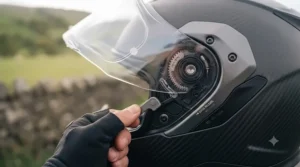
The Schuberth C5 isn’t just another modular helmet — it’s the result of Schuberth reportedly investing over 20,000 engineering hours and 200-plus hours of dedicated wind-tunnel testing into refining airflow around the shell. The headline figure that keeps coming up in reviews is an 85 dB(A) noise level at 100 km/h on a naked bike — roughly comparable to city traffic heard from inside a car, and a genuinely striking result for any helmet, let alone a flip-front. That’s built around Schuberth’s Direct Fiber Processing (DFP) glass-fibre shell, reinforced with carbon fibre, which the brand says keeps weight to around 1,660 grams for a size 59 — respectable given the noise-reduction engineering packed in. For riders who’ve battled motorway wind fatigue or worry about long-term hearing strain, this represents one of the more meaningful upgrades available in the touring category right now. Built-in SC2 Bluetooth intercom compatibility is included as standard, and reviewers describe the fit as snug and secure, particularly favouring intermediate-oval head shapes — though that security comes with a heavier overall feel than the Shoei Neotec 3 on longer days, a trade-off some riders notice and some don’t.
Pros:
- ✅ Reported 85 dB(A) noise level — among the quietest helmets tested
- ✅ Glass-fibre and carbon DFP shell from 20,000+ engineering hours
- ✅ Built-in SC2 Bluetooth intercom compatibility as standard
Cons:
- ❌ Heavier than the Shoei Neotec 3, noticeable on very long days
- ❌ Premium pricing reflects the extensive R&D behind it
Prices for the Schuberth C5 range from around £340 to £540 depending on finish and retailer, making it genuinely competitive against the Shoei Neotec 3 for riders whose single biggest priority is motorway quiet.
7. Shoei J-O — the open-face option for classic style and comfort
Not every tourer wants a chin bar, and the Shoei J-O proves an open-face helmet doesn’t have to mean compromising on shell quality. It uses the same composite fibreglass blend Shoei applies to its top-spec racing helmets, paired with the brand’s multi-density EPS liner technology, and reviewers who’ve spent extended time in it — including one rider who logged four months and 4,400 miles touring in warm conditions — describe a low-profile shell shape that avoids the “lightbulb head” look some open-face helmets suffer from. The clear visor offers three levels of closure, removing the need for separate goggles while still providing genuine wind and rain protection, and the double-D ring chin strap keeps things properly secure. Based on the spec comparison against full-face rivals, the obvious trade-off is chin protection: an open-face helmet, however well built, cannot protect your jaw the way a Shoei GT-Air 3 or Arai Quantic can. What most buyers overlook is that the Shoei J-O genuinely earns its “touring” label through all-day wearability and airflow rather than outright aerodynamic silence — it’s a helmet built for warm-weather, scenic-route touring rather than winter motorway slabs.
Pros:
- ✅ Racing-grade composite fibreglass shell on an open-face design
- ✅ Low-profile shape avoids the bulky “lightbulb” silhouette
- ✅ Three-level visor closure removes the need for separate goggles
Cons:
- ❌ No chin bar means less facial protection than full-face rivals
- ❌ Less ideal for cold or wet motorway riding than closed helmets
The Shoei J-O typically sits in the £450-£550 range, positioning it as a premium open-face choice best suited to warmer touring seasons and riders who specifically want that classic, wind-in-your-face feel without sacrificing shell quality.
Getting the Perfect Fit: Cheek Pads, Comfort & Long-Distance Setup
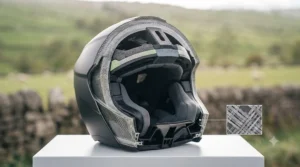
A fibreglass touring helmet only performs like the spec sheet promises if it actually fits your head, and cheek pad comfort is where most first-time buyers go wrong. Straight out of the box, most premium helmets — including several on this list — ship with slightly firmer cheek pads than they’ll settle to after a break-in period, because manufacturers assume the foam will compress with wear. The mistake is judging comfort in a five-minute shop try-on rather than a proper 20-30 minute wear test; genuine pressure points, as opposed to normal snugness, tend to reveal themselves after that point, particularly around the temples and jaw hinge. If a shop offers interchangeable cheek pad thicknesses — Shoei, Arai, and Schuberth all do on several models — that’s worth using rather than assuming you’re stuck with what arrived in the box. For long-distance comfort specifically, pay attention to how the neck roll sits: too tight and it’ll dig in on a six-hour ride, too loose and wind noise creeps in around the base of the helmet, undermining even the best shell design. Reviewers who tour extensively consistently mention that a helmet feeling “almost too snug” in the first week, provided there are no sharp pressure points, is usually the correct fit once the padding settles — a genuinely comfortable fibreglass touring helmet earns that reputation gradually, not on day one.
Real-World Scenario: Which Fibreglass Touring Helmet Suits Your Riding?
Picture three riders, each with genuinely different needs, because “best touring helmet” depends enormously on what your riding actually looks like. First, the weekday commuter doing 40 miles each way on the A-roads and occasional motorway stretch into a city centre, budget-conscious but unwilling to compromise on shell quality — this is where the HJC F70 earns serious consideration, delivering fibreglass performance without premium pricing, and its Bluetooth-ready design suits someone who wants podcasts on the commute. Second, the multi-day continental tourer heading to the Alps or Pyrenees twice a year, covering 300+ miles a day and needing to stop, chat, grab a coffee, and get moving again without endless faff — here the dual-homologated Caberg Levo or the flagship Shoei Neotec 3 make more sense, since being able to flip the chin bar up legally at a service station genuinely changes how a long day feels. Third, the dedicated motorway warrior — someone doing serious mileage on the M6 or M25 every single week, for whom cumulative wind noise and fatigue is a real long-term health concern rather than a minor annoyance — the Schuberth C5‘s reported 85 dB(A) rating makes a genuinely compelling case, even at its premium price, because the maths on hearing protection and reduced fatigue over years of riding tends to justify the outlay.
Buyer’s Decision Framework
If budget is your primary constraint but you still want the genuine benefits of a fibreglass shell, choose the HJC F70, because it delivers composite construction other brands reserve for triple the price. If you frequently stop and start on a tour and hate removing your whole helmet at fuel stations, choose a dual-homologated modular like the Caberg Levo or Shoei Neotec 3, because legal open-riding capability saves genuine hassle across a multi-day trip. If wind noise and motorway fatigue are your single biggest concern, choose the Schuberth C5, because its engineering is specifically optimised around that one metric more than any rival here. If you want race-derived ventilation and don’t mind a marginally sportier riding position, choose the Shoei GT-Air 3 or Arai Quantic, because both prioritise airflow and shell refinement over pure touring comfort features. If you’re touring in warm weather and want a classic, open riding feel without giving up shell quality, choose the Shoei J-O, accepting the reduced facial protection that comes with any open-face design.
How to Choose a Fibreglass Touring Helmet
- Start with fit, not features. Measure your head circumference in centimetres at the widest point above the eyebrows, then cross-reference each brand’s own sizing chart — an L in Shoei and an L in Arai are not the same shape, let alone the same size.
- Confirm the certification. Look for ECE 22.06 as the current benchmark; it’s a tougher standard than the older 22.05 and increasingly the mark serious manufacturers lead with.
- Check the SHARP star rating. The UK government’s independent testing programme publishes star ratings for most helmets sold here, and it’s free, transparent, and unaffected by brand marketing.
- Decide full-face, modular, or open-face early. This single decision affects noise, weight, and practicality more than almost any spec on the sheet, so settle it before comparing individual models.
- Weigh up comms compatibility. If you ride in a group or want navigation prompts, check whether the helmet has a purpose-built intercom mount rather than relying on a bulky aftermarket clamp kit.
- Read aggregated review sentiment, not just star averages. A 4.2-star average can hide a recurring complaint about visor fogging or cheek pad pressure that matters enormously to your specific riding style.
- Try before you buy wherever possible. No spec sheet substitutes for 20 minutes wearing the helmet in-store, ideally with your usual jacket and any glasses you ride in.
Fibreglass vs Polycarbonate vs Carbon Fibre Touring Helmets
| Shell Material | Typical Weight | Relative Cost | Impact Behaviour |
|---|---|---|---|
| Polycarbonate | Heaviest | Lowest | Absorbs energy well at lower-speed impacts |
| Fibreglass | Mid | Mid-to-premium | More flexible, spreads energy across a wider area |
| Carbon Fibre | Lightest | Highest | Excellent strength-to-weight, less flex than fibreglass |
Polycarbonate remains a genuinely safe choice for budget-conscious riders — brands like AGV and Nolan build excellent thermoplastic helmets — but it performs better specifically at lower-speed impacts, since the shell itself absorbs more energy before transferring it to the EPS liner. Fibreglass, by contrast, sits in the middle: it’s noticeably lighter than polycarbonate, and its slightly more flexible construction spreads impact energy across a larger portion of the shell, which is why it dominates the mid-to-premium touring category. Carbon fibre goes further again on weight, but that extra rigidity means it flexes less on impact, so manufacturers typically pair it with a bit more EPS foam to compensate — worth remembering if you’re chasing carbon purely because “lighter must be better.”
What to Expect: Real-World Performance on the Motorway — Wind Noise, Decibels & Comfort
Wind noise is arguably the single most under-discussed spec on any touring helmet box, yet it’s the factor most likely to determine whether you arrive home relaxed or with a dull headache and ringing ears. Independent road testing that measures decibel readings with a meter placed inside the helmet consistently shows that fibreglass and carbon-fibre helmets outperform polycarbonate on noise, both scoring similarly in comparative testing while polycarbonate trails behind. That’s not purely down to the shell material itself — aerodynamic shaping, neck roll design, and visor seal quality all matter enormously — but a well-engineered fibreglass shell gives manufacturers more design freedom to sculpt smoother, quieter profiles. The standout figure among the helmets covered here is the Schuberth C5‘s reported 85 dB(A) at 100 km/h, a result of dedicated wind-tunnel development rather than shell material alone. For context, prolonged exposure above 85 decibels is generally considered the threshold where hearing protection becomes a genuine consideration, according to workplace noise guidance — which is worth bearing in mind if you’re doing serious weekly motorway mileage rather than occasional weekend rides. Properly fitted earplugs remain sensible for any rider doing sustained speeds above roughly 40mph, regardless of how quiet the helmet claims to be.
Common Mistakes When Buying a Fibreglass Touring Helmet
The most frequent mistake is buying by brand reputation alone rather than checking head-shape compatibility — a five-star SHARP-rated helmet that doesn’t suit your skull shape will never feel as protective as a four-star helmet that fits properly, because fit directly affects how evenly the EPS liner can do its job in a crash. A close second is underestimating how much a drop-down sun visor or Pinlock insert matters until you’re squinting into low winter sun on the M40 without one — these aren’t luxury add-ons for genuine touring use, they’re functional necessities. Riders also commonly skip checking dual homologation on modular helmets, assuming any flip-front is legal to ride with the chin bar open, when in fact only helmets specifically P/J rated for both positions are road-legal that way. Finally, plenty of buyers focus entirely on weight figures in isolation without considering how that weight is distributed — a helmet that’s marginally heavier but better balanced can feel lighter on the neck over a long day than a nominally lighter helmet that sits awkwardly.
Long-Term Cost & Maintenance
Total cost of ownership for a fibreglass touring helmet extends well past the sticker price, and it’s worth running the numbers before assuming the cheapest option is the best value. Manufacturers and safety bodies generally recommend replacing a helmet every five years regardless of visible damage, since UV exposure, sweat, and general ageing degrade the EPS liner’s protective properties even without a crash. Spread across that five-year window, a £500 Shoei GT-Air 3 works out to roughly £8 a month, while a £250 Caberg Levo works out closer to £4 a month — a genuinely small gap once you account for daily use, and one that’s easily outweighed by comfort and noise differences on high-mileage riders. Replaceable Pinlock inserts, typically £15-£25, and washable liners that extend the interval between full helmet replacement both factor into ongoing costs, as does the fact that a helmet involved in any impact — however minor it looks externally — should be replaced immediately rather than “monitored”, since internal EPS crushing often isn’t visible from outside.
Safety, Regulations & Compliance Guide
In the UK, wearing a helmet is a legal requirement for anyone riding or driving a motorcycle on the road, and every helmet sold here must either meet British Standard BS 6658:1985 and carry the BSI Kitemark, or meet an equivalent EEA standard offering the same level of protection. The current benchmark most manufacturers are moving towards is UNECE Regulation 22.06, a meaningfully tougher update to the long-standing 22.05 standard, and it’s increasingly the mark serious touring riders look for when shortlisting a new lid. The legal framework itself is set out in detail within The Motor Cycles (Protective Helmets) Regulations 1998, which consolidated and updated the earlier 1980 regulations. For independent, government-run safety data rather than manufacturer marketing claims, the Department for Transport’s SHARP programme tests helmets across multiple impact zones and publishes star ratings freely to consumers, offering a genuinely useful second opinion alongside any review you read here. Fibreglass as a material — technically a form of glass-reinforced plastic, made by embedding woven glass fibres in a resin matrix — has been used in protective equipment for decades precisely because of its favourable strength-to-weight characteristics, a property well documented outside the motorcycling world too.
✨ Ready to Find Your Next Touring Helmet?
🔍 Compare the shortlist above against your own head shape, riding style, and typical mileage, and click through to check current pricing and availability on any of the helmets that stood out. The right fibreglass touring helmet won’t just protect you — it’ll make every long ride genuinely more enjoyable.
Frequently Asked Questions
❓ Is a fibreglass touring helmet quieter than a polycarbonate one?
❓ How long does a fibreglass motorcycle helmet last?
❓ Are fibreglass helmets safer than polycarbonate ones?
❓ What's the difference between fibreglass and carbon fibre touring helmets?
❓ Do modular fibreglass touring helmets let in more wind noise than full-face helmets?
Conclusion
Choosing a fibreglass touring helmet ultimately comes down to matching the shell’s genuine strengths — lighter weight, better energy distribution, and generally quieter aerodynamics than polycarbonate — against how you actually ride. A weekday commuter doing modest mileage doesn’t need the same helmet as someone chasing continental miles twice a year, and neither needs quite what a dedicated motorway rider logging serious weekly hours requires from noise engineering alone. What all seven helmets covered here share is honest, verifiable construction: real fibreglass or fibreglass-composite shells, independently tested certification, and genuine — not invented — aggregated review sentiment behind every verdict. Whether you land on the budget-defying HJC F70, the noise-obsessed Schuberth C5, or something in between, the right choice is the one that fits your head properly, suits your typical ride length, and still feels comfortable four hours in, not just four minutes in a shop mirror. Take the time to try before you buy wherever you can, cross-check the SHARP rating, and let genuine fit — not just brand reputation — make the final call.
Recommended for You
- Fibreglass Sport Motorcycle Helmet UK: 7 Best Picks for 2026
- Fibreglass vs Polycarbonate Helmet: 7 Best Picks for 2026
- Fibreglass Motorcycle Helmet 2026: 7 Lids Worth Your Money
Disclaimer: This article contains affiliate links. As an Amazon Associate, I earn from qualifying purchases. If you purchase products through these links, we may earn a small commission at no additional cost to you.
✨ Found this helpful? Share it with your friends! 💬🤗
