In This Article
Let’s start with a number that should make every British rider sit up straight: 340 motorcyclists were killed on UK roads in 2024 — an 8% jump from the year before. Motorcycles make up roughly 1% of traffic, yet account for around 21% of all road fatalities. You can read the full Department for Transport breakdown here. The maths are brutal, and they don’t lie.
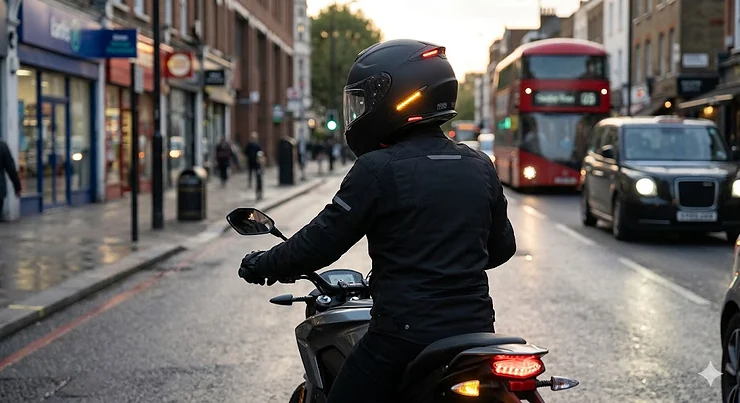
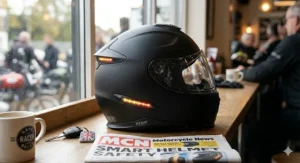
Here’s the thing nobody puts on a safety poster: your motorcycle’s indicator lights sit about 40–50 cm off the ground. In rush-hour traffic on the A406, or filtering past a queue of idling lorries on the M62, those low-mounted blinkers are essentially invisible to drivers sitting comfortably in their saloons. Mounting a motorcycle helmet with turn signals on your lid changes the geometry entirely — your signals are now at driver eye-level, where they actually stand a chance of being noticed.
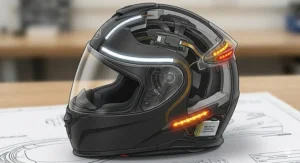
A motorcycle helmet with turn signals is exactly what it sounds like: a system that places wireless LED brake and indicator lights directly on the back of your helmet, mirroring your bike’s existing signal circuits. Some systems are add-on units that mount to any helmet you already own; others come built into smart helmets from the factory. Either way, the effect is the same — you become dramatically more visible from behind, which is precisely where most rear-end incidents originate.
This guide covers 7 of the best options currently available on Amazon.co.uk, ranging from budget-friendly LED bar systems through to full smart-helmet packages with app connectivity and SOS fall detection. We’ll cover what each one actually means for riding in British conditions — because there’s a meaningful difference between a system that works beautifully on a dry California motorway and one that holds up through six months of West Yorkshire drizzle.
Quick Comparison: Best Motorcycle Helmet with Turn Signals UK 2026
| Product | Type | Turn Signals | Wireless? | Approx. Price | Best For |
|---|---|---|---|---|---|
| Third Eye Design inView 2 | Add-on system | ✅ Full brake + indicators | ✅ Yes | £80–£110 | Serious commuters, touring riders |
| SYKIK Rider SRHL2 | Add-on system | ✅ Full brake + indicators | ✅ Wireless to bike | £50–£75 | Budget-conscious daily riders |
| LIVALL BH60SE Neo | Smart helmet (cycle/scooter) | ✅ Handlebar remote | ✅ App-connected | £80–£120 | Urban commuters, e-scooter users |
| Lumos Ultra MIPS | Smart helmet (cycle) | ✅ Wireless remote | ✅ Bluetooth app | £120–£160 | Road cyclists, city riders |
| STEELMATE H3 | Add-on system | ✅ Brake + turn sync | ✅ G-sensor | £35–£55 | Budget entry point |
| CFTGIW LED Helmet Lightbar | Add-on system | ✅ Brake + indicators | ✅ Wireless | £25–£45 | Casual riders, scooter users |
| Lumos Nyxel MIPS | Smart helmet (cycle) | ✅ Sequential indicators | ✅ Bluetooth remote | £140–£190 | Style-conscious commuters |
All prices approximate — check current prices on Amazon.co.uk, as they change regularly.
The table above gives you a snapshot, but numbers only tell part of the story. The inView 2 and SYKIK are wired into your bike’s signal circuits, which means they mirror your indicators automatically — no button-pressing required. The smart helmets like the Lumos and LIVALL work differently: they come with a handlebar remote you operate manually. For motorcycle riders, the wired add-on approach usually makes more practical sense; for scooter or e-bike riders, the smart helmet route is cleaner and far less faff to install.
💬 Just one click — help others make better buying decisions too! 😊
✨ Don’t Miss These Exclusive Deals!
🔍 Take your visibility to the next level with these carefully selected products. Click on any highlighted item to check current pricing and availability on Amazon.co.uk. These picks could genuinely make you safer on British roads.
Top 7 Motorcycle Helmet with Turn Signals: Expert Analysis
1. Third Eye Design inView 2 Wireless Helmet Signal System
The inView 2 is arguably the gold standard of add-on motorcycle helmet turn signal systems, and it’s not particularly close. The system consists of a small wireless receiver unit that adheres to the back of any helmet, plus a transmitter module that wires into your bike’s brake and indicator circuits under the seat. Once it’s paired, you forget it exists — it activates automatically when you start the engine and mirrors every signal your bike makes at head height.
The specs that matter: ultra-bright LEDs in amber for turns and red for braking, a 2–3 month battery life (yes, months — not hours), and crucially, passive engine braking detection. This last feature is genuinely useful in the UK. When you downshift approaching a roundabout on the A-road outside Harrogate, the inView 2 detects the deceleration and illuminates as a brake light even if your thumb never touched the lever. For drivers behind you, this is remarkably informative. The system is CAN-BUS compatible, which matters if you’re running a modern Honda, BMW, or Triumph with electronic engine management.
Who is this for? Touring riders and serious commuters who spend meaningful time on British A-roads and motorways. The wiring requirement is a minor inconvenience at installation — about 30–45 minutes if you’re reasonably handy — but after that it’s entirely set-and-forget. UK buyers report that the Velcro mount handles damp conditions well, though some have added a thin bead of weatherproof sealant around the transmitter connector as added insurance against prolonged British downpours.
The inView 2 ships to the UK from Amazon.co.uk and is also available from specialist motorcycle retailers.
✅ Pros: Automatic activation, genuine CAN-BUS compatibility, excellent LED brightness, 2–3 month battery life
✅ Pros: Transfers between helmets easily (two mount sets included)
✅ Pros: Passive braking detection adds a meaningful layer of safety
❌ Cons: Requires wiring into bike’s electrical system — not ideal for non-mechanical riders
❌ Cons: Price sits in the mid-to-upper range compared to budget alternatives
Price range: Around £80–£110 — worth every penny for a regular commuter.
2. SYKIK Rider SRHL2 Wireless Helmet Brake and Signal Light
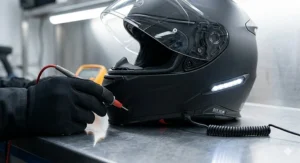
The SYKIK SRHL2 is essentially the SRHL system for riders who want full turn signal integration but don’t want to spend inView 2 money. The main light unit features over 110 LEDs, attaches to any helmet via Velcro, and the transmitter tucks under your seat and wires into your brake, left signal, right signal, and ground connections. When you hit the brakes or indicate, the helmet unit lights up accordingly.
Battery life is respectable at 16+ hours, and the unit charges via USB — which means you can top it up at your desk overnight with the same cable you use for your phone. The system comes pre-paired from the factory, so initial setup is genuinely straightforward. One feature worth noting for those with more than one bike: a single controller can pair with up to two helmet units, which is useful if you and your partner both ride.
What most UK buyers overlook about the SRHL2 is the CANbus caveat. SYKIK’s own Amazon listing notes that the system does not play nicely with CANbus-equipped motorcycles. Many modern British-registered bikes — Triumph Bonneville variants, BMW F-series, Honda CB range — use CANbus systems. Check your specific model before purchasing; this is not a deal-breaker but it is a conversation worth having before you’ve already bought it.
For a budget-conscious daily rider on an older or mid-range machine, the SRHL2 is a solid, dependable choice that does exactly what it says.
✅ Pros: 110+ LED lights provide strong visibility, 16+ hour battery life
✅ Pros: Pre-paired, straightforward installation
✅ Pros: One controller pairs with two helmet units — ideal for riding couples
❌ Cons: Not compatible with CANbus motorcycle systems
❌ Cons: Wiring still required — not a true plug-and-play solution
Price range: Around £50–£75.
3. LIVALL BH60SE Neo Smart Bluetooth Cycle Helmet
The LIVALL BH60SE Neo occupies an interesting middle ground: it’s technically a cycling and e-bike helmet, but it’s become genuinely popular with urban scooter commuters and motorcyclists doing low-speed city riding who want a cleaner, more integrated solution than a bolt-on system. The turn signals here are controlled by a small wireless remote that mounts to your handlebars, and the amber indicators in the helmet itself are surprisingly bright.
Beyond the turn signals, the BH60SE Neo packs in a lot: Bluetooth speakers, the ability to answer calls, voice commands, and PTT walkie-talkie functionality for group rides. There’s also fall detection — the helmet detects an impact and sends an SMS with your GPS location to a designated emergency contact 90 seconds later. For a solo commuter doing the daily A57 slog through Manchester, that’s not a gimmick. It’s genuinely reassuring.
The important caveat for motorcycle riders: the LIVALL is certified as a cycling helmet, not as a motorcycle helmet under UN ECE 22.06 standards. In the UK, motorcycle riders are legally required to wear a helmet that meets UN ECE 22.06 or BS 6658:1985 as enforced by the DVSA. The BH60SE Neo is therefore best suited to scooter riders (under 50cc, lower-speed urban use) or as a secondary helmet for those checking visibility systems before committing to a full motorcycle-rated setup. It’s also, frankly, brilliant for cyclists who share urban roads with motorcycle traffic.
UK-based customer support is a notable plus — useful when you’re dealing with app pairing questions and don’t want to wait for a US time zone to wake up.
✅ Pros: Integrated smart features (speakers, fall detection, SOS), handlebar remote turn signals
✅ Pros: UK customer support, Amazon.co.uk Prime eligible
✅ Pros: App connectivity with LIVALL app for ride tracking
❌ Cons: Not ECE 22.06 certified — not suitable as a primary motorcycle helmet
❌ Cons: Heavier than average at around 350–380g
Price range: Around £80–£120.
4. Lumos Ultra MIPS Smart Helmet with Turn Signals
The Lumos Ultra is the helmet that made the mainstream cycling world take smart helmet lighting seriously, and it remains one of the best-engineered products in this category. The MIPS version — MIPS being the Multi-Directional Impact Protection System liner that helps manage rotational impact forces — pairs this additional safety layer with 30 front white LEDs, 64 rear red LEDs, and full turn signal capability controlled from a wireless handlebar-mounted remote.
Brightness is the Lumos Ultra’s headline feature: up to 284 lumens from the front alone, visible up to 450 metres in daylight. In the context of UK autumn riding — grey skies, low sun, spray from passing cars — that level of luminosity isn’t showing off. It’s necessary. The automatic brake light function (available with the full Lumos Remote, sold separately from the basic Remote Lite) detects deceleration and activates the rear LED array. Battery life runs to around 10 hours, charged via USB-C.
Like the LIVALL, this is a cycling helmet certified to EN1078, not UN ECE 22.06. Motorcycle riders should note the same caveat as above. The Lumos Ultra is, however, arguably the best-in-class option for UK cyclists who regularly share road space with motor vehicles — commuters in Bristol, Edinburgh, or central London doing mixed cycling and scooter use will find it exceptionally well-suited. The SHARP helmet rating programme is the UK’s independent motorcycle helmet testing body; it’s worth a browse for anyone cross-shopping helmets at different safety tiers.
UK availability on Amazon.co.uk is strong, and the Lumos companion app (iOS and Android) adds the ability to customise LED patterns, sync with other Lumos helmets in a group, and track ride history.
✅ Pros: MIPS protection, exceptional LED brightness (284 lumens front), 10-hour battery
✅ Pros: Automatic brake detection with full remote upgrade, USB-C charging
✅ Pros: Polished app connectivity, group Team Sync feature
❌ Cons: EN1078 certified only — not suitable as a standalone motorcycle helmet
❌ Cons: Full remote required for auto-braking adds to total cost
Price range: Around £120–£160 for the MIPS version.
5. STEELMATE H3 Wireless Helmet Brake and Turn Signal System
STEELMATE are a well-established name in motorcycle electronics — you may know them from their tyre pressure monitoring systems (TPMS) — and the H3 is their motorcycle-specific helmet lighting answer. The unit synchronises with your bike’s running lights, brake light, and indicators via a wireless connection, displaying different streaming LED patterns for each state: steady amber sweep for turns, solid red for braking, animated flow for general running.
The G-sensor for brake detection is included as standard (unlike some budget competitors where it’s an upgrade), meaning deceleration via engine braking also activates the light. For UK motorway riding where trailing-throttle deceleration is common in heavy traffic, this is a meaningful feature. The unit is rechargeable via USB, waterproof, and mounts to any helmet via adhesive.
STEELMATE’s product is a competent mid-range choice. It doesn’t have the premium build quality or documentation of the inView 2, and some UK buyers have noted that the app-control features (colour and pattern customisation) are occasionally temperamental on iOS 18. That said, at this price point, the core functionality — turn signals, brake light, wireless operation — works reliably.
✅ Pros: G-sensor engine braking detection included, waterproof, USB rechargeable
✅ Pros: Multiple LED patterns and customisable colours
✅ Pros: Trusted STEELMATE brand with automotive electronics pedigree
❌ Cons: App can be temperamental on some iOS versions
❌ Cons: Build quality a step below premium alternatives
Price range: Around £35–£55.
6. CFTGIW Wireless Motorcycle Helmet LED Turn Signal Lightbar
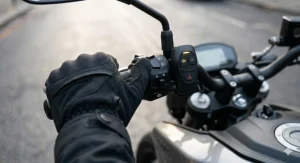
At the budget end of the spectrum, the CFTGIW lightbar is the “does exactly what it says on the tin” option. It’s a slim horizontal LED unit that adheres to the back of your helmet via the included tape and 3M adhesive strips, connects wirelessly to a transmitter module wired into your bike, and mirrors your brake and turn signals at helmet height. DC 12V, ABS housing, and USB charging; it’s not complicated, and that’s rather the point.
What you sacrifice at this price point is the sophistication of engine braking detection (this unit responds only to electrical signals from the bike, not deceleration) and some of the weatherproofing rigour of pricier alternatives. In honest terms: it’ll handle light British rain without issue, but prolonged downpours in, say, the Lake District are where budget adhesive mounts and lower-rated seals will face their sternest test. Keep a spare set of 3M strips in your kit bag.
That said, for a rider who wants the core safety benefit — making their intentions visible to traffic at head height — without complexity or significant outlay, the CFTGIW delivers. It’s especially well-suited to learner riders who want to build the habit of enhanced rear visibility early on.
✅ Pros: Genuinely affordable, straightforward installation, decent LED visibility
✅ Pros: USB rechargeable, transfers between helmets easily
✅ Pros: Slim profile sits neatly on most helmet shapes
❌ Cons: No engine braking detection
❌ Cons: Weatherproofing less robust than mid/premium options
Price range: Around £25–£45.
7. Lumos Nyxel MIPS Smart Helmet with Sequential Turn Signals
The Lumos Nyxel is the newer, lighter sibling to the Ultra — and it does one thing the Ultra doesn’t: sequential indicators. Rather than the whole rear light array flashing simultaneously, the Nyxel runs a sweeping sequential amber signal, similar to the sequential indicators seen on modern Audi and Volvo cars. For an urban rider trying to communicate intention clearly in heavy traffic, this subtle visual difference genuinely registers in the peripheral vision of drivers who might otherwise not react to a standard flash.
The Nyxel comes in three tiers: Basic (around £110), MIPS (around £140), and MIPS + Quin (around £180–£190). The Quin version adds crash detection via an internal sensor that connects to your smartphone — similar functionality to the LIVALL’s SOS system. For a London commuter who regularly navigates multi-lane junctions, this is the kind of redundancy that costs nothing in normal use and could matter enormously on the one day things go wrong.
The helmet is notably lighter than the Ultra at 438g (medium), which helps on longer rides. It pairs via Bluetooth to the Lumos app and accepts the handlebar remote out of the box. As with all Lumos products, it’s EN1078 certified for cycling, not ECE 22.06 for motorcycling — so the same regulatory caveat applies.
✅ Pros: Sequential indicators stand out in traffic, lightweight design
✅ Pros: MIPS protection, optional Quin crash detection
✅ Pros: Clean, modern aesthetic — looks like a premium cycling helmet
❌ Cons: EN1078 only — cycling helmet certification
❌ Cons: Quin crash detection requires MIPS+ tier, adding to cost
Price range: Around £110–£190 depending on tier.
How to Set Up and Look After Your Helmet Turn Signal System in British Conditions
Installation sounds daunting, but the wired add-on systems (inView 2, SYKIK, STEELMATE) follow a broadly similar pattern. The transmitter unit lives under your seat and connects to four points: your brake light wire, your left indicator wire, your right indicator wire, and a ground. On most modern bikes — Honda CB series, Kawasaki Z-range, Yamaha MT-series — these wires are accessible once you remove the seat using standard tools. If you’re not comfortable with basic electrical work, any independent motorcycle workshop will do the job for a modest labour charge; it’s typically under an hour’s work.
A few UK-specific tips that the product manuals won’t mention:
Dealing with damp. British garages and bike sheds are not the dry, climate-controlled spaces you see in American YouTube tutorials. If your transmitter unit sits near the rear tyre, it will encounter road spray, standing water, and general British greyness. Apply a thin bead of clear silicone sealant around the wire entry points of the transmitter module. It won’t affect electrical function and will meaningfully extend the unit’s lifespan through a Yorkshire winter.
Adhesive and cold temperatures. Standard 3M adhesive pads lose grip below about 5°C, which — as anyone who has attempted to stick anything in December will know — covers several months of the British riding calendar. In cold weather, warm the helmet mount area gently with a hairdryer for 30 seconds before applying fresh adhesive. Alternatively, the inView 2’s dedicated mount bracket provides a mechanical attachment that doesn’t rely on adhesive grip alone.
Urban security. If your bike lives on a London street or a shared communal car park, remove the helmet light unit when parking. The Velcro/adhesive mounting on most systems makes this a 10-second job. It’s simply not worth leaving a visible piece of electronics on an unattended helmet on a city street.
Charging rhythm. For systems with built-in rechargeable batteries (STEELMATE, CFTGIW, LIVALL), a simple weekly charge maintains peak brightness. Cold temperatures reduce lithium battery capacity, so a midweek top-up in winter keeps you from discovering a dim or dead unit at 06:30 on a Tuesday morning.
Real-World Scenarios: Which System Suits Which UK Rider?
The Manchester Commuter. You’re filtering through stop-start traffic on the A57 twice a day, five days a week. Your bike is a modern 650cc twin with CANbus wiring. You want maximum visibility behind, minimum faff, and you’d rather not rewire anything yourself. Best match: LIVALL BH60SE Neo or Lumos Ultra MIPS. Both are handlebar-remote operated with no wiring, and the LIVALL’s fall detection is a genuine bonus for solo urban riding. Note that for motorcycle legality, confirm your local regulations — the LIVALL is a cycling-certified helmet; pair it with a motorcycle-certified lid if required by law for your specific engine size.
The Yorkshire Weekend Tourer. You cover 200+ miles on a Saturday across the Dales and moors on a Triumph Tiger. You’re happy spending half an hour on installation and want a system that will genuinely hold up through four seasons. Best match: Third Eye Design inView 2. The passive engine braking detection is worth its weight in gold on descending moorland roads, the 2–3 month battery life means you’re not charging mid-trip, and the CAN-BUS compatibility handles modern Triumph wiring without complaint.
The Budget-Conscious Learner. You’ve just passed your CBT and you’re riding a 125cc scooter through Bristol. You want to be more visible without spending a fortune. Best match: CFTGIW LED Lightbar or STEELMATE H3. Start with one of these, build the visibility habit, and upgrade as your riding experience grows. Most learner machines are pre-CANbus, so the wiring compatibility concern doesn’t apply.
The Edinburgh Cycle Commuter. You ride to work through Leith and the New Town on a road bike, sharing lanes with buses and delivery vans. You want turn signals plus Bluetooth for music and the reassurance of crash detection. Best match: Lumos Nyxel MIPS + Quin. The sequential indicators genuinely register in peripheral vision, the crash detection provides meaningful peace of mind in city traffic, and it’s the best-looking option in this guide.
How to Choose a Motorcycle Helmet with Turn Signals in the UK: 6 Key Criteria
1. Wired or wireless (to the bike)? Add-on systems that wire into your bike’s electrical circuits mirror your actual indicators automatically — no extra button-pressing. Smart helmets use a handlebar remote. For motorcycle riders, the wired approach is generally more reliable; for scooter/cycle riders, the remote is simpler.
2. CANbus compatibility. Modern motorcycles from Honda, BMW, Triumph, and Yamaha increasingly use CANbus electrical systems. Not all helmet light transmitters work correctly with CANbus — check the product specification before purchasing. The inView 2 and STEELMATE H3 are among the confirmed-compatible options.
3. Safety certification. For legal motorcycle riding in the UK, your helmet must meet BS 6658:1985 or UN ECE 22.06 standards. Smart helmets in this guide (LIVALL, Lumos range) are certified to EN1078 (cycling standard). This is an important distinction. Consult the DVSA’s official guidance on motorcycle helmet standards before making your choice.
4. Weatherproofing. IP ratings matter in the UK. Look for at least IP44 (splash-resistant) for average British use; IP55 or above if you ride year-round or regularly in the Lake District, Scottish Highlands, or Wales. Check whether the transmitter module (not just the helmet unit) is rated for moisture.
5. Passive engine braking detection. This separates premium systems from budget ones. On a G-sensor or accelerometer-equipped system, decelerating via throttle-off or downshifting illuminates the brake light even without touching the lever. On British A-roads and motorways, this is a meaningful addition to your passive safety.
6. Battery life and charging convenience. The inView 2’s coin-cell approach offers months of runtime but requires a specific replacement battery. Rechargeable USB systems are more convenient for daily riders but need regular topping up — particularly important in winter when lithium capacity drops in cold weather.
Common Mistakes When Buying a Motorcycle Helmet with Turn Signals in the UK
Buying a US-spec unit without checking voltage/CANbus compatibility. Some American-market systems are wired for 12V DC and will technically work in the UK, but CANbus incompatibility can cause your bike’s ECU to throw error codes or behave erratically. Always confirm UK/EU compatibility in the product specification before purchasing.
Confusing cycling helmet safety standards with motorcycle standards. The EN1078 standard (European cycling) and ECE 22.06 (European motorcycle) are not interchangeable. A smart cycling helmet with beautiful turn signals is not a legal replacement for an ECE-rated lid on a motorcycle. This distinction matters under UK law and will affect any insurance claim.
Ignoring the transmitter location. Most buyers focus on the helmet unit and forget to think carefully about where the transmitter module mounts on the bike. Placing it too close to the exhaust heat, or in an exposed location that catches maximum road spray, shortens its lifespan significantly. Take five minutes before installation to identify a well-sheltered mounting point under your seat or tail unit.
Skimping on adhesive in cold weather. It bears repeating: standard adhesive tape fails in British winter temperatures. If you notice the helmet unit shifting or lifting at the edges, address it immediately. A unit that detaches on the motorway at 60 mph is a hazard, not a safety feature.
Forgetting to consider post-Brexit warranty implications. Some EU-manufactured electronics now carry slightly higher UK prices due to import adjustments, and warranty claims on EU-original products can occasionally involve returning the item to a mainland European address. Whenever possible, buy from Amazon.co.uk sellers with UK-warehouse stock for straightforward Consumer Rights Act 2015 returns within 14 days.
UK Regulations, Safety Standards & What the Law Actually Says
Under the Road Traffic Act 1988, sections 16 and 17, wearing a protective helmet is mandatory for all motorcycle riders and pillion passengers in the UK. The helmet must comply with approved safety standards — currently either BS 6658:1985 with the BSI Kitemark, or UN ECE Regulation 22.06.
Helmet-mounted turn signal systems are not currently regulated as a required component under UK law — they’re an optional enhancement, not a legal obligation. What the law does require is that your motorcycle itself carries fully functioning indicators, brake lights, and a rear reflector. A helmet lighting system sits on top of those requirements, as additional signalling, not as a replacement.
The SHARP (Safety Helmet Assessment and Rating Programme), operated by the Department for Transport, provides independent safety ratings for helmets sold in the UK market. If you’re shopping for a smart or add-on system and are also looking to upgrade your helmet, SHARP’s database is the best independent resource available to British riders. No commercial interests involved — just test data.
One area of ongoing discussion within the UK motorcycling community is whether helmet-mounted lights could, in unusual circumstances, confuse other road users about signal intent if the helmet light cancels before the bike’s indicator does. The practical consensus is that this is largely theoretical and far outweighed by the visibility benefit, but it’s worth being aware that your helmet turn signals are a supplementary system — maintain your normal signalling habits regardless.
What to Expect: Real-World Performance in British Conditions
In summer, a well-fitted helmet turn signal system is almost invisible in use — it just works, quietly and reliably. In British winter, things get more interesting. Here’s an honest account of what the main conditions mean for these systems:
Rain. Consistently the most important factor for UK riders. The LED units themselves are generally fine; the failure points are the adhesive mounts and the transmitter wire connections. Waterproof the transmitter connections with sealant (see installation advice above), check mount adhesion monthly, and you should have no issues through typical British rain.
Cold. Below 5°C, rechargeable lithium batteries in helmet units lose 15–20% of their rated capacity. A system rated for 16 hours at 20°C might deliver 12–13 hours in January. Account for this if you’re doing long winter rides; charge more frequently than you would in summer.
Night riding. British winters mean riding in the dark from around 4pm. LED turn signal systems with a dedicated amber colour profile are notably more effective at night than simple red/amber combination units, because amber is the colour trained into every British driver’s visual recognition for indicators. The Lumos Nyxel’s sequential amber sweep, in particular, is impressively visible in headlight glare.
Rural roads. Rural UK roads — the twisting B-roads of the Peak District, Snowdonia, or the North Yorkshire Moors — present a different challenge from urban riding. The passive engine braking detection on systems like the inView 2 proves its worth here. On a winding descent where you might spend 30 seconds slowing via engine braking before you touch the brake lever, having visible brake light activity at helmet height gives following traffic meaningful advance warning.
FAQ: Motorcycle Helmet with Turn Signals UK
❓ Are motorcycle helmet turn signal systems legal in the UK?
❓ Do helmet turn signal systems work with all motorcycles?
❓ Can I use a smart cycling helmet with turn signals as my motorcycle helmet?
❓ How long do helmet turn signal batteries last on UK winter rides?
❓ Will a helmet turn signal system work in heavy rain?
Conclusion: Which Motorcycle Helmet with Turn Signals Is Right for You?
The case for adding a motorcycle helmet with turn signals to your riding kit in 2026 is straightforward. With 340 motorcyclists killed on UK roads in 2024 and the most common collision cause being other drivers simply not seeing riders in time, placing your brake and turn signals at driver eye-level is one of the most cost-effective safety upgrades available. It doesn’t require fitting new exhaust headers or upgrading your brakes. It requires, at most, 45 minutes and a set of electrical connectors.
For most regular motorcycle commuters and tourers, the Third Eye Design inView 2 remains the recommended choice — it’s the most refined wired system, handles CAN-BUS, and the passive engine braking detection is genuinely useful on British roads. Budget-conscious riders will find the SYKIK SRHL2 a capable and honest performer, provided their motorcycle isn’t CANbus-equipped. Cyclists and scooter commuters sharing urban roads get the most value from the Lumos Nyxel MIPS or LIVALL BH60SE Neo, both of which deliver turn signals wrapped in genuinely smart packages.
Whatever you choose, buy it, fit it, and use it. The visibility difference is real, and British roads in October are not the place to discover that the car behind you couldn’t see your indicators.
✨ Don’t Miss These Exclusive Deals!
🔍 Ready to upgrade your visibility? Click on any highlighted product name in this article to check current pricing and availability on Amazon.co.uk. These picks are updated for 2026 and selected for genuine UK suitability.
Recommended for You
- Best Motorcycle Helmet with Brake Light UK 2026: Top 7 Picks
- 7 Best Motorcycle Helmet with LED Lights UK 2026
- 7 Best Quiet Bluetooth Motorcycle Helmets UK 2026 Guide
Disclaimer: This article contains affiliate links. As an Amazon Associate, I earn from qualifying purchases. If you purchase products through these links, we may earn a small commission at no additional cost to you.
✨ Found this helpful? Share it with your mates! 💬🤗
