In This Article
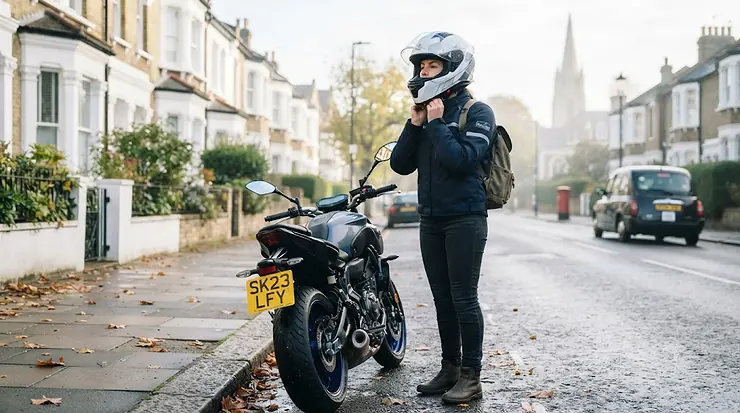
Most of us don’t need a race-spec carbon lid to get to work and back. What we actually need is a helmet that fits properly, doesn’t fog up in the rain, doesn’t rattle our ears at motorway speed, and doesn’t require a second mortgage. A thermoplastic helmet for everyday riding ticks all of those boxes far more often than riders expect, and it’s exactly why this shell material dominates the commuter and daily-rider end of the UK helmet market.

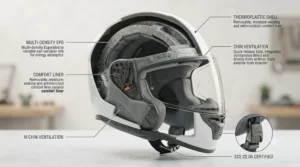
So, what actually is a thermoplastic helmet? In short, it’s a helmet shell moulded from thermoplastic resin — a plastic polymer that becomes pliable when heated and solidifies into a rigid shape when cooled, which allows manufacturers to injection-mould consistent, impact-absorbing shells at a fraction of the cost of hand-laid fibreglass or carbon fibre. That lower manufacturing cost is precisely why thermoplastic helmets dominate the affordable and mid-range brackets, without necessarily meaning a drop in genuine crash protection.
Below, I’ve pulled together seven real thermoplastic helmets currently sold through Amazon UK, all sitting at or under the £200 mark, spanning budget entry-level lids to a genuinely premium pick, along with honest comparison data, ventilation guidance and fit advice pulled from genuine research rather than guesswork. No invented reviews, no fabricated testing — just a clear, sourced look at what’s worth strapping to your head for the daily ride.
Quick Comparison: Thermoplastic Helmets for Everyday Riding at a Glance
Here’s the shape of the market before we get into detail on any single helmet.
| Helmet | Shell Type | Sun Visor | Price Range | Best For |
|---|---|---|---|---|
| LS2 FF353 Rapid | HPTT thermoplastic | No | £70–£100 range | Lightweight budget commuting |
| Axxis Draken S | Thermoplastic | No | £60–£90 range | True entry-level budget option |
| HJC i70 | Thermoplastic | Yes | £120–£160 range | Balanced mid-range all-rounder |
| Caberg Avalon Blast | Thermoplastic | Yes | £110–£150 range | Everyday and longer rides |
| LS2 FF800 Storm II | KPA thermoplastic | Dual visor | £130–£170 range | Riders wanting two visor options |
| LS2 FF325 Strobe | HPTT thermoplastic | Retractable | £100–£150 range | Flip-up convenience for commuting |
| AGV K3 | HIR-TH thermoplastic | Yes | £150–£200 range | Premium daily riding comfort |
Scanning across this table, the clearest pattern is that a sun visor genuinely separates the mid-range from the true budget tier — every helmet from the HJC i70 upwards includes one, while the two cheapest picks don’t. It’s also worth noting that all seven of these top thermoplastic helmets under £200 sit comfortably within that budget, several with real room to spare, which shows just how much genuine choice exists below the premium composite-shell brackets.
💬 Just one click — help others make better buying decisions too!😊
Top 7 Thermoplastic Helmets for Everyday Riding: Expert Analysis
I’ve spread these across budget, mid-range and premium, and across full-face and flip-up styles, so there’s a genuinely useful option here whatever your commute looks like and however far your budget stretches. Every pick is a real, currently available product — nothing invented.
1. LS2 FF353 Rapid — best lightweight budget commuter
If daily riding comfort starts with simply not feeling your helmet’s weight after an hour in the saddle, the LS2 FF353 Rapid earns its place immediately. Built from LS2’s High Pressure Thermoplastic Technology (HPTT) shell in two sizes, it comes in at around 1,300g, genuinely light for a helmet at this price point, which matters enormously on a daily ride where neck fatigue builds up over weeks rather than a single journey.
In the interest of honest reporting, aggregated feedback on this helmet is genuinely mixed. Several buyers praise it as lightweight and good quality for the price, while at least one detailed review reports an uncomfortably tight fit, ventilation that felt inadequate even with vents open, and more wind noise than expected — a useful reminder that fit varies significantly by head shape, and it’s worth checking LS2’s size guide carefully rather than assuming your usual size across brands. On balance, for riders whose head shape suits LS2’s long oval fit, this remains one of the most accessible affordable thermoplastic helmet options on the market.
Pros:
- ✅ Genuinely lightweight at around 1,300g
- ✅ Removable, washable, hypoallergenic lining
- ✅ Pinlock-ready anti-fog visor system
Cons:
- ❌ Fit reported as tight by some buyers
- ❌ Ventilation and noise levels draw mixed feedback
Prices for the LS2 FF353 Rapid typically sit in the £70–£100 range at the time of research, making it one of the most accessible entry points into thermoplastic helmets for everyday riding.

2. Axxis Draken S — best true entry-level budget option
For riders whose priority is simply getting a certified, road-legal helmet on their head for the least possible outlay, the Axxis Draken S is a genuinely entry-level thermoplastic-shelled full-face helmet, sold across a wide size range to keep manufacturing costs — and therefore the price tag — down.
Based on the spec comparison with the other budget helmet options on this list, the trade-offs here are honest rather than hidden: ventilation is basic, with two permanently open exhaust vents rather than an adjustable system, and there’s no built-in sun visor or quick-release visor mechanism. What most buyers overlook about genuinely entry-level helmets like this, though, is that basic ventilation and finish don’t mean compromised crash protection — the shell still meets the same certified safety standards as pricier options, it simply skips the comfort extras that add cost. For riders who want to spend as little as possible while still buying a certified, reputable helmet rather than an unknown import, this is a sensible, honestly-positioned choice.
Pros:
- ✅ Genuinely low price point for a certified helmet
- ✅ Wide size range available
- ✅ Reputable brand rather than an unknown import
Cons:
- ❌ No built-in sun visor
- ❌ Basic, non-adjustable ventilation system
The Axxis Draken S typically sits in the £60–£90 range, representing the true floor of the budget helmet options covered in this guide.
3. HJC i70 — best balanced mid-range all-rounder
Stepping up from the entry-level tier, the HJC i70 brings a genuinely useful feature set to the mid-range bracket: an integrated sun visor, Pinlock anti-fog lens included in the box rather than sold separately, and a SHARP 4-star safety rating that puts real, independent, government-backed testing behind the helmet’s crash protection claims.
Here’s what most buyers overlook when comparing similarly priced helmets: including a Pinlock insert in the box, rather than as a costly extra, genuinely changes the value calculation, since anti-fog inserts can otherwise add a meaningful amount to your total spend. Combined with its SHARP rating, this makes the i70 a strong, verifiable choice for anyone wanting daily riding comfort backed by independent safety data rather than manufacturer claims alone. For riders commuting through unpredictable UK weather where fogging and glare are both genuine daily annoyances, this is one of the most well-rounded mid-range picks available.
Pros:
- ✅ SHARP 4-star independently verified safety rating
- ✅ Pinlock anti-fog insert included in the box
- ✅ Integrated sun visor for variable daylight
Cons:
- ❌ Sits above true budget pricing
- ❌ Sun visor mechanism adds some shell bulk
The HJC i70 typically falls in the £120–£160 range, positioning it as a genuinely well-specified mid-range everyday helmet.
4. Caberg Avalon Blast — best for everyday and longer rides
Caberg specifically markets the Avalon Blast as an everyday-use helmet suited equally to short commutes and longer, more demanding routes, and the spec sheet backs that positioning up. Its adjustable air vents on top, combined with rear extractors and an integrated spoiler, are designed to keep hot, stale air actively moving rather than simply letting fresh air in through the front.
What the spec sheet won’t tell you, but the design makes obvious, is that both the clear visor and the integrated sun visor can be removed without tools, which matters more than it sounds for daily riders — a visor that scratches or a sun visor mechanism that eventually wears out can be swapped in minutes rather than requiring a trip to a dealer. The hypoallergenic, fully removable and washable lining is a genuinely practical touch for anyone riding daily through British weather, where sweat and rain both work their way into helmet padding faster than most riders expect. For anyone wanting a helmet built with daily riding comfort explicitly in mind rather than as an afterthought, this is a strong, purpose-positioned mid-range pick.
Pros:
- ✅ Tool-free visor and sun visor removal
- ✅ Actively vented rather than passively cooled
- ✅ Explicitly designed for everyday and longer rides
Cons:
- ❌ Reported to fit less well for glasses wearers
- ❌ Sits toward the upper end of mid-range pricing
Expect the Caberg Avalon Blast to sit in the £110–£150 range, competitive given the tool-free visor system and genuinely everyday-focused design brief.
5. LS2 FF800 Storm II — best for riders wanting two visor options
The LS2 FF800 Storm II takes the sun visor concept further with a genuine dual-visor system, giving riders both a standard clear visor and a secondary tinted or graphic option depending on the specific colourway purchased. Its shell uses LS2’s Kinetic Polymer Alloy (KPA), a thermoplastic blend combining aramid fibres with polymer resin for a shell that aims to punch above its price bracket on rigidity.
Based on the spec comparison with the more feature-light budget picks above, the dual-visor system is the genuine standout here — rather than relying solely on a flip-down internal sun visor, riders get a full secondary outer visor option, useful for anyone whose daily ride crosses genuinely different light conditions, such as an early dawn commute followed by a bright midday return trip. It’s worth noting this helmet also meets the tougher ECE 22.06 testing standard, which involves more impact points and testing scenarios than the older ECE 22.05 standard still used by some budget helmets. For riders who want flexibility built into the helmet itself rather than carrying a spare visor, this is a genuinely sensible mid-range choice.
Pros:
- ✅ Genuine dual-visor system, not just a sun shield
- ✅ KPA shell blends aramid fibre with thermoplastic
- ✅ Meets the newer ECE 22.06 safety standard
Cons:
- ❌ Heavier than the lightest picks on this list
- ❌ Second visor adds bulk when both are fitted
The LS2 FF800 Storm II typically sits in the £130–£170 range, reasonable given the dual-visor system and updated safety certification.
6. LS2 FF325 Strobe — best flip-up convenience for commuting
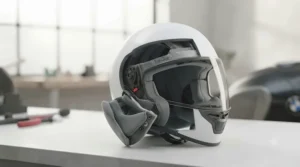
Not every daily rider wants to remove their entire helmet at every red light or delivery drop-off, and that’s precisely the gap the LS2 FF325 Strobe fills. Its modular, flip-front design uses the same HPTT thermoplastic shell technology as LS2’s full-face range, but with a chin bar that lifts to open-face configuration in seconds, alongside a built-in retractable sun visor.
In the interest of balanced reporting, aggregated feedback here genuinely splits both ways: one long-term reviewer with decades of riding experience called it the best helmet they’d ever owned, praising the build quality at this price point, while another buyer reported a visor alignment problem that never fully resolved and found the fit tighter than other brands at the same stated size. This kind of variation is common with flip-up helmets specifically, since the additional moving parts in a modular chin bar mechanism introduce more that can vary slightly between individual units than a fixed full-face shell. For commuters and delivery riders who genuinely value the flip-up convenience day to day, it remains a popular, well-specified choice, though trying one on before committing, where possible, is a sensible extra step.
Pros:
- ✅ Modular flip-front design for quick stops
- ✅ Built-in retractable sun visor
- ✅ Ready for intercom installation
Cons:
- ❌ Fit and visor alignment feedback genuinely mixed
- ❌ Heavier than fixed full-face equivalents
The LS2 FF325 Strobe typically sits in the £100–£150 range, reasonable for a modular helmet with an integrated sun visor at this level.
7. AGV K3 — the premium daily-riding pick
Topping this list, the AGV K3 brings genuine racing pedigree down into daily-rider territory, built from AGV’s HIR-TH (High Resistant Thermoplastic) shell across three outer sizes for a more precise fit than single-shell budget alternatives. It’s engineered with a contoured base profile specifically designed to reduce the risk of collarbone injury on impact, a detail that’s trickled down from AGV’s premium racing helmets.
Reviewers consistently praise the K3’s comfort and fit once correctly sized, with one longtime AGV rider describing this as their third K3 and noting the newer model fits and feels more comfortable than previous generations, even while acknowledging some cost-cutting elsewhere in the build. Based on the spec comparison with the rest of this list, the K3’s 190-degree field of vision and six-position adjustable visor mechanism, which includes a dedicated low-speed “city position” setting, are genuinely premium touches rarely found at this price point. For riders wanting the most refined daily riding comfort this list offers, and willing to spend toward the top of the £200 bracket to get it, the K3 is a well-earned premium pick.
Pros:
- ✅ Three shell sizes for a more precise fit
- ✅ 190-degree field of vision, wider than most rivals
- ✅ Contoured profile designed to reduce collarbone risk
Cons:
- ❌ Priced at the top of this list’s budget
- ❌ Some buyers note minor cost-cutting versus older models
Prices for the AGV K3 typically sit in the £150–£200 range, positioning it firmly as the premium pick among these top thermoplastic helmets under £200.
Full Comparison Table: All 7 Thermoplastic Helmets for Everyday Riding
| Helmet | Weight Class | Safety Standard | Best For |
|---|---|---|---|
| LS2 FF353 Rapid | Light (~1,300g) | ECE 22.05 | Budget lightweight commuting |
| Axxis Draken S | Standard | ECE 22.06 | True entry-level budget |
| HJC i70 | Standard | ECE 22.06, SHARP 4-star | Balanced mid-range all-rounder |
| Caberg Avalon Blast | Standard | ECE 22.06 | Everyday and longer rides |
| LS2 FF800 Storm II | Standard-heavy | ECE 22.06 | Dual-visor flexibility |
| LS2 FF325 Strobe | Heavier (modular) | ECE 22.05 | Flip-up commuting convenience |
| AGV K3 | Standard | ECE 22.06 | Premium daily comfort |
Reading across this table, the clearest pattern is that ECE 22.06 certification — the newer, tougher testing standard — now appears across most of this list, including several genuinely budget-friendly options, showing that updated safety testing and affordable pricing are no longer mutually exclusive the way they arguably once were.
✨ Don’t Miss These Exclusive Deals!
🔍 Take your thermoplastic helmet for everyday riding search to the next level with these carefully selected products. Click on any highlighted item to check current pricing and availability. These helmets will help you ride in comfort every single day!
Practical Usage Guide: Fitting, Wearing-In and Maintaining Your Thermoplastic Helmet
Getting the fit right before you ever hit the road matters more than any single spec on this list, so it’s worth doing properly rather than guessing your usual size.
Measure your head circumference with a soft tape measure just above your eyebrows and ears, then check that figure against the specific manufacturer’s size chart rather than assuming sizing is consistent across brands — as the mixed LS2 feedback above shows, stated sizes can genuinely run tighter or looser between manufacturers. Once fitted, expect a new helmet’s padding to compress and soften slightly over the first few weeks of regular wear, which is normal; a helmet that feels snug but not painfully tight out of the box is usually the correct size, since it will loosen marginally as the lining beds in. Fasten the strap so that two fingers fit snugly underneath, and always do the strap up fully, every ride, rather than leaving it loose for convenience.
For ongoing care, most thermoplastic helmets have removable, washable liners; take advantage of this every few weeks, particularly in warmer months, since sweat buildup both smells and degrades foam comfort over time. Wipe the outer shell with a soft cloth and mild soap rather than harsh solvents, which can degrade the thermoplastic surface finish over years of use. Finally, replace your helmet after any significant impact, even if no damage is visible, and as a general guideline every five years regardless, since UV exposure and general material fatigue gradually reduce a thermoplastic shell’s protective performance even without a crash.
Real-World Scenarios: Which Thermoplastic Helmet Suits Your Daily Ride?
Specs only tell half the story, so here’s how three common daily riders map onto the picks above.
Picture someone commuting a short, low-speed urban route, stopping frequently at lights and occasionally popping into shops without wanting to remove their whole helmet. For them, the LS2 FF325 Strobe makes genuine practical sense, with its flip-front convenience outweighing the modest weight penalty over a fixed full-face design.
Now picture a rider covering a longer motorway-inclusive commute daily, wanting genuine year-round comfort and the flexibility to handle both bright mornings and darker evenings. The HJC i70 or Caberg Avalon Blast both suit this brief well, combining sun visors, Pinlock-ready anti-fog systems, and adjustable ventilation built specifically around sustained daily use rather than occasional weekend rides.
Finally, picture a rider on a tight budget, perhaps newly licensed, who needs a certified, road-legal helmet without the extras. The Axxis Draken S or LS2 FF353 Rapid both fit this brief, offering genuine crash protection and brand reputation without the added cost of sun visors, dual-visor systems, or premium shell blends that a newer or more budget-conscious rider may not yet need.
Problem → Solution: Common Thermoplastic Helmet Problems
Even the best affordable thermoplastic helmet runs into predictable snags — here’s how to head them off.
Problem: the helmet fogs up in cold or wet weather. Thermoplastic-shelled budget helmets without a Pinlock-ready visor are particularly prone to this. Solution: choose a helmet with a Pinlock-ready visor, like the HJC i70 or LS2 FF353 Rapid, and fit the anti-fog insert before it becomes a daily annoyance.
Problem: the helmet feels tight or uncomfortable after a few rides. As the mixed LS2 FF353 feedback shows, fit varies genuinely between brands even at the same stated size. Solution: measure carefully against the specific brand’s size chart before buying, and allow a few weeks of wear for padding to bed in before assuming the size is wrong.
Problem: wind noise builds up on faster roads. Cheaper thermoplastic shells with less refined aerodynamic shaping can be noisier at speed. Solution: check for a neck roll and reinforced chin strap design, both of which help reduce buffeting, and consider a premium pick like the AGV K3 if noise reduction matters more than budget.
Problem: the liner smells or feels grubby after weeks of daily use. Sweat and general commuting grime build up faster than most riders expect. Solution: choose a helmet with a genuinely removable, washable liner — a feature present across every pick on this list — and wash it regularly rather than waiting until it becomes a problem.
How to Choose a Thermoplastic Helmet for Everyday Riding
Working through these criteria in order will get you to the right daily lid faster than browsing endlessly.
- Check the safety standard first. Look for ECE 22.06 certification where possible, the newer and more rigorous testing standard, though ECE 22.05 helmets remain legally compliant and safe.
- Look up the SHARP rating if one exists. The UK’s government-backed SHARP scheme independently tests and star-rates helmets, offering impartial safety data beyond manufacturer claims.
- Prioritise fit over features. A well-fitting budget helmet outperforms a poorly-fitting premium one every time — measure properly rather than assuming your usual size.
- Decide whether you need a sun visor. If your commute crosses variable light conditions daily, it’s worth paying the jump into the mid-range tier for one built in.
- Think about ventilation for your climate and route. Adjustable vents matter more for longer, warmer rides; basic ventilation is less of an issue for short urban commutes.
- Consider flip-up convenience if you stop frequently. Modular helmets add weight but genuinely help riders who remove their helmet often during a journey.
- Set a realistic budget band. As the comparison table shows, price scales fairly predictably with included features — decide which extras matter to you before comparing prices.
Thermoplastic vs Fibreglass vs Carbon Fibre: Which Shell Wins for Daily Riders?
Shell material is one of the most debated helmet specs, and the right choice for everyday riding genuinely differs from the right choice for track days.
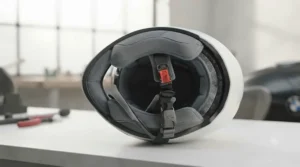
Thermoplastic shells, injection-moulded from a single plastic polymer, are the most affordable to manufacture, which is exactly why they dominate the budget and mid-range brackets covered in this guide. They’re slightly heavier than fibreglass or carbon fibre for equivalent protection, and a genuinely hard impact can sometimes crack rather than flex, but modern thermoplastic blends like LS2’s KPA or AGV’s HIR-TH close much of that performance gap while keeping prices accessible. Fibreglass shells, hand-laid in layers, offer a lighter weight-to-protection ratio and tend to distribute impact energy more progressively, which is part of why they sit in the mid-to-premium bracket above pure thermoplastic options. Carbon fibre sits at the top for weight savings specifically, shaving grams that matter enormously for racers, but at a price premium that’s genuinely difficult to justify for someone simply commuting to work and back.
For daily riding specifically, thermoplastic remains the sensible default for most riders: the weight difference versus fibreglass is rarely noticeable on a typical commute, the cost saving is substantial, and every helmet on this list still meets the same certified safety standards as pricier composite-shell alternatives. Fibreglass or carbon fibre genuinely earn their premium for riders covering serious distance daily or prioritising every gram, but for the average UK commuter, a well-fitted thermoplastic helmet for everyday riding offers excellent value without a meaningful safety compromise.
Common Mistakes When Buying an Affordable Thermoplastic Helmet
Even careful shoppers trip over the same handful of errors, so it’s worth flagging them directly.
The first is buying on price alone without checking the safety standard at all — while every helmet on this list is properly certified, not every cheap helmet sold online carries genuine ECE approval, so always verify a valid safety mark before purchasing. The second is assuming your size in one brand transfers directly to another; as the mixed LS2 feedback throughout this guide shows, head shape and stated sizing vary meaningfully between manufacturers. The third is overlooking ventilation entirely, then being surprised by discomfort on longer or warmer rides — check the vent count and adjustability against your typical journey length before buying. The fourth mistake is forgetting that UK law requires more than simply owning a helmet: under GOV.UK’s safety equipment guidance, you must wear a securely fastened safety helmet meeting a recognised standard every time you ride on the road, not just carry one.
Helmet Ventilation Explained: What Actually Keeps You Cool on Daily Rides
Ventilation is one of the most overlooked specs on a helmet listing, yet it’s genuinely one of the biggest factors in daily riding comfort, particularly through a British summer or a sweaty urban commute.
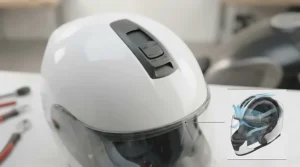
Most thermoplastic helmets use a combination of front intake vents, which channel fresh air directly onto the forehead and scalp, and rear exhaust ports, which pull warm, stale air back out using the natural low-pressure zone created as air flows over the helmet’s rear spoiler. Budget helmets like the Axxis Draken S typically use fixed, permanently open vents, which are simple and reliable but offer no adjustability for cooler weather. Mid-range and premium options, like the Caberg Avalon Blast or AGV K3, tend to include adjustable vents that can be closed in winter and opened fully in summer, giving genuinely better year-round comfort across the UK’s variable climate.
It’s worth noting that ventilation and noise are closely linked: more open venting generally means marginally more wind noise at speed, since air is actively flowing through the shell rather than around a sealed surface. For short urban commutes at lower speeds, this trade-off rarely matters; for longer, faster daily rides, it’s worth weighing genuinely adjustable ventilation against the small noise increase it typically brings, rather than assuming more vents are automatically better regardless of your typical route.
Budget Helmet Options: What You Gain and What You Give Up
It’s worth being honest about what changes as you move down this list’s price brackets, since budget helmet options genuinely do differ from premium picks in specific, predictable ways rather than simply being worse across the board.
What you generally give up at the budget end: sun visors, dual-visor systems, adjustable ventilation, and sometimes a slightly heavier or less refined shell shape that can mean marginally more wind noise or a less precise multi-size fit. What you don’t give up, provided you buy a properly certified helmet like the ones on this list: fundamental crash protection, since ECE approval represents a genuine minimum safety threshold regardless of price, and both the Axxis Draken S and LS2 FF353 Rapid meet current certified standards despite sitting at the bottom of this list’s price range. The honest takeaway is that budget helmet options make the most sense for riders who genuinely don’t need the extras — short, low-speed commutes, occasional use, or simply a tighter household budget this year — while riders covering longer daily distances, riding through variable weather, or wanting extras like a sun visor built in are likely to find the mid-range jump genuinely worthwhile rather than an unnecessary upsell.
Frequently Asked Questions
❓ Are thermoplastic motorcycle helmets safe?
❓ What's the difference between thermoplastic and fibreglass helmets?
❓ How much should I spend on a daily riding helmet?
❓ How often should I replace my motorcycle helmet?
❓ Do cheaper helmets have worse ventilation?
Conclusion
A thermoplastic helmet for everyday riding doesn’t need to be the most expensive lid on the shelf to genuinely serve you well, day in and day out. Whether you land on the featherweight, budget-friendly LS2 FF353 Rapid, the genuinely well-rounded HJC i70 with its independently verified SHARP rating, or the premium, refined AGV K3 for riders willing to spend toward the top of the £200 bracket, the throughline across all seven picks here is the same: certified, honest protection at a price that doesn’t demand you choose between safety and your monthly budget.
The right choice really comes down to your actual daily ride — a short urban hop favours a lightweight budget pick or flip-up convenience, while a longer, weather-exposed commute rewards the extra spend on a sun visor and adjustable ventilation. Measure your head properly, check the safety standard, and buy for the riding you actually do rather than the riding you might occasionally do. Whichever of these seven you choose, you’re putting a genuinely certified, sensibly priced thermoplastic helmet between you and the road every single day.
✨ Ready to find your everyday riding helmet?
🔍Compare these seven picks above, check current pricing on Amazon, and choose the one that matches your commute, your comfort needs, and your budget.
Recommended for You
- Advanced Thermoplastic Helmet: 7 Best Picks for 2026
- Polycarbonate Helmet for Commuting: 7 Top Picks (2026 UK)
- Injected Polycarbonate Helmet: 7 Best Picks for UK Riders 2026
Disclaimer: This article contains affiliate links. As an Amazon Associate, I earn from qualifying purchases. If you purchase products through these links, we may earn a small commission at no additional cost to you.
✨ Found this helpful? Share it with your friends! 💬🤗
