
In This Article
Somewhere around junction 12 on a blinding June afternoon, half the UK’s motorcycling population is squinting through a visor that’s either doing its job beautifully or quietly breaking the law. That’s the strange thing about a legal tinted visor for road use — it sounds like it should be simple, and then you start reading forum threads and suddenly you’re neck-deep in percentages, kitemarks, and half-remembered stories about someone’s mate who got stopped in Cheshire. It isn’t complicated once you strip out the noise, but it is very easy to get wrong.
This guide cuts through that noise. We’ve researched the actual regulations, cross-checked them against manufacturer compliance guidance and UK retailer notes, and pulled together seven genuinely available tinted visors that riders can buy right now — spanning budget, mid-range, and premium territory. You’ll also get a straight answer on what “50% light transmission” actually means for your eyeballs, how police forces really approach visor checks in 2026, and which popular “tinted” options are stylish traps that could land you with an endorsable offence. No fluff, no fabricated hands-on claims — just sourced facts and honest analysis, British-English and British-roads throughout.
Quick Comparison Table: 7 Legal Tinted Visor Options at a Glance
| Product | Tint Type | Road Legal? | Best For | Price Range |
|---|---|---|---|---|
| Shark VZ100 50% Light Tint Visor | Light smoke, 50% VLT | Yes | Race-R Pro/Speed-R owners wanting a sharp look | £70-£100 |
| Shoei CWR-1 Light Smoke Visor | Light smoke, 50% VLT | Yes | Premium touring and sportsbike helmets | £60-£90 |
| Caberg Flyon 2 Light Smoke Visor | Light smoke, anti-scratch/anti-fog | Yes | Adventure/flip-front commuters | £45-£60 |
| HJC HJ-09 Light Smoke Visor | Light smoke | Yes | Budget-conscious CS-15/RPHA riders | £20-£35 |
| Nolan N-Com Light Smoke Visor | Light smoke | Yes | Touring riders on N100-6/N60-6 helmets | £35-£50 |
| LS2 Storm III Light Smoke Visor | Light smoke | Yes | First-time buyers on a tight budget | £25-£40 |
| Bell Qualifier DLX Transitions Visor | Photochromic (variable tint) | Not currently certified for UK road use | Track days, non-UK touring, collectors | £70-£100 |
Six of these seven are genuinely road legal in the UK; the seventh — the photochromic Bell — is included deliberately, because it’s one of the most-searched “tinted visor” products around and one of the most misunderstood. Across the six legal options, the pattern is consistent: light smoke sitting close to the 50% VLT threshold, BSI Kitemark or ECE 22.05/22.06 certification, and a genuine “for daylight use” or “road legal” designation from the manufacturer, not just a seller’s guess. The Shoei CWR-1 and Shark VZ100 sit at the premium end because of optical clarity and Pinlock compatibility, while the LS2 Storm III and HJC HJ-09 prove you don’t need to spend big to stay legal and comfortable in summer glare.
💬 Just one click — help others make better buying decisions too!😊
Top 7 Legal Tinted Visors for Road Use: Expert Analysis
1. Shark VZ100 50% Light Tint Visor — sharpest optics for Race-R Pro owners
The standout here is straightforward: this is Shark’s own OEM light-tint visor, engineered to the exact curvature of the Race-R Pro, Race-R Pro GP, Race-R Pro Carbon and Speed-R shells, so there’s no guessing on fitment. Built to VZ100 spec with a 50% light transmission rating, it sits right at the legal daylight threshold rather than nudging under it, which matters because a handful of “light smoke” third-party alternatives quietly drop to 35-40% without saying so. It’s Pinlock-ready, which is worth flagging on its own — that anti-fog insert compatibility means you’re not choosing between glare control and a misted-up commute on a cold morning.
Based on the spec comparison with rival OEM visors, this is best suited to riders who already own a Race-R Pro-family helmet and want factory-matched optical quality rather than a generic aftermarket fit. What the spec sheet won’t tell you, but reviewers on retailer sites consistently note, is that the anti-scratch coating on genuine Shark visors tends to outlast third-party equivalents by a wide margin — several reviewers on UK retail sites report years of use with minimal pitting, versus a season or two on cheaper alternatives. A recurring theme in aggregated feedback is that the visor mechanism “clicks” more precisely into the base plate than budget replacements, reducing the wind-noise and buffeting that a loose visor introduces at motorway speed.
Pros:
- ✅ Genuine 50% VLT rating, verified road legal
- ✅ Pinlock-ready for anti-fog performance
- ✅ Precise factory fitment reduces wind noise
Cons:
- ❌ Only fits the Race-R Pro/Speed-R helmet family
- ❌ Premium pricing compared with generic alternatives
Expect to pay in the £70-£100 range at the time of research; given the fitment precision and certification clarity, it’s a strong value pick for existing Shark owners rather than a general-purpose buy.
2. Shoei CWR-1 Light Smoke Visor — best optical clarity for premium helmets
What stands out immediately is Shoei’s reputation for razor-sharp optics carrying through into the tinted range — this isn’t a case of clarity being sacrificed for style. The CWR-1 fits Shoei’s NXR2 and related sport-touring shells, uses a 50% VLT light smoke tint, and is explicitly listed by Shoei UK as road legal, in contrast to some of the brand’s darker smoke and mirrored options which are flagged “not legal for road use” on the manufacturer’s own site. That distinction matters enormously when you’re choosing between visually similar shades in the same product line.
On paper, this visor is aimed at riders who already trust Shoei’s shell geometry and don’t want to compromise on peripheral vision distortion — a known weak point of cheaper polycarbonate tints, which can introduce a slight “fishbowl” warping at the edges. Reviewers consistently report that Shoei’s anti-fog coating performs noticeably better in damp UK conditions than unbranded replacements, and several note that the visor swap system allows a change in well under a minute without tools, useful for riders who keep both a clear and a light-smoke visor in their kit bag for the same ride.
Pros:
- ✅ Explicitly confirmed road legal by Shoei UK
- ✅ Minimal edge distortion versus generic tints
- ✅ Tool-free swap system for quick changes
Cons:
- ❌ Only compatible with specific Shoei shell families
- ❌ Among the pricier single-visor purchases in this list
At around £60-£90, it’s not the cheapest way to add tint, but for riders who’ve already invested in a premium lid, matching visor quality is the sensible move rather than a false economy.
3. Caberg Flyon 2 Light Smoke Visor — best for adventure and flip-front commuters
The Caberg Flyon 2’s standout feature is versatility: it’s built for a flip-front adventure-style helmet, so it suits riders who want tinted eye protection without giving up the option to flip the chin bar up at a petrol station or drive-through. Caberg markets this explicitly as anti-scratch, anti-fog, and road legal, which places it firmly in the same 50% VLT bracket as the visors above, unlike the brand’s separately sold dark-smoke race visors, which Caberg itself labels “not homologated” and track-only.
Based on the spec comparison with Caberg’s own product range, what most buyers overlook is that Caberg draws a genuinely clear internal line between its road-legal and race-only visor lines — a distinction some smaller aftermarket sellers blur. That transparency is worth something on its own, because it means you’re not relying on a third-party listing’s word for the legality claim. Aggregated review sentiment on UK retailer sites points to strong anti-fog performance in wet, cold starts, though a minority of reviewers note the tint reads slightly darker in overcast conditions than the “light smoke” name suggests — worth bearing in mind if you ride a lot of grey British afternoons.
Pros:
- ✅ Clear manufacturer distinction between legal and race-only tints
- ✅ Anti-fog coating rated well by UK reviewers
- ✅ Ideal for flip-front adventure and commuter helmets
Cons:
- ❌ Tint can read darker than expected on overcast days
- ❌ Limited to Caberg’s Flyon 2 shell fitment
Pricing typically sits in the £45-£60 range, representing solid mid-tier value for riders who want the adventure-helmet flexibility alongside genuine road-legal tint.
4. HJC HJ-09 Light Smoke Visor — best budget entry point
The HJ-09’s standout is simple: it’s one of the more affordable genuinely road-legal light-smoke visors on the market, fitting HJC’s popular CS-15 and related mid-range helmet lines without the premium-brand price tag. That accessibility matters for riders trying tinted visors for the first time who don’t want to commit £70+ before they know whether they’ll actually use it regularly.
Here’s what to weigh: HJC doesn’t chase the same ultra-premium optical polish as Shoei or Arai, and on paper that shows up as a slightly less refined anti-distortion profile at the visor’s extreme edges. In practice, for the vast majority of road use — glancing at mirrors, checking blind spots — that difference is negligible, and reviewers largely focus their praise on value rather than complaining about clarity. Aggregated feedback on UK retail platforms repeatedly highlights the HJ-09 as good value for money, with the anti-scratch coating holding up reasonably well under normal use, though a handful of reviewers mention it scratches more readily than premium-brand alternatives if stored loose in a rucksack rather than a visor bag.
Pros:
- ✅ Genuinely road-legal light smoke at a budget price
- ✅ Wide compatibility across HJC’s popular mid-range helmets
- ✅ Strong value-for-money sentiment in aggregated reviews
Cons:
- ❌ Anti-scratch coating less durable than premium brands
- ❌ Slightly more edge distortion than top-tier optics
At roughly £20-£35, this is the visor to recommend to a friend who’s just bought their first bike and wants to try tinted riding without a big outlay.
5. Nolan N-Com Light Smoke Visor — best for long-distance touring
The Nolan’s standout feature is its integration with the brand’s N-Com communication system cutouts, meaning touring riders running intercoms don’t need to hunt for a separate compatible visor — it’s designed to work alongside the accessory ecosystem Nolan already sells. Fitting the popular N100-6 and N60-6 ranges, it carries the same road-legal light-smoke designation as the rest of this list, distinct from Nolan’s darker “race” tints sold explicitly as non-road-legal accessories.
What most buyers overlook about touring-focused visors specifically is how much glare fatigue builds up over a six-hour motorway stint — a light smoke tint isn’t just about looking sharp for a five-minute photo at a service station, it measurably reduces the squinting and eye strain that contribute to rider fatigue on long hauls. Reviewers on UK retail sites consistently mention the Nolan’s easy-fit mechanism as a genuine time-saver, since swapping between clear and tinted takes seconds rather than requiring the helmet to come off. A recurring complaint in aggregated feedback, however, is that stock availability can be patchy, with some buyers reporting multi-week waits for specific Nolan visor variants — worth checking current stock before you commit to a big touring trip.
Pros:
- ✅ Reduces glare fatigue on long motorway stints
- ✅ Quick-swap mechanism between clear and tinted
- ✅ Compatible with Nolan’s N-Com intercom ecosystem
Cons:
- ❌ Stock availability can be inconsistent
- ❌ Pricing has crept up compared with older Nolan visor generations
Expect around £35-£50 depending on retailer stock; for anyone doing serious mileage, the fatigue-reduction argument alone justifies the outlay.
6. LS2 Storm III Light Smoke Visor — lightest on the wallet without cutting corners on legality
LS2’s standout here is price-to-legality ratio: this is one of the cheapest genuinely road-legal tinted visors covered in this guide, and unlike some ultra-budget unbranded alternatives sold on marketplaces, LS2 explicitly lists it as road legal rather than leaving buyers to guess. For riders comparing five or six options purely on cost, that clarity is worth paying attention to, because the cheapest listing isn’t always the cheapest legal one.
Based on the spec comparison with other entry-level visors, the trade-off is mostly cosmetic rather than functional — LS2’s anti-scratch treatment is adequate rather than exceptional, and the tint shade leans slightly more grey than the warmer smoke tone of some premium brands. Reviewers consistently describe it as “does what it says,” with several UK buyers noting it as a sensible second visor to keep in a tank bag for sudden bright spells, rather than a daily-wear upgrade from a premium OEM clear visor. A common thread in aggregated feedback is praise for straightforward fitment on LS2’s popular budget helmet ranges, with minimal fettling required.
Pros:
- ✅ Among the most affordable genuinely road-legal options
- ✅ Straightforward, tool-light fitment
- ✅ Explicitly marketed as road legal, not a guess
Cons:
- ❌ Tint tone is flatter/greyer than premium alternatives
- ❌ Anti-scratch coating is basic rather than long-lasting
At roughly £25-£40, it’s the pragmatic pick for riders who want a spare tinted visor in the glovebox without spending premium-brand money.
7. Bell Qualifier DLX Transitions Visor — photochromic tech, but check before you fit it
This one earns its place through honesty rather than a recommendation to buy for road use. The Bell Qualifier DLX’s standout feature is genuinely clever engineering: a Transitions-branded photochromic lens that darkens automatically in UV light and returns to near-clear indoors or at night, the same core technology used in prescription photochromic glasses. On paper that sounds like the perfect solution to the “which visor do I carry” dilemma — one visor, all conditions.
Here’s the catch, and it’s an important one for UK riders specifically: current UK guidance treats photochromic and transition-style visors as not certified for road use, because they haven’t received a BSI Kitemark or equivalent EEA/ECE approval mark under the standards that currently apply, according to Shoei UK’s own compliance guidance and multiple specialist motorcycle solicitor sources. That’s despite the underlying UNECE 22.06 regulation setting a minimum 20% transmittance standard for factory-fitted sun visors, which has created genuine confusion among riders who assume “it’s a proper safety-rated helmet accessory” automatically means “it’s road legal.” Aggregated commentary from riders who’ve used these visors describes the light/dark transition as smooth and genuinely useful for touring through variable weather — but that practical usefulness doesn’t currently translate into UK road-legal status, and several legal commentators note police discretion around daylight use varies significantly by force.
Pros:
- ✅ Genuinely useful automatic light/dark adaptation
- ✅ Comes standard on the Qualifier DLX, no extra visor needed
- ✅ Popular for touring outside the UK where rules differ
Cons:
- ❌ Not currently certified for UK road use
- ❌ Legal grey area could complicate an insurance claim after an incident
Priced around £70-£100 as part of the DLX package, it’s a fascinating piece of kit — but for UK road riding specifically, treat it as a track-day, off-road, or non-UK-touring accessory rather than a daily commuting visor until certification catches up with the technology.
Fitting and Swapping Your Visor Safely: A Practical Usage Guide
Getting a new tinted visor onto your helmet correctly isn’t difficult, but it’s the step most riders rush — and rushing it is how you end up with a visor that whistles at 50mph or pops loose on a roundabout. Start by checking your helmet’s base plate mechanism against the visor’s fitting instructions before you attempt installation; most modern systems use a simple pin-and-slot or ratchet mechanism, but forcing a visor that’s slightly misaligned can crack the mounting tabs, which is a surprisingly common first-30-days mistake.
Once fitted, run through a full range of motion — fully closed, fully open, and a couple of intermediate positions — while the helmet is off your head and on a bench, checking for any grinding, uneven resistance, or gaps at the seal. A visor that doesn’t sit flush against the helmet’s face-seal gasket will whistle and let wind noise through at speed, and it’s far easier to diagnose that sitting still than discovering it doing 60mph on the A34. For riders switching between a clear visor for commuting and a tinted one for weekend rides, get into the habit of storing the spare in a padded visor bag rather than loose in a tank bag or rucksack pocket — loose storage against keys, tools, or a phone is the single most common cause of premature scratching reported across the aggregated reviews above.
Maintenance-wise, clean with lukewarm soapy water and a microfibre cloth rather than anything abrasive or alcohol-based, which can degrade anti-fog and anti-scratch coatings over time. Check the visor’s certification markings — the BSI Kitemark or the “E” mark with country code — every few months to make sure they haven’t worn away from repeated cleaning, since an illegible mark can complicate matters if you’re ever stopped, even on an otherwise perfectly compliant visor.
Real-World Rider Scenarios: Matching the Right Visor to Your Riding
The daily commuter — 12 miles each way, mixed weather. For a rider doing a regular urban and A-road commute through unpredictable British weather, the priority is a visor you can swap quickly between clear and tinted without faff. The HJC HJ-09 or LS2 Storm III make sense here: both are affordable enough to buy alongside a clear visor without feeling like a splurge, and neither requires specialist fitting knowledge. Budget matters more than ultimate optical polish for this rider, since the visor’s getting swapped in a car park most mornings, not admired on a track day.
The weekend tourer — 200+ mile days, motorway-heavy routes. Glare fatigue compounds over long stints, and this is where the Nolan N-Com or Shoei CWR-1 earn their higher price tags. A tourer covering serious mileage benefits from the reduced eye strain of a well-executed light smoke tint, plus the practical advantage of quick-swap systems for the inevitable tunnel, sudden downpour, or dusk finish to a long day.
The sportsbike rider chasing that track-inspired look — weekend blasts, occasional track days. Here, the Shark VZ100 and Caberg Flyon 2 cover both bases: road-legal for the ride there and back, with genuine OEM fitment quality that won’t look out of place next to race-inspired bodywork. For actual track days, riders in this category sometimes step up to darker, non-road-legal visors specifically for closed-circuit use — which is a legitimate approach, provided the swap back to a road-legal visor happens before the public road journey home.
What Is a Legal Tinted Visor?
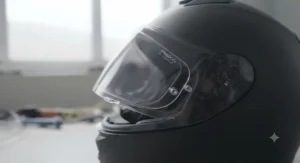
A legal tinted visor for road use in the UK is one that allows at least 50% of visible light through the lens while carrying a valid certification mark — either the BSI Kitemark under BS 4110, or an equivalent European “E” approval mark — confirming it meets the recognised eye-protection standard for vehicle users. Any eye protection must transmit more than 50% of available light, and even a clean, high-quality clear visor knocks out some light, meaning the tints permitted in law are remarkably light compared with what many riders picture when they hear the word “tinted.”
That single figure — 50% — is the dividing line the entire market is built around. Anything darker, however stylish or however confidently a seller markets it as “for daylight use,” strays into legally grey or outright unlawful territory the moment it’s fitted and lowered on a public road.
UK Visor Tint Regulations Explained
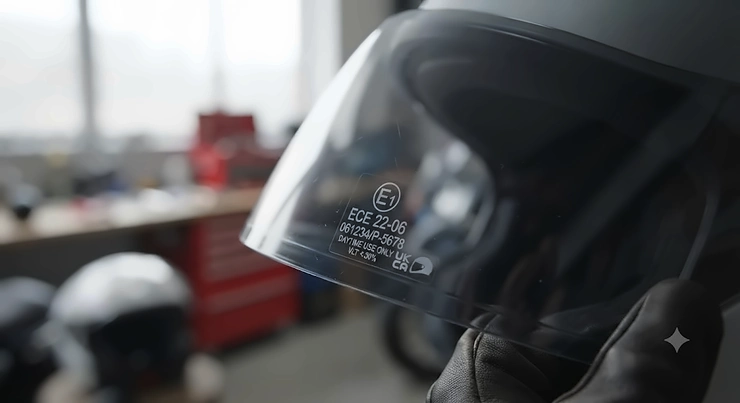
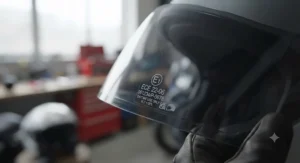
The regulatory picture in the UK is older and blunter than most riders expect. Under the Road Traffic Act 1988, it’s an offence to use eye protection that isn’t of a prescribed type, and the Department for Transport’s guidance requires visors to carry a trademark, an international approval mark (the “E” symbol with a country code — E11 for the UK), and, where relevant, a “Daytime Use Only” marking. British Standard BS 4110 specifies requirements for the optical quality, light transmission, and impact resistance of motorcycle helmet visors, and visors must meet these standards or the equivalent ECE standards to be legally sold and used in the UK.
Riders often assume this is EU-derived red tape that changed post-Brexit, but it hasn’t — the underlying UN treaty governing helmet and visor standards predates and sits outside EU membership questions entirely, applying across roughly 50 signatory countries. What has genuinely blurred the picture is newer visor technology, particularly photochromic lenses, arriving faster than certification bodies have updated testing methods for curved, variable-tint surfaces — which is precisely why product #7 above carries a legal caveat despite being a mainstream, widely sold helmet accessory.
Road-Legal Visor Tint Percentage: What the Numbers Actually Mean
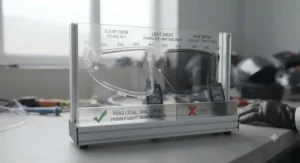
Fifty per cent sounds like a generous, noticeably dark tint on paper — split the difference, half the light gets through, right? In practice it’s a genuinely subtle shade, closer to a light pair of everyday sunglasses than the dark iridium or mirrored finishes that dominate sportsbike marketing photography. Non-certified dark tinted visors sit around 20% light transmission, following guidelines for general-purpose sun-glare eye protectors intended for uses like driving a car or school bus, which recommend a transmission range of roughly 18-29% — a genuinely dark tint by comparison, and one that isn’t rated as safe eye protection for a motorcyclist under current UK rules.
This is where a lot of buying decisions go wrong: riders see a visor marketed simply as “smoke” or “tinted” without a stated percentage and assume it’s somewhere in the legal zone, when sellers frequently stock both 50% road-legal light-smoke and 20-25% track-only dark-smoke variants of the exact same visor shape, distinguished only by a small print detail easy to miss on a mobile screen. Always look for an explicit percentage or an explicit “road legal” claim from the manufacturer directly — not just the retailer’s product title — before adding to basket.
Visor Light Transmission (VLT) Explained
VLT — visible light transmission — is simply the percentage of light that passes through the visor material rather than being absorbed or reflected by the tint. It’s measured with specialist optical equipment under laboratory conditions as part of the BS 4110 or ECE 22.05/22.06 certification testing process, and it’s the same underlying concept used to regulate car window tint, just with a different threshold applied.
Where it gets genuinely useful for buyers is understanding that VLT isn’t a purely cosmetic spec — it directly affects your pupil’s ability to adjust to sudden light changes, like riding out of a tree-lined B-road into open sunshine, or the reverse when entering a tunnel or underpass. A visor sitting right at 50% gives you meaningful glare reduction on a bright day while still leaving enough margin that a sudden shift into shade doesn’t plunge your vision into near-darkness for a dangerous second or two — which is precisely why the legal minimum was set where it was, rather than lower.
Motorcycle Helmet Law: Where Visors Fit In
UK helmet law itself is comparatively simple — wearing a helmet meeting the relevant British or European safety standard has been compulsory since the 1970s — but visor and eye-protection law sits as a distinct, separately enforced layer on top of it. You are legally permitted to ride without any visor or eye protection at all; what you cannot legally do is fit non-compliant eye protection and use it. That’s a subtle but important distinction: a helmet with no visor is lawful, while the same helmet fitted with an uncertified dark visor is not.
Critically, Rule 94 of the Highway Code states plainly that riders should not use tinted glasses, lenses or visors at night or in poor visibility if they restrict vision — guidance rather than a standalone criminal offence in itself, but evidence that can be used against a rider in the event of an incident investigation, particularly around insurance liability and any subsequent prosecution for careless or dangerous riding.
How Police Checks on Visor Tint Actually Work
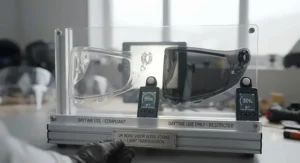
In practice, enforcement is patchy and heavily dependent on individual force policy and officer discretion. Guidance from the ACPO National Motorcycle Enforcement Strategy recommends that if tinted visors are used during daylight hours, an officer should generally only give the rider advice on their use, reserving formal action for visors used in darkness or reduced visibility — a pragmatic, proportionate approach that most forces broadly still follow.
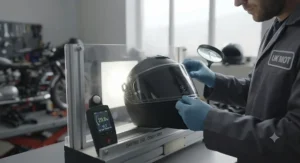
Where forces do actively enforce, some have invested in dedicated testing equipment: Cheshire Police’s motorcycle unit, for example, has obtained a specific tint-testing device to check that visors adhere to current legal limits, a story that made industry headlines precisely because it’s still relatively unusual. If you are stopped and found with a non-compliant visor, the realistic outcome for most riders in daylight, first-time circumstances is words of advice rather than prosecution — but that’s discretion, not a legal guarantee, and it evaporates quickly if you’re riding after dark, involved in a collision, or already drawing police attention for an unrelated reason.
How to Choose a Tinted Visor for Motorcycle Helmet Use
- Confirm the exact VLT percentage. Don’t accept “light smoke” as a description alone — look for an explicit 50% (or higher) figure stated by the manufacturer, not just implied by a product photo.
- Check for a genuine certification mark. Look specifically for the BSI Kitemark or an “E” mark with a country code on the visor itself, not just in the listing description.
- Match the visor to your exact helmet model and generation. Helmet manufacturers frequently update shell shapes between model years, and a visor listed for “Race-R Pro” won’t necessarily fit a later “Race-R Pro GP” without checking compatibility notes.
- Decide whether Pinlock compatibility matters to you. If you ride year-round or in cold, damp conditions, anti-fog insert compatibility is worth prioritising over a marginally cheaper non-Pinlock alternative.
- Read aggregated review sentiment before buying, not after. Genuine buyer feedback on retailer sites tends to surface fitment quirks and coating durability issues faster than manufacturer marketing copy will.
- Budget for a spare clear visor alongside your tinted one. Given the Highway Code’s night-time guidance, riders who only own a tinted visor either compromise on evening rides or ride in a legally uncomfortable grey area.
- Avoid photochromic and “transition” options for UK road use specifically, however tempting the technology, until certification catches up — as covered above with the Bell Qualifier DLX.
Common Mistakes When Buying a Tinted Visor
The single most common error is trusting a generic marketplace product title over the manufacturer’s own compliance statement — plenty of third-party sellers describe visors as “tinted” or even “road legal” without the underlying VLT data to back the claim up, and cross-referencing directly against the helmet brand’s own visor page is the only reliable way to confirm it. A close second is buying based on colour and appearance alone; iridium, mirrored, and rainbow-effect visors look striking in product photography but are overwhelmingly in the non-road-legal, track-only category, regardless of how they’re marketed.
Riders also frequently underestimate fitment specificity, assuming visors are broadly interchangeable within a brand when in practice even closely related helmet model names can use different base-plate mechanisms. Finally, a genuinely underrated mistake is neglecting the certification mark check after purchase — repeated cleaning and UV exposure over a couple of seasons can fade or wear a Kitemark to the point of illegibility, which matters if you’re ever asked to demonstrate compliance roadside.
Tinted Visor vs Clear Visor & Goggles: Benefits vs Traditional Alternatives
| Factor | Tinted Visor (50% VLT) | Clear Visor | Goggles (open-face) |
|---|---|---|---|
| Glare reduction | Strong, purpose-built for daylight | None | Varies widely by lens |
| Night-time legality | Discouraged under Highway Code Rule 94 | Fully legal, any time | Depends on certification |
| Fogging resistance | Good with Pinlock insert | Good with Pinlock insert | Generally poor, prone to fogging |
| Best For | Bright daytime commuting and touring | All-round, all-conditions riding | Open-face/retro helmet riders |
Looking at the comparison above, a tinted visor genuinely earns its place for daytime glare reduction but shouldn’t be treated as a full-time replacement for a clear one, given the night-time guidance under Rule 94. Goggles occupy an interesting middle ground — some certified options meet the same BS4110 or ECE standards as full-face visors, but many popular retro or motocross-style goggles simply aren’t rated for road eye-protection at all, making them a riskier default than most riders assume. For anyone splitting time between daylight and evening riding, the practical answer is owning both a tinted and a clear option rather than compromising with one.
✨ Don’t Miss These Exclusive Deals!
🔍 Take your road-legal visor upgrade to the next level with these carefully selected options. Click on any highlighted item to check current pricing and availability. These tools will help you ride safer, see clearer, and stay road legal all year round!
Long-Term Cost & Maintenance
A tinted visor isn’t a one-off purchase in the way a helmet often is — treat it as a consumable with a realistic lifespan of two to three riding seasons under regular use, shorter if it’s stored carelessly or ridden in gritty, high-mileage conditions. Factor in a Pinlock insert replacement roughly annually if you ride through a full British winter, since anti-fog inserts degrade faster than the visor shell itself.
Total cost of ownership across the options above ranges from roughly £25 for a budget LS2 visor with basic coatings and a shorter realistic lifespan, up to £90-plus for a premium Shoei or Shark visor that typically holds its optical clarity and scratch resistance considerably longer. It’s worth remembering why any of this matters beyond convenience: the Department for Transport’s THINK! motorcycling campaign highlights just how disproportionately motorcyclists feature in UK road casualty figures, which is exactly the kind of context that makes genuinely clear, legal vision worth the investment. Cost-per-use narrows that gap significantly for high-mileage riders — a premium visor lasting three full seasons of daily commuting works out cheaper per ride than replacing a budget visor twice in the same period, even before accounting for the inconvenience of mid-season replacement.
Frequently Asked Questions
❓ What percentage tint is legal for a motorcycle visor in the UK?
❓ Can I get points on my licence for a dark tinted visor?
❓ Do photochromic visors count as legal tinted visors in the UK?
❓ Will a tinted visor invalidate my motorcycle insurance?
❓ How do I know if my visor is genuinely road legal?
Conclusion
A legal tinted visor for road use in the UK comes down to one number and one mark: 50% light transmission, verified by a genuine BSI Kitemark or ECE approval, not a seller’s confident product description. Once you know what to look for, choosing between the seven options covered here becomes far simpler — budget riders are well served by the LS2 Storm III or HJC HJ-09, touring riders benefit from the fatigue-reducing qualities of the Nolan N-Com or Shoei CWR-1, and sportsbike owners chasing OEM-matched style have strong, genuinely legal options in the Shark VZ100 and Caberg Flyon 2.
The one product on this list to treat with real caution is the Bell Qualifier DLX‘s photochromic visor — brilliant engineering, but not currently certified for UK road use, and worth understanding fully before it goes anywhere near a public road. Whichever visor you choose, keep a clear one in reserve for evening rides, check the certification mark periodically, and you’ll spend far more time enjoying the ride than worrying about what’s written on the small print of your visor.
Recommended for You
- Value Smoke Visor Under £25: 7 Best Budget Picks for 2026
- Replacement Tinted Visor: 7 Brilliant UK Picks for 2026
- Mirror Tinted Visor for Motorbike Helmet: 7 Best Picks (2026)
Disclaimer: This article contains affiliate links. As an Amazon Associate, I earn from qualifying purchases. If you purchase products through these links, we may earn a small commission at no additional cost to you.
✨ Found this helpful? Share it with your friends! 💬🤗
